Introduction
Recent progress in basic and applied studies on embryo technologies has stimulated the development of reproductive techniques used for commercial purposes. Used alone or in combination, artificial insemination (AI), embryo transfer (ET) and in vitro embryo production (IVP) have been used successfully to increase the number of offspring from valuable animals.
Advances in techniques such as the use of frozen spermatozoa at AI, use of sexed semen as well as sperm-mediated gene transfer (SMGT) have offered new tools to produce domestic animals of greater genetic merit (Galli et al., Reference Galli, Crotti, Notari, Duchi and Lazzari2003; Carvalho et al., Reference Carvalho, Sartori, Machado, Mourão and Dode2010; Humblot et al., Reference Humblot, Bourhis, Fritz, Colleau, Gonzalez, Joly, Malafosse, Heyman, Amigues, Tissier and Ponsart2010). SMGT is not yet used routinely, although the mechanisms of binding and internalization of DNA by sperm cells are becoming clearer. Several studies have demonstrated that a part of the high variability in the outcome of IVP of bovine embryos may be due to the different ability of sperm from different bulls to fertilize oocytes. Thus, SMGT protocols associated with IVP must be well established in regard to sperm quality because viable spermatozoa have better chances to fertilize the oocyte (Iranpour et al., Reference Iranpour, Nasr-Esfahani, Valokerdi and Al-Taraihi2000). In order to raise SMGT efficiency, electroporation and induced membrane alteration protocols can be used to increase exogenous DNA uptake by sperm cells (Gagné et al., Reference Gagné, Pothierm and Sirard1991; Perry et al., Reference Perry, Wakayama, Kishikawa, Kasai, Okabe, Toyoda and Yanagimachi1999). However, it is not known if such modifications could influence sperm fertilizing ability and embryo development in cattle.
Electroporation causes a transient increase in the permeability of cell membranes after exposure to a high electric field. This effect happens because, when the transmembrane voltage induced by an external electric field exceeds a certain threshold, a rearrangement of the molecular structure of the membrane occurs, leading to pore formation and a considerable increase in permeability to molecules of sizes ranging from ions to macromolecules (Chen et al., Reference Chen, Smye, Robinson and Evans2006). Because of this characteristic, electroporation can be used to improve the number of DNA or other molecules taken up by sperm cells. According to Rieth et al. (Reference Rieth, Pothier and Dirard2000), the electric field formed during electroporation should increase the binding between exogenous DNA molecules and sperm cells. As a consequence, the electroporated cells retain DNA more efficiently than non-electroporated ones, but that does not yield a higher percentage of transfected cells (Müller et al. Reference Müller, Ivics, Erdélvi, Papp, Váradi, Horváth and Maclean1992). Moreover, high voltage protocols could reduce sperm motility after electroporation (Gagné et al., Reference Gagné, Pothierm and Sirard1991).
Similar to electroporation, there are chemical agents that may induce alterations in the sperm membrane that could facilitate exogenous DNA entrance. The lipid disorganization that occurs during the sperm capacitation process is a physiological example of these membranes alterations. Canovas et al. (Reference Canovas, Adan and Gadea2010) induced sperm capacitation with heparin followed by incubation with exogenous DNA. In the past, some authors have suggested that there was a potentially negative effect of DNA binding to sperm cells in the presence of glycosaminoglycans (Camaioni et al., Reference Camaioni, Russo, Odorisio, Gandolfi, Fazio and Siracusa1992; Jonák et al., Reference Jonák2000; Kuznetsov et al., Reference Kuznetsov, Kuznetsova and Schit2000); thus semen treated with calcium ionophore (CaI), another capacitation agent, could be an alternative (Pereira et al., Reference Pereira, Tuli, Wallenhorst and Holtz2000).
The aim of this study was to test the effects of two different SMGT protocols (electroporation or capacitation with calcium ionophore – CaI) on the viability of sperm used to produce bovine embryos in vitro.
Materials and methods
Unless otherwise indicated, all chemicals were obtained from Sigma Chemical (St. Louis, MO, USA). Tissue culture media (TCM199) (HEPES and bicarbonate) and fetal calf serum (FCS) were obtained from Gibco (Grand Island, NY, USA).
Frozen semen from a single bull was thawed in a water bath (37°C, 30 s) and prepared by centrifugation on a 45–90% discontinuous Percoll gradient for 30 min at 600 g. Selected sperm cells were then washed by centrifugation (200 g for 5 min) in Sperm-Talp medium (Parrish et al., Reference Parrish, Susko-Parrish, Winer and First1988) to remove Percoll residues. Sperm motility was evaluated (×200 magnification) and the cells were diluted to a final concentration of 1 × 10⁶ cells/ml. Sperm cells were divided randomly between experimental groups (CaI and electroporation) and the control group (untreated). Each experiment was replicated 10 times.
Electroporation
Electroporation protocol was performed with 5 × 10⁶ sperm. Cells were pre-incubated in the chamber for 10 min and then exposed to 100, 500, 750, 1000 or 1500 V and 25 μF capacitance (CellJect Pro, Hybaid, UK) for 12 ms. Electroporated cells stayed in the electroporation solution for an additional 10 min. This later incubation was meant to mimic a period in which sperm cell would interact with exogenous DNA molecules if they had been added to the solution. Cells were then washed by centrifugation on Sperm-Talp medium (200 g, 5 min) and evaluated for motility and concentration. A total of 626 oocytes were used for in vitro maturation and 171 embryos were produced using electroporated sperm cells.
Calcium ionophore (A23187)
A combination of two CaI concentrations ([CaI]; 250 nM or 500 nM) diluted in IVF medium (Parrish et al., Reference Parrish, Susko-Parrish, Winer and First1988), two intervals of incubation of sperm cells with CaI (tCaI; 1 or 5 min) and two total incubation periods (tINC; 1 or 2 h) were evaluated in eight treatment combinations. Semen samples (5 × 10⁶ sperm cells/ml per group) were incubated with one of the two [CaI] at room temperature (22–25°C) for 1 or 5 min (tCaI). Next, sperm cells were incubated for 1 or 2 h (tINC) at 38.5°C in 5% (v/v) CO2 in moisturized air. This later incubation was meant to mimic a period in which sperm cell would interact with exogenous DNA molecules if they had been added to the solution. After tINC, spermatozoa were washed by centrifugation in Sperm-Talp medium (200 g, 5 min) and sperm motility and concentration were assessed. A total of 1210 oocytes were used for in vitro maturation and 291 embryos were produced using sperm cells capacitated with CaI.
Oocyte in vitro maturation
Embryos were produced according to Yamada et al. (Reference Yamada, Caetano, Simões, Nicacio, Feitosa, Assumpção and Visintin2007). Briefly, cumulus–oocyte complexes (COCs) were obtained by aspirating follicles from ovaries collected at a slaughterhouse. Groups of 15–30 COCs with homogeneous ooplasm and multilayer compact cumulus cells were placed in a 90 μl maturation medium droplet, covered with mineral oil and cultured for 24 h at 38.5°C under 5% CO2 in air and high humidity conditions. The maturation medium was TCM 199 bicarbonate supplemented with 10% (v/v) FCS, 22 μg/ml pyruvate, 50 μg/ml gentamycin, 0.5 μg/ml follicle-stimulating hormone (FSH) (Follitropin-V; Vetrepharm Inc., Ontario, Canada), 50 μg/ml hCG (Chorulon, Intervet Schering-Plough, The Netherlands) and 1 μg/ml 17β-estradiol).
In vitro fertilization
For in vitro fertilization (IVF), COCs were washed in fertilization medium before being transferred in groups of 15–30 into plates that contained 90 μl droplets of IVF-Talp medium, that consisted of modified Tyrode stock solution supplemented with PHE (0.5 mM penicillamine; 0.25 mM hypotaurine and 25 μM epinephrine in 0.9% (w/v) NaCl), 50 μg/ml gentamycin and 0.3% fatty acid free–BSA under mineral oil. For each experimental group, droplets were inseminated at a final concentration of 1 × 10⁶ sperm/ml. In vitro fertilization was carried out at 38.5°C under an atmosphere of 5% CO2 in air and high humidity.
In vitro embryo culture (IVC)
At approximately 18 h post insemination (hpi), presumptive zygotes were partially denuded by gentle pipetting and washed three times in SOFaa medium (Tervit et al., Reference Tervit, Whittingham and Rowson1972) supplemented with 5% (v/v) FCS, MEM non-essential amino acids and MEM essential amino acids. The embryos were co-cultured with granulosa cells in 90 μl droplets of SOFaa under mineral oil, at 38.5 °C under an atmosphere of 5% CO2 in air and high humidity. Embryo culture was carried out for 12 days starting at IVF (day 0). Cleavage rate was recorded at 72 hpi and blastocyst and hatching rates were respectively recorded at days 9 and 12 post insemination.
Statistical analysis
Data were analyzed by analysis of variance (ANOVA) and means were compared by orthogonal contrast, when appropriated, with a 5% level of significance.
Results
Electroporation
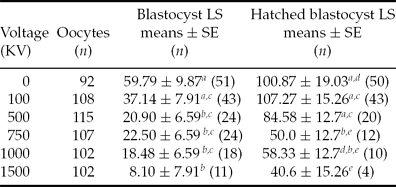
Blastocyst production using electroporated spermatozoa decreased as the voltage increased. Blastocyst rate from group 100 V did not differ from groups 500, 750 and 1000 V, but was different than that of group 1500 V. Hatching blastocyst rates from groups 100 V and 500 V were higher than those of 750, 1000 and 1500 V groups (Table 1).
Blastocyst (day 9) and hatched blastocyst (day 12) rates of in vitro produced embryos using electroporated spermatozoa at different voltages

a–eValues within columns differ, P < 0.05. SE, standard error. LS mean, least squares mean.
Calcium ionophore
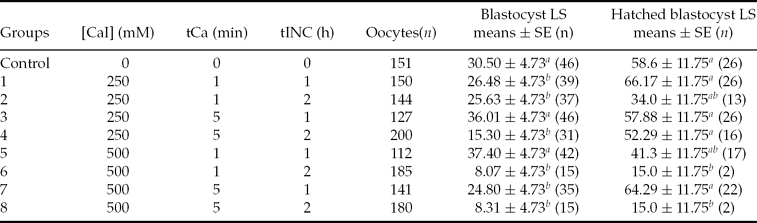
There was an interaction among calcium concentration ([CaI]), period of spermatozoa exposure to calcium (tCa) and period mimicking sperm exposure to exogenous DNA molecules (tINC), on blastocyst rate (P < 0.02). Groups of cells treated with 250 nm of CaI (1, 2, 3 and 4) showed lower blastocyst rates than the control group (P < 0.05). Group 3 had a better blastocyst rate than the other experimental groups (P < 0.05). In contrast, blastocyst rates from groups of cells treated with 500 nm (5, 6, 7 and 8) were similar to that of the control group (P < 0.05).
Moreover, blastocyst rates from groups 3 and 5 were higher when compared with other experimental groups (P < 0.05), however they were not different from that of the control group.
Hatching rates from groups 2 and 5 did not differ from other groups. Except from groups 6 and 8, all experimental groups showed hatching rates similar to the control group (P > 0.05) (Table 2).
Blastocyst (day 9) and hatched blastocyst (day 12) rates of in vitro produced embryos after sperm was treated with different calcium ionophore (CaI) concentration, exposure period and incubation period prior to CaI treatment
a,bValues within columns differ, P < 0.05.
Discussion
Our study demonstrated that electroporation and sperm membrane alteration by CaI influence sperm fertilizing capacity. As this process is essential to IVF outcome, the choice of the best protocol is decisive for the success of this technique. In this study, embryo development rates were negatively influenced increasing the electroporation voltage. According to Nishikage et al. (Reference Nishikage, Koyama, Miyata, Ishii, Hamada and Shigematsu2004), higher voltage increases cellular transfection efficiency, but based on our results it diminishes sperm viability. The SMGT associated with electroporation has been described in some species, leading to better results in transfection rates than sperm-DNA incubation alone (Gagné et al., Reference Gagné, Pothierm and Sirard1991; Sin et al., Reference Sin, Mukherjee, Mckenzie and Sin1995, Reference Sin, Walker, Symonds, Mukherjee, Khoo and Sin2000; Tsai, Reference Tsai2000). In all cases, electric pulse conditions were crucial to the technique efficiency, since higher voltages can induce damage of electroporated cells and alter embryo development rates (Rieth et al., Reference Rieth, Pothier and Dirard2000; Nishikage et al., Reference Nishikage, Koyama, Miyata, Ishii, Hamada and Shigematsu2004). Sin et al. (Reference Sin, Mukherjee, Mckenzie and Sin1995) reported that for black-footed abalone (Haliotis iris), even with decreased sperm motility, the optimal electroporation conditions for DNA uptake was 1000 V/cm with two pulses of 27.4 ms each. Therefore, sperm electroporation should be performed only in species in which an efficient protocol for DNA uptake is difficult because it does not yield a higher percentage of sperm-DNA uptake (Lavitrano et al., Reference Lavitrano, Busnelli, Cerrito, Giovannoni, Manzini and Vargiolu2006).
In our study, blastocyst rates decreased as voltage increased, but there were no difference among rates at 500, 750 and 1000 V. However, hatching rates decreased when voltages higher than 500 V were used. Our experiments confirmed that the influence of electric pulses is not only harmful to sperm function, but also affects embryo development. According to Gagné et al. (Reference Gagné, Pothierm and Sirard1991), higher voltages can interfere with late embryo development because they induce nuclear alterations or sperm-DNA damage. Hence, voltages higher than 500 V could decrease SMGT outcome.
Another alternative to optimize sperm-DNA association, CaI supplementation during sperm-DNA incubation, was evaluated in this report. Our results showed that in 250 nM CaI groups, blastocyst rates after 1 min calcium ionophore-sperm incubation (tCaI) were lower than those incubated for 5 min. This result is in accordance with findings by Pereira et al. (Reference Pereira, Tuli, Wallenhorst and Holtz2000), which described that the percentage of acrosome-reacted spermatozoa was higher when incubation time increased. Nevertheless, 500 nM CaI for 5 min, decreased blastocyst rates and better results were obtained after 1 min incubation with the same CaI concentration. Because high extracellular calcium concentration promotes more rapid sperm capacitation, only a few minutes are necessary to achieve this condition, while a toxic effect may occur with a longer incubation period. According to Landim-Alvarenga et al. (Reference Landim-Alvarenga, Graham, Alvarenga and Squires2004) excessive entry of calcium inside the sperm could change calcium homeostasis in the midpiece, affecting mitochondrial function and reducing sperm motility. This effect could explain why in the present study there was lower embryo development after a higher CaI concentration treatment, associated with longer incubation periods.
Results from the incubation period mimicking sperm interaction with exogenous DNA molecules (tINC) showed that incubation for 2 h was harmful for embryo development, regardless of CaI concentration and incubation period with sperm cells. This result suggests that not only length of the incubation period, but also CaI concentration is crucial for maintenance of sperm viability. In a previous work, our group described that incubation period was a factor in decreased sperm viability, causing acrosome membrane disruption during greater incubation periods (Feitosa et al., Reference Feitosa, Milazzotto, Simões, Rovegno, Nicacio, Nascimento, Gonçalves, Visintin and Assumpçào2009). Because sperm viability is crucial for sperm–oocyte interaction during the fertilization process, prolonged incubation period and higher CaI concentration could diminish SMGT efficiency.
Overall, the present results suggest that even with lower blastocysts rates, the manipulation of sperm aiming to optimize DNA-sperm interaction is possible, as embryos were produced with sperm cells exposed to electrical fields or to CaI.
Conclusion
This work allowed us to conclude that sperm treatment did not prevent oocyte fertilization, in spite of the reduction in embryo production. Conditions described herein can be used as an alternative method to enhance DNA integration for species in which it is difficult to standardize a SMGT protocol.
Acknowledgements
The authors would like to thank FAPESP for the financial support (03/08542-5). We also thank Marcelo D. Goissis at Michigan State University, USA for reviewing this manuscript.