With evidence that approximately one-fifth of American eighth graders performed at the below basic level on the National Assessment of Educational Progress reading tests in 2003 (National Center for Education Statistics, 2005) and American boys performed substantially worse than American girls (Ogle et al., Reference Ogle, Sen, Pahlke, Jocelyn, Kastberg and Roey2003), the issue of reading comprehension, or reading for meaning, has become much more central to research on reading than ever before. In response to these data, certain federal funding agencies have initiated studies of reading comprehension, which have been considerably outnumbered for the last 25–30 years by studies of reading accuracy and fluency. Numerous recent publications on reading comprehension have generated both novel theoretical approaches and rich empirical data (e.g., see Wagner, Muse, & Tannenbaum, Reference Wagner, Muse and Tannenbaum2007).
Comprehension
There are various models of reading comprehension. The componential structure of reading comprehension (Vellutino, Tunmer, Jaccard, & Chen, Reference Vellutino, Tunmer, Jaccard and Chen2007), in which “conventional” reading-related variables (e.g., vocabulary) explain only a portion of the variance (Braze, Tabor, Shankweiler, & Mencl, Reference Braze, Tabor, Shankweiler and Mencl2007), has been argued for years. Typically, reading comprehension is considered in a “layered” fashion (Kintsch & Rawson, Reference Kintsch, Rawson, Snowling and Hulme2005; Perfetti, Landi, & Oakhill, Reference Perfetti, Landi, Oakhill, Snowling and Hulme2005; Vellutino et al., Reference Vellutino, Tunmer, Jaccard and Chen2007), so that word-level skills (e.g., vocabulary, word accuracy, and fluency, Oakhill & Cain, Reference Oakhill, Cain, Cain and Oakhill2007) are assumed to form the foundation of comprehension, which is enhanced by factors such as background knowledge (Cromley & Azevedo, Reference Cromley and Azevedo2007), general strength of the cognitive apparatus (e.g., metacognitive indicators such as executive control, Gaskins, Satlow, & Pressley, Reference Gaskins, Satlow, Pressley and Meltzer2007), general quality of linguistic functioning (e.g., oral comprehension, Cain & Oakhill, Reference Cain, Oakhill, Cain and Oakhill2007; Nagy, Reference Nagy, Wagner, Muse and Tannenbaum2007), inferential and monitoring structures (Perfetti et al., Reference Perfetti, Landi, Oakhill, Snowling and Hulme2005), comprehension strategies (e.g., differential strategies for reading diverse types of text, Fayol, Reference Fayol, Denhiere and Rossi1991), and noncognitive factors (e.g., need for cognition, Dai & Wang, Reference Dai and Wang2007, and motivation, Guthrie et al., Reference Guthrie, Hoa, Wigfield, Tonks, Humenick and Littles2007). Today, the research on comprehension unfolds in three main directions: (a) understanding and quantifying individual differences in comprehension, both within and across different developmental periods (Schatschneider, Harrell, & Buck, Reference Schatschneider, Harrell, Buck, Wagner, Muse and Tannenbaum2007); (b) understanding sources of these individual differences (Olson, Reference Olson, Turner and Rack2004); and (c) developing and validating methods for teaching comprehension that are capable of addressing the needs of individuals across the whole range of performance on reading comprehension tasks (Gajria, Jitendra, Sood, & Sacks, Reference Gajria, Jitendra, Sood and Sacks2007).
In this article we are concerned with identifying sources of individual differences in comprehension. Our work is conceived on the premise that comprehension is a heritable trait, susceptible to environmental influences. In other words, we assume that the bases of individual differences in comprehension are genetic, like many, if not all, reading-related processes (Grigorenko, Reference Grigorenko2004), but sensitive to environmental variation, such as characteristics of family environment or quality of teaching. In other words, we assume the presence of both main and interactive effects of genes and environments in the manifestation of individual differences in reading comprehension.
To provide a specific illustration of this general premise, here we present a study in which individual differences in reading comprehension were investigated in the context of understanding main and interactive impacts of one candidate gene, the catechol-O-methyltransferase (COMT) gene, and one environmental factor, a facet of parenting.
COMT
Our selection of COMT as a candidate gene was driven by the following considerations. First, this gene codes for an enzyme, S-adenosylmethionine, which participates in the metabolic transformation of catechol compounds (catecholamines and catechol oestrogens). The enzyme is present in humans in two forms: soluble (S-COMT) and membrane-bound (MB-COMT); the production of a particular form of COMT is determined by where in the gene the translation is initiated. The S-COMT form is found in many tissues, whereas the MB-COMT form predominates in the brain. MB-COMT appears to have higher affinity for the catecholamine neurotransmitters and plays an important role in their cortical metabolism. In turn, catecholamines are intimately, although not exclusively, involved in many psychological functions, learning notwithstanding. Thus, because of the function of the protein it codes for, the COMT gene presents itself as an interesting candidate for its contributions to cognitive functioning. Second, it is not surprising that, given the function of the gene, there is a substantial body of literature depicting the involvement of the COMT gene and its genetic variation in a number of neurobiological, psychological, and psychiatric phenotypes (Craddock, Owen, & O'Donovan, Reference Craddock, Owen and O'Donovan2006; Tunbridge, Harrison, & Weinberger, Reference Tunbridge, Harrison and Weinberger2006; Weinberger et al., Reference Weinberger, Egan, Bertolino, Callicott, Mattay and Lipska2001). Third, COMT activity appears to differ across genders, being higher in males in the liver (Boudikova, Szumlanski, Maidak, & Weinshilboum, Reference Boudikova, Szumlanski, Maidak and Weinshilboum1990); erythrocytes, as shown in a number of studies (Fahndrich et al., Reference Fahndrich, Coper, Christ, Helmchen, Muller-Oerlinghausen and Pietzcker1980; Floderus & Wetterberg, Reference Floderus and Wetterberg1981; Philippu et al., Reference Philippu, Hoo, Milech, Argarwal, Schrappe and Goedde1981), but not all studies (Fitzgerald, Hamilton, Jones, & Reid, Reference Fitzgerald, Hamilton, Jones and Reid1980); and prefrontal cortex (Chen et al., Reference Chen, Lipska, Halim, Ma, Matsumoto and Melhem2004). The male COMT knockout mouseFootnote 1 shows a substantial increase in dopamine levels in the basal tissue, an increase not registered in females (Gogos et al., Reference Gogos, Morgan, Luine, Santha, Ogawa and Pfaff1998). Fourth, there are numerous reports suggesting gender-based differential roles of polymorphisms in the COMT gene as risk factors for psychiatric disorders, although the results are diverse in terms of presence, magnitude, and direction of the effects for different disorders (e.g., Egan et al., Reference Egan, Goldberg, Kolachana, Callicott, Mazzanti and Straub2001; Karayiorgou et al., Reference Karayiorgou, Altemus, Galke, Goldman, Murphy and Ott1997, Reference Karayiorgou, Sobin, Blundell, Galke, Malinova and Goldberg1999; Shifman et al., Reference Shifman, Bronstein, Sternfeld, Pisante-Shalom, Lev-Lehman and Weizman2002). A recent meta-analysis investigated gender-specific effects of the COMT polymorphisms in obsessive–compulsive disorder and confirmed their existence, although of a small–moderate magnitude (Pooley, Fineberg, & Harrison, Reference Pooley, Fineberg and Harrisonin press). Thus, given its function and reported presence of gender differences, COMT appears to be an intriguing candidate gene for those psychological functions in which gender differences are present.
The COMT gene is localized on chromosome 22q11, and is characterized by a number of polymorphisms with hypothesized functional significance. Two of these polymorphisms have attracted significant attention. The first is a single nucleotide substitution at codon 158/108 in MB-COMT/S-COMT, which encodes two different amino acids, either valine (Val) or methionine (Met), and therefore is referred to as Val158Met (or G158A, in nucleotide substitution terms). This genetic variant is associated with thermal stability of COMT: human Met158 homozygotes show lower activity in the prefrontal cortex than do Val158 homozygotes (Chen et al., Reference Chen, Lipska, Halim, Ma, Matsumoto and Melhem2004); thus, Met158 is associated with enhanced dopamine signaling (Tunbridge, Bannerman, Sharp, & Harrison, Reference Tunbridge, Bannerman, Sharp and Harrison2004). The Val158Met polymorphism has also been associated with cognitive performance in a number of studies, with individuals carrying the Met158 allele demonstrating better and more efficient processing (Barnett et al., Reference Barnett, Heron, Ring, Golding, Goldman and Xu2007; Egan et al., Reference Egan, Goldberg, Kolachana, Callicott, Mazzanti and Straub2001). This effect has been demonstrated in both adults (O'Hara et al., Reference O'Hara, Miller, Liao, Way, Lin and Hallmayer2006; Rybakowski et al., Reference Rybakowski, Borkowska, Czerski, Dmitrzak-Weglarz, Skibinska and Kapelski2006) and children (Barnett et al., Reference Barnett, Heron, Ring, Golding, Goldman and Xu2007; Diamond, Briand, Fossella, & Gehlbach, Reference Diamond, Briand, Fossella and Gehlbach2004). Gender differences are once again notable, with these cognitive effects stronger in males and weaker or even inverse in females. However, there is also evidence in the literature that the Val158 allele can offer some advantage for specific types of cognitive performance (Bilder et al., Reference Bilder, Volavka, Czobor, Malhotra, Kennedy and Ni2002; Bilder, Volavka, Lachman, & Grace, Reference Bilder, Volavka, Lachman and Grace2004).
Thus, the COMT gene appears to exert a wide-range effect on a variety of cognitive functioning involving higher order cognitive processing (e.g., executive functioning). The gene also appears to be associated with gender differences in cognition. Therefore, given that reading comprehension is a higher order cognitive skill with a substantial engagement of executive functioning and characterized by gender differences, COMT seems to be a reasonable candidate for attempts to associate genetic variability with variability in reading comprehension.
Maternal Rejection
It is well established in the literature that negative parenting tends to be associated with developmental maladjustments in both animals (Cameron, Champagne, Fish, Ozaki-Kuroda, & Meaney, Reference Cameron, Champagne, Fish, Ozaki-Kuroda and Meaney2005) and humans (Boyle et al., Reference Boyle, Jenkins, Georgiades, Cairney, Duku and Racine2004). Animal research now dramatically outpaces human research in terms of identifying combinations of genetic vulnerability and specific impacts of early maternal care on subsequent development (Meaney, Reference Meaney2001). In humans, the results are primarily behavioral: for example, it has been shown that maternal rejection is related to poor behavior adjustment in school (Yazdkhasti & Harizuka, Reference Yazdkhasti and Harizuka2006), mental health (Briscoe-Smith & Hinshaw, Reference Briscoe-Smith and Hinshaw2006; Pineda, Cole, & Bruce, Reference Pineda, Cole and Bruce2007), self-regulation (Keller et al., Reference Keller, Yovsi, Borke, Kartner, Jensen and Papaligoura2004), and various indicators of cognitive development (Ryan, Martin, & Brooks-Gunn, Reference Ryan, Martin and Brooks-Gunn2006). Of particular interest in this context are indicators of maternal care, especially along the dimensions of protectiveness and rejection. Specifically, the protectiveness dimension includes variation in the extent to which the mother physically restrains infant exploration, initiates proximity and contact, and cradles and grooms her infant. The rejection dimension includes variation in the extent to which the mother limits the timing and duration of contact, suckling, and carrying. Studies in animals indicate that, although detrimental across the board, maternal rejection is especially potentially harmful if applied to a carrier of specific genetic risk factors. Such specific risk factors are actively being identified in both animals (Maestripieri et al., Reference Maestripieri, Higley, Lindell, Newman, McCormack and Sanchez2006) and humans (Lansford, Criss, Pettit, Dodge, & Bates, Reference Lansford, Criss, Pettit, Dodge and Bates2003; Narusyte, Andershed, Neiderhiser, & Lichtenstein, Reference Narusyte, Andershed, Neiderhiser and Lichtenstein2007; O'Connor, Deater-Deckard, Fulker, Rutter, & Plomin, Reference O'Connor, Deater-Deckard, Fulker, Rutter and Plomin1998).
To follow up on the leads in both animal and human literature on the importance of parenting in general and maternal rejection in particular for subsequent development, we investigated the link between maternal rejection and reading comprehension.
In summary, our study is based on multiple studies. First, we capitalize on the literature about reading comprehension, which indicates that (a) comprehension is a complex process that recruits several psychological functions, including inference and monitoring, which are associated with executive functioning; (b) variability of performance on comprehension tasks is associated with both genetic and environmental variability; and (c) reading comprehension difficulties are more prevalent among males than among females. Second, using the literature on roles of different candidate genes in cognition, after contemplating many possibilities, we selected one gene candidate, the COMT gene. Third, we selected the factor of maternal rejection as an environmental factor that, based on the literature, is associated with various maladaptive developmental outcomes. Fourth, in choosing a sample for investigating the association among the COMT gene, maternal rejection, and reading comprehension, we selected a sample of juvenile detainees. Based on the corresponding literature (for a review, see Grigorenko, Reference Grigorenko2006), this group is characterized by a substantial amount of poor performance on reading comprehension tasks, an elevated presence of maternal rejection, and an overrepresentation of males.
Method
Participants
The offender group (n = 179) was a subset of a larger sample used in previous studies (Haeffel et al., Reference Haeffel, Getchell, Koposov, Yrigollen, DeYoung and af Klintebergin press; Ruchkin, Koposov, af Klinteberg, Oreland, & Grigorenko, Reference Ruchkin, Koposov, af Klinteberg, Oreland and Grigorenko2005; Ruchkin, Schwab-Stone, Vermeiren, Koposov, & King, Reference Ruchkin, Schwab-Stone, Vermeiren, Koposov and King2003; Ruchkin, Schwab-Stone, Vermeiren, Koposov, & Steiner, Reference Ruchkin, Schwab-Stone, Vermeiren, Koposov and Steiner2002). These participants (M age = 16.2 years, SD = 0.8) were recruited over a period of 6 months from a group of male adolescent inmates who had been court ordered to the only juvenile detention facility in the Arkhangel'sk region of northern Russia, a catchment area with a population of 1.5 million. The region is ethnically homogeneous; approximately 98% of the population is of Russian ancestry. Most participants had multiple convictions, with the most severe violations including property crimes (e.g., theft or car theft, 51%), violent crimes (e.g., assault or robbery, 38%), rape or other forms of sexual violence (6%), and murder (5%). At the time of the study, the mean length of sentence was 4.3 years, and all participants had been incarcerated for at least 6 months.
Normative participants (60 male adolescents, M age = 16.1 years, SD = 0.9) were recruited from the same region from a public school in the city of Arkhangel'sk. According to self-reports and school records for all participants, none of the individuals in the control group had any criminal record at the time of the study. Control participants were matched by age to the offender group.
Assessments
Comprehension was assessed by a set of five paragraphs with 21 comprehension questions. The assessment was standardized on a large sample of Russian children and adolescents (n = 5,343). The internal consistency (Cronbach α) of the comprehension scale was .86. Standardized comprehension scores were computed using Rasch measurement methods (Bond & Fox, Reference Bond and Fox2001; Rasch, Reference Rasch1960/1980; Smith & Smith, Reference Smith and Smith2005; Wright & Stone, Reference Wright and Stone1979) and rescored into a dichotomous variable, indicating whether an adolescent scored below or at and above the standardization sample mean.
Maternal rejection was assessed with the EMBU (the Swedish acronym for Own Memories of Parental Rearing; Perris, Jacobsson, Lindstrom, von Knorring, & Perris, Reference Perris, Jacobsson, Lindstrom, von Knorring and Perris1980), a questionnaire assessing factors of parental rearing. Rejection is characterized by physical punishment, hostility, lack of respect for the child's point of view, and unjustified criticism in front of others. The short version of the EMBU (Arrindell et al., 1999), with eight items in the maternal rejection scale to be answered on a 4-point Likert scale, was used. The Cronbach alpha value for the maternal rejection scale was .77. For the purposes of these analyses, a categorical variable was created using the median split of the continuous variable.
The categorization of the continuous variables was done to ease the understanding of interactive influences of genetic and environmental factors influencing performance on the reading comprehension task.
Procedure
All data were collected in a juvenile prison after participants were provided with a detailed description of the study and informed of the voluntary and confidential nature of their involvement. The studies were approved by the appropriate ethics committees in Russia, Sweden, and the United States. Assessments of reading comprehension and reported maternal parenting style were obtained during small group sessions (five to eight participants), with each participant seated at a separate table. Finally, participants donated 5 ml of blood from arm veins; the specimens were collected by professional nurses and preserved in 5-ml vacutainer tubes containing ethylenediaminetetraacetic acid. DNA was extracted in Dr. Oreland's laboratory and an aliquot of DNA was sent to Dr. Grigorenko's laboratory, where it was subsequently amplified with Repli-G technologies.
Genotyping
The selection of polymorphisms in the COMT gene was driven by the following considerations. First, the Val158Met polymorphism (rs4680) was selected because of the evidence in the literature of possible involvement of this polymorphism in both higher level cognitive activities and motivational regulation of cognitive activities. Two other polymorphisms in COMT, rs737865 and rs165599, are of interest because, with Val158Met, they form a haplotype that has been associated with schizophrenia in a sample of more than 700 patients and 4,000 controls (Shifman et al., Reference Shifman, Bronstein, Sternfeld, Pisante-Shalom, Lev-Lehman and Weizman2002) and with bipolar disorder (Shifman et al., Reference Shifman, Bronstein, Sternfeld, Pisante-Shalom, Weizman and Reznik2004). The rs737865 single nucleotide polymorphism (SNP) appears in the first intron of COMT and the rs165599 SNP appears downstream of the gene. It is important that, like Val158Met, rs165599 is transcribed in the human brain and has been shown to affect gene expression (Bray et al., Reference Bray, Buckland, Williams, Williams, Norton and Owen2003). The rs737865 SNP is not transcribed but may be associated with functional outcomes because it is in linkage disequilibrium with an SNP in the nearby P2 promoter region of the gene that influences COMT activity (Meyer-Lindenberg et al., Reference Meyer-Lindenberg, Nichols, Callicott, Ding, Kolachana and Buckholtz2006). Second, the rs740603 SNP is located in the UTR regions of the gene. Although this SNP has not been used widely in the COMT-associated behavioral literature, there is some evidence indicating the importance of this polymorphism for variation in human behavior. In general, the decision to select multiple polymorphisms in the COMT gene was driven by the fact that this gene does not exhibit significant linkage disequilibrium in populations of European descent (http://alfred.med.yale.edu/alfred/index.asp), suggesting that different variants in this gene can segregate relatively independently of each other. Specifically, the gene is characterized by three haplotype blocks (http://www.hapmap.org); thus, more than one polymorphism is needed to capture the potential sources of variation in COMT; in this study, two SNPs are placed in the largest block, and the remaining two SNPs are placed in each of the other two. In our data, the amount of linkage disequilibrium registered by r 2 values for pairwise comparisons for the four selected COMT polymorphisms ranged from 0.00 to 0.30, indicating, at the strongest, the presence of modest levels of linkage disequilibrium.
The genotyping of SNP polymorphisms (rs737865, rs740603, rs4680, rs165599) was performed on the ABI TaqMan platform. The quality of genotyping was acceptable, with the number of failures ranging from 0% (for rs740603 and rs165599) to 5% (for rs737865) and 7% (for rs4680).
The present study therefore examined the rs737865, rs740603, rs4680 (Val158Met), and rs165599 SNPs using multiple regression and haplotypeFootnote 2 analysis to examine the independent and interactive effects of these four SNPs on individual differences in reading comprehension.
Results
Allele and genotype frequencies for each polymorphism in each group are given in Table 1. As is evident from this table, the rarest minor allele is present in our sample at the frequency of .23 (allele g at rs737865), and there is no particular genotype that is exceptionally rare (the lowest observed frequency is 4%). In addition, when compared with a sample of nonincarcerated individuals matched on gender, age, ethnic background, and socioeconomic status (for details, see DeYoung et al., Reference DeYoung, Getchell, Koposov, Yrigollen, Haeffel and af Klinteberg2007), the allele and genotype frequencies did not differ significantly. Of note also is that comprehension difficulties and maternal rejection were present in our sample at 17 and 44.9%, respectively. Correspondingly, this data set is suitable for studies of main effects of the COMT gene and maternal rejection and their interactions.
Genotype and allele frequencies at four COMT polymorphisms

First, a set of contingency table analyses was carried out to investigate the presence of association among comprehension difficulties, maternal rejection, and the COMT alleles at the four studied polymorphisms. The genotypes were coded and defined in regressions as nominal class variables, with one type of homozygote genotype considered Class 0 (aa for all four polymorphisms), heterozygote genotype was set as Class 1, and the other homozygote genotype, as Class 2. No associations were present for any combination of the variables. In other words, there was no evidence of comprehension difficulties being associated either with maternal rejection or with any particular COMT genotype; in addition, there were no associations between specific COMT genotypes and maternal rejection.
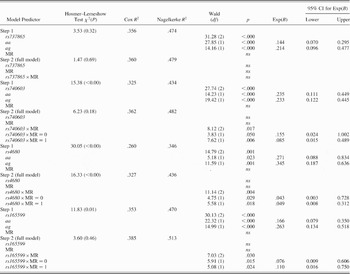
Then, four sets of logistic regressions were investigated, one for each of the studied COMT polymorphisms. Specifically, these analyses were conceived to establish (a) the contributions of the genotypes at the four COMT polymorphisms to comprehension difficulties (present = 1, absent = 0), (b) the contribution of maternal rejection (present = 1, absent = 0) to comprehension difficulties, and (c) interactive contributions of genotypes and maternal rejection to comprehension difficulties. Genotypes at rs737865, rs740603, rs4680, and rs165599 were entered as predictors. The results of these analyses are presented in Table 2.
Binary logistic regressions predicting difficulties in comprehension from variation in COMT at rs737865, rs740603, rs4680, and rs165599

Note: MR, Maternal rejection.
The Hosmer–Lemeshow statistic indicates a poor fit if the significance value is <.05. Here, all models adequately fit the data. The Cox R 2 is based on the log likelihood for the model compared to the log likelihood for a baseline model. However, with categorical outcomes, it has a theoretical maximum value of <1, even for a “perfect” model. The Nagelkerke R 2 is an adjusted version of the Cox R 2 that adjusts the scale of the statistic to cover the full range from 0 to 1. Each fitted model was specified as a two-step model: Step 1 included the main effects of specific genotypes and maternal rejection, and Step 2 included the interaction term. Each step was evaluated using the Hosmer–Lemeshow statistics and the R 2, but parameter estimates are presented only for the full model. Because the meaning of a logistic regression coefficient is not as straightforward as a linear regression coefficient, it is easier to interpret exp(B), which represents the ratio change in the odds of the event of interest for a one-unit change in the predictor. The ratio of the coefficient (B) to its standard error, squared, equals the Wald statistic; the p value of the Wald statistic indicates whether the parameter in question is statistically significant. Because all variables (specific genotype, maternal rejection, and the interaction term) in the regression equations were defined as categorical, estimates of exp(B) were calculated for the contrasts indicating the presence or absence of category membership (i.e., comparing the effect for each category of the independent variable to the reference category).
As evident from Table 2, the four tested models generated a set of interesting effects. First, in general, the analyzed models fit the data well; the Hosmer–Lemeshow test was nonsignificant for three of the four tested models. Note also that the fit of models for the four analyzed polymorphisms (rs737865, rs740603, rs4680, and rs165599, but especially rs740603, rs4680, and rs165599) improved significantly after the inclusion of the interaction term, as indicated by the change in the Hosmer–Lemeshow chi-square test. Second, the amount of explained variance in all four models was respectable, ranging from 44 to 51% according to the Nagelkerke R 2 (or from 33 to 39%, according to the Cox R 2). Third, and most interestingly, there were a number of significant effects. Specifically, (a) there were effects of particular genotypes across all four sites (Step 1, or the main effects step of the regression), which consistently indicated the involvement of the COMT gene in variability in the manifestation of individual differences in comprehension; (b) three of the four tested equations contained significant interaction effects between specific genotypes and maternal rejection; and (c) the contrast analyses, although preliminary, pointed out specific “risky” alleles in each of the four sites. Specifically, given the magnitude of exp(B), alleles g appear to be risk alleles for all for polymorphisms.
Fourth and finally, haplotype analysis was carried out with the HAPLO program (Hawley & Kidd, Reference Hawley and Kidd1995). HAPLO was also used to test departures from Hardy–Weinberg equilibrium and indicated that no groups departed significantly from Hardy–Weinberg ratios for any of the SNPs.
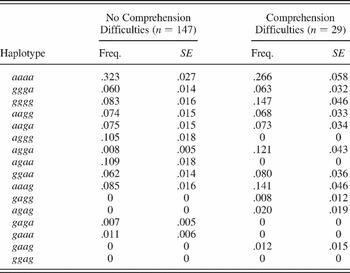
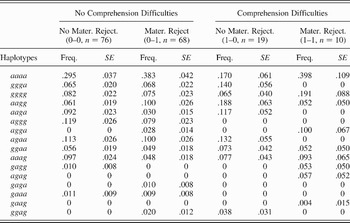
Haplotype analysis revealed a number of interesting results. Specifically, significant differences in frequencies of particular COMT haplotypes across the four studied polymorphisms were established between groups of individuals with and without comprehension difficulties (Table 3), χ2 (14) = 53.6, p < .001. The haplotypes present in the no comprehension difficulty group and rare or absent in the comprehension difficulty group were the agaa and aggg haplotypes (the “protective” haplotypes, with frequencies of .109 and 0 and .105 and 0, respectively). The haplotypes present in the comprehension difficulty group but rare in the no comprehension difficulty group were the gggg and agga haplotypes (the “risk” haplotypes, with frequencies of .147 and .083 and .121 and .008, respectively). Notably, there were no differences in haplotype frequencies for groups of individuals that did and did not report maternal rejection, χ2 (14) = 23.5, p > .1. Yet, the differences in haplotype frequencies for individuals with and without comprehension difficulties were further differentiated by stratifying these groups by presence–absence of maternal rejection (see Table 4). In particular, the group defined by presence of both comprehension difficulties and maternal rejection (i.e., the 1–1 group) differed in its distribution of haplotype frequencies from the three other groups in all pairwise comparisons, χ2 (12) = 37.0, p < .001; χ2 (14) = 27.6, p < .05; and χ2 (11) = 23.0, p < .05, compared to Groups 0–0, 0–1, and 1–0, respectively. Of note is that the haplotype that most differentiated this group from the other three was gggg, which was observed in the 1–1 group with a frequency of .191, whereas in all other groups with frequency of .08 or less. It is important to stress that three of the alleles constituting these haplotypes (g, g, and g, for rs740603, rs4680, and rs165599, respectively), were implicated in logistic regression analyses, as described earlier. Another relevant observation here is that these haplotypes carry the g allele of the rs4680 (Val158Met) polymorphism; this allele corresponds to the valine allele of this polymorphism. In general, the results of the haplotype analyses and logistic regression are consistent with each other.
Estimated COMT haplotype frequencies with their standard errors for groups of individuals with and without comprehension difficulties intervals for rs737865, rs740603, rs4680, and rs165599

Estimated COMT haplotype frequencies with their standard errors for groups of individuals with and without comprehension difficulties stratified by the presence or absence of maternal rejection intervals for rs737865, rs740603, rs4680, and rs165599

Discussion
In interpreting the results, it is important to emphasize a number of issues. First, we hypothesized and demonstrated the presence of main and interactive effects that genes (as exemplified by the genetic variance in COMT) and environments (as exemplified by maternal rejection) coexert on the formation of a complex cognitive skill such as reading comprehension. To our knowledge, this is the first study that associates variation in COMT with individual differences in reading comprehension. This hypothesis was generated based on literature that indicates associations between the COMT gene and complex cognitive functioning and literature that reasons comprehension as a complex multilayered skill. Given (a) previously reported findings of genetic association of genetic variation in the COMT gene with complex cognitive performance such as executive cognitive processing in a number of different special and typical groups, and (b) the role of executive cognitive processing in all kinds of learning and education (Meltzer, Reference Meltzer2007), we asserted that the COMT gene can wield pleiotropicFootnote 3 influences on reading-related cognitive processes (Grigorenko, in press), including comprehension. This hypothesis was confirmed: consistently, across all four polymorphisms within the gene, the COMT gene was involved in the formation of individual differences in reading comprehension.
Second, clearly COMT is not the only gene that should be expected to be relevant to reading and reading comprehension. Although comprehension has not been investigated widely as a phenotype, studies of familial transmission of reading-related traits (Naples et al., 2007; Wijsman et al., Reference Wijsman, Peterson, Leutenegger, Thomson, Goddard and Hsu2000), their heritability (for a review, see Grigorenko, Reference Grigorenko2004), and their molecular foundations (for a review, see Fisher & Francks, Reference Fisher and Francks2006) all provide evidence of multiple genes, likely of small effect, being important to the manifestation of individual differences in reading-related processes.
Third, it is interesting that the COMT gene especially appears to be relevant to individual differences in reading comprehension while interacting with the indicators of maternal rejection (as captured in our study). Given the nature of these influences, although established preliminarily, it is important to confirm the presence of these influences in other samples.
Further investigations should also verify both the direction of influence of specific alleles and which haplotypes are risky and protective. The involvement of the valine allele of the rs4680 (Val158Met) polymorphism with haplotypes that most reliably differentiate individuals with and without comprehension difficulties, especially in the presence of maternal rejection, is consistent with the literature. However, further investigations of this association should provide additional specifics of these effects.
Fourth, it is important to stress the specificity of our sample, which is atypically homogeneous for research of this nature: the participants present virtually no variability in their ethnic ancestry; according to their self-reports, they are all of Slavic ancestry and predominantly have local Arkhangel'sk roots. Given the amount of variability existing in frequencies of various COMT polymorphisms around the world (for a review, see Grigorenko, in press), our results should be interpreted with caution until the involvement of genetic variability in COMT is verified in samples of other ancestries.
Fifth, one characteristic of the study is that the presence or absence of maternal rejection was established through the subjective self-reports of the participants. Given the nature of our sample and that the relationships of the majority of the participants with their families are dysfunctional, it is not realistic to obtain this information through ways other than self-report; however, it is highly desirable to investigate the role of maternal rejection as an interactive environmental factor in cognitive development in more objective settings. The reassuring circumstance in this regard is the abundance of experimental animal literature attesting to the importance of parental interaction in general and especially maternal interaction for all aspects of development (Meaney, Reference Meaney2001). Yet, the subjective nature of reports of maternal rejection is a clear limitation of our study that, hopefully, can be remedied in future research.
Sixth and finally, our results should be interpreted with caution, given the size of the sample used in our research. Because of the relatively small sample size, the standard errors of our estimates are rather large (see Tables 2–4). Correspondingly, it is difficult to grasp the “true” magnitude of the impact of the COMT gene variability and maternal rejection, individually and interactively, on individual differences in comprehension. Samples of such nature are difficult to ascertain, but, hopefully, future research will further the precision of parameter estimates and provide specific ideas on the mechanisms of involvement of COMT in the manifestation of individual differences for reading comprehension.
Conclusion
In this work we established the importance of the joint contribution of genetic variability in the COMT gene and self-reported past maternal rejection in relation to individual variability in reading comprehension. This finding contributes to two types of literature: the first on the importance of genetic influences for the development of literacy at its multiple levels and the second on the significance of considering interactive effects of genes and environment for different aspects of human development. This study is characterized by a number of features, some of which are strengths (e.g., literature-grounded hypothesis, ethnic and behavioral homogeneity of the sample, a multipolymorphism/haplotype-based approach to genetic variability in a single gene), whereas others (e.g., small sample size, self-reported past maternal rejection) are weaknesses. As is the case with all research, especially that establishing associations between genes and behaviors (National Cancer Institute–National Human Genome Research Institute Working Group on Replication in Association Studies, 2007), the ultimate verification of our hypotheses will be in future studies attempting to replicate and extend the findings reported here.