


Introduction
When empirically supported interventions are delivered in routine practice there are marked differences in effectiveness compared with clinical trials (Gyani et al., Reference Gyani, Shafran, Layard and Clark2013; Hansen et al., Reference Hansen, Lambert and Forman2002), with outcomes up to 12% lower in routine practice, and this occurs particularly when patients do not receive evidence-based interventions (Barkham et al., Reference Barkham, Stiles, Connell, Twigg, Leach, Lucock, Mellor-Clark, Bower, King, Shapiro, Hardy, Greenberg and Angus2008; Hansen et al., Reference Hansen, Lambert and Forman2002). The recent Gaskell et al. (Reference Gaskell, Simmonds-Buckley, Kellett, Stockton, Somerville, Rogerson and Delgadillo2023) meta-analysis of the outcomes achieved in routinely delivered interventions speculated that such differences were explained by poor therapist attitudes to protocol-delivered interventions. A primary challenge of translational science in psychotherapy is therefore enabling patients in routine services not to be disadvantaged compared with participants in clinical trials (Strauman et al., Reference Strauman, Eddington, McCrudden, Rottenberg and Johnson2007). The three main efforts to enable better translation have included (a) clear treatment guidelines to ensure that only empirically supported interventions are recommended and delivered in routine practice (American Psychiatric Association, 2010; National Institute for Health and Clinical Excellence, 2018), (b) routine outcome monitoring tracking sessional outcomes and so enabling timely remedial actions by therapists (Delgadillo et al., Reference Delgadillo, de Jong, Lucock, Lutz, Rubel, Gilbody, Ali, Aguirre, Appleton, Nevin, O’Hayon, Patel, Sainty, Spencer and McMillan2018; Delgadillo et al., Reference Delgadillo, Ali and Fleck2022; Lambert, Reference Lambert2017; Wampold, Reference Wampold2015) and (c) enhancing treatment competency through effective training, regular clinical supervision, use of clear treatment manuals and routine auditing of treatment integrity (Bambling et al., Reference Bambling, King, Raue, Schweitzer and Lambert2006; Power et al., Reference Power, Noble, Simmonds-Buckley, Kellett, Stockton, Firth and Delgadillo2022; Wilson, Reference Wilson1996).
A lesser used approach to improve translation is the augmentation of existing treatments through enhancements that act on the mechanisms of change in a therapy, or manipulating factors known to be associated with outcome in a therapy. This approach is time efficient as it avoids the need to develop ‘new’ therapies and rather tries to enhance extant empirically supported therapies via augmentation. Examples of treatment augmentations have been achieved through a variety of practical-technological (e.g. automatic text messaging between sessions to increase engagement, Aguilera et al., Reference Aguilera, Bruehlman-Senecal, Demasi and Avila2017; apps to support the delivery of depression interventions, Bae et al., Reference Bae, Shin, Ji, Kwon, Kim and Hur2023) and theoretical innovations (e.g. see Oldham et al., Reference Oldham, Kellett, Miles and Sheeran2012, for a review). These changes have mostly been implemented as adjuncts to treatment and few studies have tested the effectiveness of integrating augmentations directly into the treatment content and delivery.
A range of meta-analyses have shown that one-to-one and group behavioural activation (BA) is an effective and efficacious treatment for depression (Ekers et al., Reference Ekers, Webster, Van Straten, Cuijpers, Richards and Gilbody2014; Pott et al., Reference Pott, Delgadillo and Kellett2021; Richards et al., Reference Richards, Ekers, McMillan, Taylor, Byford, Warren, Barrett, Farrand, Gilbody, Kuyken, O’Mahen, Watkins, Wright, Hollon, Reed, Rhodes, Fletcher and Finning2016; Simmonds-Buckley et al., Reference Simmonds-Buckley, Kellett and Waller2019). Behavioural activation is a time-limited psychotherapeutic approach that aims to change the manner in which a patient interacts with their immediate environment through the action of three mechanisms: (1) increasing contact with positive reinforcers of healthy behaviours, (2) reducing avoidance behaviours that limit contact to positive reinforcers and also (3) understanding and then addressing any apparent blocks to activation (Uphoff et al., Reference Uphoff, Ekers, Dawson, Richards and Churchill2019). Recovery rates, however, indicate at least 40% of BA patients do not experience a statistically clinically significant and reliable change on depression outcome measures (Hansen et al., Reference Hansen, Lambert and Forman2002; Hopko et al., Reference Hopko, Magidson and Lejuez2011), indicating the need to test treatment augmentations. It is acknowledged that patients may meet their idiosyncratic treatment goals during BA, whilst not reaching the statistical threshold for recovery on nomothetic outcome measures. The parsimonious nature of BA makes it particularly well-suited to treatment augmentation, without unduly affecting the theoretical integrity of the approach (Hopko et al., Reference Hopko, Lejuez, Ruggiero and Eifert2003). Augmentation should target key facilitators of change (van Bokhoven et al., Reference van Bokhoven, Kok and van der Weijden2003) and in the context of BA treatment acceptability and treatment engagement are viable targets for treatment augmentation.
Patients need to receive an adequate ‘dose’ of therapy in routine services to facilitate outcome, often referred to as the dose–response effect (Robinson et al., Reference Robinson, Delgadillo and Kellett2020). Patients drop out of depression treatment due to the debilitating and demotivating impact of low mood, wider systemic factors and poor treatment fit (Barrett et al., Reference Barrett, Chua, Crits-Christoph, Gibbons and Thompson2008). Treatment acceptability also suffers when there is a discrepancy between patient expectations about rate of change and the required number of sessions (Swift and Callahan, Reference Swift and Callahan2011). When patient expectations of the duration of therapy differ from the service offer, then the likelihood of drop-out increases (Callahan et al., Reference Callahan, Aubuchon-Endsley, Borja and Swift2009; Mueller and Pekarik, Reference Mueller and Pekarik2000). Psychoeducation on dose–response evidence has been suggested as a method to align patient expectations about treatment duration to a dose that would most likely invoke meaningful symptom improvement (Swift and Callahan, Reference Swift and Callahan2011). However, there are mixed findings for impact of such psychoeducation on eventual treatment attendance. Swift and Callahan (Reference Swift and Callahan2011) found pre-treatment dose–response leaflets encouraged patients to remain in treatment for longer, but Delgadillo et al. (Reference Delgadillo, Moreea, Murphy, Ali and Swift2015) found role induction orientation leaflets had no impact on attendance. Both studies delivered the psychoeducation prior to patients attending treatment, but fidelity checks were not completed. Kellett et al. (Reference Kellett, Simmonds-Buckley, Bliss and Waller2017) called for efforts to improve the acceptability of group BA. Providing psychoeducation on dose–response to improve attendance was therefore the first treatment augmentation in the current study.
The main change method of BA is the agreement and completion of activation activities as ‘homework’ (Hopko et al., Reference Hopko, Magidson and Lejuez2011). Patients’ engagement with such activities is crucial in generating a sense of progress and drives positive change (Beck and Tomkins, Reference Beck, Tompkins, Kazantzis and LĽAbate2007). The Kazantzis et al. (Reference Kazantzis, Whittington and Dattilio2010) meta-analysis found an effect size of d=0.63 for therapies without homework, versus d=1.08 for therapies with homework. Meta-analyses of the relationship between homework adherence and outcome finds mostly modest effects (r=.22 in Kazantzis et al., Reference Kazantzis, Deane and Ronan2000; r=.26 in Mausbach et al., Reference Mausbach, Moore, Roesch, Cardenas and Patterson2010). Whilst homework may be planned, it does not guarantee successful completion, so creating an unhelpful ‘intention–behaviour gap’ (Sheeran and Webb, Reference Sheeran and Webb2016) that would maintain depression. Failure to engage in activation has been identified as a contributing factor to non-response during BA (Hopko et al., Reference Hopko, Magidson and Lejuez2011). Implementation intentions have been shown to close the intention–behaviour gap and so increase goal attainment (Wang et al., Reference Wang, Wang and Gai2021). This technique involves the generation of specific plans about how, when and where goals will be acted upon, and these are crystallized using brief ‘if–then’ formats (Gollwitzer, Reference Gollwitzer1999). Establishing ‘if–then’ plans link intended actions to environmental cues and in doing so removes the need for unhelpful procrastination (Webb and Sheeran, Reference Webb and Sheeran2008). Implementation intentions are acceptable to patients (Lucock et al., Reference Lucock, Bartys, Cupac, Delgadillo, Denton, Gaines, McMillan, Prestwich and Stebbings2018) and have been shown to double the rate of activation-related goal attainment during the treatment of depression (Fritzsche et al., Reference Fritzsche, Schlier, Oettingen and Lincoln2016). Implementation intentions would be considered in BA theory as a contingency-management strategy (Kanter et al., Reference Kanter, Manos, Bowe, Baruch, Busch and Rusch2010). Integrating implementation intentions into planning and completing homework during BA was therefore the second treatment augmentation in the current study.
To summarize, few empirical studies have used translational science approaches to test the effectiveness of within-treatment augmentations to improve depression outcomes in routine practice (Portela et al., Reference Portela, Pronovost, Woodcock, Carter and Dixon-Woods2015). The main aim of this cohort comparison study was therefore to test whether augmented group BA would have better attendance rates and improved clinical outcomes compared with standard group BA.
Method
Design and setting
The study was conducted in an NHS Talking Therapies (NHS TT) for Anxiety and Depression service (i.e. previously called Improving Access to Psychological Therapies). A cohort comparison design compared outcomes for routine delivery of standard BAG with an augmented BAG (i.e. ‘BAG+’). Both BAG and BAG+ were delivered in the ‘high intensity therapy’ tier of a single NHS TT service (see Clark, Reference Clark2018, for full description of the TT stepped care approach in the English NHS). A sample size analysis using G*Power (Faul et al., Reference Faul, Erdfelder, Lang and Buchner2007) indicated n=32 was needed in each study group (total N=64) to detect a small to medium effect (f=0.18) for differences in mean reductions in depression scores measured by the interaction effect (time×BAG condition) in a repeated measures between-subjects ANOVA with .80 power at p=.05. Retrospective anonymized routine outcome data from patients who had previously received standard BAG therefore formed the historical control. Samples were matched using propensity score matching (PSM) as this method enables cohort comparisons to mimic the features of an RCT through balancing pre-treatment covariates (Austin, Reference Austin2011; see ‘Data analysis plan’ section below for full details).
Participants
The Strengthening the Reporting of Observational Studies in Epidemiology (STROBE) diagram summarizing patient flow and sample selection is presented in Fig. 1. Inclusion criteria were: (a) seeking treatment for depression; (b) referred following assessment by a Psychological Wellbeing Practitioner (PWP; Clark, Reference Clark2018) identifying depression as the presenting problem; (c) attended at least one BAG treatment session, and (d) were at least 18 years old. The single exclusion criterion was not meeting criteria for depression caseness on the Patient Health Questionnaire-9 (PHQ-9) prior to commencing treatment (i.e. a PHQ-9 score <10). Out of 34 patients who attended BAG+ across three groups, 31 met caseness criteria and so had their outcomes included in the analysis. Out of 178 patients who had attended standard BAG (across 22 groups), 161 met the inclusion criteria. PSM was then used to match 31 patients from the available pool of 161 standard BAG patients to the 31 eligible BAG+ patients in order to ensure the clinical equivalence of baseline assessments (i.e. total n=62). Therefore, the final sample was slightly under the target sample size of n=64.
STROBE flow diagram of patient selection.

Outcome measures
Outcome measures consisted of the NHS TT minimum dataset (PHQ-9, Kroenke et al., Reference Kroenke, Spitzer and Williams2001; Generalized Anxiety Disorder-7 (GAD-7), Spitzer et al., Reference Spitzer, Kroenke, Williams and Löwe2006; and Work and Social Adjustment Scale (WSAS), Mundt et al., Reference Mundt, Marks, Shear and Greist2002). Caseness on the PHQ-9 is a score ≥10, on the GAD-7 ≥8 and on the WSAS >20. In both cohorts, outcome measures were completed at the start of every group session. Patients receiving BAG+ completed a demographic information sheet capturing age, gender, ethnicity, current anti-depressant medication and previous episodes and associated treatment of depression. Anonymized clinical outcome measures and demographic information for the standard BAG cohort was retrieved and collated from routinely collected service data.
Group behavioural activation; facilitation, delivery and adherence
BAG or BAG+ groups were facilitated by two British Association for Behavioural and Cognitive Psychotherapies (BABCP) accredited CBT therapists. A total of eight facilitators (i.e. one male and seven female therapists) were in the study and all had delivered BAG before they delivered BAG+. When any group was set up, the same two facilitators then delivered all sessions. All therapists had completed the same BABCP accredited 1-year Postgraduate CBT training programme and this had a 2-day BA workshop. Length of time qualified varied from 2 to 6 years. All therapists attended a quarterly BAG peer supervision group and had 1-hour fortnightly one-to-one clinical supervision. Supervision time was therefore matched between BAG and BAG+. A 1-hour BAG+ training intervention was provided for the study therapists, and this introduced the dose–effect psychoeducation and therapists practised helping patients set implementation intentions. The training evaluation questionnaire illustrated that >80% rated understanding the theory and evidence base for implementation intentions and having confidence in using the approach.
BAG and BAG+ consisted of eight, weekly, 2-hour manualized sessions based on an extant treatment protocol and patient workbook (Houghton et al., Reference Houghton, Curran and Saxon2008; Martell et al., Reference Martell, Dimidjian and Herman-Dunn2010).
All groups were delivered in the same primary care setting. Apart from the treatment augmentations, group interventions were matched in terms of content and time. The Supplementary material summarizes the protocol, and details how and where the treatment augmentations were integrated. The first treatment augmentation was a data-informed psychoeducation enhancement targeted at increasing attendance. The psychoeducation consisted of dose–effect evidence taken from a pilot BAG outcome study (Kellett et al., Reference Kellett, Simmonds-Buckley, Bliss and Waller2017). The psychoeducation was included in a pre-treatment information pack stating that: (1) attending at least four sessions was required to enable change; (2) BAG was effective regardless of the severity of depression; and (3) BAG was effective at also reducing co-morbid anxiety symptoms. The second treatment augmentation was teaching patients how to set and use ‘implementation intentions’ when planning homework at the end of each BAG+ group. Implementation intentions were (1) introduced and modelled by the facilitators at the end of the first session, (2) the workbooks contained if–then planning sheets and (3) a session-specific example of an implementation intention homework plan was provided for every BAG+ session. Patients worked in pairs during BAG+ groups to form implementation intentions using worksheets at each session for their idiosyncratic homework assignments. Patients were instructed to silently repeat their homework implementation intention to themselves three times, then repeated it out loud to their group partner; this is standard practice in forming implementation intentions (Avishai et al., Reference Avishai, Oldham, Kellett and Sheeran2018).
Treatment adherence was assessed using an adapted version of an adherence check that has previously been used in a BA trial (Ekers et al., Reference Ekers, Richards, McMillan, Bland and Gilbody2011). The checklist included a general adherence section (split into items related to the behavioural rationale and items related to homework), a session-specific adherence section, and an overall assessment of whether the session was BA. An item relating to ‘use of implementation intentions’ was included to check adherence to BAG+. A customized page of the checklist was adapted for every session to distinguish aspects that would not be expected to be present due to session content. The session specific mood dependence item from the BAG checklist was changed to a general adherence item in the BAG+ checklist. After each BAG session, the two group therapists then independently completed the adherence checklist. BAG+ adherence was checked throughout the duration of the study and BAG adherence was checked for the delivery of the final two groups of the existing BAG protocol. Full details of adherence check for BAG and BAG+ are provided in Supplementary material (Figs S1 and S2).
All BAG and BAG+ group sessions were rated as representative of BA, indicating that patients were receiving a protocol-adherent group treatment. All the adherence items were deemed to have been present in the sessions, with the majority rated as having very clear or sufficient evidence (BAG=73%; BAG+=85%). As expected, adherence checks of the implementation intentions augmentation showed they were absent during BAG. Implementation intentions were present during BAG+ and also with sufficient or very clear evidence in over 90% of group sessions. Inter-rater reliability between group facilitators was assessed using Cohen’s kappa (Cohen, Reference Cohen1960). Adherence agreement was k=.57 and k=.44 for BAG and BAG+, respectively, indicating moderate agreement (Landis and Koch, Reference Landis and Koch1977).
Data analysis plan
The data analysis plan had three stages. First, the eligible BAG+ sample (n=31) was matched to a comparative subsample of BAG patients (n=31) using PSM, where all patients in the existing BAG archived database who met the inclusion requirements were eligible for matching (N=161). Samples were matched on depression baseline severity (i.e. PHQ-9 score) and variables previously identified as predictors of depression outcomes for interventions delivered in NHS TT services (Delgadillo et al., Reference Delgadillo, Moreea and Lutz2016) – age, baseline functioning (WSAS score) and employment status. A one-to-one, nearest neighbour matching procedure without replacement was applied, with a propensity score within a caliper tolerance of 0.2. To ensure adequate matching, mean difference (standardized differences/proportions) and distribution (variance ratios and five number summaries – minimum, 25th percentile, median, 75th percentile and maximum) diagnostics were performed on the covariates across BAG and BAG+ prior to and then post-matching. Unmatched and matched sample demographics are reported in the Supplementary material.
Secondly, to assess the impact of clustering in the data, intraclass correlation coefficients (ICCs) estimated the level of variance attributable to group level factors. ICCs and the associated design effect (DE) for all outcome measures were calculated. A DE of >2 indexes significant co-dependence and therefore unsuitability for single-level analysis (i.e. the analysis would need to be a multi-level model; Muthen and Satorra, Reference Muthen and Satorra1995). Overall, outcomes from 13 groups were analysed (BAG=10 and BAG+=3) and the average cluster size was 4.77. ICCs for PHQ-9 (–0.04), GAD-7 (–0.05) and WSAS outcomes (0.06) produced DEs of 0.85, 0.81 and 1.23, respectively. As all these DEs were <2, single-level analyses were appropriate. Outcomes were analysed using the intention-to-treat (ITT) principle, including all patients who entered group treatment. As outcomes were collected at every session, missing data were accounted for using last observation carried forward (LOCF) imputation, to align with the approach used to compute recovery metrics in routine services.
The final stage evaluated the effect of the BAG+ augmentations on attendance, clinical outcomes and recovery rates. Mean session attendance in BAG and BAG+ was calculated. Given the nature of BA and the samples, the primary outcome was depression scores (PHQ-9), with anxiety (GAD-7) and impaired functioning (WSAS) measures as secondary outcomes. Reliable and clinically significant change criteria were applied to the PHQ-9 outcomes to determine recovery rates (Jacobson and Truax, Reference Jacobson and Truax1991). Rates were defined as ‘recovery’ when PHQ-9 scores moved from above to below the clinical cut-off after treatment, ‘reliable improvement’ when there was a reliable decrease in PHQ-9 scores (i.e. a ≥6 score decrease) and ‘reliable recovery’ when there was a decrease in PHQ-9 scores of ≥6 in addition to the pre–post score moving from above to below the PHQ-9 clinical cut-off. ‘Reliable deterioration’ occurred when there was a reliable increase (>6) in PHQ-9 scores. A ‘non-response’ outcome occurred when no reliable change on the PHQ-9 occurred in either direction (i.e. neither improvement nor deterioration in depression). Post-hoc sensitivity analyses of recovery outcomes based on the NHS TT metrics combining PHQ-9 and GAD-7 outcomes (NHS Talking Therapies, 2024) are also included in the Supplementary material. Clinical outcomes, attendance and recovery rates were compared for the BAG and BAG+ cohorts using chi-square and odds ratios for binary variables. A two-way mixed (i.e. pre–post scores via condition) analysis of variance (ANOVA), t-tests and Cohen’s d within- and between-group effect sizes evaluated outcomes for continuous variables. Effect sizes of 0.2, 0.5 and 0.8 are considered small, moderate and large effects (Cohen, Reference Cohen1992). An exploratory longitudinal mixed-model analysis compared the trajectories of PHQ-9 scores over the course of treatment for each BAG condition (condition×time interaction; full analysis details and model building are reported in the Supplementary material).
Results
There are three sections to the results: sample matching and description, evaluation of treatment acceptability, and finally the evaluation of clinical outcomes.
Sample matching and sample description
The matched dataset (n=62) was checked to ensure sufficient distribution of covariates across the samples in comparison with the unmatched sample (n=192). The Supplementary material contains comparisons of baseline covariates in BAG and BAG+ in the overall unmatched sample and after PSM matching and the variance and distribution of the continuous covariates before and after matching. Standardized differences evidence that imbalances in all the specified covariates across BAG and BAG+ were reduced to below the specified threshold after matching (d<0.10). This suggests that PSM was successful at matching BAG and BAG+ pre-intervention. The Supplementary material also describes the characteristics of the BAG and BAG+ patients included in the final sample. Categories of pre-treatment depression severity were classified as 37% (n=23) severe depression, 48% (n=30) moderately severe depression and 15% (n=9) moderate depression. At pre-treatment, nearly 89% (n=55) also met clinical caseness for anxiety [i.e. 42% (n=26) severe anxiety, 37% (n=23) moderate, 18% (n=11) mild, and 3% (n=2) minimal anxiety]. On the WSAS, 73% met caseness for impairment.
Treatment acceptability outcomes
There was no difference (t 60=0.92, p=.360) in the number of sessions attended during BAG (mean 4.6 sessions, SD=2.6) compared with BAG+ (mean 5.2 sessions, SD=2.4). Overall, 10% (n=3) of BAG patients and 13% (n=4) of BAG+ patients fully attended all eight sessions; n=13 (42%) during BAG and n=9 (29%) during BAG+ dropped out before receiving at least four sessions (i.e. the minimal recommended dose in the attendance augmentation).
Clinical outcomes
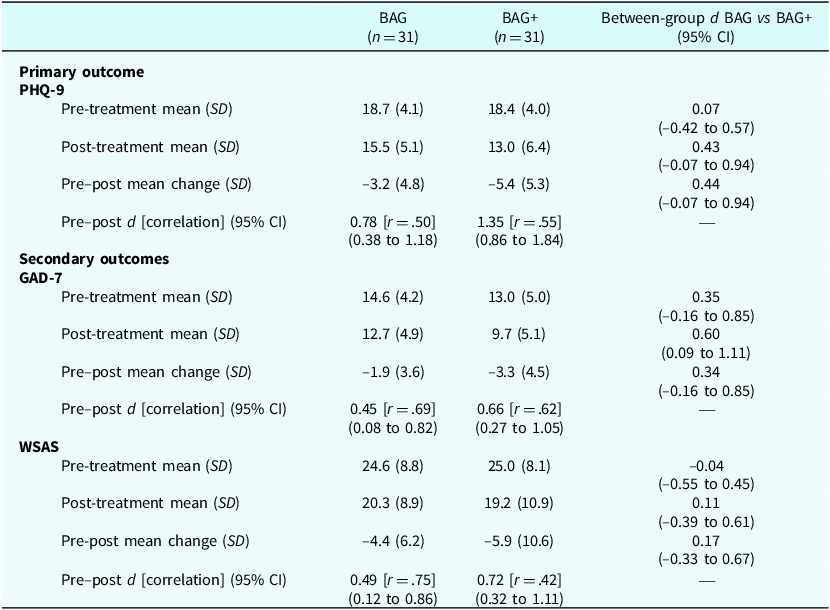
Table 1 presents the primary and secondary outcome means, pre–post effect sizes and between-group effect sizes for BAG and BAG+. Overall, depression symptoms significantly decreased following BAG treatment (pre–post PHQ-9 main effect: F 1,60=45.22, p<.001), but scores did not differ between BAG conditions (BAG condition main effect: F 1,60=1.59, p=.212). The time by condition interaction found no significant difference in pre–post changes in depression scores between BAG and BAG+ (F 1,60=2.91, p=.093). There was a similar pattern for overall impaired functioning, which significantly decreased after BAG treatment (pre–post WSAS main effect: F 1,60=21.24, p<.001), did not differ between BAG conditions (BAG condition main effect: F 1,60=0.03, p=.871) or for the time by condition interaction (F 1,60=0.40, p=.529). Anxiety scores were significantly higher in the BAG condition (BAG condition GAD-7 main effect: F 1,60=4.32, p=.042) and significantly decreased over time (pre–post main effect: F 1,60=25.38, p<.001). Again, there were no significant differences in the interaction effect for pre–post anxiety changes between BAG and BAG+ (F 1,60=1.98, p=.164).
Means, standard deviations (SD), effect sizes (d) and 95% confidence intervals (CI) for BAG and BAG+

Pre–post effect sizes (d) have been calculated by dividing the pre–post difference by the pre-SD as recommended by Minami et al. (Reference Minami, Serlin, Wampold, Kircher and Brown2008) (for reference the correlation [r] between pre–post scores is reported in square brackets). BAG, behavioural activation in groups (existing intervention cohort); BAG+, behavioural activation in groups (augmented intervention cohort); PHQ-9, Patient Health Questionnaire; GAD-7, Generalized Anxiety Disorder scale; WSAS, Work and Social Adjustment Scale; CI, confidence interval.
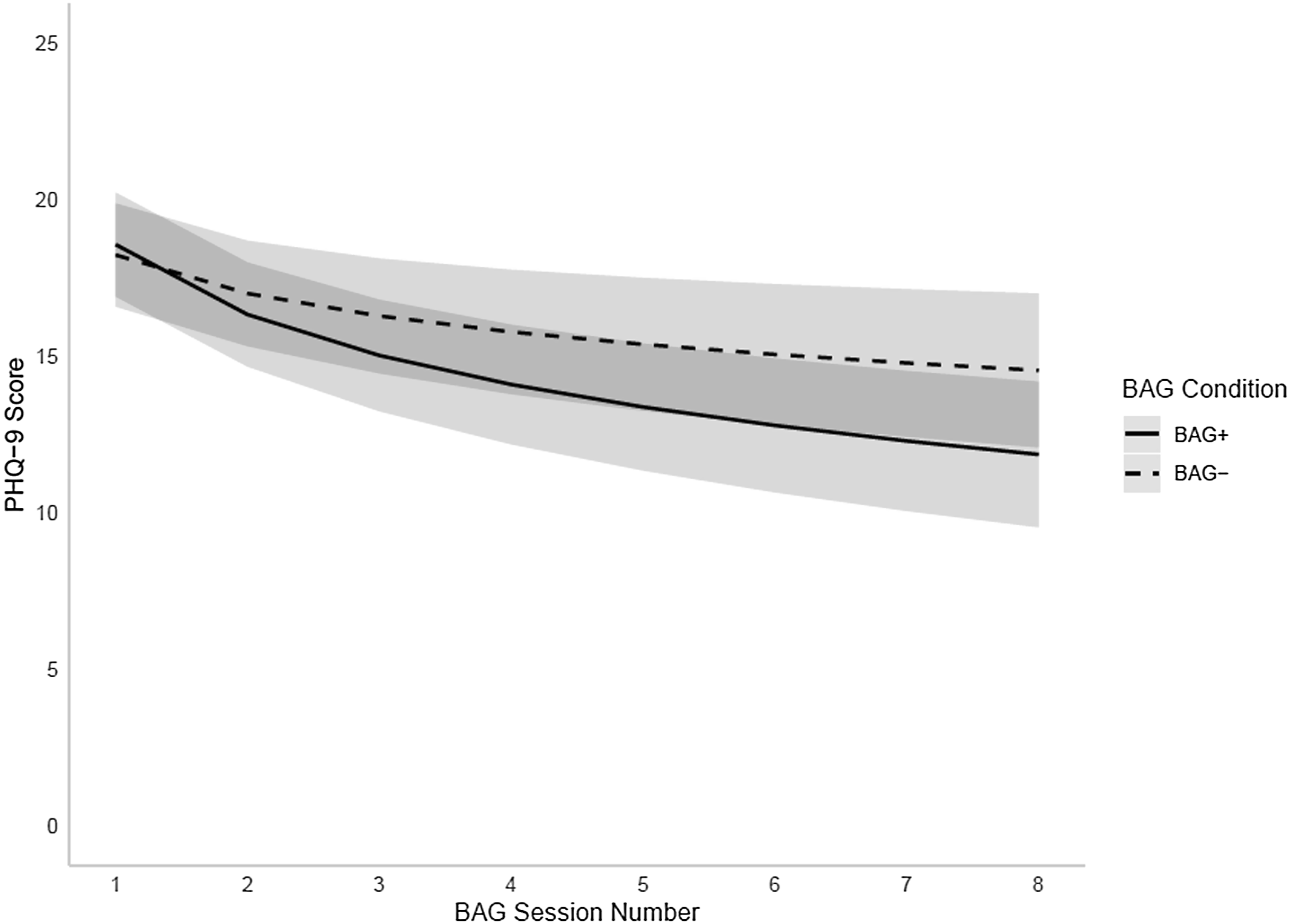
Within-group treatment reductions in depression (PHQ-9) symptoms represented moderate to large and large effects for BAG and BAG+, respectively. The lower post-treatment depression scores for BAG+ compared with BAG were representative of a small between-groups effect (d=0.43). Both BAG and BAG+ both produced small to moderate pre–post reductions in anxiety (GAD-7) and impaired functioning (WSAS). Exploratory analyses using longitudinal mixed-models found significant loglinear time trends for reductions in depression scores over the course of group treatment (time main effect β=–1.77, SE=0.50, p=.001), but no overall differences in PHQ-9 scores between BAG conditions (BAG condition main effect β=0.33, SE=1.17, p=.778). The time×condition interaction found a marginally significant difference in trajectories of PHQ-9 scores during group treatment, with BAG+ producing greater improvements after session 2 (time×condition interaction β=–1.45, SE=0.69, p=.042). Figure 2 presents the fixed effect PHQ-9 trajectory estimates and 95% confidence intervals for BAG compared with BAG+.
Longitudinal mixed-model fixed effect estimates for trajectories of depression (PHQ-9) scores over eight sessions of treatment for BAG and BAG+ (shaded bars represent 95% confidence intervals).

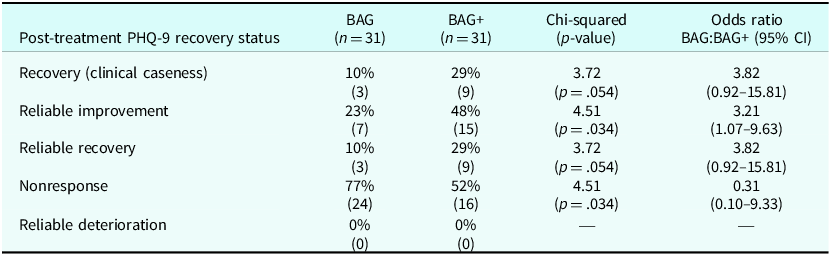
Table 2 summarizes case-by-case outcomes for depression showing that BAG+ produced a significantly lower number of ‘non-response’ PHQ-9 categories. Patients who received BAG+ were three times less likely to have a non-response outcome at the end of group treatment. These reduced non-response outcomes were explained by significantly more patients in BAG+ experiencing reliable improvements in depression symptoms. Recovery and reliable recovery rates were not different in BAG when compared with BAG+. No single patient experienced a reliable deterioration in their depression. Post-hoc recovery rate analyses based on combined PHQ-9 and GAD-7 scores did not find any significant differences between BAG and BAG+.
Individual depression (PHQ-9) recovery rates for BAG and BAG+

BAG, behavioural activation in groups (existing intervention cohort); BAG+, behavioural activation in groups (augmented intervention cohort); PHQ-9, Patient Health Questionnaire; CI, confidence interval.
To summarize, the two treatment augmentations did not improve attendance, but did appear to partially improve depression outcomes during BAG+. There was evidence of significantly more patients experiencing improvements and significantly fewer patients experiencing a non-response outcome relative to BAG, with some evidence of differing depression symptom trajectories during group delivery.
Discussion
This study used an implementation science approach to test whether treatment augmentations to an evidence-based depression treatment delivered in routine practice could be used to improve the acceptability and effectiveness of the intervention. Both augmentations were able to be integrated into the existing BAG treatment content without changing the duration of the treatment. Augmenting treatment should not necessarily mean lengthening treatment. Fidelity to the BAG and BAG+ treatment protocols were checked and was deemed sufficient and PSM procedures facilitated a balanced comparison of BAG and BAG+ outcomes in the absence of a direct or randomized control. Except for the treatment augmentations, all BAG and BAG+ patients received the same matched 8-session manualized group BA depression intervention. The combined treatment augmentations did not result in greater attendance for BAG+ and so did not appear to differentially improve the acceptability of the intervention. The overall attendance rates were poorer than those reported in the general literature (Swift and Greenberg, Reference Swift and Greenberg2012), and specifically in NHS TT services (Kellett et al., Reference Kellett, Wakefield, Simmonds-Buckley and Delgadillo2021) and may reflect the evidence that group interventions often have poor acceptability for patients (Cuijpers et al., Reference Cuijpers, Van Straten and Warmerdam2008). The effectiveness of the combined treatment augmentations on improving clinical outcomes appeared mixed. BAG+ patients were approximately three times more likely to have improved depression outcomes and appeared to have greater reductions in depression score trajectories from the third group session. However, overall post-treatment reductions in depression symptoms were not significantly different when BAG was compared with BAG+. This was mirrored in no significant differences also being observed in mean reductions in anxiety and impaired functioning scores.
The observed moderate to large within-group reductions in depression, anxiety and impaired functioning across both BAG and BAG+ provide further evidence that BA is clinically effective when delivered in groups in routine practice (Simmonds-Buckley et al., Reference Simmonds-Buckley, Kellett and Waller2019). There were no cases of depression symptom deterioration, suggesting that the treatment augmentations were safe. Improved outcomes were present in the individual depression outcome analyses, with non-response outcomes reduced from approximately 77% (BAG) to 52% (BAG+). Those fewer patients experiencing symptom non-response (i.e. those patients that did not achieve at least a reliable improvement) during BAG+ was a consequence of 26% more patients experiencing reliable improvement. The small beneficial effect reflected in the individual depression outcomes, but not the overall scores, suggests that the treatment augmentations were only beneficial to a small subsample of patients. It should be noted that partially beneficial effects of BAG+ were seen for depression outcomes only. Recovery rates combining depression and anxiety scores were not significantly different between BAG and BAG+, suggesting treatment additions were ineffective at facilitating greater improvements to wider mental health.
The results provide some tentative evidence for the utility of implementing low-cost treatment augmentations in the effort to improve the effectiveness of BA interventions, although the differences found were small and specific to depression. The mixed findings reflect the inconsistency of the evidence base for low-cost treatment augmentations. For example, Kellett et al. (Reference Kellett, Newman, Matthews and Swift2004) used practice-based evidence to better match patients to group CBT and improved outcomes and implementation intentions have been found to increase attendance at low-intensity group psychoeducational sessions (Avishai et al., Reference Avishai, Oldham, Kellett and Sheeran2018). Whilst text-messaging shows moderate benefits in increasing attendance (d=0.5), there are limited effects on clinical outcomes (Aguilera et al., Reference Aguilera, Bruehlman-Senecal, Demasi and Avila2017). Similarly, Delgadillo et al. (Reference Delgadillo, Moreea, Murphy, Ali and Swift2015) found that treatment orientation psychoeducation did not increase attendance.
Theoretical and clinical implications
The brief training intervention to support the treatment augmentations appeared feasible as it achieved its aim of enabling facilitators to change their BA practice. BAG was augmented with two simple strategies easily integrated into the extant group structure and protocol. One was a psychoeducational augmentation informed by BAG evidence targeting attendance and the other was a theory-informed augmentation targeting outcome. BAG+ patients experienced greater clinical improvements despite attending the same number of group treatment sessions as the standard BA patients. It is unknown whether patients engaged with the pre-course materials, although therapists did re-visit the information during the first treatment session unlike previous studies which only used pre-treatment leaflets (Delgadillo et al., Reference Delgadillo, Moreea, Murphy, Ali and Swift2015; Swift and Callahan, Reference Swift and Callahan2011). As depression is known to have a considerable effect on attention and memory (Otte et al., Reference Otte, Gold, Penninx, Pariante, Etkin, Fava, Mohr and Schatzberg2016), it is possible that patients found it difficult to process, retain and use the psychoeducational information.
Findings build on the clinical use of implementation intentions and demonstrate the potential of integrating ‘if–then’ plans into existing treatment protocols (Lucock et al., Reference Lucock, Bartys, Cupac, Delgadillo, Denton, Gaines, McMillan, Prestwich and Stebbings2018; Toli et al., Reference Toli, Webb and Hardy2016). The behavioural foundations of BA helped with the integration of implementation techniques into the process of setting of bespoke and idiosyncratic homework activities (Toli et al., Reference Toli, Webb and Hardy2016). Implementation intentions have previously been shown to promote engagement in personally valued activities (Fritzsche et al., Reference Fritzsche, Schlier, Oettingen and Lincoln2016). BA highlights the importance of context in both the maintenance of depression and the breaking of depressive cycles (Martell et al., Reference Martell, Addis and Jacobson2001). Similarly, implementation intentions promote the use of contextual cues to initiate pre-planned actions (Sheeran and Webb, Reference Sheeran and Webb2016). The mechanisms of ‘if–then’ planning therefore was relatively easy to integrate into the principles and practice of BA and Fritzsche et al. (Reference Fritzsche, Schlier, Oettingen and Lincoln2016) have also previously illustrated the utility of implementation intentions in managing low mood. The separation observed in depression outcome trajectories during BAG+ from BAG from group session 3 may have been due to the action of the implementation intentions during BAG+ (i.e. potentially via more effective homework completion). However, as homework completion was not monitored, it is difficult to draw particularly firm conclusions here.
Limitations and future research directions
The lack of randomization and a true control condition means that the results of this study are limited by lack of internal validity. The use of a historical control group means patients were not randomized to treatment, and so the differences found cannot be attributed with true confidence to the treatment augmentations. Future studies should therefore consider randomizing participants into BAG versus BAG+ but with adequate power to detect small effects. Because two augmentations were delivered during BAG+ it is impossible to disaggregate their separate effects. Future studies should therefore consider testing single augmentations iteratively. Potential confounds in how the cohorts were recruited into the study, how data were collected, temporal trends or small changes in service delivery over the time period, unknown usage of anti-depressant medication in the BAG historical control cohort and lack of information on any concurrent treatments in both cohorts could have accounted for the differences found. In BAG+ patients signed a consent form to participate, and this may have primed them to respond positively. The variables used to match participants could have been expanded to include the GAD-7 score, employment status, medication, long-term health condition status or disability and the amount of time waiting between referral and treatment starting.
A direct association of the treatment augmentations on the intended outcomes cannot be assumed. For example, the dose–response psychoeducational augmentation may have strengthened trust in the efficacy of BAG+ and so created a placebo effect on outcomes. The two quality improvements may have also had a synergistic rather than intended disaggregated effect. Drawing any firm conclusion of a direct connection between implementation intentions and clinical outcome is particularly undermined due to the lack of any check of homework compliance. Monitoring homework compliance would improve the method of future studies, particularly as homework compliance has been shown to fall across the duration of CBT interventions for depression (Gaynor et al., Reference Gaynor, Lawrence and Nelson-Gray2006). The durability of treatment augmentations was not assessed as no follow-up was conducted and long-term follow-up studies of the durability of treatment augmentations would be welcome.
Treatment completion rates of the full eight sessions were sub-optimal, so session-by-session scores were utilized to ensure a simplified pre–post score was available for the whole sample, replicating the approach used in routine services. However, the LOCF method used does have acknowledged limitations, as it is overly conservative and can introduce bias (Lachin, Reference Lachin2016). Use of a more sophisticated imputation method (e.g. multiple imputation) would have increased robustness of the findings. However, it should be noted that exploratory longitudinal mixed-model analyses of session-by-session outcomes that was used is well suited to handling missing data, and it found marginal evidence for greater depression reductions during BAG+ compared with BAG. The results are based solely on self-report data with associated risks of social desirability bias (Tourangeau and Yan, Reference Tourangeau and Yan2007). Using a combination of self and independent-assessor rated outcomes would strengthen the internal validity of future BAG studies.
The adherence check relied on BAG+ therapists self-rating adherence and because of the historical control nature of the study, only two BAG groups were able to be rated for adherence. Future research would therefore benefit from independent verification of adherence to treatment augmentation strategies. Because limited adherence data was possible from BAG groups, and the adherence measure for BAG excluded the implementation intention item, the study could not absolutely verify that implementation intentions were absent from all BAG groups. As the BAG+ therapists were introduced to the study and knew that the aim was to improve outcomes, this may have primed facilitators to deliver BAG+ groups more effectively. Finally, although checks were performed to assess the suitably of single-level analyses for the clustered data, it has been argued ICCs as low as 0.01 can still violate dependency assumptions (Baldwin et al., Reference Baldwin, Murray, Shadish, Pals, Holland, Abramowitz, Andersson, Atkins, Carlbring, Carroll, Christensen, Eddington, Ehlers, Feaster, Keijsers, Koch, Kuyken, Lange, Lincoln and Watson2011).
Conclusions
These results demonstrate that treatment augmentations to extant evidence-based therapies are feasible and offer a simple and direct means by which services can potentially improve outcomes. This is interventions being ‘tweaked and tested’ rather than wholescale replacement or being drawn into creating messy theoretical and clinical eclecticism. The use of practice-based data ensures that the results of this study have high external validity. The variety of processes that contribute to positive change during psychotherapy for depression provides multiple targets for treatment augmentation. Future research should continue to establish the processes that enable treatments to exert their positive influence and then target these for treatment augmentation in well controlled studies.
Key practice points
-
(1) Because much of the change work of BA is completed between sessions when activation is put in place, CBT therapists should pay attention to any factors that reduce the likelihood of homework completion (and reward homework completion). Implementation intentions appear to be a brief and useful summary of homework plans.
-
(2) Attendance in itself is a behaviour, and is the means by which BA is delivered and so therapists need to emphasize the importance of attendance.
-
(3) The reviewing and mutual design of homework exercises at each session is an effective way of socializing patients to BA and provides a containing structure to sessions.
-
(4) The delivery of BA in groups holds promise in terms of enabling patients to learn from each other and be a support to each other in terms of understanding the function of their behaviours and how to adopt an ‘outside-in’ approach to change.
Supplementary material
The supplementary material for this article can be found at https://doi.org/10.1017/S1754470X24000412
Data availability statement
The data are available on reasonable request from the corresponding author.
Acknowledgements
With thanks to the Improving Access to Psychological Therapies (IAPT) service (UK) and all the behavioral activation group facilitators who delivered the augmented interventions.
Author contributions
Stephen Kellett: Conceptualization (equal), Methodology (equal), Supervision (lead), Writing - original draft (equal), Writing - review & editing (equal); Mel Simmonds-Buckley: Conceptualization (equal), Data curation (lead), Formal analysis (lead), Funding acquisition (lead), Project administration (lead), Writing - original draft (equal), Writing - review & editing (equal); Jen Hague: Project administration (equal); Glenn Waller: Conceptualization (equal), Methodology (equal), Supervision-Supporting, Writing - original draft (equal), Writing - review & editing (equal).
Financial support
This work was supported by the Howard Morton Trust doctoral studentship awarded to the first author.
Competing interests
The authors declare none.
Ethical standards
The study received ethical and research governance approval from the Leeds East NHS Research Ethics Committee (IRAS project ID: 202197, Research Ethics Committee reference: 16/YH/0324), and was registered with a clinical trial database (ClinicalTrials.gov ID; NCT02970279) and authors have abided by the Ethical Principles of Psychologists and Code of Conduct as set out by the BABCP and BPS. Participants gave informed consent to participate in the study and for publication.





Comments
No Comments have been published for this article.