Meaningful self-expression and social connection are fundamental to the development and wellbeing of all individuals (Douglas, Reference Douglas2013). For people with an acquired brain injury (ABI) who experience aphasia, cognitive communication disorder and/or memory difficulties, the capacity for self-expression and social connection is often markedly reduced, contributing to decreased wellbeing and social isolation (Dalemans, De Witte, Beurskens, Van Den Heuvel & Wade, Reference Dalemans, De Witte, Beurskens, Van Den Heuvel and Wade2010; Hewetson, Cornwell & Shum, Reference Hewetson, Cornwell and Shum2018; Viscogliosi et al., Reference Viscogliosi, Desrosiers, Belleville, Caron and Ska2011; Wallace, Reference Wallace2010). This lack of meaningful social connection and self-expression, combined with feelings of confusion, failure and disrupted identity, can be triggers for anger and aggressive behaviour (Whitwham & Jones, Reference Whitwham and Jones2019), especially where there are underlying mental health issues (Palmer, Newsom & Rook, Reference Palmer, Newsom and Rook2016). The potential for angry outbursts further reduces the opportunity for community-based social engagement. To support social reintegration for those with ABI, group-based work has been recommended, as it offers normalisation through shared experiences, the opportunity for intra-group learning (Ben-Yishay & Lakin, Reference Ben-Yishay, Lakin, Ellis and Christensen1989) as well as alleviating isolation (Patterson, Fleming & Doig, Reference Patterson, Fleming and Doig2016).
Despite the benefits of activity in a group setting, individuals with ABI may feel alienated and fatigued by the ongoing need within such groups to listen, speak and remember (Snow & Douglas, Reference Snow, Douglas and Cummings2017). More fundamentally, there may also be difficulties for these individuals in simply tolerating another’s presence, as the behaviour of one person may trigger the sensitivity of another. Given these pressures, activity-based groups that are organised around a task rather than around verbal exchange may be more effective for some individuals within this cohort (Perna, Synder, Bubier, Rousselle & Oken, Reference Perna, Snyder, Bubier, Rousselle and Oken2004). In particular, use of the arts has been recommended, as it provides the opportunity to use symbol and metaphor to represent matter that may be otherwise inexpressible (Prigatano, Reference Prigatano1991). Visual art making, in particular, offers multiple possible processes and media, enabling self-expression that is less contingent on words and may not rely so heavily on regions of the brain that underpin verbal communication and memory (Lusebrink, Reference Lusebrink2010). Art making also offers an external focus and naturally evolving subject matter, de-emphasising the mechanics of conversation in favour of more spontaneous and motivated communication (David, Reference David1999). Furthermore, art making provides visual prompts that persist beyond a single moment, which may support those with severe memory deficits. For those whose ability to connect, and subsequently interact, is undermined by difficulties in even tolerating interpersonal proximity, art-based activity within a group environment offers the potential to work alongside one another, rather than together on the same task. This proximate engagement in a similar task can provide a vital foundational step in breaking down isolation and experiencing a sense of community. Art therapy situates all the posited benefits of the art making experience in a supportive relational framework in which creative experimentation may safely occur (Springham & Huet, Reference Springham and Huet2018). A balance of gentle challenge within secure connection is understood to support psychological wellbeing at a neurobiological level (Cozolino, Reference Cozolino2010).
Research into the impact of group art therapy on social connection in individuals with ABI has, to date, been very limited (Di Vita et al., Reference Di Vita, Procacci, Bellagamba, Jacomini, Massicci and Ciurli2020; Guay, Reference Guay2018). As such, investigations of art-based activities outside an explicit art therapy framework are also considered here. Symons, Clark, Williams, Hansen and Orpin (Reference Symons, Clark, Williams, Hansen and Orpin2011) examined the use of visual art in a small occupational therapy group to support participants’ rehabilitation. Individuals with varying ABI diagnoses reported benefit – in particular, that the group bestowed a sense of belonging and provided a stepping-stone into community-based arts participation. Similarly, a community-based team investigated participation in a creative arts programme with a small group of people who had experienced stroke (Beesley, White, Alston, Sweetapple & Pollack, Reference Beesley, White, Alston, Sweetapple and Pollack2011). Participants voiced appreciation of opportunities for self-expression, improvements in cognitive skills and language, and pleasure in the supportive and encouraging social context. As such, a limited number of investigations of art-based activities outside an explicit art therapy framework suggest that use of art to support alternate forms of self-expression in ABI may be of value.
In the art therapy literature itself, a handful of practice-based texts offer commentary on group process in ABI (McGraw, Reference McGraw1989; Sell & Murrey, Reference Sell, Murrey and Murrey2006; Wald, Reference Wald, Wadeson, Durkin and Perach1989, Reference Wald and Malchiodi1999). In addition, a few art therapy-focused research articles suggest advantages from art therapy group programmes, although some issues with study design make it difficult to draw clear conclusions. Gonen and Soroker (Reference Gonen and Soroker2000) designed a short-term, guided, dynamic, closed group intervention to complement an existing inpatient stroke rehabilitation programme. The researchers used the Loewenstein model of art therapy in stroke rehabilitation (Gonen & Soroker, Reference Gonen and Soroker2000). A stated objective of this model is to improve interpersonal relationships, by encouraging participants at a naturally introverted stage in their recovery to turn outwards and relate to others, while simultaneously reinforcing self-expression. The researchers described the normalising effect of group sharing, positing that group structure offered an empathic ‘surrogate family’. In a second study, a 10-week community-based group art therapy programme was compared with a communication skills group that used traditional (unspecified) speech therapy methods in individuals with ABI (Guay, Reference Guay2018). Empirical findings were inconclusive. Several methodological issues are likely to have contributed to this, including the small sample size of this group study and that participants self-selected the experimental group, based on their interest in art. Thus, participants were not exposed to both conditions and consequently did not act as their own controls, which would have made for a more powerful comparison. In addition, quantitative measures in the Guay study relied only on responses to questionnaire-based perceptions of participant wellbeing, without use of more objective measures. Qualitative observations suggested gains for both groups, but with a higher frequency of interaction being seen before and after art therapy sessions. Art therapy participants in this study also appeared to experience reduced shame around their difficulties. Di Vita et al. (Reference Di Vita, Procacci, Bellagamba, Jacomini, Massicci and Ciurli2020) undertook a group study examining the use of psychotherapy and art therapy in a very small cohort at least 12 months post-severe traumatic brain injury. The study aimed not to compare the interventions, but to employ a double-pronged approach to improve emotional wellbeing, as measured by a battery of tests at six intervals across the programme. Sample size and design of this group study limit conclusions that can be drawn in relation to the impact of art therapy in ABI. Nonetheless, findings suggested improvement in adaptability, awareness, social functioning and emotional regulation, alongside reductions in depression and perception of physical problems. Of note, however, exclusion criteria included marked language and memory deficits, and severe neuropsychiatric disorders.
Given such limited research concerning the benefits of group art therapy in ABI, and inconsistent attendance at an on-unit community discussion group, the current study used a single case experimental design (SCED) to compare participation in a more traditional discussion group with participation in an art therapy group. This was a multiple A-B-A time series design. Participants in the study comprised a small number of individuals with very complex needs, living long-term with ABI. Specific formats for both discussion and art therapy interventions were developed, with “sport” chosen as the theme for discussion groups. Primary outcome measures were presence in the unit’s communal space and participation (attention to the activity being undertaken). It was hypothesised that the art therapy group would better support some individuals to be present in the communal space and to participate in groups.
Method
Participants
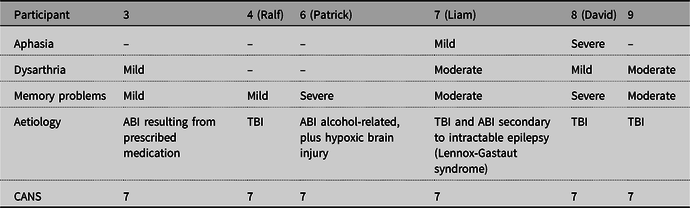
This research was conducted on a secure residential unit, specialising in longer-term rehabilitation of individuals with ABI with marked behaviours of concern and mental health issues, impeding their ability to live in the community. Some of these nine residents also had behaviour-related limitations placed on their leave from the unit. None consistently attended the weekly unit-based community meeting facilitated by varying staff members and open to all residents. It involved some general orientation for the week, along with discussion about unit issues. The inconsistent attendance raised a question about whether a group less focused on speaking and listening might be better attended than a more traditional talking-based group. All nine individuals residing on the unit during the research period were invited to take part. These nine all participated to some degree in the groups offered, but only six individuals met the key inclusion criterion for rigorous SCED of at least five measurement points per phase (Tate et al., Reference Tate, Perdices, Rosenkoetter, Wakima, Godbee, Togher and McDonald2013). The other three residents had to be excluded due to late admission and/or early discharge from the unit across the 22-week study period. All participants had an ABI, mental health and behavioural issues. The participants also presented with a range of communication difficulties and varying levels of executive dysfunction. Table 1 offers information about the six participants in this study who had five or more data points collected per phase and includes their ratings on the Care and Needs Scale (CANS) (Tate, Reference Tate2017). Scores on the CANS range from 0 – “Can live in the community, totally independently, does not need support” to 7 – “Cannot be left alone, needs nursing care, assistance and/or monitoring 24 h per day”. To maintain confidentiality, participants have been given pseudonyms.
Participant Overview

ABI = acquired brain injury; TBI = traumatic brain injury; CANS = ‘Care and Needs Scale’ (Tate, Reference Tate2017).
Procedures and materials
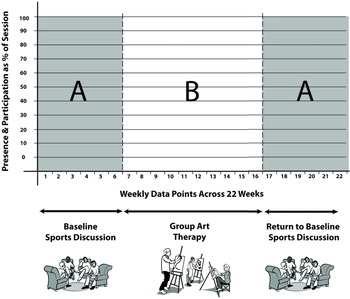
The study examined presence in the unit’s communal area (where groups took place) and participation in relation to art therapy groups (ART) compared with sports discussion groups (SPORT). Data on participation levels across weekly hour-long group sessions were collected for these six individuals using a SCED A-B-A time series design (i.e., SPORT1-ART- SPORT2). There were six baseline data points for initial sports discussion groups (SPORT1), followed by 10 data points for art therapy groups (ART) and a further six for return-to-baseline sports discussion groups (SPORT2). Groups occurred on the same day of each week, at the same time of day and all residents were gently reminded and invited to participate by facilitators and unit staff just prior to the start of each session. See Figure 1 for a representation of time series data point collection.
Schematic representation of data point collection across the time series.

Sports discussion groups
Discussion groups were led by a speech pathologist (BM) and covered recent sporting events and related topics. Items were well researched before each group and relevant photos were shown individually to participants during the groups. Participants were invited (but not compelled) to contribute information about their particular sporting interests and any sporting news they had. At the end of the group, participants were supported 1:1 to participate in a simple multiple-choice quiz. The quiz was light-hearted and correct responses were praised, while incorrect responses were played down. The group took a circle format, tending to spotlight whoever was speaking. The art therapist (EM) acted as co-facilitator for this group.
Art therapy groups
The art therapy groups were run by an art therapist (EM) and each session offered a theme, with associated tasks and materials. Themes were: Play (heads and tails collage); Motor Skills (stencils/rubbings); Self in Community (tree painting); Shape and Colour (mosaic); Layers of Self (mask painting); New Ways to use Familiar Objects (fruit and vegetable printmaking); Safe Risk Taking (scratch art); Identity: Public/Private (collaged self-boxes); Shadow Side (monster making) and Celebration/Owning the Environment (Christmas decorations). Themes provided structure for the art maker, as well as a discussion point during interaction with facilitators. Each intervention was designed to provide multiple ‘entry points’ to accommodate participant diversity and differing skill levels. For those not attracted to the core task, more general art materials were always available, with freedom to innovate. Spread throughout three adjoining communal rooms, the art therapy group was less centrally focused and allowed for discrete exchanges within ‘sub-groups’. The speech pathologist (BM) acted as co-facilitator for the art therapy groups - a mirror image of the staffing arrangement for the sports discussion group. The same facilitators were used across the groups to bring consistency to the phases and enrich the facilitators’ sense of the programme as a whole. This approach also attempted to minimise the impact of staffing differences across phases, so that the major difference for participants was the type of activity offered. After each session there was an unpressured invitation to exhibit the resulting work in the communal space of the unit.
Participants were free to come and go from the group area during both types of group. As well as the therapists, there were at least two nurses and, sometimes, support workers present during groups. Throughout sports discussion groups, these extra staff made occasional comments as appropriate. During art therapy groups, these staff provided 1:1 support to participants in their art making with direction from the art therapist. At times when they were present in the groups but not called upon to support, they were also encouraged to make their own art.
Measures
Two research assistants sat in the group area during all phases. Their role was to observe and record whether individual participants were present in the group area and, if so, whether they were participating in the group activity. Each research assistant collected data for half of the participants, spending 1 min observing a specific participant, before moving on to the next participant for the second minute, and so on, across a 5-min period. After each 5-min, research assistants returned to their first participant and once again, observed that participant for a minute, continuing in this way across the hour-long groups. Research assistants had their own synchronised digital timer. They made binary decisions regarding absence (score = 0) or presence (score = 1) of participants in the communal area and similarly about whether the individual was participating. Participation was defined as ‘eyes open and at least looking towards the group leader or material being circulated’ (for sports discussion groups) or ‘looking at the art work or support person’ (for art therapy groups). When a participant changed status for presence (by leaving or arriving in the communal area), or for participation, during their minute rating period, they were given a score of 1. Scores were tabulated for each minute interval and then transferred onto an Excel spread sheet. The research assistants received training in this procedure. They also undertook a practice session to familiarise themselves with using the procedure in real time and then discussed any clarifications with the researchers. Participants could obtain a maximum score of 12 and a minimum score of 0 across each group for both presence in the unit’s communal area and participation. Scores out of 12 were then expressed as a percentage. Participants could see the research assistants and were told that they were there to observe and make notes about the session.
Data analyses
Time series analysis
The Tau statistic was calculated using a web-based application for SCED (Vannest et al., Reference Vannest, Parker, Gonen and Adiguzel2016). The Tau statistic is a distribution-free, nonparametric technique for measuring data overlap between two phases. It is based on overlap in all data pairs and combines overlap and trend to control for effects of improving baseline trend. It is relatively unaffected by any confounding effects of autocorrelation. It is an index particularly well suited to small datasets, which are relatively common in single case research. It has good statistical power and known sampling distribution meaning that p-values can be calculated (Tate & Perdices, Reference Tate and Perdices2019). We applied a 0.05 Alpha level to determine significance and followed Vannest and Ninci’s (Reference Vannest and Ninci2015) guide for interpreting effect size: 0.2 – small change, 0.2–0.6 – moderate change, 0.6–0.8 – large change and above 0.8 large to very large change.
Results
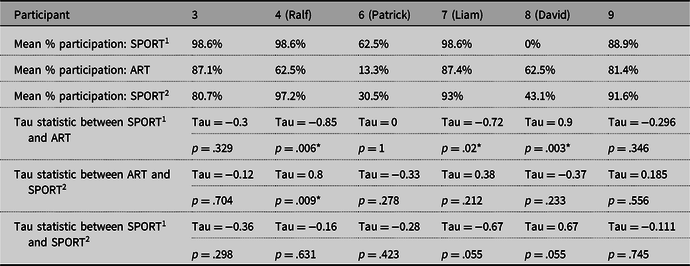
Average participation levels across the three phases of the time series and interphase Tau statistics are displayed for all six participants in Table 2. Statistically significant p-values are asterisked. In addition, Tau statistics for presence in the group area are specified below, where noteworthy. Three of the six participants (4, 7, and 8) included in the study showed statistically significant interphase differences in group participation and for one of these participants (8), there was also a significant interphase difference for presence in the communal area. SCED time series charting both measures for these participants are displayed in Figs. 2, 3 and 5.
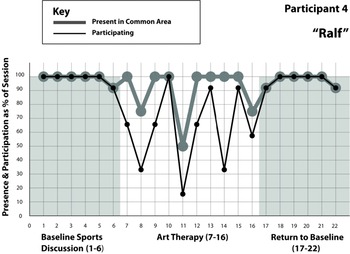
Time series for Ralf (participant 4), significant interphase difference.

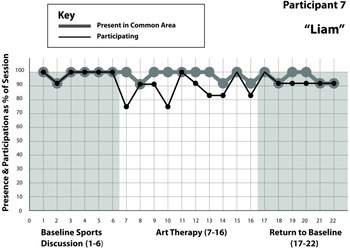
Time series for Liam (participant 7), significant interphase difference.

Summary of Individual Participation in Group Activities Across Phases

SPORT 1 is the baseline sports discussion group; SPORT2 is the return-to-baseline sports.
* Note p < 0.05.
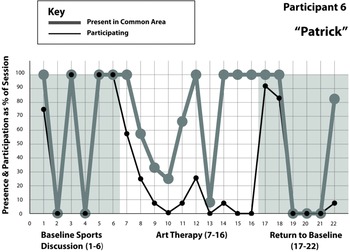
Most individuals participated consistently in SPORT1 groups. Participant 4 (Ralf, Fig 2) had very high participation during the SPORT1 phase, a significant reduction in participation during the ART phase (Tau = −0.85, p = 0.006) and a further significant increase in participation between ART and SPORT2 phases (Tau = 0.80, p = 0.009) – very large and large Tau effect sizes respectively. Participant 7 (Liam, Fig 3) had a high level of participation across groups, but a somewhat lower level for ART (87.4%), which represented a significant drop from participation in the SPORT1 phase (98.6%) (Tau = −0.72, p = 0.02) – a large Tau effect size. A further participant (6 – Patrick, Fig 4) is also noteworthy insofar as there was a substantial drop in his mean participation level between the SPORT1 (62.5%) and ART (13.3%) phases. However this interphase difference was not significant due to marked variability in the initial SPORT1 phase data. A downward trend in his participation level was also observed across the ART phase with inconsistent but overall low participation also observed in SPORT2.
Time series for Patrick (participant 6), marked differences in interphase means.

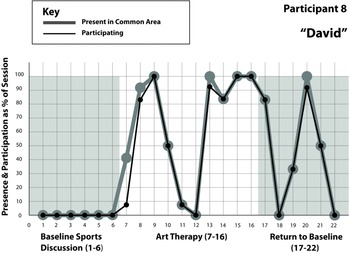
Time series for David (participant 8), significant interphase difference.

In contrast, Participant 8 (David, Fig 5) attended none of the SPORT1 groups. He showed a notable change between the SPORT1 and ART phases, participating for some proportion of time in all but one of the ART groups. Following the introduction of art therapy, the change in presence and participation was immediate, with a significant improvement for both presence in the communal area (Tau = 0.9, p = 0.003) and participation in the group activity (Tau = 0.9, p = 0.003) – both very large Tau effect sizes. There was variability observed across the first six sessions, however David achieved 100% presence for three of the last four art therapy sessions and 100% participation for the last two of these sessions. In addition, there was no significant difference between David’s ART phase and his SPORT2 phase for either presence in the communal area (Tau = −0.37, p = 0.233) or participation time (Tau = −0.37, p = 0.233). He attended some part of four of the six SPORT2 groups, with mean participation time increasing from 0% for SPORT1 to 43% for SPORT2. This increase in participation approached significance with the same result for both presence and participation (Tau = 0.67, p = 0.055).
Discussion
This exploratory study on a long-stay, secure ABI/mental health unit set out to systematically compare individual scores for both presence in the communal area and participation in a verbally based sports discussion group and a task-based art therapy group. It was hypothesised that art therapy would better support some individuals with complex communication, cognitive and mental health needs following ABI to be present in the communal space and to participate in groups. This hypothesis arose from observations that an on-unit community discussion group had inconsistent attendance. To date, literature examining the benefits of group art therapy in ABI is quite limited, lacking in rigour and focuses on individuals with less severe combinations of challenges than the cohort studied here.
The data demonstrate that the sports discussion group was popular. Given inconsistent community group attendance, this result was unexpected. However, on reflection, sport seemed a more appealing theme for this all-male cohort. Also, more planning went into each sports discussion group than was the case for the community group and it was consistently facilitated by a speech pathologist who had considerable experience working with people with ABI in a group setting. Overall, participation rates for the art therapy group were almost as high as for sports discussion, suggesting that both groups were beneficial to participants. It seemed from these outcomes, that despite their complex issues, most participants were somewhat able to adapt to the differing dynamics and demands of each group.
Six participants fulfilled the SCED criterion of at least five data points per phase. Three of these six showed no significant interphase difference in participation rates between group types, although one (Patrick) did show a downward trend in the group art therapy. The remaining three participants all demonstrated significant interphase difference between the SPORT1 and ART phases, two with a reduction in participation from SPORT1 to ART (Liam and Ralf) and one with an increase from SPORT1`to ART (David) which was also found for presence in the communal area. The latter findings were consistent with the research hypothesis. Outcomes for these individuals were influenced by logistical constraints. They also arose from interplay between group dynamics and each individual’s unique profile, including their cognitive strengths and deficits, mental health issues and personal preferences. To support this assertion, therapist observations captured in notes made during the programme are summarised below. These case discussions hint at some of the complexity, which participation statistics alone fail to reveal.
Case discussions
Ralf (Fig 2) showed a significant reduction in participation time between the art therapy phase and both sports discussion phases yet, paradoxically, he had an established sense of himself as an artist and sport was likely less important to him than creativity. Ralf’s passion for art, however, was complicated by burdensome self-expectations. Reflecting this inner conflict, Ralf often told the therapists before the art therapy group that he was not going to participate and then changed his mind once the group started. When he did participate, he would frequently become dissatisfied, destroy his artwork and abort the project or, alternatively, defer finishing the work until the next session. Unsurprisingly, Ralf was better able to sustain engagement in art making when a facilitator worked one-to-one with him, but once they moved on his engagement often waned. Although it might appear from the data that the art therapy group was relatively unsuccessful for Ralf, it stood in contrast with previous attempts to work with him in one-to-one therapy. Such attempts were repeatedly met with mistrust and refusal, while the group environment seemed to feel safer to Ralf, offering a clue as to how he might be willing to engage in future. The art making also vividly brought into view personal issues Ralf was dealing with that could potentially be addressed through consistent group or small group art therapy.
Liam (Fig 3) was observed by the facilitators to enjoy both groups enormously and his high levels of participation across the entire time series support this contention. Even so, Liam’s participation decreased significantly between SPORT1 and ART. Several factors may have contributed to this decrease. First, it was less demanding for Liam to be present in the discussion circle for an hour than to sustain a full hour of activity in the art group. Then, during art therapy he required more one-to-one assistance, which was not always available. Liam’s cognitive ebbs and flows were also made more apparent by the active nature of this group, as he would intermittently become confused due to barely perceptible absence seizures that appeared to be triggered by excitement or sensory stimulation. He was also prone to frequent severe epileptic seizures. Such variations in Liam’s ability to engage would not necessarily have been detected in the more passive participation required for the sports discussion group. Furthermore, he fell asleep for around 15 min during one art group and sometimes completed his artwork a little before the hour was up. Consequently, Liam’s significant SPORT1 to ART phase difference was not felt to reflect a group preference.
Patrick (Fig 4) had no significant interphase changes but did show a downward trend in group art therapy. His engagement was inconsistent overall, which corresponded with staff reports of his reluctance to participate in any unit activities. Patrick presented as adynamic, wary and possibly depressed. When in the communal space, he defaulted to watching television, becoming angry when it was switched off for groups. The more passive sports discussion group had parallels with watching television and appeared to provide a bridge between the familiar comfort of passive viewing with novel group participation. Patrick was mostly silent during sports groups, but the structure supported him to occasionally interject and therefore potentially experience a sense of group membership and participation. Conversely, during art therapy groups, Patrick did not actually make artwork himself and was only ever rated as participating when approached by one of the facilitators and asked to comment on their work (sessions 7, 8 and 12). As these groups progressed, Patrick was no longer open to even this type of engagement, making it clear art was ‘not his thing’. Given his severe global cognitive impairment, he may also have perceived that the art making threatened to demand something of him that he could not produce. If Patrick thought a tangible outcome was expected in art therapy, then ‘failure’ may have felt more exposing in this context than with sports discussion, where passive participation might be viewed as more acceptable. As Patrick’s participation was also poor in SPORT2, his engagement across later groups was likely further influenced by his apparent deteriorating psychological state at the time.
David (Fig 5) was the only participant who showed statistically significant interphase improvements for both presence in the communal area and participation during the art therapy intervention. After totally rejecting the SPORT1 group, David attended all but one of the ART groups. Furthermore, David was noted to be participating for 43.1% of the time across all SPORT2 groups, suggesting his tolerance for the discussion-type group may have been improved by positive experience during art therapy. This contention is supported by lack of significant difference between his participation in ART and SPORT2 phases. Considering this result, it is notable that David had the most severe communication difficulties of the cohort – compounded by substantial memory and mental health challenges. Thus, his complete absence from initial sports discussions may have reflected how cognitively overwhelming this kind of verbal interaction was for him. Time series data at the beginning of the ART phase (Fig 5, Session 7) show David in the communal area likely checking out what was happening. He participated with the art therapist right at the beginning of this session and then followed his previous pattern of withdrawing to his room. However, he then returned to the communal area and sat there for the last 20 min of the session. After this, David appeared sufficiently comfortable and motivated to participate in art making. This almost immediate response suggested an instinct that art making was something different that he could use for his own purposes. In this readiness, he seemed less encumbered by self-consciousness than Ralf and possibly Patrick. Therapist records add nuance here, noting that at times the act of art making was challenging for David, too – and yet, he persisted.
On good days, once started on an activity, David could sustain his own momentum. When he appeared more confused, David needed more one-to-one input, but was able to accept this help, creating a natural opportunity to connect. More than this, by supporting a range of possible communication strategies (from simple choice-making to the complex and abstract, verbal or otherwise), art therapy appeared to support David to become an active participant in both group occupation and social exchange. Once the stress of verbal production was reduced, David was observed to relax more in the group setting. He then achieved moments of settled focus and shared explorative activity, at times appearing sufficiently at ease to become immersed in his own sensory experience. David also agreed to the display of his work after each session. Exhibition has been identified as beneficial in ABI art therapy (McGraw, Reference McGraw1995, McGuinness & Schnur, Reference McGuinness, Schnur and Malchiodi2013), and David appeared pleased to see his art on the wall alongside that of other participants, reflecting him as an individual within a community. The tangible presence of the displayed artwork allowed David to revisit a feeling of accomplishment, likely hard won in other areas of his life. It also offered enduring, externalised subject matter for conversation, belonging to him and about which, importantly, he could not be ‘wrong’.
Consideration of each of these individuals hints at the complexity behind the statistics where organic injury coincides with mental health challenges, preference, prior experience and personality. When trying to understand what worked for whom - how and why, inherent differences were also highlighted between the dynamics of the two kinds of groups. In the sports discussion, group interactions were facilitated in a circle by mainly one therapist. They tended to focus on one or two speakers at a time, but took place in front of the whole group, including each member in shared discussion. This dynamic was probably especially rewarding for naturally sociable participants, such as Liam, but also appeared to work for Patrick and Ralf, allowing them to mostly sit back, but also to interject occasionally. In art therapy groups, by contrast, people were spread through communal areas and many discrete two- and three-way interactions, verbal and non-verbal, took place at the same time. This appeared to work for all participants, except Patrick who shunned intrusion.
Contribution to the Literature and Clinical Implications
Investigation of the existing literature failed to identify research into group art therapy for those most severely affected by ABI, facing a confounding combination of communication, cognitive and mental health difficulties. This study’s findings suggest that group art therapy may be useful for this cohort, encouraging a sense of community in a challenging environment. Smaller groups may work well where participants will tolerate ‘group-together’ interaction. This reflection resonates with practice-based recommendations from Sell and Murrey (Reference Sell, Murrey and Murrey2006) for smaller art therapy groups in this cohort. Rigorous use of a simple SCED participation measure revealed the usefulness of group art therapy for one individual in particular with profound communication, memory and mental health barriers to participation in a discussion group. For him, the most basic foundation required for social interaction needed to be re-established – simply tolerating interpersonal proximity. Supporting the research hypothesis, art therapy appeared to allow David to work alongside others and tolerate a group environment, without the additional pressure of verbal communication (Sell & Murrey, Reference Sell, Murrey and Murrey2006). The synergistic benefit of art therapy for such individuals may lie in its posited capacity to support self-expression (Gonen & Soroker, Reference Gonen and Soroker2000). David’s changing response to the group environment, both in ART and SPORT2, to some extent reinforces the report by Di Vita et al. (Reference Di Vita, Procacci, Bellagamba, Jacomini, Massicci and Ciurli2020) of increased adaptability after group art therapy and psychotherapy.
The success of the discussion group, targeting an area of substantial interest to the cohort, also provided preliminary evidence of the importance of a range of well-planned groups aiming to meet individuals “where they are at”. This approach would appear critical in boosting participation levels in this extremely complex and challenging population. Above all, the heterogeneity of the demographic, the success of both kinds of groups and the recognition that they offer differing opportunities, highlights the need for a variety of group activities on ABI units (Guay, Reference Guay2018). Such groups should also be tailored to meet users’ needs, strengths and interests (Walker, Stamper, Nathan & Riedy, Reference Walker, Stamper, Nathan and Riedy2018). Tailoring should continue throughout an individual’s rehabilitation, since the findings suggest that people have complex, individual and potentially fluid responses to therapeutic modalities, which may not always be anticipated. It is therefore important to offer alternative approaches to individuals, without prejudice.
Strengths and Limitations
The study has both strengths and weaknesses in the context of interpreting results. In relation to strengths, the clinical presentation of participants was described and the specific nature of the interventions was also outlined. In addition, target behaviours were operationally defined and thoroughly sampled through systematic observation, yielding at least five data points per phase. Interphase differences were analysed using the Tau statistic, a distribution-free nonparametric technique well suited to small data sets (Vannest et al., Reference Vannest, Parker, Gonen and Adiguzel2016).
In terms of weaknesses, phase order or onset was not randomly assigned, as it was not possible to exclude participants from specific groups because they took place in a communal area on a residential unit. In addition, due to logistical constraints, only one independent assessor was used to record each participant’s target behaviours and inter-rater agreement could not be ascertained. The obviously different appearance of each kind of group also made it impossible to blind assessors to study phase.
There were some practical differences between the groups that did not relate to individual desire to participate, but nevertheless probably influenced statistical outcomes. Sports discussion groups had clear start and finish times, with unspoken etiquette around not wandering off halfway through. Conversely, participants in art therapy groups might consider themselves ‘finished’ or come and go at different points in the group, without necessarily feeling less satisfied by the art making. The sports discussion group also required little on-site set-up prior to group, just the rearrangement of chairs, while the material-heavy art therapy groups sometimes had a ragged start due to logistical challenges. This reduced the time available during which individual participation could be recorded. The finishing time for the art group was also less clearly defined. In fact, sometimes participants continued making art well beyond the hour, however this could not be recorded due to limitations in research design. Another practical challenge was the balance between group size and staffing in art therapy, which relied on more staff being actively available to residents. Outcomes varied, depending upon which staff were working. Smaller groups of up to four with a facilitator and a support, might offer a useful variation for members of the cohort who are more ready to connect and interact.
Taking all this into consideration, purely charting participation times clearly did not reveal the whole story about what individuals were getting out of the two different groups. Deeper understanding was hampered by the limits of the chosen measure. Therapist records were useful, but future research would do well to formalise such observations through structured facilitator interview, using carefully chosen questions about participant activity. Self-report from participants would have been highly desirable, yet inherent communication and memory challenges within this demographic presented a substantial barrier to participant interview. If these challenges could have been mitigated, it would have clarified how the experience of each group differed for each individual. Further insight into participant experience could be captured through the use of unobtrusive wearable devices to measure biometric mood indicators (Imtiaz, Anwar & Khan, Reference Imtiaz, Anwar and Khan2020), but explorative energy should also be directed towards consultative ways of soliciting participant feedback.
Conclusion
This exploratory study on an ABI/mental health unit used SCED to compare individual scores for both presence and participation in a verbally based sports discussion group and an art therapy group. To some extent, findings support the hypothesis that art therapy can assist some highly compromised individuals with ABI in group participation, however further research is warranted. Overall, the sports discussion group was slightly better attended, but the generally high participation for SPORT and ART indicated that both interventions were of value. Results for the four participants discussed also suggest that the two groups offered a different experience for each individual. The good uptake of both activities therefore attests to the need for a greater choice in ABI rehabilitation of targeted, high-quality groups, utilising diverse modes of interaction. Future research into a range of such groups, aimed at meeting this challenging cohort where they are, has the potential to increase participation, build confidence and instil hope.
Acknowledgements
The authors wish to thank the Austin Health Speech Pathology Department as well as participants and staff from the Brain Disorders Program for their valuable contribution to this research.
The authors also thank Professor Bircan Erbas of La Trobe University for her advice regarding study design in the early stages of this research.
Financial support
This work was supported by the Austin Medical Research Foundation, Victoria, Australia (B.M., E.M. and C.F. grant no. 2-1255).
Conflicts of interest
Bronwyn Moorhouse has no conflicts of interest to disclose. Erica Rosalie Mainprize has no conflicts of interest to disclose. Jacinta Douglas has no conflicts of interest to disclose. Caroline A. Fisher has no conflicts of interest to disclose
Ethical standards
The authors assert that all procedures contributing to this work comply with the ethical standards of the relevant national and institutional committees on human experimentation and with the Helsinki Declaration of 1975, as revised in 2008.
Ethical approval granted by Austin Human Research Ethics Committee, Melbourne, Australia, (HREC/16/Austin/28).