Introduction
Informal, unpaid, older caregivers of people with intellectual disabilities (ID) are usually female and usually mothers. However, research to advance our understanding of gender-specific, lifelong care is limited, even though Taiwan is a country where such caregivers are relatively common. In Taiwan, between 92% and 95% of persons with ID live with their families, while the rest reside in residential facilities (Department of Statistics, Ministry of Interior, R.O.C., 2010). At present and in contrast to Western societies, residential services for people with ID, provided by the formal care system, are tending to grow in number, and these include both large and smaller residential settings (Chou and Schalock, Reference Chou and Schalock2007). Unlike family caregivers of aging parents or spouses, the length of active caregiving by parents who have daughters or sons with ID often extends for many decades. Increasing longevity means that both caregiving parents and their children with ID will live longer and experience more of the social and medical disabilities of old age (Jennings, Reference Jennings1987; Patja et al., Reference Patja, Livanainen, Vesala, Oksanen and Ruoppila2000; Maaskant et al., Reference Maaskant, Gevers and Wierda2002). As they age, older parents who are caregivers of their adult children with ID could have needs that are different from those of other caregivers. In comparison to fathers, mothers will have spent consistently more time providing care and so will have offered more types of support to their child; as a result, women typically reported a greater burden associated with caregiving than did men (Fitting et al., Reference Fitting, Rabins, Lucas and Eastham1986; Barusch and Spaid, Reference Barusch and Spaid1989; Hooyman and Gonyea, Reference Hooyman and Gonyea1995; Heller et al., Reference Heller, Hsieh and Rowitz1997).
The burden upon caregivers with responsibility for a live-in family member was first acknowledged by Grad and Sainbury (Reference Grad and Sainbury1963) in the early 1960s. The definition of burden was expanded to acknowledge the importance of subjectivity in the experience of burden (Zarit et al., Reference Zarit, Reever and Bach-Peterson1980; Kosberg and Cairl, Reference Kosberg and Cairl1986), and it was later defined as having two dimensions: one subjective and the other objective (Montgomery et al., Reference Montgomery, Gonyea and Hooyman1985; Vitaliano et al., Reference Vitaliano, Maiuro, Ochs, Russo, Light and Lebowitz1989). Montgomery et al. (Reference Montgomery, Gonyea and Hooyman1985) described burden as a product of interaction; the caregiving experience is seen as an interactive event that occurs between a caregiver and a care receiver within the social context. Thus, subjective burden presupposes feelings and attitudes while objective burden presupposes events and activities; these are both related to caregiving.
Various studies have identified several factors that are associated with an increase in caregiving burden, including having a child with ID who has additional behavioral problems, severity of the child's disability and the adult's functionality level. These factors lead to higher levels of demand, more caring hours and a need for assistance with personal care (Greenberg et al., Reference Greenberg, Seltzer and Greenley1993; Heller et al., Reference Heller, Hsieh and Rowitz1997; Pinquart and Sörensen, Reference Pinquart and Sörensen2006). In addition, aging mothers can experience stress from other sources, including problems with their own health, becoming divorced or widowed, or assuming the caregiving role for another family member or friend (Seltzer and Krauss, Reference Seltzer and Krauss1989; Kim et al., Reference Kim, Greenberg, Seltzer and Krauss2003). Barusch and Spaid (Reference Barusch and Spaid1989) and Seltzer and Krauss (Reference Seltzer and Krauss1989) have shown that maternal demographic variables (age, sex, marital status, education and income) and overall coping effectiveness are correlated with maternal physical health, life satisfaction and caregiving burden. In addition, other studies (Grant, Reference Grant1990; Magliano et al., Reference Magliano, Fiorillo, De Rosa, Malangone and Maj2005) have indicated that both the objective and subjective burdens are significantly higher among caregivers who report lower support from their social network and professionals. On the other hand, Hong and Seltzer (Reference Hong and Seltzer1995) found that one effect of their unique lifelong care role was that it might bring positive consequences with respect to their psychological well-being. This conclusion led Smith (Reference Smith1996) to suggest that positive caregiving appraisals are an essential aspect of any comprehensive theory of caregiver well-being, and the view that older parents of adults with lifelong disabilities derive considerable ego gratification from their caregiving role is substantiated.
There is little in the Western literature on the issues of the interactional difficulties perceived by family caregivers of persons with ID. There is also a paucity of studies exploring whether there are different factors related to subjective and objective caregiving burden, including positive caregiving appraisals, for older female family caregivers of adults with ID in both Taiwan and Western societies. Furthermore, the residential status of the adult with ID has been found to be a significant predictor of burden for caregivers, suggesting that, when this adult moved away from the home, the mother showed declining levels of subjective burden (Kim et al., Reference Kim, Greenberg, Seltzer and Krauss2003). Our study is designed to use a sample of Taiwanese older female caregivers of adults with ID living with their families to examine the predictors of caregiving burden. Three hypotheses were tested: (1) caregivers’ perceptions of subjective caregiving burden are likely to be predicted by caregiver variables; (2) caregivers’ perceptions of objective caregiving burden are likely to be predicted by the care recipients’ care demands; and (3) caregivers’ positive caregiving appraisals are likely to be predicted by caregiver variables.
Methods
Study population and procedures
For the purposes of this study, the “older female caregivers” that made up our study population were defined as family primary caregivers aged 55 years and older who were most responsible for the ongoing caregiving for a family member with ID who was living with the family. The inclusion criteria of the selected participants were: (1) the adult had been diagnosed with ID and lived with their family at the time the study was conducted; (2) the adult needed to be cared for and had a female family member who was the person most responsible for providing ongoing care to the adult; and (3) the adult's female family primary caregiver was aged 55 years or older.
In Taiwan, disability welfare benefits are only available to those who are diagnosed with a disability, have the approval of the local government and have been provided with a disability certificate or handbook. The level of disability is categorized into four levels – mild, moderate, severe and profound – which are based on the individual's medical diagnosis. The diagnosis of ID is based on the individual's IQ score and her/his neurological examination results, mental health situation, self-care ability, communication skills and maladaptive behavior.
In this study we were not provided with any information about who comprised our study population, namely the female older family primary caregivers of an adult family member with ID, and where they were located. This is because the local authority is only able to provide a list of persons who are diagnosed with disabilities, including those with ID or those with multiple disabilities (which may include ID as well). The above limitation to the available information meant that we needed to screen the listed adults with ID or multiple disabilities including ID (MD + ID) to reach our study population. This was carried out by approaching the caregivers of adults with ID or adults with MD + ID, where the adult was aged over 30. The study population screened was provided by the Taipei County Government, which is the biggest of the 25 counties in Taiwan. It has 29 municipalities and includes both urban and rural areas; as a result it provides the most representative sample population. The screening involved making individual telephone contact with the adult's family members to ask whether the main responsible caregiver of the adult was female and aged 55 or older. If the primary family caregiver fitted the criteria of our selected participants, we invited the family primary caregiver to join our study and asked whether she would allow us to interview her at home.
A total of 2,886 adults aged over 30 years with ID or with MD + ID were listed and 576 of them had a female primary family caregiver aged 55 years or older who was willing to participate in the study based on the telephone call. Eventually, 350 (55%) of these female older family primary caregivers took part in our study and completed the interview survey in their homes. Between the initial telephone call and the interview, 226 caregivers dropped out of the study owing to illness, hospitalization, moving away from the area, or because the adult had moved into a residential setting or because the caregiver had changed her mind about being interviewed. We compared the adults with ID of the 350 caregivers who were interviewed with the original population of 2,886 adults with ID and there were no significant differences in terms of the available demographic variables such as the adults’ sex, age and level of disability.
The interviews took place from July 2006 to January 2007 and were conducted by 23 trained interviewers who read the questionnaire and recorded the answer for each question. These interviewers consisted of 13 undergraduate or graduate students, majoring in social work and related human services, and ten practitioners from voluntary social service organizations. All of them had completed five hours of interviewer training. Ethical approval to conduct the study was obtained from the research ethics board of Yang-Ming University, Taipei, Taiwan.
Variables and measures
Measurement of care recipients’ variables and demands
The adults’ variables and care demands refer to their age, sex, level of disability, hours of care demanded per day and functionality. Care demanded per day was assessed by an item in the questionnaire, namely “how many hours per day do you take care of her/him (the family member with ID)?” Care recipient age and hours of care demanded per day were coded as continuous variables, with higher scores indicating older age and the need for more care hours, respectively. Based on the medical diagnosis, which is printed in the care recipient's disability handbook issued by the local government, the level of disability was coded as an ordinal variable (mild, moderate, severe or profound); a higher score meant a higher level of disability. Care recipients’ functionality in terms of activities of daily living (ADL) and instrumental ADL (IADL) were based on the total scores calculated from the Barthel Index (Mahoney and Barthel, Reference Mahoney and Barthel1965) and the Lawton and Brody Index (Lawton and Brody, Reference Lawton and Brody1969). A higher score indicated better functionality. The Barthel Index, Taiwanese version, assessed basic ADL: feeding, bathing, personal hygiene, dressing and undressing, toileting, use of a wheelchair, transfer from a wheelchair to bed and going up/down stairs. The Lawton, and Brody Index, Taiwanese version, measured IADL: the ability to use the telephone, go shopping, do housework, wash clothes, use a means of transport, take responsibility for medication and for finances. The internal reliability (α) was high for both the ADL (0.93) and IADL (0.90) scales used in the study.
Measurement of caregiver variables
Caregivers were asked about their age, marital status, years of education, duration (years) of caring for their adult family member with ID (care history) and their levels of health and social support. Caregivers’ marital status was coded as married (including co-habilitation) or single (including widowed and divorced) as a dichotomous variable. Caregivers’ age, years of education and duration (years) of caring were coded as interval variables. Caregivers’ general health status was measured using the EQ-5D Chinese version (α = 0.73 in this study). The scale contained five items measuring five dimensions of mobility, self care, usual activities, pain/discomfort, anxiety/depression, each of them coded by an ordinal number, ranging from 1 (no problems) to 3 (extreme problems) (e.g. I have no pain or discomfort, I have moderate pain or discomfort, I have extreme pain or discomfort) (Agency for Healthcare Research and Quality, 2005). In this study, we recoded the ordinal numbers (1 = severe problems, 2 = moderate problems, 3 = no problems); a higher score indicated a higher level of health. The caregivers’ social support was measured by the Social Support Scale, which consists of three major categories of social support, including instrumental, emotional and informational support (developed by Tang et al., Reference Tang, Mao, Chou, Chen and Liu1992). Instrumental support consisted of any human power involved in providing practical help such as cleaning, meal preparation, shopping, care work, companionship, transportation and financial support to the caregivers. Emotional support was defined as verbal encouragement by formal and informal networks that comforted the caregivers and helped them verbally express their stress and feelings through phone calls and advice. Informational support included providing related information, advice with regard to financial management and skills in taking care of their family member with ID. The reliability of this scale was established in a previous study: α = 0.88 for instrumental support, 0.87 for emotional support and 0.91 for informational support (Tang et al., Reference Tang, Mao, Chou, Chen and Liu1992). The scales contained 16 items each, coded on an ordinal scale that ranged from 0 (never) to 3 (very helpful); a higher score indicated higher support. The internal reliability of the total scale yielded a Cronbach's α of 0.85 in the present study. Caregivers were also asked about their monthly family income. Family income, coded into five ordinal categories, indicated the total amount of income of all family members in the household per month. A higher score indicated a higher family income.
Measurement of caregiver burden
The family caregiver burdens were measured by the Caregiver Burden Scale developed by Song (Reference Song2002) and based on the Overall Caregiver Burden Scale (Biegel et al., Reference Biegel, Milligan, Putman and Song1994); this was modified to fit the local Taiwan context. Sixteen out of 18 items of this scale refer to the subjective and objective caregiver burdens. The subjective caregiver burden consisted of four domains: stigma, caregivers’ anxiety, guilt and dependence and included nine items related to feelings and attitudes associated with the care recipients’ disabilities. For example, the caregiver was asked about her feelings or attitudes: “My family has a member with ID and this makes me feel ashamed” (stigma), “I worry about her/his security when she/he [adult with ID] is alone” (anxiety), “I feel I am not doing enough for her/him” (guilt) and “I feel she/he [adult with ID] counts on me” (dependence). The objective caregiver burden means the domain of career interference and family interruption. The objective burden portion of the measure included seven items related to the impact of the care recipient's disability on the caregiver's financial, work, marital, family, social and recreational activities. The caregivers rated the items on a 5-point scale (1 = never to 5 = always); higher scores indicated a greater burden. The reliability and validity of the scale were reported in a previous study that included 283 persons with mental illness from five hospitals located in northern, middle and southern Taiwan. Internal consistency estimates of reliability indicated that the Caregiver Burden Scale yielded a Cronbach's α of 0.90, which ranged from 0.72 to 0.92 at the domain level. In addition, the construct validity coefficient was 0.45 for inter-domain correlations based on factor analysis (Song, Reference Song2002). The α reliabilities of the scales for subjective and objective caregiver burdens were 0.71 and 0.84, respectively, for the present study. Two of the 18 items measured the caregivers’ degree of positive self-appraisal, and included these questions: “Taking care of him/her [adult with ID] makes me feel I am useful” and “Taking care of him/her [adult with ID] makes me become more optimistic.” The correlation between the two items was 0.27 (p = 0.000). Higher scores indicated a higher degree of caregiver positive attitude toward her role as a caregiver. A composite measure of the three domains was constructed from the total scores of the questions in each of the three domains. The composite scores for the overall caregiver burdens were based on the total scores of 16 items from the subjective and objective burden domains.
Statistical analysis
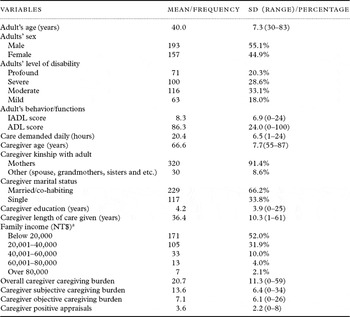
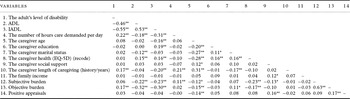
The individual caregiver was the unit of analysis. The database was analyzed using the Statistical Package for Social Sciences (SPSS), Version 18.0 (SPSS, Chicago, IL, U.S.A.). Descriptive analysis was used for the demographic data, while quantitative variables were described in terms of means and standard deviations (Table 1). We used multiple regression analysis to identify predictors of caregivers’ subjective and objective burdens, including their positive perceptions of their caregiving role. We created a Pearson correlation matrix between the 11 independent variables and three dependent variables (Table 2). Based on this matrix, we then removed the care recipient's level of disability, number of hours of care demanded per day and caregiver's length of caregiving from the regression model because these three independent variables were highly related to the other independent variables. For example, both the adult's level of disability and the number of hours care demanded per day are clearly highly related to the adult's level of ADL and IADL; furthermore, the caregiver length of caregiving is obviously highly related to the caregiver's age. We chose to keep the ADL and IADL scales as the independent variables in the regression analysis instead of disability level, because they are used as tools to measure eligibility when people with disabilities and their families apply for the Taiwan government subsidy given for home care since 2002. Eight independent variables were used in three independent simultaneous regression analyses. The level of statistical significance was set at p < 0.05.
Characteristics of the participants included in the analyses (n = 350)

a 1 US dollar = 32.45 Taiwanese dollars (12/6/2006).
Correlation matrix of variables (n = 350)

Caregiver marital status: 1 = married, 0 = not married. Adult's severity of disability, adult's level of ADL, adult's level of IADL, number of hours care demanded per day, length of caregiving, caregiver age, caregiver education level, family income, family social support, caregiver health status, caregiver subjective burden, caregiver objective burden and caregiver positive appraisals were coded as ordinal variables and a higher score indicates a higher level of disability, a higher level of ADL, a higher level of IADL, more hours of caregiving per day, a longer of time spent caregiving, older, a higher education, a higher income, a higher family support, better health, higher level of subjective burden, higher level of objective burden and higher level of positive appraisals.
*Correlation significant at the 0.05 level.
**Correlation significant at the 0.01 level.
Results
Characteristics of the participants
The demographic characteristics of the participants are presented in Table 1. Most of these female family caregivers were the biological mothers of the adult with ID. The other participants were made up of grandmothers/in-laws, wives and sisters. The majority of the caregivers were married or living with partners. The average years of education received by the caregivers was 4.2 (SD = 3.9; range 0–25). Over half of the participants’ monthly family incomes were less than 20,000 NTD. The average age of the caregivers was 66.6 years (SD = 7.7; range 55–87), while the average age of the care recipients was 40.0 (SD = 7.3; range 30–83). Over half of the care recipients were male. The average daily duration of care demanded by the recipients was 20.4 hours (SD = 6.5; range 1–24). Finally, the average total duration of caregiving was 36.4 years (SD = 10.3; range 1–61). The average caregiver overall scores, subjective burden, objective burden and positive appraisals were 20.7 (SD = 11.3; range 0–59), 13.6 (SD = 6.4; range 0–34), 7.1 (SD = 6.1; range 0–26) and 3.6 (SD = 2.2; range 0–8), respectively (Table 1).
Table 2 shows a strong correlation between caregiver subjective and objective burden (r = 0.63, p = 0.000). The most burdensome aspect reported by these older female caregivers were items related to “anxiety” and “dependence”, such as “I worry about her/his (adult with ID) security when she/he is alone” (M = 2.60, SD = 1.39) and “I feel she/he counts on me” (M = 2.46, SD = 1.51) based on the mean score analyses in each of the 16 items.
Predictors of caregivers' burdens
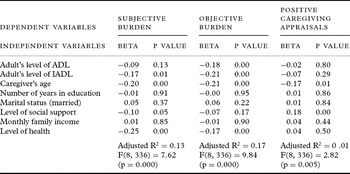
As shown in Table 3, the family caregiver having better health (p = 0.000), being older (p = 0.000), and the recipient having higher functionality in IADL (p = 0.008) were related to caregiver subjective burden. The caregiver being older (p = 0.000), the caregiver having better health (p = 0.001) and the care recipient having higher functionality in IADL (p = 0.001) and ADL (p = 0.003) were all related to the caregiver objective burden. The caregiver being older (p = 0.005) was related to a lower level of positive caregiving appraisal. In contrast, the caregiver having a higher level of social support (p = 0.001) was related to a higher level of positive caregiving appraisal.
Multiple regression analyses for variables predicting female and old caregiver subjective and objective burden and positive appraisals of caregiving role

ADL = activities of daily living; IADL = instrumental activities of daily living.
Discussion
Compared with other studies (Song, Reference Song2002; Chou et al., Reference Chou, Pu, Lee, Lin and Kröger2009), which used the same caregiver burden scale, female aging carers of adults with ID in our study had a higher level of overall caregiver burden than caregivers of adults with mental illness. This suggests that social care systems should not only focus on the needs of care recipients but must also support the caregivers of the various different types of care recipients, in particular, the lifelong older female family caregivers of adults with ID.
In this study, we hypothesized that the caregivers’ perceptions of subjective caregiving burdens are likely to be predicted by caregiver variables and that the caregivers’ perceptions of objective caregiving burden are likely to be predicted by the care recipients’ care demands. Our findings partially support these two hypotheses. As an exception from our expectations, caregivers’ subjective and objective burdens were not predicted by completely different factors such as caregivers’ characteristics vs. demands of care recipients. For example, our findings indicated that the best predictors for both subjective and objective caregiver burden were similar; they were caregiver age, caregiver health status and the care recipient IADL functionality. This is consistent with the findings of the correlation matrix (Table 2), where the subjective and objective burdens were correlated. However, care demands such as for ADL and IADL functionality were more significantly associated with caregiver objective burden than with subjective burden. Furthermore, ADL functionality was only significantly related to caregiver objective burden rather than subjective burden. This correlation of subjective and objective burden implies that both subjective and objective burden among older caregivers are highly related to their age, health status and caregiver demands, such as the care recipient IADL. Moreover, this suggests that caregivers’ subjective feelings and attitudes of stigma, anxiety, guilt, and dependence are associated with objective caregiver demands from the care recipient with ID, such as career interference and family interruptions.
We found that family caregivers whose adult children have lower levels of functionality are particularly at risk of increased caregiver burdens, particularly of objective caregiver burden, which is consistent with other research (Seltzer and Krauss, Reference Seltzer and Krauss1989; Greenberg et al., Reference Greenberg, Seltzer and Greenley1993; Heller et al., Reference Heller, Hsieh and Rowitz1997; Pinquart and Sörensen, Reference Pinquart and Sörensen2006). ADL functionality of care recipients was only associated with caregiver objective but not subjective burden. Compared to IADL functionality of care recipients, ADL functionality was more frequently used to measure the care demands in terms of personal assistance and time demanding tasks, such as bathing, feeding, toileting, and dressing. Additionally, the recipients with lower ADL functionality were more likely to be diagnosed with multiple disabilities in addition to ID.
As discussed above, the findings from both subjective and objective burden models suggested that caregivers’ age and health were significant variables associated with both subjective and objective caregiver burdens. The results indicated caregivers who perceived themselves healthier and older reported lower levels of subjective and objective caregiving burden than their less healthy and younger counterparts. Thus, our findings echoed earlier research that caregiver health is an important predictor of their level of well being (Greenberg et al., Reference Greenberg, Seltzer and Greenley1993; Smith, Reference Smith1996).
Secondly, consistent with previous research findings of caring for adults with ID (Seltzer and Krauss, Reference Seltzer and Krauss1989; Hayden and Heller, Reference Hayden and Heller1997), we found that older female caregivers were more likely to perceive fewer burdens including both subjective and objective. Our findings were similar to previous Western and Taiwanese findings of caregivers of an elderly spouse or a family member with dementia (Montgomery et al., Reference Montgomery, Gonyea and Hooyman1985; Kau et al., Reference Kau, Lu, Yeh and Liu1999); younger caregivers experienced a higher sense of burden. These findings are consistent with some studies on the influence of age on the stress and coping process, which have found that older people report less stressful life events and fewer daily stressors (Lazarus and DeLongis, Reference Lazarus and DeLongis1983; Paykel, Reference Paykel1983; Folkman et al., Reference Folkman, Lazzrus, Pimley and Novacek1987; Silverman et al., Reference Silverman, Eichler and Williams1987; Aldwin, Reference Aldwin1991). It should be pointed out that, from the vantage point of old age, many problems may be rendered trivial (Aldwin et al., Reference Aldwin, Sutton, Chiara and Spiro1996). The decrease in the reported stressors or care burdens for older people as found in this study can be attributed to their declined involvement in their social roles, such as employment and other family roles. Previous studies have shown that the old tend to have a much narrower everyday life and limit their range of activities to those that are most possible and rewarding (Aldwin, Reference Aldwin, Sutton, Chiara and Spiro1996; Baltes, Reference Baltes1987; Johnson and Barer, Reference Johnson and Barer1993). Another reason for the old to report fewer care burdens may be because the care for the adults with ID has become chronic. According to Aldwin and Brustrom (Reference Aldwin, Brustrom and Gottlieb1997), a chronic stressor necessitates the use of routinized management skills that both forestall problems and mitigate their negative impact; thus chronic stressors are no longer an immediate problem per se.
Thirdly, this also implies that, from the perspective of subjective burden (i.e. stigma, anxiety, guilty and dependence), these lifelong (> 30 years) older female caregivers do not perceive issues such as stigma or guilt as significant any longer and they do not interfere with their caregiving work. These findings are inconsistent with those of Chou (Reference Chou1985), who reported on the caregivers of young children with ID. Furthermore, caring for family members with ID might affect younger and older caregivers differently. Whether “regard for face” issues or interactional relationships (Ho, Reference Ho1976; Gabrenya et al., Reference Gabrenya, Wang and Latane1985; Chou and Palley, Reference Chou and Palley1998) are different between younger and older family members needs to be explored in the future studies. In terms of objective burden (i.e. career interference and family interruption), our findings suggest that older female family caregivers feel more obligated to take care of family members with disabilities than their counterparts with different histories of caregiving. As the older female caregivers are approaching retirement age or have already retired, their objective burden is not that different from their subjective burden as might be expected. Additionally, we believe that older caregivers submit better to their caregiver roles, both instrumentally and emotionally. It is worth pointing out that although these older female caregivers indicated a lower caregiver burden, this does not mean that they do not need support or do not need a helper to share their care tasks.
Our results showed that the caregiver marital status, education and family income did not contribute significantly to explaining either subjective or objective caregiver burdens, including positive caregiver appraisals. These results are inconsistent with those of other studies (Seltzer and Krauss, Reference Seltzer and Krauss1989; Grant, Reference Grant1990; Kim et al., Reference Kim, Greenberg, Seltzer and Krauss2003). This conflict of results implies that these caregiver sociodemographic variables are either not correlated to the extent of burden (as shown in Table 2) or that they are not strong predictors of caregiver burdens. The fact that our results showed that most of the sociodemographic variables did not have significant predictive power for caregiver burdens is inconsistent with the results of Montgomery et al. (Reference Montgomery, Gonyea and Hooyman1985) concerning caregivers of older people.
In contrast to the findings of Magliano et al. (Reference Magliano, Fiorillo, De Rosa, Malangone and Maj2005), social support did not influence caregiver burden directly in terms of either the subjective or objective burden, although it had effects on caregivers’ positive attitudes in our study. This suggests that social support is not instrumentally and emotionally supportive enough to decrease caregiver burdens among older female caregivers. Seltzer and Krauss's study (Reference Seltzer and Krauss1989) found that the level of informal support networks is related to the caregiving burden among mothers of a child with ID; but they also found that the formal support domain was not related to any of the measures of maternal well-being. Further studies are needed to identify the extent of social support that these caregivers need. The caregiver social support was positively related to positive caregiving appraisal, which means that the more social support received by caregivers, the more positive was the caregivers’ perceptions of their caregiving tasks. Additionally, previous studies have indicated that social support is related to the individual's adaptation to stress among parents of children with ID (Krauss, Reference Krauss1993); this is in terms of both physical and psychological well-being (Heller and Factor, Reference Heller and Factor1993), and their positive attitudes toward future planning (Grant, Reference Grant1990). Having social support increases caregivers’ positive perceptions of caregiving as worthwhile, even though it does not substantially reduce the subjective or objective burden. We found that positive appraisals were significantly and positively related to the objective burden (p < 0.01), but not to subjective burden (Table 2). This implies that caregivers who perceived greater objective burden in terms of their caregiving tasks were also those who had positive attitudes toward their caregiving roles, particularly among caregivers who have greater social support. In addition, compared to a younger age group, the older caregivers might feel that their caregiving tasks were futile, even although they felt lower levels of both subjective and objective caregiver burden. The older caregivers might be more used to their caregiving roles. Furthermore, several studies (Grant, Reference Grant1990; Fung et al., Reference Fung, Carstensen and Lang2001; Magliano et al., Reference Magliano, Fiorillo, De Rosa, Malangone and Maj2005) have indicated that older people report smaller social networks compared to their younger counterparts. This might be true, as there were similar findings in Chou's study (Reference Chou1985), for these older female Taiwanese family caregivers. In particular, among mothers, although their informal networks may have become smaller, this might also have decreased their negative interactional relationships as well. Specifically in Taiwan, this would include stress or negative interactional experiences in relation to interactions with their extended family (Chou, Reference Chou1985), which would affect their subjective care burden. In general, hypothesis 3 – that the caregivers’ positive caregiving appraisals are likely to be predicted by caregiver variables – was also partially supported; this is because only caregiver age and level of social support were significantly related to positive self-appraisal.
Some limitations of our study include selection of adults with ID aged 30 years or more whose female older caregivers were 55 years of age or older. The caregiver burdens experienced by younger caregivers could be different. Secondly, even though our samples may be representative of female older family carers in general, there may still be some specific differences between those who participated in the survey and those who did not. The generalizability of our study findings is thus limited by the study's voluntary nature. Thirdly, the use of a cross-sectional design limited the findings to the level of associations between variables. Further experimental and longitudinal research is necessary to unravel the exact nature of the relationships between these concepts. Another limitation could be the lack of instrument validity for the measurement of the caregiver burden. Although we felt the subjective burden and objective burden scales were valid measurements of these concepts, the instruments were developed by Song (Reference Song2002) originally for caregivers of people with mental illness and they have not been evaluated for the caregivers of persons with ID. Furthermore, lack of inter- rater reliability between our 23 interviewers in terms of how they conducted the face-to-face interviews with participants is another limitation. Finally, we only used two items to measure caregivers’ positive appraisals, which could be oversimplified.
In spite of the above limitations, this is the first study to explore the factors related to subjective and objective caregiving burden among older female caregivers of adults with ID. The findings from this study advance our understanding of lifelong caregiving among these older female caregivers and extend our knowledge with a focus on their subjective and objective caregiving burden and related factors while providing care to their adult family members with ID. These advances in our understanding of family caregiving provide the foundation for moving academic aging and gender care research in the field of ID, including both professional practice and policy.
First, these older women, who have acted as lifelong caregivers of an adult family member with ID, many for over 30 years, are highly vulnerable to their caregiving burden when compared with other types of caregivers. We suggest that relevant health and social care interventions are needed to buffer their caregiving burden. Second, our analyses show that caregiver health status and age differences are significantly associated with both subjective and objective burden. Thus, service providers are advised to assess carefully the correlation between the perceived caregiving burden of caregivers with different health levels and ages when developing appropriate support interventions. For example, health care personnel need to pay attention to the health status of these aging female caregivers, treating them as care recipients and not just as caregivers of adults with disabilities. Furthermore, more research is needed to study health-promoting behaviors in the context of the social and physical environments of these older female lifelong caregivers. The related policies and interventions developed need to consider the age difference in order to meet the unique needs of these lifelong caregivers. Additionally, a clarification of subjective and objective caregiving burden might be necessary to meet the caregivers’ unique needs. Our findings indicate that female older caregivers need assistance in managing their subjective caregiving burden, specifically with respect to how these caregivers perceive the stigma of their caregiving or their social interactional difficulties from society. The establishing of instrumental support, the provision of help with respect to the caregivers’ paid work and the development of positive family relationships among those at the lower end of the age group are examples that might help to decrease the objective burden. On the other hand, strategies and interventions that focus on buffering the subjective burden need to consider how to change social attitudes toward people with ID and their families. Finally, it would seem to be necessary to develop a holistic intervention approach that is able to decrease the subjective and objective caregiving burden of these female older caregivers across different levels of care demand, health and age. To sum up, our findings suggest that practitioners who work with older female caregivers need to identify how the caregivers perceive their caregiving burden, what level of demand for social support these caregivers have and how their own health contributes to their caregiving burden.
Conflict of interest
None.
Description of authors' roles
Yueh-Ching Chou designed the study, supervised the data collection, undertook statistical analyses and wrote the paper. Li-yeh Fu helped to collect the data and to revise the paper. Li-Chan Lin helped with the design of the study and data collection, and Yue-Chune Lee helped statistical analyses.
Acknowledgments
This study was funded by the Ministry of the Interior of the Taiwan Government. The authors thank the caregivers who gave up their time to take part in this study.