1 Introduction
The incremental model of constitutional bargaining and reform is developed in part I of Perfecting Parliament (Congleton Reference Congleton2011). Territorial governments, as organizations, adopt constitutional reforms when the interests of those with the authority to alter the standing procedures of governance change. Interest in reform is nearly continual, but reforms are most likely when relatively large shifts in the interests of those with authority to adopt reforms are induced by ‘shocks’ of one kind or another. Constitutional reforms can be induced, for example, by changes in the persons holding positions of authority within government, changes in external circumstances, and through successful persuasive campaigns by persons inside and outside government.Footnote 1
Both the rule-making procedures adopted and the reforms of those procedures subsequently adopted also reflect the self-acknowledged bounded rationality and time constraints of those creating and modifying the organization. As a consequence, most ‘new constitutions’ use an existing template for governance (the best one that they are aware of), rather than create radically new institutional designs. That it is more difficult to assemble the coalitions required for ‘large’ reforms than ‘small’ reforms implies that the core procedures of governance are usually not much affected by a single reform, but a series of ‘small’ reforms can gradually generate ‘large’ shifts in those core procedures. That small reforms are more common than large ones accounts for what some scholars have termed ‘path dependency’ in constitutional history. It also implies that there may be asymmetries in the course of reform.Footnote 2
The incremental reform hypothesis has been shown to work well in explaining shifts of authority in Europe, Japan and North America during the 19th century(Congleton Reference Congleton2011, part II), but it has not been applied to the African experience. This could be because the African experience is an exception to the incremental reform hypothesis. Most of the continent became independent within a single decade. Such rapid changes in political institutions appear to be more consistent with revolutionary models of constitutional change than incremental ones. We provide historical and statistical evidence that the incremental reform hypothesis nonetheless applies to Africa.
Certain phenomena should be present if the theory of incremental reform is correct. Most obviously, there should be evidence that governmental procedures reflect bargaining and change through time as circumstances change. There should also be evidence that reforms are incremental, rather than whole cloth, and adopted through formal procedures. Both the historical and statistical evidence developed below are consistent with those implications.
We focus on two critical junctures in African constitutional history: (1) colonial rule in the first half of the 20th century and (2) the period of self-rule following independence. Section 2 of the paper provides an overview of the history of the negotiations leading to independence. The overview focuses on constitutionally relevant negotiations and reassignments of authority over public policies in the French and British colonies. A relatively brief overview is possible, because constitutional developments were largely determined by negotiations with two major veto players, the UK and France. Although the details vary for each territory governed, general trends in the division of authority between Europeans and Africans reflected bargains reached with those colonial powers. The overview of the path to independence is followed by a short overview of reforms after independence. After independence, African governments did not abandon their carefully crafted independence constitutions, but modified them. Most contemporary African constitutions retain much of the language and organizational structure of their independence constitutions. Most of the former French and English colonies (voluntarily) remain members of French and British international organizations.
After independence, the paths of reform became largely independent of one another and we shift to a statistical analysis of constitutional reform. Section 3 provides statistical evidence that constitutional reforms in the post-independence period were incremental and reflected the bargaining environment in which they were negotiated and adopted. Internal and external shocks initially produced an illiberal trend in reforms, which was followed by a liberal period after the end of the Cold War. Additional historical and statistical support is provided in several unpublished appendices referred to in the text and available at the www.rdc1.net website.Footnote 3
2 Colonial governance in Africa and the subsequent reforms of governance
Relationships between the polities along the northern and southern coasts of the Mediterranean Sea are evident from the dawn of human history. The great religious and political revolutions that occurred after the disintegration of the Roman Empire greatly reduced intercourse between what became Christian Europe and Moslem North Africa, but did not end it. Trading relationships continued across the Mediterranean Sea and gradually expanded as ocean-going vessels came into use. Trade for the most part took place at existing port cities, although several new European trading posts were established along the Atlantic and Indian Ocean coasts beginning in the sixteenth century. A map of the very modest European holdings in Africa in 1870 is provided in Harris (Reference Harris1914: 17).
It was not until the mid-to-late 19th century that a significant number of Europeans ventured inland from their coastal entrepôts. This change in European interest in Africa was caused partly by industrialization of Europe, partly by legislation ending slavery in Europe and subsequent efforts to suppress the Atlantic slave trade, and partly by increased parliamentary authority and broader suffrage in Europe. Efforts to fully suppress the slave trade in the mid-19th century led to a variety of protectorate and trade treaties between European states and African tribes.Footnote 4 The treaties often promised protection for an African tribe or territory (often inland) in exchange for trade privileges and various degrees of sovereign authority.Footnote 5 At roughly the same time, the industrialization of Europe and new shipping capacity induced European and African entrepreneurs to look for new export markets and new sources of raw materials. Competition for trading privileges and political spheres of influence produced dozens of treaties with local rulers.
Colonial rule emerged gradually through treaties with local African governments, conflict and bargaining among European powers, and in some cases conquest. Most of Africa was formally under European rule (or protection) by 1900.
Colonial governance before World War II
British and French colonies were initially run from the ‘top down’ to the extent possible. The French colonies were ruled by governors in Dakar and Brazzaville and lieutenant governors in the various colonies, subject to vetoes from Paris. The British colonies were run by appointed regional governors who were subject to instructions and vetoes from London. It is this centralization that allows a short constitutional overview of the colonial period to be developed.
Although colonial rule did not initially exhibit or promote civic equality, it was not a period of ‘master–slave’ relationships. The colonial powers lacked sufficient information and European manpower to truly govern their colonies from top to bottom. Consequently, constitutional bargaining with native Africans was necessary from the earliest days of European intervention. Governing practices reflected explicit and implicit agreements between the colonizers and those colonized.Footnote 6 Natives administered local (village) governments, provided most of the manpower for colonial armies (although few officers), and staffed out most economic enterprises. Indeed, slavery within Africa was formally banned by the European powers during the first decades of colonial rule.Footnote 7
As a consequence, colonial governance normally included elements of self-rule with native representatives and advisors at high levels of colonial government and in local administration. Regional councils normally included both expatriate and African leaders. European legal systems were not simply imposed by fiat on the helpless residents of European colonies as the colonial powers might have wished. Colonial law was a mélange of European, Moslem and customary rules and enforcement.Footnote 8
The bargaining efforts of educated Africans during the 1910s gradually induced the French and British colonial authorities to increase representation on advisory councils and the authority of local governments. Voting rights were occasionally extended as part of those negotiations, although these were normally limited to educated French- or English-speaking Africans living in urban areas.
The French began systematically creating advisory councils at the village, circle, colony and empire level during the early 1920s. After subsequent bargaining efforts by educated Africans, elections for seats on the advisory councils were held from the late 1920s onwards, in which educated, French-speaking native Africans were entitled to participate (Conklin Reference Conklin1997). A similar administrative structure was adopted in the British colonies, which was often referred to as indirect rule, although with fewer elected positions (Lugard Reference Lugard1922; Pearce Reference Pearce2005).Footnote 9 These were, of course, not liberal democratic systems of governance, but neither were the systems that were modified or replaced.
The advisory and legislative councils initially lacked formal veto authority, although they had significant influence over policy through their advice and proposals for reform. The councils gradually obtained formal veto power over a subset of policy areas in a manner not entirely dissimilar to the royal councils and parliaments of Europe in the previous two centuries. Their influence and composition were for the most part consequences of bargaining, persuasion and peaceful protests rather than revolts (although a few revolts did occur), as predicted by the incremental model of constitutional reform.Footnote 10
Bargaining for increased autonomy and independence after World War II
World War II (WWII) upset the pre-war bargaining equilibrium between the French and British governments and their respective African colonies. Both the free French and British desperately needed African supplies and manpower for their war efforts This created new potential gains from constitutional exchange that favoured African leaders and interests. As a consequence, de Gaulle agreed to provide home rule after the war was over.Footnote 11 Churchill did not explicitly agree to do so, but did accept language in the Atlantic Charter of 1941 that suggested that the UK would also promote home rule and independence after the war.Footnote 12
After WWII was over, the British and French governments further increased the role of native Africans in their colonial governments. This was undertaken partly because of commitments made during the war, partly because expatriate and African groups continued to negotiate for increased representation and authority, and partly because European voters were more interested in rebuilding their home countries than in maintaining their colonial empires in Africa after the war. Together these changes in relevant interests generated new potential gains from constitutional exchange that reinforced the relatively liberal direction of reform evident before the war.Footnote 13
Post-war shifts in authority from the British and French central governments to their colonial governments were incremental, although larger reforms were adopted after the war than before. Post-WWII reforms were mostly consequences of peaceful negotiation and bargaining, rather than revolution or obvious revolutionary threats. This is not to say that support for constitutional reform or opposition to other colonial policies was non-contentious. There were many boycotts and public demonstrations. However, it is to say that negotiations and constitutional bargaining produced reassignments of policy-making authority rather than revolution.Footnote 14
Autonomy and independence in France's African colonies
The French process of transferring authority to its colonies in the post-war period was somewhat more centralized and uniform than the British process. Much of it took place within the framework of French constitutional reforms and associated implementation rules adopted by the colonial governors in Dakar and Brazzaville. Shortly after WWII, there were elections for a new constituent assembly that included six African representatives elected via restricted suffrage. A new constitution was adopted in 1946 (for the Fourth Republic), which included a section that addressed colonial issues and created a new French Union that included political representation from all of its colonies.Footnote 15 Local colonial assemblies were mandated (article 77) and provisions for electing colonial representatives to the new French Union Assembly were established (article 66). Suffrage was expanded and local assemblies gained additional control over local policies, although civil law, and military and many other policies, remained those of the French national government.
The colonial assemblies were, for the most part, simply modified versions of assemblies previously in place, with somewhat expanded authority and African representation. Universal suffrage was adopted in 1956. In 1958 France adopted another new constitution and replaced the French Union with the French Community under Title VI of the Constitution of the Fifth Republic. The new rules provided the territorial assemblies with greater authority over spending and legislation (article 72), while again reserving military and foreign policy for the French government.
French assurances (and subsidies) persuaded its African colonial leaders that membership in the French Community would be more beneficial than complete independence. Seven of eight territories in French West Africa accepted the Constitution of the Fifth Republic of France along with its French Community with large supermajorities, although small groups in several of those colonies had been fighting for independence. (See Appendix 1 for referenda results.)
Together, the Fourth and Fifth Constitutions of France had created increasingly autonomous political units with the aim of advancing French interests in French West Africa (Chafer Reference Chafer2002: ch. 6). Complete independence within the French Community subsequently became possible through reforms adopted in 1960, and essentially all of the French colonies took advantage of that possibility during the next few years. As a consequence, most former French colonies in sub-Saharan Africa had, and still have, political institutions that are remarkably similar (in names and organizational structures) to those of France.Footnote 16
Autonomy and independence in the UK's African colonies
The transitions to independence in the British colonies were fundamentally similar, although more decentralized. The UK government also took substantial steps toward greater colonial autonomy in its African colonies after WWII. Its colonial assemblies were given electoral foundations, and African representation on policy-making and advisory councils was increased. Additional educated natives were recruited for senior administrative positions. In contrast to France, however, the institutions for home rule were negotiated country by country with greater differences in institutional details, timing of elections and the delegation of policy authority to the colonial assemblies.
Post-war elections for the colonial assemblies of the British colonies were the first national elections ever held in those territories.Footnote 17 Electoral competition naturally induced the formation of national political organizations, which to be successful had to address the concerns of a broad cross-section of the various national electorates. As a consequence, the gradual shift to democratic forms of home rule in the late 1940s and early 1950s inadvertently facilitated the formation of the national independence movements that advocated further reforms in the 1950s and early 1960s (Reid Reference Reid2012: ch. 15). These increasingly well-organized political parties lobbied for broader representation and suffrage, self-rule and subsequently for independence, as well as for particular public policies of interest to their constituencies. It was with the leaders of such organizations that negotiations for independence within the British colonies took place.
The UK negotiated transitional constitutions along with formal schedules for independence during the 1950s. Constitutional details varied among countries in a manner that attempted to take account of ethnicity, religiosity and historical relationships. Their independence constitutions, for example, varied in the extent to which federal structures and provisions for ethnic-based representation were included. The French negotiations for independence were more centralized, and shifts of authority to colonial governments were framed by general rules included in the French constitution.
Constitutional bargaining over independence and mutual gains to trade
The French and UK governments anticipated that independence would reduce their expenditure on African security and infrastructure. The economic advantages of European enterprises in Africa could, in principle, be preserved through property protection and formal trading relationships. Native leaders and their supporters expected to benefit from greater authority over public policy, services and taxes. The leadership of the new political organizations evidently believed that continued relationships with their former rulers had benefits, including subsidies, preferential tariffs and expertise. The constitutional and legislative bargains struck both before and after independence imply that both economic and political issues were addressed during the independence negotiations.
Both the UK and French independence constitutions were ‘liberal’ or of ‘high quality’ in the sense that they were written documents; they called for elected, representative national governments; and they protected a variety of civil liberties, including private property, a (mostly) free press and equal protection under the law.Footnote 18
In this manner, several decades of negotiations in the former French and British colonies had gradually produced political constitutions that initially resembled those of their former rulers. The independence constitutions met European norms and procedures for elected government, contracts, property and eminent domain, in part because France and the UK had veto power over the result. Consistent with this ‘gains to trade’ explanation, most of the former British colonies in Africa remained members of the British Commonwealth (and subsequently joined the Commonwealth of Nations), and most of the former French colonies remained members of the French Community.Footnote 19
In general, the former French colonies had constitutions that were less finely tuned to account for national circumstances and provided somewhat greater opportunities for subsequent constitutional renegotiation, because of the mise en valeur principle of French property law, which allowed ‘unused’ property to be claimed by the government. This principle would not often be applied in France itself but could be widely applied in Africa where land that was not intensively used was commonplace. Other things being equal, these differences imply that there were likely to be more and greater reforms in the former French colonies than in the British ones after independence. The former Portuguese and Belgian colonies in contrast did not go through the same lengthy process of bargaining. (See Appendix 2 for a table of independence dates. See Appendix 3 for an overview of Portuguese and Belgian transitions. The link to the appendices is provided in note 3.)
3 A brief history of constitutional reforms in the first decades of independence
Independence provided a natural experiment with respect to constitutional bargaining theory. The results of bargaining in the French and British colonies were likely to be more liberal than Africans would have chosen themselves, thus subsequent constitutional reforms were likely to take an illiberal direction. Relatively liberal veto players had left the bargaining tables. To the extent that some constitutions allowed easier amendment or larger steps to be taken (partly because of differences in eminent domain laws), there would be more and greater anti-liberal reforms in the less-constrained countries.
The first African national elections were normally held under the auspices of the departing colonial power. In most cases, the party organizations of the colonial independence movements won supermajorities in the new national assemblies and so controlled the first independent parliaments. The first presidents or prime ministers were similarly elected and were usually the most visible leaders of their political parties.
The new governments often won with supermajorities sufficient to adopt formal constitutional amendments. Consequently, most of the transitional constitutions were reformed during the years immediately following independence (Ng'ong'ola Reference Ng'ong'ola1992; Reid Reference Reid2012; Wasserman Reference Wasserman1973). As predicted by the incremental reform model, the general architecture of governance was normally preserved. However, rules for competitive elections and free press were weakened, eminent domain rules revised and emergency powers extended. The reforms often led to one-party states with strong executive offices, which allowed many of the first generation of Africa's national leaders to remain in office for decades.Footnote 20
Nonetheless, the reforms did not always produce the political security that their proponents evidently desired. The reforms made the executive office more enticing and often placed minorities at significant risk. Most second- and third-generation African rulers thus rose to office via coup d’état, rather than election. This was essentially the only route to high office after the first wave of constitutional reforms. In a few countries, coups were commonplace from the first days of independence, as in Benin and Nigeria, where a series of coups took place in the first decade of independence. In other countries, coups were few and far between. In general, many more coups were attempted than succeeded (Marshall Reference Marshall2006: Annex 2B).
The early coups were normally organized by subsets of the former colonial military. Military organizations tend to be rule-bound, but formal and informal military rules are quite different from the rules and norms of democratic governance. Thus, the reforms adopted by the new leaderships tended to further undermine liberal constitutional procedures and norms, rather than strengthen them.Footnote 21
Consistent with the incremental theory of reform, constitutions were nevertheless rarely rewritten whole cloth. The unelected rulers simply continued the path of reform established by their predecessors. Most of the former British colonies eliminated clauses guaranteeing that compensation for government expropriation could be requested in international currencies paid to foreign accounts. Many also eliminated or reinterpreted the public use restrictions for eminent domain. Several countries added new emergency power clauses that further reduced the cost of expropriation and, in a few cases, eliminated the concept of private property as applied to land and mineral rights. Only Botswana and Mauritius kept all of their transitional constitution's safeguards against property expropriation, including the repatriation clause for compensation (Allen Reference Allen2000; Ng'ong'ola Reference Ng'ong'ola1992; Read Reference Read and Garner1975).Footnote 22
African mining and other mineral extraction businesses were often nationalized with little or no real compensation for their former owners, which were often large firms based in Europe.Footnote 23 The appropriated land and mineral rights could then be sold or leased to provide government revenues or run by the government to provide sources of revenue and patronage. In several cases, whole industries were nationalized under the revised eminent domain rules. In other cases, the taking was done extra-legally through what is sometimes called ‘right of conquest’ rules.Footnote 24
Such policies tend to reduce inflows of foreign capital by increasing risks associated with long-term investments. They also tended to discourage domestic investments by native and immigrant entrepreneurs not connected with the ruling parties. Moreover, ‘flexible’ eminent domain procedures could be directed against one's political opponents, which would induce many to be silent on issues against which they might otherwise have spoken out.
The illiberal interests of the ruling parties were reinforced by the geopolitical interests of the Western and Soviet alliances. Cold War subsidies helped to sustain ‘loyal’ authoritarian regimes and often discouraged competitive elections in the period before the dissolution of the Soviet Union in late 1991. In such an environment, the constitutional bargaining model predicts a steady decline in the usual indices of the quality of institutions: increases in executive authority, reductions in civil and political liberties and a general reduction in the rule of law. Marginal adjustments to customary and Moslem- and European-derived civil law codes had similar illiberal effects on the certainty of property claims and risks from opposing those in authority.
In this manner, a series of small changes in de jure and de facto constitutional and civil law gradually weakened the legal warp and weft of initially liberal constitutions and undermined prospects for economic development. They remained in force but were less and less constraining.Footnote 25
4 Quantitative implications of the incremental model of constitutional reform
The above historical overview demonstrates that independence emerged gradually and reflected bargaining among those with the formal and informal authority to adopt reforms. During the first half of the 20th century, the reforms exhibited a liberal trend. After European veto players left the bargaining table, the trend shifted in an illiberal direction as post-independence governments centralized authority, reduced protection for civil liberty and electoral competition and weakened civil law protections.
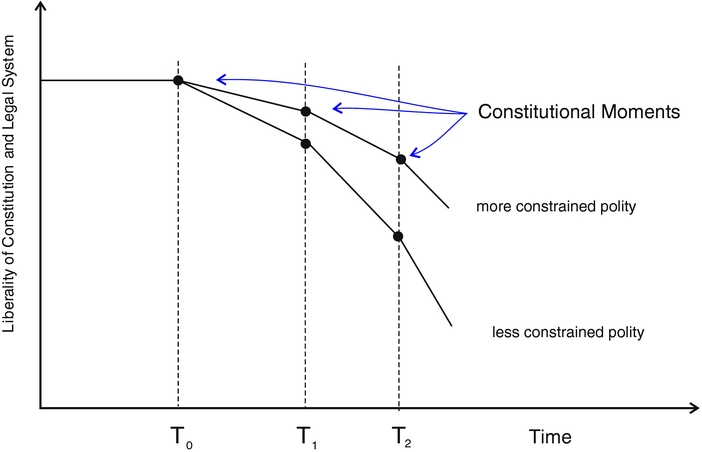
Figure 1 illustrates how a nation's initial position, number of constitutional moments and scope for reform affect a nation's constitutional trajectory in a setting in which shocks tend to increase support for illiberal reforms.Footnote 26 In periods in which constitutionally relevant shocks produce trends in reform, the more constitutional moments and the broader the scope for amendment, the greater is the potential for cumulative constitutional reform and the larger is the likely difference between the initial constitution (at T 0) and the one in place at the time of interest (T 2). Whether a series of shocks induces trends in reforms or not depends on the changes in interests induced. Trends can be induced by systematic changes in domestic or international circumstances, such as a gradual increase in the risk of coups, civil war or external military threats. They may also be induced by trends in technological innovation or ideology that systematically alter the balance of economic and political interests among those with the authority to adopt constitutional reforms. External factors such as conditional international grants or capital flows may also induce systematic changes in the interests of those in position to adopt reform. If, however, the shocks that generate constitutional moments do not systematically change constitutional interests, a random walk in reform, rather than a trend, occurs.Footnote 27
Bargaining within Broad or Restricted Domains of Constitutional Bargains during an Anti-Liberal Period

Expressed as a linear equation, the above model implies that nation j’s institutions at time t (Ijt) reflect its institutions in the previous period t–1 (Ijt –1) and constitutionally relevant anti-liberal and liberal shocks (Njt and Pjt) that induce constitutional reforms during period t:
 $$\begin{equation}
{I_{jt}} = {I_{jt}}_{-1}-{B^N}{N_{jt}} + {B^P}{P_{jt}}
\end{equation}$$
BN and BP are coefficients describing how negative (anti-liberal) and positive (liberal) shocks affect the course of constitutional negotiations over formal (de jure) and informal (de facto) reforms. These coefficients could, in principle, differ in every country and period. However, for the purposes of the statistical analysis, we assume that they are universal and stable, as is usually assumed in statistical analysis using panel data. Equation 1 can be rewritten in terms of initial conditions and cumulative shocks as follows:
 $$\begin{equation}
{I_{jt}} = I{j_0}-{B^N}^{}\left( {\sum\nolimits_{t=0}^{t}}{N_{jt}} \right){\rm{ }} + {B^P}^{}\left( {\sum\nolimits_{t=0}^{t}}{P_j}_t \right)
\end{equation}$$
Where Ij 0 is the initial quality of country j’s institutions – as at independence – and the cumulative values through year t are used, rather than a single year's constitutionally relevant shocks.
It bears noting that the factors influencing negotiations may be well known to insiders, but to outsiders they are observed only with an error term (possibly a very large one), with  ${\bar{N}_{jt}}$ = Njt + ujt and
 ${\bar{P}_{jt}}$ = Pjt + vjt, where ujt and vjt are the observation errors at time t in country j . Substituting the weighted observation errors into equation 2 yields:
 $$\begin{equation}
{I_{jt}} = I{j_0}-{B^N}^{}\left( {\sum\nolimits_{t=0}^{t}} {\bar{N}_{jt}} \right){\rm{ }} + {B^P}^{}\left( {\sum\nolimits_{t=0}^{t}}{\bar{P}_{jt}} \right){\rm{ }} + {z_t}
\end{equation}$$
For the purposes of estimation, the weighted observational error zjt = BN(∑tt = 0ujt) + BP(∑tt = 0vjt) is assumed to have an NID distribution.
Equation 3 serves as the foundation for our estimation strategy. It represents constitutions at time t as a function of a country's constitution at independence and cumulative constitutionally relevant shocks. Equation 3 can be augmented in various ways. For example, in a period in which essentially all shocks are negative (illiberal), the BP coefficient can be ignored (assumed equal to zero) and vice versa. Other variables that are thought to have systematic effects on institutional quality or bargaining but do not directly catalyse constitutional reforms can also be added to the right-hand side, such as economic development or ethnic fragmentation.
It is the largely unobserved constitutional bargaining within African governments that is the focus of the statistical analysis. Previous empirical studies of post-independence Africa suggest that the UK's culture and institutions contributed to the somewhat more stable politics and higher economic growth rates of its former colonies (La Porta et al. Reference La Porta, Lopez-De-Silanes and Shleifer2008; Lee and Schultz Reference Lee and Schultz2012). The theory and evidence developed below is consistent with that conclusion, but suggests that differences in the independence constitutions negotiated and in the number of subsequent constitutional moments account for many of the differences among the former French, British, Portuguese and Belgian colonies.
5 Statistical analysis of post-independence constitutional reform in Africa
Data were assembled from several sources. We use indices of governing institutions from the Polity Project in our first series of estimates. Other indicators from Freedom House and the World Bank are used in the second series of estimates and web Appendices 4 and 5. Colonial origin is used as a proxy for the initial characteristics of political and legal institutions for reasons developed in the historical overview.
We construct an indicator of constitutionally relevant moments (CRMs) by identifying shocks that are likely to produce new alignments of interests in support of constitutional reform. Examples include major internal shocks such as coup attempts and external pressures such as international grants. With this in mind, we assembled data on the number of coup attempts (from Marshall Reference Marshall2006), civil wars (from Arnold Reference Arnold2005) between 1960 and 2004 and communist aid (from Arnold Reference Arnold1979).Footnote 28 Insofar as Soviet aid was implicitly or explicitly conditional, it tended to favour centralization and reductions in civil liberties. In the post-1990 period, Western aid was often conditional on liberalization, which would have the opposite effect.
A cumulative measure of CRMs (0-3) is created by adding binary values for civil war (0-1), communist aid (0-1) and two or more coup attempts (0-1) between independence and the time of interest.Footnote 29 Two other indicators of constitutional moments are also considered, CRM2, which is CRM without the effects of coups and CRM-NC which is the number of coup attempts. Additional unobserved constitutional moments may also emerge during normal times, so CRM somewhat undercounts constitutional moments. These unobserved shocks are likely to reflect idiosyncratic (random) changes in domestic circumstances and so are less likely to be unidirectional (illiberal in the pre-1990 period or liberal in the post-1990 period). These unobserved moments are part of the error term.
In addition, we collected data on other factors thought to influence initial and subsequent institutional quality: ethnic fragmentation (from Alesina et al. Reference Alesina, Devleeschauwer, Easterly, Kurlat and Wacziarg2003) and real per-capita gross domestic product from the World Development Indicators (constant 2005 US$). Table 1 provides descriptive statistics for the data used in the panel estimates developed below and in the supporting appendices.Footnote 30
Descriptive statistics for former UK or French colonies in Africa, 1960–2013

The estimation strategy takes advantage of the uniformly high institutional quality of the transitional constitutions in most of the former British and French colonies at independence. History and constitutional theory suggest that the initial institutions of the former British colonies should be somewhat more resistant to unravelling than those of the former French colonies, other things being equal, because of differences in eminent domain laws and the extent to which independence constitutions took account of political and demographic variations within its former colonies. Thus, we anticipate a negative sign for the French fixed-effect variable in the Polity IV and sub-index estimates. We also anticipate a negative sign for the CRM variables in the unravelling period prior to the early 1990s and a net positive effect afterwards, as pressures for reform shifted in a liberal direction
Panel estimates of the effects of constitutional moments on constitutional reforms
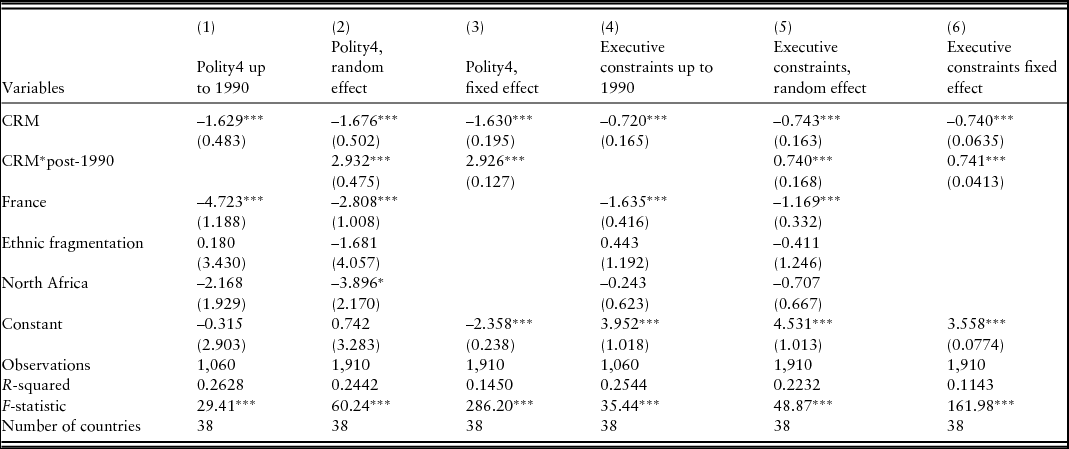
We use both linear random-effect and country fixed-effect panel estimation for our main results. Table 2 reports random-effect and fixed-effect panel estimates for the former British and French colonies. Two indices of constitutional quality are focused on: the Polity 4 index and one of its sub-indices (executive constraint). Runs are undertaken separately for the pre- and post-1990 periods, with an interaction term (post-1990*CRM) introduced for the full sample runs to test for the presence of liberal pressures for reform in the post-Cold War period.
Panel estimates of polity indices of government quality, former British and French colonies

Robust standard errors in parentheses
*** p < 0.01, ** p < 0.05, * p < 0.1
The estimated coefficients for the CRM variable have the expected negative sign during the pre-1990 period and in the overall sample period in all six estimates. The post-1990 effect in the full sample estimates is positive, which implies that liberal pressures for reform tended to induce significant constitutional reforms at CRMs and larger ones among the nations with the worst experience in the decades after independence. The sums of the two CRM coefficients are all positive in the post-1990 period. Both coefficients are statistically different from zero at the 0.001 significance level in each estimate. The French origin variable is also significantly different from zero and has the predicted negative sign in all runs. Model fits are relatively good; all F-statistics are significant at 0.001 level.
No other independent variable has a robust statistically significant coefficient. Ethnic fragmentation is not statistically significant. Location in North Africa is (marginally) statistically significant in only one case. These results suggest that starting point and number of constitutional moments (crises) are the most important determinants of institutional quality in both the ‘unravelling’ and ‘rebuilding’ sub-periods.
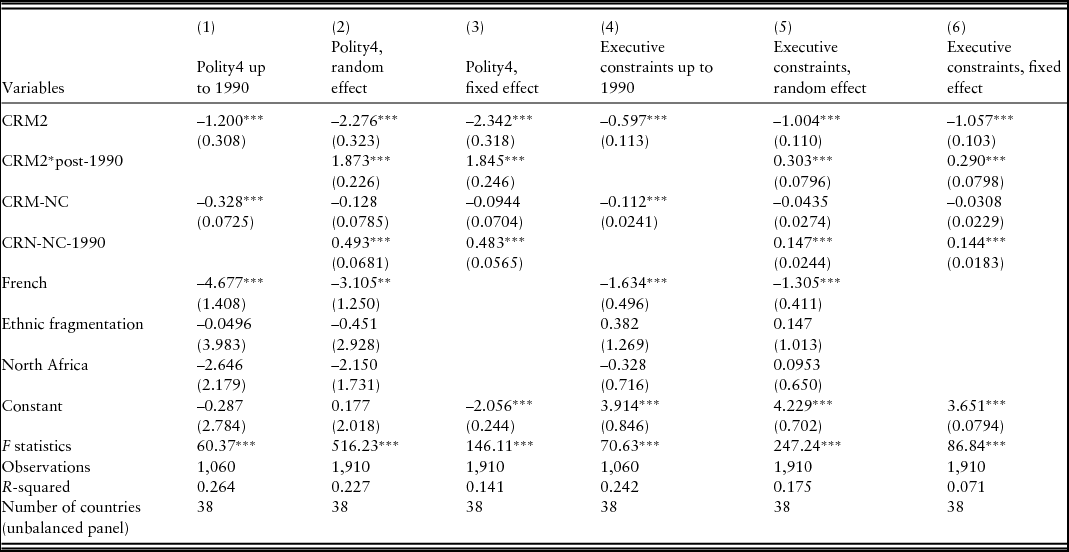
Table 3 repeats the above estimates using alternative measures of constitutional relevant moments. The first, CRM2, is a trinary variable that is the sum of two binary variables: civil war and communist aid. The second, CRM-NC is the number of coup attempts. The latter provides a continuous indicator of constitutional moments that allows ‘dosage effects’ to be captured by the estimates. The results are very similar to those of Table 2. The estimated coefficients for the CRM2 and CRM-NC variables have the expected negative sign during the pre-1990 period and post-1990 period in all six estimates. The pre-1990 effect is negative and post-1990 (net) effect is positive, which implies that both illiberal and liberal pressures for reform can induce significant constitutional reforms at constitutional moments. That the sum of the CRM-NC coefficients is positive in the post-1990 period provides evidence of what might be called a rebound effect on the quality of national political institutions.
Panel estimates of polity indices of government quality: former British and French colonies, with CRM2 and CRM-NC

Robust standard errors in parentheses
*** p < 0.01, ** p < 0.05, * p < 0.1
The French origin variable is also significantly different from zero and has the predicted sign in all runs. Model fits are relatively good; all F-statistics are significant at the 0.001 level. Again, no other independent variable has a robust statistically significant coefficient. The CRM variables are also the most robust of the variables examined in our unreported estimates for all of Africa. (See Appendices 4 and 5 on the www.rdc1.net website.)
Estimation issues associated with codetermination and other causality issues associated with the estimates reported in Tables 2 and 3 are further addressed in Appendices 4 and 5, which analyse the effects of economic development on institutional quality. Our main interest, however, is not deep sociological causality, but in whether the evidence is consistent with the predictions of the incremental model of constitutional reform.Footnote 31
Problems with reverse causality are reduced by the history of the independence constitutions. Recall that the independence constitutions were negotiated with European veto players at the table, which gave them a relatively high and common initial level of institutional quality. Differences in formal institutions existed, but these tended to be greater among former British than former French colonies. Cultural differences would subsequently affect how de jure constitutions are implemented, and also affect propensities to organize and engineer coups. That ‘dosage’ mattered in the above results implies that differences in the implementation of formal constitutions were not the only determinant of institutional quality. Propensities to organize coups and civil wars matter as well. Our results indicate that constitutionally relevant shocks, including coup attempts – which themselves may be generated by a variety of unanalysed factors (many of which may be stochastic or long term) – induce constitutional reforms. In Tables 2 and 3, the long-term effects of culture on de facto constitutional law are captured by the constant and fixed-effect terms, and the short-term idiosyncratic effects by the error term.
On the scope for constitutional bargaining: the weakening of eminent domain laws and the quality of contemporary institutions
The incremental reform model implies that the scope for negotiation tends to be important in both liberal and illiberal periods. If item X is not under the direct control of the government, authority over X cannot be traded for support of new public policies or used as part of a bargain that produces a constitutional reform. For example, under strong eminent domain laws, a private office building cannot simply be taken from its owners and used to provide office services for the national bureaucracy. The owners must be compensated and a clear public purpose must be advanced. When eminent domain laws are weaker, taking a private office building or mine and reassigning it to the public sector or another private owner becomes easier and less expensive.Footnote 32 Strong versions of eminent domain clauses were included in the transition constitutions negotiated between the British and leaders of colonial independence movements as noted above.
A direct test of the effect of the scope of constitutional bargaining on the trajectory of constitutional reform is possible using Ng'ong'ola's (Reference Ng'ong'ola1992) classification of eminent domain laws. Ng'ong'ola divides former British colonies into three categories according to the degree to which countries formally repealed provisions of their transitional constitutions with respect to eminent domain laws. Only a few countries kept all restrictions, including the right to receive compensation in the currency of one's choice. Several repealed essentially all protections, and the rest repealed only a subset of their initial protections of private property.
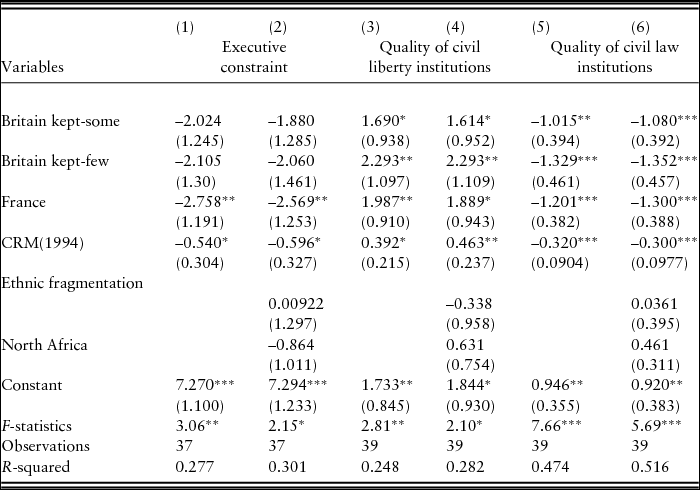
Table 4 uses a long-period cross-sectional approach to determine whether this prediction holds. The estimates include binary variables for the two of the three Ng'ong'ola categories and the original CRM variable. Averages of several institutional indicators for the 2000–12 period are used as dependent variables. This approach further addresses possible reverse causality issues by using data from past periods to explain effects well in the future.
Long-term cross-sectional estimates of the effects of declines in eminent domain protections on institutions in former French and British African colonies

Robust standard errors in parentheses
*** p < 0.01, ** p < 0.05, * p < 0.1
The coefficients on the two Ng'ong'ola categories have the predicted relative magnitudes, although they are not statistically different from zero in the executive constraint estimates. They are, however, statistically significant in the civil liberty and civil law institutions estimates. The weaker eminent domain laws were (in approximately 1992), the weaker are contemporary legal institutions and civil liberty protections. The number of CRMs before 1994 continues to affect contemporary African institutions. The CRM variable has a negative effect on contemporary political institutional quality, which suggests that the rebound effect found in Tables 2 and 3 has not yet fully reversed the effects of unravelling during the first decades of independence. Neither the North Africa dummy, nor ethnic fragmentation is statistically different from zero at conventional levels of significance.
Together the statistical evidence provided in Tables 2, 3 and 4 and in Appendices 4 and 5, suggest that both the number of constitutional moments and the scope of bargaining affected constitutional developments in post-independence Africa, as predicted by the incremental model of constitutional reform.
Overview and conclusions
In the pre-independence period, France and the UK often found it useful to grant policy-making authority to African leaders in exchange for various forms of support. Participation in the policy-making process was gradually extended to include more Africans. Electoral institutions were gradually created and suffrage extended. In most cases, constitutional bargaining after WWII produced gradual and lawful transitions to independence as national elections were held and political parties formed. Consequently, most African countries began independence with formal constitutions of relatively high quality and with some experience within governing organizations.
After independence, circumstances initially favoured illiberal over liberal reforms. This was partly because of the interests of the parties that won the first round of elections and partly because external pressures were at best indifferent to the form of government in the decades after independence. After 1990, international political and economic grants systematically encouraged liberalization and liberal trends in reform to re-emerge. Foreign direct investment, of course, is also conditional and influenced by perceived institutional quality (Asiedu Reference Asiedu2006; Busse and Hefeker Reference Busse and Hefeker2007), and would have similar effects.
That there was no ‘lock-in’ effect associated with either liberal or authoritarian reforms is consistent with an incremental model of constitutional bargaining. This model predicts that both liberal and illiberal reform-inducing shocks are nearly always possible. The constitutionally relevant moments focused on in the statistical part of the paper had the predicted consequences on African constitutional reform in each sub-period and for the period as a whole. Our quantitative representations of constitutional moments are highly correlated with indices of institutional characteristics in both the illiberal and liberal periods of reform. That reforms were not unidirectional in the post-independence period, however, challenges several other models that predict lock-in effects or essentially permanent trends in reform.
We also found evidence that the domain of bargaining, as proxied by eminent domain laws, affected the extent to which reforms altered post-independence constitutions. In general, the more constitutional moments and the broader the domain of constitutional bargaining allowed, the greater the change in political and legal institutions observed. Together, the historical overview and statistical results demonstrate that the incremental model of constitutional bargaining and reform sheds much useful light on African constitutional history.