

INTRODUCTION
Marine alien invasive species are recognized as one of the largest threats to global marine biodiversity (Molnar et al., Reference Molnar, Gamboa, Revenga and Spalding2008). Most alien species are introduced by either ballast water (microorganisms, microalgae and marine plants), hull-fouling (macroalgae and invertebrates) (Gollasch et al., Reference Gollasch, Lenz, Dammer and Andres2000; Gollasch, Reference Gollasch2002; Minchin et al., Reference Minchin, Gollasch, Cohen, Hewitt and Olenin2009) or shellfish translocation (Minchin, Reference Minchin2007). If alien species are able to adapt to new environmental conditions and reproduce, they can compete with native species and change ecosystem processes by upsetting the natural community balance (Anil et al., Reference Anil, Venkat, Sawant, Dileepkumar, Dhargalkar, Ramaiah, Harkantra and Ansari2002; Occhipinti-Ambrogi & Savini, Reference Occhipinti-Ambrogi and Savini2003; Occhipinti-Ambrogi, Reference Occhipinti-Ambrogi2007; Narščius et al., Reference Narščius, Olenin, Zaiko and Minchin2012). A poignant example where this has happened is the invasion of the Mediterranean by the tropical seagrass Halophila stipulacea (Forsskål) Ascherson (Hydrocharitacea) from the Red Sea after the opening of the Suez Canal, probably mediated by boat traffic (Ruiz & Ballantine, Reference Ruiz and Ballantine2004; Gambi et al., Reference Gambi, Barbieri and Bianchi2009), but likely carried on-board small vessels, attached to fishing gear and released in new habitats (Lipkin, Reference Lipkin1975). In the Mediterranean environments H. stipulacea meadows induced changes in the subtidal communities (Di Martino et al., Reference Di Martino, Blundo and Tita2006). A comparison between the associated algal assemblages of an invaded meadow with two contiguous meadows, dominated respectively by the seagrasses Posidonia oceanica (L.) Delile and Cymodocea nodosa (Ucria) Ascherson, revealed significant differences in species composition in the invaded community (Di Martino et al., Reference Di Martino, Blundo and Tita2006). Halophila stipulacea was discovered in the western Atlantic off the island of Grenada in 2002, and it is believed to have originated from the Mediterranean (Ruiz & Ballantine, Reference Ruiz and Ballantine2004; Ruiz et al., Reference Ruiz, Boudouresque and Enriquez2009). Since that record, the species has been documented in St Lucia and Dominica in 2009 (Willette & Ambrose, Reference Willette and Ambrose2009) and significant evidence has shown H stipulacea displacing native Caribbean seagrasses (Willette & Ambrose, Reference Willette and Ambrose2012).
The global distribution of seagrass species is divided within 6 geographical bioregions (Temperate North Atlantic, Tropical Atlantic, Mediterranean, Temperate North Atlantic, Tropical Indo-Pacific and Temperate Southern Oceans) based on assemblages of taxonomic groups (Short et al., Reference Short, Coles, Pergent-Martini, Short and Coles2001, Reference Short, Carruthers, Dennison and Waycott2007). The Tropical Atlantic (including the Caribbean Sea, Gulf of Mexico, Bermuda, the Bahamas, and both tropical coasts of the Atlantic) harbour a high diversity of tropical seagrasses with native species (Halodule beaudettei den Hartog, Halodule wrightii Ascherson, Halodule bermudensis den Hartog, Halophila baillonii Ascherson, Halophila decipiens Ostenfeld, Halophila engelmanni Ascherson, Halophila johnsonii Eiseman, Ruppia maritima Linnaeus, Syringodium filiforme Kützing and Thalassia testudinum Banks) and one introduced species (Halophila stipulacea) growing on back reefs and shallow banks in clear water (Short et al., Reference Short, Coles, Pergent-Martini, Short and Coles2001, Reference Short, Carruthers, Dennison and Waycott2007). Among all the seagrass species worldwide, four species have been introduced outside their native range: H. stipulacea; H. decipiens Ostenfeld; Zostera tasmanica Martens; and Z. japonica Ascherson & Graebner (Williams, Reference Williams2007). The colonization success of H. stipulacea has been linked to its efficient dispersal mechanisms via currents, and to its rapid vegetative expansion (Marba & Duarte, Reference Marba and Duarte1998; Williams, Reference Williams2007; Willette & Ambrose, Reference Willette and Ambrose2009). Boudouresque & Verlaque (Reference Boudouresque and Verlaque2002) observed that H. stipulacea has a similar growth rate and occurrence of the invasive macrophyte Caulerpa taxifolia (M.Vahl) C. Agardh. Halophila stipulacea can be found at various depths (from intertidal to >50 m) and it can tolerate great variations in salinity as well as high level of irradiance (Por, Reference Por1971; Beer & Waisel, Reference Beer and Waisel1981; Schwarz & Hellblom, Reference Schwarz and Hellblom2002; Willette & Ambrose, Reference Willette and Ambrose2009).
The Martinique coastal communities have been extensively surveyed during the last 10 years (Legrand et al., Reference Legrand, Lenfant, Sotheran, Foster-Smith, Galzin and Maréchal2012), and a species of the genus Halophila was noted during a marine habitat mapping survey in 2006. This paper reports the occurrence of Halophila stipulacea on the Caribbean coast of Martinique, documenting its rapid spread in the Caribbean Sea from its first record in Grenada in 2002 (Ruiz & Ballantine, Reference Ruiz and Ballantine2004).
MATERIALS AND METHODS
Marine habitats and life forms mapping data from 2006 in Martinique coastal waters
The sampling effort of Martinique coastal communities has increased in the last decade. The authors have obtained extensive data on seaweed and seagrasses biodiversity, abundance and distribution for this particular area since the commencement of monitoring studies. Bi-annual coral reef monitoring programmes were undertaken from 2001, as part of the French Coral Reef Initiative programme (IFRECOR) and habitat mapping of marine ecosystems was initiated in 2006, covering an area of over 450 km2 to a depth of 50 m around the island (Legrand et al., Reference Legrand, Lenfant, Sotheran, Foster-Smith, Galzin and Maréchal2012). A total surface area of 49.74 km2 was mapped for seagrass communities; 94% of these were present between 10 m depth and the surface, while the majority comprised Syringodium filiforme, Thalassia testudinum or mixed beds of different seagrass species. During the survey, a taxon was recorded at this time and attributed to the genus Halophila, but not identified at the species level (OMMM (Observatoire du Milieu Marin Martiniquais) GIS database).
Halophila stipulacea identification
The specimens collected in Martinique were carefully identified according to morphological characters detailed in den Hartog (Reference den Hartog1970) and Kuo & den Hartog (Reference Kuo, den Hartog, Short and Coles2011): wideness of the rhizome (0.5 to 2 mm), size of the leaf blades (3 to 6 cm long and 2.5 to 8 mm wide) and morphological features (dioecious specimens; margin serrulate; apex obtuse; base cuneate or gradually decurrent–petiolate; cross veins ascending at 45–60 degrees; petiole 0.5–1.5 cm long, sheathing lopsidedly at base) and ecological features such as the habitat (subtidal sandy and muddy bottoms, intertidal, sheltered localities).
Halophila stipulacea survey in 2010
Once the presence of Halophila stipulacea was confirmed, a sampling programme was organized in 2010 to assess the range and magnitude of its distribution off the north Caribbean coast of Martinique, between the north of Fort de France Bay and the north bay of Saint Pierre (Figure 1). The area sampled for H. stipulacea occurrence represented 22 km of coastline and covered about 9.26 km2. Communities' surface areas from the 2006 mapping campaign were estimated as: algal communities = 0.68 km2; coral reefs = 0.77 km2; infauna/sand = 5.55 km2; and seagrasses = 2.26 km2.
Marine habitats (2006 data) and geographical distribution of Halophila stipulacea along the Caribbean coast of Martinique (2010 data), French West Indies.

A small vessel was used in March 2010 to collect the data and samples. Sampling transects perpendicular to the coast, at depths between 3 and 32 m (two points) were chosen to check for seagrass communities. A drop-video recording system was used to record the sea bottom at each location. This system consisted of a waterproof CCTV camera, equipped with LEDs fixed to a steal platform, connected to a digital video recorder and screen through a 50 m video cable, and it allowed real time visual identification of specimens as well as file recording (about 15 seconds). The video system used was identical to the one used during the 2006 habitat mapping campaign. Each record was used to describe the nature of the bottom in terms of the seagrass species that were observed. The records were transferred to an Excel file with sampling points as lines and columns with geographical coordinates, species identification and substrate identification for year 2006 and year 2010. Ninety videos were recorded. Each site was geo-referenced (Garmin GPS) and data were used in a GIS database to produce maps of visual Halophila stipulacea occurrence off the Caribbean coast of Martinique.
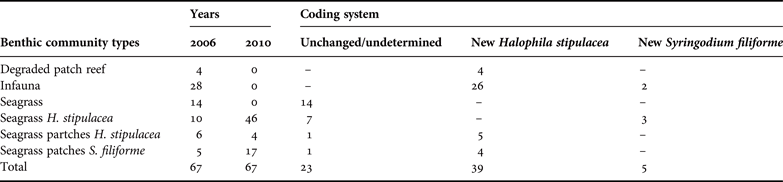
Of the 90 records obtained from 2010, 67 were compared to 2006 records as to whether they matched geographical coordinates area (there was no connection to past data for the other 23). The videos from the 2006 marine habitat-mapping project were re-examined to check for Halophila stipulacea presence. This permitted a comparison of the sea bottom (benthic communities' features, presence/absence of H. stipulacea and other species) in terms of species occurrence and cover changes vs time to be performed (Table 1). A Chi-squared test (χ2 in R-software for statistical computing and graphics, version 3.0.2) was performed to highlight significant changes in the benthic communities' cover between the two surveys. To calculate percentage changes over time, the following coding system for each record was used: no changes or unidentified records were coded as 0; changes to H. stipulacea seagrass beds were coded as 1; and changes to other seagrass species (different from H. stipulacea) were recorded as 2. The percentage change was calculated as the percentage of H. stipulacea seagrass beds over the total of sea bottom community changes.
Comparison of benthic community changes between 2006 and 2010 along the Caribbean coast of Martinique (French West Indies) and coding system for percentage change calculation. Data were obtained from video recordings (N = 67).

RESULTS AND DISCUSSION
A first identification of specimens filmed in 2006 and attributed to the alien species Halophila stipulacea was made in 2010. A small patch (>1 m2) of Halophila was checked at Anse Madame (14°37′.38″N 61°6′19.23″W) early 2010, at 11 m depth (Figure 1) and identified as H. stipulacea. Several specimens from this first collection were preserved dry in a herbarium for reference at OMMM.
In April 2010 additional patches of Halophila stipulacea were observed along the Caribbean coast of Martinique, from the Fort de France Bay to the northern bay of St Pierre (Figure 1). This survey provided valuable information on the distribution and habitat of H. stipulacea. Specimens were detected at depth from 3 to 32 m, on sandy substratum, always in sheltered areas and regularly dispersed along the coast. Most of the H. stipulacea patches observed were dense and monospecific. However, some mixed-patches were detected, which were composed of H. stipulacea and Ulva intestinalis, H. stipulacea and S. filiforme, or H. stipulacea and cyanophycean (undetermined species covering the seagrass canopy).
Recordings made during the Martinique survey of 2010 occurred all along the north Caribbean coast, suggesting that H. stipulacea had widely extended since 2006 (10s of km along the coast). The occurrence of H. stipulacea in Martinique might possibly be linked to maritime transportation in the Lesser Antilles and its dispersal could be associated with the intense tourist sailing activity in the region (Ruiz & Ballantine, Reference Ruiz and Ballantine2004; Galil, Reference Galil2006; Willette & Ambrose, Reference Willette and Ambrose2009). As a general trend, the initial occurrence of H. stipulacea in a new geographical area is often located in the close vicinity of ports or anchorage areas as previously reported in the Mediterranean (Greece, Malta, Sicily and Tunisia) and Caribbean Seas (Grenada, Dominica and St Lucia) (Ruiz & Ballantine, Reference Ruiz and Ballantine2004; Gambi et al., Reference Gambi, Barbieri and Bianchi2009; Willette & Ambrose, Reference Willette and Ambrose2009).
Once the presence of Halophila stipulacea in the coastal waters of Martinique had been confirmed in 2010, the species showed a wide distribution, extending from the north at St Pierre Bay to the south at Fort de France (Figure 1). The main threat is that H. stipulacea could potentially out-compete native seagrasses inducing changes in the subtidal community structures as surveys show changes at several previous Syringodium filiforme locations in favour of H. stipulacea. However, the influence of H. stipulacea might not be that great because its small size could allow it to co-exist under canopies of the larger native seagrass species (such as Thalassia or Syringodium) and has been shown in mixed meadows already documented in the study area. For this reason, the impact of this alien species on the abundance of other seagrass species is difficult to predict (Williams, Reference Williams2007).
Nonetheless, our initial surveys indicate that community structure changes have taken place since the introduction of Halophila stipulacea, like in the Mediterranean as mentioned by Di Martino et al. (Reference Di Martino, Blundo and Tita2006). Changes in the seabed composition were noted when the results from the 2010 survey were compared to the 2006 data. Changes in the benthic communities accounted for 65.7% compared to 2006. While 34.3% was unchanged, 58.2% was due to new H. stipulacea area and 7.46% was new Syringodium filiforme settlement. Among the percentage changes observed, this represents 88.6% in favour of the alien species H. stipulacea, indicating its high spreading capacities. A Chi-squared test, assuming similar distribution of seagrasses and other categories stated that both S. filiforme and H. stipulacea occurrence increased, the latter much more, while the other categories have disappeared (χ2 = 78.59, df = 5, P < 0.001). Our data testify to the high spreading capacity of H. stipulacea in new available environment, like sandy areas, as well as in previously colonized areas of other seagrass species, showing a substitution of indigenous phanerogam species within four years. Seagrass dynamic is highly subjected to coastal development and stochastic environmental events. It is then important to increase monitoring of these coastal ecosystems as community changes can occur very rapidly. Continuous effort is also required to assess the impact of H. stipulacea on usual seagrass benthic associated communities.
ACKNOWLEDGEMENTS
The authors thank the ‘Direction de l'Environnement, de l'Aménagement et du Logement Martinique (DEAL)’ for funding the sampling campaign and Dr Julian Mitchell (University of Portsmouth) for his advice during the preparation of this manuscript.