

Introduction
Crop phenotype is usually expressed in terms of characteristics like plant height, leaf architecture and leaf area index (LAI). In the case of maize (Zea mays L.), stalk diameter is seldom quantified because its measurement does not readily lend itself to automation without considerable constraints. For example, stalk diameter established at the end of the vegetative growth period is assumed to remain constant throughout the reproductive period. However, plant height is typically >2 m at this time which limits access by conventional implements until harvest. To complicate diameter and plant spacing measurements, the lower part of the maize canopy can be cohabitated by weeds. Near maturity, degraded leaves can also interfere with mechanical and optical measuring devices.
Early attempts to mechanically determine maize population at harvest used a potentiometer attached to a feeler-wire mounted to the header of a combine harvester (Sudduth et al., Reference Sudduth, Birrell and Krumpelman2000). This system was relatively insensitive to weeds unless they had diameters similar to the maize stalks. Hummel et al. (Reference Hummel, Drummond, Sudduth and Krumpelman2002) developed an optical sensor that performed quite well early in the growing season but near harvest time weeds, broken upper segments of stalks and senesced leaves resulted in erroneous population data. Researchers attempted to use a strong localized blast of air to remove loose leaves, but without much success. Luck et al. (Reference Luck, Pitla and Shearer2008) proposed a sensor approach to measure plant population that was only marginally successful because of senesced leaves and other materials that falsely triggered the sensor. Tang and Tian (Reference Tang and Tian2008) used a machine-vision technique to measure the spacing of recently emerged maize plants. Their algorithm provided good real-time measurement at 4.4 km/h, but the procedure was limited to small plants before leaves of adjacent plants overlapped. More recently, Shi et al. (Reference Shi, Wang, Taylor and Raun2015) used LiDAR to scan the base of maize plants midway through the vegetative growth period (V8) to measure plant population. They achieved a total plant error of 5.5% with a root-mean-squared error (RMSE) of 1.9 cm and a false positive value of 14%.
The relationship between maize stalk diameter and grain produced per plant is rarely reported because individual plant measurements are required and further confounded by the need to measure interplant spacing. Seed companies routinely update plant population effects on maize yield as new hybrids are released and concurrently assume relative uniformity in plant spacing. Within the past decade, the impact of irregular plant spacing on yield (Searle, Reference Searle, Kocher, Smith and Blankenship2008; Kovács and Vyn, Reference Kovács and Vyn2014) has been used to justify precision planting devices that increase uniformity of interplant distance.
Farmers strive for uniform seedling emergence through their planting operation. Precise seed placement in soil (interplant distance, appropriate depth and favorable seed/soil contact) goes a long way toward achieving this goal. Even with uniform seed spacing and emergence, maize plants typically display variability in apparent plant vigor that is probably best observed, but undocumented, in terms of stalk diameter. Another measure of plant vigor is leaf chlorophyll status that can be evaluated with a Minolta SPAD meter or similar device. These measurements usually involve averaging 30 or so individual measurements from representative plants within a given area. Logging SPAD values for individual plants is possible when used in conjunction with a logging device. Seldom are multiple SPAD measurements taken from a designated leaf and recorded to correlate with other plant growth parameters.
Plant-to-plant differences in plant vigor are frequently observed as seedlings emerge or when plant spacings are not uniform. Competition for light is an obvious factor contributing to non-uniformity, as is the ability of plants to compete for nutrients and water. Plant vigor is typically assessed in terms of leaf color, relative size of leaves (individual plant leaf area index, LAI), and plant height. These metrics are frequently integrated via remote sensing and expressed as a vegetation index such as the normalized difference vegetation index (NDVI). This index is largely indicative of the amount of living vegetation determined by measuring red and near infrared (NIR) reflectance. Sensitivity of NDVI to changes in crop vigor is limited to situations before the canopy closes (LAI < 2.5) because responsiveness decreases rapidly when red reflectance becomes consistently low (Gitelson and Merzlyak, Reference Gitelson and Merzlyak1998). Kelly et al. (Reference Kelly, Crain and Raun2015) measured stalk diameter, plant height and NDVI of individual maize plants in Oklahoma from V8-VT growth stages and compared the results to grain per plant. They reported the best correlation with grain yield per plant (r2=0.67) was obtained using stalk diameter x plant height at V12. These measurements (plant height, stalk diameter and individual NDVI) are laborious and time consuming which makes the information academic unless data acquisition can be automated.
The objective of this study was to evaluate the interaction between plant spacing and stalk diameter of irrigated maize on grain yield per plant. A second goal was to develop an automated system to measure stalk diameter under field conditions.
Materials and methods
Students enrolled in a farm management course at the University of Nebraska spend three days in mid-August evaluating production practices and crop responses on a farm before classes formally resume for the fall semester. Field activities include evaluating compaction issues related to wheel traffic, assessing uniformity of plant spacing, measuring LAI of individual plants in conjunction with SPAD readings and interplant distance, measuring stalk diameter and measuring yield components of individual plants (number of rows of kernels and kernels per row). Observations from 2010 through 2015 were that larger diameter stalks as assessed midway through the grain-fill period generally had higher yield potential. However, the students were not able to follow the crop to maturity and so yield per plant was not determined.
The positive stalk diameter vs. grain per plant relationship noted by the students prompted more detailed measurements on three farmer fields just before harvest in 2015. An individual row in each field was selected that would have been least influenced by wheel traffic. In the same field used by the students, 3.1 m of row (0.76-m row spacing) was identified for measurement of stalk diameter, plant spacing and grain yield of individual plants. The range in plant spacing and stalk diameter was reasonable but the distribution was skewed toward plants with larger diameter stalks. In the other two fields, plants were selected that represented a wider range in plant spacing. The goal was to collect data for at least 20 plants from each field. Maize ears were labeled and removed before counting the rows of kernels and number of kernels in each row. Grain weight per ear was adjusted to 15.5% moisture.
Justification for automating the measurement of stalk diameter and plant spacing was based on the apparent influence of stalk diameter on maize yield. A prototype-sensing device was built using a laser light source and detector that measured reflectance was modulated at 77.5 kHz. Under field conditions, the sensing device would move along the row of plants, but under a laboratory setting the situation was reversed. That is, stalks were mechanically moved in front of the stationary detector. A racetrack mechanism was constructed to securely hold stalk samples and systematically move them in front of the sensor. The racetrack was constructed of linked plastic segments that were 3.2-cm long and 10.2 cm wide resulting in a chain that was 3-m long. The resulting racetrack was in the shape of a rectangle that was 1-m long and 0.5-m wide. Stalk holders were fabricated with a 3-D printer and mounted to the plastic chain at 16-cm intervals so as to simulate plant-to-plant spacings common in a field. Stalk holders were also designed to accommodate wooden dowel rods of known diameter that were used to simulate maize stalk sections during calibration. The diameters of the eight dowel rods used for calibration ranged from 6.60 to 25.45 mm. Chain speed around the perimeter of the racetrack mechanism was varied up to 12 km/h using a 12-v motor. Speed control was performed utilizing an optical feedback PID (proportional-integral-derivative) controller.
Results and discussion
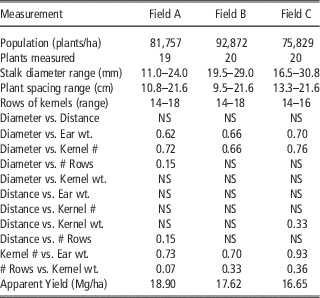
The three fields used in this study had high yield potential. Apparent yields based on the limited hand sampling involved in this study ranged from 16.65 to 18.90 Mg/ha (Table 1). The number of plants measured in each field was either 19 or 20 and the apparent population ranged from about 76,000 to 93,000 plants/ha after accounting for row width and the distance in a row that was allocated to each plant. The strongest relationship was between kernels per ear and grain weight per ear (r2 from 0.70 to 0.93). Justification for the various plant and grain measurements supports the yield estimation procedure used by farmers and consultants in the U.S. For example, the number of plants in 1/1000th of an acre is multiplied by the average number of kernels in three to five representative ears and divided by about 85 to give bushels per acre. The number of kernels per ear is estimated by multiplying the number of rows per ear by the number of average sized kernels per row. The point being that maize yield is highly dependent on kernel number.
Field statistics and coefficient of determination for plant and grain measurements from three irrigated maize fields in Nebraska, USA in 2015.

The other significant relationships were related to stalk diameter. Each significant case involved kernel number per ear or the associated grain weight per ear as noted above. The r2 values for stalk diameter versus grain weight per ear ranged from 0.62 to 0.70 and the values for kernel number per ear ranged from 0.66 to 0.76 (Table 1). The stalk diameter measurements were made shortly before harvest, but this plant characteristic was likely established midway through the growing season (around tassel emergence); however, data are not available to support this contention. This poses the question as to why stalk diameters were different. These data indicate that distance between plants did not have a significant influence on stalk diameter or any of the ear measurements, at least within the range of plant spacing observed in this study (9.5–22 cm). Plants farther apart might be expected to have larger diameters or multiple ears while those closer would be expected to have smaller diameters and might even be barren. Adjacent plants share both the below and aboveground environment, but this does not rule out some plants having a competitive advantage because of earlier emergence or differences in disease or insect pressure.
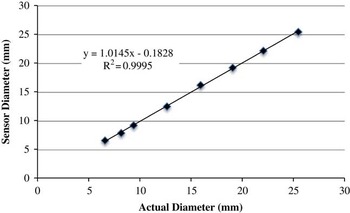
Calibration of the field simulation apparatus using wooden dowel rods with 6.60 to 25.45-mm diameters showed excellent accuracy at all speeds. A normal combine harvesting speed of 6.4 km/h (4 miles/h) was used to illustrate the accuracy of the sensor (Figure 1). The laboratory calibration involved at least 40 sets of readings for the series of eight dowel rods. The coefficient of variation across the eight dowel rods ranged from 1.3 to 2.2% with an average of 1.6% when operating at 12 km/h. At this speed, the sensor would travel 3.33 m/s and be exposed to 16–20 maize plants. The absolute error did not exceed 5% and was typically <3%.
Sensor measurement performance for a series of eight wooden dowel standards sampled at 6.44 kmph (n>40).

Under field conditions, it would be necessary to remove extraneous vegetation except for the maize stalks. The fact that maize stalks are somewhat elliptical reduces the accuracy of the true diameter measurement. Measurements made by students indicated about 10% difference between the maximum and minimum stalk diameter. Laboratory measurements with round dowel rods avoided this problem, but with an automated system in the field the sensor would be exposed to minimum as well as maximum diameter situations. The accuracy of field stalk diameter measurements will depend on the accuracy of the GPS used to log speed of the implement.
Conclusion
Measurement of maize stalk diameter with a digital caliper and grain yield on a by-plant basis indicated a strong relationship between these parameters, but showed an insignificant effect of plant spacing within the range of plants observed in three irrigated fields. An apparatus that simulated measuring maize stalk diameter under field conditions (minus weeds and trash) was able to accurately measure the diameter of dowel rods up to 12 km/h.
Acknowledgements
Support for the automated sensor development effort was provided by the John Deere Company, Moline, Illinois.