Introduction
In The Three Worlds of Welfare Capitalism, Esping-Andersen devised a typology of welfare states by constructing three indices from seven indicators of social stratification, each of which defines a distinct welfare regime: conservative, liberal and social democratic.Footnote 1 Five of these indicators measure institutional characteristics of social insurance (corporatism, etatism, private pension and health expenditure, and universalism). In addition, the indicator of benefit equality measures the ratio of post-tax maximum to basic benefits of social insurance, and the indicator of poor relief measures the extent to which welfare outside of social insurance relies on means tests. The indicators are based on 1980 data for eighteen Organisation for Economic Co-operation and Development (OECD) countries. Esping-Andersen showed that most of these countries score highly on only one of the three welfare regime dimensions. This clustering suggests the existence of three ‘worlds of welfare capitalism’. The typology of three types of welfare regimes (liberal, conservative and socialist) has been very influential.Footnote 2 The classification is used extensively in comparative welfare research to characterize actual welfare states, but it is also frequently employed in explanatory models.Footnote 3 Yet, surprisingly enough, the validity of this model has never been tested in a systematic manner. This article does exactly that: it shows that Esping-Andersen's classification of countries on the basis of these seven indicators is invalid, and proposes and tests an alternative model.
We are not the first to criticize Esping-Andersen's measures. Scruggs and Allan thoroughly re-examined the data underlying six of the seven stratification indicators and replicated Esping-Andersen's indexing and scoring methods for 1980–1 and 1996–2002.Footnote 4 They constructed two new datasets, which diverge from the original measurements on several of the indicators. On the basis of their new data, Scruggs and Allan conclude that no clear-cut typology of welfare states emerges according to the 1980 data, and that over time, the country scores on the three regime dimensions are quite unstable. Hicks and Kenworthy have argued that since the socialist and liberal dimensions are negatively correlated, they are in effect opposite poles of a single underlying dimension.Footnote 5 Their argument that the three worlds of welfare can be represented by two dimensions has actually been endorsed by Esping-Andersen.Footnote 6 Scruggs and Allan and Hicks and Kenworthy have thus engaged in constructive criticism of Esping-Andersen's empirical work, but in doing so, they have accepted his three regime scores as valid constructs for measuring country positions. In this article, we first take a step back to question the validity of these constructs before moving beyond these previous contributions.
In Section 2 we return to Esping-Andersen's original model and demonstrate that both the original and the new indicator data fail to support the basic assumption that the seven indicators of stratification can be validly reduced to three dimensions in the way that Esping-Andersen proposed. One problem with these indicators is that they are a mixture of institutional characteristics of welfare systems on the one hand and outcome measures of social stratification – notably social insurance post-tax benefit equality – on the other. Together with universalism, Esping-Andersen used this outcome indicator to operationalize the socialist regime instead of directly measuring the typically social democratic insurance system. We show that such an approach causes validity problems. Another problem concerns the measurement of means-tested welfare benefits. Scruggs and Allan's replication data completely disagrees with Esping-Andersen's data, due in part to differing criteria for distinguishing means tests from income tests. Therefore, we develop an alternative measurement model in section 3, based only on the five remaining indicators. Our ‘social insurance model’ fits the data of Esping-Andersen, as well as the two datasets of Scruggs and Allan, very well.
Section 4 focuses on the descriptive implications of the alternative model. We identify three regime dimensions – conservative, liberal and universalist – which differ from the conservative, liberal and socialist dimensions of Three Worlds. Yet when Esping-Andersen's own methods of constructing the typology of countries are applied to scores derived from our social insurance model, the resulting classification on the dimensions of universalism, conservative and liberal social insurance agrees with the original typology to a surprising extent, despite the fact that our model does not include a socialist regime dimension. The main difference emerging from this comparison is that some countries regarded by Esping-Andersen as typically liberal – Canada and Switzerland – show up as hybrid cases of strongly universalist liberal social insurance in our typology.
Even though our study yields a typology of countries that resembles Esping-Andersen's, the implications are farther reaching for research that uses the invalid regime scores of Three Worlds as independent variables in causal analyses. To demonstrate the importance of this point, we present a replication analysis of a study by Noël and Thérien in section 5, in which the 1980 socialist regime score plays a central role in demonstrating their central claim that variations in the level of foreign aid can be explained by the extent to which welfare state institutions are universalistic.Footnote 7 However, this claim is called into question when the socialist regime score is replaced by its original indicators. The final section concludes.
Esping-Andersen's Measurement Model of Welfare Regimes
Operationalization: Three Welfare Regime Dimensions
Esping-Andersen's key idea is that the welfare state is not just a mechanism for correcting market inequalities, but a system of stratification. He derives three theoretically stylized descriptions of ‘welfare clusters’ from an examination of (a) the stratification features that emerge from the historical context of initial social policy reforms and (b) crucial policy responses to problems that are common to all emerging welfare states, in particular the rise of salaried middle class workers. Esping-Andersen then identifies three distinct welfare regimes, based on data for seven indicator variables for eighteen countries in 1980.Footnote 8 On the basis of distinct combinations of country scores on these seven variables, countries are scored using three indices that measure conservative, liberal and socialist welfare regime dimensions;Footnote 9 We will refer to these three welfare regime dimensions as ‘conservatism’, ‘liberalism’, and ‘socialism’.
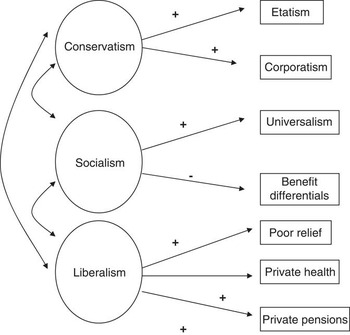
Conservatism has two positive indicators: etatism and corporatism. Etatism is measured by government expenditure on pensions to government employees as a percentage of GDP. Corporatism is measured by the number of occupationally distinct (major) public pension schemes.
Liberalism has three positive indicators: poor relief, private pensions and private health. Poor relief is measured by the level of means-tested transfer programs as a percentage of total public social expenditure. This indicator distinguishes specifically means-tested programs from ‘normal income-testing schemes’ on the basis of ‘an individual assessment of how the system operates in each nation’.Footnote 10 The private pensions indicator represents the percentage of total expenditure on pensions that is private. Private health measures the percentage of total health expenditure that is private.
Socialism has two positive indicators: universalism and benefit equality. Universalism represents the average percentage of the working population (aged 16–64) that is insured for ‘sickness, unemployment and pensions’. Coverage refers exclusively to social insurance programs, since income-tested unemployment and sickness benefits are excluded. Benefit equality is defined as the average ratio of ‘guaranteed basic social benefit to the legal maximum benefit for sickness, unemployment and pensions’, measured after the deduction of tax.Footnote 11 It must be noted that Esping-Andersen often refers to the converse of this variable as ‘benefit differentials’, which equals 1 – benefit equality.Footnote 12 Thus benefit differentials are considered a negative indicator of socialism.
These operational definitions constitute a measurement model, which specifies the observable attributes that identify the unobservable (latent) welfare regime dimensions of conservatism, liberalism and socialism.Footnote 13 We shall refer to it as the EA model, to distinguish it from the theoretical descriptions of the liberal, conservative and social democratic welfare clusters that motivate the operational definitions. Figure 1 displays this model in schematic form. On the basis of these definitions, Esping-Andersen constructs the index scores for each country. Our first question is whether this model can be accepted as valid.
EA Measurement Model. Note: model derived from Esping-Andersen.

The EA Model Tested
Esping-Andersen tested the construct validity of his measurement model by inspecting the correlations between the seven attribute variables:Footnote 14
Obviously, for regimes to exist there must be a strong relationship among the particular characteristics that supposedly identify the regime; and, in converse, these must be negatively correlated, or uncorrelated, with attributes of alternative regimes. The correlations in Table 3.2 point towards the kind of regime clustering that we had anticipated.Footnote 15
Esping-Andersen is mostly correct in arguing that there are relatively strong correlations between indicators that measure the same welfare regime dimension. However, this is only a weak test of construct validity, particularly since more rigid tests of measurement models are widely available. Moreover, not all correlations fit the anticipated pattern well. The correlation between benefit differentials and universalism is positive (0.21), about which Esping-Andersen notes that: ‘The socialist regime, finally, is more difficult to pin down because its two component values, universalism and egalitarian benefits, are not strongly correlated.’Footnote 16 While not incorrect, this remark obscures the fact that according to the EA model, the correlation should have been negative rather than positive. In the construction of the socialist regime scores, he treats the indicator scores as if this correlation were strong and negative.Footnote 17
In our view, a rigid test of the construct validity of the EA model is necessary, which can be achieved using a structural equation model (SEM). As far as we are aware, this has not been done before. SEMs test whether it is plausible that the relationships between latent variables and indicators in a measurement model, such as the model presented in Figure 1, could have generated the empirically observed covariances in the data.Footnote 18 If the empirical tests show that a measurement model has a poor fit, the operationalization is considered invalid.
This study's data meet the basic requirements for conducting analyses using SEMs.Footnote 19 The fit of the models is evaluated using three criteria. The first is the chi-square test, in which the null hypothesis is that the model has a perfect fit in the population from which the sample was drawn. Thus a good fit requires that the null hypothesis is not rejected. The drawback of this test is that it is relatively easy to get a satisfactory fit of the model when the sample size is small, which is the case in our study. The other two criteria, which combine the chi-square statistic with the degrees of freedom of the model to be tested, do not suffer from this problem and therefore provide a more rigorous test. The second criterion is the ratio of the model's chi-square to its degrees of freedom (CMIN/DF), which indicates a good fit only if this ratio does not exceed unity by a small margin. The third criterion is the root mean square error of approximation (RMSEA),Footnote 20 which must be below 0.10 to be acceptable, and below 0.05 to conclude that the model fits the data closely.Footnote 21 In addition, we investigate fitted standardized residuals to evaluate where the implied covariances of a model differ most from the sample covariances.
Test Results
Our investigation starts with a test of the EA model presented in Figure 1, using Esping-Andersen's 1980 data. In order to test the model, it is necessary to impose a number of constraints on some of its parameters.Footnote 22 We refer to this specification of the EA model as the EA test model. It estimates twelve parameters from twenty-eight sample moments and thus has df = 16. Its chi-square value is 38.18 with a probability level of 0.001. The EA test model is clearly rejected by the two criteria for a model fit that one would have to use in any case: CMIN/DF (2.39) and RMSEA (0.29). Also, two standardized residual covariances are above 2.0, again indicating that the model does not fit the data well. These tests permit only one conclusion: a test of the EA model on the basis of Esping-Andersen's original data leads to a rejection of that model.
In addition to the poor overall fit, another problem was detected. The EA model of Figure 1 assumes a positive relationship between socialism and universalism and a negative relationship between socialism and benefit differentials. However, in the EA test model, the effect of socialism on benefit differentials is slightly positive (0.22), yet not statistically significant (p = 0.36). This finding shows that in the original data, benefit differentials do not characterize socialism in the way specified by Esping-Andersen.
We also tested the EA model using the new data collected by Scruggs and Allan. A test of their 1980 dataset estimates thirteen parameters from the twenty-eight sample moments (df = 15).Footnote 23 This EA test model (SA 1980) has a chi-square value of 47.04 with a probability level of 0.000; CMIN/DF = 3.14 and RMSEA = 0.35. The model is therefore rejected on the basis of all three criteria of model fit. For the new dataset concerning 1996–2002, the EA test model (SA 1996–2002) yields a chi-square of 21.35 with probability level of 0.13; CMIN/DF = 1.42 and RMSEA = 0.16. Compared to the preceding test model, this one displays a better fit, but it is by no means acceptable. Moreover, as in the EA test model, the parameter estimate of socialism on benefit differentials in these two test models is weakly positive and not significant.Footnote 24 In sum, Esping-Andersen's widely accepted procedure to ‘score’ welfare states on conservatism, liberalism and socialism, as outlined in Three Worlds, must be rejected on the grounds of construct validity. However, this failure does not rule out the possibility that Esping-Andersen's welfare regime approach might be recast in a more promising way. The next section addresses this matter.
The Measurement Model of Social Insurance
Motivating the Model
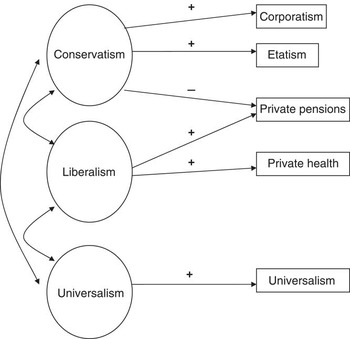
We propose a parsimonious measurement model (shown in Figure 2), which is limited to the institutional characteristics of social insurance. Before testing the model, we argue that it is theoretically plausible in view of the core theory in Three Worlds.
Alternative Measurement Model of Social Insurance

As in the original EA model, we define the liberal and conservative dimensions in terms of the specific organizing principles of social insurance, the conservative principle of differentiation according to occupational status (measured by corporatism and etatism) and the liberal principle of private market-oriented insurance provision (measured by private pension and private health expenditure). With respect to liberalism, we have omitted the poor relief indicator on the grounds that it is not measured well.Footnote 25 This proposal is practical, not theoretical. We agree that if properly measured, the percentage of means-tested welfare benefits would serve to single out the historically salient feature of liberal welfare state residualism, and could therefore be included in the measurement model.Footnote 26
We also think that conservatism could be differentiated somewhat more sharply from liberalism than the EA model does. Esping-Andersen's historical sketch of conservative welfare states suggests that these countries tend to reject the liberal idea of incorporating private market initiatives into social insurance, notably private pension arrangements.Footnote 27 This characteristic implies a negative relationship between the conservative dimension of the EA model and the liberal indicator of private pensions, which we include in the model of Figure 2.
The real novelty of our model is that it does not include the dimension of socialism. This omission is not because we think that the socialist regime has no specific institutional characteristics, but because those characteristics are not properly operationalized. According to Esping-Andersen, social democratic welfare states – typified by the Scandinavian nations – had two major aims: to cover the insurable risks of the whole working population, and to do so by means of state insurance programs accessible to everyone. In such programs, the workers’ benefits for unemployment, sickness and old age do not depend on the typical status differences (as in conservative regimes), nor on free market arrangements (as in liberal regimes). This second aim implies a specific organizing principle of social democratic insurance, which may be called ‘uniform state insurance’.
In Esping-Andersen's operationalization of socialism, the institutional signature of social democratic welfare is represented only by the indicator of universalism, for there is no indicator that measures the extent to which uniform state insurance is realized in the eighteen countries. Even though high universalism (that is, a high average percentage of social insurance program coverage) captures the first aim of social democratic welfare policy, it does not capture the second aim. On its own, high universalism does not accurately reflect the institutional specifics of the social democratic welfare state ideal. According to Esping-Andersen's descriptive theory, a high rate of social insurance coverage might be combined with the status-based or market-based arrangements that typify the conservative and liberal welfare clusters. It follows that universalism by itself cannot differentiate socialist welfare regimes from liberal and conservative regimes very well.
Esping-Andersen may have recognized this problem, since he characterizes the socialist welfare regime by both high universalism and low inequality of social insurance benefits, as measured by the outcome indicator of ‘benefit differentials’. However – and this is the second stage of our argument in favour of including universalism as the third dimension of our model rather than sticking to socialism – benefit differentials and universalism are almost uncorrelated in the original and replication data (as shown in section 2.2). Also, there is no theoretical rationale for assuming that these two indicators should be negatively related across all countries, as they are held to be in the EA model of Figure 1. It is true that in Esping-Andersen's stylized description, typically socialist welfare states do combine a high degree of universalism with a relatively low rate of benefit differentials, compared to typically liberal and conservative countries.Footnote 28 However, benefit differentials and universalism cannot be expected to be associated in any particular direction within countries of the liberal and conservative welfare clusters. The main reason is that although in Esping-Andersen's view both liberal and conservative principles of social insurance tend to produce relatively high benefit differentials, the institutional arrangements embodying those principles are perfectly compatible with either high or low degrees of social insurance coverage.Footnote 29 We conclude that there is no theoretical support for regarding benefit differentials as an indicator that negatively characterizes the socialist regime, despite the fact that typically socialist countries are described as combining high universalism with comparatively low benefit differentials.
A final reason for removing benefit differentials from our model is that they are not an institutional characteristic of welfare regimes, but rather an outcome variable that depends on broader features of political economy. As such, they are not good indicators of welfare state regimes. Esping-Andersen maintains that the comparatively high benefit equality of the socialist welfare cluster is not really a consequence of the social democratic principle of uniform state insurance.Footnote 30 Instead, it results from a general solidaristic policy aim, which involves a compromise between employee-worker solidarity on the one hand, and the benefit inequality induced by establishing earnings-graduated state insurance for high and low earners on the other. Social democratic governments use a broader institutional framework to accomplish this broader aim: public service employment to obtain a more egalitarian wage income distribution, combined with a progressive tax system that reduces the after-tax ratio of maximum to basic insurance benefits. By contrast, typical countries of the conservative and liberal welfare clusters are not influenced by such a policy aim. Thus the comparatively higher rates of benefit inequality among the insured workers of these countries are likely to be caused by after-tax wage income disparities, which are only partly related to their status or market-oriented social insurance systems.
In sum, our rejection of benefit equality as a valid and theoretically defensible feature of the socialist welfare regime inevitably means that this regime retains only the indicator of universalism. However, universal coverage with social insurance is a necessary but insufficient feature of the social ideals embodied in the socialist welfare cluster: these ideals hold that entitlements to social insurance should cover all working people in roughly the same way. Since this feature of uniform state insurance is missing, we regard the degree of universalism as a separate dimension of welfare states, rather than a partial measurement of the richer institutional notion of universal coverage within uniform state insurance programs, as described by Esping-Andersen. Country scores on the universalism dimension demonstrate the importance of the general principle of insuring against the three risks of sickness, unemployment and income loss in old age, in relation to the opposite principle of risk coverage through income- and means-tested benefits. However, observed cross-country variations in universalism say little about the extent to which the social insurance programs of the various countries are organized in either liberal or conservative ways. This indeterminacy is empirically reflected by the three available datasets, which invariably show weak and nonsignificant correlations (not exceeding absolute values of 0.3) between universalism and the four indicators (corporatism, etatism, private pensions and private health).
Test of the Social Insurance Model
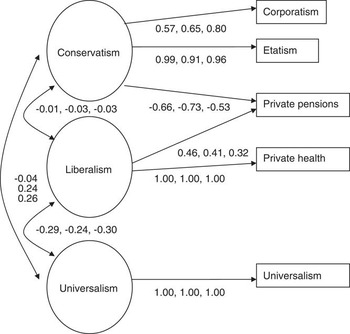
We now turn to the empirical test of the social insurance measurement model pictured in Figure 2. To estimate the model, we chose to represent the universalist regime as a latent dimension specified by the single indicator of universalism. This might seem roundabout, but it has the advantage of enabling the explicit estimation of the correlations with liberalism and conservative social insurance, the two other latent dimensions. To obtain an admissible test model for the three datasets, we fixed the weights of liberalism on private health and of conservatism on etatism at one, and we also set the variances of the three latent dimensions at one. In all datasets, it was necessary to constrain the error variances of universalism and private health to zero. This test model estimates nine parameters from the fifteen sample moments, so it has six degrees of freedom. In each of the three datasets, it displays a very good fit, with standardized residual covariances nowhere exceeding absolute values of 0.6, with CMIN/df nowhere exceeding 0.17 and the RMSEA equalling 0 in all three data sets. The estimated regression weights are significant in the predicted directions, at least at the 0.05 level. Moreover, the three dimensions of universalism, conservatism and liberalism are correlated very weakly and not significantly. The standardized estimates of the test models for each dataset are shown in Figure 3.
The Social Insurance Measurement Model. Note: tested on the three datasets (standardized estimates respectively entered for the original data, new data 1980 and new data 1996–2002).

Consequences of the Social Insurance Model for the Typology of Welfare States
Comparing Typologies: Country Scores, Rankings and Types
The country typology of Three Worlds is still highly influential for much comparative work in the field. On the basis of his regime index scores, Esping-Andersen devised a rough method of clustering the eighteen OECD countries by their predominant regime type (conservative, liberal or socialist) and identifying hybrid cases. In this section, we follow the same method and compare his typology with a typology based on the model of Figure 3, for the original 1980 data. The social insurance typologies constructed on the basis of Scruggs and Allan's alternative datasets will be briefly discussed as well. Table 1 presents the typology of Three Worlds.
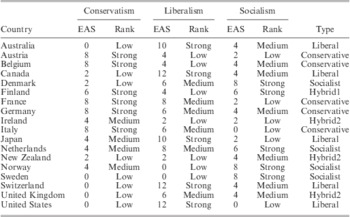
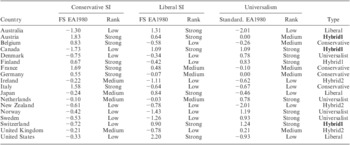
Country Typology of the EA Model

Note: ‘EAS’ denotes Esping-Andersen's country scores taken from Table 3.3 of Three Worlds. ‘Rank’ refers to Esping-Andersen's three-way ranking of countries on each regime dimension. The conservative and socialist scores of 0 and 2 are ranked as low, 4 as medium, and 6 and 8 as strong. For the liberal regime, scores of 0, 2 and 4 rank as low, 6 and 8 as medium, and 10 and 12 as strong. The entries under ‘Type’ follow Esping-Andersen's convention of labelling a country as liberal, conservative or socialist whenever it is classified as strong on the respective regime dimension and not strong on the two others. However, Finland (listed as socialist in Table 3.3) is actually strong on both the conservative and socialist dimensions. It is therefore classified as ‘Hybrid1’, meaning that the country is ranked strong on more than one regime dimension. ‘Hybrid2’ refers to countries not ranked as strong on any regime dimension.
Table 1 should be explained in detail. The regime scores (EAS) were calculated by Esping-Andersen from the indicator data.Footnote 31 The scores on the three dimensions were obtained by first recoding the seven original variables in three categories, with values of 0, 2 and 4.Footnote 32 These values were then summed. Since Esping-Andersen constructed the conservative and socialist regime scores using two indicators each, the summing procedure yielded five-point scales with values of 0, 2, 4, 6 and 8. The liberalism scores were constructed using three indicators. This produced a seven-point scale, ranging from zero to twelve.
To construct the typology, Esping-Andersen recoded the three resulting scales again into three categories: low, medium and strong ‘regime-ness’. For the conservative and socialist regimes, the low and strong ranks correspond to score values of (0 and 2) and (6 and 8) respectively, with a score of 4 representing ‘medium’. For the liberal regime, he used an asymmetrical ranking, with low corresponding to score values (0, 2 and 4), medium (6 and 8) and strong (10 and 12). According to Esping-Andersen, this three-way classification clearly shows a significant clustering of countries across the three welfare regimes. The implicit criterion that he adopted for judging the overall degree of clustering in the data is the proportion of typical countries,Footnote 33 in which a ‘typical’ country is defined as one that exhibits a strong regime score on only one regime dimension.Footnote 34 Of the eighteen countries, fourteen qualify as typical and four as hybrid cases. Austria, Belgium, France, Germany and Italy are the typically conservative countries in Esping-Andersen's typology. Australia, Canada, Japan, Switzerland and the United States emerge as the typically liberal countries, and Denmark, Sweden, Norway and the Netherlands stand out as typically socialist countries. Of the remaining four, Finland scores strongly on two dimensions: conservatism (6) and socialism (6). Finland is classified as ‘Hybrid1’ in Table 1 to distinguish it from the three other hybrid countries (Ireland, New Zealand and the United Kingdom), which score strongly on none of the three regimes (‘Hybrid2’ in Table 1).
Due to the number of arbitrary decisions in Esping-Andersen's recoding and classification procedures, there is no straightforward way to construct an analogous typology from scores based on our three dimensions of social insurance. The result of the procedure that closely matches his approach is summarized in Table 2. The social insurance country scores in Table 2 are based on Esping-Andersen's 1980 indicator data. The scores on conservative and liberal social insurance are the factor regression scores (with zero mean and standard deviation of unity) taken from a principal component analysis in SPSS 19.0 on corporatism, etatism, private pensions and private health. According to the rule of ‘eigenvalue > 1’, two components are extracted that together account for 81.6 per cent of variance in the data. We used the oblimin rotation to optimize the structure of loadings, thus allowing for correlated components. We interpret each component by looking only at factor loadings in the structure matrix with absolute values larger than 0.5 (which seems a rather safe criterion).Footnote 35 From these loadings, component 1 is clearly identified as the conservative component (loading positively on corporatism and etatism and negatively on private pensions) and component 2 as the liberal one (positive loadings on private pensions and private health). For the dimension of universalism, we used the standardized entries of Table 3.1 in Three Worlds. Footnote 36 Compared to the scores of the original typology, the three social insurance regime scores correlate quite weakly. Conservatism correlates −0.15 with liberalism and −0.06 with universalism. Liberalism is also negatively correlated with universalism, at −0.21.
Country Typology of the Social Insurance Model

Note: Original 1980 data used. SI=social insurance. ‘FS’ denotes the factor regression scores of conservative and liberal social insurance. ‘Rank’ refers to Esping-Andersen's three-way ranking of countries on each regime dimension. The conservative and universalism scores below −0.33 are ranked as low, scores between −0.33 and 0.33 as medium, and scores above 0.33 are ranked as strong, following the comparability convention described in the text. Likewise for the liberal regime, scores below −0.2 are ranked as low, scores between −0.2 and 0.6 as medium and scores above 0.6 are ranked as strong. The entries of column ‘Type’ classify a country as liberal, conservative or universalist whenever it is strong on the respective regime dimension and not strong on the two others. ‘Hybrid1’ means that a country is ranked strong on more than one regime dimension, while ‘Hybrid2’ refers to countries not ranked as strong on any regime dimension. In this column, highlighted countries disagree with Esping-Andersen's typology shown in Table 1.
To arrive at the three-way ranking of the social insurance regime scores in Table 2, it is necessary to devise a reasonable comparability convention that faithfully reflects Esping-Andersen's own ranking method. The five- and seven-point EA scores of Table 1 are mapped symmetrically onto the corresponding standardized social insurance scales of Table 2 as follows. The highest and lowest EA scores are assigned scale values larger than 1 and lower than −1, respectively. The (three or five) intermediate EA scores are represented by ranges of equal size within the interval (−1, 1). This convention allows the country positions in Tables 1 and 2 to be compared in terms of Esping-Andersen's classification of strong, medium and low ‘regime-ness’. For both universalism and conservative social insurance, the comparability convention implies: low (EA scores 0 and 2) corresponds to values below −0.33, medium (EA score 4) corresponds to values ranging from −0.33 to 0.33 and strong (EA scores 6 and 8) corresponds to values above 0.33. For liberal social insurance, we follow Esping-Andersen's asymmetrical division described above. Thus low (EA scores 0, 2 and 4) now corresponds to values below −0.2, medium (EA scores 6 and 8) corresponds to values ranging from −0.2 to 0.6 and strong (EA scores 10 and 12) corresponds to values above 0.6.
Results of the Comparison
Our comparison of the two typologies shown in Tables 1 and 2 is restricted to the classification of countries by type. It can be summarized in four points. First, with respect to the conservative regime type, the social insurance classification gives almost the same result. Esping-Andersen's five conservative countries are represented as conservative in our classification, except Austria, which we classify as a hybrid case because of its (barely) strong liberal ranking.Footnote 37
Secondly, there is agreement about the liberal status of Australia, Japan and the United States, but disagreement on the status of Canada and Switzerland. In both typologies, these two countries rank as strong on the liberal dimension. But whereas they have medium rank on socialism in Table 1, they rank as strong on the universalism dimension of Table 2. We therefore classify these countries as hybrid cases. This difference is explained by the fact that Canada and Switzerland combine universal social insurance coverage with high benefit differentials (see Table A1 of the online appendix). Because these indicators are negatively related in the calculation of the EA socialism score, the two countries are ranked medium on socialism in Table 1. Thus our classification of Canada and Switzerland as hybrid cases that combine a liberal organization of social insurance with high insurance coverage is a direct result of not including benefit differentials in our model.
Thirdly, the four countries of the socialist type in Esping-Andersen's typology (Denmark, Norway, Sweden and the Netherlands) are the only ones classified as universalist in our typology. Table 2 shows that all four rank strongly only on the universalism dimension, setting them apart from the hybrid liberal-universalist cases of Canada and Switzerland. Apparently, the disappearance of the socialist regime dimension from our social insurance model (which was defended above) does not prevent agreement on the status of these four countries. In Esping-Andersen's typology, each of them stands out as socialist, owing to comparatively high indicator scores on universalism and low scores on benefit differentials. In our typology, however, these four universalist countries may be interpreted as ‘social democratic’, for a reason quite unrelated to their benefit equality. This classification may be best explained by reference to the three Scandinavian countries, the exemplars of the social democratic welfare cluster. These three countries combine strong universalism with low ranks on both other dimensions, which is in line with Esping-Andersen's descriptive account of the social democratic organizing principle: uniform coverage by the state. Our measurement model distinguishes these three countries from others, yet it does so not by simply looking at their high scores on one of the three dimensions, but by classifying them on the basis of high universalism and low positions on the dimensions of conservative and liberal social insurance. This differentiation holds to a far lesser extent for the Netherlands, which ranks medium on both of these dimensions in Table 2. But since that is the case in Table 1 as well, there is no disagreement here. It has been well recognized that the Netherlands is something of a hybrid case anyway (see note 34), even though this does not register in Esping-Andersen's rather crude method of assigning regime types to countries.
Fourthly and finally, Esping-Andersen's four hybrid cases in Table 1 (Finland, as a hybrid of conservatism and socialism, and the three cases of Ireland, the United Kingdom and New Zealand, which do not rank strong on any regime dimension) are neatly reproduced in Table 2.
These four points show that when one replaces the Three Worlds country typology by the one based on our ‘three worlds of social insurance’, Esping-Andersen's familiar classification of welfare regimes is preserved to a quite surprising extent, at least if our suggested interpretation of the four ‘socialist’ countries as cases of high universalism in the absence of high conservative and liberal social insurance is accepted.
The Social Insurance Typology for the Replication Data
To conclude this section, we briefly examine the alternative indicator data, which was kindly supplied by Scruggs and Allan. Replicating the social insurance country scores with these data quite strongly preserves the independence between the dimensions of the social insurance model, as one might indeed expect from the test results reported above. In the 1980 replication data, conservative social insurance correlates −0.18 with liberal social insurance and 0.17 with universalism. The correlation between liberal social insurance and universalism is −0.26. In the 1996–2002 data these correlations are −0.18, 0.25 and −0.32, respectively. None of these correlations is significant, which shows that the notion of ‘three worlds of social insurance’ is robust across different measurements.
Concerning the replication of the country typology in terms of the social insurance model, there are only minor differences with Esping-Andersen's classification for Scruggs and Allan's 1980 dataset, and large differences for the 1996–2002 dataset. For reasons of space, the tables summarizing the replicated country scores, three-way rankings and type categories can be found in the online appendix (Tables A2.A and A2.B). For the 1980 replication data, Canada and Switzerland once again appear as liberal-universalist hybrids, just as in Table 2. Also, while Belgium – one of Esping-Andersen's conservative cases in Table 1 – figures as a hybrid form of universalism and conservatism, Austria (marked as hybrid in Table 2) is classified as conservative, as it is in the original typology of Table 1. For all other countries, the classifications are the same as in Tables 1 and 2, hence the social insurance typology constructed from the 1980 replication data closely matches the original of Three Worlds. However, country types change considerably when the latest replication data are used, mainly due to shifts in universalism. While Canada and Switzerland go down from a strong to a medium rank on this dimension, and re-enter the list of liberal countries of Three Worlds, Ireland and the UK go up to a strong rank, and are added to the list of universalist countries together with Norway, Sweden and Denmark. Also, conservative Germany becomes hybrid, owing to a rise in universalism. There are a few other differences, but the message is clear: over time, the social insurance typology is not very stable. The changes in the five underlying indicators between 1980 and 1996–2002 do not affect the validity of the three social insurance dimensions, but they do affect countries’ positions on those dimensions.Footnote 38
Noël and Thérien: Foreign Aid and Socialism
Foreign Aid and the Universalistic Welfare State
Research on welfare states often uses Esping-Andersen's regime scores as independent variables in causal models. In this section we discuss an important contribution in this tradition by Noël and Thérien that empirically demonstrates the positive impact of social democratic welfare states on foreign aid.Footnote 39 We use their research to illustrate how employing Esping-Andersen's invalid measures produces misleading conclusions.
Noël and Thérien found that the percentages of official development aid (ODA) around 1980 of sixteen OECD donor countries are surprisingly well predicted using Esping-Andersen's socialist regime score, whereas country scores on the liberal or conservative regimes hardly predict ODA.Footnote 40 Their theoretical explanation of this finding invokes an institutional logic, in which generosity in foreign aid is the result of social democratic welfare state universalism. They state: ‘The working principle here is universality; social democratic welfare programs are seen less as complementary measures targeted towards selected groups than as embodiments of a shared conception of citizenship.’Footnote 41 More specifically, Noël and Thérien argue that universalism in welfare state provision is an indirect measure ‘of the political and social forces – including favorable values and principles – that may influence foreign aid’.Footnote 42 At least in part, these forces would consist of a ‘shared conception of citizenship’, which may affect the outlook of ‘public opinion’, ‘bureaucrats’ and ‘interest groups’.Footnote 43
Thus they assert that the welfare institutions of universalistic countries may infuse political actors with attitudes that are favourable to a wider sharing of the benefits of citizenship with inhabitants of poorer countries around the world.Footnote 44 Noël and Thérien never consider the possibility that benefit differentials (Esping-Andersen's second indicator of socialism) would be a causal mover. This lack of consideration raises the question of whether Noël and Thérien's theory concerning the positive effect of social democratic welfare states on foreign aid is supported when universalism, rather than the EA socialist score, is used as the independent variable. As we are replicating Noël and Thérien's analyses, their data (Esping-Andersen's original data) is used in this section. Tables 3 and 4 present the standardized coefficients from regression analyses predicting ODA.
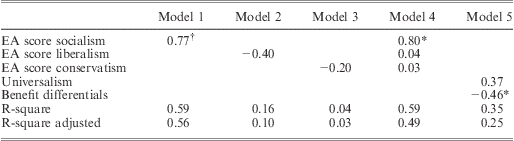
Regressions of Official Development Aid (ODA 1980) on Esping-Andersen's Regime Scores, Universalism and Benefit Differentials for Sixteen OECD Countries
Note: data from Esping-Andersen and Noël and Thérien.
*significant at p < 0.10, †significant at p < 0.05. Tests are two-tailed.
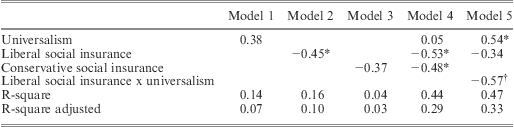
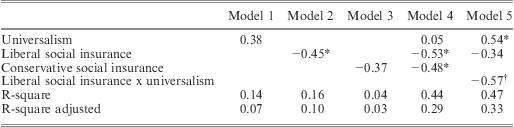
Regressions of Official Development Aid (ODA 1980) on Social Insurance Regime Scores for Sixteen OECD Countries
Note: data from Esping-Andersen and Noël and Thérien.
*significant at p < 0.10, †significant at p < 0.05. Tests are two-tailed.
Models 1 to 3 of Table 3 confirm Noël and Therien's main findings concerning the effects of Esping-Andersen's regime scores on ODA: the socialist regime score has a strong positive impact on ODA, while liberal and conservative scores exert only weakly negative and non-significant effects. Model 4, moreover, shows that the effects of liberalism and conservatism scores are neutralized by the strong impact of socialism when ODA is regressed on the three regime scores.
The EA socialism score was constructed on the basis of two indicators: benefit differentials and universalism. These variables have a weak and positive correlation, but Esping-Andersen treated them as if they were strongly negatively correlated. Since the two variables clearly measure different things, what happens if they are used jointly to predict ODA? Model 5 of Table 3 shows that the effects of the two indicators are far weaker than the effect of the composite socialism score. The positive effect of universalism is not significant, and the effect of benefit differentials is significantly negative. This preliminary analysis shows the extent to which Noël and Thérien's institutional theory concerning the positive causal impact of universalistic welfare state institutions on ODA rests on their unquestioned acceptance of the invalid EA socialist score as the relevant predictor. The evidence they presented for this theory becomes more problematic once one recognizes the role that is played by the outcome variable of benefit differentials, which is hidden inside their key predictor.
Models 1 to 3 of Table 4 regress ODA separately on each of our social insurance regime scores. As can be expected from Model 5 of Table 3, universalism has only a weak positive effect. The effects of the conservative and liberal scores are negative, and the liberal score is significant, though only at the 10 per cent level. In Model 4 of Table 4 it also appears that the effect of universalism vanishes when ODA is regressed on the three social insurance regime scores. The negative effects of liberal and conservative social insurance become somewhat stronger in Model 4, and both are significant at the 10 per cent level. Compared to how the original Esping-Andersen scores perform (see Models 1 to 4 of Table 3), these findings suggest that when welfare regimes are cast in terms of social insurance, it becomes more difficult to support a causal connection between foreign aid and differences in welfare states.
However, there may be a more complex causal connection of this kind. In section 4 we showed that ‘typically socialist countries’ are characterized by low scores on liberal and conservative social insurance, while they score highly on universalism (see Table 2). In the context of our social insurance approach, the high performance of those countries in dispensing development aid might be explained by the negative interaction effects between universalism, on the one hand, and liberal and conservative social insurance on the other. Model 5 of Table 4 presents at least partial evidence for this hypothesis. There is a positive main effect from universalism and an equally strong negative interaction effect with liberalism. The coefficients of Model 5 suggest that universalism has no effect on ODA in countries with markedly liberal social insurance, but has a strong positive effect in countries scoring low on liberalism.
We will not explore this matter further here. Noël and Thérien were certainly correct to point out that socialist welfare states tend to be relatively generous when it comes to distributing development aid. Yet, by uncritically accepting Esping-Andersen's index scores they drew invalid conclusions regarding the causal mechanism. Universalism by itself does not determine the level of ODA. It is either the specifically socialist type of universalist social insurance that affects ODA, or perhaps other aspects of socialist welfare states, outside the purview of social insurance.
Conclusions
Our message has been that Esping-Andersen's operationalization of welfare regimes, which led to his famous typology of ‘three worlds of welfare capitalism’, is not valid. Attempts to reassess the typology using improved and more recent data by Scruggs and Allan do not fix this problem.Footnote 45 One way to construct a valid measurement model on the basis of Esping-Andersen's indicators is to restrict the empirical basis to his five social insurance characteristics of welfare states. We proposed a ‘social insurance model’, which satisfies the requirement of construct validity for all available data and argued that it preserves the core of Esping-Andersen's insightful historical approach to welfare state differences. In our critical analysis of this approach, we showed that the validity problems with the EA measurement model are mainly caused by Esping-Andersen's characterization of the socialist regime dimension in terms of a negative association between universalism and benefit differentials. We think this move was necessary in order to make up for the lack of an indicator that measures the specific institutional features of social democratic welfare states he identified in his theory: uniform state insurance for unemployment, sickness and old age.
The taxonomic exercise that we presented in section 4 illustrates the importance of this point. When Esping-Andersen's own methods for classifying countries are followed, our comparison of the typology of Three Worlds with the one derived from the social insurance model for the original 1980 data shows only two systematic differences. First, the removal of the troublesome indicator of benefit differentials from our model leads to a more restricted set of liberal countries, as Canada and Switzerland combine liberal characteristics with a high degree of universalism. Secondly, the uniquely ‘socialist’ status of Denmark, Norway and Sweden in Esping-Andersen's typology is reproduced in our typology by regarding their positions on all three dimensions. They combine a high degree of universalism with low scores on liberalism and corporatism. Even though the welfare state dimension of social insurance coverage says little about the way in which insurance programs are actually organized, the comparatively low occurrence of liberal and conservative institutional features in the three universalist Scandinavian countries is perfectly compatible with Esping-Andersen's theoretical view that these countries are committed to the principle of uniform state insurance.
This is not to say that we attach much importance to our social insurance typology. As shown with Scruggs and Allan's new data, country typologies are not hewn in stone. They change over time in ways that may be analysed by reviewing the reasons for shifts in the indicators underlying the dimensions in which countries are placed. We agree with Shalev's assessment that Esping-Andersen's key contribution in Three Worlds might be better understood as offering a dimensional interpretation, rather than a typology of country cases.Footnote 46 In our view, the value of identifying valid dimensions in which welfare states can be placed is not the descriptive salience of country scores in a typology, but rather the explanatory power of the dimensions. This recognition leads to the main implication of our analysis: the substantive conclusions of studies that use Esping-Andersen's original regime scores as independent variables in causal models may have to be re-evaluated. Even apart from questions about the quality of the original indicator data, there is an important motivation to return to such studies. The plausibility of any quantitative causal statement requires valid measures of all variables. For research in which the key independent variables are operationalizations of latent dimensions – welfare regimes in the present context – the underlying measurement model must first be accepted as valid before assessing the causal meaning of correlational evidence linking the independent to the dependent variable.
If this requirement is not met, as it is not with Esping-Andersen's regime scores, then the mapping of causal theory on relationships between variables in the data analysis is likely to be inaccurate, quite apart from whether those relationships can be upheld on statistical grounds. Such inaccuracies may generate misleading conclusions. It is not always easy to provide clear instances of causal research suffering from this defect, because the theoretical framework needs to be spelled out quite clearly in order to show where problems arise. This is why we spent some time on a re-examination of Noël and Thérien's theoretically explicit hypothesis concerning the impact of the universalistic welfare state on foreign aid and called the authors’ results into question. Their data analysis depends on the invalid association between universalist social insurance coverage and benefit differentials contained in Esping-Andersen's socialist regime score. Hopefully this study will provide motivation to return to other theoretically informed empirical work in the field of comparative welfare state research that bases its causal conclusions on the acceptance of Esping-Andersen's welfare regime scores.