Seed predation by native and alien rodents can limit plant recruitment and ultimately affect forest dynamics and composition (Campbell & Atkinson Reference CAMPBELL and ATKINSON2002, Côté et al. Reference CÔTÉ, FERRON and GAGNON2003, Hulme Reference HULME1998, Sánchez-Cordero & Martínez-Gallardo Reference SÁNCHEZ-CORDERO and MARTÍNEZ-GALLARDO1998). Even partial consumption of seeds by predators may affect plant community structure, though its importance is poorly understood (Steele et al. Reference STEELE, KNOWLES, BRIDLE and SIMMS1993, Vallejo-Marín et al. Reference VALLEJO-MARÍN, DOMÍNGUEZ and DIRZO2006). Despite consumption of relatively large portions of seeds by herbivores, seeds can retain their ability to germinate if the embryo remains intact (Dalling & Harms Reference DALLING and HARMS1999, Janzen Reference JANZEN1972, Mack Reference MACK1998). Germination of damaged seeds may be accelerated or prolonged (Karban & Lowenberg Reference KARBAN and LOWENBERG1992, Koptur Reference KOPTUR1998, Vallejo-Marín et al. Reference VALLEJO-MARÍN, DOMÍNGUEZ and DIRZO2006). Damage by seed pests also facilitates ageing stress; which manifests as decreased seedling vigour, decreased seed viability, lower germination percentages and slower germination rates (Priestley Reference PRIESTLEY1986).
Palaeontological evidence indicates that Polynesia lacked rodents until they were introduced by human colonists. Beginning about 3000 y ago, the Polynesian rat (Rattus exulans Peale) was transported and became established with Polynesian settlers (Matisoo-Smith & Robins Reference MATISOO-SMITH and ROBINS2004, Wilmshurst et al. Reference WILMSHURST, ANDERSON, HIGHAM and WORTHY2008). Black rats (Rattus rattus L.) invaded the Pacific after European contact. Introduced rats depredate seeds of various plant species throughout the South Pacific (Allen et al. Reference ALLEN, LEE and RANCE1994, McConkey et al. Reference MCCONKEY, DRAKE, MEEHAN and PARSONS2003) and may have played a significant role in the prehistoric collapse of native palm forests in Hawaii (Athens et al. Reference ATHENS, TUGGLE, WARD and WELCH2002) and on Easter Island (Rapa Nui, Hunt Reference HUNT2007). Rattus rattus has been implicated as the primary contemporary consumer of dispersed fruits and seeds of Pritchardia hillebrandii (Kuntze) Becc. (Shiels & Drake Reference SHIELS, DRAKE, Turner, Merritt, Clarke, Commander and Dixon2007), a species of conservation concern, and Pritchardia kaalae Rock (Arcand et al. Reference ARCAND, BEACHY, BURT, COSTELLO, DURAND, KEIR, PALUMBO, ROHRER, SALBOSA and SOUZA2003), a federally listed endangered species (USFWS 2003). Middens of partially eaten fruits and seeds have been found within a relic P. kaalae population (Pérez, pers. obs.). However, it is not known if partially eaten seeds of Pritchardia retain the ability to germinate and become established.
We tested the extent to which rats damage seeds of P. hillebrandii and P. kaalae, and whether germination of these two palm species is affected by simulated seed herbivory (partial removal of endosperm). Specifically, we tested the hypotheses that (1) final germination percentage (FGP) decreases and (2) mean time to complete germination (MTG) increases with increasing levels of endosperm removal.
Pritchardia fruits were collected between July and September, 2002. Ripe fruits of P. hillebrandii were harvested randomly from nine cultivated trees growing in Kalāheo, Kaua'i (21°54′N, 159°35′W, elev. 29 m). Fruits of P. kaalae were collected from 57 trees of a wild population growing within lowland mesic forest on the ‘Ohikilolo Ridge, O'ahu (21°30′N, 158°11′W, elev. 933 m). Fruits were stored in open trays on a laboratory bench-top (Honolulu, Hawai'i) at about 25 °C. Experiments began approximately 3 wk after collection. Seeds were extracted from pericarps by squeezing drupes with pliers and then soaked in a 70% ethanol solution for 5 min followed by a 20-min soak in 0.5% sodium hypochlorite to reduce chances of microbial infection. Seeds (n = 15) of P. hillebrandii are smaller, averaging 1.1 g (dry mass) and 0.8 cm3, than P. kaalae (averaging 4.0 g, 6.2 cm3).
Four levels of endosperm removal were applied randomly to seeds. The treatments were no damage (0% mass removed), minimally damaged (c. 15%), moderately damaged (c. 45%) and severely damaged (c. 75%). To keep the embryo intact, endosperm removal began on the hemisphere opposite the operculum. Endosperm removal was achieved by cutting seeds with hand-held ratchet pruners (Corona Clipper, Inc. Corona, CA) and a Dremel Rotary Tool (Model 750, Dremel, Racine, WI).
Pritchardia seeds possess only morpho-physiological dormancy and germination may be spread over 21 wk after shedding. Therefore, dormancy in the test species was alleviated by removing seeds from fruits and using temperature, moisture, and light conditions outlined previously (Pérez et al. Reference PÉREZ, CRILEY and BASKIN2008). For both species, 15 seeds were treated, with four replicates per treatment. Seeds were sown in sterilized, moist sphagnum moss in clear plastic trays (15 × 12.5 × 4.5 cm). Trays were randomly blocked in a germination chamber set at 30 °C with a 12-h daily photoperiod (80 μmol m−2 s−1, cool white fluorescent light). Germination was recorded weekly until 1 wk after the last observed germination (week 7) and counted when the embryo dislodged the operculum. Due to fungal contamination in the sphagnum moss, all seeds were sprayed with a 1% solution of Captan 50-WP (ICI Americas Inc., Wilmington, DE) after 3 and 24 d of incubation.
Mean time to germination was calculated as MTG = ∑ (f x)/∑ f; where f is the number of seeds germinated on day x and x is the number of days after sowing (Furutani et al. Reference FURUTANI, ZANDSTRA and PRICE1985). Per cent germination data were arcsine-transformed prior to performing analysis of variance on FGP and MTG using GLM in SAS version 9.1 (SAS Institute, Cary, NC). Post hoc mean separation was by Duncan's Multiple Range test at α = 0.05.
Twelve adult rats (R. rattus) were captured from wild populations in mesic forest sites within the Wai'anae Mountains, O'ahu, transported to the University of Hawai'i Lyon Arboretum Rodent Housing Facility, and held in 38 cm × 22 cm × 18 cm metal-mesh cages (one rat per cage). Rats were allowed to acclimate for at least 1 wk before beginning feeding trials and between feeding trials, during which time they were fed a diet of mixed seeds (e.g. corn, sunflower, wheat, barley, oats, sorghum) and fruit wedges (tangerine). Rats were checked daily in order to ensure ample food and fresh water.
Two feeding trials took place, one for P. hillebrandii and one for P. kaalae. These were separated by 11 d and the same 12 rats were used for each trial. Prior to each trial, seeds were individually weighed and sealed in plastic bags. Three additional conspecific seeds were weighed and placed in bags which were opened and placed next to cages during the feeding trials to account for seed mass changes due to environmental hydration or dehydration. During each trial, one seed was placed in each cage and exposed to a rat for 48 h. Seeds were inspected after 24 and 48 h, after which all control and trial seeds were collected and reweighed. Loss of seed mass was determined after accounting for change in mass of control seeds. If present, the condition of the embryo was also noted after rat exposure.
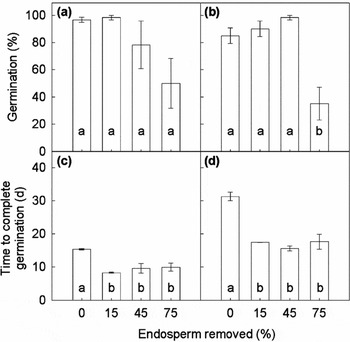
Mean FGP for P. hillebrandii and P. kaalae remained above 75% for up to 45% endosperm removal. Additionally, for both species, FGP in the minimally damaged (15%) and moderately damaged (45%) seeds did not differ significantly from undamaged seeds (Figure 1a, b). However, FGP dropped considerably when seeds were severely damaged; P. hillebrandii decreased to 50% (F 3,9 = 3.54, P = 0.06; Figure 1a) and P. kaalae to 35% (F 3,9 = 54.9, P < 0.0001; Figure 1b).
Germination of Pritchardia hillebrandii and Pritchardia kaalae seeds after removal of 0, 15, 45, or 75% of endosperm. Mean final germination after 49 d for P. hillebrandii (a) and P. kaalae (b). Mean number of days to complete germination for P. hillebrandii (c) and P. kaalae (d). Error bars denote SE, and N = 4 for each treatment. Columns within each panel with different letters are statistically significant at α = 0.05 according to Duncan's Multiple Range test.

MTG for both species was greatest when endosperm remained intact (Figure 1c, d). Pritchardia seeds experiencing any level of simulated herbivory germinated approximately two times faster than control seeds (P. hillebrandii, F 3,9 = 9.84, P = 0.003, and P. kaalae, F 3,9 = 25.3, P = 0.0001). Additionally, germination at any level of endosperm removal tended to be more rapid for the smaller-seeded species (P. hillebrandii) than for the larger-seeded species (P. kaalae; Figure 1c, d).
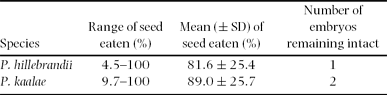
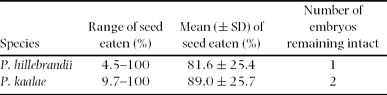
Each of the 12 rats ate at least a portion of the offered seeds of both Pritchardia species, and on average > 80% of each seed was eaten (Table 1). With the exception of one rat that was offered P. kaalae, all seed damage occurred within 24 h for both species. In many cases, the entire seed was consumed (2/12 P. hillebrandii and 6/12 P. kaalae). Only one seed of each species was chewed < 45%, and few embryos remained intact (Table 1).
Summary of Rattus rattus feeding trials. Each of the two species of Pritchardia seeds were individually offered to 12 rats (one seed per rat) for a 48-h period. The loss in seed mass (g) due to rats eating individual seeds was used to calculate the percentage of seed eaten. The total number of embryos remaining intact was out of 12 possible embryos for each Pritchardia species.
Most seeds germinated even when up to 45% of their endosperm was removed. Moreover, damaged seeds germinated faster than undamaged seeds. Our trials confirmed that Pritchardia seeds can suffer damage comparable to that which we simulated experimentally. Most Pritchardia seeds eaten by rats will die. However, the few seeds that are damaged by up to 45% may be affected by more rapid germination.
The ability to germinate when partially damaged may be due to the relatively large seed sizes of both species. Experimental and descriptive studies have found that large-seeded species retain the ability to germinate after approximately half of the seed mass was removed from Quercus phellos (Steele et al. Reference STEELE, KNOWLES, BRIDLE and SIMMS1993), four large-seeded tropical species from Papua New Guinea (Mack Reference MACK1998), and two large-seeded neotropical species (Dalling & Harms Reference DALLING and HARMS1999, Dalling et al. Reference DALLING, HARMS and AIZPRUA1997). A greater abundance of nutritive reserves in larger seeds is the likely explanation for this pattern of germination by damaged seeds (Dalling et al. Reference DALLING, HARMS and AIZPRUA1997, Mack Reference MACK1998). While both Pritchardia species withstood removal of nearly half of their seed mass, more severe damage impaired germination. As demonstrated in the captive feeding trials, rats most often severely damaged (> 75%) Pritchardia seeds, suggesting that most seeds will be killed by rats and the few seeds that may survive will be those damaged < 45%.
The most rapid germination in this study occurred in damaged seeds. This result was contrary to our hypothesis that germination is delayed (i.e. MTG increases) with increasing damage. Rapid germination of Pritchardia seeds after damage suggests that structures covering the embryo may partly control germination. A thickened endocarp, seed coat, or dense endosperm can present a barrier to imbibition and germination (Pérez et al. Reference PÉREZ, CRILEY and BASKIN2008, Vallejo-Marín et al. Reference VALLEJO-MARÍN, DOMÍNGUEZ and DIRZO2006). Therefore, removal of at least 15% of the seed may facilitate rapid penetration of available moisture; hence decreased MTG. Accelerated seed germination has been reported across a wide range of species experiencing seed damage levels of < 1% (Vallejo-Marín et al. Reference VALLEJO-MARÍN, DOMÍNGUEZ and DIRZO2006), < 25% (Koptur Reference KOPTUR1998), and 30–60% (Zhang & Maun Reference ZHANG and MAUN1991).
Damaged seeds can both positively or negatively influence recruitment (Côté et al. Reference CÔTÉ, FERRON and GAGNON2003, Janzen Reference JANZEN1972, Reference JANZEN1976; Mack Reference MACK1998). Accelerated germination in partially damaged Pritchardia seeds may be beneficial for minimizing a seed's exposure to seed predators and pathogens. Damaged seeds can have elevated susceptibility to bacterial and fungal pathogens (Ceballos et al. Reference CEBALLOS, ANDARY, DELESCLUSE, GIBERNAU, MCKEY and HOSSAERT-MCKEY2002). Even if seed herbivory or pathogen infection is not immediately lethal, damaged seeds have less resources than non-damaged seeds and this may reduce seedling establishment or survival (Janzen Reference JANZEN1976). It is plausible that damage to fruits and seeds during feeding, while not directly responsible for mortality, may still lead to recruitment failure by breaking seed dormancy when environmental conditions are not adequate for seedling establishment (Koptur Reference KOPTUR1998).
During captive feeding trials, rats damaged all Pritchardia seeds, most of them so severely they were killed. It is likely that rats interacting with these seeds in nature will typically destroy them. The few Pritchardia seeds that are damaged but not killed may experience accelerated germination, and if environmental conditions are favourable such seeds may have a competitive advantage over non-damaged seeds. Therefore, seed consumption does not always result in mortality, even in this example with tropical insular endemics that did not evolve with seed-eating mammals.
ACKNOWLEDGEMENTS
The authors thank Carol Baskin, Richard Criley, Kent Kobayashi, Michael Maunder, Christina Walters, and two anonymous reviewers for their constructive comments. Research funding was provided by the U.S. Army Natural Resources, the Ecology, Evolution, and Conservation Biology program at the University of Hawai'i at Mānoa, National Science Foundation Grades K-12 Teaching Fellowship (HEP) and Achievement Rewards for College Scientists scholarships (ABS).