INTRODUCTION
The last decades have witnessed a dramatic improvement in the survival of breast cancer patients in the Western world (Altekruse et al., Reference Altekruse, Kosary and Krapcho2010; Tabar & Dean, Reference Tabar and Dean2010). This development is commonly attributed to advancement in the early detection of breast cancer (Berry et al., Reference Berry, Corin and Plevritis2005; Schummer et al., Reference Schummer, Beatty and Urban2010) and especially to the wide use of adjuvant therapy for early stage breast cancer patients (Early Breast Cancer Trialists’ Collaborative Group, 2005; Vervoort et al., Reference Vervoort, Draisma and Fracheboud2004). Adjuvant therapy for breast cancer has undergone an especially rapid evolution over the past few years, because of the development of biologic markers such as human epidermal growth factor receptor 2 (HER2) status; quantitative detection of estrogen and progesterone receptors; genetic markers incorporated as prognostic or predictive factors; and a deeper understanding of the impact of age, menopausal status, and estrogen receptor levels on benefits from chemotherapy and endocrine therapy (Carlson et al., Reference Carlson, Brown and Burstein2006; Schummer et al., Reference Schummer, Beatty and Urban2010). Almost every woman with an operated breast cancer will nowadays be advised to receive some kind of adjuvant treatment. Adjuvant therapy is considered essential for eliminating any microscopic tumor cells that might remain in the body, and thus for decreasing the risk of cancer recurrence and improving the chances of survival. Adjuvant therapy may include local radiation therapy to the tumor bed and/or inclusion of the regional lymph nodes, chemotherapy, or hormonal therapy and targeted biological therapy. These approaches are used individually, according to the characteristics of patients and of the tumor. It needs, however, to be emphasized that adjuvant therapy may have side effects that could affect negatively the patients’ quality of life, such as premature menopause, weight gain, mild memory loss, and fatigue (Eifel et al., Reference Eifel, Axelson and Costa2001; Burstein & Griggs, Reference Burstein and Griggs2010; Taylor & Muss, Reference Taylor and Muss2010). Hence, it is recommended that adjuvant therapy be accompanied by supportive care for the patients (Pollard, Reference Pollard, Castiglione and Piccart2009).
Despite the evidence about the effectiveness of adjuvant therapy for treating early-stage breast cancer, an unexpectedly high number of women do not receive it (Shavers et al., Reference Shavers, Harlan and Stevens2003; Curtis et al., Reference Curtis, Quale and Haggstrom2008; Bickell et al., Reference Bickell, Weidmann and Fei2009). The reason is mostly refusal on the part of the women (Bickell et al., Reference Bickell, LePar and Wang2007). A recently published study showed that the characteristics of women who refused adjuvant therapy were older age, comorbidities, less knowledge about the beneficial effects of adjuvant therapy on survival, mistrust of the medical system, and lower self-efficacy (Bickell et al., Reference Bickell, Weidmann and Fei2009). Notably, the last three characteristics reflect the patients’ beliefs.
There is further evidence about the impact of beliefs on cancer patients. For example, studies showed the effect of beliefs about cancer on screening practices (Lannin et al., Reference Lannin, Mathews and Mitchell1998), beliefs about the benefits of tamoxifen on adherence to tamoxifen use (Fink et al., Reference Fink, Gurwitz and Rakowski2004), and beliefs about surgery on the choice of type of surgery (Hawley et al., Reference Hawley, Lantz and Janz2007). It has been found that having relevant information not only helps cancer patients to understand the disease and the treatment, but it also facilitates their decision making and coping (Cassileth et al., Reference Cassileth, Lusk and Bodenheimer1985; Iconomou et al., Reference Iconomou, Viha and Koutras2002). Some of the beliefs held by patients may be detrimental because they are not based on evidence, such as the belief of ~38% of lung cancer patients that air exposure at surgery causes tumor spread, which caused a part of them (19% of the Afro-American sample) to oppose surgery (Margolis et al., Reference Margolis, Christie and Silvestri2003). Findings of this kind demonstrate that the beliefs of patients may affect survival rates. Hence, it is of importance to learn about them so that they can be addressed in a targeted and informed interactive communication between physicians and patients.
Patients’ beliefs are one factor that plays a role in regard to decisions about treatments. In addition, studies show that patients tend to follow their doctors’ recommendations. For example, a study concerning lung cancer found that patients, caregivers, and physicians agreed in viewing the doctor's recommendation as the most important basis for treatment decisions (Silvestri et al., Reference Silvestri, Knittig and Zoller2003). Further, there is evidence indicating the impact of the doctor's attitude on the patient's decision to undergo adjuvant treatment. For example, if the doctor is supportive, and expresses hope in addition to providing matter-of-fact information about the treatment, the patient is more likely to accept the recommendation concerning adjuvant therapy (Tubiana-Hulin & Gardner, Reference Tubiana-Hulin, Gardner, Castiglione and Piccart2009; Chaitchik et al., Reference Chaitchik, Kreitler and Schwartz1992; Kreitler et al., Reference Kreitler, Chaitchik and Kovner1992).
However, studies show that the doctors’ views are not the only basis for the patients’ decisions, and that patients get treatment-relevant information also from other sources, including the internet, and other patients. In order to be better able to address the patients’ beliefs, it is important to learn about the source of the beliefs. A survey of studies about the information sources of cancer patients showed that in descending order, healthcare professionals, medical pamphlets, family, and friends were most used information sources, whereas the internet and support groups were least used. In regard to helpfulness, in descending order, books, healthcare professionals, and medical pamphlets were found to be most helpful information sources (Ankem, Reference Ankem2006). Eight months after diagnosis, the top three information sources used by women with breast cancer were books (64%), the internet (49%), and videos (41%) (Satterlund et al., Reference Satterlund, Kevin and McCaul2003). A recent study showed that >69% of cancer patients reported getting information from a source other than the treatment staff. Younger age, higher income, higher education, complementary and alternative medicine (CAM) use, and reporting shared decision making were related significantly to using additional information sources (Walsh et al., Reference Walsh, Trentham-Dietz and Schroepfer2010).
Accordingly, the major goals of the study were, first, to learn more about the beliefs of breast cancer patients in regard to adjuvant therapy; second, to learn about the attitudes of oncologists concerning adjuvant therapy, specifically about those aspects to which the patients’ beliefs refer; and third, to find out about the sources of the patients’ beliefs.
METHOD
Participants
There were two groups of participants: patients and doctors. The patients were 92 women who had been diagnosed with breast cancer. Their mean age was 61.2 years (range, 53–67). Their disease stages ranged from 1 to 3. At the time of the study 47 were undergoing adjuvant treatment, and 45 had terminated the adjuvant treatment 3–7 months earlier. The group included 75% (n = 69) married women, and 25% who were widowed or single. Ninety-two percent (92.4%) had children. Fifty-two percent (52.17%) had been born in countries other than Israel and had immigrated to Israel at least 9 years earlier.
The doctors’ group included 57 physicians, 23 women and 34 men. Their mean age was 42.3 years (SD = 5.2), ranging from 30 to 64 years. The group included 27 consultant physicians and 30 resident physicians. All doctors were treating oncology patients and their specializations included oncology proper (n = 28), internal medicine (n = 10), gynecology (n = 10), and surgery (n = 9).
The patients and doctors were from different medical centers in Israel. None of the doctors had any contact with any of the patients.
Instruments
Two questionnaires were used: one for the patients and one for the physicians. Both were anonymous.
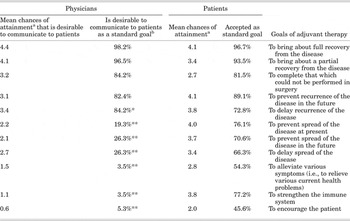
The questionnaire for patients included four sets of questions. The first set referred to background information concerning demographic (e.g., age, place of birth, marital status, number of children) and medical details (kind of adjuvant treatment and date at which adjuvant treatment was started and/or terminated). The second set of questions presented the respondent with a list of 11 goals (see Table 1) and asked the patient to state in regard to each of them (1) whether this was a standard goal for adjuvant treatment (yes or no), (2) if yes, in what percentage of cases is that goal usually attained (100%, 75%, 50%, 25%, <25%), (3) whether the goal was relevant for the patient's case (yes or no), and (4) if yes, the chances that that goal would be attained in the patient's case (100%, 75%, 50%, 25%, <25%). The third set of questions referred to evaluation of the adjuvant treatment that the patient was getting: whether the treatment had any side effects (yes or no), what was the difficulty of the adjuvant treatment in general and for herself (the responses to these two questions were: very difficult, fairly difficult, not so difficult, not at all difficult) and whether she has had doubts concerning the adjuvant treatment (many, medium, a few, none). The fourth set of questions presented the respondent with eight sources of information concerning adjuvant treatment (see Table 2) and asked the patient to rate the importance of each (high importance, medium importance, not a source at all).
Views of patients and of physicians about the degree to which 11 presented goals are standard and the chances of their attainment

aThe values in this column represent weighted means whereby the responses of 100%, 75%, 50%, 25%, <25% were scored as 5, 4, 3, 2, and 1, respectively. Therefore, the higher the value, the higher were the chances of attainment considered by the respondents.
bThe asterisks indicate the results of comparing the percents in the patients’ and doctors’ groups.
*p < 0.05; **p < 0.01.
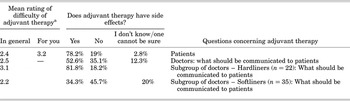
Views of patients and doctors about information concerning adjuvant therapy and its communication to patients

aFor computing the mean rating, the responses were scored as follows: very difficult = 4, fairly difficult = 3, not so difficult = 2, not at all difficult = 1.
The questionnaire for physicians included three sets of questions. The first set referred to basic demographic information (e.g., age, specialization). The second set presented physicians with 11 goals and asked them to state in regard to each goal (1) whether it was desirable to communicate this goal to patients as a goal of adjuvant treatment (yes or no), and (2) if yes, what is the percent likelihood of usually attaining the goal that is desirable to communicate to the patients (100%, 75%, 50%, 25%, >25%) (the list of goals and questions were identical to those in the patients’ questionnaire). The third set referred to what is desirable to communicate in regard to the evaluation of the adjuvant treatments that were administered to patients in general: is it desirable to state that the treatment had side effects (yes or no), and what degree of difficulty of the adjuvant treatment in general should be communicated (these questions were also identical in content to those used in the patients’ questionnaire).
Procedure
The questionnaire to the patients was administered on the ground of the clinic, which the patients visited either in order to get adjuvant treatment or for follow-up checkups. All patients who visited the hospital clinic during a predetermined period were requested to respond to the questionnaire after signing informed consent. The inclusion criteria were a diagnosis of breast cancer and sufficient knowledge of Hebrew to respond to the questionnaire. The refusal rate did not exceed 5%. Assistance from a nurse, a social worker, or a secretary was available for the patients if necessary.
The physicians were from five different medical centers. They were approached individually in the framework of medical meetings or conferences and asked to fill the questionnaire. Approximately 50% of the addressed physicians consented to participate in the study.
RESULTS
Goals of Adjuvant Treatment as Considered by Doctors and Patients
Table 1 presents the percentages of patients and doctors endorsing each of the 11 presented goals as standard objectives of adjuvant treatment. The table shows that only the two following goals—to bring about full or partial recovery from the disease—are accepted by almost all doctors (at least 96.5%) as standard goals that should be communicated to patients. Three further goals—to complete what could not be performed in surgery, and to delay or prevent the recurrence of the disease—were accepted by a majority of the doctors (82.4–84.2%) as standard goals that should be communicated to patients. The rest of the goals were endorsed by <26% of the doctors. There are three goals that most doctors agree that they should not impart to patients: to alleviate various symptoms, to strengthen the immune system, and to encourage the patient. In contrast, patients seem to endorse a higher number of goals: there are eight goals with an endorsement by at least 70% of the patients. Patients tended to endorse more goals than physicians (the mean of endorsed goals was 6.2 for patients and 2.9 for physicians, p < 0.01). A comparison of the percent of endorsement for each of the 11 goals by patients and physicians yielded significant differences in regard to seven goals, which indicates a disparity between patients and physicians in their expectations of adjuvant treatment. As noted, doctors seem to focus on the following goals: to bring about full or at least partial recovery, complete what could not be performed in surgery, and prevent or delay disease recurrence. Patients tend to accept a much broader range of goals as addressed by adjuvant treatment. Notably, none of the 11 goals is endorsed by <45% of the patients. One could conclude tentatively that it seems as if patients do not care that much about the precise kind of goal, as long as the treatment has some kind of goal that appears to be related positively, even if vaguely, to the welfare of the patient.
Similar conclusions are indicated by considering the chances of attaining the goals as viewed by doctors and patients. Doctors show consensus by viewing the chances of attainment as high for the five goals endorsed by most of them as standard goals of adjuvant treatment, and especially high (i.e., >75%) for the first two goals of bringing about full or partial recovery. Patients, in contrast, show fewer consensuses in evaluating the chances of attainment of the goals. Patients consider three goals as having high chances of attainment, that is, to bring about full recovery and prevent recurrence in the future and spread of disease at present, but assign moderate to low probability (50–75%) to six other goals. Comparing the chances of attainment for each goal in the two groups shows that only for the first three goals—bringing about full or partial recovery and completing what could not be performed in surgery—are the chances of attainment assigned by doctors higher than those assigned by patients. In regard to each of the remaining eight goals, the chances of attainment assigned by patients are higher than those assigned by doctors. This suggests that doctors are not completely successful in communicating their relative optimism in regard to the three goals of adjuvant therapy that they consider to be basic. However, comparisons of the means of goal attainment chances across all goals are 3.44 for patients and 2.58 for doctors (p < 0.05). This finding reflects the fact that patients assign higher chances of attainment to a larger number of goals than doctors do. It may tentatively be concluded that whereas doctors would like to inspire optimism in patients by emphasizing the high chances of attainment characterizing three major goals, patients derive their relative optimism precisely from assigning moderate chances of attainment to a whole range of goals that are not endorsed by most doctors.
Both in regard to the goals themselves and in regard to the chances of attaining the goals, doctors are more selective than patients and show more consensuses at least in regard to a few goals. Notably, there is some agreement between patients and doctors especially in regard to the major three or four goals of adjuvant therapy, but the agreement does not extend that much to the chances of attaining these goals that are viewed as higher by the doctors than by the patients.
In addition, the views of patients in regard to the goals and chances of their attainment in general (see Table 1) were compared with the views of patients about themselves: in regard both to goals and the chances of attainment there were no significant differences between the views of the patients about the general case and about themselves. When the goals were ranked in line with the percent of endorsement from 1 to 11, the Spearman rank correlation between the rank orderings for the patients in general and for oneself was high (r s = 0.84, p < 0.01). This indicates that basically the patients tend to consider themselves as representatives of the “general case”, not unique or special in any way, at least insofar as the characteristics of the standard treatment are considered.
Evaluation of the Side Effects and Difficulty of Adjuvant Therapy by Patients and Doctors
The first question in regard to the adjuvant treatment referred to the occurrence of side effects. As could be expected, the majority of patients said that side effects occurred. The surprising finding was the large disparity between the views of patients and doctors in regard to this point. In contrast to the 78% of the patients who agreed that adjuvant therapy had side effects, only 52.6% of the doctors claimed that patients should be told that adjuvant therapy has side effects, whereas 47.4% said that they should be told that it had no side effects or did not always have side effects (Table 2).
Some insight in regard to the abovementioned disparity may be gained by analyzing the responses of two subgroups of doctors, defined on the basis of their responses to the question about what patients should be told in regard to the difficulty of adjuvant treatment. One group included those who endorsed the view that patients should be told that adjuvant treatment is “very difficult” or “quite difficult” (n = 22; 38.6% of doctors) and the other group included those who hold the view that patients should be told that it is “not so difficult” or “not at all difficult” (n = 35; 61.4% of doctors). The findings in Table 2 show a large disparity in the views of doctors of the two groups in regard to whether doctors should tell patients that there are side effects to adjuvant treatment: 81.8% of the former group but only 34.3% of the latter group thought that patients should be told about side effects of the treatment. Therefore, we would tentatively call the doctors of the former group “hardliners” and those of the latter group “softliners.” No significant differences were found between the two groups of doctors in terms of gender distribution, age, and medical specialty.
Table 2 shows that in regard to evaluating the overall difficulty of adjuvant treatment in general, patients provide almost the same response as doctors do (2.4 vs. 2.5, namely, a midpoint between “not so difficult” and “quite difficult”). Again, the mean evaluation of the doctors represents an average between the view of the so-called “hardliners” (3.1) and the “softliners” (2.2). Additionally, in the patients’ group there is a disparity between the evaluation of the difficulty in general and the evaluation of the difficulty in regard to themselves. Notably, breast cancer patients consider the difficulty in regard to themselves to be greater (3.2) than for patients in general (2.4). It may be pointed out that the evaluation of patients of the difficulty in regard to themselves matches the evaluation of the difficulty by the hardliners.
Sources of Information
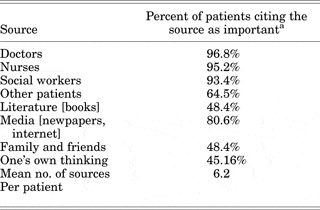
Table 3 presents the responses of the patients about the sources of information concerning adjuvant treatment that they used. It is not surprising that doctors hold the first rank as sources of information for the patients. However, not far behind are listed other sources, mainly nurses, social workers, and the media. Other patients, literature, family and friends, and oneself are listed in the following ranks of frequency, which are, however, still high. The mean number of sources of information mentioned by the patients was 5.9.
Use of different sources of information by the patients

aCiting the source as important includes those who cited it as high or medium in importance.
Doubts About Treatment and Their Correlates
The responses of patients about whether they have had doubts concerning undergoing adjuvant treatment were distributed as follows: many doubts, 16.3%; medium, 18.5%; a few, 27.2%; none, 38%. In order to get an insight into the possible sources of the doubts, two groups of patients were compared in terms of demographic variables and responses to other questions: those who had many or medium number of doubts (n = 32) and those who had only a few or no doubts (n = 60). The two groups did not differ significantly in terms of age, country of origin, stage of disease, type of adjuvant treatment, and considering the adjuvant treatment to be difficult or not difficult. The groups did differ in the following three variables: having comorbidities, number of goals of adjuvant therapy that they endorsed, and number of sources of information that they mentioned. The group that had doubts concerning adjuvant therapy included more patients with comorbidities than did the group that had no doubts (37.5% vs. 18.3%, p < 0.05). The group that had doubts endorsed fewer goals than the group without doubts (4.1 vs. 7.3, p < 0.05). The group that had doubts mentioned using more sources of information than did the group without doubts (6.8 vs. 5.4, p < 0.05).
DISCUSSION
The findings showed several distinct trends in the attitudes of patients and of doctors in regard to different aspects of adjuvant treatment. One notable result refers to the evaluation of different goals attributed to adjuvant therapy. Patients were found to endorse a large number of goals as relevant in regard to adjuvant treatment. Doctors were much more selective in their endorsement of goals and focused on fewer goals. It appeared as if patients did not care that much about the precise kind of goal, as long as the treatment had some kind of target related positively in some form to the welfare of the patient. Further, regarding the chances of attainment of the goals, doctors showed more agreement among themselves than did patients. Doctors assigned higher chances of attainment in regard to a few select objectives whereas patients assigned medium chances of attainment to a broader range of goals. An especially salient finding was the disparity between the attitudes of patients and of doctors in regard to both the relevance of different goals and the chances of their attainment. In regard to over half of the goals, there was disagreement between the attitudes of patients and of doctors, namely, the goals were endorsed by patients, but to a much lesser degree by the doctors. Similarly, in regard to the chances of attainment of the different goals there was disparity between patients and doctors. Major goals that were endorsed by doctors and considered as having good chances of attainment were considered by patients as having lesser chances of attainment, and vice versa. It appeared that patients’ views did not mirror completely the views of their doctors. One reason may be that the views of patients and of doctors served partly different interests. Whereas the interests of patients may have included satisfying the emotional need for comfort and reducing fears and anxiety, the interests of doctors focused more on communicating to patients goals that were evidence based. Notably, our findings showed that patients who had fewer doubts concerning adjuvant therapy endorsed a higher number of goals than did those who had more doubts. This supports the conclusion that endorsement of goals by patients helps patients to decide to undergo adjuvant therapy and alleviate any doubts they may have in this regard.
Another reason for the patient–doctor disparity may be the less than perfect consensus in the views that doctors hold. The fair amount of agreement among doctors in regard to goals and chances of their attainment should not make us overlook the fact that the agreement in regard to these two issues was far from complete. Patients may note this lack of agreement, which may facilitate their tendency to endorse a broader range of goals, some of which are not evidence based.
Finally, a third reason for the patient–doctor disparity in attitudes may be the fact that patients use many different sources of information, and do not rely exclusively on the views and communications of their doctors.
The findings show that patients and doctors hold divergent views also in regard to side effects of adjuvant treatment and the difficulty of the treatment. Patients are aware of the side effects of the treatment and of its difficulty. Doctors are divided in their opinion about whether to tell patients about the side effects or not. In regard to this issue our findings allowed for distinguishing between the so-called “hardliners” and “softliners”. The views of patients, for example about the difficulty of the treatment in general, fall in between the two extremes, but in regard to the difficulty for themselves, it matches the view of the hardliners.
It is of importance to note that in some respects, for example concerning the relevance of goals of adjuvant treatment, breast cancer patients regard themselves as not differing from patients in general. But in other respects, for example, in regard to evaluating the difficulty of the treatment, they consider themselves as being exposed to a more difficult treatment than the average patient.
CONCLUSIONS
In sum, the findings show disparities between patients and doctors, among different doctors, and within individual patients. This indicates the difficulty and complexity for the patient of undergoing adjuvant treatment, and for the doctor of providing the patient the relevant information in a manner that would both be correct in view of the scientific evidence and helpful in view of the emotional needs of human beings to whom the treatment is administered.