On 1 June 1903, more than 1,000 fishermen gathered in the small fishing village of Mehamn at the northernmost point of Norway.Footnote 1 As in the preceding years, the fishing season had been disappointing. Meanwhile, a group of whalers arranged a dancing party in Mehamn, celebrating their abundant whale catches. Conflicts between these two groups had been brewing for years, with the fishermen claiming that whaling was responsible for their poor catches of the commercially important Atlantic cod (Gadus morhua). When the fishermen were refused entry to the party, the situation escalated, leading to a riot that ended in the complete destruction of the nearby coastal whaling station. After this incident, the Norwegian government forbade coastal whaling in northern Norway.Footnote 2 Curiously, a very similar incident occurred a few years later on the other side of the Eurasian continent. On 1 November 1911, after another terrible fishing season, a similar group of 1,100 Japanese fishermen burned down the hated Same-ura whaling station near the port city Hachinohe, also blaming the whalers for their poor catches.Footnote 3
Today, Japan and Norway are some of the last nations that, despite international protests, still conduct coastal whaling, and are widely considered ‘whaling nations’, with a long history of the practice. However, the anti-whaling uprisings that led to the destruction of the whaling stations in Mehamn and Same-ura contest our understanding of a long and widely accepted whaling culture in these countries, as often propagated by pro-whaling advocates.Footnote 4 Demonstrations against industrialized fisheries were quite common at the turn of the twentieth century; however, the anti-whaling protests differed from other conflicts between local fishing communities and large-scale industrializing fishing conglomerates in the important aspect that whalers and fishermen were not competing for the same marine resources.Footnote 5 Why, then, did the fishing communities protest against whaling? Unlike modern-day anti-whaling movements, their desire to protect whales against hunting was not rooted in altruistic concern for the animals’ welfare or their intrinsic value. Rather, the fishermen believed that whales were necessary for bringing fish to the shore, and that hunting them caused environmental pollution that destroyed the local flora and fauna. The concept of ‘moral ecology’ has been used in a number of environmental historical studies to describe the vernacular beliefs and customs of how the poor connected ecological conservation with socioeconomic norms. Following this literature, I argue that the anti-whaling protests were motivated by the fishermen’s sense of a moral obligation to protect the coastal ecosystem against outside intrusion and overexploitation.Footnote 6 Inspired by the Japanese historian Harry Harootunian’s concept of ‘coeval modernities’, I further suggest that the protests following the introduction of Norwegian-style whaling reveals that fishing communities around the world had developed independently from each other very similar understandings of how cetaceans were beneficial to proto-industrial fishing.Footnote 7
A close examination of these ‘coeval moral ecologies’ reveals a more nuanced and diverse interaction between cetaceans and humans than the traditional whaling historiography has so far presented and can help us to better understand the role that cetaceans played in pre-industrial fishing. The knowledge of how to make non-lethal use of whales was collected over decades and transmitted between generations in the form of fishermen’s expertise and local folk tales.Footnote 8 However, with the industrialization of the coast at the turn of the twentieth century, this fishermen’s knowledge came under pressure from pro-whaling advocates, who disregarded the knowledge of local communities as unfounded superstition and asserted that fishing and whaling were in no way related. The refusal of fisheries scientists, politicians, and whalers to take fishermen’s knowledge seriously not only led to the depletion of marine resources and the diminishing of coastal ecosystems, but also ended the centuries-old coastal fishing proto-industries, which had heavily relied on cetacean hunting regimes. After the depletion of near-shore fish stocks and the transition to offshore industrial fishing, the knowledge of how to make use of whales corralling fish close to the shore was forgotten and the narrative of whaling and fishing not being connected dominated the scientific discourse until very recently. Now, thirty years after the end of commercial whaling, and with the recovery of some of the whale stocks, we may see the reappearance of these forgotten cetacean hunting regimes near the coast.
An exploration of the anti-whaling movements in Norway and Japan is intriguing from a global history perspective because it shows the simultaneous connectedness and unconnectedness of the industrialization of different coastal regions in the early twentieth century. On the one hand, we have the successful and rapid dissemination of industrial whaling techniques, first developed in the 1860s in Norway, to distant countries like Japan.Footnote 9 Japanese bureaucrats and would-be whalers not only discussed Norwegian innovations at great length in magazine articles, but also travelled to Norway to learn these new techniques, and hired Norwegian gunners to bring their expertise back to Japan. As a result of this, some Norwegian whalers were even present during the anti-whaling riots in Same-ura.Footnote 10 Furthermore, Norwegian scientific debates regarding the impact of whaling on the fishing industry were translated into Japanese and used to legitimate their own whaling activities.Footnote 11 On the other hand, while the reactions of the local populations to the introduction of industrial whaling were virtually similar in Japan and Norway, there was no mutual knowledge or even contact between the two anti-whaling movements. Even so, these protests were not isolated instances, but part of a global trend: in the first decade of the twentieth century, the shared experiences of ecological and economic decline caused by industrial whaling led to protests not only in Norway and Japan, but also in Russia, Iceland, Scotland, and Ireland, in many cases resulting in new regulations and bans on coastal whaling.Footnote 12
Industrial whaling in Norway
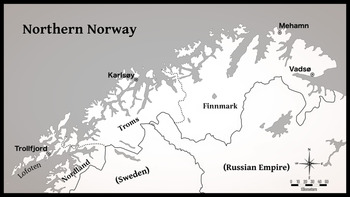
Profiting from the warm water transported by the Gulf Stream, marine wildlife thrives along the coast of Finnmark, the most northerly province of Norway (figure 1). Large baleen whales, such as fin whales (Balaenoptera physalus), roam these waters in order to catch the small capelin fish (Mallotus villosus). Another predator of capelin is the Atlantic cod, which was the main interest of the fishermen. Starting in the 1830s, cod fishing evolved into a proto-industry, with fishermen hunting cod with nets, handlines, and small rowing boats close to the coast, while interregional merchants would bring the dried fish to the markets in Europe. Although this initially brought many immigrants to the north, overfishing would eventually lead to an end of the ‘golden age’ of cod fishing in the 1880s.Footnote 13
Map of northern Norway, c. 1903.

Meanwhile, capitalist fishing enterprises introduced steam engines, trawl nets, and winches, to allow more efficient harvesting of the dwindling coastal fish stocks. The remaining family-based fishing operators could no longer compete with the industrialized conglomerates and feared becoming marginalized. The resulting conflict erupted violently on the Lofoten archipelago in 1890 in the ‘Trollfjord battle’, following which the local fishermen successfully enforced a ban on trawlers and other capital-based fishing gear.Footnote 14
One of the first Norwegian entrepreneurs to experiment with industrial processes for catching and flensing whales was Svend Foyn (1809–84). Born in Tønsberg in southern Norway, Foyn initially forged a career as a seal-hunter, but eventually realized that one blue whale had the value of 300–400 seals. In 1863, he purchased a steamship that had been custom built for catching whales. He established his first industrial whaling station in Vadsø, an all-year ice-free harbour in a fjord in eastern Finnmark near the Russian border, where he perfected his newly developed harpoon cannon. This cannon, which was mounted at the ship’s bow, shot steel harpoons into the flesh of whales, where black powder would explode, killing the animal. This new method allowed for hunting fast rorquals like fin, sei, and blue whales, which had so far not been commercially hunted. In addition to the traditional processing of whale blubber into oil at the station, Foyn developed new products including whale fertilizer, cattle feed, tinned whale meat, and glue from whale bones.Footnote 15
Initially, Foyn was received in Vadsø as a hero, bringing new job opportunities to the fishing village. However, as time passed, waste material from the station would flow out into the ocean, causing coastal pollution. In addition, the whaling vessel occasionally destroyed fishing lines and nets during open sea expeditions. Another reason for complaint was that Foyn only employed people from his hometown of Tønsberg to work at the station, while the locals did not profit from the station. The Norwegian historian Einar Niemi has thus argued that the whaling station came to be viewed as a colony from southern Norway.Footnote 16 When Foyn’s patent ended in 1882, other companies copied his methods and began building their own industrial whaling stations in Finnmark. Foyn himself built another whaling station in the fishing village of Mehamn on the Nordkyn peninsula. Two other stations were also built nearby, and Foyn’s station was later sold to another company. At the time of his death in 1884, full-scale exploitation of the baleen whale population was destroying the whale stocks at an astonishing speed, provoking protests by local fishermen all over Finnmark.Footnote 17
In February 1879, the politician Christian Andreassen submitted a bill to Stortinget, the Norwegian parliament, in which he proposed a ban on all whaling operations in Norwegian waters. According to Andreassen, it was common knowledge among the fishing population that whales played an essential part in cod fishing. Whales would drive capelin towards the shore, and the cod would follow the capelin. With their small non-motorized boats, the fishermen could not venture far out into the open sea and were therefore dependent on whales bringing the capelin and, in turn, the cod closer to the shore. Whaling operations during the capelin–cod run from January to June therefore seriously endangered the cod-fishing operations of the local communities.Footnote 18
In the late nineteenth century, Norway was one of the leading nations in developing new scientific research on the marine environment.Footnote 19 Fisheries scientists were closely intertwined with the Norwegian bureaucracy and approached many issues from the perspective of maximal resource extraction for the national economy.Footnote 20 Petter Holm has argued that the fisheries resource management of this period was a classic case of scientific knowledge being closely related to political goals, as the stakeholders had a short-term interest in overestimating the fish stocks and the ability of the ecosystem to regenerate and rebound from human disturbance.Footnote 21 The Norwegian state also relied on the expertise of fisheries scientists regarding the question of whether whaling had an effect on fisheries. Scientists were sent to Finnmark to investigate the fishermen’s claims in this regard. The first two of these scientists, the zoologists Georg Ossian Sars (1837–1927) and Gustav Adolph Guldberg (1854–1908), came to the conclusion in the 1880s and 1890s that there was no scientific evidence for such an effect. Sars, for example, argued that capelin swam towards the shore by instinct to lay eggs, and that predators like the whales and cod were merely following them. Thus, he suggested that hunting whales would not hurt the cod catches. However, Sars agreed with the fishermen that the whaling operations of the time were unsustainable and would lead to the extinction of the marine mammals. In 1896, as a compromise, Stortinget passed a law forbidding whaling off the coast of Finnmark and Troms from January to the end of May for five years, which was later renewed for another five years. However, the whalers were still allowed to hunt during the rest of the year and in the open waters.Footnote 22
This new law was intended to calm the situation in Finnmark, even though scientists and politicians in Kristiania saw no evidence that whaling and cod fishing were directly connected. However, only one year after the passing of the new whaling law, fish catches were devastatingly low, resulting in renewed protests among the local fishing population against industrial whaling. The fishery inspector Gerhard Sørensen, who ran a successful whaling operation himself, conducted an investigation to learn more about the reasons why the locals were blaming industrial whaling for their losses. He presented his results during an international fishery congress in Bergen in 1898. According to Sørensen, the fishermen expressed five points of concern:
When the whales disappear from the coastal areas, they can no longer ‘stir up’ the deep-sea fish.
The sound of the whale harpoon cannon from the whaling ships is driving the fish away from the land.
The blood of the whale carcasses is contaminating the ocean, scaring the fish away.
Seals are increasing in numbers because there are fewer whales.
The seals are hunting the already declining capelin.Footnote 23
Sørensen’s investigation gives us a rough overview of how fishing communities believed their local ecosystems functioned. As explained above, the fishermen needed whales to bring the fish closer to the coast. In this regard, the ‘stirring up’ was a necessary first step to bring the deep-sea fish to the surface. However, hunting whales not only disrupted the whale–capelin hunting regime, but also disturbed fisheries through the noise of firing the loud harpoon gun. This was a direct criticism of the new techniques, which were considered less suited to a silent hunt than the traditional small, non-motorized fishing vessels. Industrial whaling also caused widespread pollution, either from injured whales bleeding out in the open ocean or waste products being thrown into the sea by the workers at the whaling stations. In both cases, marine wildlife was negatively impacted. A further ecological consequence of removing whales from the ecosystem was the sudden appearance of seals coming to the Norwegian coast. The seals not only destroyed the stationary nets of the locals, but also competed with the cod for capelin. The fishermen linked this new menace with the whaling industry, claiming that the whales had kept the seals away in the past, and that, as the whale stock was being reduced, the seals had fewer natural enemies left so came in greater numbers.
In 1900, the Norwegian parliament established a national board for sea fisheries, one of the duties of which was to undertake scientific whaling investigations. The zoologist Dr Johan Hjort (1869–1948), the successor of Sars, as the person responsible for the scientific investigation of fisheries, was assigned to collect the necessary data on which the law should be based.Footnote 24 In October of the same year, Hjort boarded the newly built research steamship Michael Sars to travel north. Gerhard Sørensen was the captain of the ship. Hjort stayed in Finnmark for over a year, measuring water temperatures and the salinity of the currents, taking probes of plankton, and analysing catch statistics and the behaviour of fish and whales. He established good working relations with Sørensen and other whalers, inspecting their whaling ships and stations. During public discussions, he would often take the side of the whalers. Therefore, some of the locals accused Hjort of being a representative of the whaling lobby. Nevertheless, he also initiated contact with the independent fishermen and accompanied some of them on their boats during their fishing activities.Footnote 25 Moreover, like many of his colleagues, Hjort viewed the marine ecosystem as static and resilient, believing that intensified human fisheries had only a negligible influence on the fish stocks. He held that poor fish catches could be explained by naturally occurring cyclical fluctuations that could eventually be predicted. Based on this logic, the introduction of new industrial technologies would only increase the output, while not endangering the underlying marine stock.Footnote 26
In 1902, Hjort published the results of his investigations under the title Fiskeri og hvalfangst i det nordlige Norge (Fishing and Whaling in Northern Norway). In this book, he dismissed most of the fishermen’s arguments. For example, he saw no direct relationship between whaling and the emergence of the seals. He placed great emphasis on the different feeding habits of the individual whale species. He claimed that blue, sei, and humpback whales fed mainly on small zooplankton, while sperm and bottlenose whales would dive for squid, thus suggesting that only fin, minke, and killer whales would hunt fish, including capelin. While the first two whale types did not interfere with the fishing industry, the matter was more complicated for the fish-hunting whales, particularly the fin whales. Fishermen had long known that fin whales appeared near herring and capelin swarms; thus, they were known locally as ‘herring whale’ (sildehvalen) or ‘capelin whale’ (loddehvalen). Hjort had experienced how helpful it was for the fishermen to spot a fin whale on the open sea, because it often indicated the presence of herring or capelin. Without fin whales, finding fish offshore was a matter of pure luck. Hjort agreed with his predecessor, Sars, that capelin would swim towards the shallow waters to lay their eggs in the sand; however, he did not rule out the possibility that fin whales might influence to a lesser degree the route of the capelin swarms, especially when they caused panic among the fish by ‘stirring them up’ and driving them into the coastal nets of the fishermen.Footnote 27 Hjort concluded: ‘For me, it is clear that the whales’ help in the catch is essential; this justifies for me to regard fin whales as useful animals for the fishermen.’Footnote 28 Based on this assessment, he proposed changing the first paragraph of the 1896 law regarding the ban of whaling to the following: ‘It shall be forbidden to hunt, wound, or bring to land a fin whale (Balaenoptera musculus) between the first of January and the end of May.’Footnote 29
Hjort’s conclusions were both revolutionary and conservative. He acknowledged that fin whales helped the fishermen because they stirred up capelin near the shore, making it easier for the cod to find the capelin and thus for the fishermen to hunt the cod. Yet his proposal was even more limited in scope than the existing legislation. He wanted to ban only fin-whale hunting and allow the hunting of other whale species. The fishermen were unhappy with this solution because they already thought the previous law was too weak. However, as is the case in every compromise, the other side was also unhappy: the whalers complained that Hjort had omitted the passage that allowed them to hunt fin whales on the open sea, where the previous law had only banned coastal whaling. Moreover, fin whales were the whalers’ main interest in northern Norway, and spring was the best season for hunting this species.Footnote 30
Riding to parliament on a whale’s back
Meanwhile, the situation in Stortinget became even tenser with the rising popularity of the Norwegian Labour Party (Arbeiderpartiet). This new socialist party was especially strongly supported among the fishermen in the northern periphery of Norway. Dr Alfred Eriksen (1864–1934), a priest and the mayor of the fishing village Karlsøy in Troms county, was the charismatic leader of the party. In Eriksen’s eyes, the northern fishermen represented the proletariat that was threatened by the fish merchant capitalists and whaling companies. In the preceding years, many coastal fishermen had lost their independence and become contract workers in the deep-sea fisheries. Eriksen gave the frustrated fishing population a voice in his socialist magazine Nordlys (Northern Lights), founded in 1902, where he also criticized capitalist whalers. In one article, he attacked Hjort’s book as an ‘apologia for the capitalists’ in which the ‘unanimous opinion and experience of the fishermen count for nothing’.Footnote 31 In a letter to the parliament in January 1903, Eriksen demanded ‘an effective and complete ban on whaling’.Footnote 32 He further proclaimed: ‘When Dr Hjort states that whales only serve as visional [an anchor point for finding capelin] and have otherwise nothing to do with the fishing operations, then this is in the highest degree misleading. The fishermen are professionals, and their practical experiences say the contrary.’Footnote 33
Eriksen presented the fishermen as the ‘professionals’, who had greater credibility than Hjort in his eyes owing to their experience gained over a longer time. This shows that, for Eriksen, it was not relevant whether data were gained according to scientific standards; rather, he held the view that a longer duration of data gathering was more reliable. The fishermen had observed the local ecosystem for centuries and transmitted their knowledge from generation to generation, while Hjort could only refer to his one year of research. Eriksen further argued that Hjort’s scientific methods were limited in their reach and could only explain some elements of the feedback loops of the ecosystem:
Dr Hjort’s view is that fluctuations in fish stocks are solely connected to changes in the water temperature and the condition of the currents. These things have surely their part in it, but they are not the only determining factors. We had before colder temperatures in the ocean, without having bad catches. It must be recognized that these things alone cannot explain the temporal fluctuations in the fishing year by year.Footnote 34
Eriksen also challenged Hjort’s conclusion that the increase in seals had no relation to the decline of the whale stocks. Eriksen explained that whales, especially orcas, were known for hunting seals; thus, when the whales disappeared, the seals had no natural enemies and would come to Finnmark to eat all the fish. Banning only fin whales, as Hjort had proposed, would neglect the reality that other whale species also played an essential role for fisheries.Footnote 35
Similarly, in his critique of Hjort’s research, Eriksen painted a picture of whales being the central figure of a deeply interconnected marine ecosystem. He argued that scientists like Hjort failed to see all these connections because their scientific methods were only able to measure a fraction of the connectivity. The fishermen had observed many changes in the environment such as colder water temperatures over generations; therefore, he maintained that they had a ‘better grasp’ on how the feedback loops in the ecological system worked. Eriksen’s argumentation resembles in many ways how today’s anthropologists describe the concept of ‘fishermen’s knowledge’. In contrast to fisheries management based on scientific knowledge, which often tends to simplify ecosystem feedback loops in order to increase production and attempt to make the feedback loops predictable, fishermen’s knowledge takes a holistic approach and applies imperfect heuristic rules. Such a knowledge system considers countless qualitative variables on a case-by-case basis, instead of relying on a small number of quantitative variables.Footnote 36
While Eriksen was arguing with other politicians in the capital, the situation in northern Norway escalated. The seasonal cod catches of 1901 and 1902 had been underwhelming. There were already reports of people starving when it became clear that the 1903 catch would be even more disastrous. On the other side of the border, the Russian government had forbidden whaling off the Russian coast, further increasing the feeling of the fishermen in Finnmark that their government had forgotten about them. In May 1903, seals appeared in large numbers along the Norwegian coast, causing further damage, while the parliament once again delayed a final decision about the whaling question.Footnote 37
This was the backdrop when the situation escalated on 1 June 1903 in Mehamn, where over 1,000 fishermen were involved in destroying the whaling station. When the military arrested twenty-four of the rioters a few days later, the situation had reached a tipping point. It was exacerbated by the fact that the locals regarded the arrested men as national heroes and held gatherings in their honour. Rumours that many rioters hoped that Russia would intervene on their behalf spread to Kristiania. Allegedly, Eriksen and his conspirators had already met with the Russians in secret. The Norwegian government had long feared that Russia sought to annex Finnmark to gain access to an ice-free harbour.Footnote 38 Eriksen himself denied being involved in any conspiracy, but he expressed sympathy with the rioters.Footnote 39 An article in his newspaper Nordlys laid the blame for the violence on the politicians in the capital, who had provoked this reaction through their inaction with regard to a new anti-whaling law.Footnote 40
During the next election, in the autumn of 1903, the Norwegian Labour Party profited directly from this incident. Eriksen and four other representatives of the party were elected into the national parliament for the first time. All five representatives came from the three northern provinces. It was said that they were riding ‘to parliament on a whale’s back’.Footnote 41 With the possible threat of Russian intervention, the dissatisfaction of the fishermen, and the political rise of the labour party, the politicians in Kristiania had more than enough reasons to finally settle the whaling question. The arrested rioters were not charged with treason, but only with minor offences such as vandalism. Twelve were found not guilty, while ten were sentenced to bread and water for ten to twenty days, and two were fined.Footnote 42
Eventually, the parliament decided to revise the 1896 whaling law. From February 1904 onwards, it was forbidden in the three most northerly provinces of Norway to kill or shoot a whale, or bring one to the shore, for a period of ten years. The eleven whaling companies that had been operating in northern Norway up to that point were reimbursed a total of 419,800 kroner for their losses.Footnote 43 This decision marked the end of coastal whaling in northern Norway. The ousted Norwegian whaling stations had no choice but to look for other whaling grounds. For some years, these companies had been expanding their operations to other regions owing to the rapid decline of the Norwegian whale stocks. The reimbursement from the Norwegian government gave them a sufficient ‘war chest’ to invest in new whaling opportunities all over the world.
Meanwhile, the whaling industries of many other nations were in a slump: sperm and right whale stocks were overexploited and in steep decline, while new investments in petroleum extraction had caused a collapse of sperm-whale-oil prices. However, the new industrial whaling technologies developed by Foyn not only allowed Norwegian whalers to hunt a wider range of whale species but also furnished them with more effective techniques for harvesting whale carcasses and supplying new products such as canned whale meat, whale fertilizer, cattle feed, and margarine. Most of the Norwegian whalers expanded their operations to Iceland, Svalbard, Shetland, and the west coast of Ireland. Many faced similar protests as in their home waters, as they were regarded as ‘foreign invaders’ who were negatively impacting local fisheries.Footnote 44 In the 1910s, Norwegian whalers could also be found off the coasts of Chile, Australia, South Africa, Alaska, and Brazil.Footnote 45 Some Norwegians even made a move to East Asia, where they became involved in a military conflict between Russia and Japan over the control of the Korean peninsula.
Bringing industrial whaling to East Asia
Organized whaling first developed on the Japanese archipelago in the 1570s in the Bay of Ise. Japanese whalers initially used hand harpoons thrown from rowing boats to kill whales that got lost in the mazes of small islands near the coast. In the 1670s, the more sophisticated net-based whaling method was developed in Taiji, a small community on the Kii peninsula in central Japan that is (in)famous today for its dolphin drives.Footnote 46 A crew of more than 300 people would use small boats and large nets to drive whales from the open sea towards coves, where they could be killed. This method was quite successful and in the following decades dozens of whaling groups emerged along the western Japanese coast, all of them situated close to the warm Kuroshio and Tsushima currents. Many baleen whale species migrated on these currents in the spring from their calving grounds in the tropics to feed on the summer plankton bloom in the Sea of Okhotsk.Footnote 47 Following the migration of the whales, western Japanese whalers also tried to establish whaling bases in the northern parts of Honshu and on Ezo (renamed Hokkaido in 1869), but were rebuffed by the local fishermen. While many coastal communities in northern Japan made use of injured or stranded whales, they refused to hunt them actively.Footnote 48 At the end of the nineteenth century, the commercially hunted whale stocks near the Japanese coast had declined drastically owing to indigenous Japanese coastal whaling and the emergence of pelagic American whaling.Footnote 49 A tragic hunt in Taiji, where more than a hundred whalers died during a winter storm in 1878, stands symbolically for the end of the indigenous Japanese coastal whaling activities.
The Japanese Meiji government, which came to power after 1868, tried to revitalize Japanese whaling as part of its push for rapid modernization and industrialization of the empire, following the example of Western imperial powers. With this goal in mind, new technologies and experts were brought to Japan. However, initial efforts to adapt American bomb-lance whaling in Hokkaido, were met with fierce resistance from the local fishermen there.Footnote 50 Sekizawa Meisei, a technical expert working for the Ministry of Agriculture and Commerce, argued in 1888 that these anti-whaling movements represented a severe threat to the industrialization of the fisheries and should be forbidden. Regarding the reasons why the locals opposed whaling, he wrote: ‘So far, when a whale has come close to the shore of Hokkaido, herring and other fishes also gathered close to the shore. When a whale, commonly called Ebisu-sama, was hunted, [the fishermen] thought that this would cause a bad catch of herring [Clupea pallasii] and other fishes.’Footnote 51
Sekizawa countered these claims in the same article, saying that fishermen in Norway had also thought that whales were ‘emissaries from heaven’ (ten no shisha) fulfilling a divine will to bring wealth to coastal areas by drawing capelin closer to the shore. He wrote that, while Norwegian fishermen claimed that fish catches had been decreasing every year since industrial whaling began, recent scientific investigations by Ossian Sars in the region had shown that whaling did not obstruct other fisheries in any way.Footnote 52 Using Norway as an example, Sekizawa argued strongly in favour of introducing industrial whaling to Japan, suggesting that it would help to protect the northern border against an aggressive Russian empire and bring new industrial technologies and capitalistic practices to the coastal periphery.Footnote 53
Ironically, it was Russian whalers who would eventually introduce Norwegian industrial whaling techniques to East Asia.Footnote 54 As Meiji Japan was competing at this time with Russia regarding colonial influence over the Korean peninsula, the Russian advances of building a whaling station in Wonsan (now in North Korea) and securing access to marine resources such as marine mammals in the Sea of Japan were watched with great concern. The Japanese entrepreneur Oka Jūrō (1870–1923) travelled to Norway in May 1899 as a temporary employee of the Ministry of Agriculture and Commerce (MAC) to observe industrial whaling first hand. He purchased a steamship from a Norwegian shipyard and visited the Mehamn whaling station in northern Norway. After arriving back in Japan, he founded his first whaling company, chartered two additional Norwegian whaling ships, and conducted whaling around the Korean peninsula.Footnote 55
After the Japanese victory in the Russo-Japanese War (1904–05), all Russian ambitions on the Korean peninsula came to an end. Oka purchased several Russian whaling ships that had been captured during the war. He also took over the Russian whaling station in Wonsan.Footnote 56 Other Japanese whaling companies emerged and competed with Oka for the dwindling whaling resources near the Korean coast. Norwegians were hired as gunners on all Japanese ships, which caused concerns in Norway that the Japanese would use Norwegian expertise to become a ruthless competitor for worldwide whale stocks within a few years.Footnote 57 The Norwegian embassy in Japan thus had a special interest in documenting the development of the Japanese whaling industry. In 1907, the embassy concluded that the Japanese whaling euphoria had created an economic bubble and that the industry would soon face financial trouble.Footnote 58
Faced with the prospect of overhunting, Japanese lawmakers again looked to Norway and proposed copying the 1896 Norwegian whaling law, which had banned whaling during the summer months to reduce the pressure on the whale stocks. However, the Japanese whaling companies successfully protested against these plans.Footnote 59 Instead, the MAC pressured the whaling companies to merge into one large company. Oka Jūrō was eventually appointed president of the newly formed whaling company, Tōyō Hogei, in 1909, controlling two-thirds of all Japanese whaling ships.Footnote 60
Tōyō Hogei and its remaining competitors constructed industrial whaling stations along the Pacific coast. Between the stations, steamships with ranges of approximately 60–70 nautical miles (130 kilometres) were used. To ensure complete coverage of the coastal waters, each company built a new station every 70–80 nautical miles.Footnote 61 However, at many of the new stations, local sardine and bonito fishermen began to protest against industrial whaling.Footnote 62 The fiercest protests broke out at the new whaling stations in northern Honshu and Hokkaido, where local fishermen had opposed whaling for centuries. The anti-whaling disputes in Same-ura near Hachinohe would eventually result in the complete destruction of the local whaling station.
The whaling dispute in Hachinohe
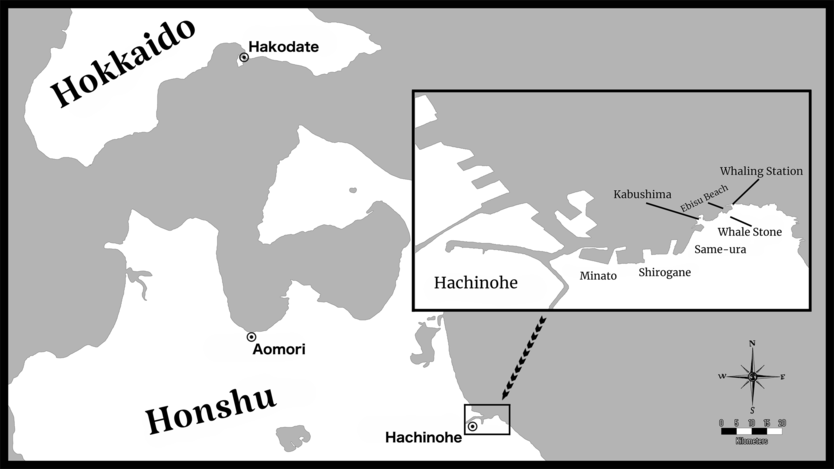
The port city Hachinohe is situated on the most northerly edge of the main Japanese island of Honshu (see figure 2). In 1908, the city boasted around 16,000 inhabitants, with roughly as many people again living in the surrounding fishing and farming outlets. Among these were the three villages of Minato, Shirogane, and Same-ura (all now parts of Hachinohe city). The region is close to the southern shores of Hokkaido, which made it a strategic point for connecting the coastal whaling station network in Honshu with the virgin whaling grounds in the north.Footnote 63 At the turn of the twentieth century, small-scale fishing was the primary occupation in Hachinohe. Many fishermen and farmers left during the summer months to participate in the herring runs in Hokkaido and Karafuto (Sakhalin). Locally, iwashi (sardines (Sardinops melanostictus), sometimes also used to describe anchovies (Engraulis japonicus)) were caught in great numbers, then dried and pressed into fish fertilizer for the rice fields in central Japan.Footnote 64 Sometimes, sardines were also used as live bait to attract the larger katsuo (bonito or skipjack tuna (Katsuwonus pelamis)), which were also made into either fertilizer or katsuobushi, a common ingredient in Japanese cuisine.Footnote 65 New regulations were introduced in the 1870s to boost the fishing industry, which led to massive overfishing and a steep decline in sardine catches in the late nineteenth century. Hachinohe’s economy was hit hard by the declining fish stocks, and social unrest grew.Footnote 66
Map of northern Honshu and the Hachinohe region as seen today.

To counter these developments, the fish fertilizer merchant Hasegawa Tōjirō (1855–1933) developed new fishing gear that allowed fishermen to hunt sardines further offshore.Footnote 67 However, small-scale fishermen were not able to invest in these new methods and remained dependent on fishing nearer to the coast. Even more controversially, Hasegawa tried to diversify the local economy by attracting a whaling company from western Japan. In a secret business meeting, he and some of his closest allies struck a deal with the whaling company Dai-Nihon Hogei (later to be merged with Tōyō Hogei), which would have given Hasegawa’s clique exclusive rights to purchase all whale waste, which they would have been able to transform into whale fertilizer at their fertilizer plants.Footnote 68 However, when this meeting became public knowledge in April 1909, more than 200 fishermen from the fishing village of Minato marched to the mayor’s office and submitted an official complaint.Footnote 69 During a crisis meeting of the Minato fishing union on the following day, the union head, who had so far reluctantly worked together with Hasegawa, had to resign. His successor, Yoshida Keizō (1877–1968), a young fertilizer producer and a rival of Hasegawa, took a decisive stance against whaling. Only a short while later, the fishing unions of Shirogane and Same-ura gave in to similar pressures and voiced their support for the anti-whaling protests.Footnote 70
In the Hachinohe region, several regional newspapers with competing political goals printed dozens of articles on the whaling issue, which allow us to gain an in-depth understanding of how the locals viewed the issue. For example, one fisherman, who opposed the planned whaling station, wrote:
I am but a simple and mostly illiterate fisherman and even without any scientific understanding on how whaling works, I have some opinions [in regard to the whaling question] which are based on what my father has told me and what I have experienced myself …
To begin with, because whales chase sardines to eat them, sardines fear whales just as a sparrow fears the falcon. When sardines see a whale on the open sea they crowd together and try to escape the whale by swimming towards the shore. In this way, it becomes easy for us fishermen to catch [the sardines]. If no whales are around, sardines disperse throughout the open sea, which makes it extremely inconvenient to catch them; it is a lot of work with little reward so we have to give up.Footnote 71
According to the author of the article, whales played a vital role in catching sardines, so without whales coastal fishing would no longer be feasible. He further explained that conducting whaling would result in damaging the livelihoods of hundreds of fishermen, while only a handful of outside whalers would profit from the new industry.Footnote 72 This example demonstrates that the fishermen’s knowledge in Japan, which was based on observation and oral transmission form one generation to the next, was very similar to the knowledge of the fishing communities in Finnmark. The author made a clear reference to knowledge created through scientific methods, which he associated closely with the whaling industry, while arguing that his knowledge as a fisherman was, despite his humble background and illiteracy (which was possibly exaggerated), similarly valuable.
The idea of whaling being harmful to the fishing industry was also discussed in a different newspaper article: ‘Since old times it has been said that a whale coming to the beach would bring seven years of bad catches [of fish], but regarding this, it is a scientific fact that blood and oil of the whales are affecting the sardine catches and other fish species.’Footnote 73 Here, the focus is placed on the effects of whale blood in the water on fish catches, which is presented as a ‘scientific fact’, while at the same time referencing an old proverb.Footnote 74 The article further stressed that, when whale blood and oil float on the water, they obstruct the growth of kombu and nori, which were traditionally harvested by the locals. It also stated that the extinction of these seaweeds would have a cascading effect on the fauna and abalone, and that shells would also wither. The author argued that, ‘even if we would make the assumption that whale oil and blood had no effect on the fishing industry’, the proposed site of the whaling station would threaten the nearby sardine spawning grounds. Furthermore, seagulls nested on the rocks of nearby Kabushima island, and these birds were crucial because their activities guided the fishermen to fish swarms on the open water. The whole rock formation was, therefore, a no-hunting zone for the fishermen. The fishermen were also concerned about the air pollution that would be caused by the flensing and cooking of the whale meat. Winds would drive the stench to the surrounding fishing villages and even to Hachinohe city. In recent years, the Shinto shrine on Kabushima island had become a popular tourist attraction, and the bad odour might discourage future tourists. Finally, the author was concerned not only about the environmental pollution caused by whaling, but also about religious pollution, expressing concerns that polluting a sacred place like the Kabushima shrine would anger the gods.Footnote 75
The complaints of the fishermen eventually reached the prefectural government. Again as with the situation in Norway, the authorities sent a fisheries scientist to verify the scientific basis of the fishermen’s accusations. In June 1909, Professor Kishinouye Kamakichi (1867–1929) from Tokyo Imperial University arrived in Same-ura, staying at the guesthouse of the whaling supporter Ishida Tako. Kishinouye dissected dead fish from a whaling area in order to determine whether an unknown ‘whale poison’ had been the cause of death.Footnote 76 After he had completed his investigation, he stayed in Hachinohe, but avoided speaking in public about his results. Instead, some prefectural officials who had worked together with Kishinouye commented that the investigation had shown that whaling would probably not damage fishing. This short explanation did not convince the locals, who noted that the statements of these officials were ‘more slippery than an eel’.Footnote 77
Eventually, some of the locals were able to locate Kishinouye and convinced him to present his results at a public hearing. More than 300 people came to the presentation, which lasted only thirty minutes. The atmosphere was hostile, and Kishinouye mainly spoke about the benefits of whaling for the industrialization of the region before cryptically stating that he could not be sure that ‘no other factors than whaling could have caused the death of the fish’, leaving open the question of whether or not whaling was having an effect on recorded fish deaths. He acknowledged that he had not conducted this kind of research before and that the experience of the fishermen should be taken into account more in the future.Footnote 78 Kishinouye’s performance did little to convince the locals of the benefits of whaling. A commentator in a local newspaper tried to explain his lacklustre scientific findings:
The scientific principle (gakuri) is only showing the current research. The fact (jijitsu), on the other hand, is a thousands-of-years-old definitive unchangeable thing. The scientific principle is in extreme infancy. … We have to respect science, but the scientific principle, which is only known to a small group [of men], still does not have satisfying explanations for countless phenomena.Footnote 79
It is a fact that all marine creatures have died just at the place where the blood and oil of the flensed whales have poured into the ocean. It is said that it is difficult to know if the cause of the deaths is linked to weather, currents, shortage of nutrients or indeed some obscure poison of the whales, but it can’t be helped as science is today still in its infancy.Footnote 80
Here, the infancy of the scientific principle is presented as the main reason why Kishinouye was unable to determine the cause of the death of the fish. In contrast, the observation of the fishermen is interpreted as an unchangeable fact that is indisputable. With arguments like this the fishermen tried to show the limits of scientific research while legitimizing their own fishermen’s knowledge.
The raid and the aftermath
After two years of intensive debates, Tōyō Hogei eventually received a licence for hunting whales during the 1911 summer season. In March of the same year, three whaling ships arrived in Same-ura, with three Norwegian gunners on board.Footnote 81 The company built a new whaling station near Kabushima Shrine at Ebisu Beach. This further enraged the locals as, according to a local folk tale, at this particular beach a whale who had been the protector god of Same-ura had died after being injured by whalers from western Japan. The locals believed that the whale had not only brought sardines to Same-ura but also rescued a shipwrecked young fisherman. After his death at Ebisu Beach, the body of the whale was transformed into a stone, which can still be seen today at a nearby shrine.Footnote 82
More than 150 people worked at the new whaling station, with an additional 350 people employed at the fertilizer plants owned by Hasegawa and his friends. This made Tōyō Hogei the biggest employer in Hachinohe.Footnote 83 However, most of the workers in the whaling station and on the whaling ships were not locals; rather, they had been hired in western Japan. The Norwegian gunners lived in Ishida Tako’s guesthouse. After work, they celebrated with the other whalers at lavish parties, to the envy of the rest of the population. Some younger factory workers flirted with local women, which was not received well. According to rumours, one of the Norwegian gunners even had a child with a local geisha.Footnote 84
The whalers caught more than 180 whales in the first season. The ships delivered the carcasses over a ramp to the station and they were flensed on dry land. However, most of the blood and oil leaked into the ocean unfiltered. In addition, as Hasegawa and his associates were not able to cope with the large quantities of waste and the whalers could sell on only a small portion of it, the rest was thrown back into the ocean. According to Kondō Isao, a former whaler, the discarding of unprocessed whale waste into the oceans led to clumping of the whale blood, which would sit on the seafloor like mud at around three metres in depth. Flora and fauna in the affected area would then die of a lack of oxygen.Footnote 85 Because the catch had been so successful, the company applied for an extension of its whaling activities to the end of the year. However, when the official approval was delayed, Tōyō Hogei decided that two of the whaling ships should continue to the Korean whaling grounds, while one was to stay behind in Same-ura and continue whaling even without the licence.Footnote 86
For the fishermen, things did not go so well. The sardine swarm that normally reached Hachinohe in September did not come in that year. Inevitably, the fishermen immediately blamed the whaling operation for their poor catches. To make matters worse, the prices for rice rose by more than 20% compared to the previous year.Footnote 87 Further, coastal pollution began to affect the plants and animals at the seashore. Traditionally, the collecting of Sakhalin surf clams (Pseudocardium schalinense) began around Kabushima island every year on 1 November, but in 1911 all the shells had died.Footnote 88
In an emergency meeting on 31 October, Yoshida Keizō, the leader of the Minato fishing union and the unofficial leader of the anti-whaling faction, met with his associates at a nearby guesthouse to discuss the situation. Fishermen came and went throughout the night; finally, the decision was taken to start the raid on the whaling station in the early hours of the next morning.Footnote 89 More than 1,100 fishermen from the surrounding villages were involved in the attack. The rioters clashed with the local police and some of the factory workers at the station. The attack ended in a fiery inferno when the whale oil caught fire during the siege, and two of the attackers were killed. After the station had been laid to waste, the rioters continued their rampage through the streets of Same-ura. They demolished the local police station, the houses of Hasegawa and Kanda (the former Minato fishing union head), and Ishida’s guesthouse. One of the Norwegian gunners was surprised while drinking sake in the guesthouse but got away with a mild shock.Footnote 90
The next day, the military arrested forty people, among them the suspected ringleaders of the riot, including Yoshida Keizō. The police interrogation protocol reveals that the authorities believed that a group of instigators (probably Yoshida and his associates), who had been excluded from Hasegawa’s whale fertilizer deal, had made use of the superstitious belief of the rioters that whale oil and blood had an effect on fishing.Footnote 91 The court proceedings were held in February 1912 in the Aomori District Court. The defence pointed out that the violence had only broken out because Tōyō Hogei had broken the law by continuing whaling activities even after its licence had expired. Without the wrongdoing of the whaling company, the incident would never have happened. It was argued that, as the executive powers had done nothing to stop the company, despite their illegal whaling, the fishermen had been left with no other choice than to use violence.Footnote 92
In a surprising turn of events, Oka Jūrō, the president of Tōyō Hogei, appeared before the court and admitted that part of the guilt lay with his company. Oka no longer tried to deny the fact that industrial whaling caused coastal pollution. He explained that the company had paid compensation money for destroying local flora and fauna in other locations, while no such deal had been agreed upon in Same-ura.Footnote 93 With this admission of guilt, it was finally acknowledged that the rioters had not acted only out of superstition, but that their concerns had been legitimate. In the end, twenty-three of the defendants received prison sentences of between one and eight years, while six rioters were fined 40 yen each. Yoshida Keizō was found not guilty. Only a few months later, upon the death of Emperor Meiji, all of the rioters were granted a general pardon.Footnote 94
Oka’s unexpected admission of guilt allowed him to reconcile with the rioters. He not only paid the compensation for the victims, but also promised to hire family members of the offenders to work at the whaling station. In general, Tōyō Hogei committed to training more locals and hiring them to work in the industry. In addition, the company would help facilitate new industries related to whaling in the region. As a part of this process, Oka terminated the exclusive whale fertilizer contract with Hasegawa and sold whale waste to all interested parties. When he had finally gained the approval of the locals, he immediately submitted a request to rebuild the station. He hired one hundred local fishermen to rebuild the station as quickly as possible, and, in June 1912, whaling commenced again.Footnote 95
Oka’s intervention not only appeased the situation in Hachinohe, but also secured the future of the Same-ura whaling station, which was essential for the further expansion of industrial whaling towards Hokkaido. After 1912, Tōyō Hogei and other whaling companies began to build new whaling stations along the coast of Hokkaido.Footnote 96 The Same-ura whaling station would keep operating until 1933, when Tōyō Hogei closed the station during the Great Depression.Footnote 97 At this time, Japan had just started its Antarctic whaling expeditions, and whale-oil prices were low on the world market. In addition, the whale catches had declined significantly, indicating that the stocks had been overfished. Five hundred jobs were directly or indirectly connected to the whaling station and on that occasion the local community fought fruitlessly to keep the station running.Footnote 98
The coeval moral ecologies of anti-whaling movements
Having analysed the fishermen’s knowledge of the fishing communities in northern Norway and northern Japan, we can now return to the question posed at the beginning of this article: why did whalers and fishermen come into conflict with each other when they were interested in harvesting different marine resources? In Norway and Japan alike, the local fishing populations seem to have believed that the presence of whales near the coast was paramount for a successful coastal fish catch. Moreover, they maintained that hunting whales would cause environmental pollution, destroying the coastal flora and fauna. However, we must consider to what degree we can believe the fishermen’s claims that whales were necessary for proto-industrial fishing. To date, historians writing about either of the two incidents discussed above have mostly sided with the fisheries scientists and whalers.Footnote 99 Indeed, there is not a single published scientific paper that supports the fishermen’s claims. In recent years, several publications written by fisheries scientists (mostly from Norway and Japan) have gone so far as to state the exact opposite: that whales and industrial fisheries are in direct competition with each other over the same fish stocks. These scientists claim that, since industrial whaling came to an end in the 1980s, some whale species have increased in numbers so drastically that only the resumption of small-scale whaling could guarantee that commercially viable fish stocks will not be depleted by whales.Footnote 100
However, considering these cases from a global history perspective reveals many similarities between fishermen’s knowledge in Norway and Japan, even though the involved fishing communities had no direct knowledge of each other. Both communities believed that certain baleen whales would drive smaller fish (capelin or sardines) closer to the shore, while larger fish (cod or bonito) would follow. Therefore, whales would not only indicate to the fishermen where large fish swarms could be found but were necessary for proto-industrial fishing to be possible at all. They both claimed that large-scale whaling activity would eventually lead to the disappearance of not only whales but also other fish species near the shore. Moreover, both groups agreed that industrial whaling would cause large-scale environmental pollution. Norwegian fishermen were especially worried that whale blood in the water would drive away fish from the coast, while Japanese fishermen lamented the destruction of coastal flora and fauna, which they had traditionally collected. To verify or disregard the claims of the fishermen, both nations hired fisheries scientists, who were tasked with establishing the objective ‘truth’ by conducting scientific inquiries. In both cases, the fisheries scientists were perceived as being biased in favour of the pro-whaling side. Therefore, the anti-whaling factions criticized the scientific method and showed its limits with regard to describing all the relevant factors of a complex feedback loop in an ecosystem. Instead, it was asserted that fishermen’s knowledge was better suited for understanding such connections.
As I have argued, Norwegian and Japanese fishermen had essentially developed coeval moral ecologies. While the origin of their protests – Norwegian-style whaling – was identical, their respective fishermen’s knowledge was derived independently. They used their knowledge in a similar fashion to challenge state-sponsored whaling and scientific knowledge. Moreover, they shared their fears with fishermen in Shetland and Ireland, who similarly believed that whaling would damage the local herring fisheries. However, unlike their Norwegian and Japanese counterparts, the Scottish and Irish fishermen had apparently no explanation for how the presence of whales was related to abundant fish stocks.Footnote 101 Nevertheless, we must acknowledge that the description of similar observations by groups of unconnected fishermen does not constitute proof that they were right in their interpretation. Otherwise, we would also have to conclude that, for example, dragons existed in earlier times, simply because several cultures that were unrelated to each other believed that they did. Moreover, the centuries-long fishing pressure on the fish stocks, as well as climatic changes such as naturally occurring regime shifts, probably had more immediate effects on fish catches.Footnote 102 On the other hand, we also cannot disregard the fishermen’s observations categorically without any counter-evidence. It is important to note that the last scientific publication on this topic was the abovementioned book by Johan Hjort, published in 1902. As we have seen, Hjort did not reject the fishermen’s knowledge completely, and he even stated that fin whales had a significant impact on fisheries. So why has no other biologist revisited this question in the century since?
I suggest two reasons for this. First, by the beginning of the First World War, all anti-whaling movements had effectively ceased to exist. Either coastal whaling operations had already ceased owing to new regulations or the collapse of the local whale stocks, or, as in Japan, the fishermen had been successfully integrated into the whaling industry through the provision of new job opportunities. In addition, the collapsing coastal fish stocks and the knowledge gained from industrial whaling further accelerated the acquisition of motorized fishing vessels, meaning that fishermen were no longer bound to coastal areas or dependent on whales bringing fish closer to the shore. With this development, whales lost their cultural and economic value for the local fishing populations. Meanwhile, industrial whaling was developing into a more pelagic operation, with large factory ships releasing their environmental pollution far offshore, thus not immediately affecting coastal waters. With fishing operations also becoming located further and further offshore, and relying on modern technology to find fish, whales lost their importance for coastal fisheries and there was no longer pressure from the local population to demand more research into this matter. In this context, the fishermen’s knowledge was lost over time.
A second factor to consider is that more than 3 million great whales were killed in the twentieth century, effectively emptying the ocean of cetaceans.Footnote 103 As outlined above, coastal whale stocks were affected first and decimated beyond swift recovery, so that even today, thirty years after the end of commercial whaling, only 14% of the former biomass of great whales remains in the oceans.Footnote 104 Some biologists suggest that hunting strategies such as driving fish towards the shore were culturally learned and transmitted over generations among particular whale groups.Footnote 105 If enough animals of a particular group died because of anthropogenic hunting, the knowledge of driving fish towards the shore would also likely disappear.
In an ironic twist, this situation might change in the future as a result of climate change. In 2015, a group of ocean biologists observed a school of herring near Hamn i Senja in northern Norway, much farther north than they would usually be seen.Footnote 106 The biologists reasoned that the herring might have come to the region because of the warming of the sea’s surface temperature in recent years. Incidentally, the herring also attracted a group of nearby humpback whales that used the rugged coastline of Senja to drive the fish into the coves in order to eat them, indicating that the Norwegian and Japanese fishermen’s knowledge was more than mere superstition.
Fynn Holm is a postdoctoral fellow at the Institute of Asian and Oriental Studies, University of Zurich. He is currently preparing a manuscript on the history of human–whale interactions in north-east Japan.