Disasters are defined as catastrophic events that can damage homes, cause injury or death to people, displace people from their places of residence, and cause family members to be separated from each other. Disasters include events that exceed the ability of the affected community to respond.Reference Akpınar and Ceran1 Disasters can occur at any time and in any place.Reference Jang, Kim, Lee and Seo2
Although disaster education is very important for everyone, it is especially important and necessary for nurses.Reference Hasan, Younos and Farid3 Nurses should have information about disasters, make individual and family communication plans, and create the necessary materials for sheltering or evacuation for themselves and their families are among the basic preparation behaviors required. In addition, nurses need to understand their roles and responsibilities within emergency plans and incident command structure. The fact that nurses have self-efficacy in all these behaviors helps nurses to be ready and accessible to care for patients during disaster and emergency events.Reference Evans and Baumberger-Henry4
Self-efficacy in disaster response is extremely important for aspiring nurses.Reference Li, Bi and Zhong5 The ability of nurses to respond to any disaster event is largely determined by disaster response self-efficacy, that is, their belief in their personal ability to perform certain behaviors related to disaster response.Reference Hammad, Arbon and Gebbie6 As an important member of the health care team, nurses are expected to actively participate and fulfill their roles in all phases of disaster management and have various roles and responsibilities in the pre-disaster phase (e.g., implementation of hospital disaster plan and identification of risks), disaster phase (providing holistic care to victims, families, and communities), and post-disaster phase (recovery and reconstruction activities).Reference Al Thobaity, Plummer and Williams7 Thus, nurses must always be ready to respond to disasters and provide effective care to victims/affected populations.Reference Al Thobaity, Plummer and Williams7, Reference Tzeng, Feng and Cheng8
Nurses have key roles in disaster management; they have knowledge about disasters, are prepared for disasters, and have the capacity to intervene quickly and assume important roles in the management of disasters.Reference Hasan, Younos and Farid3, Reference Sattar, Zahra and Mohamed9 Considering the fact that patients in disaster areas need the most critical care, it is of critical importance to ensure that nurses, especially nurses with self-efficacy in disasters, take an active role in the disaster process.Reference Hammad, Arbon and Gebbie6, Reference Tzeng, Feng and Cheng8, Reference Kılıç and Şimşek10 Veenema et al. reported that nurses trained in disaster management can assume important roles in the event of disasters and can be more successful in disaster management.Reference Veenema, Griffin and Gable11 Initiating interventions to increase nurses’ confidence to respond to disasters reveals the need to understand the different factors or variables that may contribute to the development of disaster response self-efficacy among nurses.Reference Labrague, Kamanyire and Achora12
When the studies in the literature are examined, although there are different measures developed and implemented locally and internationally to increase the disaster preparedness and competence of nurses, available evidence shows that there are deficiencies in disaster management self-efficacy among nurses globally.Reference Martono, Satino and Nursalam13–Reference Said, Molassiotis and Chiang16 Being prepared for disasters and having the capacity to respond increases the effectiveness of nurses and improves patient care outcomes. Nurses working in surgical units must cope with situations that require surgical interventions as well as continuing patient care in emergency situations. Therefore, disaster preparedness and response self-efficacy are vital for them to be able to perform their duties effectively and efficiently. According to Bandura (1997), individuals form self-efficacy beliefs by interpreting information about their own abilities. This information comes from 4 sources: mastery experiences, vicarious experiences, verbal persuasion, and physiological-emotional states.Reference Bandura17 For such reasons, it is thought that self-efficacy can be affected by individual experiences, and this study was conducted to determine the disaster response self-efficacy status and related factors of nurses working in surgical clinics.
Methods
This study was descriptive and cross-sectional. The universe of the study consisted of surgical nurses who had at least 6 months of hospital work experience and were currently actively working in surgical clinics at one university hospital in Türkiye. A power analysis was performed using the G*Power 3.1.9.2 package program to determine the number of nurses to be included in the study. As a result of the applied power analysis, the sample size was determined to be 122 nurses, according to type 1 error: 0.05, type 2 error: 0.05 (95% power level), and effect size: 0.3. The sample consisted of 127 surgical nurses who met the inclusion criteria. The inclusion criteria were having at least 6 months of hospital work experience, being currently actively working in surgical clinics (special unit in hospitals where diagnosis, treatment, and follow-up of diseases requiring surgical intervention are performed), volunteering to participate in the study, and answering the questions completely. Data were collected between June and August 2023 using an online survey system (google forms). “Sociodemographic Data Collection Form” and “Of the Disaster Response Self-efficacy Scale (DRSES)”Reference Said, Molassiotis and Chiang16 were used for data collection. The purpose of the study was explained to the individuals who volunteered to participate in the study and their consent was obtained. The principles of the Declaration of Helsinki were followed in theReference Davis, Manning and Germain32 conduct of the study.
Research Questions
-
• What is the level of disaster response self-efficacy of nurses working in surgical clinics?
-
• What are the factors affecting the disaster response self-efficacy of nurses working in surgical clinics?
Sociodemographic data collection form
It consists of a total of 11 questions about the sociodemographic and professional characteristics of the nurses such as age, gender, educational status, years of working in the profession and clinic, the clinic where they work, weekly working time and working style, and whether they have received disaster training and whether they have disaster experience.
Of the Disaster Response Self-efficacy Scale
The Turkish validity and reliability of the scale developed by Li et al. in 2017Reference Li, Bi and Zhong5 was conducted by Koca et al. in 2020.Reference Koca, Çağan and Türe18 The scale is 5-point Likert type and consists of a total of 19 items and 3 sub-dimensions (on-site rescue competence, psychological nursing competence in disaster, quality of the role undertaken in disaster, and adaptation competence). The scale is answered as not confident at all (1 point), basically not confident (2 points), somewhat confident (3 points), basically confident (4 points), and fully confident (5 points). The scale score is calculated by summing the answers given to the questions. The mean scores of the scale are classified as high (3.68-5.00), medium (2.34-3.67), and low (1.00-2.33).Reference Li, Bi and Zhong5 A high score on the scale indicates a high level of disaster response self-efficacy. In the Turkish validity and reliability study of the scale, Cronbach’s alpha coefficient was found to be 0.96.Reference Koca, Çağan and Türe18 In this study, Cronbach’s alpha coefficient was found to be 0.93.
Statistical Analysis
SPSS 26 package program was used to analyze the data obtained from the study. Descriptive data were given as number, percentage, frequency, mean, and standard deviation. Due to the normal distribution of the data, independent samples t test was used for 2-group comparisons and 1-way ANOVA test was used for comparisons with 3 or more groups. The relationship between variables was examined by correlation analysis. Cronbach’s alpha value of the scale used was calculated. P < 0.05 was accepted as significant.
Ethics
Approval permission was obtained from the ethics committee of a university to conduct the study. Permission to use the scale was obtained by email from the authors of the Turkish validity and reliability study of the “Of the Disaster Intervention Self-efficacy Scale.” The purpose and nature of the study were explained to the nurses and their informed consent was obtained by informing them that their participation was voluntary and that they could leave the study at any time.
Results
A total of 127 surgical nurses participated in the study. The mean age of these nurses was 38.62 ± 6.693 years and 93.7% (n = 119) were female. When the educational status of the participants was examined, 59.8% (n = 76) were undergraduate and 32.3% (n = 41) were postgraduate. Of the nurses, 75.6% (n = 96) had 10 years or more of professional experience and 33.9% (n = 43) had 1-5 years of surgical clinic/intensive care experience. While 51.2% (n = 65) of the nurses stated that they had not received disaster training before, 49.2% (n = 32) of the nurses who stated that they had received disaster training before stated that they received disaster training in in-service trainings. 81.1% (n = 103) of the nurses stated that they wanted to receive disaster training. Of the nurses, 72.4% (n = 92) had not experienced a disaster on duty before, and 64.6% (n = 82) stated that they felt partially competent about disasters (Table 1).
Socio-demographic characteristics of nurses working in surgical clinics

* Mean ± standard deviation (minimum-maximum)
In our study, the mean total score of the DRSES was found to be 3.78 ± 0.64. The mean total score of the sub-dimension of on-site rescue competence was 3.72 ± 0.68, the mean total score of the sub-dimension of psychological nursing competence in disaster was 3.57 ± 0.82, and the mean total score of the sub-dimension of the quality of the role undertaken in disaster and adaptation competence was 4.16 ± 0.68 (Table 2).
Of the Disaster Response Self-efficacy Scale total subscales mean scores

Table 3 shows the relationship between socio-demographic characteristics, disaster management, and exposure to disaster and DRSES. It was found to be statistically significant that nurses working in surgical clinics who had previous on-duty disaster experience had higher total scores on the DRSES than those who had no previous on-duty disaster experience (F = 3.381; P = 0.001). It was found that the mean total scores of the nurses who felt adequate about disaster were statistically significantly higher than those who felt partially adequate and those who did not feel adequate (F = 19.258; P = 0.000) (Table 3).
The relationship between socio-demographic characteristics, disaster management, disaster exposure and Of the Disaster Response Self-efficacy Scale

P < 0.001; t: Independent samples t test; F: 1-way ANOVA test
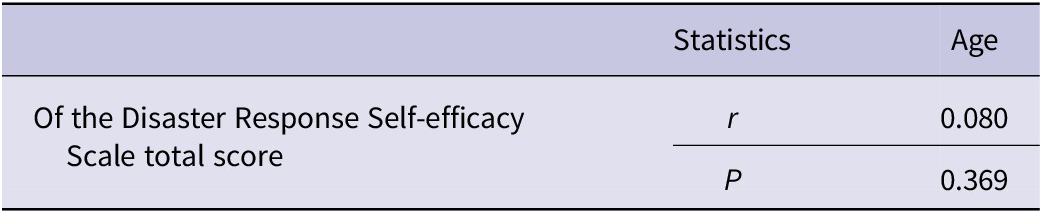
The correlation between the mean total score of the “Of the Disaster Response Self-efficacy Scale” and age was not statistically significant (r = 0.080; P = 0.369) (Table 4).
Correlation between age and total score Of the Disaster Response Self-efficacy Scale

r: Spearman correlation test
P < 0.001
Discussion
Nurses have an important position in disaster response and nurses should be prepared to respond to disasters.Reference Jang, Kim, Lee and Seo2, Reference Hasan, Younos and Farid3, Reference Veenema, Griffin and Gable11 In this study, we determined the disaster response self-efficacy levels of nurses working in surgical clinics and the effect of sociodemographic characteristics of nurses on their disaster response self-efficacy. As a result of the analysis of the collected data, important results were obtained that may have a direct impact on the education and practice of nurses.
The increasing frequency of disasters and emergencies experienced worldwide and in our country in recent years reveals the need to equip nurses with comprehensive knowledge and skills in disaster management.Reference Wenji, Turale and Stone19 Nurses, who constitute an important part of the health care team, can take responsibility in different positions such as planner, policy maker, leader, commander, educator, and researcher in disaster management, in addition to their interventionist roles in disasters and emergencies.Reference Veenema, Griffin and Gable11 In this context, training programs on disaster management can increase the disaster preparedness awareness of individuals and improve their knowledge, skills, and behaviors about disaster.Reference Nazli, Sipon and Radzi20, Reference Lee and Lee21 In our study, it was found that a little more than half of the nurses (51.2%) had not received disaster training before and this result was consistent with the results of existing studies.Reference Labrague, Kamanyire and Achora12, Reference Rizqillah and Suna14 Most the nurses who received disaster training stated that they received disaster training in in-service trainings. Disaster management should be an indispensable component of undergraduate education of nursing students and in-service education of nurses, and evidence-based, competency-oriented, and high-quality disaster education content should be created.Reference Loke, Guo and Molassiotis22, Reference Said and Chiang23
In our study, it was found that most nurses (72.4%) had no previous on-duty disaster experience, and this finding was consistent with the results of previous studies. Similarly, studies in the literature reported that the majority of nurses did not experience a disaster.Reference Tzeng, Feng and Cheng8, Reference Labrague, Kamanyire and Achora12
In our study, more than half of the nurses (64.6%) stated that they felt partially confident (a person has a certain amount of confidence in some matters or situations, but not complete conviction or certainty) about disaster. Similarly, although the importance of nurses’ high self-efficacy in disaster response has always been emphasized, nurses report that their belief in their capacity to manage disaster situations is at a moderate level.Reference Mousavi, Majidi and Shabahang24, Reference Jonson, Pettersson and Rybing25 This result reveals the necessity of providing the theoretical infrastructure for nurses to improve their self-efficacy in educational programs planned to be developed for nurses.
In our study, it was observed that most nurses (81.1%) wanted to receive training on disasters. Similarly, it has been reported in studies in the literature that the majority of nurses want to receive disaster education to improve their disaster skills and preparations.Reference Hasan, Younos and Farid26 The fact that most nurses have not participated in any training or course so far despite the fact that the majority of nurses want to receive training on disaster is consistent with the results of previous studies.Reference Said, Molassiotis and Chiang16, Reference Jeong and Lee27 In this context, considering the importance of receiving disaster training as well as the desire of nurses to receive disaster training, it is recommended that trainings should be created especially for the responsibilities of nurses in disasters, nurses should be supported to participate in these trainings, and these trainings should be accessible.
In studies conducted in different years, it has been reported that nurses are not sufficiently prepared to intervene in emergency or disaster situations, that they do not fully trust themselves, that their level of competence related to disaster management is insufficient, and that their readiness for disaster interventions, especially outside the hospital environment, is weak.Reference Tzeng, Feng and Cheng8, Reference Labrague, Hammad and Gloe15, Reference Said, Molassiotis and Chiang16 In our study, the mean total score of the AMRDS was found to be at a high level. The mean total score of the sub-dimension of on-site rescue competence was found to be high, the mean total score of the sub-dimension of psychological nursing competence in disaster was found to be moderate, and the mean total score of the sub-dimension of the quality of the role undertaken in disaster and adaptation competence was found to be high. Although it was found that nurses’ disaster response self-efficacy levels were at medium and high levels in our study, it has been reported in many studies in the literature that nurses do not have the relevant competencies needed in response to recent disasters.Reference Al Khalaileh, Bond and Alasad28, Reference Younos, Hasan and Nasreen29 In addition, it has been reported that nurses have moderate (neither too little nor too much; average) levels of knowledge, skills, and preparedness in disaster management and that they lack knowledge, skills, and training in disaster management.Reference Labrague, Kamanyire and Achora12, Reference Hasan, Younos and Farid26, Reference Younos, Hasan and Nasreen29 In the literature, it has also been reported that emergency and intensive care nurses have higher levels of disaster intervention self-efficacy compared to nurses in other units.Reference Tzeng, Feng and Cheng8, Reference Labrague, Kamanyire and Achora12, Reference Khairina, Nelwati and Maisa30 In this context, it is thought that the result we obtained in our study was due to the fact that the study was conducted with nurses working in surgical clinics.
When we look at the studies in the literature, it is reported that nurses who have participated in disaster-related training or courses have higher levels of competence and preparedness for disaster situations.Reference Labrague, Hammad and Gloe15, Reference Al Khalaileh, Bond and Alasad28, Reference Noh, Oh and Kim31, Reference Davis, Manning and Germain32 Existing evidence shows that effective disaster preparedness and disaster education can significantly contribute to the development of nurses’ disaster response skills as well as disaster recovery skills.Reference Al Khalaileh, Bond and Alasad28, Reference Duong33, Reference Chapman and Arbon34 In our study, although approximately half of the nurses stated that they received disaster-related training, it was observed that there was no statistically significant difference in disaster-response self-efficacy levels between nurses who received training and those who did not. In contrast to our findings, studies in the literature reported that disaster awareness and knowledge levels of nurses who received training on disaster were high, and disaster response experience and participation in disaster management training positively affected the disaster knowledge, skills, and preparation scores of nurses.Reference Labrague, Kamanyire and Achora12, Reference Koca, Çağan and Türe18, Reference Hasan, Younos and Farid26, Reference Hisar and Yurdakul35, Reference Huh and Kang36 In studies conducted with clinical nurses, it was reported that trainings on disaster had positive effects on nurses’ preparedness for disasters and their ability to intervene.Reference Jang, Kim, Lee and Seo2, Reference Maeda, Kotera and Matsuda37
Disaster intervention self-efficacy levels of nurses are closely related to their disaster preparedness and competencies. Disaster preparedness of nurses is also closely related to their disaster response experience.Reference Tzeng, Feng and Cheng8 In our study, it was found that nurses working in surgical clinics who had previous on-duty disaster experience had higher total scores on the DRSES than those who had no previous on-duty disaster experience (F = 3.381; P = 0.001). In addition, it was found that the mean total scores of the nurses who felt adequate about disaster were statistically significantly higher than those who felt partially adequate and those who did not feel adequate (F = 19,258; P = 0,000). Lack of experience during a disaster intervention may cause stress and fear in individuals, but individuals’ belief in the adequacy of their preparation for disaster may increase their confidence in disaster intervention.Reference Shi and Zhang38, Reference Kim and Lee39 In this context, the result obtained in our study is consistent with the results of previous studies.
Limitations
The research is limited to 127 nurses working in surgical clinics between June and August 2023. The scale used is only intended to measure the disaster response self-efficacy of volunteer nurses.
Implications for Emergency Nursing
All nurses, not just nurses working in surgical units, need to be prepared for disasters. Education is undoubtedly essential for this readiness. It is very important that trainings are given first in schools to raise awareness and then repeated at regular and frequent intervals in professional life, in line with current evidence.
Conclusion
The readiness of nurses working in surgical clinics for emergencies and disasters is affected by the clinic they work in, their disaster training status, and their disaster experience. Considering the disasters experienced in our country in recent years, it can be recommended that evidence-based, high-quality, and up-to-date training programs be delivered to nurses at periodic intervals to increase and maintain their emergency response competencies.
Statement
During the preparation of this study, the author used DeepL Translate for translation purposes. After using this tool/service, the author reviewed and edited the content as required and took full responsibility for the content of the publication.
Author contributions
Emel Külekci-Fazilet Tamer- Özgür Tuğ: Conceptualization, Data Curation, Formal Analysis, Investigation, Methodology, Project Administration, Resources, Software, Supervision, Validation, Visualization, Writing – Original Draft, Writing – Review & Editing.
The authors approve the final version of the article.
Funding statement
None declared.
Competing interests
The authors declare no conflicts of interest.
Ethical standard
Approval permission was obtained from the ethics committee of a university to conduct the study. Permission to use the scale was obtained by email from the authors of the Turkish validity and reliability study of the “Of the Disaster Intervention Self-efficacy Scale.” The purpose and nature of the study were explained to the nurses and their informed consent was obtained by informing them that their participation was voluntary and that they could leave the study at any time.