INTRODUCTION
Multiple Sclerosis (MS) present motor, sensory and cognitive alterations that are characterized by deficits in executive function, memory and visuospatial skills. These deficits affect the patients’ everyday lives and may influence driving performance (Lincoln & Radford, Reference Lincoln and Radford2008).
In recent years, several studies have investigated whether MS patients have greater difficulties driving compared to healthy controls (HC). Although there is no agreement regarding which are the most relevant cognitive domains, sustained attention (Kotterba, Orth, Eren, Fangerau, & Sindern, Reference Kotterba, Orth, Eren, Fangerau and Sindern2003; Lincoln & Radford, Reference Lincoln and Radford2008), selective attention (Schultheis et al., Reference Schultheis, Weisser, Ang, Elovic, Nead, Sestito and Millis2010; Shawaryn, Schultheis, Garay, & Deluca, Reference Shawaryn, Schultheis, Garay and Deluca2002), reaction time (Kotterba et al., Reference Kotterba, Orth, Eren, Fangerau and Sindern2003; Marcotte et al., Reference Marcotte, Rosenthal, Roberts, Lampinen, Scott, Allen and Corey-Bloom2008; Radford, Lee, & Reay, 2006; Schanke, Grimsmo, & Sundet, Reference Schanke, Grimsmo and Sundet1995; Schultheis et al., Reference Schultheis, Weisser, Ang, Elovic, Nead, Sestito and Millis2010; Schultheis, Garay, & Deluca, Reference Schultheis, Garay and Deluca2001), working memory, visuospatial skills (Lincoln & Radford, Reference Lincoln and Radford2008; Schanke et al., Reference Schanke, Grimsmo and Sundet1995; Schultheis et al., Reference Schultheis, Weisser, Ang, Elovic, Nead, Sestito and Millis2010), and visual memory (Lincoln & Radford, Reference Lincoln and Radford2008) have all been associated with driving performance in MS patients. Lincoln & Radford (Reference Lincoln and Radford2008) concluded that cognitive abilities are predictors of accident risk in people with MS because these authors found significant differences in executive function, visual memory, information processing, concentration and visuospatial abilities in a comparison of safe and unsafe patients. Safe and unsafe patients were classified using the Nothingam Neurological Driving Assessments based on patient’s performance on difficult driving road maneuvers.
Unfortunately, few studies have used detailed neuropsychological test batteries to establish the association between driving and cognition in MS (Schultheis et al., Reference Schultheis, Garay and Deluca2001), and when a battery has been used, only a global score created from all tests was considered (Ryan et al., Reference Ryan, Rapport, Telmet, Fuerst, Bieliauskas, Khan and Lisak2009).
Schultheis et al. (Reference Schultheis, Garay and Deluca2001) investigated the relationship between cognitive impairment in MS and driving risks and observed that MS patients with cognitive impairment performed significantly worse on driving measures compared to MS patients without cognitive impairments. While 14% of MS patients without cognitive impairment exhibit moderate levels of driving risk, 36% of MS patients with cognitive impairment exhibit moderate to severe risk (and up to 80% of these patients exhibit severe driving risks; Lincoln & Radford, Reference Lincoln and Radford2008).
Spasticity is a motor symptom that has been implicated in poor cognition and driving performance. Marcotte et al. (Reference Marcotte, Rosenthal, Roberts, Lampinen, Scott, Allen and Corey-Bloom2008) investigated the independent and combined impact of cognitive dysfunction and spasticity on driving tasks involving cognitive workload and lower-limb mobility in persons with MS and observed that cognitive functioning was the strongest predictor of difficulty in maintaining car position and poor response times to speed changes, whereas spasticity was associated with reduced accuracy of tracking movements and reduced speed maintenance abilities.
Different protocols and procedures have been used to study driving performance in MS patients; that is, accident registries (Lings & Dupont, Reference Lings and Dupont1992; Schultheis, Garay, Millis, & Deluca, Reference Shawaryn, Schultheis, Garay and Deluca2002; Schultheis et al., Reference Schultheis, Garay and Deluca2001; Shawaryn et al., Reference Shawaryn, Schultheis, Garay and Deluca2002), road tests (Schultheis et al., Reference Schultheis, Weisser, Ang, Elovic, Nead, Sestito and Millis2010; Schanke et al., Reference Schanke, Grimsmo and Sundet1995), driving simulators (Kotterba et al., Reference Kotterba, Orth, Eren, Fangerau and Sindern2003; Marcotte et al., Reference Marcotte, Rosenthal, Roberts, Lampinen, Scott, Allen and Corey-Bloom2008; Schultheis et al., Reference Schultheis, Weisser, Ang, Elovic, Nead, Sestito and Millis2010; Shawaryn et al., Reference Shawaryn, Schultheis, Garay and Deluca2002), and cognitive computarized measures such as the useful field of view (UFOV) test (Schultheis et al., Reference Schultheis, Weisser, Ang, Elovic, Nead, Sestito and Millis2010; Shawaryn et al., Reference Shawaryn, Schultheis, Garay and Deluca2002). This test is the most widely used because of their simplicity and inexpensiveness relative to road tests and simulators. Additionally, the results of UFOV are correlated with several important real-world factors, including the risk of an automobile crash. Several different medical conditions including dementia have been studied with cognitive computarized measures, (Badenes, Casas, Cejudo Bolivar, & Aguilar, Reference Badenes, Casas, Cejudo Bolivar and Aguilar2008; Uc, Rizzo, Anderson, Shi, & Dawson, Reference Uc, Rizzo, Anderson, Shi and Dawson2004, Reference Uc, Rizzo, Anderson, Shi and Dawson2005, Reference Uc, Rizzo, Anderson, Shi and Dawson2006), MCI (Badenes et al., Reference Badenes, Casas, Cejudo Bolivar and Aguilar2008; Brown & Ott, Reference Brown and Ott2004; Whelihan, DiCarlo, & Paul, Reference Whelihan, DiCarlo and Paul2005), and simulators (Marcotte et al., Reference Marcotte, Rosenthal, Roberts, Lampinen, Scott, Allen and Corey-Bloom2008), Parkinson’s disease (Classen et al., Reference Classen, McCarthy, Shechtman, Awadzi, Lanford, Okun and Fernandez2009; Uc et al., Reference Uc, Rizzo, Anderson, Sparks, Rodnitzky and Dawson2006, Reference Uc, Rizzo, Anderson, Sparks, Rodnitzky and Dawson2007), HIV (Marcotte et al., Reference Marcotte, Wolfson, Rosenthal, Heaton, Gonzalez, Ellis and Grant2004), and cardiovascular disease (Viamonte, Vance, Wadley, Roenker, & Ball, Reference Viamonte, Vance, Wadley, Roenker and Ball2010). Despite the differences in the protocols, all of these measures have successfully demonstrated the association between cognitive function and driving performance.
It is important to note that policies and regulations related to the issuance and renewal of driving licenses vary across countries. In a portion of European countries, licenses must be renewed on a regular basis (i.e., Italy and Spain), whereas there is no need for renewal in other countries (i.e., Sweden, Germany, France, and Belgium). None of the published studies on driving performance in MS patients used the specific tests required for the issuance and renewal of driving licenses, although these tests have been used in investigations of other pathologies such as mild cognitive impairment (MCI) and dementia (Badenes et al., Reference Badenes, Casas, Cejudo Bolivar and Aguilar2008). Our hypothesis is that patients with MS are more likely to be at risk for driving difficulties and that MS-related cognitive difficulties are associated with greater risk for driving. The primary aims of our study was: (1) To identify the percentage of MS patients at risk for unsafe driving, (2) to examine the association between the UFOV (Ball & Owsley, Reference Ball and Owsley1993), neuropsychological tests, and motor disability and the standard Spanish driving test (ASDE-test) (Monterde, Reference Monterde2001), and (3) to evaluate the additional effect of MS-related cognitive impairment upon the evaluation of risky driving
MATERIALS AND METHODS
Patients and Study Design
This was an observational, case-control (1:1), cross-sectional study with sequential inclusion.
MS outpatients attending the MS Unit at the Hospital Universitari Mutua Terrassa (Barcelona, Spain) between the 1st of June 2009 and the 31st of March 2010 were invited to participate in the study. Inclusion criteria included being an active driver, fulfilling the McDonald criteria for MS (McDonald et al., Reference McDonald, Compston, Edan, Goodkin, Hartung, Lublin, McFarland and Wolinsky2001), having received treatment in the previous 30 days, and a lack of episodes within previous month. Exclusion criteria included being a professional driver and having severe sensory deficits (visual and/or auditory).
For each MS patient, an age- and education (within a 5-year period) -matched control was included in the study. HC were chosen from among the spouses of the neurological patients and were not related to the patients. All controls were active drivers. Being a professional driver, having severe sensory deficits (visual and/or auditory), and having a current or prior history of neurological or psychiatric disorder (controls only) led to exclusion from the study.
This study was approved by the Ethics Committee of the Hospital Universitari Mutua Terrassa and was conducted in accordance with ICH GCP guidelines and the Declaration of Helsinki. All participants provided written informed consent before participation in the study.
Assessments
All study participants (MS and HC) were evaluated by a neuropsychologist who conducted the neuropsychological and driving assessments. All assessments were performed in one session by the same examiner. The total time for all tests was 120 min. MS patients were assessed by a neurologist who conducted the clinical evaluations, evaluated motor deficits using the Expanded Disability Status Scale (EDSS) (Kurtzke, Reference Kurtzke1983), and enforced the inclusion/exclusion criteria. Patients were classified according to their MS type (Lublin & Reingold, Reference Lublin and Reingold1996) into two groups, a relapsing remitting (MS RR) group and a secondary progressive (MS SP) group.
Neuropsychological and Driving Tests
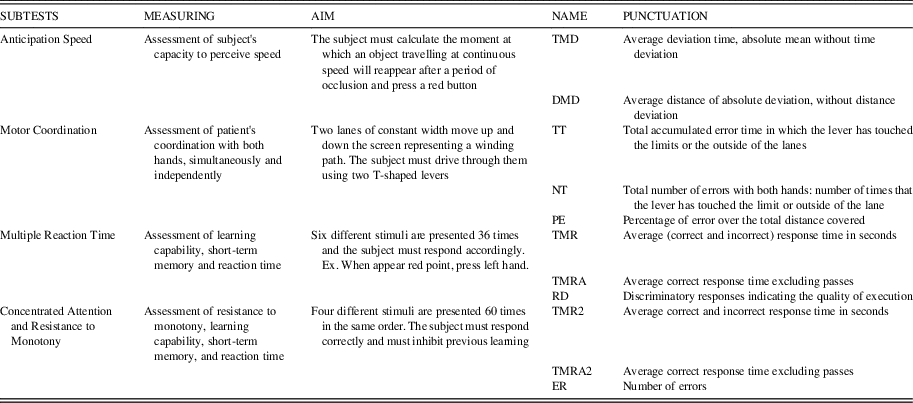
We used the following tests for the neuropsychological evaluation: the Repeatable Battery for Neuropsychological Status (RBANS) (Randolph, Reference Randolph1998), the 1-min Verbal Fluency test (using words with letter P and words without letter E) (Peña-Casanova et al., Reference Peña-Casanova, Quiñones-Ubeda, Gramunt-Fombuena, Quintana-Aparicio, Aguilar, Badenes and Blesa2009), the Trail Making Test (TMT) (Reynolds, Reference Reynolds2002), the Kohs Block test (Wechsler, Reference Wechsler1999), and the Paced Auditory Serial Addition (PASAT) test (Boringa et al., Reference Boringa, Lazeron, Reuling, Ader, Pfennings, Lindeboom and de Sonneville2001). Driving performance was assessed using the ASDE Driver-Test N-845 (Monterde, 2005) (Table 1) and the UFOV.
Description of the ASDE driver test

Higher score equals more impaired except RD.
DMD=average distance deviation; NT=total number of errors with two hands; PE=error percentage of total travel; RD=rating discriminatory responses; ER=number of errors; TMD=average time deviation; TMR=mean time response of right and wrong answers; TMRA=mean time response of correct answers;TMR2=mean time response of right and wrong answers; TMRA2=mean time response of correct answers; TT=total time error with two hands.
Participants were informed of the results of their tests (cognitive, driving tests, and EDDS). The thresholds for ASDE and UFOV were twice the SDs below the means in HC group. Using this formula, a threshold was calculated for each test. Participants who failed two tests or more were classified as risky drivers and considered for referral. Subjects with a score below 2SD in two or more ASDE subtests and/or subjects who obtained a UFOV risk score (4 or 5) were considered risky and referred for a driving tests. Subjects with a score below 2SD in two or more ASDE subtests and/or subjects who obtained a UFOV risk score (4 or 5) were considered risky and referred for a driving tests. Those participants who failed the tests were informed of the their driving risks and were advised to immediately contact a driving test center for confirmation of their driving ability.
ASDE Driver Test
This test is part of the driving exam in Spain and is conducted using a computer. The total estimated time for this test is 30 min, and the final test scores are expressed in hundredths of a second. The test includes four subtests that assess different dimensions involved in driving (Anticipation Speed, Motor Coordination, Multiple Reaction Time, Concentrated Attention, and Resistance to Monotony). The partial scores obtained for each dimension are explained in Table 1.
Useful Field of View (UFOV)
The UFOV test (Ball, Reference Ball1998) evaluates visual attention (central and peripheral) using a computer program and automatic scoring. The test is used to assess and predict the risks of automobile driving and is divided into three parts in which the subject must quickly detect, identify, and localize target objects. In the first part (UFOV1), the subject must identify a target vehicle that appears in a square at the center of the screen at variable times as a measure of visual processing speed. In the second part (UFOV2), the subject must simultaneously identify the target vehicle and a second object that appears in the periphery as a measure of divided attention. In the third part of the test (UFOV3), which measures selective attention, the subject must simultaneously locate the target vehicle and a masked vehicle that appears in the periphery of the screen. The results for each of the three parts of the test are reported in milliseconds. Additionally, a global score indicating the level of driving risk is produced (1=very low risk, 2=low risk, 3=moderate risk, 4=high risk, and 5=very high risk). Higher scores indicate greater impairment.
Statistical Analyses
Descriptive analyses of demographic and clinical data were performed. Quantitative variables are described by their mean (M) and standard deviation (SD). Qualitative variables are expressed in percentages. Chi-square tests (χ2) were used to analyze qualitative variables, and the student’s t test of means was used to compare quantitative variables. Analyses of variance (ANOVAs) were used for quantitative variables with more than two categories, Sheffé test was used for post hoc contrasts, and Levene’s test was used to verify variance homogeneity. Sensitivity and specificity indices were calculated according to Bayes’ Theorem, and the driving performance values obtained in 95% of the subjects (95% confidence interval [CI]) were chosen because no specific gold standard exists; therefore, we used a threshold that was based on the HC (mean - 2 × SD). The sensitivity and specificity values were obtained to evaluate the capability of the tests to discriminate between safe and unsafe drivers.
The thresholds for the ASDE and UFOV were twice the SDs below the means in HC group. Relationships between quantitative variables were tested using Spearman's correlations (r). Two linear multiple regression models were developed to predict the risks of driving accidents. The first model, the result of the UFOV3 test was included as the dependent variable because it is has a better correlation with cognitive tests and had a higher sensibility and specificity. Cognitive variables and motor capacity scores (as measured by the EDSS) were also included as predictive measures. For the second model, the results of Motor Coordination subscore from ASDE was included as the dependent while cognitive variables and motor capacity scores (as measured by the EDSS) were predictive measures. For both models a step-wise method, was used and co-linearity was analyzed using the tolerance index.
A significance value of α=5% (p<.05) was used in all analyses. Additionally, the effect size (Cohen, Reference Cohen1988) was calculated to verify the magnitudes of significant findings. Effect sizes (d) of less than 0.40 were considered small, between 0.40 and 0.75 were considered moderate, between 0.75 and 1.10 were considered high, between 1.10 and 1.45 were considered large, and >1.45 were considered very large.
For the analyses related to cognitive impairment, MS patients were divided according to the absence (MS−) or presence (MS+) of cognitive impairment. Subjects with scores below the 5th percentile, according to normative data in two or more neuropsychological tests were considered to be cognitively impairment (Crawley et al., Reference Crawley, Stygall, Lunn, Harrison, Brown and Newman2000; Lezak, Reference Lezak1995; Rao, Leo, Bernardin & Unverzagt, Reference Rao, Leo, Bernardin and Unverzagt1991; Schultheis et al., Reference Schultheis, Garay and Deluca2001).
Data analyses were performed using the statistical software package SPSS v17 (IBM).
RESULTS
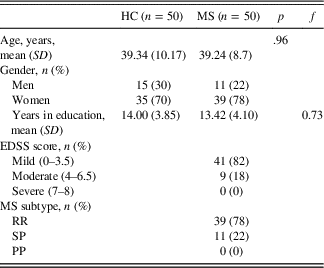
One hundred five MS patients were contacted, of which 15 refused to participate in the study, 15 had never driven before, and 25 had driven in the past but were not active drivers. Ten of the controls who were contacted refused to participate in the study. The final study sample included 50 MS patients who met the eligibility criteria for study inclusion and were matched for age, gender, and education with 50 HC. Table 2 summarizes the clinical and demographic data of the study participants. The majority of the patient population (78%; n=39) met the relapsing-remitting criteria (MS RR), and 82% of the patients had mild or no disabilities and illness durations of more than 10 years.
Description of study population
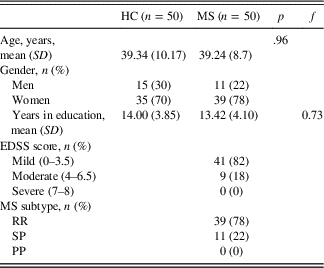
EDSS=Expanded Disability Status Score; HC=healthy controls; MS=multiple sclerosis; PP=primary progressive; RR=relapsing remitting; SD=standard deviation; SP=secondary progressive.
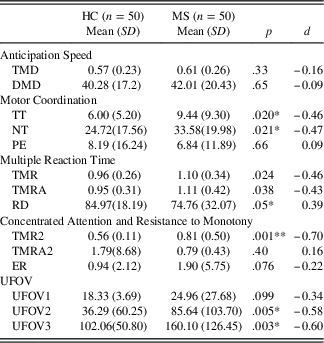
The results of the driving tests are presented in Table 3. MS patients and HC differed in performance on the ASDE, and this difference was most notable in the Motor Coordination test. The MS patients maintained the lever outside of, or touching, the lane limits for longer periods than the HC, which indicates poorer coordination. MS patients also exhibited poorer performance (response latencies) on the Concentrated Attention and Resistance to Monotony tests (p =.001). The MS patients significantly underperformed on the ASDE.
ASDE and UFOV descriptive data for HC and MS groups
Columns show the raw scores of evaluations and the differences between groups calculated with Student's t tests with a significant difference p<.05, p< 0.001.
d=Cohen’s effect size; DMD=average distance deviation; ER=number of errors; HC=healthy controls; MS=multiple sclerosis; n=number of subjects; NT=total number of errors with two hands; PE=error percentage of total travel; RD=rating discriminatory responses; SD=standard deviation; TMD=average time deviation; TMR=mean time response of right and wrong answers; TMRA=mean time response of correct answers; TMR2=mean time response of right and wrong answers; TMRA2=mean time response of correct answers; TT=total time error with two hands; UFOV=Useful Field of View; UFOV1=Useful Field of View part1; UFOV2=Useful Field of View part2; UFOV3=Useful Field of View part3
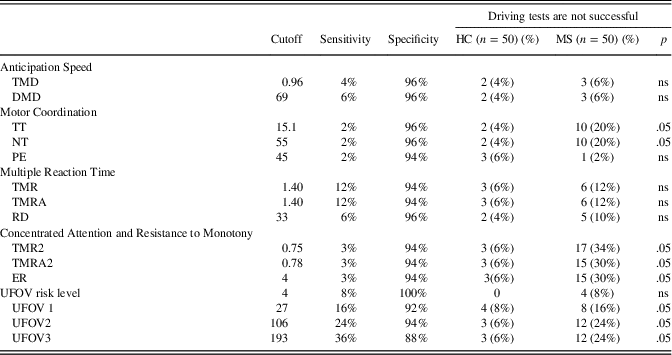
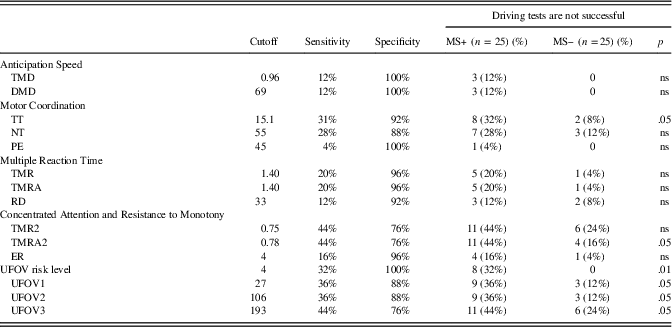
Sensitivity and specificity analyses were performed to explore the discriminatory capacity of driving performance as summarized in Table 4. The ASDE and UFOV tests exhibited high specificity and low sensitivity. Overall, 20% of the patients failed the Motor Coordination subtest, and approximately one-third of patients failed each of the Concentrated Attention and Resistance to Monotony subtests (30% and 34%, respectively). When compared to HC, MS patients performed worse on the UFOV tests of Divided Attention (part 2) and Selective Attention (part 3). Sixteen to 24% of MS patients did not pass the UFOV test. The effect sizes were moderate (0.40–0.75) for parts 2 and 3 of the UFOV test.
Sensitivity and Specificity Analysis for ASDE and UFOV tests from HC group scores
Note. Columns show the raw scores
DMD=average distance deviation; ER=number of errors; HC=healthy controls; n=number of subjects; NT=total number of errors with two hands; p=p value; PE=error percentage of total travel; RD=rating discriminatory responses; TMD=average time deviation; TMR=mean time response of right and wrong answers; TMRA=mean time response of correct answers; TMR2=mean time response of right and wrong answers; TMRA2=mean time response of correct answers; TT=total time error with twp hands; UFOV=Useful Field of View; UFOV1=Useful Field of View part1; UFOV2=Useful Field of View part2; UFOV3=Useful Field of View part3.
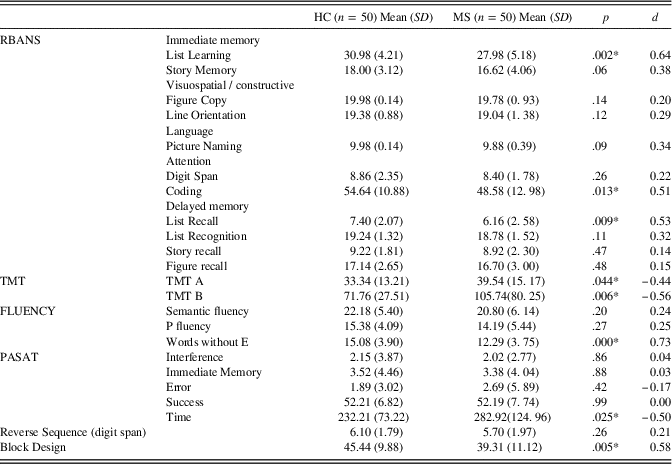
Regarding the tests of cognition (Table 5), MS patients exhibited worse scores than the HC in the executive function, psychomotor speed and memory tasks. The medium effect size of these tests was moderate (0.40–0.75).
Comparison HC and MS in neuropsychological tests
Note. All scores are raw scores. Differences between groups calculated with the Student t with a significant difference p<.05.
d=Cohen’s effect-size; HC=healthy controls; MS=multiple sclerosis; RBANS=Repeteable Battery for the Assessment of Neuropsychological Status; SD=standard deviation; TMT=Trail Making Test; TMT A=Trail Making Test part A; TMT B=Trail Making Test part B.
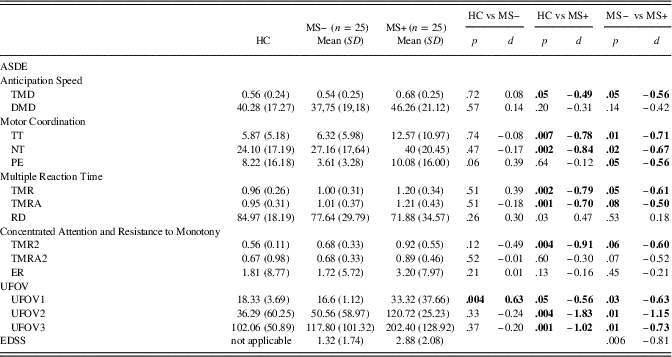
The analysis of driving performance according to cognitive status showed that the MS patients without cognitive impairment (MS−) were significantly different from the HC only in processing speed (UFOV1). In contrast, comparisons of the driving test performances between the HC group and the MS patients with cognitive impairment (MS+) and between the two MS groups (MS+ vs. MS−) revealed that MS+ patients performed worse in the ASDE subtests of Anticipation Speed, Motor Coordination, Multiple Reaction Time, Concentrated Attention and Resistance to Monotony. Moreover, MS+ patients exhibited poorer results than the MS− patients in all UFOV subtests (UFOV 1, 2, and 3), and a very large effect size was observed for the UFOV2 Selective Attention subtest comparison (Table 6).
Comparison HC and MS without cognitive impairment (MS−) and with cognitive impairment in MS (MS+) in driving tests and Expanded Disability Disease Score (EDSS)
Note. Columns show the raw scores of evaluations and the differences between groups calculated with the Student t with a significant difference p<.05.d=Cohen’s effect size; DMD=average distance deviation; HC=healthy controls; ER=number of errors; MS=multiple sclerosis; n=number of subjects; NT=total number of errors with two hands; PE=error percentage of total travel; EDSS=Expanded Disability Status Score; RD=rating discriminatory responses; S=sensitivity; SD=standard deviation; TMD=average time deviation; TMR=mean time response of right and wrong answers; TMRA=mean time response of correct answers;TMR2=mean time response of right and wrong answers; TMRA2=mean time response of correct answers; TT=total time error with two hands; UFOV=Useful Field of View; UFOV1=Useful Field of View part1; UFOV2=Useful Field of View part2; UFOV3=Useful Field of View part3.
According to the UFOV scores, risk ranged 1 to 5: 92% of HC participants had a risk of 1, 4% had a risk of 2, and 4% a risk of 3, whereas, 66% of the MS participants had a risk of 1, 12% a risk of 2, 6% a risk of 3, 4% a risk of 4, and 12% a risk of 5. Within the MS participants, MS− performed better, with a 88% having a risk of 1, 8% a risk of 2, and 4% a risk of 3, whereas 44% MS+ had a risk of 1, 16% a risk of 2, 8% a risk of 3, 8% a risk of 4, and 24% a risk of 5.
The sensitivity and specificity of the driving tests in the MS+ and MS− subgroups were also calculated (Table 7). MS+ patients exhibited poorer results in the UFOV test, which indicates increased driving risk, and these patients also performed worse on some ASDE tests, including Motor Coordination; in this test, 32% of MS+ patients failed, and 8% of MS− patients failed (p<.05). Additionally, MS+ patients performed worse in the Concentrated Attention and Resistance to Monotony tests; 36% of the MS+ patients failed the test, and 12% of MS− patients failed (p<.05). Similarly, 44% of the MS+ patients failed the UFOV3, and 24% of MS− patients failed (p<.05).
Sensitivity and Specificity Analysis in ASDE and UFOV tests
Note. MS+=MS with cognitive impairment, MS−=MS without cognitive impairment.
DMD=average distance deviation; HC=healthy controls; ER=number of errors; MS=multiple sclerosis; n=number of subjects; ns=not significant; NT=total number of errors with 2 hands; PE=error percentage of total travel; RD=rating discriminatory responses; p=significance (p value); TMD=average time deviation; TMR=mean time response of right and wrong answers; TMRA=mean time response of correct answers; TMR2=mean time response of right and wrong answers; TMRA2=mean time response of correct answers; TT=total time error with 2 hands; UFOV=Useful Field of View; UFOV1=Useful Field of View part1; UFOV2=Useful Field of View part2; UFOV3=Useful Field of View part3.
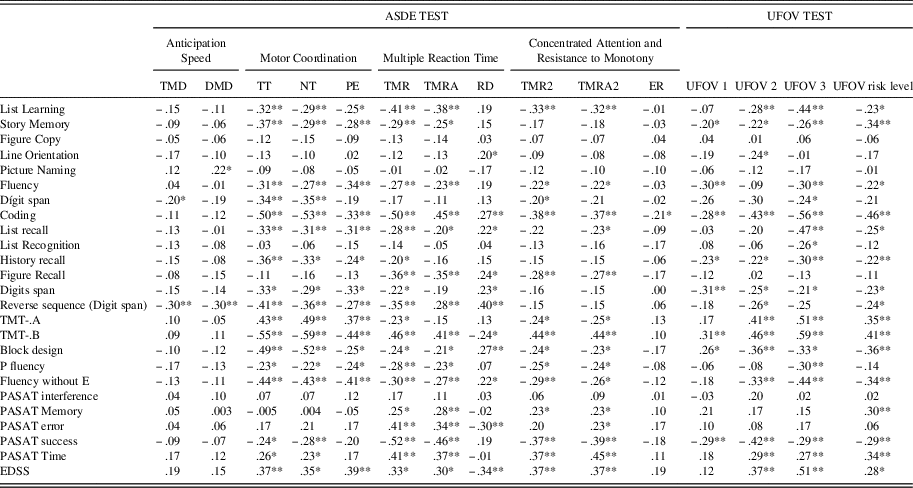
Analyses of the associations between the driving and cognitive tests (Table 8) revealed strong negative correlations between the ASDE Motor Coordination subtest and the TMTB (r=−.55) and Coding (r=−.50). There was also a negative correlation between the ASDE Multiple Reaction Time test and Coding (r=−.50). Moreover, the results from part 3 of the UFOV were negatively associated with Coding (r=−.56) and were positively correlated with the TMT-A (r =.51) and TMT-B (r =.59).
Correlations between driving tests (ASDE and UFOV) and neuropsychological tests
DMD=average distance deviation; EDSS=Expanded Disability Status Scale; ER=number of errors; NT=total number of errors with two hands; PE=error percentage of total travel; RD=rating discriminatory responses; TMT A=Trail Making Test part A; TMT B=Trail Making Test part B; TMD=average time deviation; TMR=mean time response of right and wrong answers; TMRA=mean time response of correct answers; TMR2=mean time response of right and wrong answers; TMRA2=mean time response of correct answers; TT=total time error with two hands; UFOV=Useful Field of View; UFOV1=Useful Field of View part1; UFOV2=Useful Field of View part2; UFOV3=Useful Field of View part3.
Regression analyses using UFOV3 scores as the dependent variable confirmed that motor dysfunction (EDSS) and cognitive tests (TMTA, Digit Span Backward and PASAT number of errors) significantly predicted the risk of car accidents in MS+ patients (ANOVA: F=6.82; p<.0001, tolerance 0.94, prediction accuracy R2=0.468).
Also, a regression analysis considering ASDE (Motor Coordination) performance as the dependent variable and the UFOV, motor disability (EDSS), and neuropsychological test (TMTA, Coding) significantly predicted the risk of car accidents in MS (ANOVA: F=21.80, p<.0001) prediction accuracy of R2=0.48.
DISCUSSION
The results of this study showed that, although all study participants currently possessed a valid driving license, some of the MS patients exhibited poorer driving and cognitive performances than the HC. The poor driving performances of the MS patients were characterized by lower attentional capacities, reduced information processing speeds and worse visual–motor coordination; all of these factors are important for safe driving. Additionally, our findings suggest that the driving test used in Spain for license renewal (ASDE) and the UFOV test produced similar results.
Regarding the accuracy of the tests, only some of the tests were able to differentiate MS patients from HC. The ASDE subtests related to information processing speeds (response latencies) and motor coordination and the UFOV sustained and divided attention tests were the most useful in terms of discriminant analyses. These findings agree with previous studies that have used the UFOV test and identified information processing speed as a key factor, particularly when complex and quick responses are required. Similarly, previous studies have also identified the swift application of working memory operations, attentional switching, and rapid visual scanning as key factors (Schultheis et al., Reference Schultheis, Weisser, Ang, Elovic, Nead, Sestito and Millis2010). Additionally, our study revealed that visuomotor coordination is related to driving performance.
We investigated the influence of cognitive impairment on driving performance (according to Schultheis’ criteria) and found that MS+ patients (i.e., those with cognitive impairments) performed significantly worse on all driving tests compared to the MS− patients. These results suggest that driving performance is associated with cognitive impairment in MS patients and coincide with the results of Schultheis and collaborators (Reference Schultheis, Garay and Deluca2001), who used the UFOV and the Neurocognitive Driving Test (NDT). In our study, MS+ patients showed greater impairment in the UFOV, which may indicate that the strength of the relationship between driving performance and cognition increases with disease progression.
Our results also show that, according to the UFOV scores, the frequency of risky driving is higher in MS+ subjects than in HC. The risk increases when MS is associated with cognitive impairment. Only 68% of MS+ patients were safe drivers in comparison to 100% of MS− and HC subjects.
Therefore, as has been shown previously (Amato, Zipoli, & Portaccio, Reference Amato, Zipoli and Portaccio2006), our study demonstrated that cognitive deficits that are present from the onset of the disease may play an important role in the important task of driving because of the key role of information processing speed in the execution of this task. The observed relationship between the cognitive tests of information processing speed and working memory (SDMT and PASAT) and the driving tests (ASDE and UFOV) is consistent with the findings of Schultheis et al. (Reference Schultheis, Weisser, Ang, Elovic, Nead, Sestito and Millis2010), Marcotte et al. (Reference Marcotte, Rosenthal, Roberts, Lampinen, Scott, Allen and Corey-Bloom2008), and Kotterba et al. (Reference Kotterba, Orth, Eren, Fangerau and Sindern2003). In agreement with our results, these authors found impairments of executive functions, although the differences were not as clear as those of information processing speed and working memory.
One of the aims of our study was to investigate the correlation between neuropsychological assessments and driving tests. When these correlations are strong, the neuropsychological information regularly obtained in MS wards could help to better assess the patients' driving capabilities and advise them regarding the need for further assessment by the driving license authorities and thus decrease their risk of road accidents. In previous studies of patients suffering from dementia we found strong correlations between neuropsychological tests and driving capabilities (Badenes et al., Reference Badenes, Casas, Cejudo Bolivar and Aguilar2008).
In the analyses of the relationships between driving tests and levels of motor disability (as measured by the EDSS), we observed stronger associations between the driving test results and visuomotor coordination, speed of motor response, and sustained and divided attention. These findings indicate that MS patients with motor impairment tend to move less accurately, which may affect driving safety. This finding agrees with an earlier study on visuomotor coordination (Marcotte et al., Reference Marcotte, Rosenthal, Roberts, Lampinen, Scott, Allen and Corey-Bloom2008) that showed that MS patients perform worse in handling the pedals compared to controls.
The results of the regression analyses confirmed that the UFOV tests, together with the EDSS scores, were related to the information processing speed and working memory tests (PASAT, and TMT A and inverse digits). These tests can predict driving performance and may help to identify drivers at higher risk of car accidents. Using different tests, Schulteis and collaborators (2010) also found that information processing speed is the primary deficit and the most robust finding, along with the SDMT number key test and the spatial recall test SPART 7/24.
Our study has several limitations. The ASDE test is used for the renewal of driving licenses only in Spain, which limits the applicability of our results to this country. The cognitive deficits found in this and previous studies may be influenced by fatigue, which is observed in 90% of MS patients with physical and cognitive impairments (Chiaravalloti & Deluca, Reference Chiaravalloti and Deluca2008). Therefore, future studies should take account for fatigue. Another limitation of this study is that we did not measure depression, which is highly prevalent in MS patients. Therefore, differences in depression may have mediated some of observed differences between the MS and HC samples in the cognitive and driving tests. In addition to the driving tests used in this study, further investigations should use road tests or simulators that can expose the study subjects to real-life situations (e.g., changing weather conditions and unexpected situations); these methods would allow for comparisons of the results of future studies with those obtained with the driving tests used in this study, which was constrained by the resources that were available. Finally, future studies should analyze the results within each MS subtype (MS relapsing remitting and MS secondary progressive). This analysis was not possible in our study because 22% of patients were secondary progressive and 78% were relapsing remitting; these proportions are representative of the average distribution of this disease.
In summary, our study confirmed that the functions implicated in information processing speed play a pivotal role in MS and may influence complex functions such as vehicle driving in computerized driving tests. Additionally, our study identified other relevant domains, such as visuomotor coordination, that are influenced by motor deficits. A diagnosis of MS does not necessarily suggest that the subject will fail driving tests. Indeed, most of the investigated MS patients passed their driving examinations. In this study, most of the participants presented with minor or moderate motor deficits. We deduced that individuals with severe deficits had already ceased driving. Although patients with minor deficits can pass driving tests, our study clearly shows that executive functions and visuomotor coordination play important roles in driving. Additionally, driving problems increase with the presence of cognitive impairment.
Our results reinforce the need for more frequent driving assessments given the deteriorating nature of the disease. The use of neuropsychological assessment, regularly performed on MS patients to assess the progress of the disease, complemented with UFOV and/or ASDE data, can give very useful information on their driving capabilities that otherwise would not be detected until a driving license renewal was due.
In conclusion, MS patients should be individually evaluated with an extensive neuropsychological instrument that focuses on executive functions and includes driving tests to determine the extent of the patients’ driving abilities.
ACKNOWLEDGMENTS
This study was supported by a grant from the Servei Català de Trànsit - Generalitat de Catalunya (www.gencat.cat/transit/). We would like to thank all of the participants who voluntered for this study. We thank Unitat de Recerca de Neurologia team for their assistance with recruitment and MJ Arranz for her helpful support. Conflict of Interest: None declared.