

Introduction
Terrorism has become one of the most severe Indonesian problems of the past decade, with the Bali Bombing in 2002 being hailed as the most horrendous terrorist events (Karmini, Reference Karmini2012). A variety of media including television, radio and newspapers in Indonesia have revealed that homegrown Islamist radicals have perpetrated the terrorism (Sentana & Hariyanto, Reference Sentana and Hariyanto2013). However, such evidence seems to fall on deaf ears because much of the Indonesian public instead believes in a conspiracy theory that foreign agents such as the CIA (the US Central Intelligence Agency) and the Mossad (Israel's Intelligence Agency) are instead responsible for terrorism in Indonesia (Jones, Reference Jones2009; Kipp, Reference Kipp2004; Smith, Reference Smith2005). For example, a survey conducted by illustrious online newspapers in Indonesia detik.com in 2002 following the Bali bombings uncovered that many respondents believed that the CIA or other foreign agents were involved in the terrorism (Fealy, Reference Fealy2003). Some websites, mailing-lists and Islamic newspapers and magazines have also played a crucial role in propagating such a false belief (Lim, Reference Lim2005).
A perception that Muslims are the target of Western conspiracies to attack Islam then becomes rhetoric of some members of this religious group to justify terrorism (Jikeli, Reference Jikeli, Soen, Shechory and David2012). Indeed, some studies have cited that belief in a conspiracy theory generates a host of negative intergroup attitudes and behaviours against suspected actors of a conspiracy. These behaviours and attitudes include racism and group exclusion (Miller, Reference Miller2002; Räikkä, Reference Räikkä2008), discrimination (Bilewizs & Krzemiński, Reference Bilewicz and Krzeminski2010), and social riots (van Prooijen, Reference van Prooijen, Kals and Maes2012; van Prooijen & Jostman, Reference van Prooijen and Jostmann2013). Other studies have also provided evidence that belief in a conspiracy theory reflects people's distrust towards external agents, more particularly the agents considered as powerful (Goertzel, Reference Goertzel1994; Parsons, Simmons, Shinhoster, & Kilburn, Reference Parsons, Simmons, Shinhoster and Kilburn1999). This sense of powerlessness among Muslims in Southeast Asia, such as those in Malaysia (Reid, Reference Reid2010) and Indonesia (Suciu, Reference Suciu2008), induces competitive victimhood. This refers to a subjective claim that Muslims in their relations with the West have anguished more than other religious groups. This victimhood ignites Muslims’ belief in the West conspiracy theory to harm Islam. Using a model of Group Identity Lens (Turner & Reynolds, Reference Turner, Reynolds, Brown and Gaertner2001), we suggest that the impact of Moslems’ competitive victimhood on a tendency to belief in the West's conspiracy theory behind terrorism in Indonesia stems from these Moslems’ Islamic identification. Furthermore, this effect is more prominent when the Muslims highly distrust the Western people. Building on Social Identity Theory (Tajfel & Turner, Reference Tajfel, Turner, Worchel and Austin1986), we also suggest that such consequences are triggered by Muslims’ perceptions that the values and norms of the West are incompatible with those of Islam, and this effect is stronger when the Muslims highly distrust the Western people.
Belief in a Conspiracy Theory Due to a Sense of Victimhood
Belief in a conspiracy theory is the proclivity to attribute prominent events such as terrorist attacks or assassination of famous figures to incognito, powerful agents or organizations than to lay human activities or natural forces (Imhoff & Bruder, Reference Imhoff and Bruder2014). This definition implies that at a group level, belief in a conspiracy theory signifies a categorization of the powerless in-group as the believer of the conspiracy theory and a powerful out-group as the perpetrator (Kofta, Reference Kofta1995; Sapountzis & Condor, Reference Sapountzis and Condor2013). Indeed, some studies (e.g., Abalakina-Paap, Stephan, Craig, & Gregory, Reference Abalakina-Paap, Stephan, Craig and Gregory1999; Crocker, Luhtanen, Broadnax, & Blaine, Reference Crocker, Luhtanen, Broadnax and Blaine1999) have observed that the more individuals feel powerless the more they believe in a theory that certain events are created by a conspiracy of powerful agents.
For the powerless, belief in a conspiracy theory can serve to balance their disadvantaged position (Swami, Reference Swami2012). However, the powerless need media such as relative deprivation (Bilewicz & Krzeminski, Reference Bilewicz and Krzeminski2010) and competitive victimhood (Bilewicz, Winiewski, Kofta, & Wójcik, Reference Bilewicz, Winiewski, Kofta and Wójcik2013) through which to justify and legitimize their belief in a conspiracy theory. In the context of intergroup conflict, victimhood denotes a feeling or a mindset shared by group members that they collectively suffer from other groups’ immoral and unjust harm-doings (Bar-Tal, Chernyak-Hai, Schori, & Gundar, Reference Bar-Tal, Chernyak-Hai, Schori and Gundar2009). One of the common corollaries of intergroup conflicts is a mutual competitive victimhood among groups in dispute, despite the fact that each group has an asymmetrical access to power and other resources (Nadler & Saguy, Reference Nadler, Saguy, Langholtz and Stout2003). Drawing on this explanation, Noor, Brown, Gonzalez, Manzi, and Lewis (Reference Noor, Brown, Gonzalez, Manzi and Lewis2008) proposed a concept of competitive victimhood that refers to a sense or a feeling to claim that certain groups have suffered more than other groups.
Competitive victimhood among Muslims nowadays is common, with the belief that Muslims are the victims of a conspiracy of Western countries, more particularly the United States and its supposed ally Israel, to attenuate Islam (Jikeli, Reference Jikeli, Soen, Shechory and David2012). This kind of a conspiracy theory also exists among some Muslims in Southeast Asia, such as those in Malaysia (Reid, Reference Reid2010) and Indonesia (Suciu, Reference Suciu2008), which is fueled in part by a sense of Islamic victimhood and defeat. Such sense of victimhood stimulates the need of Muslims to define a common enemy against whom they should unite (Reid, Reference Reid2010). As a conspiracy theory depicts out-groups as a collective enemy aiming at dominating an in-group (Kofta & Sedek, Reference Kofta and Sedek2005) and competitive victimhood serves as a tool to define the enemy, this victimhood may thus catalyze such beliefs.
Islamic Identification
Jikeli (Reference Jikeli, Soen, Shechory and David2012) suggested that the perception among Muslims that they are the target of Western conspiracies becomes a rhetoric of fundamentalists, which is then used to justify terrorism. This rationale is in line with the observation by van Bruinessen (Reference van Bruinessen2003) who reported that some Indonesian Muslims who strongly identify with Islam believe in a theory of international conspiracies to weaken Muslims, often masterminded by assorted enemies of Islam such as Zionists, Christian missionaries or imperialist politicians. Mashuri and Zaduqisti (Reference Mashuri and Zaduqisti2014) recently found that the more strongly Muslim participants identify with Islam, the more they believe that Western conspiracies have been accountable for perpetrating terrorism in Indonesia.
Group identification in general constitutes the degree to which group members feel emotionally and cognitively attached to their group (Tajfel & Turner, Reference Tajfel, Turner, Worchel and Austin1986). Group Identity Lens (Turner & Reynolds, Reference Turner, Reynolds, Brown and Gaertner2001) posits that group identification serves as a medium through which people evaluate the world and make the meaning of it. As a consequence, high group identifiers are inclined to engage in protective or defensive behaviours to deal with any actions or events that could harm their group (Brown, Reference Brown2000; Branscombe, Ellemers, Spears, & Doosje, Reference Branscombe, Ellemers, Spears, Doosje, Ellemers, Spears and Doosje1999; Ellemers, Spears, & Doosje, Reference Ellemers, Spears and Doosje2002). There are many groups with which people can identify such as ethnicity, nationality and religion. However, religion can be very typical because it is among the most prominent buttresses of identity (Verkuyten, Reference Verkuyten2007). As noted by Silberman (Reference Silberman2005), religion is an important part of social identity, especially for people who strongly identify with their religious group. Islam in particular can be an important part of people's social identity as this religion provides its adherents strict guidelines formally termed the Five Pillars of Islam (Verkuyten, Reference Verkuyten2007).
As discussed earlier, we argued that as a medium through which people try to project or attribute their disadvantage or powerlessness to an external collective enemy, competitive victimhood can be a precursor of belief in a conspiracy theory. Victimhood in an intergroup perspective denotes the perception that a group people belong to has been harmed by another group. Moreover, people who strongly identify with their group would be likely to defend or protect against those deemed as harmful their group (Brown, Reference Brown2000; Branscombe, Ellemers, Spears, & Doosje, Reference Branscombe, Ellemers, Spears, Doosje, Ellemers, Spears and Doosje1999; Ellemers, Spears, & Doosje, Reference Ellemers, Spears and Doosje2002). As a result, people with strong group identification may be prone to experience a sense of competitive victimhood and in turn, as a mechanism to defend the in-group, these people's victimhood generates belief in a conspiracy theory.
Group Incompatibility
Using Social Identity Theory (SIT: Tajfel & Turner, Reference Tajfel, Turner, Worchel and Austin1986), Sindic and Reicher (1999) proposed a novel concept of intergroup threat termed identity undermining. The authors defined identity undermining as a threat deriving from the inability of group members to fully enact and express the norms, values and practices characteristic of their given group's social identity. One major factor of identity undermining, as the two scholars argued, is a perceived incompatibility that has to do with a sense that group differences may lead to incommensurable ways of life. Indeed, Western ways of life are to some extent incompatible to Muslims’ ways of life. For example, Western cultures promote rationality while Islamic cultures promote religiosity. Western values reward individualism while Islamic values reward collectivism (Nurullah, Reference Nurullah2008). This group incompatibility experienced by Muslims is more noticeable nowadays as a result of globalization and cultural homogenization across the globe (Mazrui, Reference Mazrui and Akbarzadeh2006; Vertigans & Sutton, Reference Vertigans and Sutton2002).
Previous studies, however, have not yet examined how identity threat in terms of group incompatibility relates to belief in a conspiracy theory. However, Kofta, Sedek, and Slawuta (Reference Kofta, Sedek and Slawuta2011) reported that a threat to the in-group power significantly activated the belief in a theory among Polish participants that Jews have conspired to dominate the world. Mashuri and Zaduqisti (Reference Mashuri and Zaduqisti2014) recently found that a symbolic threat moderated the effect of Islamic identification on the belief in a conspiracy theory that Western people have masterminded terrorism in Indonesia. More precisely, the authors found that the Islamic identification significantly contributed to increasing belief in the conspiracy theory, and even more prominently among Muslim students who perceived that their Islamic identity is threatened by the Western cultures and norms.
There are no empirical studies to date that specifically connect group incompatibility to competitive victimhood. However, Shnabel and Noor (Reference Shnabel, Noor, Jonas and Morton2012) argued that competitive victimhood among the powerless group may originate from a threat to this group's identity as an active agent. This perceived lack of agency then gives rise to a claim that members of the dominated group suffer more than the dominating group. Such competitive suffering or victimhood in turn leads to negative intergroup attitudes which then impair conflict resolution between the dominated and dominating groups (Schnabel & Nadler, Reference Shnabel and Nadler2008).
We argued in this study that group incompatibility subjectively experienced by Muslims in their intergroup relations with Western people reflects a threat to agency. The reason is that Western identity and ways of life in this era of globalization dominate Islamic Muslims’ identity and ways of life (Nurullah, Reference Nurullah2008; Stone, Reference Stone2006; Waters, Reference Waters2001). Therefore, we argue that through this perceived loss of agency, Muslims’ see their ways of life as incompatible with Western ways of life which then can provoke competitive victimhood. This explanation implies that, because of the prediction that competitive victimhood directly influences belief in a conspiracy theory as discussed earlier, competitive victimhood may mediate the relationship between group incompatibility and belief in a conspiracy theory.
The Moderating Role of the Intergroup Distrust
At an intergroup level, distrust pertains to an in-group's perception and belief that an out-group is untrustworthy and conceives hidden, malicious agendas to harm the in-group. This distrust then fosters the in-group's negative attitudes in terms of hostility, suspicion and prejudice against the out-group, specifically a powerful out-group termed the suppressor (Eidelson & Eidelson, Reference Eidelson and Eidelson2003). As noted by LeVine and Campbell (Reference LeVine and Campbell1972), distrust is a widespread collective mindset and one of the core elements of the universal out-group stereotype.
Distrust plays a key role in determining how group members interpret another group's behaviours. For example, when distrust toward an out-group is high, people suspect that members of the out-group will exploit these people's cooperative behaviours (Rothbart & Hallmark, Reference Rothbart and Hallmark1988). In a similar vein, when distrust toward an out-group is high, people react negatively towards outgroup members’ positive behaviour in terms of apology (Darby & Schlenker, Reference Darby and Schlenker1989) or expression of responsibility (Nadler & Liviatan, Reference Nadler and Liviatan2006). Distrust in general is an emotional barrier that exacerbates negative attitudes toward an out-group in intergroup relations (Nadler & Saguy, Reference Nadler, Saguy, Langholtz and Stout2003). We argued that the role of distrust toward an out-group in structuring people's negative intergroup attitudes in general also applies to other negative intergroup attitudes as the focus of this study: belief in a conspiracy theory and competitive victimhood.
In-group identification does not automatically translate into out-group negative behaviors (Ashmore, Wilder, & Jussim, Reference Ashmore, Jussim and Wilder2001). There are some other factors that can determine how in-group identification can directly contribute to elevate out-group negative behaviors; in this study we suggest that one of these factors is distrust towards an out-group. As explained above, when people have a high degree of distrust towards an out-group, they are susceptible to interpret that this group will exploit their behaviours. Distrust towards an out-group therefore may increase the likelihood that in-group identification directly intensifies negative intergroup behaviours, including those of belief in a conspiracy theory and competitive victimhood.
As indicated in the previous discussion, intergroup differences are an undeniable social reality which may give rise to negative intergroup behaviours, particularly when the differences lead to perceived group incompatibility (Sindic & Reicher, 1999). This implies that people tend to endorse negative attitudes towards an out-group not only when they perceive that ways of life of this group are different from those of their group, but also when they perceive that these differences confine these people's ability to express and enact their identity. As explained above, intergroup distrust makes people more suspicious towards an out-group. As a consequence, when distrust is high, people's perception that their ways of life or identity are incompatible with ways of life or identity of an out-group may aggravate these people's negative attitudes towards the out-group. We argued in this study that this moderating role of distrust towards an out-group also applies to the relationship between group incompatibility and negative intergroup attitudes in terms of belief in a conspiracy theory and competitive victimhood.
Hypotheses of the Study
Based on the theoretical rationales provided above, we generated several hypotheses. Reid (Reference Reid2010) argued that competitive victimhood subjectively experienced by Muslims constitutes a medium through which members of this religious group attribute their perceived disadvantages to the Western people as a common enemy against which Muslims should unite. Kofta and Sedek (Reference Kofta and Sedek2005) proposed that the crux of belief in a conspiracy theory is an in-group's prejudiced view of out-groups as a collective enemy with malevolent agendas to harm the in-group. Drawing on these arguments, we predicted that the more Muslims felt competitive victimhood in their intergroup relations with Western people, the more they would believe in a theory that the Western people have conspired to create terrorism in Indonesia (Hypothesis 1). Furthermore, we argued that the extent to which Muslims feel competitive victimhood is contingent on the extent to which they identify with Islam. Competitive victimhood implies that in-group members feel they have suffered more than other groups, due to certain actions perceived as harming the in-group (Bar-Tal, Chernyak-Hai, Schori, & Gundar, Reference Bar-Tal, Chernyak-Hai, Schori and Gundar2009). Group Identity Lens (Turner & Reynolds, Reference Turner, Reynolds, Brown and Gaertner2001) posits that the more people identify with their group, the more they are motivated to defend or protect their group from anything that can harm their group (Brown, Reference Brown2000; Branscombe, Ellemers, Spears, & Doosje, Reference Branscombe, Ellemers, Spears, Doosje, Ellemers, Spears and Doosje1999; Ellemers, Spears, & Doosje, Reference Ellemers, Spears and Doosje2002). High group identifiers are thereby more susceptible than low group identifiers to experience a sense of competitive victimhood and protect the in-group, and this victimhood ultimately sets into motion belief in a conspiracy theory. We accordingly predicted that competitive victimhood would mediate the effect of Muslims’ Islamic identification on belief in the theory that Western people have conspired to create terrorism in Indonesia (Hypothesis 2).
We also argued that group incompatibility presumably gives rise to competitive victimhood among Muslims. Shnabel and Noor (Reference Shnabel, Noor, Jonas and Morton2012) explained that among powerless, dominated groups, competitive victimhood derives from perceived threat to members of these groups’ sense of agency as a social actor. This kind of threat among some Muslims presumably emanates from their perception that Islamic ways of life are incompatible with Western ways of life. This group incompatibility contributes to the Muslims’ perception that Western ways of life in the form of the current globalization dominates Islamic ways of life (Nurullah, Reference Nurullah2008; Stone, Reference Stone2006; Waters, Reference Waters2001). In the lens of these arguments, we subsequently predicted that competitive victimhood would mediate the effect of Moslems’ perceived group incompatibility on belief in the theory that Western people have conspired to create terrorism in Indonesia (Hypothesis 3).
Ashmore, Wilder, and Jussim (Reference Ashmore, Jussim and Wilder2001) suggested that the effect of in-group identification on people's negative attitudes and behaviours against out-groups depends upon several factors. We argued that intergroup distrust can be a factor that moulds in-group identification to raise people's negative out-group attitudes and behaviours. This notion is in line with some scholars’ contention (Darby & Schlenker, Reference Darby and Schlenker1989; Nadler & Liviatan, Reference Nadler and Liviatan2006; Rothbart & Hallmark, Reference Rothbart and Hallmark1988) that the more in-group members distrust an out-group, the more they interpret that this out-group has malevolent intentions to exploit their group. On the basis of these rationales, we proposed three hypotheses. First, we predicted that the more Muslims identified with Islam the more they would believe in a theory that Western people have conspired to create terrorism in Indonesia, more particularly when the Muslims’ distrust towards the Western people was high (Hypothesis 4a). Second, we predicted that the more Muslims identified with Islam, the more they felt competitive victimhood, more particularly when the Muslims’ distrust towards Western people was high (Hypothesis 4b). Third, we predicted that Muslims’ competitive victimhood would mediate the effect of Islamic identification on belief in a Western conspiracy theory, but this mediation effect would hold more strongly when the Muslims’ distrust towards the Western people was high (Hypothesis 4c).
Sindic and Reicher (1999) suggested that in-group incompatibility might be accountable for eliciting negative out-group attitudes and behaviours, more precisely when such incompatibility emanates from people's perception that the out-group's ways of life not only differ from but also undermine these people's ways of life. Distrust elevates suspicion towards an out-group, and therefore it might enhance the role of group incompatibility in promoting such perceived identity differences. Drawing on these rationales, we proposed three hypotheses. First, we predicted that the higher Muslims’ perceived group incompatibility the higher their belief in a theory that Western people have conspired to create terrorism in Indonesia, more particularly when the Muslims’ distrust towards the Western people was high (Hypothesis 5a). Second, we predicted that the higher Muslims’ perceived group incompatibility, the higher their competitive victimhood, more particularly when the Muslims’ distrust towards Western people was high (Hypothesis 5b). Third, we predicted Muslims’ competitive victimhood would mediate the effect of perceived group incompatibility on belief a theory that Western people have conspired to create terrorism in Indonesia, but this mediation effect would hold more strongly when the Muslims’ distrust towards the Western people was high (Hypothesis 5c).
Methods
Participant and procedure
Participants were 93 Muslim Indonesian students from STAIN Pekalongan, 92 from STIKAP Pekalongan, and 50 from IAIN Pontianak, Indonesia. Of the total participants, 134 (65.4%) were female, 59 (28.8%) were male and 12 (5.9%) did not mention their gender (Mean age = 21.31, SDage = 3.80). One hundred and fifty-six (76.1%) participants indicated that they were ethnically Javanese, 45 (22%) as ethnically non-Javanese, and 4 (2%) did not specify their ethnicity.
This survey was conducted in a classroom, wherein participants were handed a questionnaire containing the relevant scales. Unless otherwise indicated, we employed a five-point Likert scale, which ranged between 1 (Strongly Disagree) and 5 (Strongly Agree). The scores on each variable were created by averaging the items. The concept of out-groups in this study was operationally defined as Western countries or people, most notably United States and its supposed allies such as Israel, Australia, United Kingdom and countries of Western Europe. This operationalization built on the findings in some studies (Burhanuddin, Reference Burhanuddin2007; Hadler, Reference Hadler2004; Siegel, Reference Siegel2000; Suciu, Reference Suciu2008) reporting that negative sentiments in terms of victimhood, defeat and belief in a conspiracy theory against those countries among Muslims in Southeast Asia, particularly Indonesia and Malaysia, are still common. In the questionnaire, we therefore provided participants with this definition of ‘Western countries or people’ before asking them to answer items on each scale. Upon finishing, participants were debriefed and thanked for their taking part in the research.
Measures
Intergroup distrust
This construct was assessed by five items (e.g., “I cannot trust most of Western people”; “Most of Western people do not have good intentions”; α = 0.86; corrected item-total correlations ranged from 0.59 to 0.77), modified from the studies by Tam, Hewstone, Kenworthy, and Cairns (Reference Tam, Hewstone, Kenworthy and Cairns2009) as well as by Andrighetto, Mari, Volpato, and Behluli (Reference Andrighetto, Mari, Volpato and Behluli2012). To assess the moderating role of this construct as specified in the hypotheses, we followed the procedure recommended by Hayes (Reference Hayes2013). In this procedure, the construct of the intergroup distrust was split into two categories: high and low. High intergroup distrust was defined by scores on this constructs one standard deviation above the mean (+1SD above M) whereas low intergroup distrust was defined by scores on this construct one standard deviation below the mean (−1SD below M).
Islamic identification
This construct was assessed by four items (e.g., “The fact that I am a Moslem is an important part of my identity”; “I feel connected and attached to other Moslems”; α = 0.52; corrected item-total correlations ranged between 0.30 and 0.35), adopted from the study by Mashuri and Zaduqisti (Reference Mashuri and Zaduqisti2014).
Group incompatibility
This construct was assessed by six items (e.g., “The Western people and Moslems are different groups, which is difficult to put together into a coherent and mutually suitable unity; “The Western people and the Moslems are simply incompatible”; α = 0.88; corrected item-total correlations ranged between 0.52 and 0.77), adapted from the study by Sindic and Reicher (Reference Sindic and Reicher2009).
Competitive victimhood
This construct was assessed by five items in which one of these items (i.e., “I believe that Moslems are the most victimized groups of the Western people's unjust and discriminatory treatments than other religious groups”) was modified from the study by Sullivan, Landau, Branscombe, and Rothschild (Reference Sullivan, Landau, Branscombe and Rothschild2012). The remaining four items were created in an explorative way by the authors (e.g., “Moslems are the most victimized groups of the Western people's unwillingness to tolerate their existence than other religious groups”; “Miseries experienced by Moslems more than other religious groups assert their position as the victim of Western people's greed and atrocity”). The combination of these five items turned out to have a satisfying reliability (α = 0.87; corrected item-total correlations varied between 0.60 and 0.77).
Belief in a conspiracy theory
This construct was assessed by five items (e.g., “Terrorism in Indonesia thus far has been catalyzed by the Western people's conspiracy to enervate the existence of Moslems”, “Terrorism in Indonesia was ignited by the creation of the Western people's intelligence”; α = 0.87; corrected item-total correlations ranged between 0.68 and 0.73), adopted from the study by Mashuri and Zaduqisti (Reference Mashuri and Zaduqisti2014).
Demographic variables
On the last part of the questionnaire, participants were asked to indicate demographic information including gender, age, ethnicity and university affiliation.
Results
Descriptive statistics
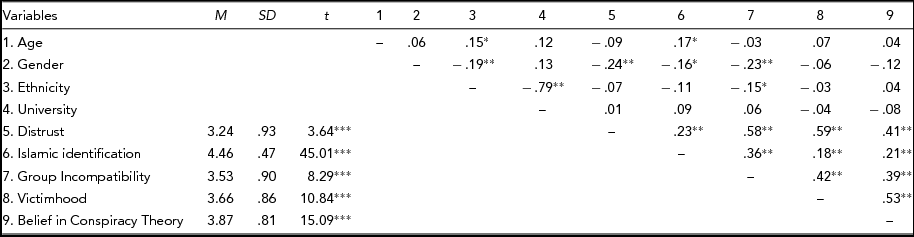
As shown in Table 1, measured variables in this research were significantly correlated to one another. In addition, inspection of a one-sample t-test revealed that all of the measured variables were high as they significantly exceeded the midpoint of three. These results implied that the observed means of intergroup distrust, Islamic identification, group incompatibility, competitive victimhood and belief in a conspiracy theory were significantly higher than the midpoint of 3 assumed as the population's mean. Finally, all demographic variables did not significantly impact the mediator (i.e., victimhood) and the outcome or dependent variable (i.e., belief in conspiracy theory), despite the observation that they were significantly correlated to one or more other measured variables. As a consequence, demographic variables were collapsed across subsequent analyses to test the hypotheses.
Descriptive Statistics and Correlations among Variables
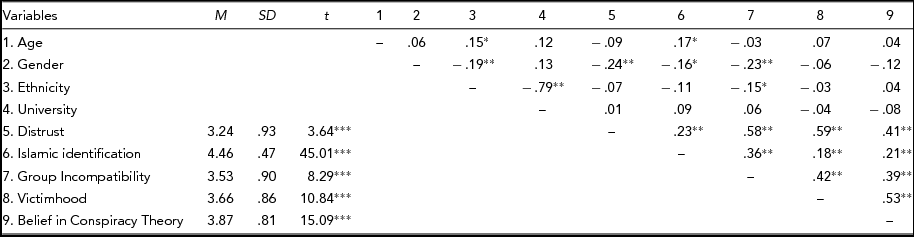
Note: * p < .05; ** p < .01; *** p < .001
Preliminary analyses
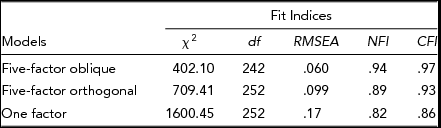
To examine the construct validity of each variable in this study, we conducted a Confirmatory Factor Analysis (CFA). In terms of the CFA, convergent validity and discriminant validity hold when CFA results in the model fits (Brown, Reference Brown2006). We examined Root Mean Square Error of Approximation (RMSEA) as an absolute fit index and the Comparative Fit Index (CFI) as well as a Normed Fit Index (NFI) as comparative fit indexes. The RMSEA value less than 0.08 and a CFI and NFI values of 0.09 or greater indicate good fits to the data (Kelloway, Reference Kelloway1998). As shown in Table 2, CFA with a five-factor oblique, which allowed all factors to correlate one another, resulted in good absolute and comparative fits to the data. This first model also had better fit to the data than did the second, five-factor orthogonal model, which specified that all factors were independent of one another, [χ2 difference (10) = 307.31, p < 0.001] and the third, one-factor model, [χ2 difference (10) = 1198.35, p < 0.001, see http://www.ma.utexas.edu/users/davis/375/popecol/tables/chisq.html for the chi-square difference test].
Comparison of Fit Indices of the First Model (Five-Factor Oblique), the Second Model (Five-Factor Orthogonal), and the Third Model (One Factor)

Main analyses
(A). Predictive effect of victimhood on belief in a conspiracy theory
To assess the predictive strength of all variables in this study, we conducted a multiple regression analysis by entering Islamic identification, Group Incompatibility, Distrust, Victimhood and all remaining demographics as independent variables and belief in Western people's conspiracies as a dependent variable. This analysis yielded a significant regression equation, F(7, 171) = 11.33, p = 0.000, Adjusted R 2 = 0.32, but Victimhood turned out to be the only significant predictor, B = 0.41, SE = 0.08, β = 0.42, t = 4.99, p = 0.000, squared partial correlation = 0.13. This finding thus substantiated Hypothesis 1, specifying that competitive victimhood had a unique effect in predicting Belief in a Conspiracy Theory.
(B). Mediation effects
To test the mediation analysis in this study, we used Preacher and Hayes’ (Reference Preacher and Hayes2004) simple mediation procedure (SOBEL), by resampling the data 5000 times. In the first analysis, Islamic Identification was specified as an independent variable, Victimhood as a mediator and Belief in a Conspiracy Theory as a dependent variable. The result was in support of Hypothesis 2, wherein Victimhood was predicted as significantly mediating the effect of Islamic Identification on Belief in a Conspiracy Theory (booth indirect effect = 0.18, se = 0.07, 95% LLCI = 0.047, 95% ULCI = 0.311, z = 2.648, p = 0.008). The second SOBEL analysis, in which Group Incompatibility was specified as an independent variable, Victimhood as a mediator and Belief in a Conspiracy Theory as dependent variable, also revealed that Victimhood significantly mediated the effect of Group Incompatibility on Belief in a Conspiracy Theory, in line with Hypothesis 3 (booth indirect effect = 0.18, se = 0.04, 95% LLCI = 0.104, 95% ULCI = 0.249, z = 4.76, p = 0.000).
To test each of the remaining hypotheses in this study (moderation and moderated mediation hypotheses), we used PROCESS (Hayes, Reference Hayes2013, see Model 8). Since PROCESS allows only a single independent variable, we set up the Model 8 into two separate steps. In the first step, Islamic Identification was specified as an independent variable, Victimhood as a mediator, Distrust as a moderator and Belief in a Conspiracy Theory as an outcome variable. In the second step, Group Incompatibility was specified as an independent variable, Victimhood as a mediator, Distrust as a moderator and Belief in a Conspiracy Theory as an outcome variable. In each step, we resampled the data 5000 times.
(C). Moderation and moderated mediation effects
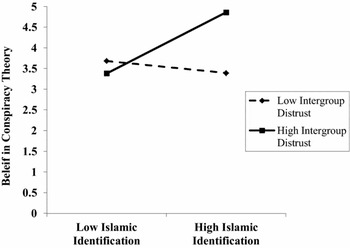
The first step of the PROCESS revealed a significant interaction effect of Islamic Identification and Distrust on Belief in a Conspiracy Theory, b = 0.32, se = 0.12, t = 2.70, p = 0.008. To probe this interaction effect, we used Hayes and Matthes’ (Reference Hayes and Matthes2009) probing interaction procedure (MODPROB). The results (see Figure 1) revealed that among participants with low Distrust (- 1SD below M), Islamic Identification was unrelated to Belief in a Conspiracy Theory, b = −0.12, se = 0.14, t = −0.81, p = 0.420. However, among participants with high Distrust (+ 1SD above M) Islamic Identification significantly predicted Belief in a Conspiracy Theory, b = .71, se = 0.19, t = 3.82, p = 0.000. These findings overall corroborated Hypothesis 4a stating that higher Islamic identification led to higher Muslims’ belief in a conspiracy theory over Western people's secret involvement in creating terrorism in Indonesia, and that this effect was more pronounced when Muslims strongly distrusted Western people.
The relationship between Islamic identification and Belief in Conspiracy Theory among participants with Low Distrust and High Distrust

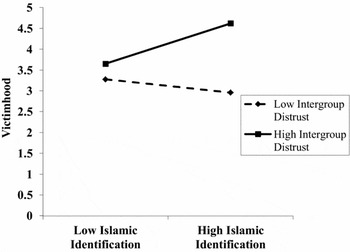
The PROCESS also revealed that Islamic Identification and Distrust interacted to significantly affect Victimhood, b = 0.31, se = 0.12, t = 2.66, p = 0.009. The MODPROB analysis (see Figure 2) demonstrated that Islamic Identification was unrelated to Victimhood among participants with low Distrust, b = −0.14, se = 0.14, t = −1.01, p = 0.316. However, among participants with high Distrust, Islamic Identification significantly predicted Victimhood, b = 0.46, se = 0.18, t = 2.65, p = 0.009. These findings overall corroborated Hypothesis 4b predicting that higher Islamic identification led to higher Muslims’ competitive victimhood, and that this effect was more pronounced when Muslims strongly distrusted Western people.
The relationship between Islamic identification and Victimhood among participants with Low Distrust and High Distrust

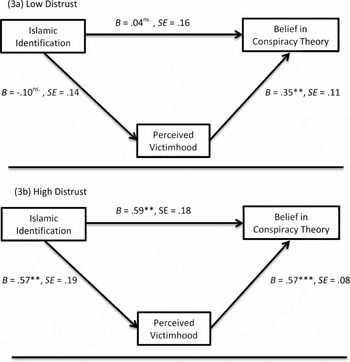
The first step of the PROCESS revealed that consistent with Hypothesis 4c, the role of Victimhood in mediating the relationship between Islamic Identification and Belief in a conspiracy theory was significant among participants with high Distrust (conditional indirect effect = 0.18, SE = 0.08, 95% LLCI = 0.044, 95% ULCI = 0.362, see Figure 3B), but not significant among participants with low Distrust (conditional indirect effect = −0.04, SE = 0.05, 95% LLCI = −0.155, 95% ULCI = 0.065, see Figure 3A).
(A) The role of Victimhood in mediating the relationship between Islamic identification and Belief in Conspiracy Theory among participants with Low Distrust, (B) The role of Victimhood in mediating the relationship between Islamic identification and Belief in Conspiracy Theory among participants with High Distrust
Note: B is an unstandardized regression coefficient, SE is Standard Error. Each path in the model was based on a simple regression analysis. The path from Islamic Identification to Belief in Conspiracy Theory is the total effect (without controlling for Perceived Victimhood). ** = p < 0.01, *** = p < 0.001, ns.. = not significant

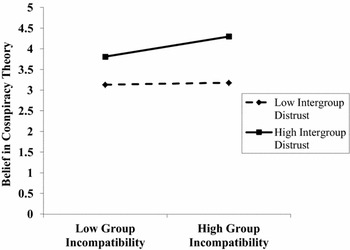
The second step of the PROCESS showed a significant interaction effect of Group Incompatibility and Distrust on Belief in a Conspiracy Theory, b = 0.11, se = 0.05, t = 2.24, p = 0.026. The MODPROB analysis (see Figure 4) demonstrated that among participants with low Distrust, Group Incompatibility was unrelated to Belief in a Conspiracy Theory, b = 0.08, se = 0.08, t = 1.01, p = 0.312. However, among participants with high Distrust, Group Incompatibility positively predicted Belief in a Conspiracy Theory, b = 0.37, se = 0.09, t = 4.02, p = 0.000. These findings supported Hypothesis 5a predicting that higher perceived group incompatibility led to higher Muslims’ belief in a conspiracy theory over Western people's secret involvement in creating terrorism in Indonesia, and that this effect was more pronounced when Muslims strongly distrusted the Western people.
The relationship between Group Incompatibility and Belief in Conspiracy Theory among participants with Low Distrust and High Distrust

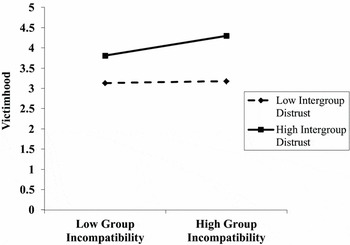
The second step of the PROCESS also demonstrated that Group Incompatibility and Distrust significantly interacted to affect Victimhood, b = 0.11, se = 0.05, t = 2.11, p = 0.036. The MODPROB (see Figure 5) analysis revealed that among participants with low Distrust, Group Incompatibility was unrelated to Victimhood, b = 0.03, se = 0.08, t = 0.40, p = 0.691. However, among participants with high Distrust, Group Incompatibility positively predicted Victimhood, b = 0.24, se = 0.09, t = 2.69, p = 0.008. These findings were in line with Hypothesis 5b predicting that higher group incompatibility led to higher Muslims’ competitive victimhood, and that this effect was more pronounced when Muslims strongly distrusted Western people.
The relationship between Group Incompatibility and Victimhood among participants with Low Distrust and High Distrust

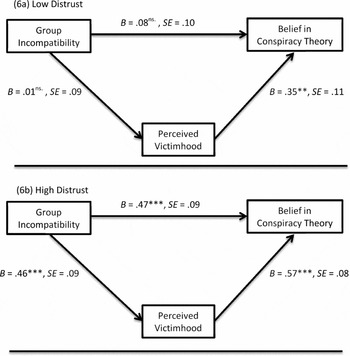
Finally, the second step of the PROCESS also revealed that, corroborating Hypothesis 5c, the role of Victimhood in mediating the relationship between Group Incompatibility and Belief in a conspiracy theory was significant only among participants with high Distrust (conditional indirect effect = 0.09, SE = 0.04, 95% LLCI = 0.027, 95% ULCI = 0.184; see Figure 6B). Among participants with low Distrust, the mediation effect of Victimhood was no longer significant (conditional indirect effect = 0.02, SE = 0.03, 95% LLCI = −0.053, 95% ULCI = 0.081; see Figure 6A).
(A) The role of Victimhood in mediating the relationship between Group Incompatibility and Belief in Conspiracy Theory among participants with Low Distrust, (B). The role of Victimhood in mediating the relationship between Group Incompatibility and Belief in Conspiracy Theory among participants with High Distrust
Note: B is an unstandardized regression coefficient, SE is Standard Error. Each path in the model was based on a simple regression analysis. The path from Group Incompatibility to Belief in Conspiracy Theory is the total effect (without controlling for Perceived Victimhood). ** = p < 0.01, *** = p < 0.001, ns.. = not significant

Discussion
The finding in this study that victimhood is a strong predictor of belief in a conspiracy theory extends the existing literature by connecting the belief to nationalism-based victimhood (Bergmann, Reference Bergmann2008; de Zavala, Cichocka, Eidelson, & Jayawickreme, 2012). That is, the relationship between victimhood and belief in a conspiracy theory not only applies to a sense or a feeling that one nation has suffered more than another nation, but also in a sense or a feeling that Muslims have suffered more than other believers. The finding also implies that in the Indonesian context, the discourse of victimhood among Muslims not only relates to belief in Jewish conspiracies as pointed-out by some scholars (Burhanuddin, Reference Burhanuddin2007; Hadler, Reference Hadler2004; Siegel, Reference Siegel2000; Suciu, Reference Suciu2008) but also in Western people's conspiracies in general. However, this result should be carefully interpreted since it was only explored from the context of terrorism.
The powerful effect of Muslims’ victimhood on belief in Western conspiracy as found in this study also confirms the core assumption of the Needs-Based Model of Reconciliation (Shnabel & Nadler, Reference Shnabel and Nadler2008) which states that the dominated group in intergroup relations or intergroup conflicts suffer a basic psychological threat to their identity as powerful actors. Members of the dominated groups therefore experience feelings of powerlessness, loss of control, and loss of honour and status. To regain these emotional deprivations, a bilateral coping strategy would be to assign responsibility for social problems or injustices to the dominating groups (Shnabel, Nadler, Ulrich, Dovidio, & Carmi, Reference Shnabel, Nadler, Ullrich, Dovidio and Carmi2009). Indeed, such sense of powerlessness among Muslims is very intense, especially in response to an environment of globalization which deficits in technological and economic resources are made salient (Acevedo, Reference Acevedo2008). Likewise, many Muslims have felt that today's globalizing system is an intrusion of Western cultures which catalyzes a sense of injustice (Moghaddam, Reference Moghaddam2006), from which hostility towards Western people and Jews then flourishes (Mendelson, Reference Mendelson2008). Perhaps it is due to this combination of powerlessness and perceived injustice that competitive victimhood among Muslims in their relationship with Western people may emerge, which in turn activates Muslims’ belief in a theory that the Western people have conspired to mastermind terrorism in Indonesia.
In this study, Islamic identification significantly instigated victimhood and this victimhood in turn provoked belief in a conspiracy theory. This finding is in accordance with the model of the Group Identity Lens (Turner & Reynolds, Reference Turner, Reynolds, Brown and Gaertner2001). This model posits that the more people identify with their in-group the more they are prone to show defensive reactions with which to boost their positive social identity and to prevent another group's action from harming the interests of their group. As uncovered in this study, the more participants identified with Islam the more they reacted defensively by perceiving that they are a victim of Western people's domination and by blaming these Western people as the protagonist of terrorism in Indonesia. Moreover, group identification in Islam is internalized and socialized as a nominal instead of continuous commitment, the result of which group identification for Muslims is more normative and total rather than varying in degree (Verkuyten & Yildiz, Reference Verkuyten and Yildiz2009). Group identification for Muslims thus has to do with the ways in which they should be a Muslim and not with whether they identify or do not identify as a Muslim (Verkuyten & Yildiz, Reference Verkuyten and Yildiz2010). Moreover, strong religious identification could end up leading to ethnocentrism, the belief that the in-group's worldviews and related norms or values are totally more superior to those of out-groups, which generates negative intergroup attitudes (Hunsberger & Jackson, Reference Hunsberger and Jackson2005). These normative and ethnocentric characteristics of religious identification may contribute to Islamic identification causing negative intergroup attitudes in terms of Muslims’ victimhood and the belief in a theory that another group (i.e., Western people) has conspired to create terrorism in Indonesia.
Previous studies tend to position distrust as a direct predictor of belief in a conspiracy theory. For example, Goertzel (Reference Goertzel1994) as well as Parsons, Simmons, Shinhoster, and Kilburn (Reference Parsons, Simmons, Shinhoster and Kilburn1999) found that lack of interpersonal trust or distrust in government was significantly correlated to the belief of a conspiracy theory. The moderating role of the intergroup distrust as found in this study thus potentially widens the perspectives within the victimhood and conspiracy theory belief literature.
Distrust enhances so-called ‘sinister attribution error’ that refers to individuals’ tendency to assume that other people are untrustworthy, in which intergroup instead of personality factors trigger such tendencies (Kramer, Reference Kramer1994). Among these intergroup factors are group categorization (in-group versus out-group) and intergroup differences (Kramer, Reference Kramer1998a). From this perspective, we examined group categorization in terms of Islamic identification and intergroup differences in terms of group incompatibility. The externalization of blaming Western people for having victimized Muslims and for having been involved in the conspiracy behind terrorism in Indonesia as observed in this study perhaps reflect such phenomenon of sinister attribution error. More strongly when Muslims had a high degree of distrust toward Western people, those intergroup factors of Islamic identification and group incompatibility turned out to escalate competitive victimhood and belief in the Western conspiracy theory.
Some limitations in this study should be acknowledged and deserve discussion. First, the sample used in this study was based upon convenience, and therefore the results in this study cannot be generalized to Indonesian Muslim students in particular and Indonesian Muslims in general. Future studies interested in the same topics may employ a large scale survey on the basis of a random sampling to secure the generalization of research findings into a wider population of Indonesian Muslims. Second, belief in a conspiracy theory among Indonesian Muslims is not only limited to the discourse of terrorism, but also that of Islamic sects or organizations considered as deviant and heretic. For example, some Indonesian Muslims believe that the Islamic sect of Ahmadiyya is created by the British conspiracies to disunite Islam and the Islamic liberal organization JIL (Jaringan Islam Liberal: Liberal Islamic Networks) is labeled as ‘the Western henchman’ (Suwarno, Reference Suwarno2013). Therefore, future studies may also examine whether the pattern of relationships among variables as found in this study also applies to belief in a conspiracy theory in the context of Ahmadiyya and JIL in Indonesia. Fourth, this study recruited only Muslims from Islamic universities, which theoretically fall within, referring to Geertz's terminology (1976), a Muslim santri or a Muslim who piously practices Islam. In the meantime, there are many Indonesian Muslims categorized as a Muslim abangan or simply anominal or less committed Muslim (Geertz, Reference Geertz1976; Howell, Reference Howell2001). Follow-up studies thus may recruit Indonesian Muslims with abangan orientations to testing the consistency of research findings in this study.
Discovering strategies to reduce the intergroup distrust, victimhood and conspiracy theory belief is the focus of practical implications in this study. Reducing distrust in between-group relations is a complex process, necessitating two parties in dispute to involve in repeated acts of cooperation (Nadler & Saguy, Reference Nadler and Saguy2004). The intergroup contact between the Western people and Muslims could be increased through engagement in this string of cooperation. Enhancement of intergroup contact in and of itself has proven to attenuate prejudice by augmenting knowledge about the out-group, reducing intergroup anxiety, and facilitating empathy and perspective-taking (Pettigrew & Tropp, Reference Pettigrew and Tropp2008). Besides ongoing, the cooperation should also be mutual in the sense that it aims to achieve common instrumental goals which are beneficial for both parties (Nadler & Schnabel, Reference Nadler, Shnabel, Nadler, Malloy and Fisher2008). To this end, Western people and Muslims could cooperate on common goals which seem worthwhile for both parties such as global warming, health and a clean environment. This trajectory facilitates a continuing and instrumental cooperation between the Western world and Muslim world, which potentially reduces negative intergroup attitudes among Muslims in terms of competitive victimhood and conspiracy theory belief in their relationship with the Western people. The Indonesian government could encourage this kind of cooperation in an attempt to cope with the reduction of Indonesian Muslims’ victimhood and their belief in the Western people's conspiracy theory to perpetrate terrorism in Indonesia.
In addition, illumination to the Indonesian Muslims about the danger of terrorism conspiracy theories should be included on the Indonesian government's counterterrorism agenda. Thus, the Indonesian government should not only emphasize a hard-core counterterrorism strategy by detaining, incarcerating and killing terrorists. Instead, the Indonesian government could also conduct an intensive campaign to counter the belief by socializing and admitting that Islamist radical groups in Indonesia exist and are the real actors behind terrorism in Indonesia. To be efficacious, however, such campaign should be conducted synergistically, involving a number of legitimate stakeholders, including the Indonesian government, Indonesian Ulema (i.e., The body of scholars who are authorities on Muslims religion and law), community or local leaders, and scientists (Mashuri & Zaduqisti Reference Mashuri and Zaduqisti2014).
Acknowledgements
We would like to sincerely thank Justin Saddlemyer who has spent a great time and effort to proofread the earlier version of this paper.