In 1989, Robert Sharer remarked, “we now know relatively more about the origins of complex societies in a number of regions outside the Gulf Coast than we know about Olmec civilization itself” (Sharer Reference Sharer and Grove1989:4). The situation has improved a great deal since with settlement surveys, excavations at sustaining area settlements, and renewed investigations of major centers, but we still know relatively little about interactions among Gulf Olmec sites beyond the relationships of major centers to their immediate hinterlands. The reasons for this are several; they include a perception of Olmec centers and polities as sequential, rather than temporally overlapping, entities; difficulties in establishing well-dated chronological sequences; difficulties in identifying intraregional exchange patterns of some commodities; and an understandable preoccupation with long-distance interaction between the Gulf Olmecs and their contemporaries. While we agree with John Clark (personal communication 2005) that understanding interactions at and beyond the margins of polities is important to understanding their organization, we argue that it is also necessary to understand the articulations and disarticulations among communities “back home,” especially in cases, such as the Olmecs and Early Formative Mesoamerica, where interregional interaction appears to have varied a great deal in intensity and form (Clark Reference Clark1997:229; Pool Reference Pool2007a).
In this paper we explore intra- and interregional interaction from the vantage point of the Eastern Lower Papaloapan Basin (ELPB), and more specifically the site of Tres Zapotes, at the western margin of the Olmec “heartland.” Our focus is on the Early Horizon (ca. 1250–900 uncal b.c. or 1500–1000 cal b.c.), represented at Tres Zapotes by the newly defined Arroyo phase, which we have recently isolated in stratigraphic contexts. Although we think our results speak to the territorial extent and number of Early Horizon Gulf Olmec polities, our principal concern is not whether these early complex polities were organized as states or chiefdoms, but how communities forged social and economic networks with their neighbors and more distant contemporaries.
THE ARROYO PHASE AT TRES ZAPOTES
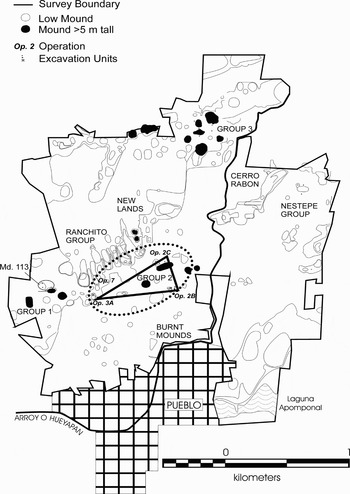
Alhough several authors have suspected the existence of an Early Formative period component at Tres Zapotes on the basis of scattered surface finds and redeposited artifacts in excavations (Lowe Reference Lowe, Sharer and Grove1989; Ortiz Ceballos Reference Ortiz Ceballos1975; Pool and Ohnersorgen Reference Pool, Ohnersorgen and Pool2003), it was not until our 2003 excavations that Early Formative period deposits were uncovered in a secure stratigraphic context. Our first discovery came at a depth of 5–6 m in excavation Unit 12 in Group 2, also known as the Arroyo Group, hence our name for the phase (Figure 1). At 5.25 m below datum we uncovered a plate fragment with Limón Carved-Incised decoration containing a catfish spine. Associated with the plate was a blackware sherd with Calzadas Carved decoration and a white-slipped sherd with vertical carving. In the same levels we found the partly articulated bones of a dog. About 40 cm deeper we found the skull, patella, and distal femur of a human burial, apparently interred in a flexed position. Centuries later the deposits of the Arroyo phase and the Middle Formative period Tres Zapotes phase were covered by an 80-cm-thick cap of gray clay, bracketed by dates of 2450 ± 40 BP (Beta-199251, wood charcoal, δ13C−27.2) (780–400 cal b.c.) and 2410 ± 40 BP (Beta-199241, wood charcoal, δ13C−27.2) (760–390 cal b.c.) (all dates calibrated at 2σ using Calib rev4.4.2. [Stuiver and Reimer Reference Stuiver and Reimer2004]). Subsequently we found stratified Arroyo phase deposits in Unit 8 about 250 m to the south, which yielded a date of 2970 ± 40 BP (Beta-199248, wood charcoal, δ13C−27.7) (1310–1040 cal b.c.). Arroyo phase materials were also recovered from excavations 600 m to the west in Operations 3A and 7, but some mixing with later materials is indicated, so we exclude them from quantitative description of the phase. Excavations with Arroyo phase materials describe an area of about 7 ha. Other Early Horizon materials recovered from auger tests 6 to 8 m deep in floodplain deposits and surface collections suggest a maximum extension of about 17 ha for the Arroyo phase village (Pool and Ortiz Ceballos Reference Pool, Ceballos, Uriarte and González Lauck2008).
Map of Tres Zapotes showing extent of Arroyo phase in excavations (triangle) and in excavations, auger tests, and surface collections combined (dotted oval).

Ceramics
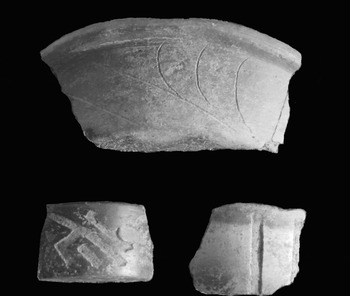
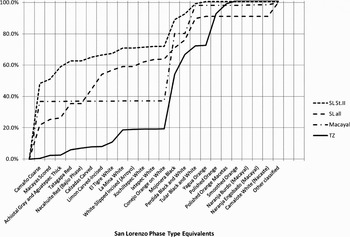
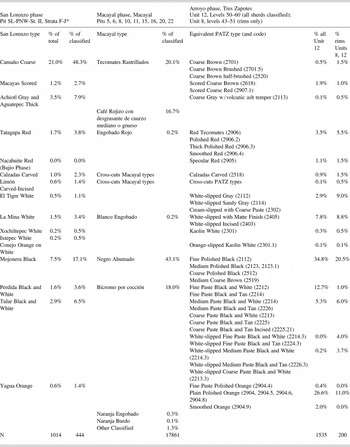
Ceramics of the Arroyo phase include diagnostics that show clear ties to the San Lorenzo phase (Figure 2), but the phase also exhibits a strongly local character as well as interaction with other more distant areas. Table 1 and Figure 3 compare sherd percentages of equivalent ceramic types for the Arroyo phase at Tres Zapotes, the San Lorenzo phase at San Lorenzo, and the Macayal phase equivalents at Macayal, a village site about 15 km southwest of San Lorenzo in the Coatzacoalcos basin. We focus our quantitative comparisons with San Lorenzo primarily on the Yale University project's Stratigraphic Pit II (SL-PNW-St. II, or simply St. II), strata F through J (Coe and Diehl Reference Coe and Diehl1980:Table 4-1). According to Coe and Diehl (Reference Coe and Diehl1980:84–85, 133), this pit produced the clearest stratigraphic sequence from their excavations, and the San Lorenzo phase assignment of materials from these strata appear straightforward. Recently, David Cheetham (personal communication 2008) has compiled relative frequencies of types for rims and for total sherd counts from the much larger sample from all of Coe and Diehl's pits in the collections at Yale University. Cheetham has generously provided us with this unpublished information so that we may refer to it when trends differ markedly from those in St. II (see also Figure 2). We also note that Ann Cyphers has recently developed a new classification for San Lorenzo phase materials (Symonds et al. Reference Symonds, Cyphers and Lunagómez2002), but frequency data from her excavations have not been published as of this writing.
Arroyo phase pottery from Unit 12. Limón Incised plate (top); Calzadas Carved beaker (lower left); white-slipped sherd with vertical carving (lower right).

Cumulative percentages of ceramic types in assemblages of the San Lorenzo, Macayal, and Arroyo phases. For the Macayal phase, sherds with Calzadas Carved and Limón Incised decoration are included with black and differentially fired ware frequencies (see Table 1).

Comparison of San Lorenzo, Macayal, and Arroyo phase assemblages

*From Coe and Diehl Reference Coe and Diehl1980:Table 4-1.
We have adapted our quantitative comparisons to accommodate differences in the recording and reporting of data (Table 1). Published data from San Lorenzo pit St. II present type frequencies as counts, which may be converted to percentages of all sherds (n = 1014) or of classified sherds (n = 444). At Macayal, 3,164 of 21,025 sherds were unclassifiable—2,225 of them due to the degree of erosion. We therefore use percentage of classified sherds as our main basis of comparison. At Tres Zapotes, we recorded type counts for all sherds in a sample of units that provided key stratigraphic sequences, including the 1,535 sherds from Arroyo phase deposits in Unit 12. In other units, we classified only rim sherds by type and recorded counts and weights of body sherds. This was the case for the Arroyo phase deposits in Unit 8. Inclusion of relative type frequencies for rim sherds provides a broader sampling of Arroyo phase contexts at Tres Zapotes but reduces the total sample size to 200. Nevertheless, we present these rim sherd data to facilitate future comparisons with assemblages from Canton Corralito and San Lorenzo (Cheetham Reference Cheetham2011).
In terms of general paste characteristics, the distinctive dark, basaltic, volcanic ash of the Tuxtla Mountains is a common temper in the Arroyo phase as is quartz sand, with which it is often mixed. As distinct from the curved splinters typical in vitric ashes, the Tuxtla basalts produce rounded particles of dark glass embedded with phenocrysts of olivine, pyroxene, and plagioclase. Such basaltic ash temper is apparently absent from ceramics of the San Lorenzo and Macayal phases, although recent reports suggest that vitric ash temper is relatively common at San Lorenzo, and other tempering materials besides quartzite sand also are present in the San Lorenzo phase assemblage (González et al. Reference Gonzáles, Behl, Cheetham and Neff2006; see also Guevara Reference Guevara2004, cited in Neff et al. Reference Neff, Blomster, Glascock, Bishop, Blackman, Coe, Cowgill, Cyphers, Diehl, Houston, Joyce, Lipo and Winter2006:112).
Black ware sherds are more common in the village assemblages at Macayal and Arroyo phase Tres Zapotes than at San Lorenzo, regardless of the measure used (percentage of all sherds, classified sherds, or rims). As a percentage of all classified sherds, differentially fired wares appear to be more common in the Arroyo and Macayal phases than in the San Lorenzo phase. However, differentially fired wares account for 63% of all San Lorenzo phase rim sherds (Cheetham, personal communication 2008) but only about 16% of the Arroyo phase rims. Moreover, the differentially fired wares of the Arroyo phase tend toward finer pastes equivalent to Perdida Black-and-White (unless only rim sherds are considered; see Table 1), and their lighter surfaces tend toward tan and buff tones. White-slipped pottery also appears to be more common in the Arroyo phase than the San Lorenzo and Macayal phases and was occasionally used to enhance the light rims of differentially fired pottery at Tres Zapotes. This greater prevalence of white slipping most likely is a consequence of the generally better preservation of slips in the excavated Tres Zapotes material, rather than the relatively late Early Formative date of the Arroyo phase. Better preservation of surfaces at Tres Zapotes would also help explain the lower proportions of unslipped gray pottery comparable to Aguatepec Thick of the San Lorenzo phase, the sherds of which were all heavily eroded (Coe and Diehl Reference Coe and Diehl1980:156).
One of the most striking differences with both Coatzacoalcos basin sites is the much lower proportion of a type comparable to Camaño Coarse in the Arroyo phase. This is somewhat surprising because brushed coarse brown jars (Rastreado) become the dominant utilitarian type in the Late Formative period at Tres Zapotes, but comparable treatments are nearly absent from Early Formative period contexts.
Another impressive contrast is the high proportion of “Polished Orange” in the Arroyo Phase (about 30%). Polished Orange is a type with a fairly soft and lightly tempered orange paste that is easily eroded, although it is likely that many vessels were left unburnished. Burnishing raises a “self-slip” on some examples, but otherwise the Arroyo phase variants all lack the slips that are diagnostic of Middle and Late Formative Polished Orange. The closest parallel to Polished Orange in Coe and Diehl's San Lorenzo phase descriptions is Yagua Orange, but it is far less common (1.4%). Naranja erosionado reported by O'Rourke (Reference O'Rourke2002:171) at Las Galeras may also be related, but at 3% of the Formative period assemblage, it too is much less common than is Polished Orange in the Arroyo phase. Naranjo Burdo and Naranja Engobado, however, are very localized types of the Macayal phase, with no precise equivalents at San Lorenzo or Tres Zapotes. These Formative period types are also distinct from Classic period Coarse Orange in the Tuxtla Mountains (see Arnold et al. Reference Arnold, Pool, Kneebone and Santley1993; Pool Reference Pool1990; Stoner et al. Reference Stoner, Pool, Neff and Glasscock2008).
Calzadas Carved and Limón Carved-Incised each constitute less than 1% of the sherds from the Arroyo phase. This is not terribly different from 1 to 2.3% for the San Lorenzo phase levels of St. II (Table 1). Cheetham's tallies for Calzadas and Limon sherds from all pits at San Lorenzo in the Yale collection, however, are much higher at about 8% of all sherds for each (or 6.4% and 8.8%, respectively, of rims) (personal communication 2008). Current evidence, then, suggests that relative frequencies of these typically Olmec decorative styles at Tres Zapotes were more in line with such distant sites as Canton Corralito (Cheetham. Reference Cheetham2010), San José Mogote, or Zohapilco (Stark Reference Stark, Scarborough and Clark2007:551–552, Table 3.1) than at the much closer site of San Lorenzo.
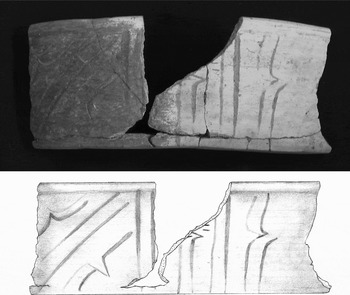
Some of the Calzadas-like motifs in the Arroyo phase resemble styles reportedly more common in Oaxaca than at San Lorenzo, including incised “music brackets” (Flannery and Marcus Reference Flannery and Marcus2000:24; see also Stark Reference Stark, Scarborough and Clark2007:50–53).Footnote 1 In one plate (Figure 4), we have the unusual co-occurrence of diagonal and vertical incised (not carved) motifs associated by Pyne (Reference Pyne and Flannery1976) with the zoomorphic supernatural in Oaxaca. This calls to mind the less abstract design on a famous vessel attributed to Tlapacoya, which bears profile and frontal views of the zoomorphic supernatural (Joralemon Reference Joralemon1971:42). Note, however, that the slanted element on this vessel is not the typical abstracted sky motif but a double music bracket (Motif 11), which Pyne (Reference Pyne and Flannery1976) associates with the were-jaguar and Marcus (Reference Marcus, Sharer and Grove1989) associates with earth/earthquake.Footnote 2 To our knowledge, this particular combination of vertical and slanted music brackets is not reported from Oaxaca or San Lorenzo, suggesting some local reinterpretation of the significance of these motifs at Tres Zapotes. Note that we make no claim here of importation of pottery from Oaxaca, and in fact paste characteristics suggest this piece was locally made.
Photograph and drawing of differentially fired vessel with incised “music bracket” design. Tres Zapotes, Unit 8, level 44. Drawing by Israel Trujillo Ramirez.

Figurines and Other Ceramic Artifacts
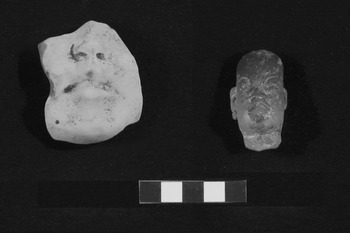
Arroyo phase figurines include local and regional styles. Hollow, white-slipped baby figurines (Blomster's [Reference Blomster2002] Type I) are rare, but do occur (Figure 5). We have two face fragments and two or three limbs. One face fragment was redeposited in a Late Formative context, and the other is from the surface, but there can be no doubt they are of Early Formative period manufacture.
Olmec-style figurines of the Arroyo phase. “Olmec baby” face fragment (left). San Lorenzo type figurine (right).

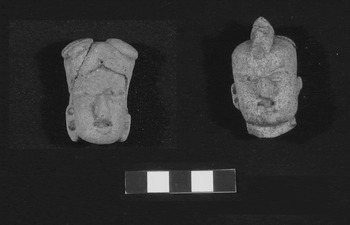
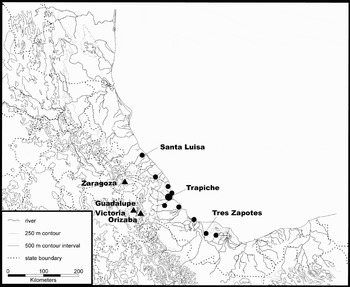
Solid heads similar to San Lorenzo phase examples are rare (Figure 5). More common are the hawk-nosed variants with filleted mouths first identified by García Payón (Reference García Payón1942; see also García Payon Reference García Payón1966) at Trapiche, and soon thereafter described at Tres Zapotes as a “Morelos” type by Weiant (Reference Weiant1943:92–93) and Type II-D by Drucker (Reference Drucker1943:79) (Figure 6). Arnold and Follensbee (Reference Arnold, Follensbee, Kolb and Otis-Charlton2004) described similar figurines for the Early Formative period at La Joya, which they subdivided into “Cantante” and “Bantam” varieties—both of which occur in the Arroyo phase. Despite some similarities to some highland Type C, D, and K figurines, particularly in the filleted mouth, and eye treatments, the Trapiche figurine type is mainly associated with Veracruz, where it has been identified as far north as Santa Luisa, and eastward to the central Tuxtlas (García Payón Reference García Payón, Ekholm and Bernal1971:521) (Figure 4). They are rare or absent at San Lorenzo, although one helmeted figurine assigned to the Nacaste phase is similar (Coe and Diehl Reference Coe and Diehl1980:366, leftmost). We have not yet found any Arroyo phase figurines resembling Arnold and Follensbee's (Reference Arnold, Follensbee, Kolb and Otis-Charlton2004) Axoquín type, which they compare to Pilli figurine heads from the Basin of Mexico.
Trapiche-type figurines of the Arroyo phase.

Figurine bodies include seated and cross-legged variants resembling examples from the San Lorenzo phase but only one tripod figurine. Particularly spectacular examples include a large female torso, whose rightward-leaning posture resembles seated examples from San Lorenzo; a seated old, pot-bellied man, and a beautiful white-slipped standing female figure whose skirt was highlighted by omitting the slip. We have not recovered ceramic spatulas like those reported from San Lorenzo (Coe and Diehl Reference Coe and Diehl1980:284, Figure 399) and Cantón Corralito (Cheetham 2005, Reference Cheetham2010), although we cannot rule out their existence without more extensive excavation.
Obsidian
The Arroyo phase obsidian assemblage from Units 8 and 12 comprises 113 pieces, dominated by flakes (106, 93.8%) and bipolar flake cores (5, 4.4%), with only 2 (1.8%) prismatic blades or blade tools. Visual categories of obsidian previously sourced by INAA to the Guadalupe Victoria source (Knight Reference Knight and Pool2003) account for 49.6% of the assemblage, Pico de Orizaba may account for as much as 38.1%, and the rest consists of varieties of black and banded obsidian tied to Zaragoza-Oyameles (12.4%).Footnote 3 In contrast to the San Lorenzo phase (Cobean et al. Reference Cobean, Coe, Perry, Turekian and Kharkar1971, Reference Cobean, Vogt, Glascock and Stocker1991) none of the materials from the Arroyo phase deposits are visually assignable to Otumba, Pachuca, or Guatemalan sources, and the overall variety of sources is much less.
Groundstone
The stone material for utilitarian groundstone artifacts appears to consist entirely of olivine and pyroxene basalts derived from the Tuxtla Mountains, principally Cerro el Vigía (Kruszczynski Reference Kruszczynski2001; Williams and Heizer Reference Williams and Heizer1965), although recently completed analysis suggests varieties from more distant Tuxtlas sources may also be represented in minor amounts (Jaime-Riverón, personal communication 2006). Basalts from the western Tuxtlas appear not to have been imported to San Lorenzo (Willams and Heizer Reference Williams and Heizer1965; Fernández and Coe Reference Fernandez, Coe, Coe and Diehl1980) owing, no doubt, to the greater proximity of sources at Llano del Jícaro and other locales in the eastern Tuxtlas.
Other Exotic Artifacts
We recovered one multiperforate ilmenite cube fragment from Arroyo phase levels in Unit 12. Five ilmenite cubes almost certainly dating to the Arroyo phase were encountered 200 m to the west in the Ranchito group by Stirling (Weiant Reference Weiant1943:121 and Plate 78), and we recovered one on survey 600 m to the west in the vicinity of Operation 7. The source of the ilmenite for these small, enigmatic objects is probably the Río La Venta area of western Chiapas, where excavations at Plumajillo recovered over 2,000 pieces in various stages of production (Agrinier Reference Agrinier1984:80–81). In the southern Gulf lowlands they have been found at the village site of La Joya in the Tuxtla Mountains (Arnold Reference Arnold1995:195), at the secondary center of Las Limas (Yadeun in Agrinier Reference Agrinier1984:75). They are most numerous, however, at San Lorenzo, where a total of over six metric tons of finished and discarded multiperforate ilmenite cubes were found in two large pits (Cyphers and Di Castro Stringher Reference Cyphers and Di Castro Stringher1996) as well as a few in other contexts (Coe and Diehl Reference Coe and Diehl1980:242). It is not clear if the cubes at Tres Zapotes were acquired directly from the source or indirectly via San Lorenzo.
Olmec Monuments
We doubt that community leaders of the Arroyo phase at Tres Zapotes had the authority or labor reserves to carve and transport the two known colossal heads to the site, and so we assign them to early in the Middle Formative Tres Zapotes phase. As several people have noted, the Tres Zapotes heads are carved in a local style distinct from those of San Lorenzo or La Venta (Clewlow et al. Reference Clewlow, Cowan, O'Connell and Beneman1967; de la Fuente Reference de la Fuente1977; Kubler Reference Kubler1962; Wicke Reference Wicke1971). Most of the other six or seven Olmec monuments from Tres Zapotes also appear to be of a Middle Formative period date (Pool Reference Pool2007b; Pool and Ortiz Ceballos Reference Pool, Ceballos, Uriarte and González Lauck2008). Two seated figures, however, may be from an earlier time. Milbrath (Reference Milbrath1979) tentatively assigned Monument I, the crossed legs of a seated figure (Stirling Reference Stirling1943:Plate 9a, b), and Monument M, the torso and head of a seated figure (Stirling Reference Stirling1943: Plate 11b, c, d), to her sculptural Group II, to which she also assigns seated figures from San Lorenzo, La Venta, Arroyo Sonso, Cruz de Milagro, and Cuahtotoalpan Viejo, among others. Crenulated earflaps on Monument M relate it to both early Formative San Lorenzo Monument 52 and (probably) Middle Formative La Venta Monument 77 (the latter discussed below). Unfortunately, Monument M and the right half of Monument I have disappeared since Stirling reported them, making detailed comparisons difficult.
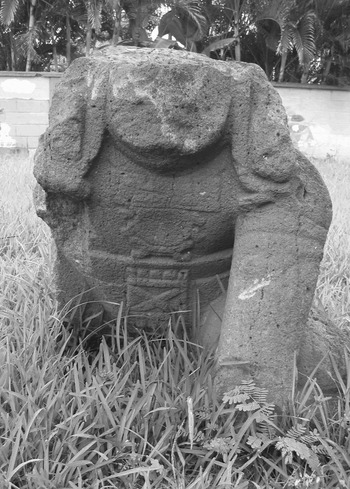
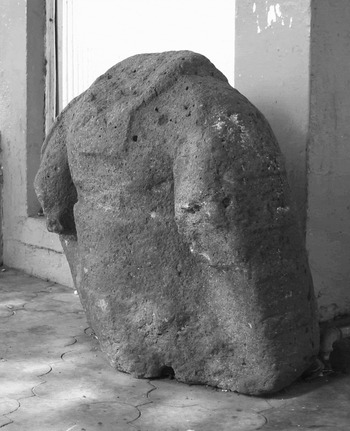
Two monuments recently discovered to the north of Tres Zapotes hint at political interactions with eastern Olman. One, currently at the Casa de Cultura in Lerdo de Tejada, closely resembles the San Martín Pajapan monument (Figure 5). The other monument is currently on the plaza in Angel R. Cabada (Figure 6). It is also mutilated, but the rope-like elements on its stiff cape are clearly visible, as is the battered attachment of its legs to the torso, showing it to be a seated, cross-legged figure. Although caped cross-legged figures appear at San Lorenzo, the closest in form and details of costume to the Cabada monument is La Venta Monument 77. Interestingly, the element worn on the belt of the Lerdo monument (Figure 5) also links it to La Venta Monument 77, which wears an identical belt. Given the presumed association of these monuments with themes of rulership, we cannot rule out the possibility that the northeastern Papaloapan plain fell under eastern Olmec hegemony for a time, but it would appear to relate to the apogee of La Venta and so postdate the Arroyo phase.
ARROYO PHASE SETTLEMENT IN THE EASTERN LOWER PAPALOAPAN BASIN
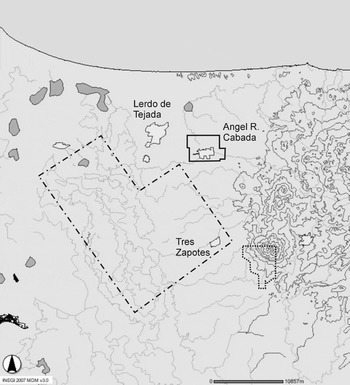
Recent surveys in the Eastern Lower Papaloapan Basin (ELPB) provide information of variable quality on Formative period settlement patterns (Figure 7). In a “siteless” feature-based survey of 28 km2 around Angel R. Cabada, north of Tres Zapotes, Loughlin (Reference Loughlin2004) encountered 28 locations with Arroyo phase materials. These locations consisted primarily of later mounds into which nearby deposits with Arroyo phase sherds had been redeposited as fill. Clusters of these locations and isolated finds suggest the existence of Arroyo phase communities on the scale of villages or hamlets, although their extent is difficult to determine due to heavy alluviation covering most of the in situ deposits.
Distribution of sites with Trapiche type figurines (circles) and sources of obsidian used at Tres Zapotes in the Arroyo phase (triangles).

Olmec Monument found in municipio of Lerdo. Photo by Pool.

Olmec Monument found in municipio of Cabada. Photo by Pool.

Map of settlement surveys in the Eastern Lower Papaloapan Basin: solid line, El Mesón area (Loughlin Reference Loughlin2004); dotted line, Cerro el Vigía (Kruszczynski Reference Kruszczynski2001); dashed-and-dotted line, JIMBA 3D survey (León Pérez Reference León Pérez2003). MAP modified after INEGI 2007.

Kruszczynski (Reference Kruszczynski2001) surveyed a 24 km2 area covering the southwest quadrant of Cerro el Vigía. At the time of Kruszczynski's survey, the Arroyo phase had not been identified, and the author did not discriminate between the Middle and Late Formative periods (Tres Zapotes and Hueyapan phases). It is therefore possible that some Arroyo phase occupations were lumped with later phases. Nevertheless, no site of Late Formative period date or earlier in Kruszycynski's survey was larger than 1.2 ha.
In a more expansive but less intensive survey that extended from west of Angel R. Cabada south to Tres Zapotes, the late Ignacio León Pérez (Reference León Pérez2003) identified 31 sites with Formative period components in an area of 356 km2. All except three of these sites are classified as villages and hamlets. Unfortunately, León Pérez's report does not distinguish chronological subdivisions of the Formative period, but the one center for which ceramic type frequencies are provided is clearly Late Formative period in date, and the other two Formative period “centers” are described as occupying 2 ha or less. Therefore, to date, it is fair to say that no Early Formative period administrative center has been identified in the ELPB. Rather, the area appears to have been lightly occupied by hamlets and villages, including a medium to large village at Tres Zapotes.
DISCUSSION AND CONCLUSION
The Arroyo phase artifact assemblage from Tres Zapotes underscores the heterogeneity of Gulf Olmec material culture as well as differential participation of Gulf Olmec communities in overlapping social and economic networks. Ceramic pastes are primarily of local materials, incorporating alkali basalt ash as a temper, as well as widely available quartz sand. This is hardly surprising. What is surprising is the degree to which the assemblage differs from contemporaneous assemblages at San Lorenzo and El Macayal at modal and typological levels, with far less brushed Camaño Coarse-like pottery and much more orange-paste pottery. In fact, the ceramic assemblage of Tres Zapotes appears less similar to that of San Lorenzo in several respects than does that of the far more distant Soconusco site of Canton Corralito reported by Cheetham (Reference Cheetham2010). We also note differences in the relative frequencies of tecomates between the Arroyo phase (12.1% of 173 rims) and the Coyame phase at La Joya (about 45%) (Arnold Reference Arnold2003:Figure 6). This may relate to greater residential mobility at La Joya, where Arnold (Reference Arnold, Skibo and Feinman1999) argues that tecomates served as multifunctional vessels that offered a compromise among requirements for “transportability, durability, and cooking effectiveness” (Arnold Reference Arnold, Clark and Pye2000:127).
Ceramic decorative techniques reflect the participation of Tres Zapotes in regional style zones of the Gulf Coast (especially for Limón Carved-Incised decoration and Tatagapa Red incised designs) as well as incorporating motifs, like incised music brackets, that appear to be more common in the highlands.
Figurine styles likewise exhibit a combination of more typically Gulf Olmec Styles (Type I baby faces, solid San Lorenzo heads) and styles with a central Gulf orientation (Trapiche style heads) not typical of eastern Olmec centers, with the latter predominating.
Materials for grinding stones exhibit local patterns of exploitation, all apparently coming from western Tuxtlas basalt sources, principally Cerro el Vigía. On the other hand, obsidian, necessarily from sources beyond the Gulf Coast, came from a smaller and more spatially restricted suite of sources than at San Lorenzo, and these were concentrated in eastern Puebla and adjacent Veracruz.
From these observations we may conclude, first, that Olmec material culture was not homogeneous across Olman, a point that has been made by others, especially Philip Arnold and Robert Santley (Arnold Reference Arnold, Clark and Pye2000, Reference Arnold2003; Santley et al. Reference Santley, Philip J., Thomas P., Stark and Arnold1997). Second, Olmec social networks were not tightly bounded, at least inasmuch as we can discern from the flow of information as represented in pottery and figurine styles. Third, Early Formative period Olmec communities participated differentially in overlapping long-distance exchange networks. Although Tres Zapotes may well have obtained its ilmenite cubes from intermediaries at San Lorenzo, it seems too much of a coincidence that the obsidian at Tres Zapotes comes exclusively or nearly so from the nearest sources and that the amount of obsidian reaching Tres Zapotes appears to decline with distance from the source, if control over the acquisition of obsidian was not in local hands.
At the regional scale, what settlement data exist do not indicate the establishment of an administrative hierarchy in the region, either developed internally or imposed from without. Of course, we cannot say if the Arroyo phase witnessed a reorganization of settlement because we have no information on pre-Arroyo phase settlement. With regard to more overt indicators of power, Olmec monuments reasonably interpreted as proclaiming political authority exist in the ELPB, but with two possible exceptions (Tres Zapotes Monuments L and M) they appear to postdate the Arroyo phase and the two with the strongest similarities to eastern Olmec sculptures, those from Cabada and Lerdo, are linked by iconography and style to La Venta. Early Formative period monumental architecture simply has not been detected in the region.
We find little support in the foregoing for external political domination of the ELPB in the Early Formative period. But even if San Lorenzo claimed nominal dominion over the area, its inhabitants appear to have exercised considerable autonomy in their tastes for material culture and their external interactions. The larger point, though, is that Early Formative Gulf Olmec society was not a homogeneous entity, and it cannot simply be reduced to San Lorenzo. Rather, we must continue to explore the interactions of other Gulf Olmecs with their contemporaries within Olman and beyond.
RESUMEN
Para elaborar modelos de la participación de los olmecas en las redes de interacción del período formativo temprano se requiere de un mejor conocimiento de las relaciones de las comunidades olmecas del golfo entre ellos así como con otras sociedades contemporáneas en otras partes de Mesoamérica. Comparamos los conjuntos de alfarería, figurillas y obsidiana de un componente del formativo temprano recién identificado en Tres Zapotes con los conjuntos contemporáneos de San Lorenzo y Macayal en la cuenca del río Coatzacoalcos. Nuestro análisis indica que los habitantes de la aldea en Tres Zapotes interaccionaron con poblaciones en el este de Olman pero también elaboraron sus propias ligas económicas y sociales con el centro de Veracruz y las tierras altas de México. Estos datos sugieren un paisaje heterogéneo en términos económicos y políticos en el cual las unidades políticas de diversos niveles de complejidad participaron en redes traslapadas de interacción, alianza y competencia dentro y fuera de Olman.
ACKNOWLEDGMENTS
The research at Tres Zapotes reported in this paper was conducted under NSF grant BCS-0242555 with the permission of the Instituto Nacional de Antropología e Historia of Mexico. Ceramic analysis was conducted by Ponciano Ortiz Ceballos and students from the University of Kentucky, the Universidad Veracruzana, and UNAM. The obsidian was analyzed by Charles Knight, Eric Stockdell, and Esmeralda Robles Fernández. Ground stone was analyzed by Olaf Jaime-Riverón. Jeff Blomster, David Cheetham, Michael Coe, Annick Daneels, and Barbara Stark provided very helpful suggestions on previous drafts of this article. We thank them for their perceptive commentary as we absolve them of any responsibility for any errors of fact or interpretation that may remain. Finally, we thank David Cheetham and Jeff Blomster for their invitation to present a version of this paper in their symposium at the 2006 meetings of the Society for American Archaeology.