A problem in the expression of tense is among the most ubiquitous findings in the literature on children with language impairment (LI). This is decidedly the case for English-speaking children with LI; these children use present and past tense forms less consistently than younger typically developing (TD) children as well as same-age TD peers (Leonard, Eyer, Bedore, & Grela, Reference Leonard, Deevy, Kurtz, Krantz Chorev, Owen and Polite1997; Marchman, Wulfeck, & Ellis Weismer, Reference Marchman, Wulfeck and Ellis Weismer1999; Norbury, Bishop, & Briscoe, Reference Norbury, Bishop and Briscoe2001; Oetting & Horohov, Reference Oetting and Horohov1997; Redmond, Reference Redmond2003; Rice & Wexler, Reference Rice and Wexler1996). In other Germanic languages that mark present and past tense through inflection, such as Swedish, tense is also problematic for children with LI (Hansson, Nettelbladt, & Leonard, Reference Hansson, Nettelbladt and Leonard2000). Studies of languages that express past tense through auxiliary + participle constructions, as in German and Dutch, show that children with LI often omit the auxiliary, thus rendering tense unspecified (de Jong, Reference de Jong1999; Rice, Noll, & Grimm, Reference Rice, Noll and Grimm1997). Even studies of Romance languages such as Italian and French that employ the auxiliary + participle construction for past tense reveal problems with the expression of tense on the part of children with LI, due to frequent omission of the auxiliary (Leonard, Sabbadini, Leonard, & Volterra, Reference Leonard, Sabbadini, Leonard and Volterra1987; Paradis & Crago, Reference Paradis and Crago2001).
The present study is concerned with children with LI who are acquiring Hungarian. As will be seen, this language permits an assessment of tense as well as another temporally related detail of grammar, aspect. Following a review of tense and aspect in the current LI literature, we discuss the contributions of studying Hungarian-speaking children with LI.
One prominent account of problems with tense is that children with LI are especially slow in developing the principle that tense is obligatory in main clauses (Rice, Reference Rice, Levy and Schaeffer2003; Rice & Wexler, Reference Rice and Wexler1996, Reference Rice and Wexler2001; Rice, Wexler, & Hershberger, Reference Rice, Wexler and Hershberger1998). According to this view, tense is represented in the grammars of children with LI so that when tense is expressed it is used appropriately. The problem rests in the children's failure to grasp that tense must always be used in a sentence. For Germanic languages, this account holds for both auxiliaries and verb inflections that mark tense; for most Romance languages and null-subject languages more generally, this account holds for auxiliaries in particular (Wexler, Reference Wexler1998, Reference Wexler, Levy and Schaeffer2003).
Recently, studies have appeared that also raise questions about these children's command of the temporal details pertaining to tense. In languages such as English, tense and aspect interact in important ways, and young TD children do not appear to keep these notions distinct in their early interpretation of sentences. Tense refers to the temporal relationship between the time of the event being described and some other time, usually the time of speaking. Thus, a sentence such as She read the newspaper article refers to an event that occurred before the time of speaking. Aspect differs from tense in referring to the temporal distribution of an event independent of the event's location in time (Comrie, Reference Comrie1976). For example, She was reading the newspaper article and She is reading the newspaper article differ in tense but both refer to an event (reading) that extends across some period of time. In contrast, two sentences can employ the same lexical verb and tense but can differ in aspect. The sentence She read the newspaper article (and enjoyed it) indicates not only an event in the past but also that the event was completed. However, in She was reading the newspaper article (when the phone rang), the event occurred in the past but there is no implication that the event (reading the newspaper article) had been completed.
There are two forms of aspect. One of these is lexical aspect, pertaining to the meaning of the verb in combination with the contents of the larger predicate. An important lexical aspect distinction is the distinction between telic events and atelic events. Telic events specify an endpoint or completion; atelic events do not specify an endpoint. Thus, We cleaned the garage in an hour is telic, whereas We cleaned the garage for an hour is atelic. Note that the same lexical verb (cleaned in this case) and tense (past tense) can be used for atelic as well as telic events because it is the larger predicate, which is the verb in combination with the particular lexical items or phrases that follow (as in in an hour versus for an hour), that determines telicity.
Grammatical aspect is the other form of aspect. Here, the distinction is made between the perfective and the imperfective (Bybee, Reference Bybee1985). The perfective involves viewing the described event “from the outside, as a completed whole” (Wagner, Reference Wagner2001, p. 663). In contrast, the imperfective views the event from within; there is no assumption of completion. In English, the imperfective is reflected in the use of the progressive. In the example, He was writing the love letter, there is no basis for knowing if the event was completed. English is much less transparent with regard to the perfective. Constructions such as the present perfect (as in We have eaten) do not express perfective aspect but rather express present relevance of past events (Comrie, Reference Comrie1976). However, past tense in English can have a default perfective interpretation. For example, the sentence He wrote the love letter has a perfective interpretation. Note, however, that a slight change in the predicate can alter the interpretation; He wrote love letters can refer to an activity pursued in the past with no assumption of completion.
TENSE AND ASPECT INTERACTIONS IN CHILDREN WITH LI
In a language such as English, young TD children's initial use of verb inflections seems to reflect influences of both lexical and grammatical aspect (Bloom, Lifter, & Hafitz, Reference Bloom, Lifter and Hafitz1980; Shirai & Andersen, Reference Shirai and Andersen1995). Children's early use of -ed (and irregular past forms) appears to be closely associated with completed actions as expressed in telic predicates (e.g., He pushed me). The initial use of -ing tends to mark imperfective aspect focused principally on atelic predicates in the present (e.g., Look, horsie running). Although this interaction between tense and aspect may be viewed as challenging for the young language learner, it seems likely that the strong correlations in the language between continuous actions and present tense on the one hand and completed actions and past tense on the other hand provide children with a means of hooking into the tense system of the language. That is, these relationships between particular forms of aspect and tense may be facilitative.
The possibility that aspect may facilitate the acquisition of tense seems more plausible given the differences seen between TD children and children with LI with regard to their sensitivity to aspectual information in the comprehension and production of tense. For example, Leonard et al. (Reference Leonard, Eyer, Bedore and Grela2007) found that young TD children acquiring English were more likely to use past tense in utterances with telic predicates than in utterances with atelic predicates, whereas somewhat older children with LI, whose overall use of past tense was lower than that of the younger TD children, were no more likely to use past tense with telic predicates than with atelic predicates. Even the use of the progressive -ing inflection, which is often assumed to be a relative strength among children with LI (Leonard, Reference Leonard1998), was not used as frequently by children with LI as by same-age TD peers in past progressive contexts. Whereas both younger and older TD children were more likely to use -ing when referring to past events involving atelic predicates than when referring to past events involving telic predicates, the children with LI showed no such distinction.
Leonard and Deevy (Reference Leonard and Deevy2010) examined tense–aspect interactions in the sentence comprehension of English-speaking children with LI and younger and older TD children. They found that both groups of TD children were more accurate in understanding telic predicates in the past progressive if the actions had been completed than if they were left incomplete. The children with LI, whose overall accuracy was lower, showed no difference as a function of whether the action had been completed.
Collectively, these findings led Leonard and Deevy (Reference Leonard and Deevy2010) to propose that children with LI may be relatively insensitive to aspectual distinctions that can interact with tense, and therefore these children cannot take advantage of potential starting points for learning past tense. For example, young TD children seem to be sensitive to the completion of actions and, because completed actions are often referred to with past tense, completion can direct the children's attention to past tense forms. If children with LI are relatively insensitive to the linguistic relevance of action completion, their attention to past tense forms may be delayed.
Although these previous studies of children with LI were designed to assess whether children with LI are missing important cues to past tense by their insensitivity to aspectual information, it can also be argued that aspect itself may be relatively weak in this clinical population. As noted earlier, English is not an ideal language in which to test this possibility given that only the imperfective is marked, in the form of the progressive. Even the English progressive is not very transparent given that it is often used to refer to actions in the present even when the continuous nature of the action is not of particular relevance to the speaker or listener. For example, a picture of a girl walking is likely to be described with the progressive, as in A/the girl is walking, not to emphasize the continuous nature of the action but simply to name the action. Speakers of other languages might well use a simple present tense form (the equivalent of A/the girl walks) to describe the same picture. Indeed, the Leonard et al. (Reference Leonard, Deevy, Kurtz, Krantz Chorev, Owen and Polite2007) finding that children with LI were less likely than TD peers to use -ing in the past progressive may suggest that the children had not clearly disassociated progressive aspect from present tense.
The literature on LI in other languages also reveals signs that these children may have weaknesses in the area of aspect. Fletcher, Leonard, Stokes, and Wong (Reference Fletcher, Leonard, Stokes and Wong2005) found that Cantonese-speaking children with LI were less likely to use aspect markers than younger and older TD peers in contexts where these are highly likely. In Cantonese, aspect markers are monosyllabic morphemes that immediately follow lexical verbs to specify that the action has been (or will be) completed, is (or was) ongoing, and so on. Cantonese does not mark tense. Thus, if tense were the sole temporally related feature that was problematic for children with LI, Fletcher et al. (Reference Fletcher, Leonard, Stokes and Wong2005) might have found no differences between the LI group and the TD groups. However, a difference was observed that suggested that aspect may be an area of weakness in LI.
Evidence from German also seems consistent with the notion that aspect is a relatively weak area of language in children with LI. Penner, Schulz, and Wymann (Reference Penner, Schulz and Wymann2003) and Schulz and Wittek (Reference Schulz, Wittek, Beachley, Brown and Conlin2003) found that German-speaking children with LI were less likely than TD peers to require evidence of an endpoint when judging telic verbs as appropriate in contexts such as “Has the girl closed the door?” There is even a hint from the literature that there may be a nonlinguistic source for some of this insensitivity. Kelly and Rice (Reference Kelly and Rice1994) found that a group of children with LI differed from TD peers in their preferred interpretations of novel verbs. Whereas the TD children were more likely to prefer a change of state interpretation than a motion interpretation, no such preference was shown by the children with LI.
THE ROLE OF ADVERBS
In many languages, adverbs express notions of time that can complement the use of tense or aspect. Adverbs or adverbial phrases such as Yesterday or A minute ago frequently accompany past tense forms, whereas adverbs such as still and already often accompany aspect forms. Children with LI seem to acquire certain adverb forms earlier than tense forms (Moore & Johnston, Reference Moore and Johnston1993). Children's familiarity with temporal adverbs might serve to facilitate their development of compatible tense or aspect forms. However, given the overlap between adverbs and tense/aspect, there is also the risk that children may go through a period during which the use of an adverb is viewed as a sufficient expression of past/present time or completed/incomplete action, and hence, when an adverb is used, the tense/aspect form is omitted (Krantz & Leonard, Reference Krantz and Leonard2007).
TENSE AND ASPECT IN HUNGARIAN
In this paper, we examine the use of tense and aspect in children with LI who are acquiring Hungarian. This language offers an especially useful view of tense and aspect because of the manner in which these two temporally related notions are marked. Past and present tense are distinguished by the presence versus absence of a verb inflection, and perfective and imperfective aspect are distinguished by the presence versus absence of a prefix (Kiefer, Reference Kiefer, Kiefer and Kiss1994). Tense marking and aspect marking can each occur without the other. When past tense occurs without perfective marking (hence, 0 + verb stem + past), the interpretation is that of an action in the past in which completion cannot be assumed, which is an imperfective interpretation. When the perfective prefix occurs without past tense (hence, perfective + verb stem + 0), completion is expressed without an assumption of the event occurring in the past. These details permit an inspection of how (or whether) children make the imperfective–perfective distinction when this distinction does not require tense. The remaining combinations involve the simultaneous expression of perfective aspect and past tense (perfective + verb stem + past) and the simultaneous expression of imperfective aspect and present tense, a combination that requires no overt morphology (0 + verb stem + 0). Examples appear in Table 1. Hungarian also employs agreement inflections. These are separate morphemes that follow the past tense morpheme in sequence, in agglutinating fashion. In the present study, we controlled for agreement by employing only third-person singular contexts. Verb forms in these contexts have the simplest structure.
Imperfective and perfective aspect forms in present and past tense for the third person singular form of pakol “pack” (e.g., “pack a suitcase”)

A common test for the imperfective and perfective that is applicable to Hungarian is whether the event is divisible (Dowty, Reference Dowty1979). In the case of the imperfective, for a sentence such as Jeanette 9:00-től 9:15-ig pakolt a bőröndbe “Jeanette was packing the suitcase from 9:00 to 9:15,” it is true that Jeanette was packing at many time points between 9:00 and 9:15. In the case of the perfective, the event is not divisible in this way. For example, in Jeanette 15 perc alatt bepakolt a bőröndbe “Jeanette had packed the suitcase in 15 minutes,” it is not true that at different points in the interval Jeanette had packed the suitcase. (In translation, we use the English past perfect as the closest approximation to the Hungarian perfective in past tense.) In most cases, the imperfective is the default interpretation when a verb overtly marked only for tense and agreement is used. In past tense, such verbs therefore describe an action in the past but do not imply that the action had been completed. Most often, the imperfective is unrestricted, in the sense that the action described is not dependent on the temporal structure of another event. An example in English would be I was reading most of the day; in Hungarian, the verb conveying this act would be a simple verb in past tense.
Hungarian makes use of several different prefixes to mark the perfective. For example, whereas meg- is employed to express the perfective in “had eaten” (meg-ette), the prefix ki- is employed to express the perfective in “had painted” (ki-festette). Because the use of a prefix to express perfective aspect is a productive process, whereas the particular prefix that must be selected is often verb-specific, young children can make errors in the particular prefix they use with a verb, although such errors can be recognized as an attempt to express the completion of the action.
In the present study, the items selected to test the imperfective–perfective distinction are verbs used with definite direct objects. Verbs in these contexts without a prefix are uniformly interpreted as imperfective; when the prefix is added, a perfective interpretation is required (Kiefer, Reference Kiefer, Kiefer and Kiss1994, p. 450). We also examine the role played by adverbs in facilitating (or inhibiting) the children's use of aspect. As noted earlier, the complementary nature of particular adverbs and particular types of aspect may assist children in selecting the appropriate aspect form to use. However, it is also plausible that children could treat the adverb as a sufficient means of communicating the completed or incomplete nature of the event and thus fail to express aspect when adverbs are involved.
Despite the independent marking of tense and aspect in Hungarian, young TD children acquiring this language are prone to refer to pictures of ongoing actions (e.g., someone drinking juice) using the imperfective with present tense but to refer to pictures showing a completed action (e.g., a picture of someone holding a glass with only a few drops in it) using the perfective with past tense (Pléh, Reference Pléh, Kenesei and Pléh1992). In this study, we assess the children's ability with the imperfective–perfective distinction while keeping tense constant.
Finally, we include in our task items that serve at once as filler items and as a further control. Prefixes are required to express perfective aspect; therefore, it is possible that any difficulties with perfective items are not due to perfective aspect per se but are due to the necessity that the prefix must be attached to the verb. Fortunately, Hungarian also makes use of prefixes for functions other than marking perfective aspect. Prefixes can also serve functions such as marking the direction, mode, or intensity of an action when used with particular types of verbs. By including items of this type in our experimental task, we provide the children with occasional items that do not focus on aspect and do so in a manner that allows us to assess the children's more general ability with prefixes.
METHOD
Participants
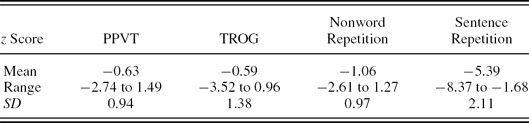
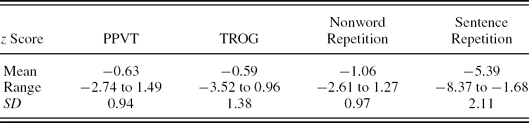
The LI group consisted of 21 monolingual Hungarian-speaking children between the ages of 4 years, 10 months (4;10) and 7;2 who had been diagnosed with LI. All children were enrolled in language intervention programs prior to their recruitment for this study. Inclusive criteria for the LI group were significant deviation from age norms (−1.5 SD) on at least two of the following four language tests: a test of grammatical comprehension (Test for the Reception of Grammar [TROG]; Bishop, Reference Bishop1983), a test of receptive vocabulary (Peabody Picture Vocabulary Test [PPVT]; Csányi, Reference Csányi1974), a sentence repetition test (Hungarian Sentence Repetition Test Magyar Mondatutánmondási Teszt; Kas & Lukács, Reference Kas and Lukács2011) and a nonword-repetition test (Racsmány, Lukács, Németh, & Pléh, Reference Racsmány, Lukács, Németh and Pléh2005). A summary of the children's performance on these tests, computed in terms of z scores, appears in Table 2.
Test scores (z scores) for the children with language impairment
Note: PPVT, Peabody Picture Vocabulary Test; TROG, Test for the Reception of Grammar.
Tests that were adaptations of existing tests (PPVT and TROG) were standardized following modifications of lexical and grammatical details to ensure that the resulting items were relevant to, and developmentally appropriate for Hungarian. The Hungarian version of the TROG consists of 20 blocks, each with four sentences of the same construction. Examples of construction types include comparatives, postmodified subjects, and embedded clauses. Changes from the English version (beyond translation) were necessitated because the Hungarian pronouns do not make a distinction according to gender, suffixes are used to express notions that are expressed by prepositions in English, and, where passive sentences are used in English, Hungarian makes use of active sentences with object–verb–subject word order (with case marking on the object), among others.
It can be seen from Table 2 that the children with LI earned extremely low z scores on the sentence repetition test. Indeed, all 21 children in the LI group scored lower than −1.5 SD on this test. The sentence repetition test is newly developed, and it is possible that the existing normative data for TD children are not representative, resulting in uncharacteristically low z scores for the LI group. However, although it is possible that the sentence repetition abilities are not quite as low as these extreme z scores suggest, recall that to be included in the LI group, a child had to score −1.5 SD or lower on at least two of the language tests. Therefore, inclusion of a child in the LI group was not based on the sentence repetition test score alone. Finally, children with a nonverbal IQ below 85 (Raven Coloured Progressive Matrices; Raven, Court, & Raven, Reference Raven, Court and Raven1987), or a history of hearing impairment or any neurological conditions were excluded from the study.
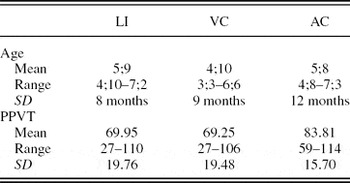
Performance of the LI group was compared to that of two TD control groups. All TD children were enrolled in regular preschools or elementary schools and were regarded as developing in an age-appropriate manner according to teacher and parent report. The 21 children in one of these comparison groups were matched individually with children in the LI group according to receptive vocabulary (PPVT) raw scores to within four points. At the time of the study, the TROG was in the process of being standardized; we therefore used the PPVT as the basis for matching, as normative data for this test were well established. Because the production task involved completing the examiner's sentences with short (three-word) responses, this task did not place an utterance length burden on any of the children. The PPVT-matched children ranged in age from 3;3 to 6;6, which we refer to here as the vocabulary control (VC) group. Because the children with LI scored below age level on the PPVT, the children in the VC group were considerably younger than the children with LI. The 21 children in the other comparison group were matched to the children in the LI group to within 2 months of age. Their ages ranged from 4;8 to 7;3; we refer to this group here as the age control (AC) group. All children in the comparison groups scored within the normal range on the PPVT. A summary of the three groups’ age and PPVT scores is provided in Table 3.
Ages and raw scores on the PPVT for the three groups of children

Note: Age mean and range are in years;months. PPVT, Peabody Picture Vocabulary Test; LI, language impairment; VC, vocabulary control; AC, age control.
Procedure
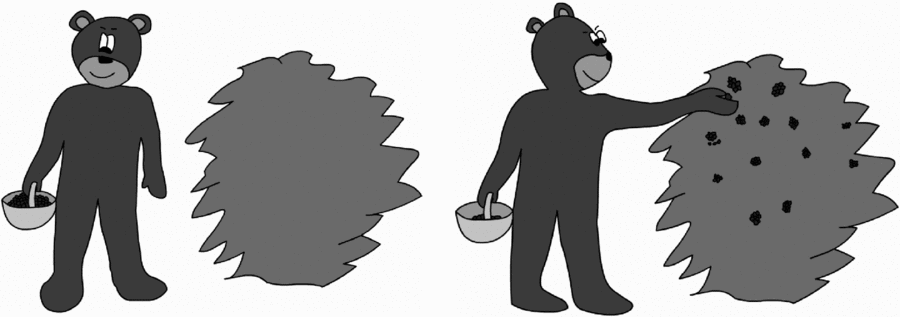
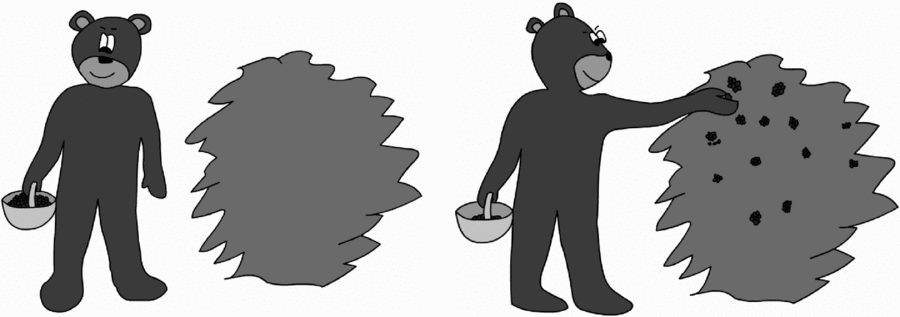
Comprehension. Two tasks were devised to assess the children's ability with the imperfective–perfective distinction. The first was a comprehension task. Two drawings were presented on a page, one depicting a completed action, the other depicting the same action in progress. An example is shown in Figure 1. All drawings depicted an animal performing (or having just performed) a humanlike action. All test sentences included a definite article plus subject noun, a verb in past tense in either imperfective or perfective form, and a direct object consisting of a definite article plus object noun. In constructions of this type, the presence or absence of a prefix makes the clearest distinction between the imperfective and perfective (Kiefer, Reference Kiefer, Kiefer and Kiss1994, p. 450). To ensure that the sentences without prefixes were compatible with an imperfective interpretation, the examiner described the following scenario to the child (given here in English): “Yesterday a photographer went to the zoo, and took pictures of what the animals were doing. Help me sort the pictures. Point to the picture that shows what I say.” The examiner then preceded each item with “When this picture was taken . . .” This clause, Amikor lefényképezték, is literally translated as “When [they] had photographed [him/her] . . .” and is perfective (with the prefix le-) and in past tense.
The picture pair for the target sentence Amikor lefényképezték, a medve leszedte a málnát. (“When this picture was taken, the bear had picked the raspberries.”).
Fifty items were used; 40 of these were divided into the conditions of interest and the remaining 10 items were filler items. Four conditions were employed, with the same 10 verbs used in each condition. Twenty of the items were sentences in the imperfective and the remaining 20 were sentences in the perfective. The imperfective and perfective items were subdivided, resulting in 10 of each type that had an accompanying adverb and 10 of each type that had no accompanying adverb. Thus, the same verb appeared in an imperfective with adverb condition, an imperfective with no adverb condition, a perfective with adverb condition, and a perfective with no adverb condition. The particular adverb used (még mindig “still” for the imperfective, már teljesen “already completely” or már az összes “already . . . the whole” for the perfective) was consistent only with, and could be viewed as providing semantic support for the particular type of aspect with which it was paired. Examples of four items are shown in (1); the entire list of items appears in Appendix A. Recall that English does not possess a distinct form to mark perfective aspect; in these examples, the English past perfect (“had eaten”) is used as the closest equivalent to convey that the action had been completed following a clause such as “When this picture was taken . . .”
- (1)
a. A malac még mindig ette a jégkrémet
“The pig was still eating the ice cream”
b. A majom ette a tortát
“The monkey was eating the cake”
c. A nyúl már megette a répát
“The rabbit had already eaten the carrot”
d. A tigris megette a levest
“The tiger had eaten the soup”
The 10 verbs used in each of the four conditions were ette/megette (“was eating/had eaten”), itta/megitta (“was drinking/had drunk”), vágta/kivágta (“was cutting out/had cut out”), szedte/leszedte (“was picking/had picked”), festette/kifestette (“was painting/had painted”), rajzolta/lerajzolta (“was drawing/had drawn”), építette/felépítette (“was building/had built”), mosta/kimosta (“was washing/had washed”), vágta/levágta (a haját) (“was cutting/had cut (her hair)”), and szerelte/megszerelte (“was fixing/had fixed”). The second verb form listed in each pair is the perfective, containing the prefix. As noted earlier and as can be seen from these 10 verbs, there is more than one perfective prefix in Hungarian (e.g., meg-, le-, ki-); the particular prefix employed depends in large part on the specific verb used. As will be seen, this fact was taken into consideration in the scoring.
For each of the 40 test items, the target and foil drawings depicted the same subject, ongoing/completed action, and object. The left versus right location of the target drawing on the page was counterbalanced across the four conditions.
The 10 filler items involved pairs of pictures that could be distinguished on the basis of a difference in prefixes that served a different (nonperfective) function (e.g., a mouse having just run up the stairs versus a mouse having just run down the stairs, a pig having just turned on the tv versus a pig having just turned off the tv). If children performed poorly on the perfective items, these filler items could allow us to determine if the problem rested with prefixes in general or only with those that marked perfective aspect.
Production. The comprehension task provided an indication of whether the children had a basic understanding of the imperfective–perfective distinction when tense was held constant. The production task (always administered after the comprehension task) placed greater demands on the children because the children were given the same type of background about a photographer at the zoo, but this time were asked to complete the sentence produced by the examiner by supplying the verb and direct object. This required the child to choose not only the appropriate aspect but also the appropriate tense. For example, after being told that the photographer took pictures of what the animals were doing, the child was given the prompt Amikor lefényképezték (e.g., a ló . . .) “When this picture was taken (e.g., the horse . . .).” Again, 10 items involving the same verbs were used for each of the four conditions. For items in the imperfective with adverb condition and the perfective with adverb condition, the examiner provided the adverb immediately after the name of the subject, as in Amikor lefényképezték (e.g., a majom már . . .) “When this picture was taken (e.g., the monkey already . . .).” In Hungarian, adverbs of this type often precede the verb, and thus, literally translated, have the order seen in “The lion still was fixing the car” and “The rabbit already had eaten the whole carrot.” Therefore, the child's response in all conditions required only the verb (with appropriate tense and aspect) and direct object. The target pictures used in the comprehension task were also used for the production task. The comprehension and production tasks were administered on separate days.
Scoring
The scoring of the comprehension task was simply the number correct out of 10 items in each of the four conditions. (The filler items were scored in the same way, to verify the children's understanding of simple nonperfective prefixes.) The probability of a correct response by chance was 50% as there were two alternative drawings (target and foil) for each item. Results will be discussed in terms of percentages so that the children's level of performance relative to chance is always clear.
Scoring of the production task was performed in two ways. The first scoring method required both past tense and the use of the correct type of aspect (imperfective or perfective). If children used a different but plausible verb and correctly marked it for tense and aspect, it was scored as correct. In addition, for perfective items, if children produced a different prefix than the one ordinarily associated with the verb in the particular context being tested, but the prefix served to mark perfective aspect (and past tense was marked), it was scored as correct. It should be noted that in all of the instances in which an unexpected prefix was used, its use was grammatical even though it was not the prefix that would be selected by adult speakers in that particular context. If the child added an adverb to a response that otherwise met our tense and aspect criteria as just described, the response was treated as correct. Errors were productions of an imperfective form in a perfective context or vice versa, whether with the target verb or with another plausible verb. Productions of the appropriate imperfective or perfective form but with present tense were likewise treated as errors. Finally, if a verb form other than an imperfective or perfective form (regardless of tense) was used, it was scored as an error.
The first scoring method was regarded as demanding because the children had to retain the past tense information contained in the examiner's prompt while selecting the appropriate form for imperfective or perfective aspect. We also adopted a second scoring method that was identical to the first except that we allowed either a present tense or a past tense form of the verb. This second scoring method allowed us to evaluate the children's command of the imperfective–perfective distinction even if the past tense information in the examiner's prompt was not retained in the child's response.
RESULTS
Comprehension
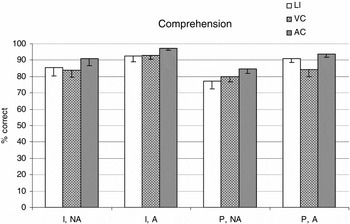
The comprehension task provided an estimate of the children's understanding of the imperfective–perfective distinction when (past) tense was held constant. A mixed model analysis of variance (ANOVA) was used, with participant group (LI, VC, AC) as a between-subjects factor and aspect (imperfective, perfective) and adverb (adverb, no adverb) as within-subject factors. The assumption of homogeneity of variance for the ANOVA was met. Participant group was not significant, F (2, 60) = 2.33, p = .11, and an inspection of Figure 2 reveals that the largest numerical differences were between the VC and AC children, with the children in the LI group falling at intermediate levels. A main effect was found for aspect, F (1, 60) = 5.80, p = .02, partial η2 = 0.09, with higher accuracy on imperfective items than on perfective items. Adverb was highly significant, F (1, 60) = 35.80, p < .001, partial η2 = 0.37. Items containing an adverb in the prompt were more likely to be correct than those with no adverb. No interactions were significant (all Fs < 1.00, all ps > .40).
The mean percentage correct on the comprehension task. Error bars are standard errors. I, imperfective; P, perfective; NA, no adverb; A, adverb.

As can be seen from Figure 2, the children's accuracy was relatively high. For example, the children with LI scored above chance, even on items in the most difficult condition, the perfective with no adverb condition, t (20) = 5.98, p < .001. However, given that scores were not at ceiling level, it appeared useful to determine the degree to which the errors that were seen might be due in part to a weakness in comprehending prefixes in general. Recall that the filler items involved contrasts between nonaspectual prefixes (e.g., running up vs. running down the stairs). The children's accuracy on these items was quite high (LI, M = 90%, SD = 10.95; VC, M = 97.1%, SD = 0.46; AC, M = 93.8%, SD = 0.74). Furthermore, a comparison between the children's performance on the filler items and their performance on the items of the perfective with no adverb condition (which required an understanding of the perfective prefix for a correct response) revealed a significant difference favoring the filler items, F (1, 60) = 36.17, p < .001, partial η2 = 0.38. Participant group only approached significance, F (2, 60) = 2.82, p = .07, partial η2 = 0.09. The interaction was not significant, F (2, 60) = 0.04, p = .96.
Production
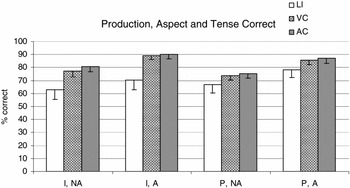
Tense and aspect correct. The first scoring method for the production task required that the children responded with a past tense form as well as the correct aspect (imperfective or perfective). A mixed-model ANOVA was employed with participant group (LI, VC, AC) as a between-subjects variable and aspect (imperfective, perfective) and adverb (adverb, no adverb) as within-subjects variables. Again, the assumption of homogeneity of variance was met. A main effect was found for participant group, F (2, 60) = 4.21, p = .019, partial η2 = 0.121. Least significant difference testing revealed that the children with LI were less accurate than both the AC group (p = .010) and the VC group (p = .024). The AC and VC group did not differ (p = .729). Aspect was not significant, F (1, 60) = 0.03, p = .86. However, adverb proved significant as a main effect, F (1, 60) = 35.91, p < .001, partial η2 = 0.37, with higher scores for the adverb conditions than for the no-adverb conditions. No interactions were significant (all Fs < 1.00, all ps > .34). A summary of the results can be seen in Figure 3.
The mean percentage correct on the production task with the scoring method that required both tense and aspect to be correct. Error bars are standard errors. I, imperfective; P, perfective; NA, no adverb; A, adverb.

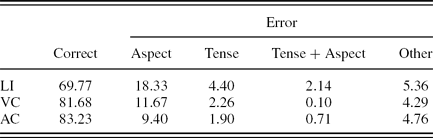
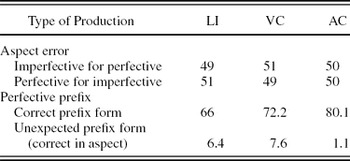
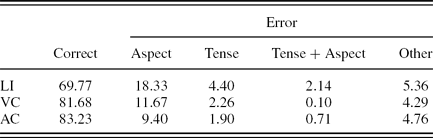
Table 4 provides the distribution of the children's production responses. As can be seen, errors of aspect only, in which the children produced a past tense imperfective form in a past tense perfective context or a past tense perfective form in a past tense imperfective context, constituted the most frequent error type for all three groups, although such errors were considerably more frequent in the responses of the children with LI. It is important that these errors occurred in both directions. For the children with LI, of the aspect-only errors, 49% were productions of the imperfective on items requiring the perfective, and 51% were productions of the perfective on items obligating the imperfective. Examples appear in (2) and (3), respectively. For the VC group, these errors were 51% and 49%, respectively, and for the AC group, these errors were evenly divided (50% and 50%, respectively). An especially noteworthy detail is that the productions of perfective forms in imperfective contexts involved commission errors: using a prefix where none was required. For the verbs included in our items, the prefixed forms have lower frequencies of occurrence in Hungarian than the nonprefixed forms. A summary of the aspect substitution errors appears in Table 5.
Distribution of responses (mean percentages) on the production task
Note: LI, language impairment; VC, vocabulary control; AC, age control.
Distribution of aspect errors and use of perfective prefixes (mean percentages) on the production task

Note: LI, language impairment; VC, vocabulary control; AC, age control.
(2)

(3)

Recall that children's production of a perfective prefix form that differed from the one expected in the context was scored as correct provided that it occurred in a perfective context. As can be seen from Table 5, such productions did not constitute a large percentage of the perfective prefixes produced. It is important that all of the observed productions of this type were grammatical; they were simply not the form that an adult speaker would select in that particular context. For example, some children produced levágta a fát “had cut the tree” rather than kivágta a fát. When referring to cutting fingernails or beards, only levágta can be used, but in the context of cutting trees, adults would select kivágta, even though levágta is not ungrammatical.
Errors of tense only were considerably less frequent than errors of aspect only in all three groups, although the children with LI produced more of these errors than did their TD compatriots. These errors were instances in which the children produced the present tense form in place of the past tense form, but employed the proper form of aspect. It can also be seen from Table 4 that the children were more likely to err in aspect or tense than to produce an error involving both. Finally, “other” errors were seen in all three groups. These included instances in which children produced the Hungarian equivalent of “was done with” or “finished” in contexts requiring perfective forms. Along with being semantically imprecise, these forms do not involve perfective prefixes. Another error placed in the “other error” category occurred when children produced the Hungarian equivalent of “almost” plus a verb in perfective form in a context suitable for an imperfective form.
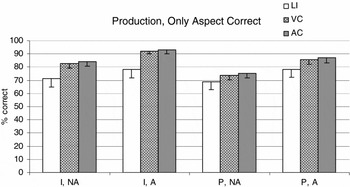
Aspect correct, tense requirement relaxed. The second scoring method allowed responses that were in present tense as well as past tense, provided that aspect (imperfective, perfective) was correct. An ANOVA identical to the one used with the first scoring method was applied to the scores based on the second scoring method. The assumption of homogeneity of variance was met. Participant group was again significant, F (2, 60) = 3.46, p = .04, partial η2 = 0.10. Least significant difference testing revealed that the children with LI were less accurate than both the AC group (p = .013) and the VC group (p = .027). The AC and VC group did not differ (p = .768). Aspect was approaching significance, F (1, 60) = 3.09, p = 0.08, partial η2 = 0.05. However, adverb was highly significant, F (1, 60) = 36.68, p < .001, partial η2 = 0.38. Again, no interactions were significant (all Fs < 1.00, all ps > .35). The findings are illustrated in Figure 4.
The mean percentage correct on the production task with the scoring method that required only aspect to be correct. Error bars are standard errors. I, imperfective; P, perfective; NA, no adverb; A, adverb.

From a comparison of Figures 3 and 4, it can be seen that the children's performance levels did not increase appreciably with the second scoring method, and group differences were again apparent. These findings suggest that a problem with tense was not a major factor, either globally or specifically within any of the four conditions.
DISCUSSION
This study was based on the premise that aspect may be vulnerable in children with LI. Previous studies in other languages suggested not only that children with LI might be insensitive to aspectual information as it interacts with tense, but that aspect might be an area of weakness independent of tense. Hungarian provided an excellent opportunity to examine the status of aspect in children with LI, as this language permits a view of the imperfective–perfective distinction that can be made without the involvement of tense.
Results from our comprehension task suggested that the children with LI had an understanding of the imperfective–perfective distinction that was comparable to that of their TD peers. They performed above the level of chance on even the most difficult of the item types, those involving the perfective without an accompanying adverb. Although these children, like their TD peers, occasionally made errors, their performance suggested considerable knowledge of this aspectual distinction, at least as it was tested here.
However, the production performance of the children with LI revealed weaknesses even relative to the younger TD children. Our initial scoring required appropriate use of (past) tense as well as correct use of the imperfective or perfective. Analysis based on that scoring showed that the children with LI were less accurate than both the VC and the AC children. Such a finding could be attributable to a problem with tense. However, when we scored the children's productions solely in terms of their use of the imperfective or perfective, the same group differences were found. Scores improved very little, suggesting that choice of the wrong tense was not a central factor in the findings. We interpret these findings to mean that the children with LI had some weakness in the expression of aspect, more specifically, in the expression of imperfective and perfective aspect. Before discussing the implications of this interpretation, we consider alternative interpretations, and provide reasons for why we find them unconvincing.
First, it might be argued that the perfective prefix, which is a monosyllabic syllable in word-initial position, is not perceptually salient and, because children with LI are often reported to have perceptual limitations, these limitations may have made the children's acquisition of the perfective prefix more difficult. This does not seem likely given that, in Hungarian, the first syllable of a word is stressed. Thus, whereas a verb without a prefix will have stress on the first syllable of the stem, the same verb with a prefix will have stress on the prefix itself. Another reason for not preferring a perceptual explanation is that the children with LI were similar to the TD children in their comprehension of perfective (and imperfective) items; the children with LI scored lower than the TD children only in production. A related argument might be that the past tense inflection requires production of /t/, a brief consonant that might have been difficult in production as well as in perception. However, in the context in which past tense occurred in this study—with a definite direct object—the past tense allomorphs were the syllabic forms /ta/ or /te/. Another reason to believe that this factor could not have played a major role is that the children with LI showed lower production accuracy than the VC and AC children even when we excluded tense accuracy from consideration in the scoring.
Second, it might be argued that the static nature of the visual stimuli made the distinction between imperfective and perfective events more difficult to discern. Certainly the ongoing action depicted in the target pictures for imperfective items might have made the expression of past tense more difficult. However, in this case, the most likely error would be one of using the imperfective in present tense. This was not the typical error. As just noted, when tense was ignored in the scoring, the children with LI nevertheless scored lower than the VC and AC children on all item types, including those assessing the imperfective.
It still might be argued that perfective aspect was inadequately represented by our pictures. That is, the result of the action was depicted (e.g., first drawing in Figure 1) but without the action visible in the picture, the children had to infer that the action had actually been performed. Perhaps the ability to infer was the obstacle for the children, not the use of perfective aspect. However, two observations cast some doubt on such an interpretation. First, the children were administered the comprehension task prior to the production task. The comprehension task employed the same pictures and target sentences. Thus, the children had already heard the examiner provide the correct description of the pictures intended to reflect perfective aspect, albeit in a prior testing session. Second, and of importance, most of the children's errors on perfective items were productions of the imperfective. Such productions contain the name of the action (e.g., ette “was eating”). Thus, even when children chose the wrong form of the verb, they evidently could infer the action performed by observing the result.
Current accounts of verb morphology deficits in children with LI were not designed to handle the types of difficulties observed in this study. For example, the agreement deficit account of Clahsen and colleagues (Clahsen, Bartke, & Göllner, Reference Clahsen, Bartke and Göllner1997; Clahsen & Dalalakis, Reference Clahsen and Dalalakis1999) does not seem applicable, as all of our contrasts in comprehension and production involved the same third-person singular subject. Person and number information did not have to be considered, yet the children with LI nevertheless performed below the level of the VC and AC children on the production task. Similarly, because Hungarian is a null-subject language, it does not fall within the purview of the “extended optional infinitive” account of Rice, Wexler, and their colleagues (Rice, Reference Rice, Levy and Schaeffer2003; Rice et al., Reference Rice, Wexler and Hershberger1998; Rice & Wexler, Reference Rice and Wexler1996).
In null-subject languages, many verb inflection errors by children with LI can be regarded as “near-miss” errors, which are errors that differ from the correct form on only one of several possible details (e.g., Bedore & Leonard, Reference Bedore and Leonard2001). In a recent study of tense and agreement by Lukács, Leonard, Kas, and Pléh (Reference Lukács, Leonard, Kas and Pléh2009), Hungarian-speaking children with LI showed the same near-miss pattern, such as producing a present tense first person singular form in place of a present tense first person plural form or producing a past tense third person plural form in place of a past tense first person plural form. No single inflection type was consistently in error, and no evidence of a default form was found. Instead, the children seemed to have difficulty consistently selecting the inflected form that possessed the correct combination of features. Lukács et al. (Reference Lukács, Leonard, Kas and Pléh2009) characterized the difficulty as one of processing, given that the children exhibited sufficient knowledge to generate the correct form in most instances but sometimes erred in ways that suggested retrieval of a form that approximated but did not match the target form.
There were details in the data of the present study that also suggest that processing factors were at work. First, the children with LI scored lower than the VC and AC children in production but did not differ significantly from their TD peers in comprehension. Evidently the act of retrieving the appropriate form for production was relatively more difficult for the children with LI than for the TD children even though their recognition of the correct form in the comprehension task was comparable to that of their peers.
Second, the children with LI did not err primarily on one type of aspectual form. Instead, occasional errors were made on aspect items of each type. It was also clear that the children did not rely on a single type of form as a default form. A likely choice for a default form would have been a verb that lacked both a prefix and a past tense inflection, given that forms of this type have no morphological embellishments and are actually grammatical in a present tense imperfective context. However, instead, the children with LI usually produced perfective items correctly but sometimes used the imperfective form instead, and usually produced the imperfective items correctly but occasionally added a prefix that resulted in an (inappropriate) perfective form. That the children varied their response, even when in error, also serves as evidence that the children were clearly not simply mimicking the form given in the examiner's prompt, which never varied.
Third, errors of aspect only and errors of tense only were each more frequent than errors of both aspect and tense. These differences are consistent with a near-miss pattern of errors.
Fourth, the children with LI were less accurate than the VC and AC children but showed the same pattern of performance across conditions. There were no significant interactions involving group, and all groups showed increased accuracy when the examiner's prompt included an adverb that was compatible with the imperfective or perfective form expected for the item. The similar pattern of performance across conditions in the three groups suggests that the children with LI had greater difficulty across the whole task and were not disproportionately affected by any one aspect type.
However, one important detail in the findings suggests that a processing explanation is not sufficient. The near-miss errors included the use of perfective forms in contexts requiring imperfective forms. These errors were commission errors on the part of the children: adding a prefix to the verb stem where one was not needed. Usually processing limitations result in the omission or simplification of the target in some way. However, in these particular instances, the form produced by the child contained more information (a prefix) than was required.
This finding of commission errors suggests that the children's difficulties were due in part to some confusion about the expression of aspect, at least in past tense contexts. The children seemed to have had some grasp of imperfective and perfective aspect given that they performed above the level of chance in comprehension. However, selecting the appropriate form for production may have required greater command of aspect than the children possessed. The difficulty could have involved uncertainty about the particular type of aspect that applied to the context, or to the particular form (e.g., a prefix or no prefix) that was to be used to express the selected aspect.
That the presence of adverbs facilitated the children's accuracy suggests that the children's limited ability with aspect was not confined to recognizing the correct form (an ability assessed on the comprehension task). The adverbs employed were closely associated with the respective type of aspect (“still” with the imperfective, “already” with the perfective). The presence of the adverb in the examiner's prompt, then, may have served as an important cue as to the type of aspect—imperfective or perfective—the child should express during the production task. It is also plausible that the children's prior experience with the adverbs led to the development of associations between particular adverbs and particular verb forms (e.g., perfective prefixes follow “already,” whereas no prefix is used following “still”). Given that the VC and AC groups also benefited from the presence of adverbs, it is clear that their skill with aspect was not yet consolidated. Clearly, though, the children with LI were even more limited in their skill with aspect; even with the benefit of adverbs in the prompt, these children's level of accuracy never reached 80% with either type of aspect, even with the more lenient scoring method.
That the children with LI differed from the VC children on imperfective as well as perfective aspect use has important implications for current views on the status of progressive -ing in the grammars of English-speaking children with LI. In the adult grammar of English, progressive -ing marks imperfective aspect. Given the early appearance of -ing in the utterances of English-speaking children with LI (see Leonard, Reference Leonard1998), it has been assumed that this inflection is a relative strength in these children, and by extension, so, too, is the use of imperfective aspect. Yet, in the present study, the children with LI had considerable difficulty in the use of imperfective aspect. This is especially noteworthy because, in Hungarian, imperfective aspect requires no prefix.
The finding of weaknesses in the use of imperfective aspect by children with LI can also be found in other languages. In particular, Fletcher et al. (Reference Fletcher, Leonard, Stokes and Wong2005) found that Cantonese-speaking children with LI made significantly less use of both imperfective and perfective forms than did younger TD compatriots. Together, these findings suggest to us that the use of -ing by English-speaking children with LI may have been overinterpreted. Instead of reflecting an age-appropriate command of imperfective aspect, these children's use of -ing may reflect in part their awareness that this form is commonly used when describing actions in the present. An intention to convey the continuous nature of the action may not be present.
In summary, the findings of the present study suggest that children with LI may have a problem with temporally related information that extends beyond tense. Aspect also appears to be a vulnerable area. Specifically, it appears that children with LI may have difficulties with the grammatical expression of aspect, at least in past tense contexts. A clearer picture of this vulnerability will no doubt emerge in future studies that employ tasks that differ in their processing demands and languages that vary in how clearly they separate aspect from tense.
APPENDIX A
Target sentences in comprehension and production

Note: I, imperfective; NA, no adverb; A, adverb; P, perfective; F, filler.
ACKNOWLEDGMENTS
This research was supported by Research Grant R01 DC00458 from the National Institute on Deafness and Other Communication Disorders, National Institutes of Health (to L.B.L.), and by OTKA TS 049840 from the Hungarian National Science Foundation (to C.P.). Ágnes Lukács was a grantee of the Bolyai János Research Scholarship of the Hungarian Academy of Science. The authors are grateful to the children in the Dr. Nagy László Institute of Special Education in Köszeg, the ELTE Special Preschool and Early Intervention Centre, and the Zölderdő Preschool for Speech Therapy and Nature Preservation for their participation. We also thank the speech therapists in both institutions for their help with screening and organization and to Patricia Deevy for her helpful comments.