1. Introduction
Descriptive representation is, as Mansbridge (Reference Mansbridge2003) writes, a situation where representatives “in their own persons and lives in some sense typical of the larger class of persons whom they represent.” By electing representatives who share demographic traits with the citizens of their districts, constituents across the nation can look to their representative as someone “like them” who provides their group a seat at the table. This, in turn, increases trust in the legislative process to represent the interests of the group in question (Mansbridge Reference Mansbridge1999). Given that representative democracies rely upon voters’ trust in their representatives, descriptive representation is necessary to a functioning polity.
One feature in American politics that works to ensure the representation of racial minorities is minority–majority districts. Without the active creation of minority–majority districts, racial minorities suffer extreme barriers to office, especially in the deep south (Hicks et al. Reference Hicks, Klarner, McKee and Smith2018). Further, research has noted that, without the presence of racial minority members in the legislature (Pitkin Reference Pitkin1967; Tate Reference Tate2003a), parties would have no incentive to represent the needs of racial minorities in the electorate—including the Democratic Party (Tate Reference Tate2003a,b). Therefore, these minority–majority districts are instrumental in ensuring descriptive representation within the United States.
However, the creation of minority–majority districts has some unintended consequences. Research has found that the creation of minority–majority districts following Thornburg v. Gingles Footnote 1 and the realignment of the South to the Republican Party (Grose Reference Grose2011; Lublin Reference Lublin1997) detracts from the ability of Democrats to win more seats within Congress and state legislatures (Grose Reference Grose2011; Calidas Reference Calidas2008; Chen and Rodden Reference Chen and Jonathan2013). Additionally, others argue that minority-influenced districts—as opposed to minority–majority districts—are more helpful in producing substantive representation for members of racial minority groups at the expense of increased descriptive representation (Lublin Reference Lublin1997).
Despite the significant literature on descriptive representation, we believe that one crucial component of this phenomenon is unstudied—the knowledge of being descriptively represented. Implicit in arguments in favor of descriptive representation is that constituents know they are descriptively represented. For example, to contact a legislator who shares your racial or gender identity, you must know whether such a representative exists.
We argue that district design itself can lead to a direct break in the constituent–representative link (CRL) that leads to a reduction in the ability for constituents to identify with their representative. Specifically, we argue that districts splitting geographic units used to facilitate communication make it more difficult for constituents to identify their representative and that representative’s race.
We specifically build upon the research of Curiel and Steelman (Reference Curiel and Steelman2018) and posit that the division of ZIP codes impairs the CRL for racial minority individuals by making it more difficult for individuals to identify the race and party of their representative. Consequently, racial minority individuals will be less likely to approve of their representative, detracting from the purpose of minority–majority districts.
We test the extent to which descriptive representation rests upon geographies central to the CRL by employing survey data of racial minority respondents from the Congressional Cooperative Election Study (CCES) for 2010, 2012, and 2014. Our multilevel survey-weighted logistic regression reveals supportive evidence for our expectation. Insofar as ZIP codes are split between districts with representatives of different races, the ability to recognize the race and party of one’s representative is greatly reduced, which, in turn, reduces approval. However, the benefits of descriptive representation experienced by a Black individual living in a split ZIP code exceed the benefits they may enjoy living in a wholly nested ZIP code represented by a white legislator.
Therefore, these results offer evidence that there is more to ensuring descriptive representation than the initial creation of minority–majority districts. These findings suggest that to preserve the link between constituents and their representative, district mapmakers must actively seek to avoid creating districts that hamper this connection.
1.1. Balancing descriptive and substantive representation
Descriptive representation as described by Mansbridge (Reference Mansbridge2003) within the United States is primarily centered around the discourse of race, given America’s single-member district system and foundation of racial oppression. Descriptive representation for racial minorities also exists in tension with other forms of representation. Of the categories of representation established by Pitkin (Reference Pitkin1967)—formal, substantive, symbolic, and descriptive—the forms of substantive and descriptive most clearly conflict given America’s history of racism. Where substantive representation equates to policy outcomes in line with the will of constituents, racial minorities largely depend upon Democratic control of legislative chambers to advance their interests (Cameron, Epstein and O’Halloran Reference Cameron, Epstein and O’Halloran1996; Epstein et al. Reference Epstein, Herron, O’Halloran and Park2007; Swain Reference Swain1993; Knoll Reference Knoll2009). However, at least some racial minorities are necessary within legislative chambers to craft legislation and more effectively reach out to constituencies (Grose Reference Grose2011; Grose, Mangum and Martin Reference Grose, Mangum and Martin2007; Canon Reference Canon1999; Bowen and Clark Reference Bowen and Clark2014). Additionally, strong evidence exists as to racial minorities feeling more attached to their representative and the political world in general when they share a racial identity, the core of descriptive representation (Swain Reference Swain1993; Tate Reference Tate2003 a,b; Broockman Reference Broockman2014). Bowen (Reference Bowen2014) finds that other nonpolicy activities related to constituency service are better received by racial minorities when they are descriptively represented. Clark (Reference Clark2019) additionally finds Democrats within state legislatures prone to ignore racial minority interests, especially those of African Americans, within the South along the dimension of welfare aid. Therefore, even if it is not the place of social scientists to say which dimension of representation is more important, it is almost certainly the case that some compromise between the two is necessary.
To complicate matters of translating the interests of racial minorities to legislative delegations are single-member districts. American legislatures and localities explicitly employed districting, including the use of multimember and at-large districts, to keep racial minorities out of government (Banfield and Wilson Reference Banfield and Wilson1963; Tate Reference Tate2003 a). The history of racial minorities unable to elect their representatives led to the U.S. Supreme Court to create the Thornburg v. Gingles Footnote 2 (1986) standard where minority–majority districts should be created to prevent minority vote dilution, conditional upon: (1) a minority group is populous and sufficiently compact enough to form its own district, (2) the minority group is politically cohesive and shares similar voting behavior, and (3) the majority votes to suppress the preferred candidate of the minority. At the same time, litigation starting with Shaw v. Reno Footnote 3 (1993) ruled that some other connection beyond race proved necessary to create a minority–majority district. The Supreme Court accepted as evidence oddly shaped districts, such as the infamous NC 12th district stretching hundreds of miles down I-85 to connect Charlotte to Greensboro, as proof of redistricting on the grounds of race alone (Calidas Reference Calidas2008; Barabas and Jerit Reference Barabas and Jerit2004; Lublin Reference Lublin1997). The evidence of “weird” looking districts proved instrumental in a 2011 ruling addressing NC’s 1st and 12th congressional districts as racial gerrymanders in Cooper v. Harris (2016).Footnote 4
Despite the litigation and rulings from state and federal courts regarding how to draw districts, it is not entirely clear how to draw districts in a manner that strikes the correct balance between descriptive and substantive representation. Epstein and O’Halloran (Reference Epstein and O’Halloran1999) and Cameron, Epstein and O’Halloran (Reference Cameron, Epstein and O’Halloran1996) find that courts often overestimate the proportion of racial minorities necessary to elect a representative of their choice, leading to surrounding districts “bleached” and drained of the necessary Democratic support to contest majority control of legislative and congressional delegations (Grose Reference Grose2011; Lublin Reference Lublin1997, Reference Lublin1999). However, one must also be careful to avoid accidentally diluting racial minority representation via cracked districts. Racial minorities are robbed of the chance to elect a representative of their choice while also preventing Democratic contestation of majority control. Hicks et al. (Reference Hicks, Klarner, McKee and Smith2018) most recently found that in the deep south that the African-American population of a district needs to be at least 50% for African Americans to have a 50% chance at winning, compared to 40% for the nonsouth. Additionally, Epstein et al. (Reference Epstein, Herron, O’Halloran and Park2007) offer robust evidence that the increase of minority–majority districts led to an increase in Republican control, which led to policies far outside the range of racial minority preferences.
The overall trend in research suggests that the more we know, the more we realize how difficult it is to balance these two competing dimensions of representation. As Hicks et al. (Reference Hicks, Klarner, McKee and Smith2018) conclude,
“Despite conducting the most thorough analysis of the factors contributing to the attainment of black representation since the fateful Thornburg v. Gingles (1986) ruling, the weight of the evidence does nothing to resolve competing normative positions. The old adage that politics makes for strange bedfellows holds with respect to majority–minority districts and black representation. To the extent that some African-American candidates and officeholders care more about their own political careers than the fate of the Democratic Party, many will continue to align with Republicans who are more than happy to pack African-American voters into majority-black districts so that the net effect fosters GOP legislative majorities while practically guaranteeing the election of black Democrats.” (420)
Therefore, research has reached a crossroads—both positively and normatively—over how to district in a way that maximizes the representation of racial minorities. Descriptive representation is worth pursuing and is a necessary building block to representation. Rather than adding to a crowded field on electoral outcomes at the district and chamber level, we therefore ask a different question: can districts be drawn such that the necessary conditions for descriptive representation are violated? Can districts be drawn such that racial minorities are elected to office, yet constituents do not feel connected to that representative?
1.2. Necessary conditions for descriptive representation
The necessary conditions that act as the foundation for descriptive representation are reasonably intuitive and flow into one another. Bowen and Clark (Reference Bowen and Clark2014) offer a cogent survey of the field and identify the following conditions within the broader research on descriptive representation as theoretically imperative:
-
• Recognition as to who belongs to the community of interest (Dewey Reference Dewey1954; Tate Reference Tate2003 a; Banducci, Donovan and Karp Reference Banducci, Donovan and Karp2004).
-
• Contact and communication between members of the community of interest (Jewell and Morehouse Reference Jewell and Morehouse2001; Eulau and Karps Reference Eulau and Karps1977).
-
• Affinity towards in-group members and a sense of shared fate (Tate Reference Tate2003 a,b; Box- Steffensmeier et al. Reference Box-Steffensmeier, Kimball, Meinke and Tate2003; Gay Reference Gay2002).
This set of conditions might not be sufficient but make sense as necessary conditions. It is impossible to meaningfully contact in-group members if one does not know who is in the group, and one cannot feel close to people they do not contact or know. Breaking these links is the very definition of atomization and, at the extreme, decay of civil society (Dewey Reference Dewey1954; Gross Reference Gross1982; Smolar Reference Smolar1996).
The question then arises, can one design districts to impair the above set of conditions? Curiel and Steelman (Reference Curiel and Steelman2018) answer affirmatively. They do the following: First, they identify ZIP codes as the central geography of communication and identification between constituents and representatives. Constituents and political activists can identify constituents with representatives with ease via the ZIP code look-up feature. Further, Curiel and Steelman (Reference Curiel and Steelman2020) follow-up and confirm that representatives update their constituent database by sending mail to all simplified addresses, every four-digit extension of the standard five-digit ZIP code.Footnote 5 Through a historical and legal review, they find each ZIP code to be legally obligated to minimize the travel times between delivery points on a mail route, and violations of this as grounds for legal action against the postal service. Finally, they present robust quantitative evidence that splitting ZIP codes between multiple districts leads to lower recognition of whom one’s representative is, decreased contact between them, and greater perceptions of ideological distance while controlling for a wide array of covariates and potential confounders. Crucially, insofar as any geography enables the identification and communication necessary for the CRL, the impact of ZIP codes outweighs that of counties and media market areas as seen in work by Winburn and Wagner (Reference Winburn and Wagner2010), and that of congressional-level district compactness (Bowen Reference Bowen2014). Given that ZIP codes likewise are the smallest unit of publicly known geography (i.e. no need to geocode), these findings by Curiel and Steelman (Reference Curiel and Steelman2018) and followed up in Curiel and Steelman (Reference Curiel and Steelman2020) make sense. Further, while even census blocks need to be split in the attempt to literally adhere to “one person, one vote” Curiel and Steelman (Reference Curiel and Steelman2018) demonstrate via ensemble simulations that it is possible to minimize population deviation to under 5% when preserving whole ZIP codes in NC, meaning that it is possible to greatly minimize splits in ZIP codes more so than counties or media market areas. While all boundaries are artificial, the function of ZIP codes appear to make them useful in understanding barriers to the CRL.
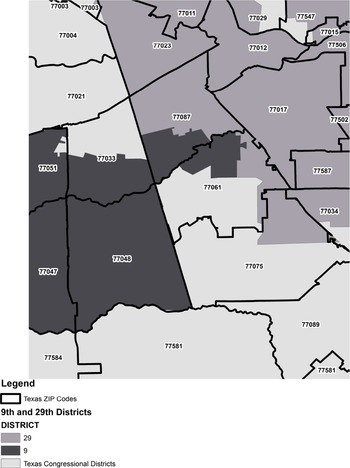
As an example of the confusion that might arise, Figure 1 presents the ZIP codes within the Houston area represented by two Democrats in 2008, Al Green from the 9th district and Gene Green from the 29th district. Whereas Al Green is African American, Gene Green is white. Therefore, one would expect to see great confusion about who one’s representative is and their race within ZIP codes 77087 and 77061. According to the findings of Curiel and Steelman (Reference Curiel and Steelman2018), any split ZIP code should lead to confusion as to name recognition. However, even amidst split ZIP codes, one is statistically most likely to guess the race of their representative correctly if they answer white, though such will not be the case in districts split between representatives of different races. Although most districts might not have the level of confusion as TX’s 9th and 29th districts, we would expect any splitting of ZIP codes between members of different races to lead to confusion and an impairment of the CRL.
ZIP code splits in TX’s 9th and 29th Congressional districts, 2008. ZIP codes around the Houston, TX metropolitan area. ZIP codes color-coded as part of the ninth district are represented by African American Democrat Al Green. ZIP codes represented under the 29th district are represented by White Democrat Gene Green.

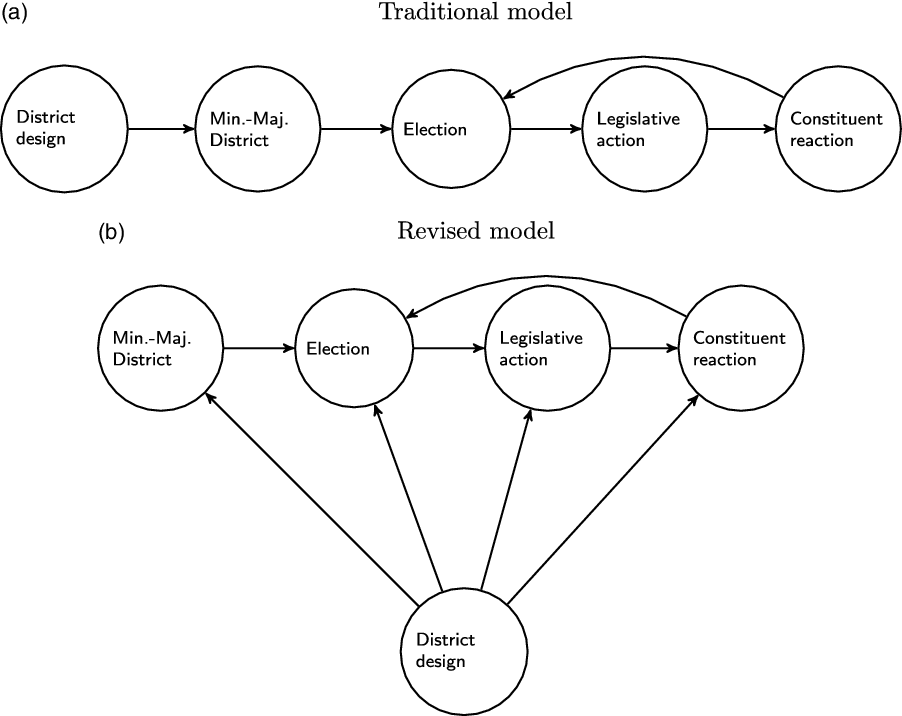
We posit a model where overall district design is more prevalent in the mediation of representation in all its forms, including descriptive. This outlook is visualized in Figure 2. Figure 2a represents a simplified model of understanding of overall representation. Traditionally, district design for a given state affects representation insofar as it sets the stage for the presence of minority–majority districts, where the elected member ultimately affects the quality of representation for racial minorities. The process ultimately culminates in the constituent reaction, which is presumably favorable than otherwise would be given descriptive representation.
Different models of mediated representation. (a) Traditional model and (b) Revised model. Arrows reflect the path flow of representation and its overall aggregated quality.

In Figure 2b, we propose a modification where district design impacts every stage of representation to varying degrees. District design most strongly determines the presence of minority–majority districts. However, other stages are affected as well, and crucially in our case, the constituent reaction. If a constituent does not know their representative, there will be friction in aspects such as credit claiming, position taking, constituency service, and other activities typically conducted by representatives (Mayhew Reference Mayhew1974)
We expect two mechanisms behind the poor identification of one’s representative along the two main drivers of the CRL—race and party. As articulated by Curiel and Steelman (Reference Curiel and Steelman2018), we expect the act of splitting ZIP codes—in their capacity as a means of communication—to reduce recognition. This should operate as contact to these split areas either receive too much outreach and competing signals, or no outreach at all.Footnote 6 A more specific source of confusion to the CRL would be where representatives of different races represent the overlapping districts. A constituent might receive communications by competing representatives and see different races in these communications in such a situation.
We therefore expect these impairments to geographies of communication to lead to the following impacts on descriptive representation:
Hypothesis 1 The more a ZIP code is divided between different districts, the less likely one will recognize the party and race of their representative.
Hypothesis 2 The more a ZIP code is divided between representatives of different races, the less likely one will be able to identify the party and race of their representative.
By analyzing recognition, we provide what might be considered a hoop test or sobriety test, given that the ability to recognize the race, party, and/or name is a necessary condition to engage in more complicated cognitive tasks, such as recall/remembrance.
If one cannot identify the race and party of their representative, it is necessarily true that one cannot more strongly identify with their representative. Additionally, supposing one is less likely to seek out information and know their representative, the CRL that implicitly forms the basis of one of the central components of descriptive representation cannot be met. One such benefit of shared identity is legislator approval, which also leads us to expect:
Hypothesis 3 The less able one is able to recognize the party and race of their representative, the less likely one will approve of the performance of their representative.
If these hypotheses are supported, it would suggest that district design of minority–majority districts can compromise the very benefits of descriptive representation.
2. Data and methods
We take advantage of the CCES, which asked respondents from racial minorities three questions of interest in 2010, 2012, 2014, and 2016. The first two questions asked if the respondent recognized the name of their incumbent member of Congress, and if so, the party and race of their member. In the third question, the CCES asked respondents if they approve of their lawmaker’s performance. The CCES is a mass survey with tens of thousands of respondents, with multiple respondents from every congressional district in the nation, with respondent’s ZIP codes provided (Ansolabehere and Schaffner Reference Ansolabehere and Schaffner2018). Therefore, the CCES provides the necessary data to test the CRL pertaining to the representation of minority voters. For these years, the CCES has 46,689 respondents.
In assessing the ability of a respondent to recognize the race and partisan affiliation of their representative, respondents were given a great degree of latitude and were given no predetermined options for their response. We can match the answers given by respondents against the known party and race of their representative, and code their responses dichotomously as correct (1) or incorrect (0). For the approval of one’s member, respondents could respond strongly approve, somewhat approve, somewhat disapprove, strongly disapprove, or unsure. We code the approval dichotomously such that a response indicating approval is coded as one and zero otherwise.
With these CCES data, we run multilevel models with random intercepts for ZIP codes by state, coupled with the CCES sampling weights. We estimate three different models. The first two are independent multilevel logistic regressions. The first models whether one recognizes their representative’s race, and the second models whether one knows the party of that representative. The CCES asks these questions at the same time, though the two concepts do not appear to be hierarchical, therefore we are able to estimate two independent models. The third model amounts to a second-stage, multilevel logistic regression of whether the respondent approves of their representative. We carry over the predicted residuals from the first models (Angrist and Pischke Reference Angrist and Pischke2009) to do so.
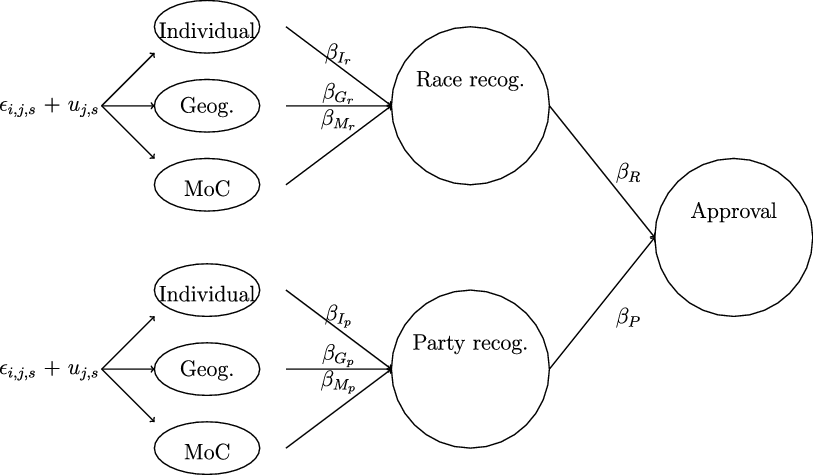
We take these outcomes of interest and regress on the explanatory variables of interest. These can be seen in Figure 3, where we have three types of variables of interest: individual, geographic, and member of Congress level factors.
Constituent–representative link (CRL) model. A general model of the CRL. Circles are the outcomes, and ellipses Congressional Cooperative Election Study explanatory variables. Errors apply at each stage, and estimated for the individual, i, in the ZIP code j and state s. The β values represent the groupings of coefficients estimated.

2.1. Measuring ZIP code violations
We employ two explanatory variables and their interaction to capture barriers to the CRL as measured using divided ZIP codes. First, the extent to which a ZIP code is fully nested within a single district. Second, the proportion of a ZIP code represented by members of different races. These measures capture the geographic influences in the model as shown in Figure 3.
To measure the extent to which ZIP codes fully nest within a district, we employ a measure of diversity known as the Herfindahl index (Wolak Reference Wolak2009) which was adapted by Curiel and Steelman (Reference Curiel and Steelman2020) to the study of legislative districts. The Herfindahl index calculates the sum of squared proportions of a ZIP code’s population living within a ZIP code–district dyad. The score works such that scores of one reflect perfect nesting of a ZIP code within a single district and zero indicates infinite splitting of a ZIP code’s population.Footnote 7 The population of these dyads are estimated from data created by Curiel and Steelman (Reference Curiel and Steelman2018), who employed a python toolbox to measure the intersection between congressional districts, census block groups, and ZIP Code Tabulation Areas using shapefiles from the Congress Boundaries UCLA dataset by Lewis et al. (Reference Lewis, DeVine, Pitcher and Martis2013) and the U.S. Census Bureau.Footnote 8
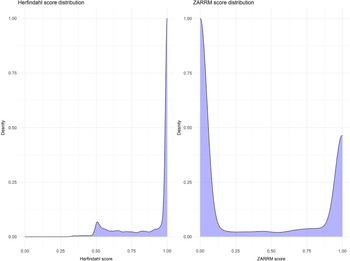
As shown in the left panel of Figure 4, the majority of individual ZIP codes are wholly nested inside a single congressional district. However, without additional context, this figure is misleading. Wholly nested ZIP codes account for all ZIP codes located in states with a single congressional district and those ZIP codes located in larger districts of a state’s legislative map. In this analysis, 20% of the individuals analyzed live in single-district states and while a majority of ZIP codes may be wholly nested, a majority of individuals do not call these ZIP codes home.
Distribution of geographic covariates of interest. Herfindahl index reflects the level of nestedness, with scores approaching one equates to full nesting of a ZIP code within a district and zero infinitely divided. ZIP code’s average representational racial minority (ZARRM) score is such that scores of one equate to all of a ZIP code’s population represented by a representative of racial minority status and zero completely white representatives.

To capture the confusion that might arise over a representative’s race, we create a new measure of the percent of the population for a given ZIP code represented by non-white representatives. Upon creating the ZIP–CD dyads, we merge data from the Volden and Wiseman (Reference Volden and Wiseman2018) dataset on legislative effectiveness to code districts as represented by a non-white (1) or white (0) member of Congress. From there, we weight the non-white dummy variable by the proportion of the population represented by a non-white representative within a ZIP code. We call this variable the ZIP code’s average representational racial minority (ZARRM) score. The ZARRM score directly captures confusion such as might occur in areas as shown in Figure 1. The distribution of the ZARRM scores is presented in the right panel of Figure 4.
As shown in the right panel of Figure 4, most individuals within our CCES data live in a ZIP code that is represented by a legislator (or legislators) of a single race. Additionally, half of the respondent’s ZIP codes are represented entirely by a white representative, which is unsurprising given that the U.S. House is predominately composed of white representatives. Additionally, at the 75th percentile and above, the ZAARM scores reach a score of 0.99 or greater. If we check for observations with a ZARRM greater than 0.05 and less than 0.95, that leaves 6,238 observations, which is only slightly above 10% of our observations. Therefore, more so than the Herfindahl index, there is limited variation in this measure.
2.2. Controls
We also include several theoretically relevant controls to an individual’s political knowledge and engagement that might also predict their ability to correctly provide their incumbent legislator’s race. These follow the structure as shown in Figure 3 as combinations of individual, geographic, and lawmaker-level variables. We follow the set of controls used by Curiel and Steelman (Reference Curiel and Steelman2018), Bowen (Reference Bowen2014) and Bowen and Clark (Reference Bowen and Clark2014) in their analysis of CCES data and the effect of district design on representation.
We start with individual-level controls. With the combination of reference data for representatives laid out in the CCES and merged information from the LES data by Volden and Wiseman (Reference Volden and Wiseman2018), we code for whether respondents are of the same race as their representative, coded one if yes and zero otherwise. We also control for whether a respondent voted in the previous election, one if yes and zero otherwise. Likewise, we also account for whether a respondent is of the same party as their representative. Beyond these measures matched to their representative, we also incorporate a respondent’s age (measured in years), education (number of years), and income (measured in $5,000 increments). We further control for the length of time a respondent lived at their residence, as respondents who have lived longer at their residence tend to be more involved in politics or may be more knowledgeable than more transient respondents (Ansolabehere, Brady and Fiorina Reference Ansolabehere, Brady and Fiorina1992; Crespin Reference Crespin2005; Bowen and Greene Reference Bowen and Greene2014). We expect these controls to positively correlate with a stronger CRL in the form of more knowledgeable respondents (Bowen Reference Bowen2014; Bowen and Clark Reference Bowen and Clark2014).
Several geographic ZIP code-level variables are controlled for as well, as they have been demonstrated to impact political activities and behavior (Ansolabehere, Brady and Fiorina Reference Ansolabehere, Brady and Fiorina1992; Cain, Ferejohn and Fiorina Reference Cain, Ferejohn and Fiorina1987; Bowen and Clark Reference Bowen and Clark2014). These data include the home-owning percent of the population, the non-white percentage of the population, the percentage of the ZIP code with at least a high school education, and the logged population in the ZIP code. We acquired these data from the U.S. Census Bureau. These data allow us to estimate the geographic contexts that might correlate with the desirability and burdens to outreach by political organizations (Bowen Reference Bowen2014).
Congressional representative-level effects consist of the seniority of a representative and their two-party vote percentage from their previous election. Longer serving members of Congress should be more well known (Cain, Ferejohn and Fiorina Reference Cain, Ferejohn and Fiorina1987; Bowen and Clark Reference Bowen and Clark2014), and more competitive elections should increase the interest and knowledge of a representative among their constituents (Ansolabehere, Brady and Fiorina Reference Ansolabehere, Brady and Fiorina1992; Bowen and Clark Reference Bowen and Clark2014).Footnote 9
Finally, at the state level, we control for whether the state where a respondent resides is within the deep south.Footnote 10 As demonstrated by Hicks et al. (Reference Hicks, Klarner, McKee and Smith2018), districts and voters within these states are systematically different in the levels of polarized voting by race, which might lead to heteroscedasticity if not addressed properly.
Given these covariates, we structure the models such that there are random intercepts employed at the level of ZIP code–district dyad for a given year. For the final model of approval of one’s member, we include all covariates and predicted residuals from the models for race and party recognition. We can better ascertain the direct and indirect effects of our covariates of interest and minimize the possibility of heteroscedasticity leading to type one error. Positive coefficients from these variables would imply a stronger CRL in the form of a better ability for respondents to recognize the party and race of their representative, and in turn, their overall approval of their representative.
2. Results
We first run basic t-tests on recognition of a representative’s race and party for groupings of the independent variables of interest. When comparing ZIP codes wholly nested within a district versus those with a Herfindahl score of 0.5 or lower, the difference between means reach statistical significance (p < 0.01), with correct party recognition at 57% compared to 49%, and correct race recognition at 48% compared to 43%. Therefore, some support exists for other hypotheses for the measure of ZIP code splits via the Herfindahl index. In the case of the ZARRM variable, there is no significant difference in correct party recognition between completely homogeneous ZIP codes versus those with a score between 0.4 and 0.6. However, a significant difference does arise (p < 0.01) for correct race recognition, albeit substantively small at 48% relative to 47%. Therefore, the racial heterogeneity measured via the ZARRM score does not appear to exert much of an effect on the CRL.
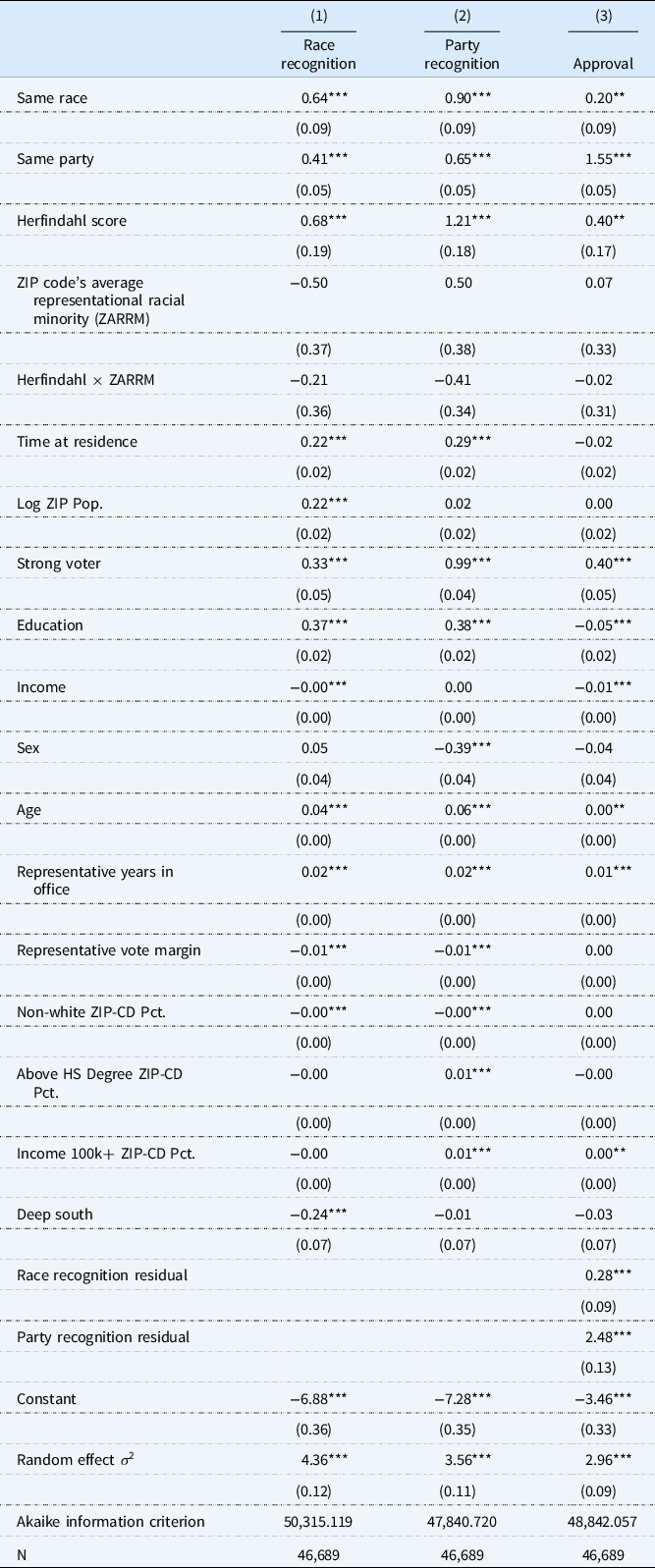
Table 1 presents the three main models of interest, all multilevel logistic regressions. Models 1 and 2 are the first stages, the ability of racial minority CCES respondents to correctly recognize the race and party of their representative, respectively. The substantive effects of interest are whether the respondents are of the same race or party as their representative, in line with the results by Bowen (Reference Bowen2014), Bowen and Clark (Reference Bowen and Clark2014), and Curiel and Steelman (Reference Curiel and Steelman2018).
Constituent–representative link models

In these models, the primary covariates of interest are the Herfindahl index and ZARRM. We see that in both models 1 and 2 the Herfindahl index reaches statistical significance (p < 0.01) and exerts a positive effect. The result suggests that as ZIP codes are increasingly nested within a single congressional district, the more likely a respondent can correctly identify their representative with the correct race and party. Note that the range of the Herfindahl index is from 0.27 to 1.0.Footnote 11 For comparison, the effective range of the Herfindahl index is approximately 70% of that of a respondent being of the same race as their representative for model 1. As for the ability of respondents to recognize the party of their representative (Model 2), the Herfindahl index is a bit under nine-tenths of the effect of the same race variable. For ZAARM and its interaction, it fails to reach statistical significance for either race or party recognition. The interaction between the two variables also fails to reach traditional levels of statistical significance.
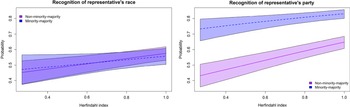
Given that the coefficients are produced by a logistic regression, it is necessary to plot the predicted probability for interpretation. We plot the change in the predicted probability that a respondent can recognize the race and party of their representative in Figure 5. The left panel presents the predicted probability of correct race recognition, and the right panel the predicted probability of correct party recognition. All other variables are held at their appropriate means or modes. All else equal, there is no meaningful difference between successful recognition regarding whether a respondent is of the same race.Footnote 12 Moving from a district with Herfindahl index of 0.27–1.0 increases the successful recognition of race by 12.3 percentage points. From a score of 0.5–0.67, increasing the Herfindahl index score one standard deviation increases correct recognition by approximately 2.9 percentage points.
Predicted recognition of representative’s race and party. Lines represent the median predicted values, and the shaded areas the 95% confidence intervals.

Moving onto the right panel of correct party recognition, we see that the effects of the Herfindahl index and the variable measuring the same race are both substantively significant. In districts where a respondent is of the same race as their legislator increases correct party recognition by 24.4 percentage points on average. No matter the position on the Herfindahl index, the benefits of being the same race outweigh the divisions of ZIP codes arising from district design. However, the benefits of nesting a ZIP code entirely within a single district are apparent. Moving from the minimum to maximum values of the Herfindahl index increases correct recognition of party on average by 21.65 percentage points. Moving from an evenly split ZIP code at a Herfindahl score of 0.5 by one standard deviation increases recognition of party by 5.15 percentage points. We see from the plots in Figure 5 that the benefits of creating a district such that individuals are of the same race as their representative weakly dominate the benefits of fully nesting a ZIP code within a district. However, there are still benefits to maximizing the Herfindahl index, or nesting of ZIP codes, given the significant and substantive association with correct race and party recognition.
We now move onto model 3, approval of one’s representative. The model is such that it includes both the direct and indirect effects of the covariates of interest. Unsurprisingly, we see that the residuals from the previous two models exert a significant and positive effect on approval. The effect of the residuals of the ability to successfully recognize a party is several times larger than the effect of the residuals of one’s ability to recognize the race of their representative. We also see that being of the same race and party exerts a direct significant and positive effect. The Herfindahl index also exerts a significant (p < 0.05) direct effect approximately one-third larger than the direct effect of same race. However, the ZARRM score and its interaction with the Herfindahl index do not reach statistical significance in its impact on approval.
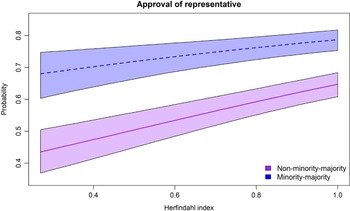
Like models 1 and 2, we plot the predicted effects in Figure 6. Like with party recognition, the impact of being of the same race always reaches greater levels of approval than not, no matter where on the Herfindahl index axis. Being of the same race as one’s representative increases the probability that a respondent approves of their representative an average of 19.4 percentage points. Additionally, the impact of the Herfindahl index is substantive. Moving from the minimum to maximum value on the Herfindahl index is associated with a 21.2 percentage point increase in approval on average. Moving from an evenly divided ZIP code to a one standard deviation increase is associated with a 5.1 percentage point increase in approval of one’s member. Therefore, we see that while it is always better to guarantee descriptive representation as opposed to a fully nested ZIP code, fully nesting a ZIP code within a district can substantively increase the approval of one’s member through the combined direct and indirect effects.
Predicted approval of representative. Lines represent the median predicted values, and the shaded areas the 95% confidence intervals.

3. Discussion
Our results add further support to the theory that ZIP codes act as the modern-day geographical unit to preserve the CRL that counties performed in early America. Further, our results demonstrate applicability to matters of descriptive representation of racial minorities. It appears that ZIP codes are more than some artifact capturing statistical noise related to racial majority members. Although members of Congress may not reach out to voters by holding town halls at post offices like they once did, they do communicate to their constituents through direct mail via ZIP codes. As demonstrated by our results, the violation of ZIP codes is strongly associated with confusion among constituents, which decreases knowledge of crucial information about their elected officials. ZIP code violations lead citizens to know less about their representatives, which we believe impacts representation in the United States negatively. Much like the original gerrymander of 1812, the splitting and violation of ZIP codes between congressional districts impair the connection between constituents and their representatives.
We must also stress that these results arise even when controlling for important concerns like party and race. Constituents of the same party affiliation and race of their representative should be among those best represented by their representatives (Bowen and Clark Reference Bowen and Clark2014). The damage that the violation of ZIP codes does to the CRL meets the criteria set in 1986 by Davis v. Bandemer, as constituents are not represented well following elections.
To put these findings in context, the 1st and 12th districts of NC have approximately 750,000 and 850,000 constituents, respectively. Our results suggest that an average of 30% of the residents in each of these congressional districts live in a ZIP code where another congressional district dominates the ZIP code’s population. If we extrapolate our findings to these two majority–minority districts, we anticipate that almost 500,000 constituents live in these types of split ZIP codes. Given our findings that approximately 1 in 10 of those constituents are unaware of the descriptive representation afforded to them, almost 50,000 constituents are systematically denied a fundamental aspect of descriptive representation.
However, we should stress the importance of ensuring minority–majority districts and descriptive representation. The presence of descriptive representation demonstrates clear benefits related to political knowledge and efficacy, exceeding that of preserving ZIP codes. It would be incorrect to simply create less odd-looking districts and expect representation to improve. Ultimately, whatever representational costs arise from splitting ZIP codes, the sheer momentum of descriptive representation provided by minority–majority districts overcomes these costs.
Since we find evidence that splitting ZIP codes poses direct representational harm to individuals, there is no legitimate reason to split ZIP codes, given that their population is always smaller than a congressional district. Preserving ZIP codes is superior in effect and practicality to the preservation of county lines. Counties frequently exceed the average size of congressional districts—like Cook County in Chicago with over 2 million residents—and have not been demonstrated to impact the CRL (Bowen Reference Bowen2014). The preservation of county lines is certainly untenable in urban areas, but these urban areas pose no real problem when districts are required to preserve ZIP codes. Therefore, we continue the call put forward by Curiel and Steelman (Reference Curiel and Steelman2018) to draw legislative district lines with respect to ZIP code boundaries as much as possible.
Supplementary material
To view supplementary material for this article, please visit https://doi.org/10.1017/rep.2021.33