The word love has been used in many ways and holds many meanings. It remains, however, a word that is not commonly used in Westernised educational research or professional contexts. In this sense, it can create some uncertainty and discomfort in its application (Palmer, White, & Wooltorton, Reference Palmer, White and Wooltorton2018). This is understandable given the meaning of the word in popular culture, with love being commonly associated with emotions and subjectivity; a far stretch from academic contexts. Furthermore, the word love is complex, misunderstood, and in need of clarification (Engelmann, Reference Engelmann2019; Hodgson, Vlieghe, & Zamojski, Reference Hodgson, Vlieghe, Zamojski, Hodgson, Vlieghe and Zamojski2017). We argue that love holds meanings and applications that are integral to the work of environmental educators as described in this article. It is recognised that love is entangled with nature, justice, sustainability and environmental education (Griffiths & Murray, Reference Griffiths and Murray2017; Palmer et al., Reference Palmer, White and Wooltorton2018); however, we question what love means in this context. How do we understand love as environmental educators and researchers? And, what are the implications of our meaning-making of love with/in/for environmental education?
This article seeks to explore the location of love in environmental education research (EER) given that, despite its apparent prevalence, the top two environmental education journals hold limited searchable titles containing ‘love’; the Australian Journal of Environmental Education currently has none and the Environmental Education Research Journal has two. We acknowledge the work of the editors and contributors to The Journal of Sustainability Education who released a special issue in 2015 titled ‘What’s love got to do with it?’, which we discovered during our literature review. We appreciate the contributions this has made to the field, but also view this as a token gesture akin to a sustainability day and argue that a more consistent and ongoing approach is required by researchers in EER. This gap in the research provided inspiration and justification for this article.
Multi-Ontoepistemological Beginnings
We came together with a shared interest in deepening our understanding of the concept of love in EER through our meeting at a research symposium workshop (Blom, Brown, & Siegel, Reference Blom, Brown and Siegel2018; Brown, Siegel, & Blom, Reference Brown, Siegel and Blom2020) where we explored the theories of Karen Barad (Reference Barad2007). Barad’s (Reference Barad2007) theories espouse that meaning making is no longer a human endeavour solely tied to ‘individual words…but an ongoing performance of the world in its differential dance of intelligibility and unintelligibility’ (p. 149). This idea presents the process of knowledge generation forming from alternatives to traditional reductionist methodological paradigms (which seek to condense data into neatly packaged themes; see Hart, Hart, Aguayo, & Thiemann, Reference Hart, Hart, Aguayo and Thiemann2018) and instead explores the potential of data that is lively and emergent (Mazzei, Reference Mazzei2014; Taylor, Reference Taylor2013). Mazzei (Reference Mazzei2014) purports that the diffractive methodological approach, theorised by Haraway (Reference Haraway, Grossberg, Nelson and Treichler1992) and proposed in practice by Barad, offers an opportunity to read ‘insights through one other’ (Barad, Reference Barad2007, p. 25).
We viewed this as an opportunity to explore the relationships that exist with love in EER through our own research and our different theoretical and ontoepistemological (where we acknowledge that ways of knowing and being in the world cannot be separated; see Barad, Reference Barad2007 for a detailed explanation of this idea) viewpoints with a diffractive methodology. Adopting this methodological approach, we sought to respond to the call by Hart et al. (Reference Hart, Hart, Aguayo and Thiemann2018) for research that ‘explores and engages [in] emergent theories and methodologies’ (p. 76). This exercise aimed to more deeply understand how ‘the world articulates itself differently’ (Barad, Reference Barad2007, p. 149) through a diffraction of our different ways of observing and knowing love in EER. As described by Mazzei (Reference Mazzei2014):
A diffractive reading of data through multiple theoretical insights moves qualitative analysis away from habitual normative readings (e.g., coding) toward a diffractive reading that spreads thought and meaning in unpredictable and productive emergences. (p. 742)
Through our three theoretical positions — Steiner philosophy, ecosomaestheticsFootnote 1 theory (understood through the lens of the Santiago school of cognition; see Aguayo, Reference Aguayo2019; Luisi, Reference Luisi2016; Maturana & Varela, Reference Maturana and Varela1980), and biophilia theory — we seek to explore how the concept of love is understood and emerges through a diffractive analysis.
Drawing on a Diffractive Analysis
We adopted a diffractive analysis to explore our individual research data with, in and through each other in an attempt to encourage ‘new ways of thinking about and relating to data and meaning-making’ (Taylor, Reference Taylor2013, p. 692). However, it is also noted that the practice of diffractive analysis does not produce anything new but is more of an exploration of hidden meanings, as a
diffraction is not a set pattern but rather an iterative (re)configuring of patterns of differentiating-entangling. As such, there is no moving beyond, no leaving the ‘old’ behind. There is no absolute boundary between here-now and there-then. There is nothing that is new; there is nothing that is not new (Barad, Reference Barad2014, p. 168).
From this, we also learn that time is reconceptualised as it is diffracted in a dynamic process rather than a fixed occurrence in space. Barad (Reference Barad2014) refers to this idea as ‘spacetimemattering’.
We were aware that exploring the concept of love through a diffractive analysis of our own introspective research journeys together would require courage, and that it may stir delicate and vulnerable inner emotions experienced viscerally in our human bodies; which may be expressed outwardly in and through other human and nonhuman bodies alike. Despite these fragilities, we were motivated by the importance and benefit of this work for EER and practice and continued the journey. Following the research symposium, we met monthly for a period of 18 months through the online communication platform Zoom videoconferencingFootnote 2 to theorise love through each of our theoretical positionings: Steiner, ecosomaesthetics, and biophilia. By theorising our works together through a diffractive analysis, we aim to allow you — the reader — to explore your own research experiences with love in environmental education. We offer you opportunities to consider how love forms the foundation of teaching and research praxis in environmental education.
Locating Love in Timespace: The Seeding of our Research Journey
At the Australian Association of Environmental Education Research Symposium, we (Simone, Claudio and Teresa) (re)connected during a workshop that explored Barad’s (Reference Barad2007) concepts in environmental education titled ‘Entanglements of Matter and Meaning — The Importance of the Philosophy of Karen Barad for Environmental Education’ (Blom, Brown & Siegel, Reference Blom, Brown and Siegel2018). On conclusion of the workshop, all participants in the symposium workshop gathered in a circle. Each participant shared a word or words in response to their experience. Words such as ‘connectedness’, ‘interconnectedness’, ‘humanity’ and ‘balance’ were being offered. Then the circle reached Claudio; he simply said, ‘love’.
Teresa: It took me by surprise. This word mentioned in a research symposium. The word filled my heart with joy. Towards the end of the day, we discussed the key words for EER. Claudio stated ‘Love is the basis for everything’. I listened; this idea resonated with me deeply.
Simone: Metaphorically, it was like the word ‘love’ was a rock falling into a lake. Given the theme of diffraction for this symposium presentation, it was quite fitting that this word diffracted out in waves across the seemingly still ‘lake’ of the room ricocheting through the group circle, intra-acting with bodies — human and nonhuman — in a performance. This moment proved to be a timely and for me, tangible example of diffraction-in-action. It reminded me of a moment described by Murris and Haynes (Reference Murris and Haynes2018) during their research study with Grade 2 children. During their research, the children were positioned similarly to us — in a sharing circle. Murris and Haynes (Reference Murris and Haynes2018, p. 162) observed bodily movements in response to a comment made by one of the child participants,
[it] triggered a reactive ripple, a gasp. It was as if an arrow appeared from nowhere, spiked in and hovered — commanding attention, creating dis-ease. There was a suspension of the familiar, then the silence of held breath. An exhale followed, a moan, a sigh, a giggle in between the furtive glances, the search for reassurances.
In this moment of unsettlement or ‘dis-ease’ (Murris & Haynes, Reference Murris and Haynes2018, p. 162), I did a double-take and asked myself the question — ‘Did he really say that at a research symposium?’ Although it was seemingly out of context in the academic space, it was perfectly placed. In stating the word ‘love’ with the meaning that Claudio held in this context, he effectively redefined the potentiality of love. The moment of stillmotion was out of timespace proportion as it seemed much longer than any other word or phrase shared. However, despite the seeming longevity of the moment and the unspoken rearrangement of the word on the group’s becomings, the flow of sharing words and phrases around the circle remained unchanged.
Claudio: I am a strong believer in the power of words and their meanings. To me love is the most powerful feeling we can have as humans. It provides a supportive environment for people to thrive and flourish. When unconditional love is present, people are free to explore, learn, fail without worries, with full comprehension and support no matter what. It allows individuals to grow in harmony. When love is missing, the opposite tends to occur. I knew the word would unexpectedly provoke the audience and wanted to test the waters and feel the reactions. What I felt after speaking the word was like a wave of energy coming out of my mouth, going around the circle reshaping and growing, and finally coming back to me all at once with great impetus and power. I really felt it. I again experienced the power of words and their meanings at that moment; how four letters said in sequence could generate such a reaction, which at the end was channelled and harvested into this piece — an exploration of where love sits, or should sit, with/in EER.
These experiences and perceptions are shared here to illustrate that such moments that are felt and interpreted differently are also moments of sameness. We all felt something, but our visceral and affective responses were perceived and interpreted in our individual ways through our different ontoepistemological positions. Despite these differences, this moment was a bringing together of us; an acknowledgement of our inseparability.
Through past connections and associations, we met together in an area outside the Australian Association of Environmental Education Research Symposium workshop room and discussed our perceptions of love and how they were related to the symposium workshop we had just encountered. This was the seeding of this paper. We now invite you to explore love with us through our research into environmental education, as we diffract our individual research interests and findings in, with and through each other in a diffractive analysis. We seek to explore the intersections and data that becomes, from attempting research in different and nontraditional ways.
Love is …
As is part of the diffractive analysis, we begin at a point. This point does not hold a relative linear positioning in timespace, as is part of the posthuman tradition (see Barad, Reference Barad2014).
The point we have found, or that found us, was considering when love in EERFootnote 3 first began. Many describe the formal beginning of environmental education as a field in the Western world in the early 1970s when the World Conservation Union and the United Nations Educational, Scientific and Cultural Organisation (UNESCO) hosted the International Working Meeting on Environmental Education in the school curriculum where they formally defined environmental education (Dyment, Hill, & Emery, Reference Dyment, Hill and Emery2015; Edwards, Reference Edwards2015; Gough & Gough, Reference Gough, Gough and Kridel2010; Palmer, Reference Palmer2002; Stevenson, Ferreira, & Emery, Reference Stevenson, Ferreira and Emery2016). However, this fails to acknowledge the traditional custodians of the land, the Indigenous people and Aboriginal people’s ancient ways of knowing and being with the land as a form of environmental education praxis (Bunda, personal communication, February 28, 2020; Cajete, Reference Cajete, Smith and Williams1999; Cutter-Mackenzie-Knowles et al., Reference Cutter-Mackenzie-Knowles, Brown, Osborn, Blom, Brown and Wijesinghein press; Singleton, Reference Singleton2015; Snively & Williams, Reference Snively and Williams2018). This article acknowledges these cultural differences, as humanity has a mixture of ideologies, faiths and cultures that encapsulate the concepts of love and spirituality as a means and mechanism for environmental education. This love, connection and appreciation of the natural world contributes to the importance of maintaining, sustaining and restoring the Earth’s natural health and beauty (Bristow, Reference Bristow1979) and is found expressed differently through many cultures.Footnote 4
Where is the Love in Steiner Philosophy?
The Anthroposophical ethos proposed by philosopher Rudolf Steiner (Reference Steiner1999) enhances the positive influence of environmental education through an understanding of the relations with/as love, humanity and nature through spiritual science. Love is powerful, and in practice can make ripples of creation in the cosmos (Steiner, Reference Steiner1999). Steiner education reflects appreciative aspects of Hinduism philosophy demonstrating the power of love, spirituality and ritual in connection with/as nature. Similarly, the theory of care for the environment through ecological theories and practices observed in the Hindu faith has filtered through international forums, whereby human responsibility and connection with/as nature grows (Lovat, Fletcher, Follers, & McGrath, Reference Lovat, Fletcher, Follers and McGrath2006). Hindu philosophy proposes humanity’s obligation to living ethically, which includes environmental ethics as the basis for the moral connection between human and nonhuman realities. Lovat et al. (Reference Lovat, Fletcher, Follers and McGrath2006, p. 201) argue that ‘it is the underlying tenets of Hinduism which offer a spiritual approach to the environmental issues at a global level’. Hinduism philosophy is present in the Steiner education system where it incorporates a reverence and love for nature in its curriculum (Carapeto, Reference Carapeto2018).
The ethos of love and environmental education are worked into the day-to-day teaching and learning practices at Steiner Waldorf Schools worldwide. Carapeto’s (Reference Carapeto2018) work draws on Steiner’s theory on education to explore the importance of love and connection with/as nature in teacher practice through embedding environmental education in the classroom. Steiner (Reference Steiner1998) expresses love in poetry and displays gratitude for the gifts of the natural environment, gently weaving this warmth throughout many of his lectures, such as, ‘love is the “moral” sun of the world. Interest in the earth’s evolution is the necessary antecedent of love’ (p. 181). Steiner continues on to describe love, ‘without sense-born love, nothing material comes into the world’, and ‘creative forces unfold through love. We owe our existence to deeds of love wrought in the past’. Sagarin (Reference Sagarin2015) argues that the Steiner education system gives graduates many benefits, such as ‘students receive a reverence for life and for the world; a concern for the environment, however defined’ (p. 3). Carapeto’s (Reference Carapeto2018) research unveils imagination and creativity as tools necessary for educators to embed environmental education in the contemporary classroom (see Figure 1).
Steiner was inspired by 18th century philosopher and poet Goethe and his work in exploring humanity’s spiritual relationship ‘as nature’ Footnote 5 ; this led to the development of the ethos of Anthroposophy (Childs, Reference Childs1991). Anthroposophy philosophy seeks natural means to maintain good health and wellbeing of the Earth (Childs, Reference Childs1991). Steiner (Reference Steiner2016) highlights that ‘it must be stressed that everything of a solid, earthen nature has as its foundation in elemental spirituality’ (p. 165). Steiner’s philosophy connects spirituality and the natural environment together. Steiner (Reference Steiner2016) explored the worlds of spirit, love and nature during his lectures, which highlight his courageous and curious attempt to penetrate public awareness for the good of humankind and the conservation of the earth. Steiner (Reference Steiner2016) states that ‘plant life is an outer expression of the interworking of world love and world sacrifice with world gravity and world magnetism’ (p. 131).
Humanity’s love for the natural world needs to be rekindled (Steiner, Reference Steiner2016). In order to protect and conserve the natural environment, humanity must once again learn to connect/love as nature. Similarly, in loving a specific place, Judson (Reference Judson2016) concludes that it is this emotional bond of love that can heighten the possibilities of humanity’s practice in environmental ethics. Childs (Reference Childs1991) explores Steiner’s history in documenting humanity’s spiritual relationship with nature where Steiner’s study of philosophy aims to connect the ‘visible’ world of nature to the ‘invisible’ world of spirit. Snell and Simmonds’ (Reference Snell and Simmonds2012) empirical study into qualities and outcomes of individuals’ spiritual experiences in a natural environment involved conducting interviews and applying an interpretative phenomenological analysis. This research identifies the themes to indicate ‘that spiritual experiences in nature may lead to long-term psychological well-being’ (Snell & Simmonds, Reference Snell and Simmonds2012, p. 1). The findings also demonstrate the participants’ desire to care for the environment, hence expressing love for nature.
Steiner Waldorf education has historically been consciously and subconsciously entwined with the environmentalist movement, stemming primarily from the Waldorf school community’s heartfelt connection/love between human and nonhuman nature; noting that environmentalism has often been defined as a broad philosophy, as an ideology and at best a social movement, particularly regarding concerns and actions for the protection of the environment (Allaby & Knight, Reference Allaby and Knight1971). In the same way, activists such as Bristow (Reference Bristow1979) illustrate and express this feeling of love and care for the natural environment as demonstrated in their work, ‘to show others how satisfying it can be to provide food for your family, while preserving a clean, safe environment for all living things, and to be happy, really contented, with the simple essential luxuries of life’ (p. 5). Additionally, Carapeto (Reference Carapeto2018) highlights the benefits to Steiner Waldorf teachers from the practice of working with nature to embed environmental education and ethics in the classroom. These benefits arise through connecting/loving as nature, whereby their teaching practice and wellbeing is further enhanced.
Where is the Love in Ecosomaesthetic Theory?
Payne et al. (Reference Payne, Rodrigues, Carvalho, Freire, Aguayo and Iared2018, p. 95) refer to a ‘major gap in the theoretical and empirical development of EER’ within the field and propose that ecosomaesthetics has a role in addressing ecological aesthetics, affectivity and feelings. Some exceptions, as reported by these authors, include McKenzie, Hart, Bai, and Jickling’s (Reference McKenzie, Hart, Bai and Jickling2009) Fields of Green, where concepts of emotions and feelings are explored and addressed; Marin’s (Reference Marin2008) contribution on nostalgia and sensitivities; and Carvalho and Steil’s (Reference Carvalho and Steil2013) work focusing on the sacred and the spiritual. This general lack of engagement with aesthetics and affectivity in EER calls for exploring and addressing the ‘feelings’ and the affective dimensions in the research and practice of environmental education from an inter-, cross- and/or transdisciplinary approach (Payne et al., Reference Payne, Rodrigues, Carvalho, Freire, Aguayo and Iared2018).
From the field of cognitive scienceFootnote 6 we ‘hear’ that feelings and emotions are linked to our physiological and psychological states (Aguayo et al., Reference Aguayo, Dañobeitia, Cochrane, Aiello, Cook and Cuevas2018; Ekman, Reference Ekman1992). Although theories of emotions in cognitive science remain undefined due to the various existing epistemological approaches in the field, current literature accepts that emotions originate as much in the embodied corporal changes as in the mental perceptions and processes (Coleman & Snarey, Reference Coleman and Snarey2011). This means that emotions can be seen as a bodily expression of our internal state of the mind; and as a consequence of our physiology. Different scholars also acknowledge the existence of a set of core emotions that drive our experience with others and with the world. These are negative, neutral and positive emotions that include anger, fear, sadness, surprise, joy and love (Kreibig, Reference Kreibig2010; Ortony & Turner, Reference Ortony and Turner1990).
The Santiago school of cognition considers the adaptive capacity of living organisms toward their environment as an intelligent cognitive process; establishing that human experience and cognition are uniquely enacted from ‘being’ in/with the environment (Maturana & Varela, Reference Maturana and Varela1980; Thompson, Reference Thompson2007). In the Biology of Love, by Maturana and Verden-Zoller (Reference Maturana and Verden-Zöller1996), rooted in the Santiago school, love is described as the grounding of our human existence. Love needs not to be learned — humans are loving animals by essence; since the very moment of our birth, an unconditional loving environment permits us to grow and thrive to reach our fullest potential through the mother/child relation and beyond (Maturana & Verden-Zoller, Reference Maturana and Verden-Zöller1996). Yet the negation of love can bring quite the opposite in a child, and later in an adult person. In the words of Maturana and Verden-Zoller (Reference Maturana and Verden-Zöller1996, p. 80):
In the blindness that the negation of love creates in our living, we stop seeing ourselves as part of the harmonious interconnectedness of all existence in the unending dynamics of life and death, and we begin to live guided by ambition, greediness and the desire for control.
Through awareness of the humanistic view of love by Maturana and Verden-Zoller, we expand its meaning to include all living and nonliving things that compose the harmonic web of life. What makes humans ‘living entities’ as much as for mammals, birds, plants, single-celled bacteria (to name some examples of living entities) as well as mountains, rivers and forests (Capra, Reference Capra1994; Kohn, Reference Kohn2013; Mead, Reference Mead2016), in relation to technological and material things, is the innate capacity to feel (Merleau-Ponty, Reference Merleau-Ponty1968); the sense-making of the intrinsic and internal unity in relation to the outside environment can be felt.
In this sense, it seems that the articulation of environmental issues, with the tensions coming from the lack of affectivities and feelings in the research and practice of environmental education, can almost be resolved by itself, from the living society (Aguayo, Reference Aguayo2015). This living society, capable of feeling and loving, is urgently in need of reconnecting with its emotional capabilities to promote a social and cultural adaptation and transformation of environmental problems into environmental solutions. The challenge remains in our hands as environmental educators and researchers to embrace and cultivate ‘our loving living nature’, our ecosomaesthetics (Payne et al., Reference Payne, Rodrigues, Carvalho, Freire, Aguayo and Iared2018; Thrift, Reference Thrift2008). In doing so, we enact the emotional and sentimental dimension, which are the things of the heart (from Spanish las cosas del corazón).
What would it take us? From all of our feelings, emotions and somatic affectivities, love and our ‘heart’s feelings’ are probably the emotional components that our societies are desperately searching for to reconnect with our natural environment, with ourselves, with the harmonic and sacred flow of life, and with other living and nonliving things composing the web of life (Aguayo, Reference Aguayo2015; Capra, Reference Capra1994).
The field of environmental education should be able to offer and promote a kind of emotional ecosomaesthetic link with the world that is relevant to the living society from its very nature; that we can readapt and embed ourselves as researchers and educators with the discourse and the practice of unconditional love for individuals and communities to thrive. At the same time, we can redirect our educational priorities and strategies towards emotional empowerment and social emancipation. That is, to know how to reach the hearts of our communities, of the living society and of the continuum that exists between us and the flesh of the world (Merleau-Ponty, Reference Merleau-Ponty1968). This is a type of EER that calls to feelings. It is EER that exalts the emotional, the affective and the visceral; it is about the ecosomaesthetics and the things and the feelings of the heart (Aguayo, Reference Aguayo2015).
Yet, the role that emotional and affective dimensions can have in the learning of environmental issues by individuals and communities, poses perspectives and challenges that go beyond human comfort. For example, the following questions can be asked: How to educate taking into account the emotions and feelings of individuals and communities? What kind of philosophical and methodological approaches does this process require? How can we exalt and enact such dimensions well enough through EER and practice? Should we even consider such a kind of integration between the educational and the sentimental? Are there real benefits for the socio-ecological sustainability of the planet, and the empowerment and emancipation of all our living societies?
From the above, we could consider that what makes us living human beings in the web of life is the visceral. Hence, feelings, emotions and ecosomatic affections, love and the things of the heart are perhaps the ingredients that the living society calls out for to reconnect with our natural environment (Aguayo, Reference Aguayo2015). Yet, those ingredients lie somewhere deep within our humanity, in our essence; just as with other entities in nonhuman nature. As educators we have the opportunity to facilitate this introspective re-search to emancipate and empower each other towards a kind of socio-ecological sustainability. That is why we pose the question, where is the love in EER?
Where is the Love in Biophilia Theory?
The term biophilia was introduced by Fromm (Reference Fromm1973, pp. 365–366) who described ‘the passionate love of life and of all that is alive’. However, this definition has been expanded to include all aspects of nature — both living and nonliving — through the pivotal work of Wilson (Reference Wilson1986), Biophilia. This book was foundational in grounding biophilia as a concept to describe ‘children’s love of and affinity with nature’ (Cutter-Mackenzie, Edwards, Moore, & Boyd, Reference Cutter-Mackenzie, Edwards, Moore and Boyd2014, p. 29).
At the other end of the biophilic spectrum (if indeed there is one) is the concept of biophobia. A biophobic propensity could be attributed to the perceived disconnect that is currently being observed between human and nonhuman nature (Cutter-Mackenzie et al., Reference Cutter-Mackenzie, Edwards, Moore and Boyd2014; Hensley, Reference Hensley2015). Moreover, biophobia describes the tendency for humans to associate with technology, human-made materiality and interests when relating with the natural world (Cajete, Reference Cajete, Smith and Williams1999; Hensley, Reference Hensley2015). It could be argued that a biophobic trajectory currently exists in humanity given the unprecedented ecological, social and cultural juncture of the Anthropocene (a new geological epoch defined by Crutzen & Strommer, Reference Crutzen and Stoermer2000) that the planet is now experiencing. Research has attributed this perceived movement away from nature to a number of factors, particularly observed in children, who now: spend increased time indoors on digital technology (Crabb & Stern, Reference Crabb and Stern2010; Neumann, Reference Neumann2015); experience limited time for spending in nonhuman nature, given the busy lives of families and educators (Malone, Reference Malone2007); have reduced access to natural spaces (Louv, Reference Louv2006); and have fear around traffic, crime, pollution and nonhuman nature itself (Malone, Reference Malone2007; Malone & Tranter, Reference Malone and Tranter2003; Shaw, Anderson, & Barcelona, Reference Shaw, Anderson and Barcelona2015, Sobel, Reference Sobel2008).
Fromm (p. 196, as cited in Orr, Reference Orr2004) argues that if biophilia is not the chosen disposition then biophobia is adopted. This proposition describes the binary notion of biophilia and biophobia without option for it to be a continuum. This creates a tension in considering whether someone likes some parts of nature but is averse to others. Biophilia is then seen as an overarching view, one where people are inclined to either love or hate nature; another dualism that is reflected in the nature/culture or human/nonhuman discourse. Similarly, Orr (Reference Orr2004, p. xii) declares that humans ‘love it or lose it’ as a response and potential solution to the declining health of human and nonhuman nature through the signs of climate change, species loss, obesity, war, overconsumption and ecological decline. Although it is known that human health is impacted by the state of the environment, the current ‘symptoms’ of the Anthropocene could be attributed to humanity’s lack of love for nonhuman nature or lack of biophilia; also discussed as a lack of nature connectedness (Sandifer, Sutton-Grier, & Ward, Reference Sandifer, Sutton-Grier and Ward2015).
The evidence and benefits of a love of nature through biophilia theory have been demonstrated through much research in environmental education (e.g., Bai, Elza, Kovacs, & Romanycia, Reference Bai, Elza, Kovacs and Romanycia2010; Cho & Lee, Reference Cho and Lee2017; Hensley, Reference Hensley2015; Kalvaitis & Monhardt, Reference Kalvaitis and Monhardt2015; Kellert, Reference Kellert2016; Simaika & Samways, Reference Simaika and Samways2010; Singleton, Reference Singleton2015; Zhang, Goodale, & Chen, Reference Zhang, Goodale and Chen2014). In a review of the literature, Sandifer et al. (Reference Sandifer, Sutton-Grier and Ward2015) summarise the psychological, cognitive, physiological, social and cultural benefits of experiences in nature with examples such as reduced stress levels, improved mood and self-esteem and increased resilience. Experiences in nature are enacted when biophilia is encouraged, developed, deepened, grown and nurtured in the human species; it details the human role and responsibility in holding a loving relationship with/as nonhuman nature (Singleton, Reference Singleton2015).
So, how can the biophilia concept be used to arrest this biophobic whirlpool in and of the Anthropocene? How can environmental educators and researchers give voice to biophilia in the human-centred, Westernised lives that are consumed with an incessant need to obtain and do? Put simply, how do humans develop and rekindle a love for nature (Orr, Reference Orr2004)? The remainder of this section explores these questions by providing examples from the research about how biophilia is enabled in EER.
The movement toward biophilia is enacted through developing self-awareness to the process of loving nature. An example of this was demonstrated by Bai et al. (Reference Bai, Elza, Kovacs and Romanycia2010), who highlight the significance of bringing attention and awareness to self as a process for developing biophilia; a love of nature. They propose that children need time and space to just be: ‘being space, being bodies, being perceptions, being feelings’ (Bai et al., Reference Bai, Elza, Kovacs and Romanycia2010, p. 360). This is a purposeful movement away from education that is ‘busily and excessively into “doing” and “having”’ (Bai et al., Reference Bai, Elza, Kovacs and Romanycia2010, p. 360) and towards an awareness of the body and self as a way of acknowledging the biophilia within. This process was similarly demonstrated in an ethnographic study by Blom (Reference Blom, Cutter-Mackenzie, Malone and Barratt Hacking2018) where ‘understanding-self’ was a key finding in understanding how nature is perceived and in relationship with/as. This process of (be)coming to know humans as nature through biophilia was also described through: an inner movement (Dickinson, Reference Dickinson2013), a returning of attention and energy to the being, to ourselves (Bai et al., Reference Bai, Elza, Kovacs and Romanycia2010); a knowing of the inner-heart (Blom, Reference Blom2016) and a withinness (Blom & Crinall, Reference Blom and Crinall2020).
This conceptualisation espouses that biophilia is our connection: ‘an inner knowing that our body-is-nature and that it connects us innately with all other living and nonliving aspects of the natural world’ (Blom, Reference Blom, Cutter-Mackenzie, Malone and Barratt Hacking2018, p. 13). What are the possibilities for environmental education and research if each human loved and cared for their body-as-nature as a first priority and as equally and preciously, as every aspect of nonhuman nature? Could this then flow ‘onward and outward to the human-non-human nature community’ (Osborn, Blom, Widdop-Quinton, & Aguayo, Reference Osborn, Blom, Quinton, Aguayo, Cutter-Mackenzie-Knowles, Lasczik, Wilks, Logan, Turner and Boyd2020 p. 10)?
Humans are nature (Dickinson, Reference Dickinson2013). Human bodies are made of cells, akin to other living bodies. Human bodies respond to the cycles and rhythms of nature through following the patterns of day–night, seasons, moon cycles and so forth, akin to other living bodies. However, it is proposed that human lifestyles, with priorities of consumerism and technological reliance and advancement under neoliberal governance, have moved the human species away from an awareness of this natural connection and affinity, leaning humans to a biophobic tendency. Moreover, the notion of human separation from nonhuman nature is grounded in a very specific sociocultural worldview that does not account for other ways of knowing nature and being nature (Cajete, Reference Cajete, Smith and Williams1999; Fletcher, Reference Fletcher2017). However, if human bodies are nature, it is argued that biophilia is never lost, nor are humans disconnected from nature; for how can you be disconnected from something which you are (Blom, Reference Blom, Cutter-Mackenzie, Malone and Barratt Hacking2018; Dickinson, Reference Dickinson2013)? If humans are considered living things and in an entangled bodily system of molecules, cells, tissues, organs and space, where cells are considered nature, how can they possibly be separate from nature? Could biophobia be a perception of disconnection; as biophilia is part of the human biological self?
Sobel (Reference Sobel2008) argues for an ‘environmental education [that] needs to be kinaesthetic, in the body’ (p. 21) when describing the importance of allowing love in and of nature to take root and flourish, especially before any knowledge is introduced. Reconnecting biophilia could be as simple as listening to the voice of the human body, the body-as-nature. Giving voice to the human-body through acknowledgement and activity then develops greater awareness of biophilia (Blom, Reference Blom, Cutter-Mackenzie, Malone and Barratt Hacking2018). However, there are many challenges to enacting and embodying biophilia as it is not with/in social and/or cultural norms to listen to nature, and many systems are not designed to support this development. Dickinson (Reference Dickinson2013) calls for this embodied learning through the notion of an ‘inward expansion’ where humans become ‘reflective in [their] inner unknown spaces’ where time ‘in nature’ ‘is with a reflexive spirit of co-presence, where one is with and of nature, not in it’ (p. 330). For example, children are told to wait until break times to go to the toilet and care for their body as nature; similarly, many teachers will often not acknowledge their own need to self-nourish and self-care well beyond receiving the bodily call. Reactivating the human body-as-nature and giving the mind awareness to its voice is one approach to reigniting biophilia in EER and practice (Blom, Reference Blom, Cutter-Mackenzie, Malone and Barratt Hacking2018; Singleton, Reference Singleton2015).
Diffracting Steiner, Ecosomaesthetics and Biophilia Through the Concept of Love
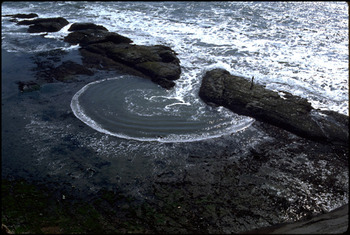
To return to the question ‘Where is the love in EER?’, this section invites you to consider the alignments, tensions and emergences of the three ontoepistemological influences and positions of Steiner, ecosomaesthetics and biophilia. We opted to undertake a diffractive analysis as a methodological approach in this article in response to the concept of diffraction that was explored at the research symposium workshop. In adopting this postqualitative methodology, we have found a space to play with these ideas and ground them in EER; our ‘playground’. We use the literal notion of diffraction (as described by quantum physics in Barad, Reference Barad2007) to conceptualise the process of three ‘waves’ — Steiner, ecosomaesthetics and biophilia — being pushed through a gap or hole in a barrier where ‘the barrier serves as a diffraction apparatus for ocean waves’ (Barad, Reference Barad2007, p. 74). Barad (Reference Barad2007) uses the example of diffraction in nature to describe this (see Figure 2: an ocean wave pushing through a gap in a causeway; image first seen in Barad, Reference Barad2007, p. 75). This diffractive process measures ‘the effects of difference [and] even more profoundly they highlight, exhibit, and make evident the entangled structure of the changing and contingent ontology of the world, including the ontology of knowing’ (Barad, Reference Barad2007, p. 73). We see the concentric circles, the ‘alternating light and dark lines’ (Barad, Reference Barad2007, p. 75) that are produced as our ‘data’ — the peaks that seem to matter and the toughs that sink into shadows and attempt to remain hidden. Both are equally peaks, just in different directions — some reflecting the light and the others void of it (see the concepts of light and dark explored through postqualitative inquiry in Blom & Crinall, Reference Blom and Crinall2020).
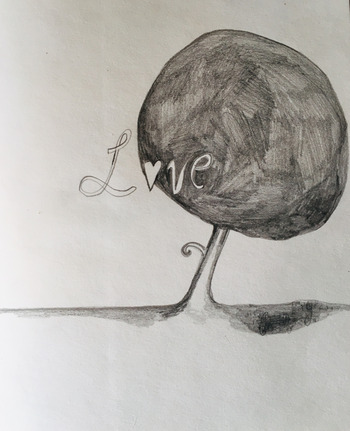
Tree sketch.

Diffraction in nature — ocean waves diffracted through a gap in a causeway. Photo © Exploratorium, www.exploratorium.edu. Some rights reserved. This work is licensed under creativecommons.org/licenses/by-nc-sa/3.0/us/.

We return again and move with Barad’s (Reference Barad2014, p. 169) notion of time and space, and the new;
where each moment is an infinite multiplicity. ‘Now’ is not an infinitesimal slice but an infinitely rich condensed node in a changing field diffracted across spacetime in its ongoing interaction across spacetime in its iterative repatterning.
In conducting a diffractive process, we have sought to demonstrate the ‘multiplicity, ambiguity and incoherent subjectivity’ of our data without ‘coding or thematising’ (Mazzei, Reference Mazzei2014, p. 743). As described by Mazzei (Reference Mazzei2014, p. 743), the data demonstrate our ‘moment of plugging in, of reading-the-data-while-thinking the-theory, of entering the assemblage, of making new connectives’; while we acknowledge that they are not new, as nothing is (Barad, Reference Barad2007).
For 18 months, we met from our different world locations via Zoom to talk theories, concepts and to unravel how we each understand love. Here we acknowledge our own entanglement in the research process and, that these conversations are data:
ideas and concepts are not innocent or neutral, but actively engage in the diffractive entanglement of any research … we, as researchers, are part of, and encounter, already entangled matter and meanings that affect us and that we affect in an ongoing, always changing set of movements. (Davies, Reference Davies2014, p. 735)
The nature of diffractive entanglements describes how we are not objective in this process of understanding love in EER; we are implicit in its becoming. In this diffractive analysis we have together pushed the theories through each other, the ‘gap in the causeway’ to see what emerges. This was an interesting and challenging process as the diffractive works that informed our practice were undertaken by individuals (Barad, Reference Barad2014; Davies, Reference Davies2014; Mazzei, Reference Mazzei2014; Taylor, Reference Taylor2013). So, we played around a little more in our playground and this is what emerged.
Love is Innate
As we read through our ‘data’ — our writings on love through our different ontoepistemologies — we are drawn to the ideas proposed by Maturana and Verden-Zoller (Reference Maturana and Verden-Zöller1996) in their book the Biology of Love, that
love needs not to be learned — humans are loving animals by essence.
This refers to love as an innate, inborn capacity to feel. We recall the musings of Rachel Carson about being in nature with children and possible futures; many of which are now presents. Carson’s words have been theorised through the biophilia concept (Blom, Reference Blom, Cutter-Mackenzie, Malone and Barratt Hacking2018; Hensley, Reference Hensley2015), particularly the idea that,
‘it is not half so important to know as it to feel’ (Carson, Reference Carson1965, p. 45).
It is noted that this was written prior to the coining of the term biophilia by Tanner in 1980. Blom (Reference Blom2016, p. 38) noted that
‘Her [Carson’s] ideas may also have influenced and been a founding observation and principle in the debate between the affective versus the cognitive approach to environmental education (Cachelin, Paisley and Blanchard, Reference Cachelin, Paisley and Blanchard2009)’.
Returning again to the idea of ecosomaesthetics proposed in this article,
from all of our feelings, emotions and somatic affectivities, love and our ‘heart’s feelings’ are probably the emotional components that our societies are desperately searching for to reconnect with our natural environment, with ourselves, with the harmonic and sacred flow of life, and with other living and nonliving things composing the web of life (Aguayo, Reference Aguayo2015; Capra, Reference Capra1994).
Ecosomaesthetics then proposes a kind of harmonisation of the inner with the outer nature — the natural environment. This is a key concept in the Santiago school, which brings forth the concept of enaction: human experience arising through the coming together of the individual with the environment, creating a new and unique emergence of the two parts into a new whole (Brown, Reference Brown2019; Maturana & Varela, Reference Maturana and Varela1980; Varela, Thompson, & Rosch, Reference Varela, Thompson and Rosch2016). Such a process is understood to constitute the basis of the process of cognition. As offered by Brown (Reference Brown2019, p. 7):
‘this view of cognition integrates being, knowing, and learning’.
It then becomes a process of becoming. It is a way of knowing nature that is not through traditional Western ways of knowing; it is about complementing nature to become one, all together. It is through our senses and an inner-knowing. We explain that
we can feel and sense our intrinsic and internal unity in relation to the outside environment.
Then we come to Steiner, and a timely quote was observed by Simone in Teresa’s email signature,
‘We can only find nature outside us if we first know her within us. What is akin to her within us will be our guide’ (Steiner, Reference Steiner1999, p. 19).
Through biophilia we acknowledge the earth’s rhythms,
our bodies respond to the cycles and rhythms of nature.
Similarly, through Steiner philosophy, Woodard (Reference Woodard2005) highlights,
‘the student in a Waldorf school is carefully led to awareness of the order of the Universe’ (p. 85).
The cycles and rhythms of nature are presented in verse, poetry and song throughout Waldorf education curricula. The call of Steiner, ecosomaesthetics and biophilia theories is to acknowledge the innate experiential knowingness of humans as nature.
Love is Feeling With the Heart
Steiner philosophy and ecosomaesthetics draw on human emotions to evoke a sense of reverence towards the natural world. The premise of Waldorf education is
thinking, feeling and willing,
and here the essence of Steiner’s overarching framework brings forth the idea of
head, heart and hands Footnote 7 (Woodard, Reference Woodard2005).
Singleton (Reference Singleton2015) also explores the concept of head, heart and hands while drawing on biophilia theory to explain the observation that people have an affinity with nature and that this contributes to understanding why nature provides a meaningful context for transformative learning.
Similarly, ecosomaesthetics and the Biology of Love draw on the aspect of the ‘heart’ to explore human relations as/with the natural world (Aguayo, Reference Aguayo2015; Maiese, Reference Maiese2017; Maturana & Verden-Zoller, Reference Maturana and Verden-Zöller1996),
the things of the heart (from Spanish las cosas del corazón).
Biophilia has equally been likened to a feeling — ‘a sense of wonder’ (Carson, Reference Carson1965) — understood as the inner-heart as a way to relate to and communicate with nature (Blom, Reference Blom2016); and through the work of Bai et al. (Reference Bai, Elza, Kovacs and Romanycia2010, p. 360),
‘biophilia grows in being: being senses, being bodies, being perceptions, being feelings’.
We propose that an acknowledgment of feelings and emotions, particularly love, is to be reignited and hold a louder voice and larger space in EER. We have highlighted Steiner’s call for a ‘learning to love’ that explores reconnecting to nature through love and affect,
humanity’s love for the natural world needs to be rekindled (Steiner, Reference Steiner1998). In order to protect and conserve the natural environment, humanity must once again learn to connect/love as nature.
This idea is echoed by Sobel (Reference Sobel1996), who states that
‘what’s important is that children have an opportunity to bond with the natural world, to learn to love it, before being asked to heal its wounds’ (p. 10).
If we push Steiner, ecosomaesthetics and biophilia theories into the affective/emotional domain, learning is viewed as a process of reconnection with the nature we already are; it highlights the interconnectedness of and with everything. This is shown through Steiner philosophy, as
Steiner Waldorf education has historically been consciously and subconsciously entwined with the environmentalist movement, stemming primarily from the community’s heartfelt connection/love between human and nonhuman nature.
The emergent concepts of love as innate and love as feeling highlight the peaks of the diffractive waves and ripples, where these ‘new and not new’ ideas emerge as possibilities and potentialities for EER. Does this then bring to light that instead of focusing on the individual ontoepistemological positions, we should come together in our alignments for matters that matter rather than what does not? Would developing EER on the affective capacities and potentials of love as a way of knowing, being, becoming nature better situate human and nonhuman natures movements in our current global crisis?
We also seek here to acknowledge the disruptions and tensions that exist in our perspectives as we move to explore the notion of spirituality in EER.
Could Love Be …
When we diffractively explore ‘love’ in EER from our multi-ontoespistemological perspectives, we see strong alignment, and reasons why we need to dig out (the lack of) love from wherever it is buried/hidden/being postponed, and place it at the forefront of our EER praxis. Here, we draw on spirituality and love from the silenced aspects of the diffractive rings — out of the shadows and into light. This cycling from dark to light, from hidden to emergent, is described by Barad (Reference Barad2014) as where
‘there is no sharp boundary separating the light from the darkness: light appears within the darkness within the light within’ (p. 170).
The concept of spirituality is evident in Steiner philosophy discourse through the spiritual science of anthroposophy; however, it is not (yet) largely visible in biophilia and ecosomaesthetics theories. Woodard (Reference Woodard2005) states that
‘though anthroposophy is never taught in the school, it serves as a guide to teach with attentiveness and care’ (p. 85).
Moreover, a clear engagement with spirituality and ‘the sacred’ is missing in ecosomaesthetics and biophilia; perhaps because both concepts are very much grounded on the notion of the visceral and its relation to nature through love. We acknowledge that this is coming from a Western paradigm, but that ‘spirituality and the sacred’ are intrinsically part of Indigenous worldviews (Akama, Hagen, & Whaanga-Schollum, Reference Akama, Hagen and Whaanga-Schollum2019; Barlow, Reference Barlow1991; Cepeda, Reference Cepeda2017; Huambachano, Reference Huambachano2016) where many have profound connections to nature, and live in harmony with Mother Earth. As Barlow (Reference Barlow1991) presents, there is a spiritual knowing:
‘The heart provides the breath of life, but the mauri has the power to bind or join. Those who die have been released from this bond and the spirit ascends the pinnacle of death. The mauri enters and leaves at the veil which separates the human world from the spirit realm’ (p. 83).
Here we also make a call for those in the EER field to consider such old/emerging worldviews as a way to reconnect with nature. This call puts into practice timespacemattering (Barad, Reference Barad2014) as a past, present, future harmonisation where, as Trinh T. Minh-ha (as cited in Barad, Reference Barad2014) states:
‘every gesture, every word involves our past, present, and future’ (p. 182).
Here we see an opportunity to bring traditional wisdom and Indigenous ways of knowing, doing and being to the fore. The ancient practices, working now, for an ever unknown future. We view this absence of spirituality as a call to reconnect with ‘traditional wisdom’ and ‘Indigenous ways of knowing and doing’ — the hidden and compressed Indigenous voices by colonisation (Cutter-Mackenzie-Knowles et al., Reference Cutter-Mackenzie-Knowles, Brown, Osborn, Blom, Brown and Wijesinghein press).
Through this diffractive analysis, we were able to bring to light these emergent ideas that may otherwise have been hidden in the shadows, void of light. This further signifies the importance of diffraction as a methodological tool in future EER.
Conclusion
As we discuss throughout this article, understanding love in environmental education and EER is not a traditionally intellectualised, humanist pursuit of knowing a definition, but a process of becoming love with/as nature. Perhaps learning to love nature is not where the focus of research and education practices needs to be, but rather reconceptualising love as a way of knowing and being in the world’s becoming is what needs to be addressed. Through a diffractive analysis we found that when understanding the concept of love in EER through Steiner, ecosomaesthetics and biophilia theories that love is innate and love is feeling with the heart. We identified a tension in the strong focus on spirituality in Steiner philosophies and considered how this is demonstrated through traditional wisdom and ways of knowing, doing and being. This is where we suggest further contributions to EER are needed in future studies.
We emphasise again here that humanity’s love with, for and as nature needs to be rekindled. In doing so, we recognise the limitations of the three theoretical perspectives as being largely humanist, and throughout this article have suggested ways that these theories could be explored by approaching a less human-centred, posthuman paradigm. If we want to influence and shape current and upcoming environmental issues, humans must be willing to transform their thinking and in the process themselves, as educators and researchers. As environmental educators and researchers, we must yearn to feel, understand and love nature in all facets; including when we look into ourselves as nature and when we explore the materiality of the world. We must understand our response-ability in the entangled way that knowledge is generated and shaped in the world’s becomings, and in EER in particular. This is one way of knowing, understanding, intellectualising and embodying nature. Imagine the implications to the field of EER, and herein lies the challenge.
Acknowledgments
We thank and deeply acknowledge the work of the editorial board of the Australian Journal of Environmental Education that is led by Professor Amy Cutter-Mackenzie-Knowles. We give special thanks to the editors of this special edition, Dr Peta White and Dr Sally Birdsall, for their invaluable support and work in making this edition happen. We wish to thank the organisers of the Australian Association of Environmental Education Research Symposium and Conference. We also wish to acknowledge the contribution of the March 2015 special edition of the Journal of Sustainability Education, which we discovered after this paper was seeded.
Conflicts of interest
None.