


Introduction
With the marked increase in the availability of the Internet (Office for National Statistics, 2010) has come an increase in the general public's reliance on the Internet as a health information resource, with as many as 80% of Internet users seeking health information online (Fox, Reference Fox2011). Despite the potential benefits of increasingly accessible online health information (e.g. convenience, accessibility), it has been suggested that searching for health information online can exacerbate anxiety about health, a phenomenon dubbed ‘cyberchondria’ (White & Horvitz, Reference White and Horvitz2009; Taylor, Reference Taylor2010). Anxiety about health is a common and distressing problem, affecting most people at some point in their lives and becoming a severe, persistent and clinically significant problem for up to 5% of the general population (Gureje et al. Reference Gureje, Ustun and Simon1997). Severe health anxiety not only causes great suffering for the individual but is also costly in terms of higher medical care utilization (Barsky et al. Reference Barsky, Orav and Bates2005) and occupational disability (Mykletun et al. Reference Mykletun, Heradstveit, Eriksen, Glozier, Øverland, Maeland and Wilhelmsen2009). Hence, it is a priority for the sake of both sufferers and healthcare providers to understand factors that may contribute to excessive anxiety about health.
The concept of ‘cyberchondria’ is consistent with cognitive behavioural models of health anxiety which view repetitively checking sources of medical information as a form of reassurance seeking, and thus as a maintaining factor in health anxiety (Warwick & Salkovskis, Reference Warwick and Salkovskis1990; Taylor & Asmundson, Reference Taylor and Asmundson2004). However, research into ‘cyberchondria’ is in its infancy. Several studies have shown that the more health anxious search for health information online more frequently (e.g. Haviland et al. Reference Haviland, Pincus and Dial2003; Lemire et al. Reference Lemire, Paré, Sicotte and Harvey2008; Muse et al. Reference Muse, McManus, Leung, Meghreblian and Williams2012). There is also some research suggesting that searching for health information more frequently has the potential to exacerbate health anxiety. For example, White & Horvitz (Reference White and Horvitz2009) report that using general search engines as a diagnostic tool (the most common method of seeking health information online; Rice, Reference Rice2006; Ybarra & Suman, Reference Ybarra and Suman2006; Nelson et al. Reference Nelson, Murray and Kahn2010), disproportionately exposes the person to information about serious illnesses, and that 70% of individuals who use general search engines to search for common, innocuous symptoms progress to searching for rarer, more serious conditions. Furthermore, Muse et al. (Reference Muse, McManus, Leung, Meghreblian and Williams2012) found that levels of health anxiety were positively related to the levels of distress and anxiety experienced when seeking health information online, and Eastin & Guinsler (Reference Eastin and Guinsler2006) reported levels of health anxiety mediated the relationship between seeking health information online and healthcare utilization. These preliminary studies suggest that those with higher levels of health anxiety may not only search more frequently, but also be differentially affected by searching for health information online.
While these studies provide preliminary evidence that searching for health information online may exacerbate health anxiety, we do not know anything about how Internet searching exacerbates anxiety. Hence, we conducted a qualitative exploration of high health anxious individuals’ experiences of searching for health information online in order to examine (i) what motivates those with health anxiety to search online (ii) how they search (iii) how they perceive the information they find, and (iv) what impact this activity has on them. The overall aim of the study is to increase understanding of how searching for heath information online impacts anxiety about health. This information may then be used to inform clinical interventions.
Method
Design
Qualitative data was generated from semi-structured interviews. As little prior research has examined the relationship between Internet use and health anxiety, a purposive homogenous sample of high health anxious participants were interviewed about their motivations, experiences and the impact of seeking health information online. Interview transcripts were analysed using Interpretative Phenomenological Analysis (IPA), an experiential approach, which draws upon concepts from phenomenology, hermeneutics, symbolic interactionism and idiography, to focus upon the meanings which participants ascribe to events (Smith et al. Reference Smith, Flowers and Larkin2009).
Participants
Inclusion criteria for the study were (i) a score of ≥16 on the Short Health Anxiety Inventory (SHAI; Salkovskis et al. Reference Salkovskis, Rimes, Warwick and Clark2002) suggesting significant health anxiety, (ii) self-reported use of the Internet for seeking health information and (iii) fluency in English. All potential participants completed a screening questionnaire pack, consisting of the SHAI and a question asking whether they used the Internet as a source of information about their own health (yes/no). Following ethical approval (from the University of Oxford), invitations to participate were sent to 12 people who had previously taken part in health anxiety research studies, four of whom responded expressing an interest, were eligible, and agreed to take part. A further 12 people responded to advertisements in local universities, but only four scored >16 on the SHAI. Thus there were eight participants in total. Participants were reimbursed £20 for participation.
Measures
Frequency and duration of online health information seeking
Participants were asked how often they sought health information online (0 = less than once a month to 5 = several times a day) and how many minutes they typically spent searching for health information online during a single searching session.
The SHAI
The SHAI (Salkovskis et al. Reference Salkovskis, Rimes, Warwick and Clark2002) is a commonly used screening tool for assessing health anxiety in clinical and non-clinical samples. It has 18 items, each rated on a 4-point likert scale from 0 (no presence of health anxiety) to 3 (large presence of health anxiety), which are summed to give a total score between 0 and 54; higher scores indicate more severe health anxiety. The SHAI has good internal consistency (α = 0.86–0.89), discriminant and convergent validity, and excellent test–retest reliability (r = 0.90) (Salkovskis et al. Reference Salkovskis, Rimes, Warwick and Clark2002).
Semi-structured interview
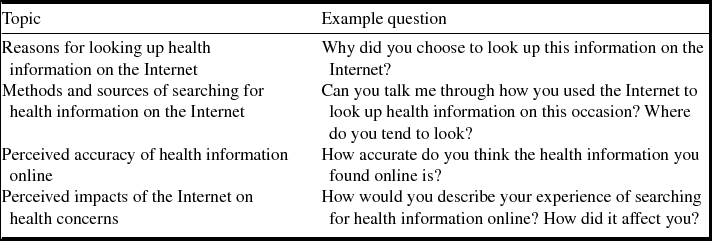
A semi-structured interview was used flexibly to guide the interview, with participants being encouraged to lead the discussion (Smith et al. Reference Smith, Flowers and Larkin2009). In line with the exploratory nature of the study, open-ended questions exploring triggers, motivations, experiences and impacts of searching for health information online were covered (see Table 1 for key topics). To facilitate accurate recall participants were first asked to recollect a typical recent occasion when they sought health information on the Internet and were asked the questions in relation to this occasion. They were then asked a ‘catch-all’ question to confirm this example was typical. Interviews lasted between 35.80 and 109.67 min (mean = 59.65 min, s.d. = 25.63 min) and were audio-recorded and subsequently transcribed verbatim, anonymized at the point of transcription.
Topics covered in the interview schedule and example questions used

Data analysis
Transcripts were analysed using IPA (Smith & Osborn, Reference Smith, Osborn and Smith2003; Smith et al. Reference Smith, Flowers and Larkin2009). One of the authors (C.L.) took the lead in developing a close, line-by-line analysis of each participant's transcript in turn, and in the subsequent identification of emergent patterns. A comprehensive set of descriptive and conceptual codes and comments associated with words and phrases was developed. Similarities and differences in the codes were then interpreted as emergent themes for each participant. Emergent themes from all participants were clustered and connected to form sub-themes. Sub-themes which were recurrent in at least one-third of the sample (Smith et al. Reference Smith, Flowers and Larkin2009) were identified as ‘super-ordinate themes’ through summarizing and condensing. At each stage, the thematic structure was developed through detailed collaboration with F.M. and K.M., who checked to ensure interpretations emerged from participants’ narratives. Guidelines for enhancing validity (Flick, Reference Flick1998; Yardley, Reference Yardley2000) were consulted and implemented where applicable (e.g. situating the sample, a ‘paper trail’ approach, and grounding in examples).
Results
Demographic characteristics
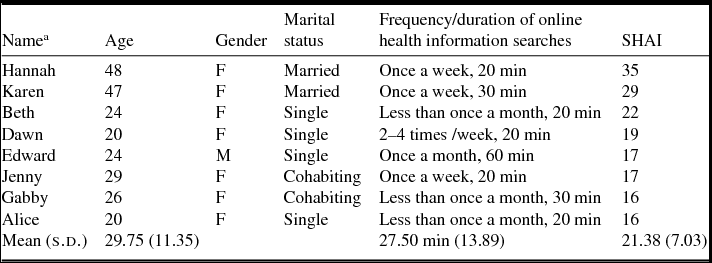
Participants’ demographic and clinical characteristics are outlined in Table 2. Participants’ mean SHAI score was 21.38 (s.d. = 7.03) reflecting levels of health anxiety above those reported by student samples, general practice patients, or anxious controls, but lower than scores reported for patients diagnosed with hypochondriasis (Salkovskis et al. Reference Salkovskis, Rimes, Warwick and Clark2002). Five participants sought health information online at least once a month, which is comparable to frequency of searches demonstrated in participants with high health anxiety (Muse et al. 2012). Three participants sought information less than once a month, which is comparable to the frequency of searches demonstrated in participants with low health anxiety (Muse et al. 2012). The mean time participants spent searching for information online was 27.50 min during a single searching session, which is comparable to the duration reported by participants with high health anxiety (mean = 26.78) and higher than the duration reported by participants with low health anxiety (mean = 17.43) (Muse et al. 2011).
Participants’ demographic and clinical characteristics and patterns of Internet use
SHAI, Short Health Anxiety Inventory
a Participants’ names have been changed to preserve anonymity.
Qualitative results
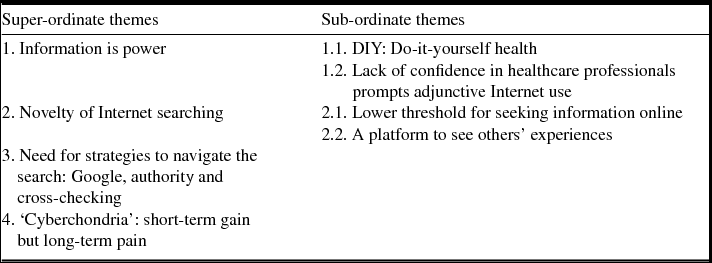
Super-ordinate and sub-ordinate themes are outlined in Table 3 and described, interpreted and illustrated with exemplar verbatim quotations below (participants’ names have been changed to preserve anonymity) Footnote †.
Summary of themes
Information is power
This theme emerged from participants’ reflections on their motivations for seeking health information online. A belief that information is power, and thus has the potential to prevent illness, was shared across participants, and the Internet gave easy access to a wealth of such information, allowing them to feel more in control of their health. As Alice commented, ‘If anything doesn't feel right I just immediately go on the Internet to ask like, OK, what the hell is going on?’ For many, it was prior experiences of illness which motivated them to strive to detect initial signs of illness so they could be treated at the earliest possible stage:
Hannah: You do hear people who have . . . caught an illness and nipped in the bud because they read something online . . . So if I see a symptom and it's a very early symptom, and it can be nipped in the bud and be OK, why is that not a good idea? Because that didn't happen with my sister . . . so I think now the slightest symptoms, if you can find out what's wrong with you, you’ll be OK because it's a very first sign and you could be treated.
While not all participants related prior experiences of serious illness, they all seemed to share the belief that finding out more about early symptoms would help to prevent illness and possibly save their lives.
DIY: Do-it-yourself health. Six participants described searching online in response to symptoms and, because of the instant accessibility of the Internet, they were able search as soon as they experienced a symptom. Participants described seeking an explanation or label for their symptoms and self-diagnosis tools on websites such as Boots WebMD made this particularly easy:
Jenny: If I have a symptom like pain in my right shoulder but I don't know what it is, you know, I go straight to WebMD and type into the symptom checker.
In addition to self-diagnosing, participants also used the Internet to try to prevent illness and gain information about health promotion strategies:
Edward: [During] swine flu if I feel that I’m having some flu or something, I’ll be bit cautious and try to get more and more knowledge about [it].
Whether it was concern about epidemics or bodily symptoms, the Internet enabled participants to learn more about their concerns at an early stage, thus providing a potential tool for preventing or limiting the impact of illness.
Lack of confidence in healthcare professionals prompts adjunctive Internet use. As participants considered any one source insufficient in isolation, particularly in situations where concerns were serious, they wanted to cross check as many sources as possible (e.g. GPs, friends and family, newspapers, magazines/books). However, different sources were not credited equally, with six participants indicating a preference for face-to-face contact. One possible explanation as to why participants may have utilized the Internet for health information despite preferring face-to-face interaction is that all participants related at least one direct or indirect negative experience with healthcare professionals:
Jenny: When I was a kid I actually had a kind of parasite . . . and I was sick for almost a year, because they didn't know what it was, and when they did find out what it was it was actually really easy to treat but they just didn't know for a long time. And I think that's done permanent damage.
Negative expectations and experiences with healthcare professionals prompted online searches for information to compliment that obtained from healthcare providers. For example, Gabby perceived a lack of attention from her GP and thus sought information online prior to consultation:
Gabby: I’d maybe try to find out about it first before I go in to see the GP, specifically because I feel she [her GP] doesn't really give her full attention . . . so I guess that's why I feel I need the reassurance about my health from other sources.
Some participants also feared that consulting their GP would lead to them being labelled as a time-waster or ‘hypochondriac’ and so sought information to legitimize their visit:
Karen: They tend to think you’re a bit hypochondriac . . . and also you kind of feel as if you’re perhaps wasting their time a bit if you haven't got something concrete to go in there and talk about.
The Internet was not seen as a replacement for medical consultation, as all participants expressed the need to ‘see someone’ for serious concerns, rather it was seen as a valuable adjunctive source.
Novelty of Internet searching
This theme uncovered some of the unique advantages the Internet afforded and provided some explanation as to why participants continued to use the Internet as a source of health information despite sometimes preferring other sources.
Lower threshold for searching for information online. All participants viewed the Internet as a low-cost tool which provided a quick, convenient method of accessing health information in ‘just a click’ (Dawn) and which had fewer barriers than conventional sources. For example, participants appreciated the instant accessibility and privacy of the Internet:
Karen: Because it's instantly accessible, you know, I can just tap in . . . I could just sit there in the privacy of my own room, access it without having to deal with the embarrassment . . . and if I get really worried at least it's kind of something I could instantly do about it . . . whereas in my GP surgery, typically I’ll have to wait two or three weeks for an appointment.
Consequently participants sought health information online at an earlier stage and for more minor health concerns, e.g.
Alice: If there's any kind of like, little problems, I’ll just find myself looking it up on the Internet.
A platform to see others’ experiences. Participants noted that the Internet afforded them access to health forums and message-boards, which provide less-regulated health information where anyone can post information. Five participants described using message boards and forums to seek out details of other's health experiences that were similar to their own. However, there was some disparity in the way participants’ used the information they found. Some seemed to trust and act on others’ advice and information:
Dawn: I found information about the dream cream, lots of people recommended it so after ten minutes I went out, went shopping and bought it and started trying it.
Others were more sceptical and, while they read forums, these participants stressed they did not contribute, did not trust the information provided and would not act upon it:
Hannah: I don't contribute or anything . . . I started to read them but I don't take them as gospel. I don't sort of think, ‘Oh right, that's what's wrong with me now’, because . . . anybody can write anything really.
While participants had varying opinions of the quality of information, most felt comforted by the sense that they were not alone in suffering with a particular issue:
Alice: Just to know that it was a common condition and it does exist somewhere else . . . It's kind of like ‘oh I’ve done quite well’, even though I’m moaning about it to myself, I’m justified in moaning about it.
There was a sense that participants’ had their subjective experience of being unwell/in need of care legitimized, and felt reassured that their own subjective experience was accurate. This may link with the ‘information is power’ theme, although it is a different type of empowerment; that of feeling more able to trust in the self, and therefore justified in help-seeking.
Need for strategies to navigate the search: Google, authority and cross-checking
While participants felt the vast quantity of online health information had advantages, they also found identifying relevant information difficult and time-consuming. As Karen commented ‘it's information overload on the Internet I think’. Participants were also aware that the Internet provided poor quality, inaccurate information as well as high-quality, useful information. To navigate their way through the vast amount of variable quality health information online, participants developed strategies to identify accurate, relevant information. Five participants described cross-checking across different websites in order to see identify common themes. Google was also used by all participants to look-up health information online and participants often trusted and relied upon the first few search results, feeling this strategy provided a way of ensuring they obtained good quality information:
Edward: I do believe in Google . . . The way of my searching [on Google] is I try to search on page one and page two, so it's always been read by a number of users and been liked by and appreciated by a number of users, so you definitely get back-up for this thing you’re reading.
Another strategy common across participants’ was to look for authoritative sources, including those associated with institutions or companies they recognized, and those they believed to be regulated, such as the NHS Direct or Boots WebMD. All participants felt that more authoritative websites could be trusted to provide accurate information:
Beth: They’ve reasons to keep their information accurate, they’ve their brand name thing to safeguard. But other sites, you know, what would they say when nobody's checking them.
‘Cyberchondria’: short-term gain but long-term pain
Searching for health information online appeared to exacerbate participants’ health worries and anxiety, and to foster new concerns. Four participants described how searching online exposed them to information about illnesses they were not previously aware of, and which they subsequently found themselves worrying about. The information obtained online also prompted participants to look for and notice the symptoms in themselves:
Dawn: When they write about having a heart attack then it's like it really hurts and my left, my heart has shooting pain.
Participants described how browsing the Internet for long periods of time increased the likelihood that they would be exposed to more worrying descriptions of illnesses, so they responded by trying to limit the amount of time they spent searching online.
Although participants felt that searching online sometimes got them now nearer to finding the information they desired, and often even exacerbated their worries, they felt compelled to continue searching because they believed in the power of having information, and felt that the process of seeking health information online could in itself provide some comfort or relief from anxiety:
Karen: I Googled it and I printed it off, like you’re doing something about it rather it just going round and round and round in my head. So it would be to kind of . . . break the worry cycle.
Nevertheless, participants felt that the reassurance provided by seeking health information online was only temporary:
Alice: I think sometimes it's just for comfort. So it's something that I’ve kind of looked up, and I’ve seen that information . . . I’ve found a bit of comfort in like I could do that and it might help . . . but a lot of the time I don't actually follow it – I just read it and it kind of like provides a short comfort.
Participants were aware that it had exacerbated their anxiety in the past, or that they had not found the information they sought, but they expressed a hope that this time would be different, that perhaps there would be some new information or potential solution available. Because participants were aware that the Internet is a source of information that is continually updated, the hope that it would provide something useful in the future triumphed over the experience that it had failed to in the past:
Hannah: I think it's probably frustrating and then, it's not very helpful, but then you tend to forget that and do it again another time, ’cause you think, you hope, that it’ll be different this time from last, and it’ll give you the answer to your problem.
Discussion
Research in the wider population has shown that most people seek health information online to find problem-oriented information about current symptoms and treatment options (Nelson et al. Reference Nelson, Murray and Kahn2010). This is consistent with participants in this study who used the Internet to understand their problem and decide on a strategy for solving it (e.g. self-diagnosis and treatment or medical consultation), to feel better about having the problem by having ‘done something’ about it, or to share others’ experiences of the problem and feel less alone.
Seeking online health information seemed in part to be prompted by negative expectations of and experiences with healthcare professionals. However, participants reported seeking information online as an adjunct to information obtained from medical consultations, rather than as a replacement for it. The Internet was used to assess the legitimacy of their concerns and justify the need for a medical consultation. This mirrors previous research which has noted that seeking health information online is associated with medical consultations (Andreassen et al. Reference Andreassen, Bujnowska-Fedak, Chronaki, Dumitru, Pudule, Santana, Voss and Wynn2007; Taylor, Reference Taylor2010), with 28% of patients preparing for consultations by seeking information online and 26% using the Internet to debrief from consultations (Nelson et al. Reference Nelson, Murray and Kahn2010).
In line with the advantages of seeking health information on the Internet outlined by Powell et al. (Reference Powell, Inglis, Ronnie and Large2011), participants noted that there are fewer barriers to accessing health information online: no embarrassment or stigma, appointments or travel, and lower financial or time costs. Furthermore, they described the quick and easy accessibility to online information leading to a reduced threshold for seeking information. A novel finding was that some also noted the benefits of being able to connect with people who have similar problems and gain support or advice from their experiences.
In line with previous research (Powell & Clarke, 2011) participants were aware that information obtained online was not necessarily relevant or accurate. This knowledge, in combination with awareness of the vast amount of information available, necessitated strategies to filter and validate the information. These strategies were similar to those used by the general population (Eysenback & Koehler Reference Eysenbach and Köhler2002; Morahan-Martin, Reference Morahan-Martin2004; Ybarra & Suman, Reference Ybarra and Suman2006) and included relying on Google, using more authoritative websites and cross checking across sites and sources. Individuals across the spectrum of health anxiety therefore appear to use a broadly similar approach to seeking health information online. However, Muse et al. (Reference Muse, McManus, Leung, Meghreblian and Williams2012) report that high health anxious participants were more likely to seek information about other's illnesses experiences on message boards/forums. This was reflected in some participants’ accounts and seemed in part to relate to the need to feel reassured about and normalize their problem. There may, therefore, be some differences in what those with high and low health anxiety are exposed to online.
The current findings raise a number of possible explanations for why or how seeking health information online maintains anxiety about health. First, compared to other information sources (e.g. medical consultations, textbooks), the Internet contains a large amount of unregulated, poor quality, inaccurate and incomplete health information (Eysenbach & Diepgen, Reference Eysenbach and Diepgen1998; Kunst et al. Reference Kunst, Groot, Latthe, Latthe and Khan2002; Rajani et al. Reference Rajani, Mukherjee and Chambers2007). Thus reliance on the Internet may increase exposure to conflicting, unreliable, inaccurate or outdated health information. Participants in the current study showed some awareness of this and developed strategies to navigate and validate information (e.g. relying on Google, establishing authority and cross-checking). However, most strategies failed to take into account basic credentials, such as source legitimacy and publication date (Eysenbach & Köhler, Reference Eysenbach and Köhler2002; Morahan-Martin, Reference Morahan-Martin2004), thus undermining their validity. Furthermore, the most commonly employed strategy involved heavy reliance on general search engines (e.g. Google), which have been shown to yield irrelevant results (Berland et al. Reference Berland, Elliott, Morales, Algazy, Kravitz, Broder, Kanouse, Muñoz, Puyol, Lara, Watkins, Yang and McGlynn2001), and escalate searches for common, innocuous symptoms to searches for rarer, more serious conditions (White & Horvitz, Reference White and Horvitz2009). Hence, individuals seeking health information online may not only be exposed to a large amount of worrying misinformation but may also fail to recognize the degree of inaccuracy, resulting in increased perception of threat and preoccupation with bodily signs and sensations (Warwick & Salkovskis, Reference Warwick and Salkovskis1990).
Second, previous research has suggested that participants with high health anxiety are more likely to perceive illness information as personally threatening (Hadjistavropoulos et al. Reference Hadjistavropoulos, Craig and Hadjistavropoulos1998). This tendency is reflected by participants in this study who reported ‘fitting’ themselves to symptoms and illnesses found online, i.e. perceiving that they have certain symptoms or syndromes after reading about them. Thus searching for health information online may maintain health anxiety by increasing awareness of serious illness, which those with high health anxiety perceive as personally relevant, leading to an increase in the individual's sense of personal threat from illness.
Finally, in thinking about why participants sought health information online despite finding it unhelpful, it is possible that searching for health information online functioned as reassurance seeking (Warwick & Salkovskis, Reference Warwick and Salkovskis1990; Taylor & Asmundson, Reference Taylor and Asmundson2004). Thus it was negatively reinforced by short-term reduction in anxiety (the ‘comfort’ gained from doing something about the problem and obtaining information with the potential to prevent or limit illness) but maintained by longer term increase in anxiety due to having further threatening illness related information to focus on and ruminate about. Seeking health information online may be a particularly potent form of reassurance seeking as it does not have the ‘costs’ typically associated with seeking reassurance (e.g. inconvenient appointments, having to wait for appointments, stigmatization). If this were the case then it may be maintained by operant principles in that it is reinforced in the short-term by an initial comforting effect but in the longer term it acts to maintain anxiety by increasing exposure to further threatening information. Indeed, online searching may be particularly powerfully reinforced as participants noted the variable nature of the reinforcement schedule. In other words, while the majority of time searching online did not lead to anything, they are occasionally rewarded when they do come across helpful information. The reinforcement schedule may be quite different when seeking information online than when doing so face-to-face in that the Internet is more likely to yield irrelevant information, and focusses on serious illnesses.
This qualitative study investigating health anxious participants’ experiences of searching for health information online sheds some light on the phenomena dubbed ‘cyberchondria’. The first theme, ‘information is power’ reflected participants’ sense of health information being powerful and gaining such information helping them to feel in control, or reassured. The themes relating to the novelty of the Internet as a source of health information, and of the need for strategies to navigate the search, reflected participants’ awareness that there was a huge amount of varying quality information available from the Internet. The final theme ‘short-term gain, long-term pain’ relates to how searching on the Internet might maintain health anxiety by acting as a form of reassurance seeking that may provide some comfort in the short term, but exposes the individual to more worrying information and maintains attention on negative health information in the longer term. It would be premature to suggest clinical implications; however, clinicians may wish to assess health anxious patients’ use of the Internet and consider whether it may play a role in maintaining the individual's anxiety.
In line with the principles of IPA, this study offers in-depth insight into the experiences of a limited group of individuals, rather than seeking to provide a representative sample (Brocki, & Wearden, 2006). Thus, further research will be needed in order to examine the generalizability of these findings beyond the current sample. It is a limitation that there was no clinical assessment of participants and they were not diagnosed with any disorder. It is also noteworthy that the sample was predominately female (although this is representative in that women are more likely to seek health information online; Rice, Reference Rice2006) and thus the findings may have limited applicability to men. In addition, the retrospective nature of the study means that participants’ accounts may have been influenced by factors such as the social context of the interview and memory biases. Thus caution must be exercised in the interpretation and application of the findings from this study – results and interpretations are offered to promote further investigation rather than as definitive conclusions.
Acknowledgements
The authors are grateful to the Lupina Foundation for funding the current study. J. Mark G. Williams is supported by programme grant G067797 from the Wellcome Trust. The authors thank Dr Paula Smith for helpful suggestions in developing the interview schedule for the study.
Declaration of Interest
None.
(1) This study examines the use of the Internet to seek health information in high health anxious participants.
(2) Semi-structured interviews were conducted and analysed using Interpretive Phenomenological Analysis.
(3) Themes identified reflect the motives, methods and impact of seeking health information online on health anxiety.
(4) ‘Cyberchondria’ was seen by participants as having short-term advantages and longer term disadvantages.



Comments
No Comments have been published for this article.