Introduction
In the past few decades, short food supply chains (SFSCs), local and regional food systems and attempts to (re-) connect consumers with food producers have attracted increased international research and policy attention (Marsden et al., Reference Marsden, Banks and Bristow2000; Kneafsey et al., Reference Kneafsey, Cox, Holloway, Dowler, Venn and Tuomainen2008; Deakin et al., Reference Deakin, Diamantini and Borrelli2015). The European Union's (EU) rural development regulation (1305/2013), for example, contains a number of measures to promote SFSCs with the primary aim of improving farmers’ incomes and thus helping to support rural economies. In the United States, federal policies to support local food systems were expanded in the 2008 Farm Bill and the 2014 Agricultural Act (Martinez, Reference Martinez2016). While these policies have been oriented primarily toward boosting rural development and farmer livelihoods, many local food systems and short food chains are based in urban and peri-urban contexts (Opitz et al., Reference Opitz, Berges, Piorr and Krikser2016). They have been stimulated by demand from urban ‘food citizens’ interested in the social, environmental, ethical and health qualities of food (Renting et al., Reference Renting, Shermer and Rossi2012; Sonnino, Reference Sonnino2016) and many cities now have well-established food policies and food councils which include among their objectives the re-localization of urban food supply (Chiffoleau et al., Reference Chiffoleau, Millet-Amrani and Canard2016). There have been numerous studies making the case for the multifunctional and cultural capacity of urban food systems to promote social inclusion, pro-environmental behaviors, health and well-being in urban communities (Wiskerke, Reference Wiskerke2009; Zasada, Reference Zasada2011; Mundler and Rumpus, Reference Mundler and Rumpus2012; Dimitri et al., Reference Dimitri, Oberholtzer and Pressman2016). Moreover, the concepts of urban agroecology, circular economy and urban metabolism emphasize the interaction between urban areas and peri-urban agriculture, via waste disposal or water management, for example, or the establishment of close market relations (Wibbelmann et al., Reference Wibbelmann, Schmutz, Wright, Udall, Rayns, Kneafsey, Trenchard, Bennett and Lennartsson2013; Tornaghi, Reference Tornaghi2014; Florin and Renting, Reference Florin and Renting2015).
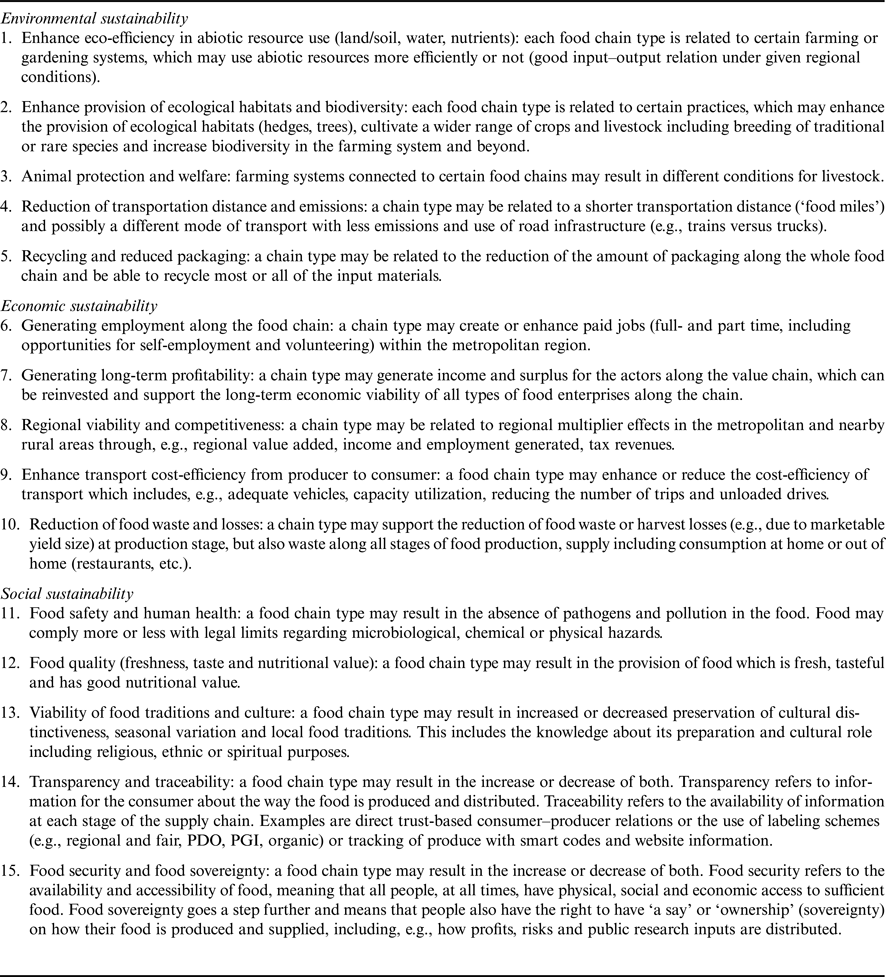
Despite this increased general attention to urban and peri-urban food systems, relatively little research has critically examined the impacts of the different types of SFSCs that now operate in urban settings. Several recent studies have proposed typologies of SFSCs (Aubry and Kebir, Reference Aubry and Kebir2013; Kneafsey et al., Reference Kneafsey, Venn, Schmutz, Balázs, Trenchard, Eyden-Wood, Bos, Sutton and Blackett2013), but few have compared the relative merits and impacts of the different types of SFSCs in large cities. Doernberg et al. (Reference Doernberg, Zasada, Bruszewska, Skoczowski and Piorr2016) have for instance assessed the potential contribution of different regional organic food supply models to a sustainable metropolitan food system, but limiting the comparison to organic retail trade and community supported agriculture (CSA) examples. This paper therefore addresses this knowledge gap by using and adapting a sustainability impact assessment (SIA) methodology to examine a broader variety of SFSCs operating in one of London's inner city boroughs. SIA is a widely applied methodology (Ness et al., Reference Ness, Urbel-Piirsalu, Anderberg and Olsson2007) and is used by the OECD (OECD, 2010), the EU (European Union, 2016) and Food and Agricultural Organization (Yakovleva et al., Reference Yakovleva, Sarkis, Sloan, Sonesson, Berlin and Ziegler2010; FAO, 2013). Building upon the EU's approach toward SIA, we developed indicators (Table 1) aiming at the integration of the three ‘classic’ sustainability dimensions: environmental, economic and social. The research was undertaken as part of the Foodmetres project, which modeled the potential to increase food production and short food chains in urban and metropolitan regions surrounding six major cities in the EU and Kenya (Wascher et al., Reference Wascher, Kneafsey, Pintar and Piorr2015; Zasada et al., Reference Zasada, Schmutz, Wascher, Kneafsey, Corsi, Mazzocchi, Monaco, Boyce, Doernberg, Sali and Piorr2017). The main objective of this paper is to present the results of two SIAs of different SFSCs operating in Greater London. The first reflects the perceptions of various food chain stakeholders who took part in a workshop to compare the performance of different types of SFSCs; the second reports on the viewpoints of food producers and consumers regarding specific sustainability impact areas at a community-led local food market.
Detailed explanation of the 15 indicators used for the sustainability impact assessment (SIA).

Concepts and methods: SFSCs and SIA
SFSCs in urban settings
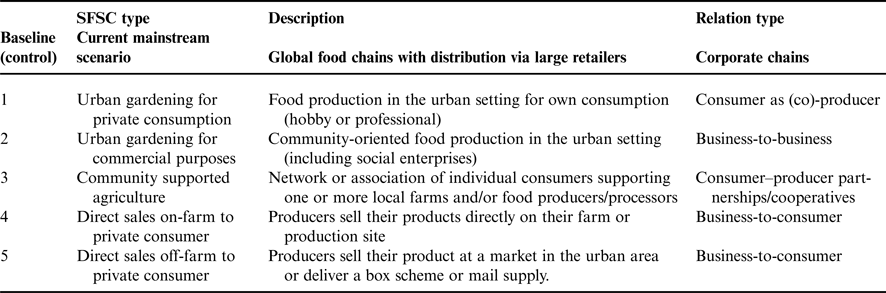
SFSCs operate with a reduced number of intermediaries between producer and consumer, when compared with ‘conventional’ complex food chains. The foods involved are identified by the locality, or even specific farms, where they are produced. A vital feature of SFSCs is that the product reaches the consumer embedded with information, which allows the consumer to make ‘value judgments’ about the food and the production methods involved (Marsden et al., Reference Marsden, Banks and Bristow2000). In SFSCs, emphasis is placed on building trusting and transparent commercial relationships between producers and consumers. Information about the food, producer and production methods can be conveyed either on packaging or in person through verbal communication at point of sale. Regarding the number of intermediaries typically involved in a SFSC, the idea is that these are kept to a minimum. In France, for example, SFSCs or circuit court (direct translation: short circuit) are widely understood as having no more than one intermediary between producer and consumer. Intermediaries can include shops, retailers, restaurants, school canteens and collective groups who enable producers to access markets. In cases where the producers and consumers are in the same region, the term circuit court de proximité is used. Similarly, Kneafsey et al. (Reference Kneafsey, Venn, Schmutz, Balázs, Trenchard, Eyden-Wood, Bos, Sutton and Blackett2013) split SFSCs into ‘proximate’ or ‘distance’ types. The former involve face-to-face sales and direct sales and are characteristic of ‘local’ food systems. The latter can also be direct sales, but often involve an intermediary and may also be based on internet sales. Adopting a slightly looser definition than that used in France, the European rural development regulation (1305/2013) states that a SFSC involves a ‘limited number’ of economic operators, committed to co-operation, local economic development, and close geographical and social relations between producers, processors and consumers. However, a commission delegated regulation (11.03.2014) stipulates that support for the establishment and development of SFSCs shall cover only supply chains involving ‘no more than one intermediary between farmer and consumer’ (Article 11). The EU regulations, in common with the early definitions of SFSC, recognize the importance of social relationships between people involved in the food chain. This point has been reinforced further in a recent report by a European expert focus group on SFSCs, which stressed that they are ‘much more than simply a tool for improving farm incomes’ and can also be seen as ‘a means to restructure food chains in order to support sustainable and healthy farming methods, generate resilient farm-based livelihoods (in rural, peri-urban and urban areas) and re-localize control of food economies’ (EIP-AGRI 2015: 5). The report emphasizes that the main reason for shortening food chains is to reduce the number of intermediaries in order to achieve more transparent food chains, where the producer retains a greater share of the value of the food that is sold, and where intermediaries act as valued and trusted partners in the chain. For the purpose of the research reported in this paper, five main types of ‘proximate’ SFSCs were chosen for the SIA. They were identified from an exhaustive list developed in the Foodmetres project (Zasada et al., Reference Zasada, Doernberg, Piorr, Pintar, Glavan, Schmutz, Kneafsey, Bos, Venn, Mbatia, Simiyu, Owour, Asselt, Wascher and Sali2014) and are described in Table 2.
Description of the five urban and peri-urban short food supply chain types (1–5) being assessed against the current mainstream scenario—supermarket supply chain as baseline or control.

They were identified as being of most relevance to the context of the Greater London urban food system, based on a review of secondary data and expert advice from the representatives of Sustain (Sustain is a national Alliance for Better Food and Farming in the UK, and was a partner on the Foodmetres project). They all feature zero or maximum one intermediary between producers and customers, where the customer is understood as the entity buying the food (e.g., a restaurant, hotel or person).
SIA of SFSCs
The SIA approach adopted in this study consists of a normative approach, which uses a benchmarking method to assess the different SFSCs regarding their maximum benefits in comparison to ‘conventional’ long distance, complex food chains. The SIA was designed as a tool to enable qualitative assessments to be undertaken by knowledgeable actors such as food chain participants, civil society organizations and food chain researchers. Three sets of indicators were developed to assess the social, economic and environmental performance of SFSCs. The indicators were chosen based on an extensive review of existing research and the SIA was first pre-tested by the Foodmetres consortium and then pilot tested by 37 internationally based academic researchers. As a result of the tests, the number of indicators was reduced from 18 to 15 and many were re-worded (for a detailed description of the methodological development, see Zasada et al., Reference Zasada, Doernberg, Piorr, Pintar, Glavan, Schmutz, Kneafsey, Bos, Venn, Mbatia, Simiyu, Owour, Asselt, Wascher and Sali2014). Table 1 provides a detailed description of the indicators, which were finally chosen.
As can be seen in Table 1, the SIA in effect asks respondents to make judgments about the expected environmental, economic and social impacts of different types of SFSCs. So, for example, in the environmental impacts section, respondents are asked to make assumptions about the type of production systems and transport distances involved with SFSCs. This reliance on assumptions could be viewed as a weakness of the SIA, but our approach is based on the idea that gaining an insight into the perceptions and knowledge of different food chain stakeholders is essential for supporting transitions toward more sustainable food systems. Their assumptions are highly valuable because they are grounded in the practical realities of trying to build viable sustainable food systems, which deliver a range of public and private goods in a particular social and spatial context. The information given to participants regarding SFSC and the baseline is shown in Table 2. In addition, practical examples in London for each type of supply chain were discussed before the SIA exercise. Further information on how the method was applied is found in SIA workshop section.
Application of the SIA: a case study from Lambeth
For this research, we worked primarily with stakeholders in the inner city London borough of Lambeth (population 318,000), which has a history of early and progressive engagement with urban food system sustainability and governance issues. For example, in 2013 it launched a multi-stakeholder Food Partnership with a vision ‘to galvanise organisations and individuals to cultivate a healthier and more sustainable local food culture. By working together we are greater than the sum of our parts’ (Lambeth Food Partnership, 2013). The aims of the Food Partnership are to (1) develop stronger and healthier communities, (2) develop a resilient and sustainable environment and (3) develop a vibrant and prosperous economy (Lambeth Food Partnership, 2013). Within this context, there is considerable interest among local civil society actors, enterprises and public sector agencies in supporting local food systems and community-led food trade to deliver health and sustainability outcomes—although the terminology of ‘short food chains’ is not so widely used. We applied the SIA methodology in two different ways. The first was in a participatory workshop, organized in Lambeth and the second application consisted of a survey at a local food market in the south of the borough, in which we developed questionnaires for market stallholders and market customers, based on the indicators in the SIA.
SIA workshop
The participants at the SIA workshop were citizens, food entrepreneurs, food growers, food researchers and local policy makers. The invitation to the workshop was shared widely through the network of the Lambeth Food Partnership and social media. As only interested people participated, the sample was self-selected and based on the people connected to London food networks. The workshop was held in Lambeth Town Hall in March 2014, and 17 participants were given a brief introduction to the SIA methodology. Participants were asked to assess the five different types of SFSCs described in Table 2, using a matrix with the 15 indicators (Table 1). Vegetable supply chains were selected as they are present in all five urban SFSCs and in the ‘baseline scenario’ which was defined as ‘where most of the urban population's vegetable supply comes from—namely supermarkets, long food chains and large-scale producers’. Following the introduction to the SIA and the explanation of the matrix, workshop participants were invited to fill in the SIA matrix in small groups (each had to reach a consensus on the scoring). Participants were asked to think about how each of the five SFSCs compares to the current ‘mainstream’ or ‘baseline scenario’. A Likert scale impact measure [from ‘very negative impact’ (−3) to ‘no impact’ (0) to ‘very positive impact’ (+3)] was used to assess what they (as citizens, food entrepreneurs, local policy makers, etc.) would expect to realistically happen if there were increases in the amount of vegetables supplied through the different types of SFSCs. The participants discussed the timeframe of the impact and collectively settled on ‘medium term’, which was defined as 5 yr.
All stakeholders at the workshop completed the SIA matrix. One form was incorrectly completed and excluded from the analysis. While for most participants, the matrix was self-explanatory and understandable, a few questioned the definitions and wanted to know more detail and clarification. There was a lively discussion in each group about why and how they rated the impacts as they did. An important outcome was that workshop participants wanted to know if it would be possible to test the SIA on a specific example of a SFSC, rather than basing results only on their own perceptions, and it was this suggestion, which led the research team to develop the next phase of the study (see SIA of community-led local food market with urban and peri-urban SFSCs section).
SIA of community-led local food market with urban and peri-urban SFSCs
To gather additional information related to the different sustainability impact areas, we further carried out a questionnaire survey at a community-led, not-for-profit food market in South London, which aims to support small-scale, sustainable and local farmers primarily from Greater London and the counties of Surrey, Kent and Sussex. During 2 days, we conducted face-to-face interviews with all the market stalls present (a total sample of 18 businesses/social enterprises). The market stallholders (called ‘producers’ in contrast to ‘consumers’ further on) represented all five types of SFSCs researched before. In addition, face-to-face interviews were conducted with all consumers willing to participate during a market day (51 consumers). The interviews were based on a structured questionnaire with mainly closed questions, following broadly the ‘environmental’, ‘economic’ and ‘social’ issues discussed in the SIA workshop. It was not possible to extract exactly the same information as in the SIA workshop, but the aim was to try and gather data which would correspond broadly to the indicators, discussed in the workshop and could be used as a proxy for the indicator. A key consideration was that data had to be collected in a 15–20 min interview while the producers were working on their stalls, and so the questionnaire had to be relatively straightforward and easy to answer. The question text can be seen in Table 3 for businesses and Table 4 for consumers. Data were analyzed using descriptive static methods. Means and standard errors are shown and a Student's t-test with two distribution tails and a type 3 test [two-sample unequal variance (heteroscedastic) test] was conducted to compare the 18 producer data sets with the 51 consumer data sets. Statistically significant differences were calculated for 0.1, 0.05 and 0.01 significance levels.
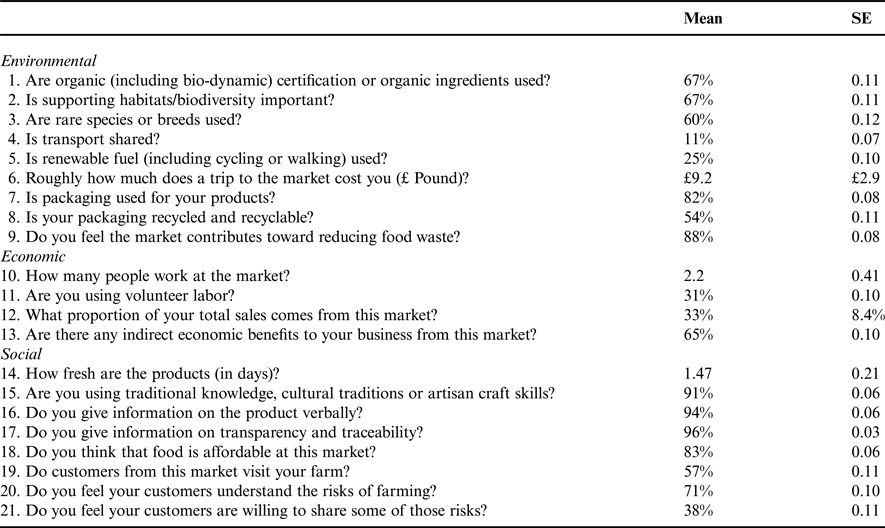
SIA questionnaire of all 18 producers at a community-led market using urban and peri-urban short food supply chains.

Data show results for ‘environmental’, ‘economic’ and ‘social’ issues. The question text is slightly shortened to fit the table. All answers are averages (mean) given in percentage (%—yes), £ Pound, persons or days. SE (standard error) for the entire population is also shown.
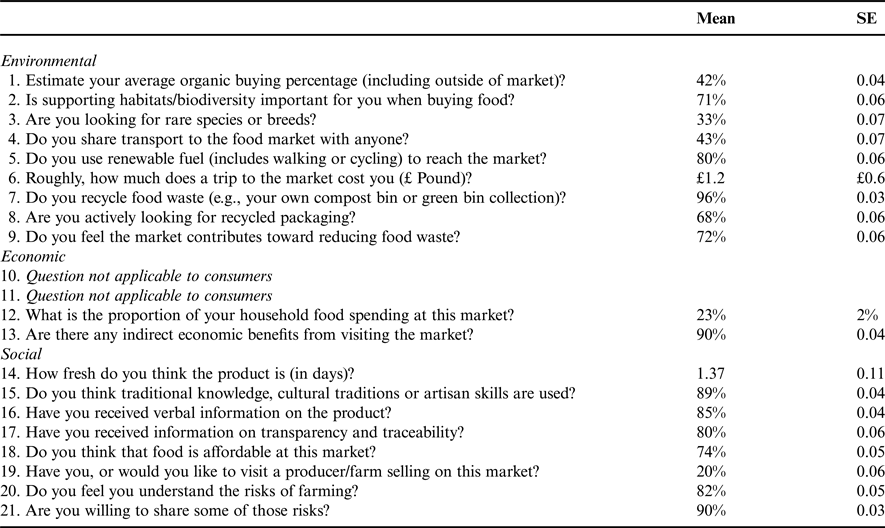
SIA questionnaire of 51 consumers at a community-led market using urban and peri-urban short food supply chains.

Data show results for ‘environmental’, ‘economic’ and ‘social’ issues. The question text is slightly shortened to fit the table. All answers are averages (mean) given in percentage (%—yes), £ Pound, persons or days. SE (standard error) for the sample is also shown.
Results
SIA of urban and peri-urban SFSCs by stakeholders
The results (Table 5) showed that there are considerable differences regarding the sustainability contribution between the different SFSC types compared to the baseline situation of a conventional retail chain. Among the SFSCs, ‘consumer–producer partnerships/cooperatives’ (CSAs) rated highest for the combined social, environmental and economic impact with a value of 1.98. This was followed by ‘urban gardening for commercial purposes’ with a rating of 1.80 and ‘urban gardening for private consumption’ and ‘direct sales off-farm to private consumer’ both with 1.70. The lowest overall rating (1.55) was for the supply chain ‘direct sales on-farm to private consumer’. Among the three sustainability dimensions, social aspects show the highest scores for all five SFSCs. Economic and environmental aspects were rated considerably lower with little difference in between them. There was one notable exception: the economic impact of ‘urban gardening for private consumption’ was rated a lot lower than the environmental impact (1.05 for economic versus 1.74 for environmental). This low economic rating is interesting and may indicate a rating only of the direct (monetary) economic benefits from urban gardening. Other research (Schmutz et al., Reference Schmutz, Courtney and Bos2014) shows that the indirect economic benefits (from health and wellbeing and from community life and life satisfaction) can be much higher than the direct (monetary) ones.
Average SIA rating for five different urban and peri-urban SFSCs.

The results are shown for all dimensions combined (‘SIA-all’) and then for the individual dimensions ‘environmental’, ‘economic’ and ‘social’. The ratings range from −3 ‘very negative impact’ to +3 ‘very positive impact’ compared to current baseline supermarkets, which have a neural score (17 participants, for details, see SIA workshop section).
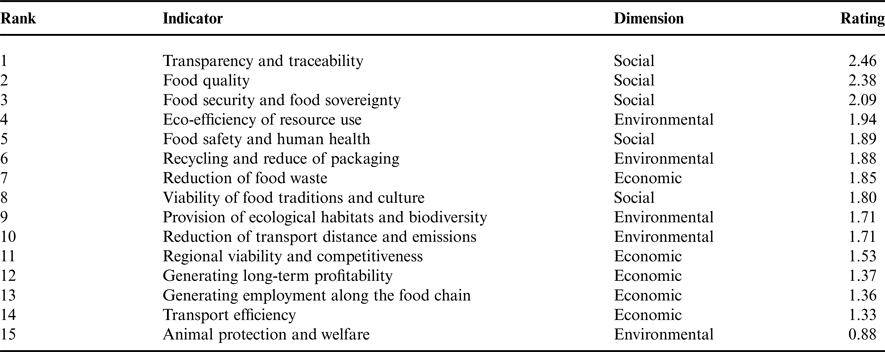
The results for the individual indicators (Table 6) showed that within the social dimension ‘transparency and traceability’ (2.46) closely followed by ‘food quality’ (2.38) and ‘food security and food sovereignty’ (2.09) were rated highest. This was followed by ‘eco-efficiency of resource use’ (1.94) and ‘food safety and human health’ (1.89). ‘Animal protection and welfare’ had the lowest rating (in vegetable supply chains, the effects might be mainly indirect through low-meat, ethical-meat or vegan/vegetarian diets and their effect on demand for systems with different animal welfare). We conclude that economic issues are regarded as having the lowest expected impact rating and ‘transport efficiency’, ‘employment along the food chain’ and ‘long-term profitability’ in urban SFSCs are in this bottom triplet. In addition, ‘transport efficiency’ also had the lowest rating overall (1.33), and this was for the particular food supply chain of ‘direct off-farm’. In other words, participants appear to agree that the current mainstream supermarket supply chain has a relative strength in ‘transport efficiency’, especially if compared with other impacts of the current food supply mainstream. Another low impact (1.36) was on ‘generating employment along the food chain’ for the supply chain ‘urban gardening (self-supply)’, which is not surprising given that this SFSC is primarily concerned with domestic food production for private consumption. Urban gardening is strictly speaking a very short or ‘zero-chain’ food supply chain. However, since it is very common in London and supplies specific foods (e.g., fruit and vegetables), we have included it in the assessment. It is also often used in combination with other urban and peri-urban food supply chains.
Fifteen different indicators with their sustainability dimension (‘environmental’, ‘economic’, ‘social’), ranked in order of their average rating for all five urban and peri-urban SFSC types.

SIA of community-led market using urban and peri-urban SFSCs
Results from the community-led market survey showed many similar answers from producers (Table 3) and consumers (Table 4). The majority of producers are certified organic or use organic ingredients, support the conservation of habitats and biodiversity and breed rare species (67%). Regarding transport efficiency, only a minority (11%) share transport or use renewable energy (25%). Just over half of the packaging used is recycled and recyclable, but a larger proportion (88%) think that the market helps contribute to reducing food waste. The average transport cost of £9.20 (10.5 Euro) can be seen as a proxy for local delivery. This is about a 10.5 km return trip with a small delivery van (or 16 km with a car), so the produce delivered to this market is truly local—not just perceived as local as in the SIA workshop. In terms of economic impacts, this was the most difficult section of the SIA to convert into a survey format. Regarding the economic impact of the market on the enterprises, we found that an average of 33% of their total sales is processed through the community market. However, this share varies between 5% and 95% for individual producers. In addition, 65% of the enterprises agreed that the market delivered indirect economic benefits to their business. Among the indirect benefits mentioned were: ‘other market requests’, ‘more interest in private, bespoke orders’, ‘more customers on our farm’, ‘larger customer base has increased internet service’, ‘marketing and testing products’, ‘difficult to say, but there are emotional benefits’, while others were ‘not sure’ or had ‘no’ or ‘not yet’ seen any indirect economic benefits. The average number of people working at a market stall was 2.2 per stall, and almost a third of the enterprises used volunteer labor.
Our findings regarding the social impacts on the producer side are more definitive, with a large majority of cases using traditional knowledge and skills and providing information on their products. All the respondents agreed that consumers ask about the products, which underlines the importance of transparency and traceability in SFSCs. A sizeable majority (83%) agreed that the food at the market is affordable. In relation to customers visiting their farms, 57% said yes and 71% of businesses felt their customers understand the risks weather can cause to producers. However, only 38% think customers are willing to share some of these risks.
Turning to the results of the consumer survey (Table 4), there are some interesting similarities and differences. The first point to note is that the consumers spend a relatively high proportion on organic food—the average of 42% is higher than national figures (the fresh produce share of organic in the UK is 23.5%, but the share of the total food and drink market in monetary value is currently around 1.5%, Soil Association, 2017). Just over 70% are looking to support the conservation of habitats and biodiversity through their food purchase. However, only 33% were looking for rare breeds or species, whereas 60% of producers were using these (examples include ‘heritage wheat’ and ‘native’ meat breeds). In terms of environmental impacts, a higher proportion of consumers share transport and use renewable fuel than producers. A very high proportion of consumers (96%) recycle food waste and 68% look for recycled packaging, whereas only 54% of the producers offer recyclable packaging. Seventy-two percent of consumers felt that the market contributes toward reducing food waste, whereas 88% of the producers felt this. Economic data show that consumers on average allocated almost a quarter of their expenditure at the market and that 90% felt that the market had indirect economic benefits, compared with just 65% of producers. For consumers, these indirect benefits were different to producers with typical answers like ‘I now know the people selling’, ‘It brings happiness’, ‘It's fun to hung out’, ‘A sense of community’, ‘Social contact to Transition Town & Edible Garden Communities’, ‘Knowing people like stallholders and patchwork farmers’, ‘Building confidence, trust, loyalty, friendships’ ‘Wellbeing and food quality’ and ‘I like supporting things local not super-market’. While the 10% which could not see benefit said ‘no benefits’ or ‘they selling just surplus’ or ‘not now, but might be in the future’.
Moving on to the social impacts, consumers had a slightly higher estimation of the freshness of the products (this question referred to the fresh produce like vegetables and fish; cured meat and processed foods like juices were excluded as not applicable) compared to the information provided by producers—1.37 compared with 1.46 days. (Note: because of the nature of the two different viewpoints, the question was not exactly the same: e.g., producers were asked what they know about how fresh produce is and consumers were asked what they think about how fresh produce is.) The consumers were very close to the producers in terms of agreeing that traditional knowledge and skills are used (89 and 91%) but diverged a little in terms of information given on transparency and traceability. While 96% of producers said they gave this information, 80% of consumers felt that the information was available. Similarly, while 94% of producers said they gave this information verbally, 85% of consumers felt that they had received this. There was a divergence in views on the affordability of food, with 74% of consumers agreeing it was affordable, compared with 83% of producers. Only 20% of consumers had either visited, or would like to visit a farm; whereas 57% of producers had hosted visits (unsurprising given the larger number of consumers compared with producers). A particularly interesting finding is that 82% of consumers felt they understood the risks of farming, whereas only 71% of producers felt this to be the case. Even more striking is that 90% of consumers said they were willing to share some of the risks of farming, whereas only 38% of producers thought this would be the case.
Using a two-sample unequal variance t-test, we find no significant differences between the answers of producers and consumers for most of the 21 questions. This is remarkable as producers and consumers seem to be in agreement on many issues, there are however a few notable exceptions. First, producers provide more rare species and breeds (60%) than consumers (33%) were actually looking for (0.1 significance level). Secondly, although 80% of consumers said they received information on transparency and traceability, 96% (0.05 significance level) of producers stated that they had given this information. Thirdly, significantly more consumers (90%) than producers (65%) felt that the market delivered indirect economic benefits (0.05 significance level). Finally, with the highest significance level (0.01) more consumers said they were willing to share risks (90%), than producers believed would do so (38%).
Discussion and conclusions
This paper has presented the empirical results of a participatory SIA of different urban SFSC types, which is complemented by a survey among SFSC producers and consumers. The main objective was to gain an insight into how stakeholders estimate the sustainability impacts of different types of SFSCs, which are found operating in London. The paper does not compare a SIA of SFSC with conventional retail chains, such as supermarkets, but instead examines the relative performance of different urban SFSCs compared with a common mainstream ‘control’. The results show that stakeholders in the workshop SIA rated SFSCs as generally performing better than mainstream global food supply chains. Emphasizing the role of food and the human-centered interaction and behavior around food and the less economic activity of agriculture and commodity production, models of short food supply are shifting toward an arena, where the food topic is linked to a multitude of other urban policy fields, sectors and functions, such as health, education, social inclusion and civil society, urban renewal and quality of life. Compared to global agri-food systems, the different types of SFSC may have the potential to cross-fertilize these topics directly or indirectly and to develop multiple benefits for them, something which is framed as the ‘multi-functionality of food’ (Morgan, Reference Morgan2014). In this sense, the spread of SFSC could re-link the food consumption and production domains and thus be a lever to induce societal and behavioral changes, which are linked with a more conscious understanding of food. This includes the reduction of food waste, consumption of healthier and more sustainable produced food, and ethical considerations or increased knowledge and information around food and its origin. These impact areas were found to be relevant and influential within our study, but our data also show that in practical SFSC examples, producers and consumers are not totally ‘in-sync’ on everything. Although we found many remarkable similarities in perceptions (freshness, use of traditional skills, etc.), there were differences, especially in terms of producers underestimating consumers’ willingness to share the risks producers face.
Our results also revealed impact performance differences between investigated SFSC types, which point to a specific strength–weakness pattern of individual SFSCs regarding their contribution to a sustainable metropolitan food system. While stakeholders believe that SFSCs generally have relevant impacts on the social dimension, particularly on transparency, food safety and security, certain weaknesses or at least a minor contribution to sustainability are perceived, such as for employment effects or transport efficiency. These findings are in line with research concluding that the concept of food miles is of little use when discussing carbon emissions, with transportation mode being as important as distance (Coley et al., Reference Coley, Winter and Howard2014). The ability of SFSCs to generate more employment (compared to the ‘control’ current mainstream) and long-term profitability was also in some doubt, although care is needed in interpreting these results. For example, the inclusion of ‘urban gardening (self-supply)’ has skewed the general results for economic performance. As no commercial food trade is involved and no turnovers are generated, urban gardening for self-supply can contribute little to direct income generation, it can however reduce household spending on food and generate trade at garden centers, mail order of seeds and other inputs. Already, Krikser et al. (Reference Krikser, Piorr, Berges and Opitz2016) have identified major differences between the various SFSC types, explicitly distinguishing social- and commercial-oriented models. They also highlighted the special role of SFSCs, which are based on self-supply, including the limited economic benefits. Our findings concerning the strong contribution to social benefits mirror research evidence, which tends to agree strongly on the social benefits of SFSCs, but is less conclusive in terms of environmental and economic indicators (Kneafsey et al., Reference Kneafsey, Venn, Schmutz, Balázs, Trenchard, Eyden-Wood, Bos, Sutton and Blackett2013).
Overall, the participatory SIA process fills a gap between quantitative evaluations of certain commodity chains, which focus on environmental effects (e.g., Life Cycle Analysis) and qualitative evaluation of single cases of SFSCs and offers the possibility of a direct comparison of different types of short food chains. The advantage of the approach is that it allows not only statements about the direction of an expected or perceived effect, but also about its intensity. Nevertheless, if the SIA methodology is to be more widely adopted in stakeholder workshops, we suggest further refinement. First, further work is needed to clarify the terminology so that all participants have a common understanding of the indicators. Secondly, the pre-selection of the sustainability indicators and the focus on the three ‘classical’ sustainability dimensions (Brunori et al., Reference Brunori, Galli, Barjolle, van Broekhuizen, Colombo, Rougoor, Giampietro, Kirwan, Lang, Mathijs, Maye, De Roest, Schwarz, Schmitt, Smith, Stojanovic, Tisenkopfs and Touz2016) can be challenged. Using alternative methods like the ‘theory of change’ used in social return on investment (SROI Network—Social Value UK, 2012) could help avoiding static categories and pre-selection of indicators and rather capture the values of stakeholders (Garden Organic, 2014; Schmutz et al., Reference Schmutz, Courtney and Bos2014).
Combining the SIA workshop method with the SIA survey on a real example has proved valuable, because together both methods enabled us to contrast perceptions of sustainability with data on sustainability at a specific site. It was also possible to collect SIA data independently from consumers and producers and contrast them, too. In other words, we conclude that the methods might be stronger together than they would be on their own. Our attempt to convert the workshop SIA into a survey-based SIA also highlighted some interesting results and lessons for future research. The most obvious general finding is that both tools produced overall agreement on the social benefits of SFSCs. A valuable element of the SIA survey was the attempt to generate comparable data from producers and consumers. This revealed interesting similarities and equally differences around perceptions of affordability, transparency and risk sharing. Most notably, producers underestimated consumers’ willingness to share the risks producers face and this requires further research in order to better understand the reasons for the different views; at this stage, we do not know whether it is due to a difference in how the concept of ‘sharing risk’ was understood or whether it may be attributable to a sense of caution on the part of producers who are aware of the potential for consumers to change their buying behaviors should economic conditions change. In addition, expressed willingness to share risk does not necessarily mean consumers will actually do this, if this requires behavior change. Risk sharing in agriculture (Meuwissen et al., Reference Meuwissen, Hardaker, Huirne and Dijkhuizen2001) has seen limited interest in academic research and the consumer part of risk sharing has mainly been discussed in the CSA literature (Fieldhouse, Reference Fieldhouse1996; Lamine, Reference Lamine2005). For example, Galt (Reference Galt2013) examining qualitative and quantitative data from 54 CSAs in the California (USA) find that farmers are not sharing production risks—rather than sharing farmers appear to take self-inflicted economic hits and this remains hidden from the CSA members/consumers. Here too farmers/producers might possibly underestimate their ‘consumers’ and supporters within the CSA, they also might not communicate the risk associated with farming. Risk sharing with producers as part of a new food culture is only just emerging as a concept. A better understanding of risk sharing may lead to more resilience and trust in food supply chains.
In terms of the methodology itself, the SIA survey of the market was limited in its ability to evaluate economic impacts, due to limited capacity to collect relevant data. Understanding the economic impact of SFSCs is complicated, depending on whether the impact is measured in relation to a particular enterprise, or a place, for example. Moreover, farm businesses are often complex, and may make use of a variety of routes to market and unpacking the impacts of each one of these can be difficult without undertaking a full analysis of the business structures. Another particular weakness with converting the SIA into a survey format is that we were unable to gain a deeper qualitative understanding of what respondents had in mind when answering the question about ‘indirect economic benefits’. Any future research, we suggest, should aim to combine qualitative and quantitative methodologies in order to overcome this limitation. For both SIAs (workshop and survey), we also recommend that they should take into account a full understanding of the regional or local context within which SFSCs are operating. In all cases, assessments are highly context dependent: for example, whether a SFSC delivers well on food safety may depend more on national regulatory requirements rather than the nature of the SFSC itself and similarly, the economic viability of a SFSC is very much linked with the general economic health of the region in which it is located. Given these points, it is therefore important to note that the SIA is primarily a tool for gaining an insight into the perceptions and assumptions surrounding SFSCs in any given context. We conclude that further research is required in order to identify existing practical solutions or to develop new solutions, including social and technical innovations, which can improve these sustainability dimensions of urban and peri-urban SFSCs. A better understanding of the motivations, drivers and constraints of the urban social entrepreneurs who develop and make novel practical solutions, such as community-led local food markets a reality, is also required. SFSCs have developed from their initial ‘farm income/rural economy’ focus to social relationships between people and transparency and traceability (EIP-AGRI 2015: 6) within food chains. Our data suggest that they could develop further in the form of knowing, trusting and sharing of risks which farming faces. This could be a collective urban support and responsibility—sharing risks with the territory around the city.
Acknowledgements
The authors would like to thank all the participants who attended the Lambeth SIA workshop. Sue Sheehan of the Lambeth Food Partnership provided invaluable support. Matjaz Glavan (Ljubljana University) and Jane Berger (Enfield Council) provided guest talks at the workshop. The authors would also like to thank the community-led food market in South London for access to data about the market, all the businesses at the market for participation in the research and more than 50 consumers who contributed to the findings. The authors also thank Elizabeth Bos, Laura Venn and Anja Jakse for valuable help in organizing the Lambeth workshop and collecting data at the market. This study has been carried out within the research project Foodmetres (‘Food Planning and Innovation for Sustainable Metropolitan Regions’), funded by the Seventh Framework Programme of the European Union (Grant agreement no: 312185).