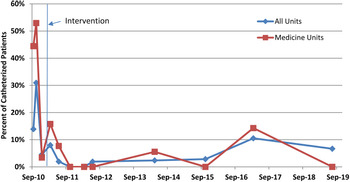
Urinary tract infection is one of the most common healthcare-associated infections, and it is usually associated with indwelling urethral catheter use. In February 2011, the Veterans Affairs (VA) Ann Arbor Healthcare System implemented a program to reduce catheter-associated urinary tract infection (CAUTI).Reference Miller, Krein and Fowler1 The intervention comprised the following measures: standardized indwelling urethral catheter insertion kits with a closed system; a urinary management nursing note template in the electronic medical record to facilitate daily review of catheter presence and need; and a urinary management policy encouraging prompt removal of nonindicated catheters. Initial results, evaluated through June 2012, showed a 3.1% absolute reduction in indwelling urethral catheter prevalence hospital-wide, including a significant reduction in internal medicine units (4.6% absolute reduction; P = .01).Reference Miller, Krein and Fowler1 We also detected an 11.0% absolute reduction in inappropriate urethral catheter use.Reference Miller, Krein and Fowler1
The infection prevention literature is full of examples of interventions with initial success.Reference Meddings, Rogers, Krein, Fakih, Olmsted and Saint2 Unfortunately, assessing sustainability, the extent to which program benefits (ie, effectiveness) persist,Reference Shediac-Rizkallah and Bone3,Reference Scheirer4 is much less common; only a few studies have shown the long-term success of programs to reduce urethral catheter utilization or CAUTI.Reference Regagnin, da Silva Alves and Maria Cavalheiro5,Reference Gupta, Irukulla, Shenoy, Nyemba, Yacoub and Kupfer6 Thus, we sought to determine whether the initial improvements in appropriate use of urethral catheters observed as part of the VA Ann Arbor CAUTI prevention program were sustained over an 8-year period.
Methods
Using the same methods as the initial study,Reference Miller, Krein and Fowler1 we used point-prevalence surveillance to assess urethral catheter use and appropriateness between March 2011 and July 2019. Every ~1–2 years during this period, study staff evaluated every patient in the hospital every day during a work week to determine the percentage of inpatients with an indwelling urethral catheter (ie, catheter prevalence). We determined the indication for catheter use (ie, appropriateness) by medical record review, based on Centers for Disease Control and Prevention guidelines.Reference Gould, Umscheid, Agarwal, Kuntz and Pegues7
For this analysis we assessed sustainability over an 8-year postintervention period (March 2011–July 2019). We generated run charts for both catheter prevalence (ie, the number of patients with an indwelling urethral catheter divided by the number of all hospitalized patients), and catheter appropriateness (ie, the number of patients with a catheter in place with an inappropriate indication divided by the number of catheterized patients). We performed logistic regression with robust standard errors to account for overdispersion for each outcome controlling for time using SAS version 9.4 statistical software (SAS Institute, Cary, NC). A P-value of < .05 was considered statistically significant.
Results
Before the intervention was implemented (September 2010–December 2010), 902 patient days were evaluated for presence and appropriateness of an indwelling urethral catheter. During the 8-year postintervention period (March 2011–July 2019), 3,031 patient days were similarly evaluated. During this period, urethral catheters were present on 395 days (13.0%), and 13 of those catheter days were deemed inappropriate (3.3%). The prevalence over time of urethral catheters is presented in Figure 1, which shows catheter prevalence starting at 13%–25% before the intervention in 2010 and ending at 7% in 2019 in all units. In medicine units, catheter prevalence remained <10% for the entire postintervention period. Following an initial drop after the intervention, the use of inappropriate catheters remained low over the entire follow-up period (range, 0%–11% for all units; 0%–14% for medicine units) (Fig. 2). The logistic regression results showed a continued decrease in urethral catheter-use point prevalence during the 8 years after the intervention (OR, 0.91; 95% CI, 0.86–0.97; P = .003). We found no significant change in inappropriate use of urethral catheters during this time (OR, 1.2; 95% CI, 0.93–1.55; P = .16).
Urethral catheter point prevalence (ie, the number of patients with an indwelling urethral catheter divided by the number of all hospitalized patients).

Patients with an inappropriate indication for indwelling urethral catheter use (ie, the number of patients with an inappropriate indication divided by the number of catheterized patients).

Discussion
Reducing inappropriate urethral catheter use is an important method of preventing CAUTI and enhancing patient safety. Our intervention, implemented nearly a decade ago, revealed that a simple set of practices can reduce inappropriate catheter use and can contribute to decreased CAUTI rates: use of a standardized catheter kit with a closed system, a nursing note template facilitating daily nursing review of catheter presence, and a policy prompting removal when no longer indicated.Reference Miller, Krein and Fowler1 The results from this study show a continuing decrease in indwelling urethral catheter prevalence and a sustained reduction in inappropriate use over 8 years following the implementation of this multimodal intervention.
Sustainability in quality improvement interventions is a complex phenomenon and represents a key goal for patient safety leaders and policy makers. Sustainability generally consists of 3 elements: effectiveness; routinization and institutionalization of the program; and staff capacity, including having effective program champions.Reference Shediac-Rizkallah and Bone3,Reference Scheirer4 Several program features may have contributed to the sustained reductions in inappropriate catheter use revealed in this study. First, some of the elements used in our multimodal intervention had demonstrated effectiveness in prior work.Reference Meddings, Rogers, Krein, Fakih, Olmsted and Saint2,Reference Gould, Umscheid, Agarwal, Kuntz and Pegues7,Reference Huang, Wann and Lin8 Thus, we had implemented changes that were evidence-based. Second, the note template in the electronic medical record made catheter assessments a part of the routine daily nursing care and documentation process, which prompted removal of urethral catheters as soon as they were no longer indicated. Third, the focus on appropriate catheter use was institutionalized by making the daily review of urethral catheter presence and need a standard part of nurse hand-off communications. Finally, our facility had effective champions who continued to monitor fidelity to the intervention and infection rates after the initial intervention. When there were increases in infection rates in the facility, a group was convened to determine the cause and address the issue accordingly.
Outside our intervention, national efforts to decrease CAUTI rates during this time may have contributed to the success observed. In 2008, the Centers for Medicare and Medicaid Services stopped payments for the treatment of many hospital-acquired conditions, including CAUTI, which has led to CAUTI prevention efforts in US hospitals nationwide.9,Reference Saint, Greene and Krein10 In 2006, the VA developed the Inpatient Evaluation Center to monitor ICU patient outcomes, including CAUTI, which was later expanded to include monitoring infections in acute-care settings around the start of the intervention.
Our study should be interpreted in the context of the following limitations. First, we conducted this study at a single site; therefore, our results may not be generalizable to other healthcare systems. Although the VA Ann Arbor is part of the single largest healthcare system in the United States, the VA has certain characteristics that distinguish it from other nongovernmental healthcare facilities. These include the use of an electronic health record that spans multiple facilities and a financial model that is focused on prevention of illness versus fee for service. Second, we focused on the process measure of urethral catheter use and did not assess outcomes, such as infectious or noninfectious harms. The ultimate goal of this program is to reduce catheter-associated harms; however, we were unable to asses these outcomes for this follow-up study. Finally, our assessments were done sporadically over the 8-year period; variations in urethral catheter use over this period may not have been captured.
Limitations notwithstanding, our findings show sustainability of the initial results of a multimodal CAUTI prevention intervention with an ongoing decrease in catheter use and sustained reduction in inappropriate urethral catheter over an 8-year period. Although additional research to understand how different program elements might contribute to sustainability may be warranted, we expect that such a program can be modified and adapted for use in other healthcare systems.
Acknowledgments
The authors wish to thank Jason Engle for his assistance with manuscript preparation.
Financial support
This work was funded by the VA National Center for Patient Safety through the Ann Arbor Patient Safety Center of Inquiry. Dr Krein was also supported by a VA Health Services Research and Development Research Career Scientist award (no. RCS 11-222).
Conflicts of interest
Dr Saint reports being on the medical advisory board for Doximity and Jvion and receiving honoraria from ISMIE Mutual Insurance Company during the conduct of the study. In addition, Dr Saint holds a provisional US patent on a technology to improve aseptic placement of urethral catheters, which was not part of this study. The remaining authors have no conflicts of interest to report.