Norovirus (NoV) is a major cause of gastroenteritis worldwideReference Patel, Widdowson, Glass, Akazawa, Vinje and Parashar 1 – Reference Ahmed, Hall and Robinson 3 and accounts for approximately 75%–90% of all gastroenteritis outbreaks in healthcare settings.Reference Haller, Eckmanns and Benzler 4 – Reference Lopman, Reacher and Vipond 6 Hospital NoV outbreaks cause excess morbidity among vulnerable inpatients and may lead to severe consequences.Reference Mattner, Sohr, Heim, Gastmeier, Vennema and Koopmans 7 , Reference Lopman, Reacher, Vipond, Sarangi and Brown 8 For healthcare facilities the outbreaks result in shortage of available beds, ill staff, and economic loss.Reference Lopman, Reacher and Vipond 6 , Reference Danial, Cepeda, Cameron, Cloy, Wishart and Templeton 9
The impact of hospital NoV outbreaks has become more evident in Sweden and other industrialized countries over the past 2 decades, parallel with the introduction of new virus strains.Reference Lopman, Vennema and Kohli 10 Now outbreaks are a recurrent challenge to hospitals,Reference Belliot, Lopman, Ambert-Balay and Pothier 11 especially during the cold winter season when the number of cases and outbreaks peak.Reference Mounts, Ando, Koopmans, Bresee, Noel and Glass 12 – Reference Hedlund, Rubilar-Abreu and Svensson 14 Surveillance of NoV outbreaks in healthcare settings is important for early recognition and immediate infection control action and to evaluate outbreak impact and preventive measures. Despite the importance of this pathogen in healthcare settings, data on incidence of hospital NoV infections and outbreaks are still limited and the surveillance systems are diverse. Surveillance has mostly been based on either reporting of clinical cases and outbreaks of gastroenteritis or laboratory reporting of NoV positive samples. Both methods have inherent limitations because the former is dependent on compliance to report and the latter is dependent on sampling frequency and relation to outbreaks. The 2 different sources of data and methods to detect NoV outbreaks have not been systematically compared previously.
In this study, we estimated the incidence of NoV outbreaks in hospitals in southern Sweden and compared the sensitivity of the 2 different methods of surveillance, based on either reports of clinical outbreaks of gastroenteritis or analysis of clusters of NoV-positive laboratory results.
METHODS
Design
We performed a prospective observational study of outbreaks of NoV gastroenteritis during 2 consecutive winter seasons: from November 20, 2010, through April 23, 2011, and from November 26, 2011, through April 28, 2012, at all hospitals in Region Skåne in southern Sweden. Outbreak reports were compared with the NoV laboratory results obtained from all inpatients at any hospital in the region. The study was approved by the regional ethics committee.
Hospitals and Study Population
Region Skåne, with 1.2 million inhabitants, has 8 public hospitals and 1 small private hospital with a total of 194 inpatient wards and approximately 3,300 beds. The median ward size was 16 beds (interquartile range, 11–22). During the study period 184,500 hospital admissions were registered. One regional infection control team (ICT), consisting of 16 nurses and 3 medical officers, served all the hospitals.
Clinical Outbreak Surveillance
In accordance with the clinical routine, the ICT was contacted by the medical staff when an outbreak at a ward was suspected. In addition, the ICT received information about positive NoV findings in inpatients directly from the laboratory. The ICT routinely contacted the wards with NoV-infected patients to advise about infection control measures. During outbreaks the ICT had daily contact with the affected wards and completed a report to record epidemiologic characteristics of each outbreak. The regional guideline for NoV outbreak management recommended testing at least 2–3 cases when suspecting an outbreak. No attempt was made to increase testing during the study.
Definitions used for ICT clinical outbreak reports were as follows: A suspected NoV case was defined as a patient or healthcare worker with diarrhea and/or vomiting (≥2 episodes within 24 hours) that could not be attributed to any underlying illness or medication. A confirmed NoV case was a suspected case with a positive NoV test result by reverse transcription polymerase chain reaction. A possible outbreak was defined as 2 or more suspected cases, with onset within 5 days of each other, with suspected transmission within the ward. A confirmed outbreak was a possible outbreak with at least 1 confirmed NoV case. An outbreak was considered to have ended after a period of 7 days after the last patient was reported symptom-free. 15
Laboratory Surveillance
All NoV diagnostic testing in Skåne was performed at the clinical microbiology department by reverse transcription polymerase chain reaction for NoV genogroup I and II.Reference Kageyama, Kojima and Shinohara 16 Information about results, sampling wards, and dates was obtained from the laboratory database. Dates of admission to hospitals and wards for all NoV-positive patients were obtained from the patient administration database.
A NoV cluster was defined as at least 2 patients at the same ward positive for NoV of the same genogroup with sampling dates within 5 days. Clusters were categorized as either ward acquired, non–ward-acquired, or indeterminate on the basis of the time from ward admission to NoV sampling. If at least 1 of the patients had been admitted to the ward at least 5 days before the date of the sampling, the cluster was defined as a ward-acquired cluster. Clusters with patients sampled 0–1 day after ward admission only were classified as non–ward-acquired. Clusters were classified as indeterminate if any patient had been admitted to the ward 2–4 days before sampling and the definition of ward-acquired was not met. A cluster was considered ended after a period of 9 days without any NoV-positive samples. This definition was set with 2 extra days to allow for clinical resolution to be comparable with the clinical surveillance definition. Only the first NoV-positive sample per patient and ward was used for cluster analysis. For NoV incidence only the first positive NoV test result per patient and season was used. NoV infections in individual patients were classified as nosocomial, community-acquired, or indeterminate on the basis of being sampled at least 5, 0–1, or 2–4 days, respectively, after admission to the hospital, not to the ward. The delay from symptom onset to sampling was validated in a random sample of 41 of the 402 patients with nosocomial infections by means of their medical records. The sampling delay was 0–1 days in 36 (88%), 2–3 days in 4 (10%), and more than 4 days in 1 (2%) of the 41 patients.
Data Analysis
Wards and periods of the reported outbreaks and clusters were cross-checked for overlapping occurrences. A cluster was considered to correspond to a reported outbreak if occurring at the same ward with overlapping dates. Ward-acquired clusters without a corresponding outbreak report were called nonreported outbreaks. Nonreported outbreaks and NoV-confirmed reported outbreaks were defined as NoV outbreaks.
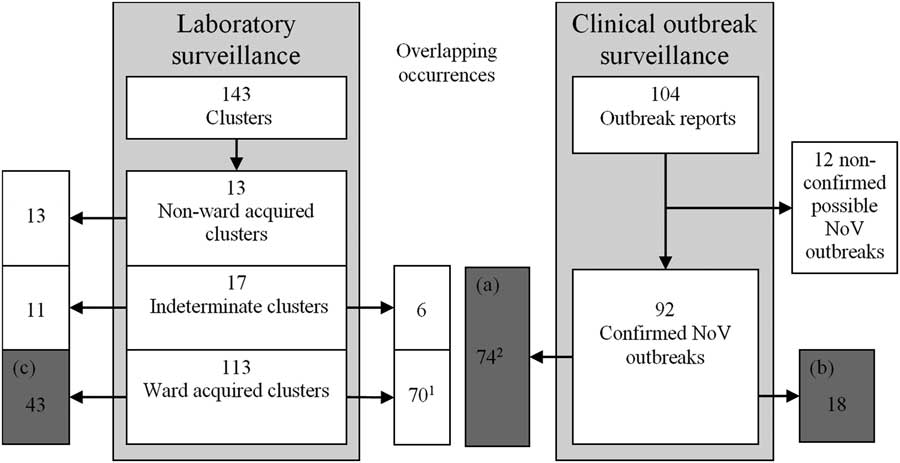
Data were stored and analyzed in Epi Info, version 3.5.3 (Centers for Disease Control and Prevention), and Excel, version 2010 (Microsoft). In the study all wards were categorized as either psychiatric, pediatric, surgical, or medical. Incidence was calculated using total number of events. Confidence intervals were calculated using the Poisson distribution. Sensitivity (separate NoV outbreaks detected/total NoV outbreaks) and positive predictive values (separate NoV outbreaks detected/total reported outbreaks or clusters) were calculated for laboratory surveillance using the cluster definition and for clinical surveillance using the possible outbreak definition with NoV outbreak as reference. To estimate the number of outbreaks missed by both surveillance methods the capture-recapture method was used.Reference Stephen 17 , Reference Hook and Regal 18 The capture-recapture method can be used for estimates of nondetected occurrences by evaluating the level of overlap among 2 incomplete and independent surveillance methods. The probability of detection in one or both methods can also estimate the probability of no detection. Nondetected outbreaks (x) were calculated by this equation: x=bc/(a+1), where a=outbreaks detected by both methods, b=outbreaks detected by ICT reporting only, and c=outbreaks detected by laboratory surveillance only (see Figure 1). The probability for a new NoV-positive inpatient, at a ward without any known ongoing outbreak, to be included in a NoV outbreak was calculated by dividing NoV outbreaks by the sum of NoV outbreaks and NoV-positive patients not included in any NoV outbreak.
Results of the 2 surveillance methods and the analysis of overlapping occurrences. Novovirus outbreaks marked with dark gray: (a) reported confirmed outbreaks with corresponding cluster, identified by both methods; (b) reported confirmed outbreaks without corresponding cluster, identified by clinical surveillance only; and (c) ward-acquired cluster without corresponding outbreak report (nonreported outbreaks), identified with laboratory surveillance only. 1One of the 70 ward-acquired clusters corresponded to 2 reported outbreaks. 2A total of 69 of the 74 reported outbreaks matched with ward-acquired clusters and 5 matched only with indeterminate clusters; 71 of the 74 reported outbreaks matched to a single cluster but 3 reported outbreaks matched with 2 clusters.

RESULTS
NoV-Positive Patients
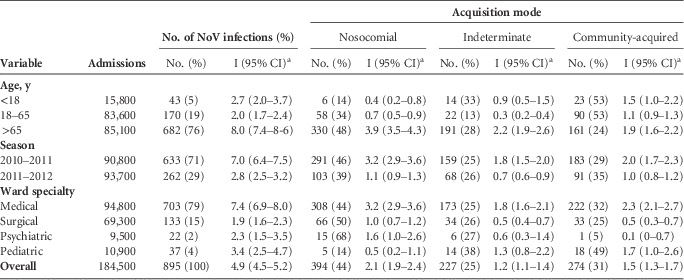
During the study 1,156 positive samples were submitted from inpatient wards representing 895 inpatients, of which 19 had positive tests at 2 or 3 wards, resulting in 915 inpatient NoV-positive tests that were used for cluster analysis. Another 14 NoV-positive individuals could not be verified as inpatients by hospital records. The sex distribution among all patients and Nov-positive patients was the same: 54% female and 46% male. The incidence of NoV infection among inpatients during the 2 seasons in relation to age, season, ward specialty, and mode of acquisition is summarized in Table 1.
Incidence of Confirmed Norovirus (NoV) Infection for Inpatients and Association Between Age, Ward Specialty, and Mode of Acquisition for 2 Winter Seasons

a Incidence per 1,000 admissions.
Reported NoV Outbreaks
During the 2 winter seasons, the ICT registered 104 outbreak reports, of which 92 were confirmed as NoV outbreaks (Figure 1). Of the remaining 12 possible outbreaks, 9 had at least 2 patients who tested negative for NoV and 2 outbreaks with no NoV tests performed. Eighty-nine of 92 outbreak reports included complete data of number of cases and comprised 817 patient and 523 healthcare worker cases. The median number of patient cases in these outbreaks was 6 (interquartile range, 4–11, max 57) and of healthcare worker cases was 4 (interquartile range, 1–9, max 32). The median duration was 8 days (interquartile range, 5–12 days, max 73 days) from day of onset of the first to the last cases. Ward closure was used as a control measure in 58% of the outbreaks.
NoV Clusters
Of the 915 NoV-positive inpatients, 693 were included in 143 NoV clusters. Of these clusters, 113 (79%) were classified as ward-acquired clusters, 13 (9%) as non–ward-acquired, and 17 (12%) as indeterminate clusters (Figure 1).
Evaluation of the Surveillance Systems
The reported outbreaks and laboratory-defined clusters were compared by wards and dates to find corresponding results (Figure 1). A total of 135 NoV outbreaks were identified. Of these, 74 were identified by both clinical and laboratory surveillance, 18 were identified only by clinical surveillance, and 43 were identified only by laboratory surveillance. The laboratory surveillance identified all 74 reported NoV outbreaks with more than 1 NoV-positive patient. The 18 reported outbreaks not identified by the laboratory surveillance had only 1 NoV-positive patient included per outbreak. As 3 reported outbreaks corresponded to double clusters and 1 cluster corresponded to 2 reported outbreaks, 116 of the 143 clusters correctly corresponded to a single NoV outbreak, 27 did not correspond to any or a separate outbreak, and 19 reported outbreaks were not separately identified by laboratory surveillance. The sensitivity and positive predictive value for NoV outbreak identification was 86% and 81% for laboratory surveillance and 68% and 88% for the clinical surveillance. Using the capture-recapture method, we estimated that an additional 10 outbreaks would have been missed by both surveillance methods, resulting in an estimated total number of 145 NoV outbreaks. With this estimation the adjusted sensitivity for the laboratory and the clinical surveillance was calculated to be 80% and 63%, respectively.
Both the 92 reported and the 43 nonreported outbreaks included a median of 3 NoV-positive patients per outbreak (interquartile range, 2–6 and 2–4.25, respectively).
The reported outbreaks comprised 435 NoV-positive patients, of whom 60% had nosocomial and 11% had community-acquired infections. The nonreported outbreaks comprised 198 NoV-positive patients, of whom 52% had nosocomial and 24% had community-acquired infections. Ten of the 43 nonreported outbreaks occurred at infectious disease wards and accounted for 95 NoV patients; of these patients, 32 (34%) had nosocomial and 42 (44%) had community-acquired infections. Nosocomial, but not ward-acquired, infections occurred in 1 (3%) of the 33 NoV-positive patients in non–ward-acquired clusters and 5 (7%) of the 67 NoV-positive patients in indeterminate clusters.
The probability of a new NoV-positive patient at an inpatient ward without a known ongoing outbreak to be included in a NoV outbreak was 32% during the study periods.
Incidence of NoV Outbreaks
During the 2 seasons the 135 NoV outbreaks were distributed among 79 (41%) of the 194 wards in Region Skåne. Forty-three of these wards were affected by only 1 outbreak but 22 wards by 2 and 12 wards by 3 or more outbreaks.
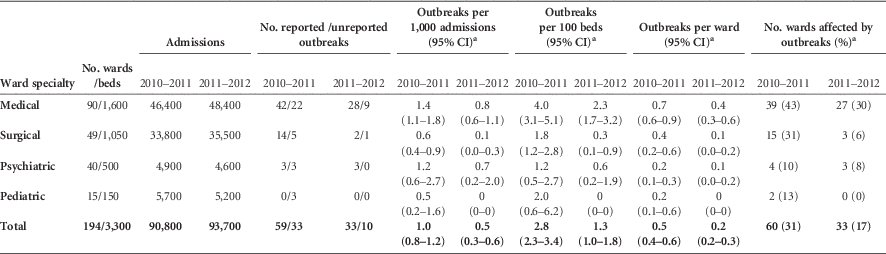
The outbreak incidence was 1.0 (95% CI, 0.8–1.2) and 0.5 (95% CI, 0.3–0.6) per 1,000 admissions for the 2 different seasons studied. The incidence of NoV outbreaks by ward specialty and season is shown in Table 2. Medical wards had significantly (P<.05) more outbreaks than surgical wards per 1,000 admissions and 100 beds. Outbreaks at pediatric wards were rare.
Incidence of Norovirus Outbreaks During the 2 Seasons by Main Type of Specialty of the Wards

a Reported and unreported norovirus outbreaks.
DISCUSSION
In this large prospective study, comprising all inpatients wards in the entire region, we show that the impact of hospital NoV outbreaks is high. Almost half of the medical wards experienced at least 1 outbreak during the high incidence 2010–2011 winter season and a third of the wards during the low incidence 2011–2012 winter season.
Both surveillance methods underestimated the true NoV outbreak incidence. The sensitivity of outbreak identification based on laboratory surveillance was higher than of the existing system based on active reporting.
The outbreak incidence was similar to previous reports, from which derived data show an incidence of 0.3–0.5 outbreaks per ward-yearReference Lopman, Reacher and Vipond 6 , Reference Danial, Cepeda, Cameron, Cloy, Wishart and Templeton 9 , Reference Billgren, Christenson, Hedlund and Vinje 19 and 2.9–7.9 per 100 beds and year.Reference Hauri, Westbrock and Claus 20 As illustrated in our results, seasonal difference and wards included can explain some of the variations between studies. We used the outbreak definitions recommended by the British Health Protection Agency, 15 and used an equivalent cluster definition. Previous studies have used similar, but not identical, cluster definitions for outbreak identification.Reference Beersma, Schutten and Vennema 21 – Reference Beersma, Sukhrie and Bogerman 23 In our setting the definitions used seem adequate considering that all reported outbreaks with more than 1 NoV-positive patient were identified as clusters. We used 5 or more days from admission to hospital and ward to sampling to define nosocomial infection and ward-acquired clusters, respectively, as this conservative definition has been used in previous studies.Reference Beersma, Schutten and Vennema 21 – Reference Franck, Nielsen, Holzknecht, Ersboll, Fischer and Bottiger 24 We preferred sampling date instead of symptom onset because data are readily available and may be used in future automated processing. The nonreported ward-acquired clusters were similar to reported clinical outbreaks in size, but contained more patients with community-acquired infections. This was mainly due to the nonreported outbreaks at infectious disease wards, indicating that these wards, responsible for the care of community-acquired NoV patients, continued admitting patients during ongoing ward transmission and refrained from contacting the ICT. We still consider our data to be conservative estimates of the true incidence because (1) it is likely that some of the indeterminate clusters without any corresponding report or the possible nonconfirmed outbreaks also were NoV outbreaks, (2) 33 of the 402 nosocomially infected patients were not included in any reported outbreak or ward-acquired cluster, and (3) only 8% of the reported outbreaks contained 2 or 3 cases but 15% had 4 or 5 cases and 77% had more than 5 cases (data not shown), indicating that smaller outbreaks are less frequently reported, as is also previously described.Reference Hauri, Westbrock and Claus 20 Furthermore, the capture-recapture method, previously used in estimates of NoV outbreak burden in England,Reference Harris, Adams, Lopman, Allen and Adak 25 gave an additional 10 outbreaks missed by both surveillance methods in our analysis. Noncompliance of the ward staff to inform the ICT of suspected outbreaks and difficulties for the ICT to identify possible outbreaks by information from single NoV positive laboratory results without analytic tools might explain why ward-acquired clusters were not always recognized and reported as outbreaks. Active monitoring by regular systematic ward visits, though more resource intensive, or easy electronic reporting might improve the clinical reporting system.
In our study 44% of all the inpatients with laboratory-confirmed NoV had nosocomial infections. This is less than reported from a Danish population studyReference Franck, Nielsen, Holzknecht, Ersboll, Fischer and Bottiger 24 and from a Dutch hospital,Reference Beersma, Schutten and Vennema 21 both with the same definition as the current study, where 63% and 52% of the NoV-positive inpatients had nosocomial infections. In a German population study, with definitions based on symptom onset, 49% had nosocomial infections.Reference Spackova, Altmann, Eckmanns, Koch and Krause 26 Apart from seasonal variation, setting and sampling indication might explain the observed differences.
This is one of the largest studies of hospital NoV outbreaks and the first time 2 different surveillance methods have been directly compared. The study is based on all in-hospital wards in the entire region, served by 1 microbiological laboratory, minimizing selection bias. The study was conducted during 2 consecutive seasons, representative of typical high and low incidence seasons.Reference Mounts, Ando, Koopmans, Bresee, Noel and Glass 12 Skåne comprises more than a million inhabitants, so we believe results are generalizable to many settings.
A limitation of the study is the uncertainty of sampling delay between symptom onset and NoV sampling because it could result in misclassification of the mode of acquisition of the infections. However, the subset validation did not indicate that misclassification should be of great significance. Only patients with a NoV test from an inpatient ward were included in the study, which might result in a false low incidence of community-acquired infections and also affect the identification of clusters if patients tested at outpatient units were later hospitalized. No comparison of timeliness of the methods was performed because time of first outbreak alert was not recorded. Time lag from sampling to availability of results was a mean of 1.7 days, and the time difference from when the outbreak and cluster definition was fulfilled, and an outbreak notification theoretically could have been sent, was a median of 3 days (data not shown). Laboratory surveillance using the cluster definition is thus not perfect for rapid response. The likelihood of just 1 NoV-positive patient at a ward without any known outbreaks to become a part of an outbreak, as calculated in the present study, might be high enough for action. This “outbreak risk” might also be used for comparison over different seasons and regions, but needs further validation before being used as a quality outcome measure.
In conclusion, this study shows that the addition of laboratory surveillance to outbreak reporting significantly improves outbreak surveillance and provides a more complete estimate of the burden of NoV outbreaks in hospitals, especially when combined with admission dates. We recommend laboratory surveillance as a method for the ICT to be informed about outbreaks not reported otherwise and to evaluate clinical surveillance systems. Better methods of surveillance will improve understanding of outbreak epidemiology in healthcare settings.
ACKNOWLEDGMENTS
We kindly thank all members of the ICT in Skåne for meticulous data collection and surveillance activity.
Financial support. Regional research grants (Södra regionvårdsnämnden: REGSKANE 453151).
Potential conflicts of interest. All authors report no conflicts of interest relevant to this article.