Charismatic leadership is one of the most-researched and established leadership theories (Dinh, Lord, Gardner, Meuser, Liden, & Hu, Reference Dinh, Lord, Gardner, Meuser, Liden and Hu2014; Ng, Reference Ng2017; Yammarino, Dionne, Uk Chun, & Dansereau, Reference Yammarino, Dionne, Uk Chun and Dansereau2005). In general, scholars have described charismatic leadership as a phenomenon resulting from three prerequisites: a leader with charismatic qualities, followers susceptible to charisma, and an environment conducive to charisma (Klein & House, Reference Klein and House1995). Previous research has mostly investigated these elements of charismatic leadership in isolation from each other. In particular, focusing on environmental antecedents, a large body of research has established that charismatic leadership is more likely to emerge under situations where there is a high anxiety level and especially under conditions of crisis (Bligh, Kohles, & Meindl, Reference Bligh, Kohles and Meindl2004a; Davis & Gardner, Reference Davis and Gardner2012; Halverson, Holladay, Kazama, & Quiñones, Reference Halverson, Holladay, Kazama and Quiñones2004; Hunt et al., 2004; Jamal & Abu Bakar, Reference Jamal and Abu Bakar2017; Pillai, Reference Pillai1996; Popper & Zakkai, Reference Popper and Zakkai1994; Scheurelein, Chaldkova, & Bauer, Reference Scheurelein, Chaldkova and Bauer2018; Seyranian & Bligh, Reference Seyranian and Bligh2008; Waldman, Ramirez, House, & Puranam, Reference Waldman, Ramirez, House and Puranam2001; Williams, Pillai, Lowe, Jung, & Herst, Reference Williams, Pillai, Lowe, Jung and Herst2009). Crisis is typically defined as a condition where ‘a system is expected to handle a situation for which existing resources, procedures, policies, structures, or mechanisms are inadequate’ (Boal & Bryson, 1988: 16; however, see King, Reference King2002 for other definions). A parallel stream of research has focused on the role of follower characteristics in determining followers' susceptibility to and evaluation of charismatic leaders (De Vries, Roe, & Taillieu, Reference De Vries, Roe and Taillieu1999; Ehrhart & Klein, Reference Ehrhart and Klein2001; Felfe & Schyns, Reference Felfe and Schyns2006). Past research has shown that, over all, there are positive effects of charismatic leadership on followers across a wide range of outcomes (de Hoogh et al., Reference de Hoogh, den Hartog, Koopman, Thierry, van den Berg, van der Weide and Wilderom2004; Judge & Piccolo, Reference Judge and Piccolo2004; Ng, Reference Ng2017; Wang, Oh, Courtright, & Colbert, Reference Wang, Oh, Courtright and Colbert2011; Zwingmann, Wegge, Wolf, Rudolf, Schmidt, & Richter, Reference Zwingmann, Wegge, Wolf, Rudolf, Schmidt and Richter2014).
However, to date no attempts have been made to study the combined effects of environmental factors and follower characteristics as prerequisite for charismatic leadership. This is problematic because interactions between these components are theoretically expected. In particular, while past studies show that follower susceptibility to charismatic leadership is driven by situational as well as by personal factors, they do not inform us about how followers are affected if circumstances that tend to give rise to charismatic leadership co-occur with opposite leadership preferences, for instance, the need for autonomy and for work without a leader (De Vries et al., Reference De Vries, Roe and Taillieu1999; Kerr & Jermier, Reference Kerr and Jermier1978; Podsakoff, MacKenzie, & Bommer, Reference Podsakoff, MacKenzie and Bommer1996). The present study is concerned with addressing this research gap by investigating three key variables: team crisis, follower self-direction (a personal value reflecting individuals' need for control, their sense of autonomy, and reliance upon their own judgment when coping with challenges), and charismatic leadership. We propose that, under times of crisis, charismatic leadership may have negative consequences for followers who are high in self-direction because such followers will prefer to act autonomously and self-reliant when it comes to dealing with a crisis.
Thus, our study contributes to the charismatic leadership literature in the following ways. First, we investigate the interaction of environmental factors and follower characteristics as the determinant of the effects of charismatic leadership. Doing that, we provide a more nuanced understanding of the conditions under which charismatic leadership is useful in times of crisis. Second, we extend the existing literature by investigating a follower characteristic that so far has been rather neglected: the degree of self-direction of followers.
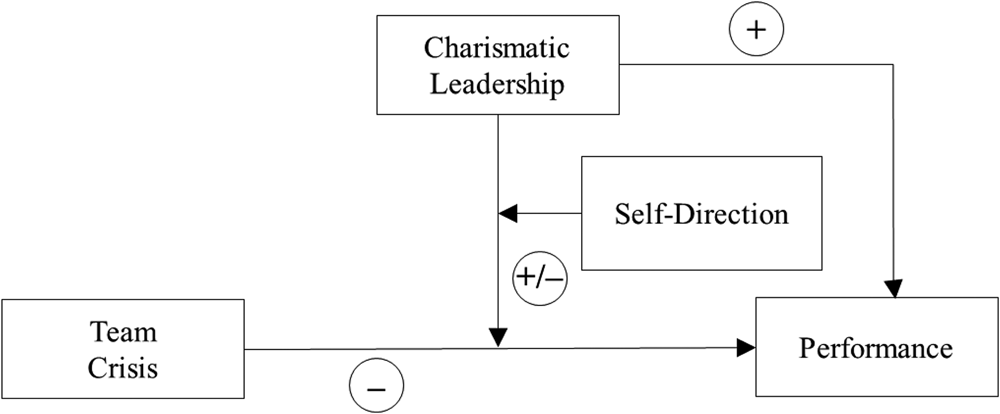
In the following, we first discuss the negative impact of team crisis on follower performance. Following that, we argue that this negative effect may dissipate in the presence of charismatic leadership. Finally, we explore the interaction between leader and follower characteristics and suggest that charismatic leadership will decrease individual performance in a team crisis, but only for followers high in self-direction. Our overall research model is depicted in Figure 1.
Hypothesized research model

Theoretical Background and Hypotheses Development
The impact of team crisis on follower performance
With increasing frequency, employees in today's workforce have to grapple with unforeseen events that threaten team functioning and often reach a level of criticality that necessitates leadership intervention (Mumford, Zaccaro, Harding, Jacobs, & Fleishman, Reference Mumford, Zaccaro, Harding, Jacobs and Fleishman2000; Zaccaro, Rittman, & Marks, Reference Zaccaro, Rittman and Marks2001). Such events extend beyond ordinary disruptions of the workflow. They require team members to devote attentional and information processing resources to cope with the situation (Morgeson & DeRue, Reference Morgeson and DeRue2006) and force-afflicted teams to undergo adaptation processes (LePine, Reference LePine2003). In early crisis research, Hamblin (1958) defined a team crisis as ‘an urgent situation in which all group members face a common threat’ (Hamblin, 1958: 322). In more general terms, any type of ‘work situation causing stress and anxiety’ can be defined as a team crisis (Pillai & Meindl, 1998: 653). Studies in the field of event-based research have created a number of related terms, ranging from ‘emergencies’ (Latané & Darley, 1969), to ‘negative events’ (Lavallee & Campbell, 1995), to ‘shocks’ (Lee & Mitchell, 1994). The notion of team event criticality reflects ‘the degree to which an event is important, essential, or a priority to [a] team’ (Morgeson & DeRue, Reference Morgeson and DeRue2006: 273). Accordingly, critical team events ‘become the central focus of teams and team leaders until the event is resolved. Thus, because critical events are threatening to team functioning, leaders are likely to spend considerable amounts of time intervening in the team when critical events occur’ (Morgeson & DeRue, Reference Morgeson and DeRue2006: 273). Critical team events can involve issues related to, among others, performance (e.g., operating procedures), personnel (e.g., new team members), task resources (e.g., lack of resources), safety (e.g., injuries), or disagreements (e.g., intragroup conflict) (Morgeson & DeRue, Reference Morgeson and DeRue2006). For the purpose of the current research, we focus on a specific type of team crisis that relates to value-based disagreements resulting from strong disagreements within or between individual team members (Morgeson & DeRue, Reference Morgeson and DeRue2006). This type constitutes a strong, relationship-oriented type of crisis for which the potential negative impact on both performance and well-being should be particularly pronounced. Therefore, we predict:
Hypothesis 1
The occurrence of a team crisis decreases individual follower performance.
The role of charismatic leadership in team crisis
Albeit the direct, negative effect of team crisis on follower performance, this relationship should be considered in the context of team leadership. Leadership is a critical factor since crisis in teams creates a need for assistance from a leader (Jamal & Abu Bakar, Reference Jamal and Abu Bakar2017; Morgeson & DeRue, Reference Morgeson and DeRue2006). In familiar environments where routines are in place, followers may be self-managing and have few leadership needs. In times of crises, however, followers are exposed to circumstances that they may not be able to effectively handle themselves (Marks, Zaccaro, & Mathieu, Reference Marks, Zaccaro and Mathieu2000). This calls for leader interventions that help followers reduce their experienced uncertainty, adapt to the new situation, and maintain performance standards (Cicero, Pierro, & van Knippenberg, Reference Cicero, Pierro and van Knippenberg2010).
Past research examining the intersection of crisis and leadership has provided two major explanations for why charismatic leadership is the one type of leadership that lends itself to be particularly relevant in such a context of crisis. The first line of explanation relates to the unique abilities of charismatic leaders that become evident in crisis situations. Crises loosen organizational constraints and increase decision leeway for charismatic behavior and thus offer leaders more opportunities to voice their proposals for radical change (Conger, Reference Conger1999). Furthermore, crises create conditions that attest to the effectiveness of charismatic leadership, i.e., they favor the emergence of charismatic leaders because in highly ambiguous situations, such leaders are especially adept in identifying opportunities that benefit organizations and followers (Jamal & Abu Bakar, Reference Jamal and Abu Bakar2017; Yukl, Reference Yukl1999).
The second line of explanation focuses on the followers and their increased susceptibility to charismatic leaders in times of crisis, reflecting their charisma hunger (Bass, Reference Bass1990). This assumption rests on a psycho-analytical foundation which proposes that followers attach themselves to their leaders because they offer security in times of uncertainty (Kets de Vries, Reference Kets de Vries1988). The need for such leadership salvation can be understood as a coping mechanism that followers employ when exposed to high levels of stress (Madsen & Snow, Reference Madsen and Snow1991). In other words, the uncertainty that followers experience during a crisis leads to an increased follower readiness for charismatic leadership (Kets de Vries, Reference Kets de Vries1988; Madsen & Snow, Reference Madsen and Snow1991). More precisely, crises create environmental contingencies under which the need for charismatic leadership becomes salient: followers who have felt safe before may now feel fearful and wish for support from a charismatic leader (De Vries et al., Reference De Vries, Roe and Taillieu1999; Howell & Shamir, Reference Howell and Shamir2005). Indeed, charismatic leadership has often been examined in the context of large-scale crises, such as natural disasters, terrorist attacks, or economic downturns (e.g., Bligh & Hess, Reference Bligh and Hess2007; Bligh, Kohles, & Meindl, Reference Bligh, Kohles and Meindl2004a, Reference Bligh, Kohles and Meindl2004b; Davis & Gardner, Reference Davis and Gardner2012; Jamal & Abu Bakar, Reference Jamal and Abu Bakar2017; Pennebaker & Lay, Reference Pennebaker and Lay2002; Williams, Pillai, Deptula, & Lowe, Reference Williams, Pillai, Deptula and Lowe2012). A large body of literature shows that charismatic leadership is effective in times of crisis (e.g., Halverson et al., Reference Halverson, Holladay, Kazama and Quiñones2004; Pillai, Reference Pillai1996). In a crisis, followers may tolerate or even demand leadership actions that are different from the status quo and can therefore resolve the crisis (Yukl, Reference Yukl1999). Research from the political field has also shown that followers tend to collectively rally behind their leader in times of crisis (Bligh, Kohles, & Meindl, Reference Bligh, Kohles and Meindl2004a; Oneal & Bryan, Reference Oneal and Bryan1995).
While different conceptualizations of charismatic leadership exist today (Burns, Reference Burns1978; Conger & Kanungo, Reference Conger and Kanungo1987; House, Reference House, Hunt and Larsen1977), we build on the self-concept-based motivational theory of charismatic leadership to develop our research model and apply it to a team-setting. According to this approach, charismatic leaders cause a profound change in their followers by elevating their self-concepts (Shamir, House, & Arthur, Reference Shamir, House and Arthur1993). They achieve this by communicating an attractive vision, and more specifically, by making use of certain rhetorical elements, e.g., more references to the collective identity, follower's worth, important values, and distal goals (Shamir, Arthur, & House, Reference Shamir, Arthur and House1994). We also chose this theoretical framework because the rhetorical elements outlined lend themselves well for the experimental manipulation of a crisis intervention speech (cf. below) and because rhetorical aspects of charismatic leadership have been found to play a significant role across different crisis contexts (Bligh, Kohles, & Meindl, Reference Bligh, Kohles and Meindl2004a; Bligh, Merolla, Schroedel, & Gonzalez, Reference Bligh, Merolla, Schroedel and Gonzalez2010; Davis & Gardner, Reference Davis and Gardner2012; de Bussy & Paterson, Reference de Bussy and Paterson2012; Heracleous & Klaering, Reference Heracleous and Klaering2014; Pennebaker & Lay, Reference Pennebaker and Lay2002; Robinson & Topping, Reference Robinson and Topping2013). Taken together, we further predict:
Hypothesis 2
Charismatic leadership increases individual follower performance in a team crisis.
The interaction between charismatic leadership and follower self-direction
So far we have argued that under times of crisis, follower performance may decrease, but that charismatic leadership can reverse this effect. However, this narrative lacks an important component – followers' preferences in the face of situational uncertainty. Past studies have shown that under ambiguous conditions, followers strive to reduce their experienced uncertainty (Cicero et al., Reference Cicero, Pierro and van Knippenberg2010). Moreover, research on charismatic leadership from a follower-centered perspective has shown that the need for security is predictive of a preference for charismatic leadership (Ehrhart & Klein, Reference Ehrhart and Klein2001). While these findings are important because they show that follower susceptibility to charismatic leadership may not just be driven by situational but also by personal factors, they do not inform us about how followers are affected if charisma-favorable circumstances co-occur with opposite leadership preferences, for instance, the need for work without a leader (De Vries et al., Reference De Vries, Roe and Taillieu1999; Kerr & Jermier, Reference Kerr and Jermier1978; Podsakoff, MacKenzie, & Bommer, Reference Podsakoff, MacKenzie and Bommer1996). We address this research gap by investigating followers who are high in self-direction.
Self-direction is a component in Schwartz's work values framework (Schwartz, Reference Schwartz1992). While work values in general regulate how individuals deal with the social and physical world, self-direction in particular reflects individuals' need for control, their sense of autonomy, and reliance upon their own judgment when coping with challenges (Schwartz, Reference Schwartz1999, Reference Schwartz2012). We propose that followers who are high in self-direction prefer to adapt to critical team events on their own and, therefore, reject external support from a charismatic leader. In fact, for such followers, charismatic leadership may have negative consequences because needs become salient that cannot be fulfilled by a leader. Followers high in self-direction will prefer to act autonomously and self-reliant when it comes to dealing with a crisis. Such followers may show little responsiveness to charismatic leaders that, by intervening, fail to link follower values to superordinate goals (cf. Howell & Shamir, Reference Howell and Shamir2005). On the other hand, followers low in self-direction are susceptible to social cues from powerful others and seek a sense of direction through identification with a charismatic leader (Conger & Kanungo, Reference Conger and Kanungo1998; De Vries et al., Reference De Vries, Roe and Taillieu1999; Felfe & Schyns, Reference Felfe and Schyns2006). This hypothesis is also consistent with the research on the contextual need for leadership which asserts that individuals have different needs in different settings (Hoogervorst, De Cremer, & van Dijke, Reference Hoogervorst, De Cremer and van Dijke2013; Kets de Vries, Reference Kets de Vries1988; Mayer, Bardes, & Piccolo, Reference Mayer, Bardes and Piccolo2008). If the context does not give rise to leadership needs of followers, they are likely to discount leader contributions or even perceive leadership to be an impediment to their goal achievement (De Vries et al., Reference De Vries, Roe and Taillieu1999).
Following from the above, we argue that a team crisis makes the need for charismatic leadership salient for individuals who are low in self-direction, but not for individuals high in self-direction. Thus, we argue that in response to a critical situation, charismatic leadership can be misdirected because the act of offering charismatic leadership assistance to highly self-directed followers is in conflict with their preference to deal with the crisis on their own. Our study thus challenges the commonly held assumption that all followers perform well under the guidance of a charismatic leader.
Hypothesis 3
There will be a three-way interaction between leadership, team crisis, and follower self-direction on performance: Charismatic leadership will decrease individual performance in a team crisis, but only for followers high in self-direction.
Method
Participants
Eighty-eight undergraduate students at a large German university participated in the laboratory study in exchange for course credits or a remuneration of 5 EUR. The study was advertised as a brainstorming competition (cf. below). Participation was voluntary and the mean age of participants in the sample was 23.99 (SD = 3.72); 60 were female and 28 were male.
Procedure
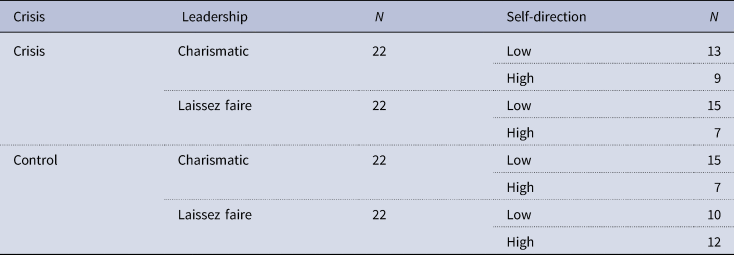
We used a 2 (team crisis: crisis, control) × 2 (leadership: charismatic leadership, control) × 2 (self-direction: low, high) factorial design. Participants were randomly assigned to the crisis and leadership conditions. The final two conditions of low versus high self-direction were established by a retrospective median split, therefore yielding unequal cell distributions (see Table 1). We advertised the study as a brainstorming competition in student magazines and on the webpage of the university, stating that a technological spin-off company of one of the university's research faculties was looking for creative student ideas on how to advertise novel consumer products. We included the information that members of the three teams with the best ideas would receive an award of 50 EUR, 25 EUR, and 15 EUR, respectively. With this information, we intended to motivate participants to take the brainstorming tasks seriously.
Distribution of participants to experimental conditions

Participants were randomly assigned to 44 teams of three members, two participants and one confederate that was needed to induce the team crisis (sc. below). Each team was invited to a seminar room at the university where the experimenter (male) told participants a cover story that the company that had advertised the brainstorming competition was preparing the commercial launch of two new (unbeknownst to participants, fictitious) consumer products. The experimenter gave participants background information on the products – a cleaning spray and a functional food product – and informed them that both products were based on the state-of-the-art nanotechnology that can modify matter on a molecular level in order to provide added benefits to the consumer.
After filling out a questionnaire assessing the work value of self-direction, participants executed the brainstorming task for the first product (Task 1). The experimenter gave participants a joint goal instruction with the directive to generate as many ideas as possible and with the highest quality possible in terms of ideas that would promote the product's successful marketing. Three categories for idea generation were given, i.e., (a) product names, (b) advertising slogans, and (c) spokespeople that could be used for the commercial launch of the products. Participants were told that they had a time limit of 6min in total to generate ideas in these categories. They were given individual response sheets to write down their ideas and were informed that their individual ideas would be summed to determine the team score. They were also informed that they could discuss their individual ideas with the other team members, if desired. Brainstorming for the first product (Task 1) was followed by the experimental manipulations (cf. below) and the brainstorming task for the second product (Task 2), which had the same instructions as Task 1. Upon completion, participants filled out a questionnaire with manipulation checks and demographic data. To maintain the cover story, we debriefed the participants about the experimental manipulations only after we had collected all data of the sample. Finally, even though the consumer products had been fictitious, members of the three teams with the highest brainstorming performance were disbursed the promised team award.
Manipulation of critical team event
A trained student confederate (female) with a background in psychology was assigned to each two-person team to enact the role of a fellow student as the ‘third’ member of each team. In order to ensure consistency across experimental conditions, the behavior and the speech contents by the confederate followed prescribed and rehearsed scripts. The confederate's input of ideas was also held constant in all conditions. For the manipulation of the critical team event, the student confederate joined the two participants at the outset of each experimental session as the third team member. After the team completed the brainstorming activity for the first product, the cleaning spray (Task 1), the experimenter gave further information on the second product, a functional food product. Specifically, the experimenter emphasized that the ideas generated by the participants would be used toward the advertisement of the product for its soon-to-come commercial launch with the aim of boosting sales. However, the experimenter also mentioned that there were some health concerns known about this product, i.e., the nanotechnology used to enhance the food product with added consumer benefits was cited by food regulators to have some inherent risks (e.g., once the food product was ingested, there was a probability of nano-particles crossing the blood barrier and causing physical damage to internal organs). The experimenter further included the statement that the results of scientific studies on the safe use of nanotechnology in food products were equivocal and that the product was still undergoing testing and had as of yet not been approved by federal food authorities. This explanation can be considered realistic and verifiable based on the scientific reports on the potential health risks of using nano-particles in food products (e.g., BfR, Reference Zimmer, Hertel and Böl2009).
Based on an elaborate script, the student confederate then raised concerns about her participation in the brainstorming competition, citing the potential health hazards of the product in question and objecting to support a cause with potential damage to innocent consumers. The script ended with the student confederate openly and explicitly voicing her disagreement with the purpose of the competition and leaving the group altogether, thus achieving a critical team event in the form of a value-based disagreement as described earlier (cf. Morgeson & DeRue, Reference Morgeson and DeRue2006). In the control condition, the student confederate joined the two participants at the outset of each experimental session and fulfilled the role of the third team member throughout both brainstorming tasks without any interference.
Manipulation of leadership style
Immediately after the manipulation of team crisis, we manipulated leadership style. The experimenter communicated a rehearsed leadership speech that was either charismatic or (in the control condition) laissez-faire in nature. In the experimental condition, this occurred directly after the manipulation of the team crisis when the criticality of the situation was most salient, i.e., after the confederate left the team. In the control condition, this occurred before the brainstorming activity for the second product (Task 2). We developed the charismatic leadership speech based on the work of Shamir, Arthur, and House on charismatic rhetoric (Shamir, Arthur, & House, Reference Shamir, Arthur and House1994). The leadership speech in the control condition was composed of passive instructions based on laissez-faire leadership (Bass, 1985) (see Appendix). As before, in order to ensure consistency across experimental conditions, behavior and speech contents by the confederate in the remainder of the experimental session followed prescribed and rehearsed scripts.
Measures
We used three manipulation checks to test the successful manipulation of conditions. One item was used to assess if the situation represented a team crisis, based on past definitions than conceptualize team crises as events that disrupt teams and pose a common threat for its members (Morgeson & DeRue, Reference Morgeson and DeRue2006). The item was, ‘The team's success was threatened by disruptions.’ Participants could respond on a 6-point Likert scale from 1 (=strongly disagree) to 6 (=strongly agree). One item was used to assess whether participants perceived a value-based disagreement by the confederate (who left the team during the manipulation), operationalized as the reverse-coded variable of task endorsement. The item was, ‘In my opinion, my team mates endorsed the purpose of the task.’ Participants could respond on a 6-point Likert scale from 1 (=strongly disagree) to 6 (=strongly agree). One item taken from Bass and Avolio's (Reference Bass and Avolio1995) Multifactor Leadership Questionnaire (MLQ) was used to measure charismatic leadership. The items referred to the experimenter as the leader, i.e., ‘This leader talks optimistically about the future.’ Participants could respond on a 5-point Likert scale from 1 (=strongly disagree) to 5 (=strongly agree). To calculate an individual performance measure, we counted the number of ideas written on the response sheet of each real participant, subtracted by the number of ideas that were also written on the response sheet of the other real participant (such ideas had been discussed between the team members and cannot be counted toward the number of ideas generated by one individual team member). The number of ideas that the confederate had contributed was held constant across all conditions and was not going into the performance values of the two real participants within each team. Self-direction was assessed with two items taken from the Portrait Values Questionnaire (PVQ; Schwartz, Melech, Lehmann, Burgess, Harris, & Owens, Reference Schwartz, Melech, Lehmann, Burgess, Harris and Owens2001) adapted to the work setting (work values). Participants were asked to read two statements about an employee exhibiting different work values and indicate to what extent they perceived the employee to be similar to them. An example item is ‘It is important to him to make his own decisions about what he does. He likes to be free to plan and to choose his activities for himself.’ Participants could respond on a 6-point Likert scale from 1 (=not similar to me at all) to 6 (=very similar to me). Cronbach's α of the two-item scale was .65. In order to compare participants that are low versus high on self-direction, we split the sample at the median of 2.00.
Results
Descriptives and manipulation checks
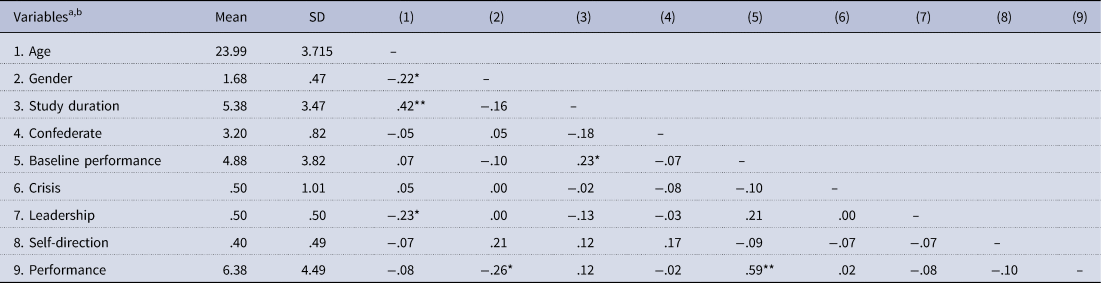
Table 2 shows the means, standard deviations, and inter-correlations of all variables. We administered a postexperimental questionnaire to verify the successful manipulation of experimental conditions. The t-test analysis revealed significant differences of crisis threat perceptions between the control condition, M = 2.30, SD = 1.42, and the value-based critical team event, M = 4.47, SD = 1.61, t (85) = 6.66, p < .001. For value-based disagreements, t-test analysis indicated significant differences between the control condition, M = 3.16, SD = 1.28, and the value-based critical team event, M = 4.30, SD = 1.15, t (86) = 4.39, p < .001. For perceptions of charismatic leadership of the experimenter, t-test analysis revealed significant differences as well, i.e., participants in the charismatic leadership conditions perceived the experimenter as more charismatic, M = 3.84, SD = .89, than in the control conditions, M = 3.47, SD = .74, t (85) = 2.15, p < .05.
Means, standard deviations, and correlations among study variables

a n = 82 due to missing data.
b Coding was as follows: age: number of years; gender: 1 = ‘male’, 2 = ‘female’; study duration: number of semesters; confederate: 1 = ‘confederate 1’, 2 = ‘confederate 2’, 3 = ‘confederate 3’, 4 = ‘confederate 4’; baseline performance: number of ideas in task 1; crisis: 0 = ‘control’, 1 = ‘crisis’; leadership: ‘0 = control’, 1 = ‘charismatic’; self-direction: 0 = ‘low’, 1 = ‘high’; performance: number of individual ideas in task 2.
*p < .05; **p < .01.
Hypothesis tests
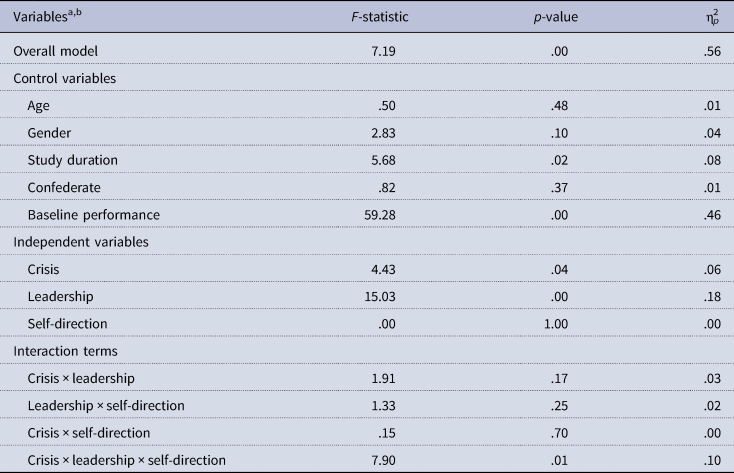
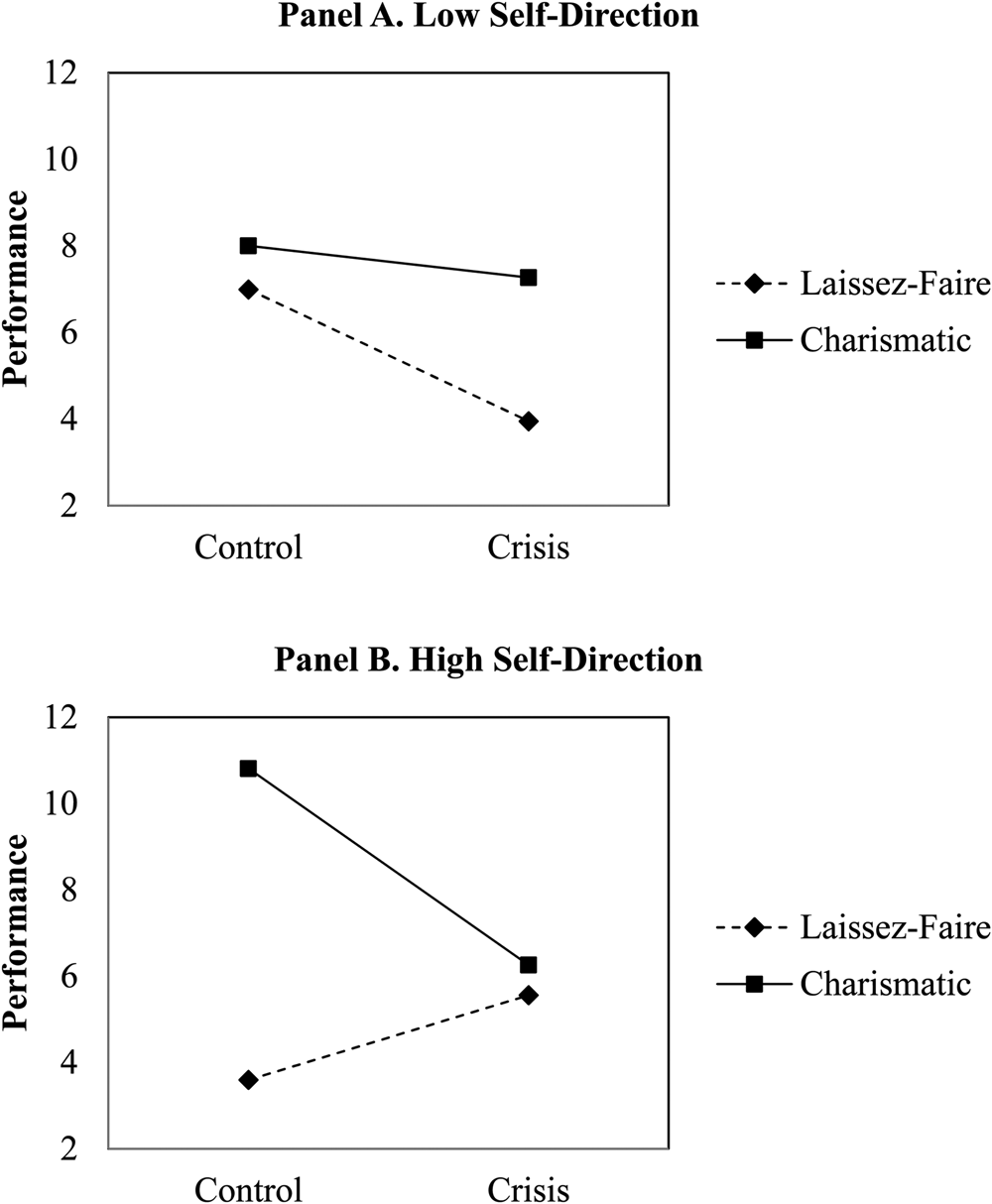
In order to investigate the impact of the experimental conditions and leadership on follower performance, an ANCOVA was conducted with brainstorming performance (Task 2) as the dependent variable and age, gender, study duration, confederate, and the baseline performance measure (Task 1) as covariates. ANCOVA results are summarized in Table 3. Results indicated a significant main effect of team crisis, F(1, 69) = 4.43, p < .05, ηp2 = .06. Subsequent analysis of simple effects revealed a significant negative effect of team crisis with a mean difference of −1.59 between team crisis and the control condition, F(1, 69) = 10.73, p < .05, η2 = .06. Thus, Hypothesis 1 was supported by the data. Furthermore, results indicated a significant main effect of leadership, F(1, 69) = 15.03, p < .001, ηp2 = .18, on follower performance. Subsequent analysis of simple effects revealed a significant positive effect of leadership style with a mean difference of 3.06 between charismatic leadership and the laissez-faire control condition, F(1, 69) = 15.03, p < .001, η2 = .18. Thus, Hypothesis 2 was also supported. As predicted, there was furthermore a significant three-way interaction between team crisis, leadership, and follower self-direction, F(1, 69) = 7.90, p < .01, ηp2 = .10. The three-way interaction plots are presented in Figure 2, demonstrating that charismatic leadership indeed reduces performance in a team crisis, but only for followers high in self-direction.
Results of ANCOVA when predicting performance

a n = 82 due to missing data.
Three-way interaction of crisis, leadership style, and self-direction

Hence, Hypothesis 3 was supported. In sum, these results show that (a) charismatic leadership increases performance, (b) the occurrence of a team crisis reduces performance, and (c) charismatic leadership decreases performance of followers high in self-direction in a team crisis, though overall transformational leadership had a positive impact on performance.
Discussion
This study examined whether charismatic leadership reduces performance of followers high in self-direction in the context of a value-based team crisis. We found, as expected that followers high in self-direction perform worse after being exposed to a charismatic leadership crisis intervention. Our findings contribute to the existing literature in a threefold way.
First, we widen the notion of crisis in order to advance crisis leadership literature by examining the charismatic leader–follower relationship in the context of critical events that teams experience on a recurring basis. Critical events create novel environments for which followers may not be prepared for (Marks et al., Reference Marks, Zaccaro and Mathieu2000). We investigated a specific type of team crisis that lends itself well for testing the proposed interaction. Second, we increase the current understanding of the role of follower characteristics by including self-direction (Schwartz, Reference Schwartz2012) in the analysis. High self-direction was found to be predictive of followers' predisposition of wanting to deal with critical events on their own, thereby reducing their susceptibility to charismatic leadership. By taking into account follower preferences regarding the resolution of a critical situation, we answer scholarly calls for a follower-centered perspective on charismatic leadership (Meindl, Reference Meindl1995; Uhl-Bien, Riggio, Lowe, & Carsten, Reference Uhl-Bien, Riggio, Lowe and Carsten2014). Third, our study extends research on negative effects of charismatic leadership (e.g., Eisenbeiß & Boerner, Reference Eisenbeiß and Boerner2013; Kark, Shamir, & Chen, Reference Kark, Shamir and Chen2003). We found that while charismatic leadership generally is likely to have positive effects on followers in certain critical events because it motivates them to extend effort in challenging circumstances, it can be counterproductive if followers are high in self-direction and therefore not in need of such leadership. In sum, our study offers novel insight into the charismatic leader–follower relationship. Its findings are in accordance with arguments put forth by leadership scholars who propose that charismatic leadership in crisis results not solely from the interaction of a crisis context and a charismatic leader, but also from the interaction with followers who are open to charisma (Klein & House, Reference Klein and House1995).
The results of this study have important managerial implications. First, the negative effect found for charismatic leadership points toward important limitations of this approach. Whereas charismatic leadership commonly has implied a ‘good fit’ for followers in routine situations, such a leadership intervention may be a ‘bad fit’ for certain types of followers in a team crisis. This begs the more general questions of whether leaders can intervene too much and what the right amount of leadership intervention is, depending on the characteristics of both the environment and followers. Second, our findings suggest that charismatic leaders need to learn to distinguish between followers with different preferences and consequently, use different motivational strategies to engage them in a team crisis. Our results suggest that there are circumstances when charismatic leaders should just step back and let followers manage challenging situations on their own. On the other hand, other types of followers might need to be facilitated when experiencing difficulties in critical situations. However, research indicates that with continuous intervention, a charismatic leader runs the risk of developing excessive follower dependence, which can lead to adverse organizational outcomes (Eisenbeiß & Boerner, Reference Eisenbeiß and Boerner2013; Kark, Shamir, & Chen, Reference Kark, Shamir and Chen2003). Adding to that, follower's dependency on their leader is likely to increase in times of crisis (Madsen & Snow, Reference Madsen and Snow1991; Shamir, Reference Shamir1991). On the other hand, the continued use of charismatic rhetoric may also lead to decreases in effectiveness over time, if salience of the crisis declines or if followers experience numbing due to unnecessary repetitions (Davis & Gardner, Reference Davis and Gardner2012). Weber (Reference Weber, Henderson and Parsons1947) similarly proposed that charisma requires repeated validation of the leader's exceptional qualities through continued successes. This shows that leaders need to take great care and strike a fine balance in deciding how to intervene for different followers who are faced with challenges.
Limitations
This study has several limitations. First, our chosen design implies a validity issue. Because we examined students in a laboratory setting, it cannot be concluded definitely that the patterns observed would also extend to employees in a real organizational setting. However, the available literature suggests that leadership intervention studies conducted in the laboratory (e.g., using goal setting or trained actors showing different leadership behaviors) have similar effects as leadership interventions conducted in field settings. In other words, there is strong evidence that these findings can be generalized to more realistic conditions (Avolio, Reichard, Hannah, Walumbwa, & Chan, Reference Avolio, Reichard, Hannah, Walumbwa and Chan2009; Locke, Reference Locke1986). Moreover, we invested extra effort in developing naturalistic task-conditions (e.g., information about the new company was given, a structured brainstorming task was used with task-interdependence, options for communication between team members, offer of team rewards for high performance). Thus, it seems reasonable to conclude that the findings of our study could also apply to real teams. In addition, we were able to show via several manipulation checks that core underlying phenomena of interest (perception of a team crisis, having a charismatic leader, see below) were indeed experienced by the participants of this experiment. It should be also noted that our experimental approach has the advantage of determining causality in assessing the effectiveness of different leadership behaviors in crisis situations (cf. Avolio et al., Reference Avolio, Reichard, Hannah, Walumbwa and Chan2009; Mook, Reference Mook1983). Nevertheless, compared to a naturalistic setting, the laboratory setting is decontextualized. Therefore, the relationships examined should be replicated in a study with nonstudent samples and in an organizational setting across different fields.
Second, another limitation is linked to the experimental manipulations used in this study. While past studies have used many different approaches to operationalize crisis in a small-group setting (Halverson et al., Reference Halverson, Holladay, Kazama and Quiñones2004; Halverson, Murphy, & Riggio, Reference Halverson, Murphy and Riggio2004; Hunt, Boal, & Dodge, Reference Hunt, Boal and Dodge1999; Pillai, Reference Pillai1996), we exerted much effort to create a specific type of critical team event that would represent a significant threat to participants. However, while the manipulation of the value-based critical team event was successful as indicated by significant differences of the manipulation check, stronger inductions of event criticality are conceivable that could be analyzed in order to gain additional insight into the effects of charismatic leadership contingent on crisis conditions. For instance, besides value-based disagreement as examined in this study (combined with the consequence that one member is leaving the team), other types of events that can be expected to trigger a critical situation are sudden task problems such as mistakes, breakdowns in equipment, or safety issues (Morgeson & DeRue, Reference Morgeson and DeRue2006). While the types of critical team events mentioned here are all likely to generate a need for leadership interventions, they probably represent distinct issues that imply different directions of influence of charismatic leadership due to the varying nature of emotional experience and demands posed by actual stressors that followers experience (Sayegh, Anthony, & Perrewé, Reference Sayegh, Anthony and Perrewé2004; Sommer, Howell, & Hadley, Reference Sommer, Howell and Hadley2016).
Third, it can be questioned whether charismatic leadership can be created in a laboratory setting in the first place. However, numerous studies have successfully manipulated charismatic leadership experimentally in a compressed space of time (e.g., Avolio et al., Reference Avolio, Reichard, Hannah, Walumbwa and Chan2009; Awamleh & Gardner, Reference Awamleh and Gardner1999; Holladay & Coombs, Reference Holladay and Coombs1994; Hunt, Boal, & Dodge, Reference Hunt, Boal and Dodge1999; Johnson & Dipboye, Reference Johnson and Dipboye2008; Kirkpatrick & Locke, Reference Kirkpatrick and Locke1996; Stam, van Knippenberg, & Wisse, Reference Stam, van Knippenberg and Wisse2010). Charismatic leadership may be studied under laboratory conditions if there is a strong induction of the charismatic leadership effect (Howell & Frost, Reference Howell and Frost1989). We tried to achieve this by basing our charismatic leadership manipulation on sound theory, i.e., the self-concept-based motivational theory of charismatic leadership (Shamir, Arthur, & House, Reference Shamir, Arthur and House1994, Reference Shamir, House and Arthur1993). This might pose a limitation insofar as prior experimental studies have suggested a greater importance of delivery of charismatic speeches relative to content (Awamleh & Gardner, Reference Awamleh and Gardner1999; Holladay & Coombs, Reference Holladay and Coombs1994). Charismatic content has been found to be particularly important for contexts with visible performance criteria and charisma-conducive environments (Baum, Locke, & Kirkpatrick, Reference Baum, Locke and Kirkpatrick1998; Johnson & Dipboye, Reference Johnson and Dipboye2008; Scheuerlei et al., 2017), as it was the case in our study. Nonetheless, future studies should uncover the effects of charismatic leadership on followers by also contrasting charismatic content with charismatic delivery.
Finally, there are some further limitations related to the specific design of our study. Self-direction was only assessed with two items. However, time constraints in survey-based research often necessitate the use of short measures and the use of two-item scales is not uncommon for self-assessments (Eisinga, Grotenhuis, & Pelzer, Reference Eisinga, Grotenhuis and Pelzer2013). Further, we used a median split for testing individual difference effects in the proposed relationships. While this approach is not uncommon in studies on values (Jetten, Postmes, & McAuliffe, Reference Jetten, Postmes and McAuliffe2002), this yields a rather low statistical power for detecting the influence of personality factors. On the other hand, these findings are therefore even more impressive as we did find a three-way interaction. Another issue is the validity of the dependent variables. While the use of brainstorming tasks provides the opportunity to objectively measure individual follower performance, the generalizability to organizational team tasks with differing degrees of complexity or interdependence is not known. Nevertheless, as brainstorming is an activity that is comparable to common tasks of many teams in organizations, we expect the fundamental processes observed in our study to apply to real settings as well. Still, future research should seek to replicate our findings with more sophisticated measures, larger samples, and different work tasks in order to draw stronger conclusions about their generalizability.
Future Research Directions
There are further general research directions we propose. The first is concerned with how charismatic leadership can be abused in critical team events, as proposed by the notion of the dark side of charisma (Judge, Piccolo, & Kosalka, Reference Judge, Piccolo and Kosalka2009). Charismatic leaders may not always be interested in benefitting their organizations and followers, but rather pursue their personal agenda (Connor, Mumford, Clifton, Gessner, & Connelly, Reference Connor, Mumford, Clifton, Gessner and Connelly1995; Sankowsky, Reference Sankowsky1995). As mentioned earlier, a crisis provides a fertile ground for the emergence of charismatic leadership. Uncertainties and fears may prompt followers to engage in unethical behavior if leaders direct them toward such conduct through their charismatic behavior (Barling, Christie, & Turner, Reference Barling, Christie and Turner2007; Effelsberg, Solga, & Gurt, Reference Effelsberg, Solga and Gurt2013). Thus, further research on boundary conditions of how crises offer the unethical charismatic leader the opportunity to influence followers seems worthwhile.
In addition, future research could benefit from a more fine-grained analysis of the examined relationships from both the leader and follower perspective. The leader perspective is concerned with the role of different leadership sources. While we looked at leadership interventions by an external leader in this study, there are other sources of leadership that could play a significant role for followers when dealing with critical team events, for instance, shared leadership (Pearce, Manz, & Sims, Reference Pearce, Manz and Sims2008; Wegge et al., Reference Wegge, Jeppesen, Weber, Pearce, Silva, Pundt and Piecha2010). Against this background, it would be worthwhile to examine whether this or other forms of leadership can serve as substitutes for leadership that reduce the need for charismatic leadership in critical situations (Kerr & Jermier, Reference Kerr and Jermier1978). The follower perspective is concerned with a more detailed look at team composition variables that influence how teams respond to critical team events. The need configuration of followers that determine their susceptibility to leadership interventions likely interacts with the need configuration of the team they are members of. Future research could particularly examine the personality composition of workgroups to shed more light on these issues (see Bradley, Klotz, Postlethwaite, & Brown, Reference Bradley, Klotz, Postlethwaite and Brown2013; Fisher, Bell, Dierdorff, & Belohlav, Reference Fisher, Bell, Dierdorff and Belohlav2012). Also, because crises represent situations with a strong impact on affective states of followers (Landau et al., Reference Landau, Solomon, Greenberg, Cohen, Pyszczynski, Arndt and Cook2004; Madera & Smith, Reference Madera and Smith2009), research would benefit from examining emotional contagion processes (Kelly & Barsade, Reference Kelly and Barsade2001). Charismatic leadership has often been linked to the emotional experience of followers (Bono & Ilies, Reference Bono and Ilies2006; Cherulnik, Donley, Wievel, & Miller, Reference Cherulnik, Donley, Wievel and Miller2001; Johnson, Reference Johnson2008), but little is still known about how charismatic leadership affects the dispersion of emotions in teams during times of crisis.
Moreover, it should be noted that our study is in line with recent criticism on charismatic-transformational leadership theory, particularly the limitation of its conceptualization and operationalization which confounds leadership with its effects (van Knippenberg & Sitkin, Reference van Knippenberg and Sitkin2013). We circumvented this problem in our study by experimentally manipulating charismatic leadership as an independent variable and assessing objective performance data in teams, thus mitigating biases that are a potential problem in studies that examine the relationship between charismatic leadership evaluations and performance assessments that are both subjective in nature. Notwithstanding this strength of our study, we did not test mediators of the main effects and the new three-way interaction that was found, even though the self-concept-based motivational theory of charismatic leadership by Shamir, House, and Arthur (Reference Shamir, House and Arthur1993) has specified a set of theoretically meaningful effects that likely explain the relationship, for instance, social identification, self and collective efficacy, and value internalization. Future research should examine these issues in more detail. A promising platform for studies focusing on potential mediators of – more or less successful – charismatic leadership was recently presented by Ng (Reference Ng2017). In this research, five different mediating pathways were identified (in addition to identification also affective, motivational, social exchange, and justice enhancement processes are relevant), explaining why transformational leadership improves performance. In a similar vein, we recommend that a micro-level analysis of what leaders actually do verbally (e.g., asking questions) and nonverbally (e.g., behavioral mimicry) can enrich our understanding of mediating the processes involved in leadership processes and effects (see e.g., Meyer et al., Reference Meyer, Burtscher, Jonas, Feese, Arnrich, Troster and Schermuly2016).
Future research could also benefit from extending the perspective we have taken in our study to the team level. Leadership during a crisis is often handled by already established and well-trained crisis teams, in particular in crisis-prone industries such as medical or pharmaceutical manufactures, commercial banks or telecommunication companies (Kielkowski, Reference Kielkowski2013; King, Reference King2002). Such teams, often designed cross-functional, are well prepared for effective communication and responses in a crisis situation (e.g., contamination, fire, layoffs). Thus, a promising avenue for further studies would be to assess follower characteristics (i.e., self-direction) in this type of teams, as well as preferences and effects of charismatic leadership behavior during crisis communication and crisis management activities.
In conclusion, we think that the results of our study highlight that charismatic leadership can have negative effects in specific types of team crises, if such leadership is enacted on highly self-directed followers. These findings are novel and can form the basis for developing new leadership interventions aimed at resolving the specific challenges associated with critical team situations. Understanding how charismatic leadership can fail to address the specific needs of followers in different types of team crisis is an important area for future study. Ideally, this research should also reflect the common practice of using crisis teams in organizations in order to handle crisis communication and crisis management by taking a multi-level perspective of leadership behavior in different types of crisis teams.
Appendix: Leadership Manipulations
For the charismatic leadership manipulation, we prepared a short script that included references to elements of charismatic rhetoric developed and used in prior research (Bligh et al., 2004; Shamir et al., 1993). In particular, these included references to adversity, collective focus, follower's worth, and high-performance expectations. Statements made by the experimenter explicitly addressed the critical situation and included: “This is an unfortunate situation, but you can still win the team award with joint effort. View this as a challenge, you can do this. You are intelligent students. It is important for this university that you perform well.” For the laissez-faire leadership intervention, the statements made by the experimenter did not address the critical situation and were comprised simply of “There is nothing I can do about this” and “Please just continue.”