1 Introduction
This study investigates variation in the realisation of /θ/ amongst adolescents in London and Edinburgh. Previous work on TH-frontingFootnote 2 has typically taken the approach of examining patterns of variation that are specific to one particular dialect or dialect group. This study responds to calls for comparative analyses of regional varieties of English and an inclusion of the concept of space into variationist studies (Britain Reference Britain, Ammon, Dittmar, Mattheier and Trudgill2004; Maguire et al. Reference Maguire, McMahon, Heggarty and Dediu2010; McMahon et al. Reference McMahon, Heggarty, McMahon and Maguire2007). Additionally, rather than focusing on token frequencies or measuring the distance between varieties based on a selection of features, we contribute to comparative analyses of English dialects by making variation itself the focus of statistical analysis and by comparing constraint hierarchies affecting variation (Tagliamonte Reference Tagliamonte, Chambers, Trudgill and Schilling-Estes2002).Footnote 3
A comparative study of TH-fronting in London and Edinburgh is particularly illuminating since it provides insights into a sound change in progress at two different points in its implementation. We examine the progressive lexical and grammatical diffusion of TH-fronting amongst adolescents in London, where TH-fronting is well established, and Edinburgh, where it is a relatively new phenomenon. This allows us to assess what happens when TH-fronting diffuses into and within a community and observe the process of adaptation in Edinburgh. In so doing, we hope to be able to shed light on two related questions:
1. What are the sociolinguistic constraints on TH-fronting in London as opposed to Edinburgh?
2. How does the age of the sound change influence the use of TH-fronting synchronically?
We begin by reviewing a selection of the existing literature on TH-fronting with three main goals in mind: firstly, to outline what is already known about the development of the phenomenon in the UK; secondly, to summarise the main theoretical claims that aim to explain why TH-fronting happens; and thirdly, to identify factors that constrain the realisational variation of /θ/.
As Wells (Reference Wells1982: 327–30) first observes, many speakers of English display variation in the phonetic realisation of the dental fricatives, /θ/ and /ð/. Alongside the standard pronunciations – i.e. [θ,ð] – these sounds may be targets for a variety of phonological processes: these include (i) plosivisation (e.g. [thɜːzdeɪ] Thursday, [fɜːdə] further);Footnote 4 (ii) glottalling or elision (e.g. [ʔɪs], [ɪs] this); and (iii) fronting (e.g. [fɪŋk] think, [fɛvə] feather). Although these variant realisations attest to the relative instability of /θ,ð/ in English, previous studies have in fact identified a number of factors which appear to constraint TH, DH-variability in theoretically interesting ways.
Wells notes, firstly, that TH,DH-stopping and fronting are features traditionally associated with Cockney English. Indeed, Sivertsen (Reference Sivertsen1960: 105, 123–4) documents the occurrence of stopping and fronting amongst Cockney speakers born before 1900. Whereas plosive realisations of /θ/ are attested only sporadically now, recent studies report that TH-fronting and DH-fronting dominate in the idiolects of many Cockney speakers today. More recent research also confirms that TH,DH-fronting now regularly occurs in many other areas of London and southern England, especially in youth speech. For example, recordings taken by Cheshire et al. (Reference Cheshire, Fox, Kerswill and Torgersen2008) of speakers from different age groups and different ethnic heritage groups in the economically deprived community of Hackney reveal that word-initial TH-fronting occurs with very high frequency (>85%) amongst younger speakers; however, older speakers (aged 70–80) display significantly lower amounts of word-initial fronting (<30%). The authors also note that DH-stopping is very common nowadays in Hackney for word-initial /ð/. Tollfree (Reference Tollfree, Foulkes and Docherty1999) reports the results of a study of South East London English: here, there are no significant differences between older and younger speakers in terms of the rate of application of TH,DH-fronting; and generally, this phenomenon occurs less frequently in South East London English than in Cockney. Interestingly, however, Tollfree also mentions that /θ/ may undergo debuccalisation (e.g. [haŋʔks] thanks) in addition to fronting; and [ʔ]-realisations of /θ/ are attested word-internally in pronunciations of the word something.
Limiting our review to TH-fronting now, it is often assumed that the change has spread from south-eastern England to other areas of the UK: yet numerous sociolinguistic studies report the use of fronting even in areas where there are only minimal levels of direct dialect contact with London. Britain (Reference Britain and Bertacca2005: §3 and references therein) summarises the findings of a variety of studies on dialectal variation in England, commenting that TH-fronting has been documented for Colchester, Reading, Milton Keynes, Norwich, the Fens, Derby, Birmingham, Hull, Sheffield, Middlesbrough and Newcastle. Many of these studies show consistencies in their findings: in particular, TH-fronting seems to be favoured by working-class adolescents (Kerswill Reference Kerswill, Britain and Cheshire2003; J. Milroy Reference Milroy1996; Stuart-Smith & Timmins Reference Stuart-Smith, Timmins, Caie, Hough and Wotherspoon2006; Stuart-Smith et al. Reference Stuart-Smith, Timmins and Tweedie2007) and especially by males (J. Milroy Reference Milroy1996; Robinson Reference Robinson2005). However, whilst the exact details about the origin of TH-fronting are contested, this issue will concern us only minimally here:Footnote 5 we instead focus on the sociolinguistic diffusion of the established change, which most scholars would agree started in London before it emerged in Edinburgh.
Sociolinguistic work on Scotland reveals that TH-fronting is now a notable, but relatively new, feature of many Scottish dialects. The first reported evidence comes from Macafee (Reference Macafee1983: 54). In a study on Glaswegian, Stuart-Smith & Timmins (Reference Stuart-Smith, Timmins, Caie, Hough and Wotherspoon2006) found that [f]-realisations of /θ/ occur with significantly greater frequency in a corpus of recordings taken in 2003 than in an older corpus from 1997. This indicates that the use of TH-fronting is on the increase, particularly for younger speakers. In more specific terms, Stuart-Smith & Timmins observe that TH-fronting arises most frequently in word-final position, whereas alternative pronunciations – including canonical [θ] and an [h]-realisation that is particular to Scottish English – dominate in non-word-final positions. The spread of TH-fronting has also been observed in Livingston, a New Town approximately 15 miles west of Edinburgh (Robinson Reference Robinson2005).
Furthermore, Clark & Trousdale (Reference Clark and Trousdale2009) examined the speech of pipe-band members from West Fife for evidence of TH-fronting: the principal finding of this research is that the use of [f]-realisations is significantly affected by both social and phonological factors. With regard to the phonological factors, the asymmetries in the use of TH-fronting echo the findings of Stuart-Smith & Timmins: fronting occurs more frequently in syllable-final contexts than in syllable-initial contexts (cf. the word-final ~ non-word-final distinction in Glasgow); and words containing the think and thing lexemes display a strong tendency for <th> to be realised as [h] rather than [f] or [θ]. Corpus word-frequency also plays a significant role: words which only vary between [f] and [θ] and which are attested more frequently in the recordings from this set of speakers show higher rates of fronting than low-frequency items.
Whereas the general focus of many of the existing sociolinguistic studies has been on accounting for varying patterns of synchronic usage of TH-fronting and of its geographical spread, Blevins (Reference Blevins2004: 134–5) considers the question of the historical origin of the fronting phenomenon in English. Here, she argues that TH-fronting bears all the hallmarks of a phonetically grounded sound change that has arisen diachronically from misperception effects. Small differences in formant transitions preceding and following realisations of [θ] and [f] are of crucial importance for accurately discriminating between the two fricatives. Thus, under hearing conditions when attending to these transitional cues is difficult, listeners are likely to fail to perceive the [θ]~[f] contrast accurately (this phenomenon is also documented in the language acquisition process of English by children; see Vihman Reference Vihman1996).
In keeping with the studies mentioned above, this article represents a contribution to the discussion of the diachronic emergence and the synchronic variability of the TH-fronting process. It has two main foci: firstly, that of interregional variation, and secondly, that of the influence of the age, development and established nature of a sound change on patterns of synchronic variation. Whilst studies on varieties of English have uncovered a relatively stable set of social and linguistic factors which constrain the use of TH-fronting cross-dialectally, the relative influences of these factors may differ from place to place. That is to say, a sound change may diffuse to a location and be incorporated into the local system, but this process may also result in a restructuring of its original conditioning factors. In view of this, it is not clear whether TH-fronting, in fact, constitutes the exact same change in London as in Edinburgh. Thus, our data provide insights into a sound change in progress, not only in two locations but also at two different stages in its diachronic evolution.
The mechanisms which cause innovative phonological features to spread from one speech community to another are not a point of focus in this article. Instead, we concentrate on the issue of how innovative phonological phenomena like TH-fronting undergo progressive lexical and grammatical diffusion once they have been introduced into a speech community. Our results reveal that the application of TH-fronting is constrained in Edinburgh in ways that are not relevant for London, and vice versa. Specifically, whereas TH-fronting is sensitive to phonotactic context and prosodic position in Edinburgh, we observe no such effects amongst the London speakers. Morphological complexity, on the other hand, is a significant predictor of TH-fronting in both regions; however, we also find evidence of significant gender differences in the use of TH-fronting in London that do not emerge in our Edinburgh data. This, we claim, is a predictable result in view of the fact that TH-fronting is a more established dialect feature in London than in Edinburgh: the availability of TH-fronting for gendering practice is less pronounced in Edinburgh as it is a relatively new change there. These findings have important implications for understanding processes of on-going sound change in Britain that have not been recognised previously in research on TH-fronting. The results of this study therefore further highlight the need for sociolinguistic research to take a comparative approach to analysing patterns of dialectal variation and change.
The article is organised as follows. Details about the data collection and data coding processes and the statistical analysis techniques employed in this study are given in section 2. Section 3 then presents the results of the analysis for London (section 3.1) and Edinburgh (section 3.2). Section 4 is devoted to discussing the implications of the results for sociolinguistic theories of phonological change. Section 5 concludes.
2 Methods
2.1 Data collection
Recordings were conducted in two high schools, one in Edinburgh and one in London, as part of a larger project that also included non-native students (data from these informants are, however, not considered here). The Edinburgh data were collected at a school in west Edinburgh and the London data were collected in Ealing (in the west of London). Both schools are comparable with regard to the socioeconomic status of their pupils.
The Edinburgh sample consists of 21 Edinburgh-born teenagers (8 males, 13 females) and the London sample consists of 24 London-born teenagers (12 males, 12 females). At the time of recording, the informants were all aged between 12 and 18, and were of roughly the same class background.Footnote 6
Our data come from two sources. Firstly, sociolinguistic interviews were conducted by a locally born female research assistant in both locations: students were recorded speaking in friendship pairs in order to facilitate the collection of conversational data under the most casual atmosphere possible (L. Milroy & Gordon Reference Milroy and Gordon2003: 66; Schleef & Meyerhoff Reference Schleef, Meyerhoff, Meyerhoff and Schleef2010: 3–5). All interviews were structured around certain topics; however, the conversation was not constrained by these topics and participants were encouraged to talk freely on other topics too. Speakers were also recorded performing a short reading task of 17 sentences that had been designed to elicit a wide range of different sociolinguistic variables of which (th) is one. All data were transcribed using ELAN, resulting in an integrated, time-aligned corpus. Combining reading and conversation data provides a measure for comparing differences in speech style, in the Labovian sense of attention paid to speech (Labov Reference Labov1972). Thus, whilst /θ/ does not occur very frequently in comparison to other fricatives in English, our recordings do provide a sufficient number of tokens for statistical analysis.
2.2 Data coding procedure
All tokens of /θ/ that occur in the corpus were coded according to their phonetic realisation by two research assistants. Following the first round of coding, a second round of coding checks was carried out. Cases of coding disagreement were discussed with another phonetically trained researcher and mutually agreed.
Fronted and non-fronted variants of /θ/ can be discriminated auditorily under laboratory listening conditions: this therefore meant that data could be impressionistically categorised without the need for acoustic analysis. Tokens that could not be reliably categorised were excluded from the analysis (e.g. in cases where speakers talk over one another). The main realisations of /θ/ that we observe in the corpus are [θ], [f] and [h]: however, as detailed in sections 3.1–3.2 below, other minority realisations also occur (e.g. elisions and [ʔ]-realisations) which were also coded for. However, as already alluded to, the focus in this study is given to the fronting pattern – i.e. the variable use of [f] and [θ] in both regional groups. The analysis presented in section 3 is therefore based exclusively on the results of statistical tests run on this subset of data.
2.3 Statistical testing
We take a comparative variationist approach (Poplack Reference Poplack2000; Poplack & Tagliamonte Reference Poplack and Tagliamonte1991; Tagliamonte Reference Tagliamonte, Chambers, Trudgill and Schilling-Estes2002) to analysing our data. For the purpose of testing the use of TH-fronting in the two communities statistically, data were subjected to multivariate logistic regression analyses using Rbrul (Johnson Reference Johnson2011, version 2.02) in which (th) (coded as a binomial factor: [θ]~[f]) was the dependent variable and [f] functioned as the application value. Rbrul is a variable rule program similar to Goldvarb (D. Sankoff et al. Reference Sankoff, Tagliamonte and Smith2005); yet whereas Goldvarb is limited to running fixed-effects models, Rbrul is capable of running mixed-effects models in which categorical and interval variables can be combined. Furthermore, Rbrul can also cope with random factors. This permits variables which code typically non-replicable variation (e.g. individual speaker variation) to be included in Rbrul models.
The comparative approach makes variation itself the focus of statistical comparisons by subjecting data from different groups of speakers (here adolescents from London vs Edinburgh) to the same multivariate analysis using the same set of predictors. Rbrul creates models for these groups that best explain the respective input variation. It outputs statistically significant factors, which allows us to compare the variability of /θ/ in the two locales. This approach has been used in a variety of previous studies which examine instances of phonological variation in situations of language contact (Meyerhoff Reference Meyerhoff2009; G. Sankoff Reference Sankoff, Byrne and Winford1993) and dialect contact (Buchstaller & D'Arcy Reference Buchstaller and D'Arcy2009). Furthermore, this method has also been applied in testing historical relatedness of different varieties, as well as comparing varieties that differ geographically, by age and similar social factors (Tagliamonte Reference Tagliamonte, Chambers, Trudgill and Schilling-Estes2002).
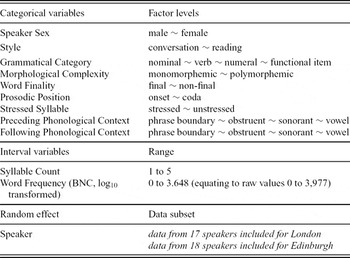
In order to address questions about the interregional variation in the use of TH-fronting, separate statistical models for London and Edinburgh were calculated. All available data from speakers who use TH-fronting to some extent in their idiolect were included in these models; data from non-users of the fronting pattern were excluded from the analysis in order not to inflate the significance of [θ]-usage in either location (see sections 3.1–3.2 for details). The independent variables used to model the variability of the TH-fronting process are listed in table 1.
Independent variables used for modelling TH-fronting in Rbrul

The use of the independent factors listed in table 1 allows for the influence of social, grammatical and contextual factors on the application of TH-fronting to be tested statistically. Firstly, Speaker was included as a random factor: thus, in calculating which factor grouping best predicts the variable use of [θ] and [f], the model takes into consideration any potential biases that may arise because of idiosyncratic variation.Footnote 7 In addition to this, inclusion of the Speaker Sex factor permits the differences between male and female speakers to be tested; and likewise, Style was included as a fixed factor in order to provide an indication of any differences that may emerge in the use of TH-fronting under the two speech conditions. We also consider a number of linguistic variables, the choice of which is guided by previous work on TH-fronting as well as the specific research questions outlined in section 1. For example, the inclusion of Grammatical Category in the model allows us to examine the effect of lexical vs functional items; and furthermore, subcategorisation of the lexical vocabulary permits the rates of application of TH-fronting in nominals, verbs and numerals to be examined. Given the finding that morphological compositionality may play a role in the application of /θ/-fronting,Footnote 8 Morphological Complexity is included as a factor in the model. The Word Finality factor also permits any asymmetries between grammatical word-final /θ/ and non-word-final /θ/ (Stuart-Smith & Timmins Reference Stuart-Smith, Timmins, Caie, Hough and Wotherspoon2006) to be tested.
In addition, a number of phonological variables were included which allow for further hypotheses to be tested. Under the assumption that neutralisation processes often preferentially target coda segments (see Yu Reference Yu, Van Oostendorp, Ewen and Hume2011; Clark & Trousdale Reference Clark and Trousdale2009: §4.3ff.; Kiparsky Reference Kiparsky and Good2008: §4ff.), Prosodic Position tests the prediction that syllable-final /θ/ may be more prone to fronting than syllable-initial /θ/. Likewise, the well-known resistance of segments to undergo reduction under the influence of primary stress could potentially affect the application of /θ/-fronting: we therefore include the Stressed Syllable factor for the purpose of addressing this question, and a further interval variable, Syllable Count, which tests the hypothesis that words containing more or fewer syllables may display different rates of application of TH-fronting. Finally, inclusion of Preceding Phonological Context and Following Phonological Context in the model also allows us to examine to what extent TH-fronting is affected by phonotactic contextual factors.
Based on the results of previous research (e.g. Bybee Reference Bybee2007) showing that the use of innovative phonological processes may be affected by word frequency, we also include a Word Frequency factor in our model. Frequency counts are based on the spoken frequency rankings in the British National Corpus (BNC) which lists frequencies per million words (Leech Reference Leech2001). Words that are not listed in the BNC were assigned a value of zero. The value of 1 was then added to all raw frequency indexes so that words of zero-frequency – i.e. those that do not occur in the BNC – could be included in the statistical models. These values were then log10 transformed to minimise the effect of the left-tail skew in the overall distribution (see Hay & Baayen Reference Hay, Baayen, Booij and van Marle2002; Clark & Trousdale Reference Clark and Trousdale2009).
3 Results
First and foremost, analysis of the data reveals clear asymmetries between the London and Edinburgh speakers; and furthermore, interesting differences between female and male speakers are also observed. In view of these findings, we first consider the patterns of variation affecting /θ/ in London in section 3.1; section 3.2 then presents the data from the Edinburgh speakers.Footnote 9
3.1 The variability of /θ/ in London
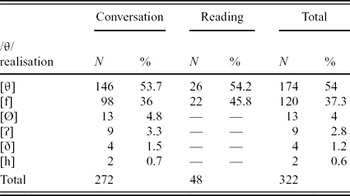
Table 2 summarises the range of realisations for /θ/ from the London speakers in the corpus. From these data, we may firstly observe that approximately half of all instances of /θ/ have a non-standard realisation for the London speakers. As expected, the conversational recordings yield a greater range of non-standard forms than the read speech: in particular, we observe instances of /θ/-elision, glottalling, voicing and debuccalisation in the conversations that do not occur in the reading passage. Nevertheless, these processes appear to be highly restricted: [ʔ]-realisations are confined to the word something (i.e. [sʌmʔɪŋ] or [sʌmʔɪn] – see Tollfree Reference Tollfree, Foulkes and Docherty1999), and the two [h]-realisations are single tokens of think and thing (produced by different speakers) that occur in a phrase-medial post-consonantal context. [ð]-realisations of /θ/ occur only in intervocalic position (e.g. I think [aɪðɪŋk]) or following a nasal (e.g. than thirty [ð ðɜːʔi]).Footnote 10 Moreover, elisions occur in consonant cluster contexts which may either be word-internal (e.g. maths [mas], months [mʌns]) or phrasal (e.g. hardest thing [hɑːdɪsɪŋ]). Although these realisations provide evidence for the relative instability of /θ/ in London English, low token count prevents any meaningful statistical tests from being carried out.
Realisation of /θ/ for the London speakers

One particularly striking finding is the fact that, in contrast to the other non-standard realisations, TH-fronting is not suppressed in reading style: in fact, it is more common in our read-speech data than our conversational data, in both London and Edinburgh. On the one hand, this might be viewed as an unexpected finding for a variable that, in Labov's (Reference Labov and Fishman1971) terminology, ought to be considered a stereotype rather than a marker or an indicator. On the other hand, this finding does concur with other studies on TH-fronting that investigate stylistic differences. Robinson (Reference Robinson2005: 189), for example, finds TH-fronting to be much more common in word-list than conversational style; and Stuart-Smith et al. (Reference Stuart-Smith, Timmins and Tweedie2007: 236) find no difference between conversational and word-list style. Whilst the stylistic differences in the current study are not statistically significant, it is nonetheless an interesting finding. We do not share Stuart-Smith et al.'s (Reference Stuart-Smith, Timmins and Tweedie2007) assessment that teenagers treated the reading task as an opportunity to display cases of ‘their’ speech, as we find the expected style differences in all other variables we have so far investigated, i.e. (ing) and (t) (see Schleef et al. Reference Schleef, Meyerhoff and Clark2011; Schleef in press). Thus, speakers seem to be very much unaware of their use of TH-fronting: that is to say, whilst they block out other non-standard realisations, [f] does not seem to be monitored in the same way. Anecdotal evidence also suggests that some TH-fronters are unable to hear the difference between [θ] and [f], which may also contribute to speakers’ inability to consciously monitor TH-fronting in reading. We are, in any case, left here with a variant that seems to be considered a stereotype in the wider community but behaves like an indicator stylistically.
3.1.1 Constraints on TH-fronting in London
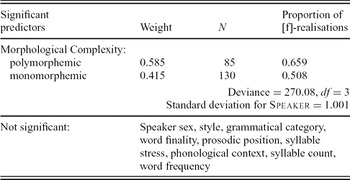
We now turn to the analysis of TH-fronting in London. Of the 24 Londoners who participated in the recordings, 9 never exhibit TH-fronting. The implication of this finding is discussed in section 3.3 where we note that there are important gender differences in the use or non-use of TH-fronting. Before addressing this issue, however, it is instructive first to consider which factors influence the application of TH-fronting for those speakers who have the pattern in their idiolect. With this in mind, consider table 3: this presents the results of the Rbrul model calculated on the data from the 17 London speakers who use fronting.Footnote 11
Significant predictors for the fronting of /θ/ in London with [f] as application value

Observe here that only one predictor achieves statistical significance: Morphological Complexity is the only constraint that significantly affects variability of (th) in London. As indicated, TH-fronting applies with greater frequency in morphologically complex words (e.g. thinks, anything, fourth) than morphologically simple words (e.g. think, south): this is particularly interesting since no previous studies have reported a similar morphological effect on the use of fronting.
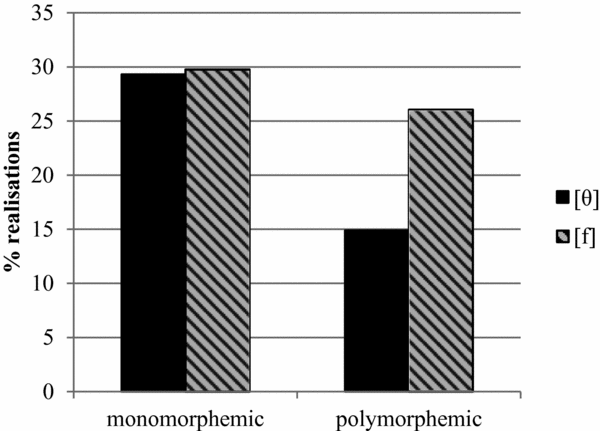
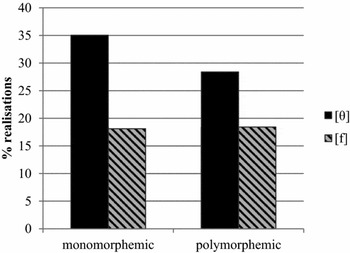
Figure 1 illustrates the proportion of [θ]-realisations and [f]-realisations according to the morphological complexity of the words in our London data. As shown, the monomorphemic words, which account for approximately 60 per cent of tokens, display almost equal rates of application of TH-fronting. However, the polymorphemic words pattern asymmetrically: rather than showing a 50:50 split between fronted and non-fronted variants, morphologically complex words display a statistically robust tendency to favour fronting. A breakdown of these data is shown in table 4.
The effect of morphological complexity on the realisation of /θ/ in the London data

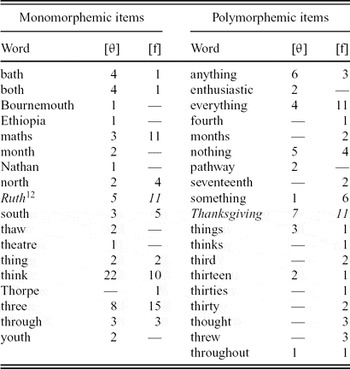
Rates of TH-fronting in monomorphemic and polymorphemic words for the London speakers

A number of observations can be made from close inspection of these lists. Firstly, with regard to the polymorphemic items, notice that there are numerous words that never occur with a canonical [θ]: these include words from different grammatical categories (e.g. nominals, verbs, numerals etc.) and words in which /θ/ occurs in different phonological contexts (e.g. word-initial onset position, word-final preconsonantal coda position etc.). Indeed, this finding is reflected in the Rbrul model: neither Prosodic Position nor Word Finality emerge as significant predictors of fronting in this data set. This is a particularly interesting finding for London given that previous research on other speech communities has found significant positional differences for TH-fronting (e.g. Stuart-Smith & Timmins Reference Stuart-Smith, Timmins, Caie, Hough and Wotherspoon2006; Clark & Trousdale Reference Clark and Trousdale2009). In contrast to these studies, our data indicate that phonological environment does not exert influence on the application of fronting for the London teenagers in any significant way.
A second important point here is that word-frequency also plays no significant role in determining which words undergo fronting and which words do not. For example, of all the monomorphemic words listed in table 4, think has the highest frequency value in the BNC; yet the fact that this item occurs as [θɪŋk] more than twice as often as it occurs as [fɪŋk] poses a major challenge to the hypothesis that sound change processes target high-frequency items before targeting low-frequency items (see, for example, Pierrehumbert Reference Pierrehumbert, Gussenhoven and Warner2002). Indeed, the fact that think clearly resists fronting more readily than low-frequency items like Ruth – which preferentially undergoes fronting even under the more formal reading condition – is particularly illuminating in this regard.Footnote 13 The implication of this finding for theorising about the grammatical and social diffusion of TH-fronting is discussed in section 4.1: and this result becomes increasingly relevant in consideration of the fact that the occurrence of TH-fronting for the Edinburgh speakers also cannot be predicted on the basis of word-frequency counts.Footnote 14 Thus, before discussing the diachronic spread and synchronic stability of TH-fronting, it is fitting first to examine the distribution of the non-standard realisations of /θ/ in the Edinburgh data.
3.2 The variability of /θ/ in Edinburgh
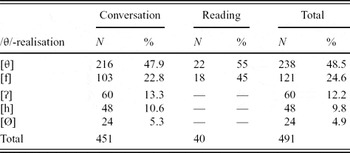
Table 5 summarises the realisational variation across the 21 Edinburgh speakers who participated in the recordings. Inspection of these data reveals two important trends.
Realisations of /θ/ for the Edinburgh speakers

Firstly, as with the London data, we observe that approximately 50 per cent of instances of /θ/ have a standard realisation in [θ]. However, note additionally that [f]-realisations occur with overall lower frequency for the Edinburgh speakers than for the London speakers: whereas 37.4 per cent of /θ/-tokens are realised as [f] in London (see table 2), we see fronting only in 24.6 per cent of cases in Edinburgh. Secondly, glottal realisations of /θ/ – i.e. [ʔ] and [h] – occur with much greater frequency for the Edinburgh speakers.Footnote 15 This finding therefore mirrors results reported on in Stuart-Smith & Timmins (Reference Stuart-Smith, Timmins, Caie, Hough and Wotherspoon2006) and Stuart-Smith et al. (Reference Stuart-Smith, Timmins and Tweedie2007) for Glasgow, in Robinson (Reference Robinson2005) for Livingston, and in Clark & Trousdale (Reference Clark and Trousdale2009) for Fife. Thus, whereas realisational variation of <th> in London primarily entails an optional and variable neutralisation of the /θ/~/f/ contrast, determining the phonological status of the [θ] and [f]-variants is more complex for Scottish dialects of English in which glottal realisations occur with high frequency. In the interest of being able to make stronger comparisons between the two regional groups, we have chosen to exclude all glottal realisations of <th> from the statistical tests reported on section 3.2.1 below. Thus, we now turn to consider how the application of TH-fronting in Edinburgh is affected by the factor groups listed in table 1.
3.2.1 Constraints on TH-fronting in Edinburgh
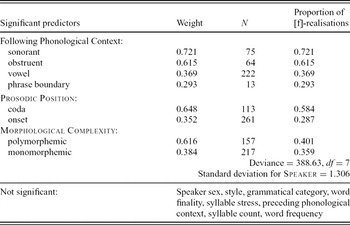
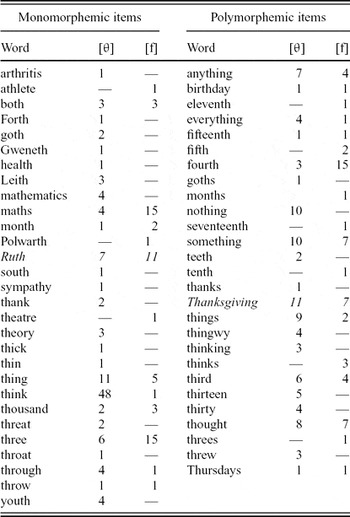
TH-fronting data from the Edinburgh speakers were analysed using the same procedure as described above for the London speakers. Accordingly, although the exclusion of the [h,ʔ]-realisations from the statistical tests provides only a partial indication of the full scope of variation in <th>, the Rbrul model presented in table 6 nevertheless allows for important comparisons to be made about the use of TH-fronting and its grammatical conditioning in the two regional groups. This is particularly the case since, in the current data set, TH-fronting also occurs in words containing the think and thing lexemes (see table 7).
Significant predictors for the fronting of /θ/ in Edinburgh with [f] as the application value

Rates of TH-fronting in monomorphemic and polymorphemic words for the Edinburgh speakers

Of the 21 speakers who contributed to the recordings, only 2 fail to exhibit any sign of TH-fronting: data from these non-users were excluded from the statistical analyses in the same way as for the London speakers. From the Rbrul output in table 6, we see that the application of TH-fronting for the Edinburgh speakers is significantly affected by a greater number of factors than for the London speakers.
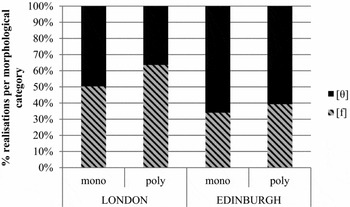
Firstly, notice that Morphological Complexity also emerges as a strongly significant constraint for the Edinburgh speakers. This result is critical because it provides further evidence that morphology has an influence on the application of fronting; however, closer examination of the data reveals that this effect is subtly different from the morphological effect that we have observed in the London data (see figure 2 below).
The effect of morphological complexity on the realisation of /θ/ in the Edinburgh data

Recall that the morphological effect in London is that polymorphemic items significantly favour the application of TH-fronting: thus, /θ/ in morphologically complex words is more likely to be realised as [f] than [θ]. This is also the case in Edinburgh, although the proportional differences are less pronounced than in London. However, the most notable difference between London and Edinburgh lies in the monomorphemic words. In London, [f] and [θ] occur with roughly equal frequency, whereas in Edinburgh [θ] is clearly favoured in monomorphemic words (see figure 3).
Relative frequency of fronting in monomorphemic and polymorphemic items: London vs Edinburgh

Figure 3 confirms that, despite the fact that there are significantly higher amounts of fronting in polymorphemic words than in monomorphemic words in both regional groups, polymorphemic TH-fronting is the dominant pattern in London. By contrast, in Edinburgh [θ]-realisations occur with overall greater frequency than [f]-realisations in both morphological categories (although some word-specific exceptions to this pattern can be noted – see table 7).
A number of important generalisations can be extracted from consideration of the regional differences illustrated by figure 3 and the word list in table 7. Firstly, it must be noted that our data do not provide evidence that specific suffixes produce certain patterns of fronting or non-fronting (as predicted, for example, by Lexical Phonology: see McMahon Reference McMahon1991, Reference McMahon2000: 170ff. on the Scottish Vowel Length Rule). At this stage, we are limited by the data to claiming that we are dealing with a monomorphemic~polymorphemic effect: further research is needed to address the question as to what extent specific morphological operations (e.g. compounding; derivational vs inflectional affixation) and specific morphological material affect the use of TH-fronting.
In addition to the finding that polymorphemicity favours the application of TH-fronting in both cities, the data listed above show another important effect: some words display behaviour that is not predicted by usage-based models of variation that assume a strong correlation between word frequency and the use of an innovative phonological variant. If indeed sound change processes target high-frequency items before targeting low-frequency items – as, for example, articulated by Pierrehumbert (Reference Pierrehumbert, Gussenhoven and Warner2002) – we would expect Word Frequency to emerge as a strongly significant predictor of the use of TH-fronting in both regional groups. But it does not. On the contrary, our findings agree with Labov (Reference Labov2006) and Dinkin (Reference Dinkin2008) who demonstrate convincingly that not all sound changes should be expected to exhibit frequency effects. Dinkin (Reference Dinkin2008) asserts that frequency effects may be first and foremost associated with reductive processes; and in fact, Bybee (Reference Bybee2002) seems to suggest this herself in places. However, TH-fronting is not a reductive sound change. It is a replacement of one phoneme with another; and if indeed word frequency effects are more common in reductive sound changes, finding such effects in TH-fronting would be surprising.
Moreover, the Rbrul model presented in table 6 indicates that two phonological factors contribute significantly to the realisational variability of /θ/ in Edinburgh. Specifically, Prosodic Position and Following Phonological Context emerge as significant predictors of [θ]~[f] variation: /θ/ in preconsonantal coda positions displays a far greater likelihood to undergo fronting than /θ/ in syllable-initial contexts or in prevocalic and prepausal contexts. This finding is particularly interesting considering that TH-fronting is a variable, but nevertheless categorical, neutralisation process: indeed, as much phonological theoretical work has shown, neutralisation phenomena often preferentially target segments in coda positions, both preconsonantally and non-preconsonantally (Kiparsky Reference Kiparsky and Good2008: §4ff.; Yu Reference Yu, Van Oostendorp, Ewen and Hume2011). Accordingly, it is perhaps unsurprising that we observe clear onset~coda asymmetries in the Edinburgh data; yet what is less expected is that we do not find a similar effect in the London data. The implications of this difference merit further discussion since they bear upon the question of how innovative phonological features diffuse throughout the lexicon over time. These issues are addressed in section 4.1: we first turn to consider a final empirical result of central importance for understanding the sociolinguistic situation affecting TH-fronting, namely the influence of gender.
3.3 Gender differences in /θ/-fronting
As discussed above, non-variable speakers were excluded in the regression analyses as it would be unwise to include them when constructing a model of factors that influence trends of variation. As a consequence of their exclusion, one important finding does not show in the constraint hierarchies, namely that many non-users are female: and the difference between male users and female non-users is particularly remarkable in London.
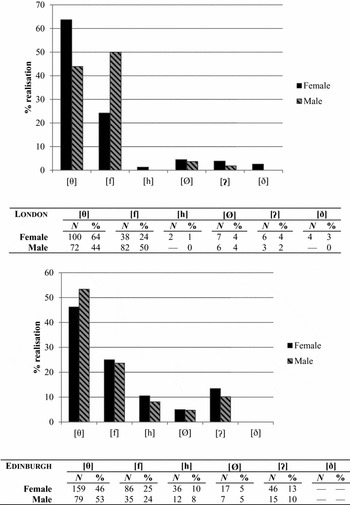
Paired chi-square tests were conducted to test for a gender effect when these speakers are included. There is a statistically significant gender difference in the use of [f] versus [θ] in London (χ 2 (1, N = 290) = 19.066, p < .0001), but not in Edinburgh (χ 2 (1, N = 359) = .674, p = .411). We also tested for various other differences in the phonetic realisations in Edinburgh as there are more [h], [Ø] and [ʔ] tokens than in London: none returned significant results. Figure 4 summarises the gender results, showing clearly how gender plays a major role in London, but not in Edinburgh.
Realisation of /θ/ by speaker sex in London (upper panel) and Edinburgh (lower panel)

Considering the robust finding that women play an important role in the diffusion of language change (e.g. Holmes Reference Holmes1997; Labov Reference Labov1990), searching for patterns linking gender and language change is important as it could yield insights about the interaction of linguistic and social processes. In particular, exploring the role of gender in a variety of communities is crucial as it puts linguists in a better position to make generalisations about sociolinguistic effects in the implementation of language change. In view of this, how then can we best explain the findings made in this study and contribute to generalisations on language change? We take up this point again in section 4.2 after first discussing the implications of linguistic effects.
4 Discussion
4.1 Generalisation of TH-fronting
To recap, our results indicate that there are important differences in the application of TH-fronting in London and Edinburgh. Whereas polymorphemic contexts favour the use of the [f]-variant in both regions, the Edinburgh speakers use fronting with significantly greater frequency in preconsonantal codas than in other phonological contexts. In the following discussion, we explore the possibility that this result could be accounted for by theoretical models of sound change which predict that neutralisations will occur more frequently in phonological environments that are perceptually disadvantaged (Blevins Reference Blevins2004; Kiparsky Reference Kiparsky and Good2008; Steriade Reference Steriade, Hume and Johnson2001). Under the view that TH-fronting is a sound change in progress, we argue that the lack of positional asymmetries in the London data is indicative of an increasing integration of the fronting process with higher-level grammatical structure. This hypothesis, in turn, has implications for the cross-regional adaptation of linguistic innovations and the lexical diffusion of new phonological variants.
4.1.1 The perceptual origins of /θ/~/f/ neutralisation
Whereas some studies argue that TH-fronting occurs because of the marked nature of /θ/ cross-linguistically (e.g. L. Milroy Reference Milroy, Cain and Russom2007: 162), other studies on sound change – and in particular, on the diachronic evolution of phonological mergers – highlight the crucial role that speech perception plays. For example, Ohala (Reference Ohala and Jones1993a, Reference Ohalab) has argued at length that difficulties encountered by the listener in correctly identifying a given phonological target from the speech signal in perceptually disadvantaged environments are an important source of sound change (see also M. Ohala & Ohala Reference Ohala and Ohala2001); and in this vein, Blevins (Reference Blevins2004) emphasises the fact that phonological systems are shaped diachronically by misperception effects which give rise to new allophonic processes and neutralisations. Likewise, Steriade (Reference Steriade, Hume and Johnson2001, Reference Steriade, Hanson and Inkelas2009) demonstrates that many languages neutralise phonological contrasts synchronically in contexts where the perceptibility of crucial phonetic cues (e.g. place-of-articulation, voicing etc.) is inhibited or eclipsed by other, more salient acoustic information.
With regard to the current data, these studies provide important insights into the contextual asymmetries that we observe in the application of TH-fronting in Edinburgh. Specifically, an intriguing hypothesis is that the apparent readiness of /θ/ to undergo fronting in preconsonantal codas – and the resistance of prevocalic /θ/ to participate in fronting – may reflect the fact that /θ/~/f/ neutralisation has a perceptual origin. Phonetic studies on the perceptibility of the /θ/~/f/ contrast are not abundant; however, the previous research which has been carried out consistently concludes that [θ] and [f] share acoustic properties which, under certain phonetic conditions, render them perceptually confusable (see Fernández et al. Reference Fernández, Feijóo, Balsa and Barros1998; Flynn & Fulop Reference Flynn and Fulop2012; Jongman et al. Reference Jongman, Wayland and Wong2000).
Whilst these studies show that [θ] and [f] are probably always confusable, to some extent, in any language system in which they occur contrastively, we do not take this as evidence for the independent emergence of TH-fronting in Edinburgh. On the contrary, the claim that TH-fronting is an imported feature originating in a set of youth norms in the southeast of England (Williams & Kerswill Reference Williams, Kerswill, Foulkes and Docherty1999; Foulkes & Docherty Reference Foulkes, Docherty, van der Velde and van Hout2001; Milroy & Gordon Reference Milroy and Gordon2003) is something that we do not seek to challenge; and neither do we contest Milroy's claim (1997: 162) that this salient youth-related pattern of neutralisation to [f] produces a strong bias against the development of a neutralisation process whose output is [θ]. However, what is most revealing about the prosodic and phonotactic asymmetries in the application of TH-fronting in Edinburgh is that once [f] as a possible variant of /θ/ diffuses to and within Edinburgh, the fronting process preferentially applies in contexts where place-of-articulation cues are difficult to extract accurately from the continuous speech stream. This finding, in our view, provides good grounds for speculating about how the fronting process may have originally emerged in London from contextual misperception effects; and pursuing this hypothesis, in turn, yields insights for the question of why Morphological Complexity is the only significant predictor of [θ]~[f] variability in our London data. In this connection, then, consider figure 5.
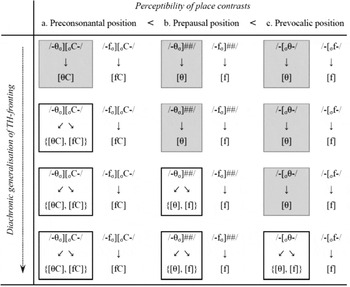
Emergence and diachronic generalisation of variable TH-fronting

Figure 5 schematises a trajectory of sound change that, we hypothesise, can explain the contextual and interregional differences in the use of TH-fronting in our corpus. We assume, firstly, that preconsonantal position is the context in which accurate identification of consonantal place-of-articulation cues is most disfavoured. Secondly, new neutralisations spread to perceptually more favourable environments only after they come to apply in less favourable environments. Thus, in line with classic cases of lexical diffusion, TH-fronting constitutes a sound change that is phonetically abrupt and lexically gradual (Labov Reference Labov1994: 542).
This model is motivated by the generalisation that the [θ]~[f] contrast is more likely to be accurately perceived in environments where these transitional cues to place-of-articulation are most acoustically salient. Recall that Blevins (Reference Blevins2004: 135) notes that the crucial acoustic cues that listeners use to discriminate [θ] and [f] are the transitional formant contours preceding and following the fricative closure; and likewise, Steriade (Reference Steriade, Hume and Johnson2001: 237) notes that accurate discrimination of speech sounds that are acoustically very similar depends heavily on contextual factors.Footnote 16
Thus, taking on board the claim that misperception fuels sound change, the pathway of change illustrated in figure 5 indicates that variable neutralisation of the /θ/~/f/ contrast most probably first emerged in London speech in the environment where perceptual cues to this contrast are most difficult to discriminate: namely, in preconsonantal coda position. From there, TH-fronting generalises to other environments, targeting other perceptually disadvantaged contexts before favourable ones (see Vennemann Reference Vennemann, Vennemann and Wilbur1972: §3 for discussion of other examples of rule generalisation of this type). As already noted, this, in our view, is the principal cause underlying the coda~onset asymmetries that we observe in Edinburgh: once TH-fronting diffuses to a new speech community, the perceptual grounding of the original innovation plays an important role in the lexical diffusion process. Specifically, phrase-final /θ/ and prevocalic /θ/ lag behind preconsonantal /θ/ with regard to the lexical diffusion of fronting precisely because the acoustic cues to the [θ]~[f] contrast are more easily discriminated in these contexts.
Nevertheless, it must also be highlighted that our Edinburgh data do not provide evidence that fronting applies more frequently prepausally than prevocalically. Such an asymmetry is predicted by the model in figure 5 on the basis of the fact that, in prepausal contexts, listeners may rely on transitional cues at the point of closure for determining fricative place-of-articulation, but the lack of a following vowel means that the release cues are not available for this purpose. Thus, intervocalic position, in which transitional cues both at the point of closure and at the point of release are available to the listener, is predicted to be the environment most amenable to correct identification – and, thus, to non-neutralisation – of the [θ]~[f] contrast. Yet, as indicated by the proportion values in table 6, we in fact observe less fronting prepausally than prevocalically for our Edinburgh speakers. However, the failure of prepausal /θ/ and prevocalic /θ/ to display a significant difference in the rate of application of fronting in the expected direction (i.e. more fronting prepausally, less fronting prevocalically) may well be attributable to the fact that our data come primarily from unscripted speech: as shown in table 6, our Edinburgh data set contains only 13 tokens of prepausal /θ/ compared to 222 tokens of prevocalic /θ/. Thus, we are restricted by our current data to claiming that, in dialects of English that have acquired the pattern only recently, TH-fronting may apply more frequently in phrase-final contexts than in intervocalic contexts (see Steriade Reference Steriade, Hume and Johnson2001: 237). Further research will nevertheless be necessary before we can confirm whether the trajectories of lexical diffusion of TH-fronting that we predict in figure 5 on the basis of the contextual perceptibility of acoustic cues are indeed reflected in synchronic patterns of use amongst young Edinburgh speakers. In spite of this, the crucial finding is that the perceptual model of sound change does explain why TH-fronting applies so much more frequently preconsonantally than prepausally and prevocalically in our Edinburgh data.
Despite the fact that the misperception effects in different phonological contexts provide an insight into why TH-fronting is so prevalent preconsonantally in Edinburgh, the fact that the use of fronting in London is not predictable on the basis of any prosodic or phonotactic contextual factors is puzzling. Rather than constituting evidence against the gradual generalisation of fronting into different phonological environments, we take the view that the lack of positional asymmetries for the London speakers is explicable in consideration of the evidence that TH-fronting is a more established process in London. Our motivation for this claim is discussed briefly in the following sections.
4.1.2 Towards morphologisation?
The finding that the rate of application of TH-fronting is not significantly affected by phonological contextual factors for the London speakers might be viewed as unexpected, especially in view of the positional asymmetries that we have observed in the Edinburgh data. Nevertheless, here, we shall argue that failure of prosodic or phonotactic position to significantly influence the use of the [f]-variant in London is consistent with the view that TH-fronting emerged earlier in London dialects, and that it is more synchronically stabilised as a productive phonological process than in Edinburgh.
Firstly, our results clearly indicate that the variable neutralisation of /θ/ and /f/ in London is now in the final stage of the diachronic trajectory shown in figure 5. Specifically, although the process is not yet fully stabilised, it is sufficiently advanced that it now exhibits equal rates of application across phonological contexts (a)–(c). The loss of the phonological contextual conditioning of the process in London therefore leaves us with only the morphological differences as a significant predictor of the use of the [f]-variant. One possible explanation for this result is that TH-fronting may already be on its way to becoming morphologised in the speech of young adolescents in London who, quite conceivably, have been exposed to the pattern after generations of use.Footnote 17 To reiterate, we have no evidence as yet that specific morphological operations are conducive to the application of fronting: the hypothesis that the fronting process is becoming gradually more dependent on morphological structure for the London teenagers is therefore a tentative one. Accordingly, a priority for future research on this phenomenon is to examine to what extent different morphological material either increases or decreases the probability of occurrence of TH-fronting. Furthermore, if our hypotheses in this regard are correct, the current data provide very interesting evidence for how new dialect features may diffuse throughout the lexicon independently of word frequency. For example, in the absence of a word-frequency effect, is it possible that the readiness of polymorphemic items to undergo fronting in some way reflects compositional frequency – i.e. a combined frequency effect of the base and affixal material? This remains an open question for the present; however, in our opinion, these findings provide a critical motivation for future studies on pathways of phonological change and lexical diffusion to pay due attention to grammatical factors in addition to word-frequency and social factors.
Nevertheless, it also must be stressed that the diffusion pattern that we observe here cannot immediately be extended beyond the speech habits of our west London adolescents. The evidence for the perceptual origins of TH-fronting do give us confidence that our arguments are correct in respect to London; yet whether speakers in Edinburgh will eventually follow this same path is a completely different matter. A somewhat different scenario is certainly conceivable: and in particular, although all [h,ʔ]-realisations were excluded from the statistical model in section 3.2.1, we suspect that the high frequency with which these realisations occur in our corpus will produce significant effects on the ongoing lexical diffusion of TH-fronting in Scottish dialects in which both patterns are robustly attested. It is certainly possible, if not likely, that an incoming change such as TH-fronting interacts with existing phonological patterns and may thus result in a different outcome for Edinburgh than for London. Maguire et al. (Reference Maguire, McMahon, Heggarty and Dediu2010: 77) suggest this, and Stuart-Smith & Timmins (Reference Stuart-Smith, Timmins, Caie, Hough and Wotherspoon2006: 178ff.) argue this point very strongly. Yet since [h] occurs almost exclusively in words of the think/thing group, the relative contribution of these realisations to the limited diffusion of the [f]-variant is hard to disentangle from the perceptual factors which – at least in our view – are crucial for understanding the contextual asymmetries. The development of TH-fronting in Edinburgh, thus, is intimately dependent both upon perceptual factors and upon words like think and thing which introduce complications, both from the perspective of phonological analysis and from the point of view of a child acquiring these varieties of English. This is very fertile ground for additional work on these sound changes: future research will certainly provide further insights into the way perceptually driven neutralisations interact with other dialect-specific sound patterns, such as the use of glottal realisations of <th> in Scottish English.
Finally, we turn to a brief discussion of our gender findings as, crucially, they confirm and provide independent evidence for our claim that the diachronic trajectory of a sound change can also considerably influence sociolinguistic constraints.
4.2 Gender and language change
In assessing the role that gender may play in determining trends of variation, numerous factors can be brought into consideration: e.g. the status of a variable as stable or changing above or below the level of consciousness (Labov Reference Labov1990); the status of a variable as local or supralocal (Holmes Reference Holmes1997; J. Milroy et al. Reference Milroy, Milroy, Hartley and Walshaw1994); and the relative age of a change, as already indicated, may also play a critical role (Cameron Reference Cameron2005; Eckert Reference Eckert1989; Labov Reference Labov1990). However, neither Labov's principles 1, 1a and 2, nor the concept of locality seem to be fully applicable to our results. We will therefore focus only on a brief discussion of the role of gender in the diachronic evolution of TH-fronting here.
Cameron (Reference Cameron2005: 25) hypothesises that quantitative differences between the sexes will be greater when males and females are separated to a larger extent: e.g. in their pre-teens and past working age. Differences are often also high during adolescence when there is more of what he calls ‘borderwork’, i.e. ‘interaction based on and even strengthening – gender boundaries’ (Thorne, quoted in Cameron Reference Cameron2005: 41). Cameron points out that not all variables are equally suited to the expression of gender and that, crucially, the potential for a variable to express gender may evolve over the life of a sound change. He proposes (cautiously) that his gender segregation hypothesis only seems to apply to stable variables and to mid-range and nearly completed changes (i.e. not to new changes). Specifically, he remarks that ‘for mid-range changes, the first half of life is expected to show evidence of the effect of gender segregation. For nearly completed changes, the effect is seen in the second half of life’ (Cameron Reference Cameron2005: 52).
Furthermore, Eckert (Reference Eckert1989) shows in her study of the Northern Cities Chain shift in Detroit that the newer variables of (e) and (uh) show no significant gender constraints, whereas mid-range and older variables like (oh), (a), and (æ) do show a significant gender difference. By contrast, Labov's discussion of data from Philadelphia highlights that it is women who lead new sound changes, such that gender differences tend to disappear in older, more established changes. Yet this observation, in principle, does not contradict Cameron's (Reference Cameron2005) view: indeed, Labov (Reference Labov2010: 255) specifies that the gender differences disappear as changes near an endpoint. This also accords with findings for T-glottalling for the same two groups of speakers whose TH-data we report on here: word-final T-glottalling, which shows application values of 92 per cent in Edinburgh and 86 per cent in London (Schleef in press), is not significantly affected by gender differences. Clearly, therefore, part of the problem here is the exact meaning of new, mid-range and old with regard to sound change processes: for how long can a new sound change rightfully be considered new?
The fact that TH-fronting is a relatively new change in Edinburgh, but a much older change in London, is very clear. If we consider fronting rates as an indicator of the relative age of the sound change (i.e. a total of 24% in Edinburgh vs a total 37% in London – see the application values given in tables 2 and 5), TH-fronting can certainly be classified as relatively new for Edinburgh. By contrast, it is better considered as a mid-range change in London. Thus, our data may provide support for the findings of Cameron (Reference Cameron2005) and Eckert (Reference Eckert1989), specifically, with regard to the claim that new changes do not show gender differences whilst mid-range (and older) changes do.Footnote 18
This, however, leaves us with the question of why there would be a link between gender and TH-fronting in the first place, and why there are no such differences in new changes. Here, it is fitting to point out that there is a very strong link between TH-fronting and lower social classes: this has been convincingly demonstrated for both England and Scotland (e.g. Kerswill Reference Kerswill, Britain and Cheshire2003; J. Milroy Reference Milroy1996, Stuart-Smith & Timmins Reference Stuart-Smith, Timmins, Caie, Hough and Wotherspoon2006; Stuart-Smith et al. Reference Stuart-Smith, Timmins and Tweedie2007). Trudgill (Reference Trudgill1972) advances the claim that use of TH-fronting presents a perfect opportunity for males to express masculinity. More recent approaches to gender suggest that gender is normally indexed indirectly (Ochs Reference Ochs, Duranti and Goodwin1992), thus, the roughness and toughness associated with the working classes can indirectly index other social concepts such as masculinity. Following this line of argumentation, new changes like TH-fronting in Edinburgh do not show any gender differences because their potential for gendering practice is only just establishing itself.Footnote 19 In London, on the other hand, the associations of the (very local) TH-fronting phenomenon with the working classes are uncontested: fronting thus represents an ideal feature for the indirect indexing of masculinity.
In sum, here too we take the view that the gender differences in the use of fronting that we observe are a predictable result considering that TH-fronting is a more established dialect feature in London than in Edinburgh.
5 Conclusions
In conclusion, our examination of the progressive lexical and grammatical diffusion of TH-fronting amongst adolescents in London and Edinburgh has revealed that the application of TH-fronting is constrained in Edinburgh in ways that are not relevant for London. Specifically, whereas TH-fronting is sensitive to phonotactic, prosodic and morphological factors in Edinburgh, only morphological complexity emerges as a significant predictor of TH-fronting in London. We also find evidence of significant gender differences in the use of fronting in London, whereas such differences do not arise in our Edinburgh data.
In considering the diachronic implementation of sound change, we have argued that these results obtain because of the more established nature of TH-fronting in London, as compared to Edinburgh. Furthermore, whilst the pattern we have observed is clearly one of gradual diffusion, word frequency is irrelevant in our data.Footnote 20 We are therefore a long way from being able to state that all phonological change is explicable on the basis of word-frequency effects, either locally or cross-regionally. However, just as social and linguistic constraints differ during the evolution of a sound change, so too may the role of word frequency (Labov Reference Labov2006).
These are tantalising findings, but more research, especially across different generations, will be necessary before a full understanding of them can be reached. Many questions remain unanswered: for example, are we on the way to a morphologically conditioned [θ]~[f] alternation in London? What exactly is the role of word frequency in phonological processes that are clearly categorical and non-reductive in nature (see Clark & Trousdale Reference Clark and Trousdale2009; Dinkin Reference Dinkin2008)? Our findings very clearly place the onus on researchers studying diffusion and phonological variation not to limit themselves to looking at word frequency and social factors alone: prosodic, phonotactic and grammatical factors – particularly morphological factors – are crucial and may well reveal important findings.
Finally, considering the various linguistic and non-linguistic forces which may influence its ongoing evolution, attempting to predict the social future of TH-fronting is an extremely tall order, if not wholly futile. If Holmes (Reference Holmes1997) and Milroy et al. (Reference Milroy, Milroy, Hartley and Walshaw1994) are correct, an adoption and endorsement by (middle-class) female speakers is essential for the success of an innovation. Thus, it will be necessary for this phenomenon to experience a change in evaluation similar to that already experienced by word-final T-glottalling; whether such a change in evaluation may be in store for TH-fronting or not remains an open question. However, it is certainly clear that attitudes, gender identities and personal aspirations will be equally important factors alongside linguistic factors in the diffusion of TH-fronting. As we have shown here, the relative importance of these factors may differ from location to location in critical ways. It is this that makes the comparative variationist approach – which pays responsible consideration to both linguistic and non-linguistic influences on the implementation of sound change – indispensable for understanding patterns of dialectal variation and change.