Introduction
Apathy is as a syndrome characterized by a reduced motivation, reduced goal-directed behavior and cognition and a flattening affect (Robert et al., Reference Robert2009). It is a common and important behavioral syndrome in various neuropsychiatric diseases, such as several subtypes of dementia, Parkinson's disease (PD) and schizophrenia. Apathy is the most common neuropsychiatric symptom in Alzheimer's disease (AD), with reported prevalences ranging from 42% to 92% (Drijgers et al., Reference Drijgers, Aalten, Winogrodzka, Verhey and Leentjens2009). It has a major impact on the quality of life of both patients and caregivers as evidenced by its widespread associations with caregiver distress, functional decline, and increased likelihood of institutionalization (Tun et al., Reference Tun, Murman, Long, Colenda and von Eye2007). Likewise, apathy is one of the most frequently observed neuropsychiatric symptoms in patients with mild cognitive impairment (MCI) (Robert et al., Reference Robert, Mulin, Mallea and David2010). A recent systematic review reported that the prevalence of apathy in MCI varies from 12–15% in population-based studies to 11–53% in hospital-based studies (Monastero et al., Reference Monastero, Mangialasche, Camarda, Ercolani and Camarda2009). Moreover, it has been suggested that apathy is an important feature of pre-dementia stages because it may be predictive for developing dementia (Robert et al., Reference Robert2006a; Onyike et al., Reference Onyike2007; Palmer et al., Reference Palmer2010).
Apathy in dementia is increasingly considered as a discrete syndrome, independent of depression, with similar symptom constellations and pathophysiological correlates across diagnostic boundaries (Chase, Reference Chase2011). Abnormalities within fronto-subcortical circuits have been related to apathy, with particular emphasis on changes in the anterior cingulated which is thought to be responsible for motivated behavior (McPherson et al., Reference McPherson, Fairbanks, Tiken, Cummings and Back-Madruga2002; Chase, Reference Chase2011). These findings imply that apathy is associated with specific cognitive impairment caused by disruption of these brain areas. Indeed, apathy has been associated with executive dysfunction in previous studies, especially in AD patients (Kuzis et al., Reference Kuzis, Sabe, Tiberti, Dorrego and Starkstein1999; McPherson et al., Reference McPherson, Fairbanks, Tiken, Cummings and Back-Madruga2002).
However, whether apathy is associated with a specific neuropsychological profile across various stages of disease remains largely unknown. Studying the possible impact of apathy on cognitive status in MCI and comparing this with AD may provide insight into the underlying pathology and may lead to new options for early diagnosis and treatment options. So far, only a few studies have compared the neuropsychological correlates of apathy in patients with MCI and dementia (Kuzis et al., Reference Kuzis, Sabe, Tiberti, Dorrego and Starkstein1999; McPherson et al., Reference McPherson, Fairbanks, Tiken, Cummings and Back-Madruga2002; Ready et al., Reference Ready, Ott, Grace and Cahn-Weiner2003; Robert et al., Reference Robert2006b). Therefore the aim of the present study was to investigate the association between apathy and neuropsychological functioning in patients with MCI and AD. We hypothesized that apathy is associated with decreased performance on tests involving initiation processes and executive functioning rather than with tests representing other cognitive domains and that this profile is consistent in both MCI and AD. Furthermore, we hypothesized that this relationship is independent of depression.
Methods
Subjects
Subjects were 438 ambulatory patients from the Memory Clinic of the Maastricht University Medical Centre. Of these, 260 (59%) people had dementia according to DSM-IV (American Psychiatric Association, 1994). All patients were diagnosed with mild to severe AD in accordance with the NINCDS/ADRDA criteria (McKhann et al., Reference McKhann, Drachman, Folstein, Katzman, Price and Stadlan1984). The remaining 178 patients (41%) had objective cognitive impairment but did not meet the criteria for dementia and were therefore classified as having MCI.
Neuropsychological examination
Cognitive staging and assessment of global cognitive functioning was done with the Global Deterioration Scale (GDS) and the Mini-Mental State Examination (MMSE) respectively (Folstein et al., Reference Folstein, Folstein and McHugh1975; Reisberg et al., Reference Reisberg, Ferris, De Leon and Crook1982). Verbal learning and memory was measured using the immediate recall, delayed recall and recognition trials of the Verbal Learning Test (VLT) (van der Elst et al., Reference van der Elst, van Boxtel, van Breukelen and Jolles2005). Selective attention as well as information processing speed were assessed using the Stroop Color Word Test (STROOP) card 1 and 2, and the Letter-Digit-Symbol Test or Symbol Digit Modalities Test (LDST, SDMT) (van der Elst et al., Reference van der Elst, van Boxtel, van Breukelen and Jolles2006). Psychomotor tracking as well as attention was measured with the Concept Shifting Task or Trail Making Test (CST, TMT) part A and B (number and letter tracing, respectively) (van der Elst et al., Reference van der Elst, van Boxtel, van Breukelen and Jolles2006). The Verbal Fluency test, STROOP card 3 and CST/TMT part C (alternating between numbers and letters) were used to measure executive functioning (van der Elst et al., Reference van der Elst, van Boxtel, van Breukelen and Jolles2006).
Assessment of apathy
Apathy and depression were assessed with the Neuropsychiatric Inventory (NPI) (Cummings et al., Reference Cummings, Mega, Gray, Rosenberg-Thompson, Carusi and Gornbein1994). The NPI is a semi-structured instrument that evaluates the presence and severity of 12 neuropsychiatric symptoms. The validity and reliability of the NPI and its Dutch version are well established (Kat et al., Reference Kat, De Jonghe, Aalten, Kalisvaart, Droes and Verhey2002). The frequency and severity of each symptom are scored on the basis of structured questions administered to the patient's primary caregiver. The continuous score for each symptom is obtained by multiplying severity (1–3) by frequency (1–4) and thus ranges from 1 to 12. In line with previous studies, a score greater than 3 was taken to indicate the presence of “clinically relevant” symptoms (Aalten et al., Reference Aalten, De Vugt, Jaspers, Jolles and Verhey2005).
The apathy subscale of the NPI consists of a screening question and eight sub-questions consistent with behaviors typically observed in apathetic patients. The questions evaluate several sub-domains of apathy, such as lack of motivation, loss of interest in the world, and reduction in affection.
Statistical analysis
Differences in demographic characteristics and disease variables were analyzed using the Kruskal-Wallis test for non-normally distributed continuous variables and the χ2 test for categorical variables. The influence of apathy on the various neuropsychological tests was examined with linear regression analyses corrected for age, gender, level of education and depression. The level of significance for all analyses was set at p < 0.05. Statistical analyses were conducted using STATA 11.0 (StataCorp, 2009).
To minimize potential bias by restricting analyses to complete observations, multiple imputation (MI) of missing data was performed. Given the fact that data in observational studies are generally missing at random (MAR), meaning that missingness is probabilistic rather than deterministic, missing data can be imputed using available information (Rubin, Reference Rubin1976). MI constructs several alternative versions of the complete data set by predicting missing data points using data that are not missing. Each dataset contains slightly different imputed values by adding a random error term to the estimate. The analysis is then done on each of the imputed datasets separately and effect sizes and standard errors, which may vary, are then combined using simple arithmetic to obtain an overall estimate (Schafer and Graham, Reference Schafer and Graham2002). Only neuropsychological tests with less than 40% missing data may be included in MI. We imputed 20 datasets in STATA 11.0 using the ICE routine. After imputation, the linear regression analyses were conducted using the MIM prefix.
Results
Demographic and clinical characteristics
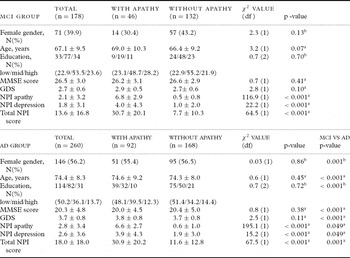
Demographic and clinical characteristics of the total MCI and AD group as well as the characteristics of patients stratified by apathy status are presented in Table 1. In total, 138 of the 438 patients (31.5%) were apathetic. Apathy was significantly more prevalent in the AD group than in the MCI group (35.3% versus 25.8% respectively; χ2 value (df) = 4.5 (1), p = 0.04). Of the AD patients 53.7% had mild AD (MMSE ≥ 21), of whom 34.3% were apathetic, 43.1% had moderate AD (MMSE 11–20), of whom 36.7% were apathetic and 3.1% suffered from severe AD (MMSE ≤ 10), of whom 25% was apathetic. In both the MCI and AD group the apathetic patients did not significantly differ from the non-apathetic patients with respect to age, gender, level of education, MMSE score and GDS score. In both diagnostic groups the apathetic patients were significantly more depressed according to the NPI and showed a higher total score on the NPI than non-apathetic patients. Although NPI scores for depression and apathy were moderately correlated, (Pearson's r = 0.40, p < 0.001), 58% of the apathetic patients were not depressed and 49% of the patients with depression were not apathetic.
Demographic characteristics of the MCI and AD groups, according to apathy status

Values represent mean ± SD unless otherwise stated.
a Kruskal-Wallis; b χ2.
MMSE = Mini-Mental State Examination; GDS = Global Deterioration Scale; NPI = Neuropsychiatric Inventory.
Results of neuropsychological tests
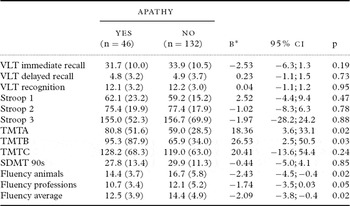
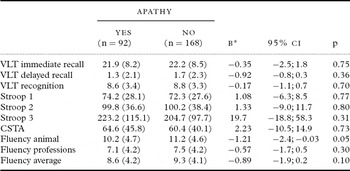
In the MCI group, linear regression analysis showed a significant main effect of apathy on Verbal Fluency (animal naming, profession and aggregate measure), in which patients with apathy scored significantly lower than patients without apathy (Table 2). Apathetic patients were also significantly slower on the TMT parts A and B than non-apathetic patients (Table 2). No significant differences in neuropsychological performance were found on other tests. In AD, apathetic patients performed worse on Verbal Fluency animal naming, compared with non-apathetic patients, but no differences were observed in naming professions or the aggregated Verbal Fluency measure (Table 3). Depression had no effect on any neuropsychological measure in either patient group (data not shown).
Neuropsychological data of the MCI group

*Adjusted for age, gender, level of education and depression.
VLT = Verbal Learning Test; TMT = Trail Making Test; SDMT = Symbol Digit Modalities Test.
Neuropsychological data of the AD group
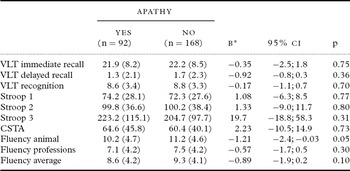
* Adjusted for age, gender, level of education and depression.
VLT = Verbal Learning Test; CST = Concept Shifting Task.
Discussion
The present study investigated the association between apathy and neuropsychological functioning in patients with MCI and AD. With a prevalence of 35.3%, more AD patients were apathetic than patients with MCI (25.8%). Apathetic MCI patients scored worse than non-apathetic MCI patients on tests for executive functioning and psychomotor tracking. This association was independent of the presence of depressive symptoms, as indicated by the NPI. In the AD group the difference between apathetic and non-apathetic patients was less pronounced and significant only for a single test of the Verbal Fluency (animal naming) representing executive functioning. No significant differences were found on measures of memory, attention and information processing speed.
Worse scores on Verbal Fluency by apathetic patients characterize poor initiating. Since impaired initiating capacities may be partly explained by psychomotor retardation, we corrected the scores on the Verbal Fluency task for psychomotor speed in a post-hoc analysis. In this analysis, part 1 of the TMT was used as covariate to correct for psychomotor speed. After this correction, no significant differences in verbal fluency remained between apathetic and non-apathetic MCI patients (animal naming: B = −1.70, CI = −3.7; 0.3, p = 0.10; naming professions: B = −0.98, CI = −2.7;0.8, p = 0.27; aggregate measure: B = −1.13, CI = −2.8;0.6, p = 0.20). These results confirm that apathy in MCI patients is particularly related to poor initiating related to reduced motor speed.
The prevalence rate of MCI patients observed in the current study fell within the range reported in previous studies (Clarke et al., Reference Clarke, Ko, Lyketsos, Rebok and Eaton2010). Although the prevalence rate of apathy in AD patients was on the low side compared to other studies (Ishii et al., Reference Ishii, Weintraub and Mervis2009), it is known that prevalence rates of apathy vary widely due to differences in population characteristics and assessment tools. Since apathy increases with disease severity, a possible explanation for the relatively low prevalence in our study could be that our AD group consisted of an outpatient population with a relatively high percentage of mild AD patients.
In a cohort of community-based older adults, Onyike and colleagues (Reference Onyike2007) reported findings in line with those of the present study. They also used a NPI cut-off score > 3 and found deficits in executive functioning (Verbal Fluency) and psychomotor tracking (TMT) in cognitively normal people with apathy but not in participants with “cognitive impairment not dementia” (CIND), and dementia. Since the mean MMSE score of this group was 21, it might be argued whether, on average, these people should be regarded as cognitively normal, or that they may be better considered as having MCI. Of major interest is that both our study and the study of Onyike and colleagues suggest that the effect of apathy on cognition becomes diluted with progression of overall cognitive impairment. A possible explanation is given by the latter authors who stated that when cognitive impairment is sufficiently severe, the impact of apathy on test performance is obscured or confounded by other cognitive disabilities (Onyike et al., Reference Onyike2007). Hence, neuropsychological outcome measures fail to distinguish between patients with and without apathy when neuropathology and associated cognitive deficits are severe enough. In particular, apathy seems to be related to executive functioning only in the early stages of cognitive deterioration, e.g. MCI. In the revised view on the concept of MCI and AD, in which MCI is characterized by the onset of the earliest cognitive symptoms and seen as a prodromal phase of AD supported by one or more biomarkers (Jack et al., Reference Jack2010; Dubois et al., Reference Dubois2010), apathy may be one of the first symptoms of early neurocognitive deterioration. This view is also in line with previous studies showing apathy to be an early predictor of AD in patients with MCI (Robert et al., Reference Robert2006a; Palmer et al., Reference Palmer2010).
Our results are partly in contrast to some results of previous studies. For instance, Robert and colleagues studied neuropsychological performance in MCI patients with and without apathy. They reported that apathy in MCI patients was not associated with executive dysfunction (Robert et al., Reference Robert2006b). Kuzis et al. (Reference Kuzis, Sabe, Tiberti, Dorrego and Starkstein1999) and McPherson et al. (Reference McPherson, Fairbanks, Tiken, Cummings and Back-Madruga2002) compared AD patients with and without apathy and depression. Kuzis and colleagues reported that apathy, independent of depression, is associated with worse performance on tests of verbal memory, naming, set shifting and verbal fluency than patients without apathy (Kuzis et al., Reference Kuzis, Sabe, Tiberti, Dorrego and Starkstein1999). McPherson et al. concluded that apathy was mainly related to executive functioning (McPherson et al., Reference McPherson, Fairbanks, Tiken, Cummings and Back-Madruga2002). However, because these studies used either other apathy scales (Kuzis et al., Reference Kuzis, Sabe, Tiberti, Dorrego and Starkstein1999; Robert et al., Reference Robert2006b), had smaller sample sizes (Kuzis et al., Reference Kuzis, Sabe, Tiberti, Dorrego and Starkstein1999; McPherson et al., Reference McPherson, Fairbanks, Tiken, Cummings and Back-Madruga2002) or used less strict cut-off scores (McPherson et al., Reference McPherson, Fairbanks, Tiken, Cummings and Back-Madruga2002; Robert et al., Reference Robert2006b), their results are not strictly comparable to our outcomes.
A major strength of our study is the relatively large sample size and the inclusion of patients with both MCI and AD who all underwent an extensive neuropsychological assessment. Moreover, we used strict cut-off scores on the NPI to ensure that the apathy symptoms were clinically relevant, whereas some previous studies applied very broad and mild cut-off scores (Kuzis et al., Reference Kuzis, Sabe, Tiberti, Dorrego and Starkstein1999; McPherson et al., Reference McPherson, Fairbanks, Tiken, Cummings and Back-Madruga2002; Robert et al., Reference Robert2006b). In addition, to deal with the missing data correctly multiple imputation methods were used and linear regression analyses were performed afterwards. We also conducted thorough statistical analyses in which we corrected for depressive symptoms.
This study also had some limitations. First of all, apathy was measured with the NPI. Although this is a commonly used, broad and validated instrument to assess neuropsychiatric symptoms, including apathy, it is not a specific apathy scale. Therefore we were not able to make a distinction between affective apathy, behavioral apathy and cognitive apathy (Chow et al., Reference Chow2010). Besides that, some of the neuropsychological tests in our AD group had too many missing observations to be included in the multiple imputation method. Consequently, these were not included in the analyses. Another limitation is the broad inclusion of patients with objective cognitive complaints, without specific MCI criteria (Petersen, Reference Petersen2004). Nevertheless, subjects with cognitive complaints due to severe neurological, somatic or psychiatric disorders were excluded.
In conclusion, our study showed in particular that apathy is associated with impaired executive function, characterized by poor initiating, in the early phase of cognitive impairment, but not in more advanced cognitive dysfunction. The association of apathy with executive dysfunction in the MCI group is interesting since it may be an early predictor of AD. More awareness of apathy and executive dysfunction in the early phase of cognitive impairment may help in the diagnostic process. More studies, preferable using a longitudinal design, should investigate the relationship of apathy and cognition. Since apathy is a highly prevalent syndrome in various neuropsychiatric diseases future studies should focus on a broad range of clinical diagnoses. In addition, the influence of different subtypes of apathy on cognitive performance should be studied.
Conflict of interest
None.
Description of authors' roles
R. L. Drijgers, F. R. J. Verhey, A. F. G. Leentjens and P. Aalten formulated the research question. R. L. Drijgers conducted analyses and wrote the paper. S. Köhler assisted with data analyses. All authors contributed to the revision of the paper.