Introduction
Hypereutectic Al–Si alloys contain a large number of in situ formed, primary Si particles (PSPs), and the size, distribution, and morphology of PSPs have a huge impact on the mechanical properties, such as tensile strength and wear resistance [Reference Zhong, Shu-Sen, Ping, Mao and Shi-Zhao1, Reference Zhang, Yu, Liu, Li, Liu and Zhang2]. To satisfy the industrial requirements of hypereutectic Al–Si alloys, the PSPs in the alloys must be refined and homogenized. The addition of phosphorus (P) into the Al–Si alloy promotes the nucleation rate of PSPs and inhibits the growth of PSPs by increasing the cooling rate [Reference Liu, Kang and Liu3], which results in refinement and homogenization of PSPs in Al–Si alloys. The spray deposition technology can efficiently refine the PSPs, but hot isostatic pressing and machining of the treated alloy billets are required to obtain the qualified parts. However, due to the large solidification interval of hypereutectic Al–Si alloys, shrinkage cavities and porosity are easily produced during the casting process. Hence, the liquid casting of hypereutectic Al–Si alloys has been rarely carried out at the industrial scale.
In semisolid forming, the inclined plate and electromagnetic stirring technologies refine the PSPs [Reference Li, Li, Zheng, Huang, Chen and Ma4, Reference Mullis5, Reference Zhang, Wu, Liu, Zhang, Pang and Ding6]. Meanwhile, the high viscosity of semisolid slurry reduces the air entrapment during melt filling. Consequently, several research groups have adopted semisolid forming technology to cast hypereutectic Al–Si alloys. However, it is very difficult to control the distribution of PSPs in the molten melt during high-speed filling and the macrosegregation is hard to suppress. Apparent viscosity is an important physical parameter, which has a significant influence on the filling mode [Reference Simlandi and Barman7]. The semisolid slurry has the characteristics of shear thinning, and apparent viscosity of slurry decreases with an increasing shear rate. In addition, the change in viscosity influences the degree of segregation between solid and liquid phases.
Herein, rotating-rod-induced nucleation technology is adapted to synthesize the semisolid hypereutectic Al–Si alloys slurry. In addition, the influence of different cooling conditions and shear rates on the apparent viscosity of molten melt and semisolid slurry has been examined by self-made high-precision and high-temperature apparent viscosity test equipment. The present study aimed to explore the correlation between the shear rate and uniformity of hard phases in the semisolid slurry of hypereutectic Al–Si alloys. Also, the current study provides a baseline for the design and development of semisolid squeeze casting process of hypereutectic Al–Si alloys and the structure of matching mold. Furthermore, the present study provides useful insights into the filling behavior of Al matrix composites.
Experimental results and discussion
Apparent viscosity of alloy melt under continuous cooling
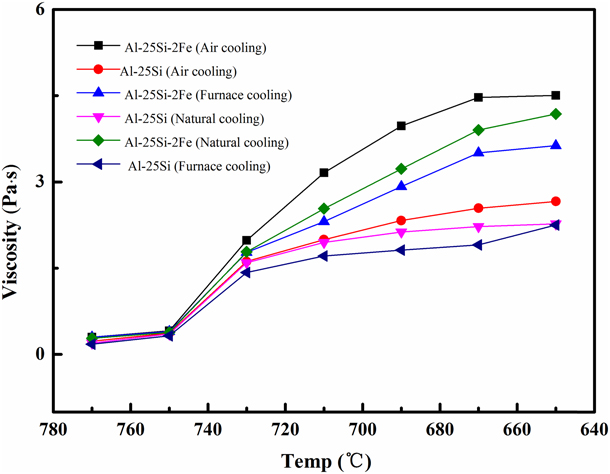
Under continuous cooling, the apparent viscosity of both types of high silicon–aluminum alloys was studied at a constant shear rate of 23.76 s−1 in different cooling modes. The apparent viscosity of Al–25Si–2Fe was all larger than the Al–25Si in different cooling modes, as shown in Fig. 1. The difference in apparent viscosity of both molten alloys gradually increased when the temperature was less than 730 °C. For the same molten alloys, the apparent viscosity was lowest after furnace cooling, whereas it was higher after air cooling. When the temperature was reduced to 770 and 750 °C, the apparent viscosity slowly increased and reached a critical point of 0.374 Pa s. Then, the apparent viscosity suddenly increased when the temperature was reduced to 730 °C. When the temperature was maintained in the range of 730–650 °C, the cooling process gradually lowered the apparent viscosity, which was still higher than the temperature range of 770–750 °C. One should note that the molten melt attains a near liquid state when the temperature is higher than 750 °C and the solid particles, dispersed in the molten melt, exhibit the fluid characteristics [Reference Luo, Cheng and Shan8]. In the course of the continuous cooling process, the primary silicon particles and Fe-rich phase were instantly separated. As the temperature decreased, the volume fraction of the solid particles and the friction force between solid particles and stirring head gradually increased, which also contributed to the increase in apparent viscosity. With constantly decreasing temperature, the apparent viscosity slowly increased. However, as the temperature continued to decline, the highest solid fraction of molten melt displayed a near solid state, which possesses the interconnected solid phases. At this time, the apparent viscosity obviously increased with decreasing temperature. During furnace cooling, since the solid phase particles are more likely to grow up, solid features appeared in the molten melt and led to the suddenly increased apparent viscosity at 650 °C.
Apparent viscosity versus temperature curves of both types of hypereutectic Al–Si alloys at different cooling rates.
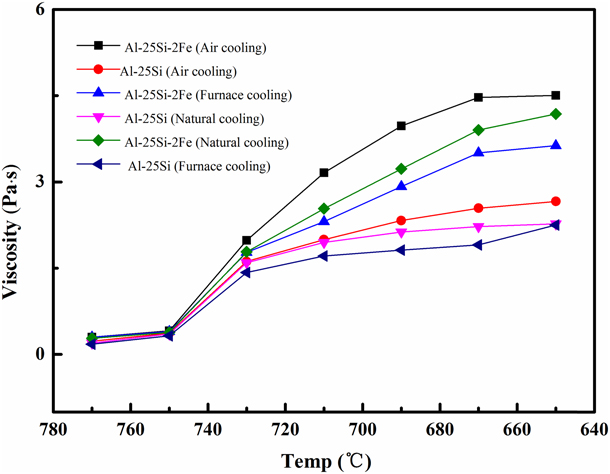
As seen from Fig. 1, the apparent viscosity of Al–25Si–2Fe was higher than that of the Al–25Si alloy when the temperature was lower than 750 °C. Due to the addition of Fe element, the Fe-rich phase has sufficient time to precipitate. The volume fraction of solid particles in Al–25Si–2Fe molten alloys was higher than that in the Al–25Si alloys. Consequently, the frictional force among the particles in the Al–25Si–2Fe molten melt and the friction between the melt and the stirring head increased, which resulted in a higher apparent viscosity. Zhou et al. observed a large amount of solid phase atomic clusters in molten alloys. The stirring time was longer during furnace cooling. The atomic clusters moved to the surface of precipitated particles, which resulted in a higher amount of spherical solid particles [Reference Zhou and Tao9]. The resistance to the relative motion between layers inclined to become smaller under the action of shear force, which resulted in a lower apparent viscosity [Reference Zhou, Mao, Liu, Xu and Shi10, Reference Zhen, Mao, Yan, Cui, Zhao and Zhong11]. As a result, the apparent viscosity under furnace cooling is lower. As the stirring time was short under air cooling, the particles did not form rounded shapes and exhibited an irregular plate-like microstructure. The friction among the particles was higher, which inevitably increased the apparent viscosity of the molten alloys.
Isothermal apparent viscosity of the semisolid slurry
Influence of shear rate on the microstructure of semisolid slurry
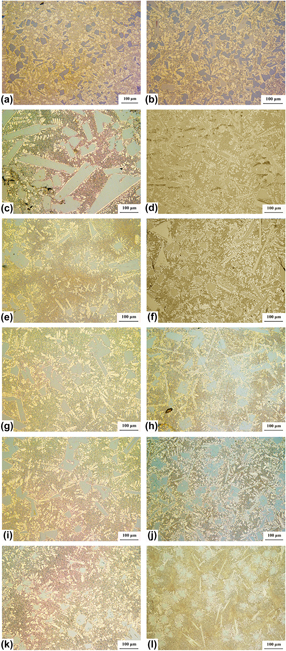
Based on the preliminary results, the concrete pouring temperature and rotation speed of rods were set to 780 °C and 600 r/min, respectively. The final preparation temperature of the semisolid slurry was ∼720 °C. Figures 2(a) and 2(b) present the semisolid microstructures of Al–25Si and Al–25Si–2Fe alloys before the shear process. After suffering from the treatment of rotating rods, the molten melt was chilled and a large number of primary silicon particles appeared in the form of regular polygons, with an equivalent diameter of 40 ± 5 μm. The Fe-rich phases mainly exist in block form, with an equivalent diameter of 50 ± 5 μm. The primary silicon particles and Fe-rich phases are evenly distributed in the matrix.
Semisolid microstructures of Al–25Si alloys in different rotations speeds: (a) no-stirring, (c) 100 r/min, (e) 200 r/min, (g) 300 r/min, (i) 400 r/min, (k) 500 r/min; semisolid microstructures of Al–25Si–2Fe in different rotation speeds: (b) no-stirring: (d) 100 r/min, (f) 200 r/min, (h) 300 r/min, (j) 400 r/min, (l) r/min.
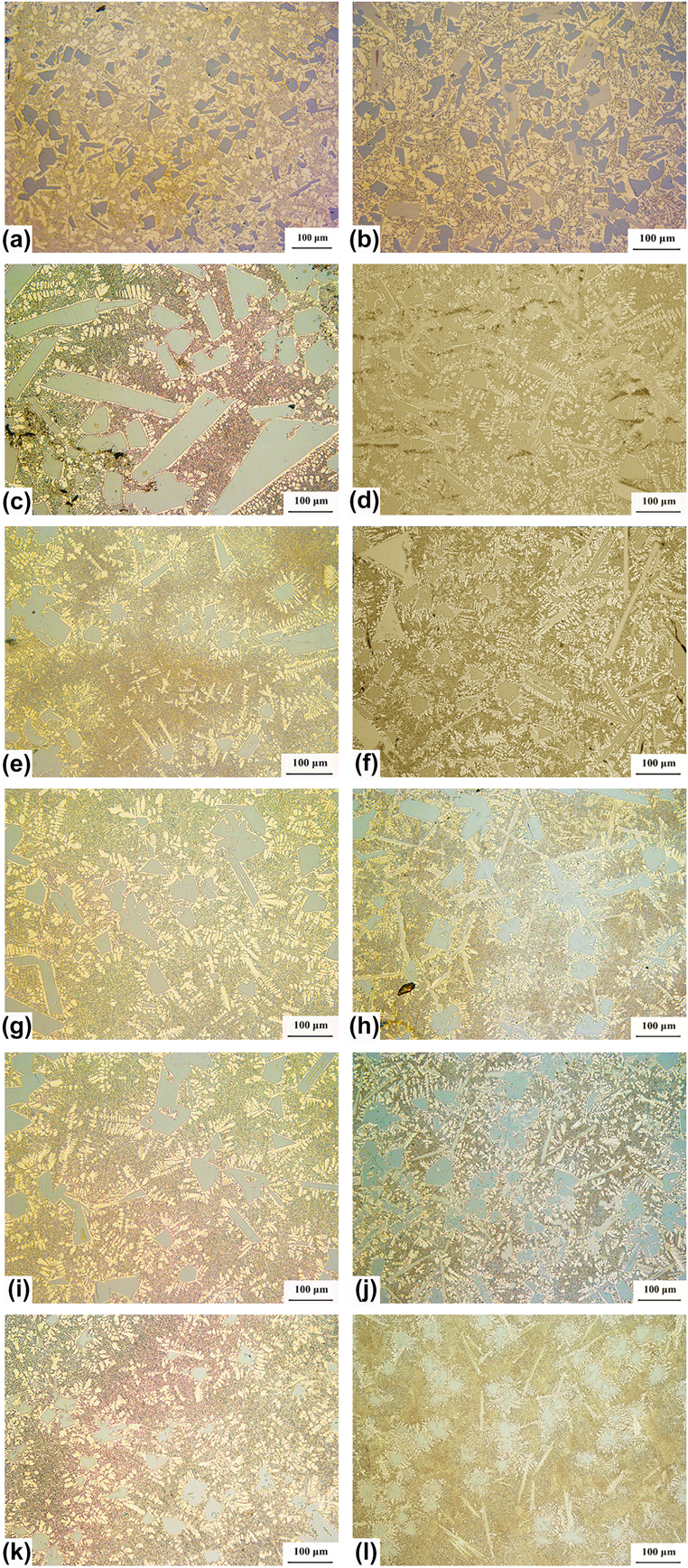
Figures 2(c)–2(l) present the microstructure of semisolid slurries of Al–25Si and Al–25Si–2Fe alloys at a shear speed of 100 r/min, 200 r/min, 300 r/min, 400 r/min, and 500 r/min. It can be seen that the primary Si particles were irregular polygons with an equivalent diameter of about 200 ± 20 μm at the shear rate of 23.76 s−1 [Figs. 2(c) and 2(d)]. The Fe-rich phases presented a rod-shaped morphology, with a length of about 150 ± 20 μm. We have also observed adhesion between primary silicon particles, primary silicon, and Fe-rich phases, which resulted in severe particles agglomeration. When the shear rate was increased to 47.51 and 71.27 s−1 [Figs. 2(e)–2(h)], primary Si still kept the shape of irregular polygons, whereas the shape of Fe-rich phases became elongated rod and irregular polygons. The agglomeration between particles was relieved at the shear rate of 23.76 s−1. When the shear rate of the semisolid slurry was increased to 95.03 s−1 [Figs. 2(i) and 2(j)], the equivalent diameter of primary Si became much smaller, with an average of about 50 ± 10 μm and the length of the rod-like Fe-rich phases decreased. When the shear rate of the semisolid slurry was further increased to 118.72 s−1 [Figs. 2(k) and 2(l)], primary Si became small and block-shaped with an equivalent diameter of 40 ± 10 μm. Also, the rod-like Fe-rich phases reached the length of 100 ± 10 μm. In addition, primary Si particles, primary silicon, and Fe-rich phases were evenly distributed in the matrix.
Influence of shear rate on isothermal steady apparent viscosity
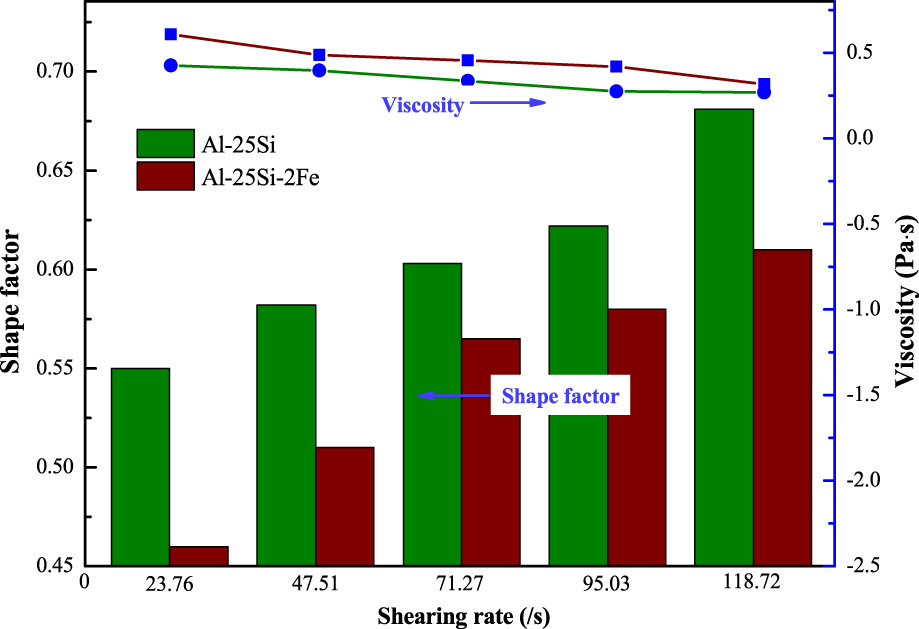
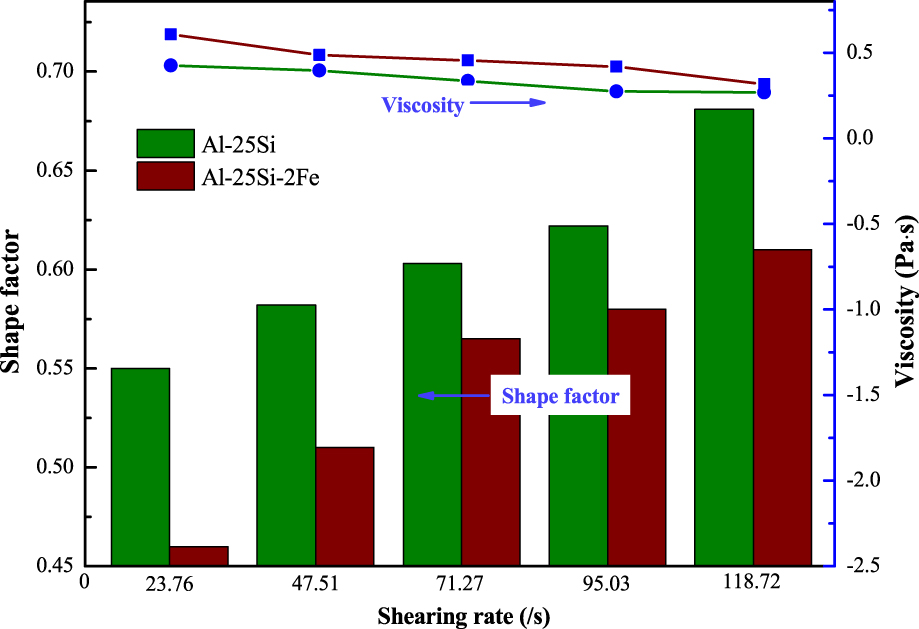
Figure 3 presents the change in apparent viscosity with respect to shape factor and a shear rate of both types of hypereutectic Al–Si alloys semisolid slurry in steady state at 720 °C. It can be seen that the apparent viscosity of both types of hypereutectic Al–Si alloys semisolid slurries decreased with an increasing shear rate. Also, both alloys have exhibited the shear thinning behavior. Figure 3 clearly demonstrates that the apparent viscosity of Al–25Si–2Fe alloys slurry is greater than that of the Al–25Si alloy under the same shear rate, which can be attributed to the fact that the viscosity is essentially the binding force between atoms [Reference Wu and Liu12]. The addition of Fe element leads to the enhanced bonding force between particles in the hypereutectic Al–Si alloys slurry, which implies that the viscosity of Al–25Si–2Fe alloys is higher than that of the Al–25Si alloy. Under isothermal conditions, the solid fraction of the same kind of semisolid slurry of hypereutectic Al–Si alloy is the same. At this stage, the apparent viscosity of semisolid slurry of hypereutectic Al–Si alloy is mainly influenced by the fine structure of the slurry, which corresponds to the aggregation degree of the solid particles in the microstructure. As shown in Fig. 2, the larger shear rate corresponds to the higher shear force. Consequently, it is easier to break the aggregation of the primary phase of semisolid hypereutectic Al–Si alloy. The decrease in the effective solid phase fraction results in the reduction in the apparent viscosity of the slurry. The shape factor tends to be smaller, generating more irregular grains. In other words, the higher roundness of the grains results in the lower friction force between the grains, which reduces the apparent viscosity of the semisolid slurry. As shown in Fig. 3, the shape factor increases with an increasing shear rate, leading to the higher amounts of spherical grains. In addition, the shape factor of Al–25Si–2Fe alloy was smaller than that of the Al–25Si alloy, which implies that the Al–25Si–2Fe alloy has a smaller amount of round particles. In the shear process, the internal friction force between grains is enhanced, which implies that the apparent viscosity of Al–25Si–2Fe alloy is higher than that of the Al–25Si alloy.
Apparent viscosity versus shape factor and shear rates of both types of hypereutectic Al–Si alloys semisolid slurry.
Steady-state apparent viscosity model for hypereutectic Al–Si alloys
Influence of solid fraction on the isothermal steady-state apparent viscosity
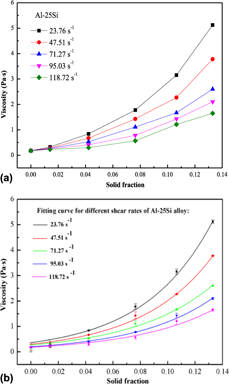
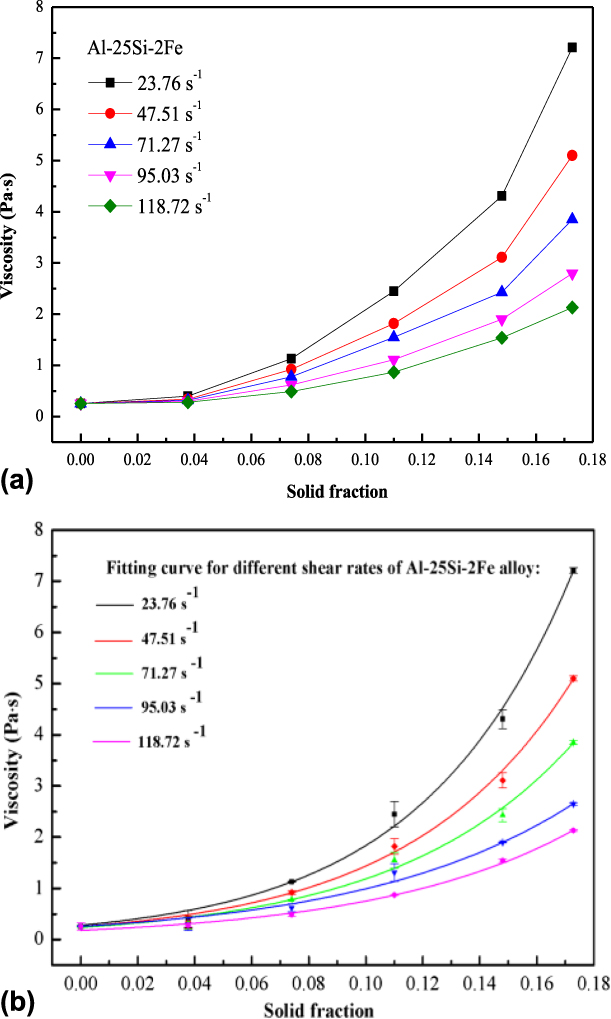
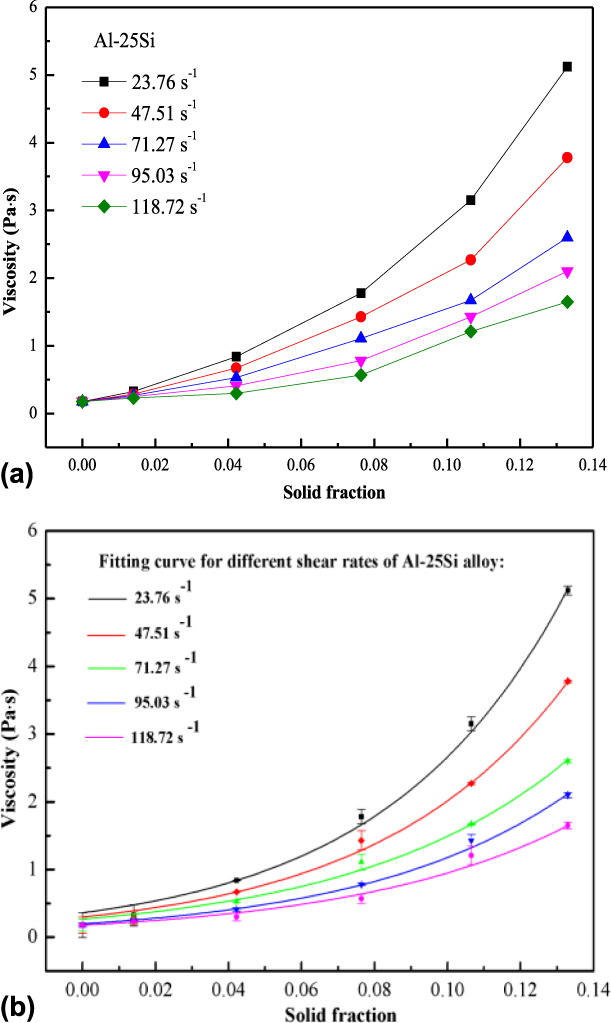
Figures 4 and 5 present the relationship between the steady-state apparent viscosity and solid fraction of both types of hypereutectic Al–Si alloys semisolid slurry. Figures 4(a) and 5(a) show that the apparent viscosity became higher with decreasing shear rate at the same level of solid fraction. However, for the same shear rate, the apparent viscosity gradually increased with the increasing solid fraction. This can be further explained as follows: when the solid-phase fraction is low, most of the slurry is present in the form of the liquid phase. At this stage, the viscosity is mainly determined by the liquid phase of the slurry. Hence, the semisolid slurry exhibits extremely low apparent viscosity. With the increase in solid-phase fraction, the number of solid-phase particles in the slurry and the contact area between solid particles gradually increased. Hence, the collision and friction between particles became more frequent, which resulted in more resistance from stirring in the semisolid slurry. Therefore, when the shear rate is the same, the apparent viscosity of the alloy increased with increasing solid fraction.
The steady-state apparent viscosity of semisolid slurry of Al–25Si alloys. (a) The relationship curve and (b) the fitting curve between apparent viscosity and a solid fraction under different shear rates.
The steady-state apparent viscosity of semisolid slurry of Al–25Si–2Fe alloys. (a) The relationship curve and (b) the fitting curve between apparent viscosity and a solid fraction under different shear rates.
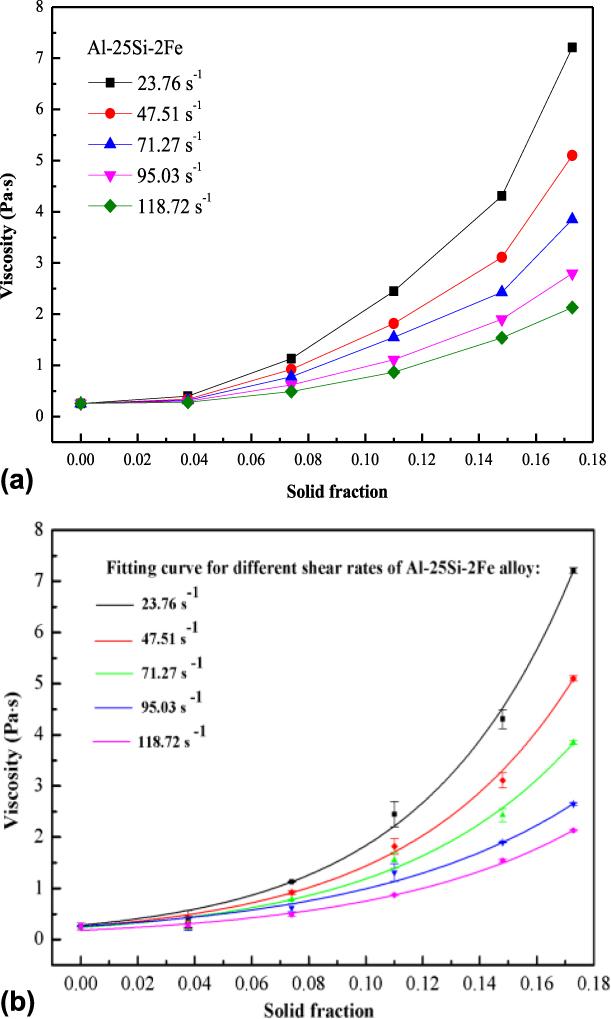
However, when the solid fraction is low, the steady-state apparent viscosity of the slurry increased at a low rate with the solid fraction [Reference Chen, Chen and Liao13]. However, when the solid volume fraction reached a critical value, the apparent viscosity began to increase rapidly because the gap between solid particles becomes very small and they contact each other. At this point, as long as the solid-phase fraction slightly increases, the collision and friction between solid particles increase dramatically, which leads to a sharp increase in apparent viscosity.
Steady-state apparent viscosity fitting equation
It can be concluded from the above experimental results that the solid phase fraction and shear rates significantly influence the steady-state apparent viscosity of hypereutectic Al–Si alloys. Figures 4(b) and 5(b) show that there is an exponential relationship between the apparent viscosity and the solid fraction of the alloys. Therefore, it can be assumed that the relationship between the apparent viscosity and the solid fraction satisfies the given equation:
 $$\eta = A\exp \left( {B{f_{\rm{s}}}} \right)\quad .$$
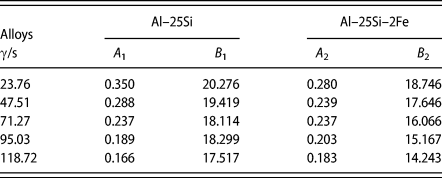
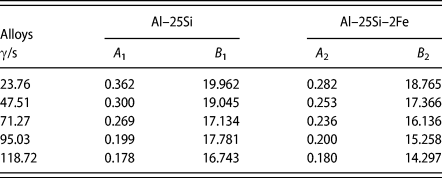
The viscosity curves of Al–25Si and Al–25Si–2Fe at different shear rates were fitted with exponential fitting, and the results are shown in Table I.
Exponential fitting values of apparent viscosity curves at different shear rates.

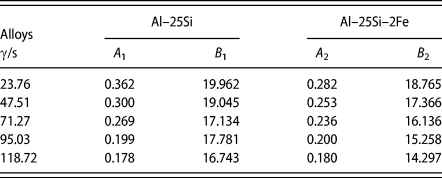
It can be seen from Figs. 4 and 5 that the results after the fitting process have errors, which have been rectified during the secondary fitting procedure (Table II):
Exponential fit values after quadratic fitting.
Mehrabian et al. [Reference Joly and Mehrabian14] have carried out steady-state isothermal experiments on Sn–15% Pb alloy molten melt and observed that the relationship between apparent viscosity and shear rate approximately satisfies the power law:
 $$\eta = k{\gamma ^n}\quad ,$$
where γ refers to the shear rate, and k and n correspond to the two factors related to the solid phase fraction. The smaller n value corresponds to the presence of more significant pseudoplasticity characteristics in the melt.
It can be seen from Tables I and II that with the increase in the shear rate, the values of A became smaller and the range of change became larger. On the other hand, the values of B exhibited a small change and it can be considered as a constant with average values of B 1 = 18.133 and B 2 = 16.364. Due to the shear thinness characteristics of semisolid alloys, its apparent viscosity and shear rate conform to the power law. Therefore, if A = kγn and the values of A and shear rate are taken from Table I, we obtain k 1 = 1.32 and n 1 = −0.40, k 2 = 0.64 and n 2 = −0.25, respectively. Therefore, the model equations of the steady-state apparent viscosity, solid phase rate, and shear rate of Al–25Si and Al–25Si–2Fe alloys can be given as follows:
 $${\eta _1} = 1.32\exp \left( {18.133{f_{{\rm{s1}}}}} \right) \cdot {\gamma ^{ - 0.4}}\quad ,$$
 $${\eta _2} = 0.64\exp \left( {16.364{f_{{\rm{s2}}}}} \right) \cdot {\gamma ^{ - 0.25}}\quad .$$
Equations (3) and (4) show that the steady-state apparent viscosity of hypereutectic Al–Si alloys is exponentially related to the solid fraction. Also, the power law is inversely related to the shear rate, which implies that it decreases with increasing shear rate.
Conclusions
This research adopted a self-made Searle coaxial double-tube rheometer to measure the apparent viscosity of two kinds of hypereutectic Al–Si alloys, which were prepared by the rotating-rod-induced nucleation technology. The findings of the present study can be summarized as follows:
(1) Microstructure at different shear rates indicates that the particles tend to attain spherical shape and the apparent viscosity becomes lower at higher shear rates. We have observed that the apparent viscosity is mainly influenced by the fine structure of the grains under the same level of solid fraction. The friction inside grains becomes smaller with increasing roundness of the particles, which resulted in lower apparent viscosity.
(2) During the isothermal shear processing, the apparent viscosity of both alloys decreased with the increase in shear rate. Moreover, the apparent viscosity of semisolid slurry of Al–25Si–2Fe alloy is higher than that of the Al–25Si alloy. As the shear rate increases, the shape factor of the alloy also increases, which results in a higher fraction of round grains. As a result, the apparent viscosity is decreased due to less friction in the shear process of round particles.
(3) During the continuous cooling process, the apparent viscosity of semisolid alloy gradually increased with the decrease in temperature. At the same temperature, the apparent viscosity of semisolid alloy at the high cooling rate is higher than the low cooling rate.
Methodology
(i) The semisolid slurry of Al–25Si and Al–25Si–2Fe alloys was prepared by rotating-rod-induced nucleation technology.
(ii) The rheological properties of hypereutectic Al–Si alloys melt under continuous cooling and isothermal temperature conditions were studied by the self-made Searle coaxial double-tube rheometer.
(iii) The torque sensor measured the resistance value of the sticky molten melt. The apparent viscosity, which depended on the shear rate, can be calculated by using the torque value and rotation speed.
Materials and methods
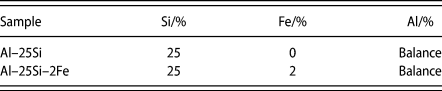
Two compositions of the hypereutectic Al–Si alloy were prepared as the target objects. Pure aluminum was used as the matrix material. Al–25Si and Al–25Si–2Fe alloys were prepared by adding Si (purity level: 95%) (wt%) as an alloying element and Fe (purity level 95%) (wt%) as an additive (see Table III).
Chemical compositions of the experimental alloys (wt%).

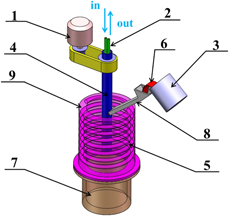
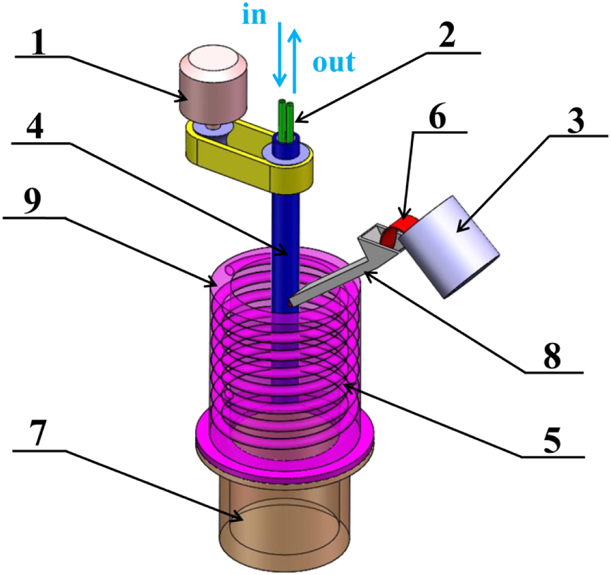
The schematic illustration of the rotating-rod-induced nucleation to prepare semisolid slurry is presented in Fig. 6, which takes an advantage of a certain degree of controllability and high efficiency [Reference Chen, Li, Zhou, Jiang, Zhou and He15]. The experimental setup consists of a speed motor, a cooling system, a pouring cup, a tin bronze rotary bar, and an environmental temperature control system of the slurry preparation chamber. Internal continuous cooling water was brought into a rotating rod of Ø 75 mm hollow in tin bronze, with an adjustable speed of 0–2500 r/min. The metallographic sample (20 × 20 × 20 mm) was taken from the center of the prepared semisolid billet and etched by 0.5% HF corrosion solution after polishing. The microstructures were observed using a Leica optical microscope.
Schematic illustration of the rotating-rod-induced nucleation method to prepare a semisolid slurry.
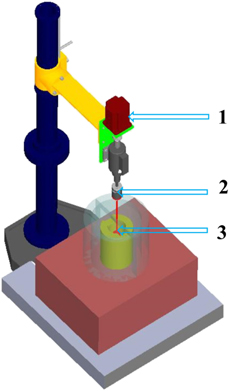
The rheological properties of hypereutectic Al–Si alloys melt under continuous cooling and isothermal temperature conditions were studied by the self-made Searle coaxial double-tube rheometer. The rheometer consists of a stationary external cylinder and a rotating internal cylinder [Reference Tzimas and Zavaliangos16], as shown in Fig. 7. The apparent viscosity measurement of semisolid alloy slurry, aiming at high-temperature molten melt, is different from the general liquid viscosity measurements. Therefore, the key components should have high-temperature resistance and mechanical stability during the measurement process. The rotor of the rheometer is made of high temperature resistant stainless steel to avoid device distortion during heating. The coaxiality of the rotor and the inner tube is within 0.1 mm, which makes the disturbance amplitude of the inner tube as weak as possible during the viscosity measurements. The joint position of the rotor and the torque sensor is overdone through the asbestos block, which reduces the upward conduction of heat. During the stirring process, the influence of molten melt on torque is passed through the rotor to the torque sensor. In addition, the recording instrument inside the equipment records the real-time change in torque parameters with respect to time. The torque sensor has an accuracy of 0.0001 N m, whereas the inner tube diameter and height were 30 mm and 100 mm, respectively.
Schematic illustration of the Searle coaxial double-tube rheometer.

During the shear process, the resistance can be produced on the inner tube due to the viscosity of sticky molten alloys, which hinders the stirring of the inner tube. The torque value of resistance can be obtained from the torque sensor. The apparent viscosity, which indicates the degree of viscosity of molten alloys, can be calculated by using the torque value and rotation speed. The relationship between torque and apparent viscosity can be expressed as follows [Reference Zhou, Mao, Liu, Xu and Shi10]:
 $$\eta = {M \over {4\pi h\omega }}\left( {{1 \over {r_1^2}} - {1 \over {r_2^2}}} \right)\quad .$$
The average shear rate of the rotor can be calculated from the given relationship [Reference Zhou, Mao, Liu, Xu and Shi10]:
 $$\gamma = {{2\omega {r_2}{r_1}} \over {{r_2}^2 - {r_1}^2}}\quad .$$
The solid phase fraction of semisolid slurry can be obtained from the Scheil formula [Reference Simlandi and Barman7, Reference Barman17]:
 $${f_{\rm{s}}} = 1 - {\left( {{{{T_{\rm{a}}} - {T_{\rm{l}}}} \over {{T_{\rm{a}}} - T}}} \right)^{{1 / {\left( {1 - k} \right)}}}}\quad ,$$
Herein, η represents the apparent viscosity of molten alloys (Pa s), γ refers to the shear rate, M denotes the viscous torque, h corresponds to the infiltration height of the inner tube (mm), ω represents the rotation speed of the inner tube, r 1 refers to the radius of the inner tube (mm), r 2 denotes the radius of the outer tube (mm), T a represents the melting point of pure Al, T l refers to the liquidus temperature, T corresponds to the actual temperature, and k is the equilibrium solute distribution coefficient of alloys.
The variation in isothermal steady-state apparent viscosity of Al–25Si and Al–25Si–2Fe semisolid slurries and the changes in apparent viscosity under different cooling modes, such as air cooling, natural cooling and furnace cooling, have been systematically investigated in this study. Five rotation speeds were adopted to measure the apparent viscosity from 100 r/min to 500 r/min, with an increment of 100 r/min. From the formula (6), the corresponding shear rates were calculated as 23.76, 47.51, 71.27, 95.03, and 118.72 s−1.
Acknowledgments
The authors acknowledge funding for this research from National Natural Science Foundation of China (51505205), Science Foundation of Kunming University of Science and Technology (KKZ3201532005). This work is supported by the National and Local Joint Engineering Laboratory of Advanced Metal Solidification Forming and Equipment Technology, Kunming University of Science and Technology. Kunming, China.