INTRODUCTION
The Scyliorhinidae is a large family of sharks distributed in the Atlantic, Pacific and Indian Oceans (Compagno et al., Reference Compagno, Dando and Fowler2005). Four species of catsharks of the genus Schroederichthys are endemic to South America: Schroederichthys tenuis Springer, Reference Springer1966 (northern Brazil to Suriname); S. chilensis Guichenot, 1848 (southern Chile to Peru); S. saurisqualus Soto, Reference Soto2001 (southern Brazil); and S. bivius Müller & Henle, 1838 (central Chile to southern Brazil). One species is endemic to Central America, S. maculatus Springer, Reference Springer1966 (Honduras and Nicaragua) (Springer, Reference Springer1966, Reference Springer1979; Soto, Reference Soto2001; Gomes et al., Reference Gomes, Signori and Gadig2006).
The narrowmouth catshark Schroederichthys bivius (Data Deficient—IUCN Red List of Threatened Species) (Chiaramonte, Reference Chiaramonte2005) is oviparous (~80 cm total length as adult), with a recorded distribution from Rio Grande do Sul, southern Brazil, to the Beagle Channel and the south-east Pacific to north of Chile (Soto, Reference Soto2001; Chiaramonte, Reference Chiaramonte2005). This species inhabits the south-western Atlantic Ocean at depths from 14 to 350 m, and feeds on cephalopods, fish, benthic crustaceans and other invertebrates (Sánchez et al., Reference Sánchez, Noemi and Bernardele2009). This paper reports the first record of S. bivius from the coast of Paraná State, southern Brazil, increasing its distribution along the Brazilian coast.
MATERIALS AND METHODS
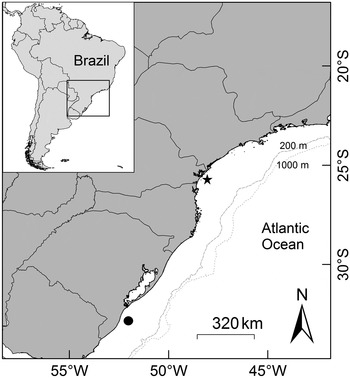
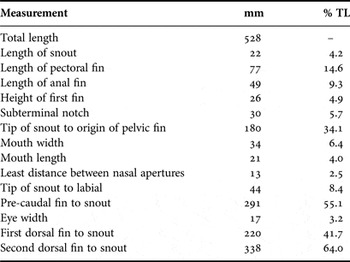
A female S. bivius was caught by gillnet of 9 cm mesh-size (between opposite knots) in September 2011. This specimen was captured between 10 and 12 m in depth at Itacolomis Island (25°50′S 48°24′W), ~15 km from the coast of Paraná State (Figure 1). Identification of the specimen followed the criteria of Springer (Reference Springer1979) and Soto (Reference Soto2001). Morphometric and morphological data were extracted according to the method of Springer (Reference Springer1979) (Table 1). The measurements were performed after the specimen was preserved.
Southern Brazil: circle represents the limit of distribution previously known (Rio Grande do Sul coast), and star represents the new Schroederichthys bivius occurrence from the Paraná coast.

Measurements (as percentages of total length: 528 mm TL) of the Schroederichthys bivius female (MHNCI 12481), captured off the Paraná coast, southern Brazil. Measurements based on those of Springer (Reference Springer1979).

RESULTS AND DISCUSSION
The narrowmouth catshark female measured 529 mm total length (TL) and weighed 251.5 g. Proportional measurements are expressed as percentage of TL in Table 1. Probably this individual is sexually mature according to TL reported by Soto (Reference Soto2001). Biological data through dissection were not obtained. The specimen is deposited in the Museu de História Natural Capão da Imbuia (MHNCI 12481), Curitiba, Brazil.
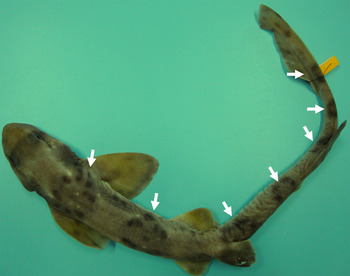
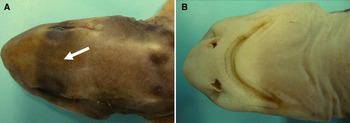
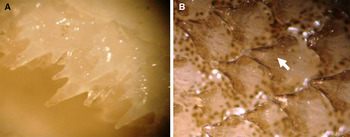
The specimen was identified as a S. bivius because of its dorsal coloration, composed of eight dark, poorly defined saddles and small white spots dispersed over a brown surface (Figure 2), unlike S. tenuis that has small spots outlining its saddles, without white spots (Gomes et al., Reference Gomes, Signori and Gadig2006). Schroederichthys bivius has a black bar between eyes (Figure 3A) and nasal flaps narrow (Figure 3B). The origin of the first dorsal fin in our specimen is over posterior end of pelvic fin base, as is typical of S. bivius, while S. saurisqualus has a greater interdorsal space, with first dorsal fin origin posterior to the vertical through insertion of pelvic fin. Schroederichthys bivius also has two dorsal saddles between dorsal fins, whereas S. saurisqualus has four saddles. In addition, S. bivius showed pointed dermal denticles with two ridges forming a groove (Figure 4A), unlike the rounded dermal denticles found in S. saurisqualus and with four or five ridges, and S. tenuis with four ridges. The dentition is composed of teeth multi-cuspidate, typically of Schroederichthys species, with a primary cusp and two or three cusplets on each side (Figure 4B).
Schroederichthys bivius female caught off the Paraná coast: white arrows indicate the seven dark saddles on brown dorsal surface.

Dorsal and ventral view of Schroederichthys bivius head caught off the Paraná coast: (A) black bar (arrow) between eyes; (B) nasal flaps narrow.

(A) Multi-cuspidate teeth of upper jaws of Schroederichthys bivius caught off the Paraná coast; (B) pointed dermal denticles taken from below first dorsal fin (anterior facing right), with two ridges. The arrow indicates the right ridge.

To date, only one specimen of S. bivius was reported and documented in Brazilian waters (Gadig, Reference Gadig2001; Soto, Reference Soto2001). This individual was a male of 702 mm TL captured off the Rio Grande do Sul coast in 1988. However, specimens of Schroederichthys from south-eastern Brazil are presently being studied (J. Soto, personal communication). The new occurrence of this species off the Paraná coast is a novelty and increases its distribution along the Brazilian coast (Figure 1). In addition, this individual can contribute to the ongoing taxonomic studies of Schroederichthys from South America. The distribution of S. bivius can overlap with S. saurisqualus.
ACKNOWLEDGEMENTS
We thank the fishery community of Matinhos; and Dr Carlos Bustamante, Dr Ulisses Leite Gomes and Jules Soto for information about Schroederichthys species.
FINANCIAL SUPPORT
We thank the Petrobrás Ambiental (PETROBRÁS) for financial support to M.C.R., L.S. and P.A.W., and CNPq for a scholarship to H.B.