Introduction
Due to advances occurring in fetal and neonatal medicine over the past several decades, the first generation of ELBW survivors have survived to adulthood and become parents. Even though preterm survivors appear to be more sensitive to stress and its effectsReference Waxman, Van Lieshout and Boyle1, Reference Van Lieshout, Boyle and Saigal2 no studies have investigated the transmission of this stress vulnerability to their offspring. It is therefore important that we understand the impact of exposure to significant perinatal adversities both for survivors and for their offspring.
Adverse early experiences can influence parenting and the transmission of personality phenotypes known to portend psychiatric risk of offspring. Indeed, previous research has shown that survivors of prematurity, particularly those born at extremely low birth weight (ELBW) have higher rates of shynessReference Waxman, Van Lieshout and Boyle1, Reference Van Lieshout, Boyle and Saigal2, a stress vulnerability factor for mental illness and other adverse health, interpersonal, and vocational outcomes across the life spanReference Saigal, Feeny and Rosenbaum3, Reference Saigal, Szatmari and Rosenbaum4. Until now, however, no one has had the opportunity to examine parenting among ELBW survivors and the transmission of their shy personality phenotype to their children.
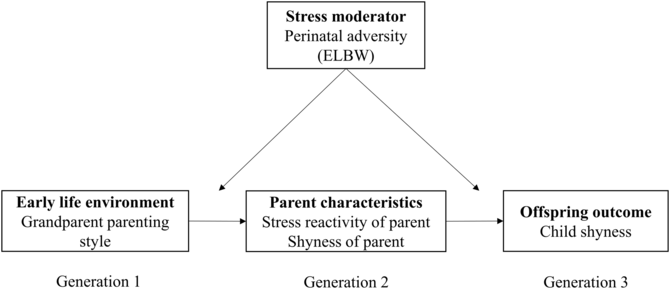
Here we explore the intergenerational transmission of shyness using data from a prospectively followed cohort of ELBW survivors (<1000 g) and normal birth weight (NBW) controls at age 30–35 when many of them have become parents. We examined whether (1) shyness and parenting stress in ELBW and NBW participants (Generation 2; G2) mediated the association between the parenting style of their own parents (Generation 1; G1) and shyness in their own children (Generation 3; G3) and (2) the altered stress reactivity of ELBW/NBW parents (G2) resulting from their perinatal exposure to severe perinatal stress (i.e., ELBW birth weight status) moderated the mediating effect of their shyness and parenting stress on shyness in their children (G3) (Fig. 1).
Proposed intergenerational transmission of risk model for shyness.

Methods
Sample
The study sample consisted of a prospectively followed cohort of ELBW survivors born (<1000 g) in central-west Ontario, Canada, between 1977 and 1982. A total of 397 ELBW infants were recruited at birth, and of these, 179 (45%) survived to hospital dischargeReference Saigal, Feeny and Rosenbaum3. At age 8, 145 full-term, NBW children were matched to these ELBW survivors by ethnicity, sex, and familial socioeconomic status (SES; G2)Reference Saigal, Szatmari and Rosenbaum4. Longitudinal follow-up assessments of all G2 participants took place at ages 8, 14, 22–26, and 30–35 years. Both ELBW and NBW groups participated in an identical follow-up protocol at each assessment. At the 30- to 35-year follow-up assessment, 100 ELBW survivors and 89 NBW controls participated. At this time, 45 of these participants (18 ELBW and 27 NBW) had children of their own and provided information on both their parenting stress and their child’s temperament. These 45 parents had a total of 68 children (28 offspring of ELBW survivors and 40 offspring of NBW controls). The local Research Ethics Board provided ethics approval, and all participants provided written informed consent.
For the present study, grandparents or G1 comprised the parents of ELBW survivors and NBW controls, G2 comprised ELBW and NBW participants, and G3 comprised children of the ELBW and NBW participants.
Variables
Outcome: shyness in children (G3)
When they were 30–35 years old, parents (G2) completed the Colorado Child Temperament Inventory (CCTI) for each of their children (G3). The CCTI measures multiple domains of temperament, including sociability, emotionality, activity, soothability, attention span/persistence, and shyness. Each subscale comprises five items, ranging from 1 (not at all characteristic) to 5 (extremely characteristic) for a subscale score range from 5 to 25, with higher scores on the subscale representing higher levels of that temperament characteristic. Given that shyness is a personality phenotype of individuals born extremely premature, the shyness subscale was of particular interest in the present study. A sample item is “Child takes a long time to warm up to strangers.” The CCTI has good psychometric propertiesReference Rowe and Plomin5, Reference Buss and Plomin6, and the shyness subscale had acceptable reliability in our sample (α = 0.63).
Mediator 1: parenting stress in parents (G2)
The Parenting Stress Index–Short Form (PSI-SF)Reference Abidin7 was completed by ELBW survivors and NBW control participants (G2) at age 30–35 and is a 36-item measure that assesses the level of stress in the parent–child unit. The PSI-SF contains three scales (a) parental distress, (b) difficult child, and (c) parent–child dysfunctional interaction as well as total parenting stress. Items are measured on a 5-point scale from strongly agree to strongly disagree, with a higher score representing greater perceived parenting stress. We used the total parenting stress score in this study, with a possible range of scores from 36 to 180. Reliability in our sample was excellent (α = 0.93), consistent with previous research on the questionnaire’s psychometric propertiesReference Reitman, Currier and Stickle8.
Mediator 2: shyness in parents (G2)
Shyness in G2 at age 30–35 was measured using the five highest loaded shyness itemsReference Bruch, Gorsky and Collins9 of the Cheek and Buss Shyness ScaleReference Bruch, Gorsky and Collins9–Reference Cheek and Buss11. Items on this scale include “I find it hard to talk to strangers” and each item is rated on a 5-point Likert scale from 0 (extremely uncharacteristic) to 4 (extremely characteristic). Higher scores indicate greater shyness. The shyness subscale has good internal consistency in our sample (α = 0.79), in keeping with the established reliability of the measureReference Bruch, Gorsky and Collins9, Reference Cheek and Buss11.
Exposure: parenting style in grandparents (G1)
When ELBW and NBW participants (G2) were 22–26 years old, they retrospectively reported on the parenting style that their parents (G1) used during their childhood (up to age 16) by completing the parental bonding instrumentReference Parker12 (PBI). The PBI is a 24-item scale with 12 items assessing overprotective parenting behavior (e.g., “let me decide things for myself”) and 12 items assessing insensitive parenting behavior (e.g., “seemed emotionally cold to me”), which are rated on a 4-point scale from 0 (very like) to 3 (very unlike). Higher total scores indicate overprotective and insensitive parentingReference Parker and Mater13. The PBI has been shown to be a reliable and valid measure of the parenting environmentReference Wilhelm, Niven and Parker14. Internal consistency in our sample was excellent (α = 0.92).
Covariates
Maternal psychopathology and SES are known influences on the relation between parenting behavior and offspring social inhibitionReference Natsuaki, Leve and Neiderhiser15. Accordingly, SES and maternal negative affect in grandparents (G1) when parents (G2) were 8 years old were considered as covariates in all analyses.
Maternal negative affect was assessed using the five negative affect items of the Bradburn Affect Balance ScaleReference Bradburn16. Higher scores indicate greater negative affect. This scale has good psychometric propertiesReference Bradburn16 and had acceptable internal consistency in our sample (α = 0.62). The Hollingshead two-factor index was used to obtain SESReference Hollingshead17. This index considers parent educational attainment and occupational prestige, and grandparents’ scores were classified from 1 (high SES) to 5 (low SES).
Data analysis
Birth weight group differences were identified using t-tests for continuous variables and χ2 tests for categorical variables. To examine the intergenerational transmission of shyness across the three generations, we conducted a multilevel, multiple-group path analysis controlling for clustering of responses at the family level.
The product coefficient methodReference MacKinnon18 was utilized to assess the mediating effect parenting stress and shyness of parents (G2). The method of variance estimates recoveryReference Zou and Donner19 was utilized to determine whether path estimates for ELBW survivors significantly differed from NBW controls. All tests were two sided at α = 0.05. Model fit was based on the following indices: goodness of fit, comparative fit index (CFI), and standardized root mean square residual (SRMR)Reference Schreiber, Nora and Stage20.
Missing data
Multiple imputation (10 data sets) was used to account for data assumed to be missing at random. Data on household SES or maternal negative affect of G1 were missing for 7% of participants.
Results
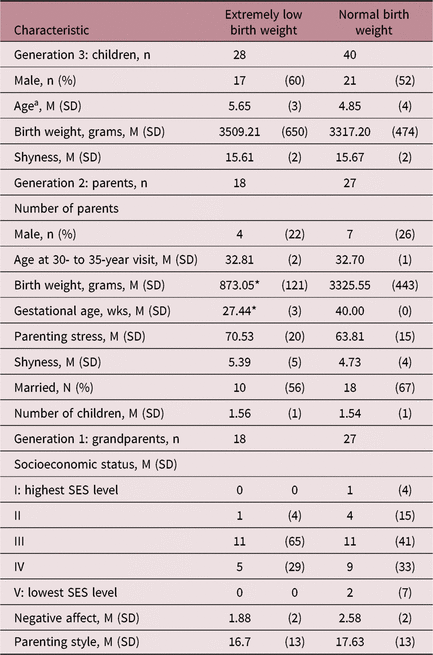
No statistically significant differences were found comparing sociodemographic characteristics such as age, sex, birth weight, and SES of ELBW survivors and NBW controls at any of the three generations. Further, no statistically significant differences were observed between children born to ELBW survivors and NBW control participants (Table 1).
Sample characteristics

* p < 0.0001.
a Refers to age of children at the time of 30- to 35-year follow-up of parents (G2).
Transmission of stress across three generations
The insensitive and overprotective parenting style of grandparents (G1) was positively associated with shyness of the children (G3) of ELBW survivors (G2), β = 0.64, 95% CI 0.41, 1.41, p = 0.01, but not of NBW control participants (β = 0.17, p = 0.21).
Mediation by parenting stress of parent (G2)
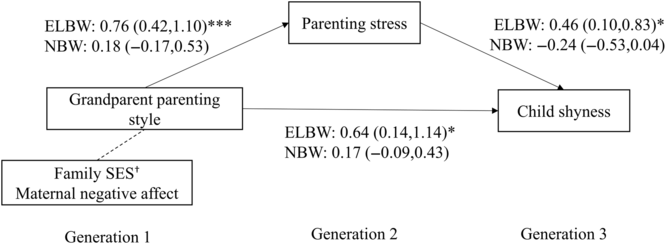
Figure 2 illustrates the relation between the parenting style of grandparents (G1), parenting stress of parents (G2), and shyness in children (G3). Birth weight of parents (G2) significantly moderated the relation between the parenting style of grandparents (G1) and parenting stress of parents (G2), Δβ = 0.58, 95% CI 0.09, 1.07, such that overprotective and insensitive parenting of grandparents (G1) predicted greater parenting stress in ELBW parents (G2) (β = 0.76, p = <0.001), but not NBW parents (β = 0.18, p = 0.32). Birth weight also moderated the relation between parenting stress of parents (G2) and shyness of children (G3) (Δβ = 0.70, 95% CI 0.24, 1.17). As ELBW survivors experienced greater stress in their parenting role (G2), they reported greater shyness among their children (G3) (β = 0.18, p = 0.01), a finding that was not observed among NBW parents (β = 0.15, p = 0.10).
Path model of the intergenerational transmission of shyness through parenting stress. Models were specified for extremely low birth weight survivors (top) and normal birth weight survivors (bottom) of Generation 2. *p < 0.05, **p < 0.01, ***p < 0.0001. †Path model adjusted for family socioeconomic status (SES) and maternal negative affect when Generation 2 was 8 years of age.

The mediating effect of parenting stress of parents (G2) on the relation between the parenting style of grandparents (G1) and shyness of children (G3) was also moderated by birth weight status, Δαβ = 0.40, 95% CI 0.06, 0.73. Parenting stress of parents (G2) mediated the relation between the parenting style of grandparents (G1) and shyness of children (G3) among ELBW survivors, αβ = 0.35, 95% CI 0.03, 0.67, but not among NBW control participants, αβ = −0.04, 95% CI −0.14, 0.06. Therefore, among ELBW survivors, the parenting style of grandparents (G1) predicted greater stress in their children’s role as parents (G2) and greater shyness among their children’s children (G3). Among NBW controls, no relations were observed among the parenting style of grandparents (G1), parenting stress of parents (G2), and shyness in children (G3). Acceptable fit was achieved for this model, χ2(4) = 6.4, CFI = 0.95, SRMR = 0.05.
Mediation by shyness of parent (G2)
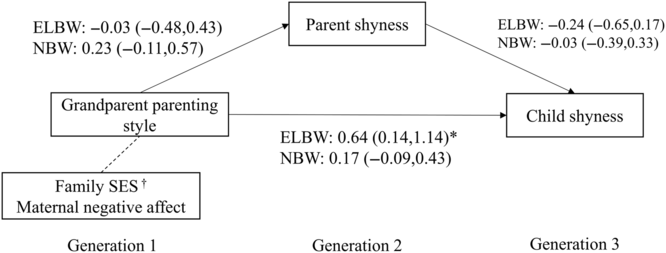
Figure 3 depicts the relation between the parenting style of grandparents (G1), shyness of parents (G2), and shyness of children (G3). For both ELBW and NBW parents (G2), parenting style of grandparents (G1) was not related to shyness in parents (G2) at age 30–35 (G2) (ELBW: β = −0.03, p = 0.91; NBW: β = 0.23, p = 0.19). Further, shyness in ELBW and NBW parents (G2) was not related to parent-rated shyness in children (G3) (ELBW: β = −0.24, p = 0.26; NBW: β = −0.03, p = 0.18). Shyness in parents (G2) also did not mediate the association between parenting style in grandparents (G1) and shyness in ELBW or NBW parents’ offspring (G3). No relations were observed among the parenting style of grandparents (G1), shyness in parents (G2), and shyness in children (G3) among both ELBW and NBW controls. The data fit this model well, χ2(4) = 3.5, CFI = 0.99, SRMR = 0.04.
Path model of the intergenerational transmission of shyness through parent shyness. Models were specified for extremely low birth weight survivors (top) and normal birth weight survivors (bottom) of Generation 2. *p < 0.05, **p < 0.01, ***p < 0.0001. †Path model adjusted for family socioeconomic status (SES) and maternal negative affect when Generation 2 was 8 years of age.

Discussion
To our knowledge, this is the first study to explore relations among perinatal adversity, parenting stress, and personality development across three generations in general, and in ELBW offspring in particular. We found that an early parenting environment that is overprotective and insensitive may influence ELBW survivors’ later experience of parenting stress, and potentially negatively affects their offspring in the form of elevated levels of shyness. These findings suggest that among those who experience perinatal adversity, stress reactivity may generalize to other domains such as parenthood and may be transmitted to their offspring, reflected in their perceptions of their children as shy and socially anxious. This personality phenotype may subsequently place their offspring at risk of later psychopathology.
The findings of this study are consistent with previous work that has identified links among retrospective reports of an early life parenting environment that was harsh (G1), high maternal distress in adults (G2), and social problems in offspring (G3)Reference Assel, Landry and Swank21. Assel and colleagues (2002) did not identify an effect of prematurity, though other studies have shown that offspring who experienced added stress or vulnerability (i.e., low birth weight) are especially sensitive to the effects of overprotective and controlling parenting stylesReference Tully, Arseneault and Caspi22. Overprotective and controlling parenting styles have been associated with higher levels of children’s dependence on parents and lower levels of confidence in novel situationsReference Wood, McLeod and Sigman23, so it is possible that ELBW survivors may experience reduced confidence in their later role as parents, influencing their overall parenting behaviors. In our study, even though ELBW survivors do not report significantly greater stress in their parenting role compared to NBW controls, their unique vulnerability combined with a suboptimal early parenting environment was positively related to high stress reactivity to the demands of parenthood (i.e., parenting stress), and the perception of poor competency of their children in new social situations (i.e., shyness).
Perinatal adversity is thought to induce epigenetic modifications of the hypothalamic–pituitary–adrenal axis, resulting in a heightened stress response and altered neuronal development in areas related to emotion regulation and copingReference Bock, Rether and Gröger24, Reference Van Den Bergh25. These early developmental changes increase vulnerability to stress and disease into adulthoodReference Gluckman, Hanson and Cooper26, Reference O’Donnell and Meaney27, but no studies appear to have examined the transmission of this vulnerability to subsequent generations. Previous work has observed increased rates of behavior problems in childhoodReference Roberts, O’Connor and Dunn28 and depression into later lifeReference Roberts, Chen and Slopen29 among offspring of maltreated mothers, supporting a generational impact of child abuse. However, this is the first study to observe the stress vulnerability of ELBW survivors in their offspring (i.e., social inhibition/shyness) and to support the transmission of risk to subsequent generations using another model of early life adversity.
These findings suggest that the perinatal programming of ELBW survivors (G2) may be passed on to their offspring (G3). The transmission of stress vulnerability due to perinatal adversity of the ELBW parent generation (G2) may occur through various mechanisms. Females born ELBW (G2) may continue to manifest a heightened stress response during pregnancyReference Bock, Wainstock and Braun30. Stress-induced global histone methylation changes have also been observed in animals models in subsequent generations not exposed to stressful environmentsReference Klosin, Casas and Hidalgo-Carcedo31, Reference Crudo, Petropoulos and Moisiadis32, and so epigenetic alterations may be inherited by G3 through germ line transmission, continuing the cycle of risk even after stress conditions have ceased.
Conversely, environmental contributors to the transmission of stress vulnerability have been proposedReference Natsuaki, Leve and Neiderhiser15, Reference Rice, Harold and Boivin33 such as the early parenting environment. For example, responsive parenting of children of socially phobic biological parents interrupted the transmission of behavioral inhibition among offspringReference Natsuaki, Leve and Neiderhiser15. Parenting behaviors of ELBW parents (G2) may therefore induce postnatal epigenetic changes in the brain of their offspring during later sensitive periods of developmentReference Bock, Wainstock and Braun30 as well. Therefore, nongenomic behavioral transmission may induce a social stress/shyness phenotype of their offspring, supporting the continuation of a stress vulnerable phenotype among subsequent generations.
Limitations
This study has some limitations that should be discussed. First, as this study followed participants for over three decades, there has been some attrition. The current cohort comprised 68% (n = 18) and 67% (n = 27) of the original ELBW and NBW sample, respectivelyReference Morrison, Ramsingh and Gunn34, with a smaller proportion (28% of ELBW survivors and 45% of NBW controls) having had children by age 30–35. This attrition resulted in a small sample size.
Second, the measures used to assess early parenting environment, parenting stress, and temperament were all completed by the same informant, that is, only one parent (G2), and so the observed effect may be inflated due to shared method variance. Furthermore, identical measures of parenting across G1 and G2 were not available, but nevertheless, we were able to demonstrate the intergenerational continuity of stress reactivity.
Third, investigators interested in using the results of this work to inform sample size calculations in future studies should be mindful of the limited sample size available in this study.
Fourth, given the concurrent assessment of variables, it is difficult to establish causal relations among them. It is possible that the reciprocal relations exist between parenting stress (G2) and child shyness (G3). Future studies should use a larger sample with multiple informants, including direct behavioral observations of parents and children, in a prospective longitudinal design to provide more robust evidence regarding the potential mechanisms of transmission of child temperament.
Conclusion
These findings have both important theoretical and practical implications. In the oldest known prospectively followed cohort of ELBW infants in the world, and the first known investigation of their offspring, we were able to test novel hypotheses regarding the intergenerational transmission of stress and the antecedents of shyness across three generations. To our knowledge, this is the first study to investigate the association among perinatal adversity, parenting, and personality development across three generations. Findings support a cycle of stress vulnerability across generations, as parenting stress of the ELBW parents (G2) mediated the relation between the parenting style of grandparents (G1) and shyness in children (G3). Thus, these findings suggest that perinatal stress may be transmitted to the next generation in humans. A three-generation approachReference Cheng, Johnson and Goodman35 including support for grandparents (parents of ELBW infants), parents (ELBW survivors), and children (offspring of ELBW survivors) could have the potential to interrupt this cycle of transmission. Continued assessment of ELBW survivors into adulthood and parenthood and of their offspring is warranted to further understand the multigenerational effects of perinatal stress on physical and emotional well-being and to develop interventions aimed at optimizing the health and success of children and families.
Acknowledgements
The authors thank all the study participants and their families as well as Mr. Calan Savoy for his assistance with manuscript preparation.
Financial support
All phases of this study were supported by Canadian Institutes of Health Research grants CIHR: TMH-103145 (to L.A.S) and CIHR: MOP42536 (to S.S.) and National Institute of Child Health and Human Development grant NICHD: 1-R01HD40219 (to S.S.). All funding sources did not have a role in the study design, collection, analysis, or interpretation of the data; the writing of the manuscript; or the decision to submit the manuscript for publication.
Conflicts of interest
None
Ethical standards
The authors assert that all procedures contributing to this work comply with the Tri-Council Policy Statement of Ethical Conduct for Research Involving Humans and with the Helsinki Declaration of 1975 and have been approved by the Hamilton Integrated Ethics Review Board (HiREB).