When a bilingual intends to speak in one language, translation equivalents and related words in the non-intended language are also activated (Kroll, Bobb & Wodniecka, Reference Kroll, Bobb and Wodniecka2006). Given this pattern of co-activation, one would then also like to know whether or not the forms of the non-intended language enter into actual online competition with those of the intended language during speech production. Models that emphasize the selectivity of bilingual lexical access (Costa, Miozzo and Caramazza, Reference Costa, Miozzo and Caramazza1999) view cross-language competition as reflecting “only the flow of activation, not genuine competition for selection” (Kroll et al., Reference Kroll, Bobb and Wodniecka2006, p. 121). For these models, lexical selection is truly competitive only within languages, but not across languages.
In contrast, non-selective models assume that the processor considers all activated candidates from both languages. In this framework, successful selection of the proper candidate can be achieved by maintaining a higher level of activation for words from the intended language (see Costa and Santesteban, Reference Costa and Santesteban2004). Alternatively, the same result can be obtained by inhibiting words in the non-intended language (Green, Reference Green1998).
Recent work has suggested that selectivity may be linked to language proficiency. In this regard, Costa and Santesteban (Reference Costa and Santesteban2004) found a striking difference in the performance of highly proficient bilinguals vs. less proficient L2 learners in a language-switching task. Asymmetrical switching costs were observed for Spanish learners of Catalan and Korean learners of Spanish (i.e., it was harder to switch from the L2 into the L1 than vice versa.), but these switching costs were not present when highly proficient Spanish–Catalan bilinguals were asked to perform the switching task either in their L1 and L2, or in their L1 and L3. Costa and Santesteban suggested that the highly proficiently bilinguals may be able to achieve language selection without actively inhibiting cross-language competing candidates whereas the L2 learners may need to make use of inhibitory control to ensure selection in the intended language. They argued that, for a bilingual speaker, an increase in proficiency might lead to a qualitative change from “the reliance on inhibitory control to the reliance on a language-specific selection mechanism during lexical selection” (2004, p. 505). Kroll et al. (Reference Kroll, Bobb and Wodniecka2006) examined additional evidence suggesting that selectivity may be a function of language proficiency factors.
In the current studies, we are interested in pursuing this issue by exploring the roles of (1) L2 vocabulary knowledge, (2) working memory capacity and (3) language learning history in promoting or hindering language selectivity. Our initial default hypotheses here are fairly straightforward.
First, we expect that speakers with higher-level L2 vocabulary knowledge should demonstrate stronger language selectivity. We make this prediction on the basis of evidence in support of the Revised Hierarchical Model of Kroll and Stewart (Reference Kroll and Stewart1994). In this model, L2 lexical representations are initial dependent on L1 representations. As L2 lexical access becomes increasingly independent, it becomes easier to achieve selectivity, because L2 forms can be activated as a group without triggering co-activation of the L1 forms to which they are linked. It is possible to measure L2 vocabulary knowledge in terms of both vocabulary size and vocabulary depth (Laufer & Nation, Reference Laufer and Nation1999). Vocabulary size denotes the number of words a learner possesses of the target language. Vocabulary depth includes knowledge about the form, position, function and meaning of a word (Nation, Reference Nation1990). Li (Reference Li2003, Reference Li2007) examined the role of L2 vocabulary knowledge on semantic processing of Chinese learners of English using a primed lexical decision task. The results showed that learners with high-level English vocabulary knowledge were significantly quicker and more accurate than those with low-level L2 vocabulary knowledge.
Second, it is possible that bilinguals with greater working memory capacity may show stronger language selectivity. Modern theories of working memory (Botvinick & Plaut, Reference Botvinick and Plaut2006; Cowan, Reference Cowan2005; Miyake & Shah, Reference Miyake and Shah1999; Rosen & Engle, Reference Rosen and Engle1998) view it as a system not only for storing and processing temporary information, but also for suppressing irrelevant information and allocating cognitive resources (e.g., Just and Carpenter, Reference Just and Carpenter1992). High working memory capacity has been found to be particularly critical for bilingual tasks that demand the activation of both languages (Tokowicz, Michael & Kroll, 2004). It is relatively less useful in more automatic bilingual tasks (Li, Reference Li2004).
Third, it is possible that bilinguals who acquire their knowledge of L2 in more interactive learning contexts may come to acquire greater control over language selection. Tokowicz et al. (Reference Tokowicz, Michael and Kroll2004) examined the effects of study-abroad experience and working memory capacity on the types of errors made in a single-word translation task from the L1 into L2. Their study suggests that study-abroad experience leads individuals to make more meaning-related responses.
Several studies have examined the independent effects of L2 vocabulary knowledge, working memory capacity and learning experience on the issue of selectivity in L2 lexical access. However, no study has yet examined their (possibly complex) joint effects in a single experimental framework. The current study seeks to explore these relations.
To examine these issues, we chose to use the semantic competitor priming (SCP) paradigm, devised by Wheeldon and Monsell (Reference Wheeldon and Monsell1994), and modified by Lee and Williams (Reference Lee and Williams2001). In this paradigm, each trial involves five events. In the first three events, participants are asked to provide a name in response to a given definition. For example, a participant might be given the definition “an animal which a traveler rides on in the desert” and then have to respond with the name “camel”. Each trial begins with three such definitions, all provided in the L1. After providing the names to match the three definitions, the participants name two pictures – first a filler picture and then the target picture. The language required for naming the pictures is cued by the presence of a flag for the relevant country.
The design used by Lee and Williams (Reference Lee and Williams2001) involved a crossing of the three factors of semantic relatedness of the prime to the target (related–unrelated), the language of the filler picture (L1–L2), and the language of the target picture (L1–L2). In the within-language priming condition, the target picture is to be named in the L1. In the cross-language priming condition, the target picture is to be named in the L2. In the language-switch conditions, the filler preceding the target is in a different language from the target. In the no-switch conditions, the target and the preceding filler are in the same language.
For the within-language priming condition, the time to name the target picture is longer when the prime is a related semantic competitor. The production of a related prime, such as “camel”, interferes with the later naming of a semantically related target picture such as “horse”, as opposed to some unrelated picture. This effect occurs despite the fact that there are two (and sometimes more) other naming events between the prime and the target. However, this effect is completely wiped out in the language-switch condition. Thus, the presence of a picture of an unrelated word like pluie “rain” to be named in French eliminates the SCP effect for within-language interference priming from “camel” to “horse”. Similarly, the presence of the picture of an unrelated word like “rain” in English eliminates the SCP effect for cross-language interference priming from “camel” to “cheval”. Lee and Williams took the elimination of the SCP effect by the language switch as evidence for the selective nature of lexical access in bilingual processing.
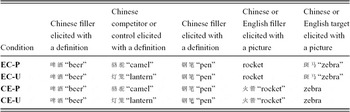
In our studies, we wanted to focus on the links between this elimination of the SCP effect in the language-switch conditions and the dimensions of vocabulary knowledge, learning experience and working memory (WM) capacity. Therefore, we only used language-switch trials in which the two pictures to be named came from different languages. This means that we used four trial types instead of eight, as in Lee and Williams (Reference Lee and Williams2001). Table 1 illustrates the design of our studies and the names of the four conditions: EC-P, EC-U, CE-P and CE-U.
A sequence of expected responses in one run of trials for four experimental conditions.

In Study 1, we tested the role of L2 vocabulary knowledge on SCP with Chinese–English bilinguals with more than 12 months study-abroad experience as participants. We hypothesized that bilinguals with a higher level of L2 vocabulary knowledge would benefit more from their study-abroad learning experience than their counterparts with a lower level of L2 vocabulary knowledge due to richer vocabulary, and that this difference in lexical knowledge would affect how they achieve language selection in spoken word production. Thus, we predicted that the within-language SCP effect might be observed for the bilinguals of both higher and lower levels of L2 vocabulary knowledge, but a different pattern might be demonstrated with regard to the cross-language SCP effect.
In Study 2, we tested the role of learning experience on SCP with Chinese-speaking learners of English with no study-abroad experience as participants. We hypothesized that learning experience might affect the way how Chinese–English classroom learners might achieve their language selection in spoken word production; therefore Chinese–English classroom learners were expected to demonstrate only the cross-language SCP effect, but not the within-language SCP effect.
In Study 3, we explored the role of individual differences in working memory capacity and learning experience on SCP by examining the spoken word production process of Chinese–English bilinguals with study-abroad experience and Chinese-speaking learners of English with no study-abroad experience. We hypothesized that individual differences in working memory capacity and learning experience would also influence the way participants achieve language selection. Advantage in cognitive resources might allow individuals with higher working memory capacity to maintain the head start which the Chinese competitor had on the primed target picture naming in the within-language priming condition; therefore, we predicted that within- and cross-language SCP effects could be observed for the individuals with higher working memory capacity regardless of study-abroad experience, but this pattern might not be demonstrated for those individuals with lower working memory capacity.
Study 1
Method
Participants
Twenty-four paid full-time university students participated in this study. They were relatively fluent Chinese–English speakers with more than 12 months study-abroad experience. At the time of the study, they were studying at a university in Pittsburgh, Pennsylvania. Twenty-two of them were graduate students and two of them were undergraduate students. Half of them were male students and half were female students.
Materials – pictures and definitions
The thirty-five target pictures were selected from pictures provided by the International Picture Naming Project at CRL-UCSD. The pictures were chosen from the six categories of animals, small artifacts, big artifacts, clothes, food and people. All of the selected pictures could be named using two Chinese characters. The definitions for these two-character words were taken from the Contemporary Chinese Dictionary (2005).
To verify our stimuli, we recruited twenty graduate students native speakers from Chongqing University to provide names to match the definitions and pictures. All selected pictures and definitions elicited agreement at the level of 80% or higher. After that pretest, a semantic relatedness rating task was administered to another group of twenty graduate students native speakers at the same university. Using a five-point scale on which 1 was “unrelated” and 5 was “highly related”, we found a semantic relatedness rating of 4.29 for the related pairs and 2.11 for the unrelated pairs.
Individual difference measures
(i) Vocabulary measurement. Laufer and Nation (Reference Laufer and Nation1999) designed the Controlled Active Vocabulary Test (CAVT) to measure learners' ability to access a word for use in a constrained context. There are ninety sentences and each of them has a word with a missing part, which has to be supplied. The first letter of each item is always provided so that there is only one correct answer for each item. For example: “He was riding a bic ___”. The participants need to understand the meaning of the sentence or activate their knowledge of the missing word before they are able to fill in the blank. A correct answer is scored 1 point in this task, and the highest possible score is 90.
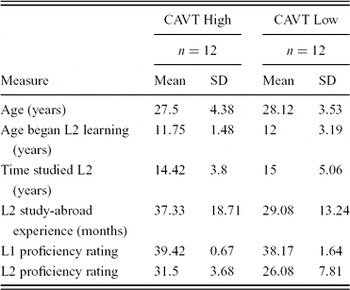
(ii) Language history survey. Participants completed a language history survey in which they reported on their L2 learning experiences in L1 Chinese. They all began their English learning in schools in PR China. Some of them began their English learning in a primary school and some in a secondary school. Each participant rated their L1 and L2 ability separately for the four skills of reading, writing, speaking and listening. For each skill, participants judged their proficiency on a 10-point scale with 10 marking the highest level. They also indicated their types of L2 language learning exposure as well as the age at which they began learning the L2. Table 2 provides details regarding the group means for the major measures of the survey.
Language history survey data for the Chinese–English bilinguals.

(iii) Working memory span task. We used a modified version of the Conway and Engle (Reference Conway and Engle1996) operation span task. In this task, which was conducted in Chinese, sixty-six mathematical operations were randomly paired with a total of sixty-six to-be-remembered Chinese words. The mathematical operations were organized into fifteen series, and the number of operation-word strings per series varied from two to six, with three series of each length being performed. The order of series length was randomized. Three series of two operation-word strings were used for the purpose of practice.
During the task, the participants were presented with operation-word strings, e.g., “(6÷2) + 2 = 5?” They were instructed to read the operations aloud and decide whether the operations were correct or not by pressing the “Y” or “N” button and at the same time saying dui “correct” or cuo “wrong” aloud. After that, a two-character Chinese word would appear immediately on the screen, and the participants were asked to read aloud the Chinese word presented. Then, the experimenter immediately clicked the mouse, and another operation-word string was presented. This process continued until the recall cue was presented, and then the participants were to recall the Chinese words in order. A mini-recorder was used to record their recall. The instructions for this task were presented in written form in Chinese.
Procedure
The design of the study was summarized in Table 1. We created four list orders to systematically vary trial order across participants. Each participant was asked to respond orally to three self-paced Chinese definition trials each using a two-character Chinese word followed by two picture-naming trials. If a participant did not know the word the definition referred to, he/she was instructed to say 不 知 道 “I don't know”. As in Lee and Williams (Reference Lee and Williams2001), before each picture, a cue was displayed on the computer screen, telling the participant what language to use when naming the following picture. Participants were also instructed to name pictures as quickly as possible in either Chinese or English following the language cue before the picture. When they named a picture in Chinese, they were also required to respond with a two-syllable word. If a participant did not come up with a response, he/she could say I don't know or 不 知 道 according to the language cue given before the picture.
Participants were tested individually and the complete testing session lasted about 50 minutes. Participants were instructed to complete the SCP task first. Then they were asked to take the CAVT in L2 English. After a short break, the participants were required to complete a language history survey in their L1, and, finally, they were asked to take a working memory span task in L1 Chinese.
Results
CAVT data
Participants were grouped on the basis of their CAVT scores. Twelve participants in the CAVT high group had a mean score of 78.17 (SD 6.60) and 12 participants in the CAVT low group had a mean score of 57.17 (SD 9.00). Results of an independent t-test revealed a significant difference between the mean scores of the two groups (t(22) = 6.515, p < .0001).
Language history survey data
We compared the CAVT high and low groups in terms of (1) their age, (2) the age at which they began to learn L2, (3) the number of years they had studied L2 and (4) the number of months of study-abroad experience (see Table 2). There were no reliable group differences on those dimensions (ps > .05). We also compared the overall proficiency rating of the two groups for their L1 and L2 and we found that participants in the CAVT high group gave a higher L1 overall proficiency rating than their counterparts (t(22) = 2.442, p < .05), and they also rated their L2 overall proficiency higher than their counterparts (t(22) = 2.173, p < .05).
Both subgroups rated their L1 proficiency significant higher than their L2 (for the CAVT high group: t(11) = 7.453, p < .01; for the CAVT low group: t(11) = 6.106, p < .01). Thus, we considered Chinese as their L1 dominant language and English as their second language for both groups.
Working memory capacity data
The average working memory capacity (WMC) span score was 21.88 (range = 6 to 49), and the average accuracy rate on the mathematical operations was 84.65% (range = 56.67% to 96.67%). We also compared the mean differences of the span scores in the CAVT high and low groups. The mean span score was 23.25 (SD 12.58) for the former group and 20.5 (SD 8.22) for the latter group. No significant difference was found between these two groups (t(22) = .634, p = .533).
Semantic competitor priming data
The data exclusion procedure followed the procedure implemented by Lee and Williams (Reference Lee and Williams2001). As in that study, target picture naming data were excluded, if there was no response after three seconds. Trials were also excluded if the wrong language was used, if the picture was named incorrrectly, if the subject said “I don't know”, or if the expected competitor was not elicited as the definition response for the prime. If a target item had more than one-third of the data excluded, then it was discarded from further analysis. Using these criteria, four items were discarded from the analyses. If a participant had more than one-third of the target naming data discarded, those data were excluded from the final analyses. Target picture naming data for correct responses which fell beyond 2.5 SD of the group means in each condition were also excluded from final analyses. Data from all the twenty-four participants met this criterion.
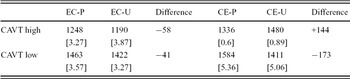
Subject analyses of variance (ANCOVA) were conducted in SPSS using a 2 (Language of target pictures: L1 vs. L2) × 2 (SCP: primed vs. unprimed) × 2 (L2 vocabulary knowledge: high vs. low) mixed design, and working memory span scores were treated as a covariate to eliminate potential confounding effects in the analyses. Although there was no significant difference between the mean span scores of the CAVT high and the CAVT low groups, there might be differences within each group, given the fact that the SD for each group was quite large (12.58 and 8.22, respectively). Therefore, ANCOVA was used for both the latency and error rate analyses. The analysis on the latency data showed a significant main effect of working memory scores (F(1,21) = 4.677, p < .05) and an interaction between language of the target picture and working memory scores (F(1,21) = 6.451, p < .05). So, adjusted mean scores are reported here. But, the analysis on the error rate data did not yield a main effect of working memory scores (F < 1); and the interaction between competitor priming and working memory scores did not approach significance (F(1,21) = 3.716, p = .068). Therefore, raw scores of percentage of error rate are reported here (see Table 3).
Mean target picture naming latency (in ms) for the Chinese−English bilinguals (mean percentage of error rate is indicated in square brackets).

To evaluate the SCP effect, we calculated the mean naming latencies to target pictures for correct responses and the mean error rate. In the analyses of naming latencies, the main effect of Language was significant (F(1,21) = 12.675, p < .001). Target pictures were named about 122 ms more quickly in L1 Chinese than in L2 English. There was also a main effect of L2 vocabulary knowledge (F(1,21) = 5.766, p < .05), because the high CAVT bilinguals named the target pictures about 156 ms faster than the low CAVT bilinguals (1314 ms vs. 1470 ms).
None of the two-way interactions were significant. However, there was a significant three-way interaction of Language, SCP and L2 vocabulary knowledge (F(1,21) = 4.619, p < .05). This interaction was based on the contrasting effects of priming for naming in L2 for the two different vocabulary knowledge groups. Bilinguals with higher CAVT named primed target pictures (in CE-P condition) faster than unprimed target pictures (in CE-U condition) in L2 (1336 ms vs. 1480 ms), and the result from pairwise comparisons revealed that the difference of 144 ms in naming latency between these two conditions was reliable (p < .05). However, the opposite pattern was observed for the bilinguals with lower CAVT. These participants named primed target pictures more slowly than unprimed target pictures in L2 English (1584 ms vs. 1411 ms), and the result from pairwise comparisons revealed that the difference of 173 ms in naming latency in the two conditions was significant (p < .05).
For the error rate data, the only significant main effect was for L2 vocabulary knowledge (F(1,21) = 5.545, p < .05). The error rate for the high CAVT bilinguals was significantly lower than that for the low CAVT bilinguals (2.16% vs. 4.32%). The only significant two-way interaction was between Language and L2 vocabulary knowledge (F(1,21) = 11.59, p < .01). For the high CAVT bilinguals, the error rate in naming target pictures in L2 was significantly lower than that in naming target pictures in L1 (0.79% vs. 3.57%), but for the low CAVT bilinguals, the reverse pattern was observed, which means that their error rate was higher when they named the target pictures in L2 than in L1 (5.21% vs. 3.42%).
Discussion
Study 1 yielded two important results. The first was the three-way interaction of Language, SCP and L2 vocabulary knowledge in the latency data. For all participants, a trend of within-language SCP effect was observed when the language of the target picture was L1 Chinese with a language switch preceding the naming of the target.
The second finding was that a cross-language SCP effect (CE-P vs. CE-U) was only observed for bilinguals with lower-level L2 vocabulary knowledge. In those conditions, Lee and Williams (Reference Lee and Williams2001) had also found that a cross-language SCP effect in unbalanced bilinguals. This suggests that our low CAVT group may be most comparable to the bilinguals in the Lee and Williams (Reference Lee and Williams2001) study. These results support the suggestion (Costa, La Heij & Navarrete, Reference Costa, La Heij and Navarrete2006) that language selectivity is linked to language proficiency. The fact that the high CAVT bilinguals named the target pictures faster and more accurately than the low CAVT bilinguals also provides evidence that they did in fact have a higher level of language proficiency.
These findings indicate that language selectivity may increase with vocabulary knowledge. Could it also be the case that selectivity increases as a result of the experiences involved in extensive study-abroad experience? In order to address this question, we will examine the role of learning experience on the within- and the cross-language SCP effects, using a group of Chinese−English classroom learners with no study-abroad experience.
Study 2
Method
Participants
The participants were twenty-seven first-year students enrolled in the graduate program of Linguistics and Applied Linguistics at Chongqing University, PR China and ten first-year graduate students in science and engineering programs at Zhejiang University, PR China. All of them had Chinese as their native language and English as their second language. They had received English classroom instruction since secondary education. At the time of this study, participants from the first group were taking four or five academic courses in Linguistics and Applied Linguistics, all conducted in L2 English, whereas participants from the second group were taking a comprehensive course of College English. None of the participants had any experience of studying or living in English-speaking countries.
Procedure
Participants were tested individually in their home institutions and data collection was spread out in a period of two weeks. The materials and procedure were the same as those described for Study 1.
Results
CAVT and language history survey data
Participants were measured on their L2 vocabulary knowledge using CAVT. Their scores ranged from 46 to 68 with a mean of 54.2 (SD = 5.84). Moreover, their mean CAVT score was similar (p = .266) to that of the low CAVT group in Study 1. On average, participants in this study were 24.96 (SD = 3.06) years old; they had begun their English learning in secondary schools at the age of 12.67 (SD = 0.87); and they had studied English in a classroom setting for an average of 11.75 years (SD = 2.05). Participants gave an average total rating of 34.92 (SD = 4.54) for their ability in their native language and 28.67 (SD = 4.33) for their ability in L2 English.
Semantic competitor priming task data
The data exclusion criteria were the same as in Study 1. Seven participants who were not able to name nine or more of the target pictures were excluded from the analyses. One participant was also excluded because the recording volume was not loud enough. In order to keep the number of participants in each material list equal, data were included from twenty-four of the total twenty-nine eligible participants. All subsequent analyses reported are based on this revised set of twenty-four participants.
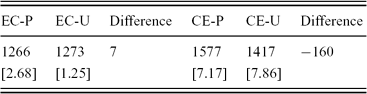
Subject analyses of variance were conducted using a 2 (Language: L1 vs. L2) × 2 (SCP: primed vs. unprimed) design. Both mean lexical latencies of target pictures for correct responses and mean error rate were analyzed (see Table 4 for the means).
Mean target picture naming latency (in ms) for the Chinese−English classroom learners (mean percentage of error rate is indicated in square brackets).

In the analyses of naming latencies, the effect of Language was significant (F(1,23) = 20.154, p < .001). Target pictures were named 227 ms more quickly in L1 Chinese than in L2 English. The main effect of SCP was not significant (F(1,23) = 3.998, p = .06). Although the primed target pictures were named 76 ms slower than the unprimed ones, the difference was not significant. However, the interaction between the Language and SCP factors was significant (F(1,23) = 5.99, p < .05). The nature of the interaction was just as Lee and Williams (Reference Lee and Williams2001) had reported: unbalanced bilinguals only demonstrated the SCP effect when they named the target pictures in L2 (CE-P vs. CE-U), rather than in L1 (EC-P vs. EC-U).
In the analyses of error rate, the effect of Language was significant, with a higher error rate in naming the target picture in L2 than in L1 (7.49% vs. 1.96%) (F(1,23) = 63.175, p < .001). None of the other effects were significant.
Discussion
The central result of this study was the significant Language × SCP interaction yielded from the analyses of target picture naming latencies. There was a cross-language SCP effect when the classroom learners named the target picture in L2 English, but no within-language SCP for target picture naming in L1 Chinese. In the case of within-language trials, the interpolation of an L2 trial eliminated the SCP effect. Moreover, the sizes of the cross-language SCP effect were very similar to those obtained in the low CAVT group in Study 1, as indicated by a comparison of Table 3 and 4. These results can be interpreted as suggesting that these learners in Study 2, the low CAVT bilinguals in Study 1, and the unbalanced bilinguals in Lee and Williams (Reference Lee and Williams2001) all demonstrate incomplete levels of language selectivity, as contrasted with the high CAVT bilinguals with study-abroad experience in Study 1. This would suggest that vocabulary proficiency by itself might be the major determinant of the ability to attain selectivity. However, it is also possible that selectivity arises from controlled attentional processes that have often been associated with individual differences in working memory (Bialystok & Craik, Reference Bialystok, Craik and Overton2010; Prior & MacWhinney, Reference Prior and MacWhinney2010). Study 3 examines this possibility.
Study 3
Method
Participants
Sixteen bilinguals with study-abroad experience (SAE) and sixteen classroom learners (CL) participated in this study. For the SAE group, the CAVT score ranged from 41 to 68 with a mean of 59.42; for the CL group, it ranged from 46 to 59 with a mean score of 51.94.
Results
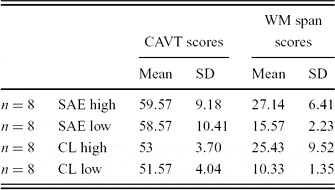
Participants in the CL group were measured on their working memory span using the same span task as described in Study 1. In general, participants in this group responded correctly to 89.25% of the mathematical operations (range = 26.70% to 100%). They were then divided into a high-span and a low-span group, with a mean span of 25.43 for the high-span group and 10.33 for the low-span group.
The SAE group was also grouped on the basis of their performance in the working memory span task with an accuracy rate of 87.55% for the mathematical operations (range = 60.67% to 90.67%). The mean span score of the high-span group was 27.14 while the mean span score of the low-span group was 15.57 (see Table 5 for the CAVT and working memory span scores for SAE and CL groups). The SAE group and CL group did not differ in their CAVT scores (F(3,28) = 1.995; p = .142) and post-hoc tests did not reveal any significant differences (ps > .2).
CAVT scores and working memory span scores for SAE and CL groups.

We conducted several additional tests to verify the presence of reliable differences for the two individual differences factors. Results from a one-way ANOVA showed that there was a significant difference for working memory span scores between the high- and low-span participants (F(3,28) = 13.24, p < .001). Post-hoc Scheffe tests revealed a significant difference between the mean high- and low-span scores of the SAE group (p < .01) as well as a significant difference between those of the CL group (p < .001). Moreover, Scheffe tests showed no significant difference between the two high-span groups (p = .947) or between the two low-span groups (p = .333).
To determine the role of working memory capacity (WMC) and learning experience (LE) on within- and cross-language SCP effects, we used a 2 (Language: L1 vs. L2) × 2 (SCP: primed vs. unprimed) × 2 (WMC: high vs. low) × 2 (LE: SAE vs. CL) mixed ANOVA design. The analyses on the latency data revealed a significant main effect of Language (F(1,28) = 9.26, p < .01). Target pictures were named more quickly in L1 Chinese than in L2 English (1331 ms vs. 1465 ms).
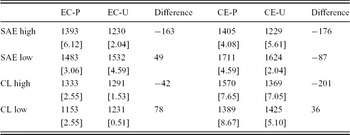
The analyses also showed a significant interaction between SCP and WMC (F(1,28) = 4.571, p < .05) (see Table 6). Primed target pictures were named 146 ms more slowly than unprimed target pictures for the participants of higher WMC. However, this pattern was not observed with the participants of lower WMC.
Mean target picture naming latency (in ms) for SAE group and CL group breakdown by the working memory span (mean percentage of error rate is indicated in square brackets).

There was also a significant interaction between WMC and LE (F(1,28) = 6.006, p < .05). Results from pairwise comparisons showed that higher WMC participants in the SAE group named the target pictures more quickly than those of lower WMC (p < .05), but participants of higher and lower WMC in the CL group did not show such difference (p = .395). None of the other effects were significant (ps > .11).
The analyses on error rate data showed a significant main effect of Language, with a lower error rate in naming the target picture in the L1 than in the L2 (2.87% vs. 5.68%) (F(1,28) = 15.091, p < .01). The interaction between Language and LE was also significant (F(1,28) = 13.747, p < .01). The participants in the CL group named the target pictures in L1 Chinese with a much lower error rate than they did with the pictures in L2 English (1.79% vs. 7.27%), while participants in the SAE group named the pictures in L1 Chinese and L2 English with a similar error rate (3.95% vs. 4.08%).
There was no main effect of SCP, but there was a significant three-way interaction of Language, SCP and WMC (F(1,28) = 4.266, p < .05). In the within-language comparison of EC-P vs. EC-U, participants with higher WMC named primed targets with a higher error rate than unprimed targets (4.34% vs. 1.79%) in L1 Chinese. However, in the between-language comparison of CE-P vs. CE-U, they named the primed and unprimed targets with a similar error rate in L2 English (p = .656). However, for the participants with lower capacity, the pattern was reversed. They named primed and unprimed target pictures in L1 Chinese with a similar error rate (p = .818). However, in L2 English they named primed targets with a higher error rate than unprimed targets (6.63% vs. 3.57%).
Discussion
With regard to the error rate data, there were two important results. The first was the interaction between Language and LE. The participants in the CL group tended to be less skillful when naming targets in L2 English. However, their counterparts in the SAE group showed no difference between the error rates for L1 and L2. As noted earlier, the SAE group and CL group did not differ in their CAVT scores; the interaction effect seems to suggest that study-abroad experience leads to a more accurate L2 naming in a language-switching task of this type.
The second result of importance for the error data was the significant three-way interaction of Language, SCP and WMC. The fact that the lower WMC participants failed to demonstrate within-language SCP indicates that they may not be keeping the prime active in memory. The fact that higher WMC participants show the SCP effect for L1 indicates that they have the basic verbal processing needed to display the SCP effect for errors as well as latencies, but that their relatively low level of L2 experience makes the effect of SCP relatively weaker in L2 English in terms of error data.
For the latency data, both the within- and the cross-language SCP effects were observed for the participants with higher WMC. Higher WMC may allow participants to keep the Chinese competitor in mind when naming pictures in both L1 Chinese and L2 English. Although Studies 1 and 2 revealed a robust cross-language SCP effect from L1 to L2 for the low CAVT bilinguals with study-abroad experience and classroom learners with no study-abroad experience, only a weak trend was demonstrated for the participants with lower WMC in the SAE group. For the participants with lower WMC in the CL group, no such trend was seen at all. It seems that, for the participants with study-abroad experience, their lack of cognitive resources could be compensated for to some extent by their experience in the target language context.
General discussion
The studies presented here were designed to determine the extent to which the functioning of the language selection mechanism is influenced by the factors of L2 vocabulary knowledge, learning experience and individual differences in working memory capacity. Recently, Kroll et al. (Reference Kroll, Bobb and Wodniecka2006) have argued for viewing the control of language selection as a dynamic process influenced by factors of the sort tracked in the current study. The results of these three studies illustrate the value of this approach and the extent to which our understanding of the growth of selectivity can be furthered by studying different groups of learners.
The results of these three experiments can be best viewed as illustrating the growth of selectivity with increased language exposure and proficiency. At the lowest level of proficiency and exposure, learners show a SCP effect in cross-language (CE-P vs. CE-U) comparisons. This occurs for the classroom learners in Study 2 and the classroom learners with higher WMC in Study 3. These learners also have high error rates in naming and longer naming times. At the next higher level, we find the SAE bilinguals with higher WMC in Study 3 who show lower error rates and faster naming times, but still have a cross-language SCP effect. Further, we find a trend of SCP effect in within-language (EC-P vs. EC-U) comparisons. This occurs for low CAVT bilinguals in Study 1 and the classroom learners with higher WMC in Study 3. At the next higher level, we have the high CAVT bilinguals of Study 1 who have studied English on average for 14.71 years. The participants in Study 1 were living in a country where L2 was being spoken on a regular basis, whereas the participants in Lee and Williams (Reference Lee and Williams2001) were living in an L1-speaking context at the time of testing. Together, these forces led these participants to show a positive SCP effect in the cross-language condition. It appears that these participants were able to not only avoid any interference between L1 and L2 on the lexical level, but also to make positive strategic use of semantic field similarity to further L2 access.
These developmental trends can best be understood by viewing the developing L2 system as initially dependent on the structure and properties of L1, as suggested by the Revised Hierarchical Model (Kroll & Stewart, Reference Kroll and Stewart1994) and the Competition Model (MacWhinney, in press). According to the Competition Model account, early childhood bilinguals have languages that develop in parallel without dependence. For these bilinguals, mechanisms for interconnection within languages are built in smoothly from the beginning and language selectivity is therefore optimally grounded. Bilinguals who acquire a second language at later times must go through a transition from first having the second language dependent on the first to later relative independence for the second language.
The finding that cannot be explained as the result of the development of selectional control involves the absence of a within-language SCP effect for the low working memory span participants in Study 3. We believe that this result arises because these participants are not able to keep the prime active in memory. Therefore, this result should be viewed as resulting more from individual differences than from developmental trends.
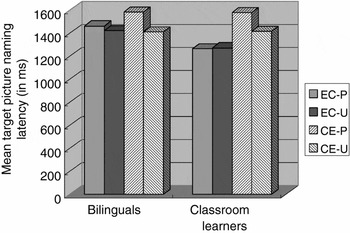
Figure 1 displays the contrast between the bilinguals in the low CAVT group in Study 1 and the classroom learners in Study 2. For the former group, it is possible that, as their naming in L2 might involve less inhibition of words of the non-intended L1 than the classroom learners, they might resort to the language-specific mechanism, which allowed them to maintain the head start which the Chinese competitor had on the naming of the target picture in L1 Chinese, thus producing a weak trend of within-language competition. For the latter group, it is possible that they might make use of inhibitory control to ensure selection in the intended language by inhibiting candidates from L1 Chinese, thus producing the absence of such competition.
Mean target picture naming latency in four conditions for the Chinese–English bilinguals in CAVT low group in Study 1 and Chinese–English classroom learners in Study 2.

Successful selection of the correct lexical form by a bilingual speaker can be achieved by any mechanism that provides a clear way of discriminating L1 and L2 forms. This discrimination could be achieved through special tags, differential activation levels, local inhibitory connections, within-target excitatory connections or attentional processes that interact with any of these lower-level cues (Green, Reference Green1998). Overall, our findings suggest that the growth of bilingual control involves the development of a system of this type. However, the exact shape of this system can vary widely from group to group. For the Chinese−English classroom learners in Study 2, selectional control would seem to rely primarily on inhibitory processes. However, for bilinguals of the type studied by Costa et al. (Reference Costa, La Heij and Navarrete2006), language separation occurs during early childhood and could well be integrated directly into the lexicon, supported perhaps by a network of language internal connections that can be activated independently but which connects directly to lexical forms.
The findings from Study 2 also suggest a role for learning experience to modulate the language selection mechanism. For L2 classroom learners, their language selection is achieved by means of suppressing lexical items in the non-intended language. For the bilinguals with study-abroad experience, their language selection does not require a massive inhibition of the non-intended language. The difference, as noted in the foregoing discussion, could arise from a different degree of activity of the two languages. Classroom learners could not enjoy as many authentic communications as those bilinguals could in the target language learning context. So, their L2 could not be as frequently activated as that of their counterparts even though their L2 lexical knowledge level was similar. According to the Activation Threshold Hypothesis (Paradis, Reference Paradis1987), their L2 activation threshold could be higher, which might demand a larger amount of inhibition of L1 Chinese, thus the elimination of the within-language SCP effect.
Study 3 yields evidence for within- and cross-language SCP for the bilinguals with study-abroad experience as well as for the classroom learners with higher working memory capacity. It is sometimes argued that classroom learners have to learn to suppress L1. These data suggest that this suppression arises both in classroom learners and in bilinguals with study-abroad experience. However, when we look at the error data from Study 3 along with the latency data, we see that the participants with study-abroad experience had achieved a more flexible control of language selection.
The current study has focused on the role of experiential and individual difference factors in shaping the SCP effect. However, it would be equally interesting to study the effect of these same individual differences in other commonly used paradigms, including the picture naming method used by Costa et al. (Reference Costa, Miozzo and Caramazza1999), Hermans, Bongaerts, de Bot and Schreuder (Reference Hermans, Bongaerts, Bot and Schreuder1998), and others. Because different tasks place different demands on the language processing system and the selection mechanism, we cannot expect to find completely parallel results across tasks. Instead, we could hopefully use differences in the patterns of results across tasks to illuminate further details of the language selection mechanism and its development through experience.
In summary, the findings of the three studies suggest several tentative conclusions. For Chinese−English bilinguals, the smooth functioning of the language selection mechanism depends on achieving a high level of L2 lexical knowledge. Language selection is also facilitated by study-abroad experience and high working memory capacity. Furthermore, it may be that activation of L2 is promoted when testing is done in an L2 context.