Among the diverse treasures of the Royal Asiatic Society are two early nineteenth century paper playing boards for the north Indian game of gyān caupar̩, the ‘Chaupar of Knowledge (Gnosis)’. This once popular game, played with dice or cowry shells, leads its players gradually up the board from hellish states or earthly vices to higher virtues and ultimately to heaven or liberation. It is known in various Jain and Hindu (mainly Vaiṣṇava) versions of the eighteenth to nineteenth centuries and a small handful of nineteenth century Muslim (or Sufi) examples. By the 1890s it also gave rise, in a simplified and denatured form, to the English children's game of Snakes and Ladders.Footnote 1 One of the Society's boards is an ingenious 124-square version of the Vaiṣṇava form of gyān caupar̩, unique in its design and philosophical conception,Footnote 2 whose inventor has been identified as the Brahmin scholar Thiruvenkatacharya Shastri.Footnote 3 The Society's other board is a rare example of the 100-square Muslim form of gyān caupar̩ (Fig. 1), inscribed with Persian and Arabic square names that are loosely based around Sufi terms for the stages of the mystical path. I am here concerned with this form of the game and in particular with an expanded variant form of it that has recently come to light.
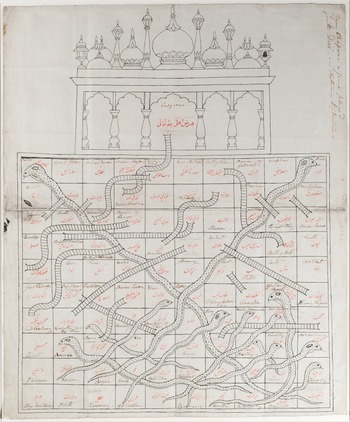
100-square Sufi gyān caupar̩ board. North India, possibly Delhi or Lahore, c.1810. Ink on paper, 54.5 x 45.4 cm. Royal Asiatic Society, London, 064.001.

As discussed elsewhere,Footnote 4 the RAS board is drawn and inscribed on English paper with an 1805 watermark. It was collected and perhaps commissioned by Major-General J. S. Harriott (1780–1839). A contemporary marginal note identifies the game as “Gyan Chapar—a game played with Dice—in Northern Hindustan”, and its Persian and Arabic square names are accompanied by English translations. The player's journey starts as usual at the bottom left corner, from ‘adam (non-existence, 1), walādat (birth, 2) onwards. According to the throw of six cowries, it proceeds upward through the ten rows of squares in a back and forth (boustrophedon) fashion. The players are led through sundry vices, temptations and afflictions in the lower half of the board, with frequent opportunities for demotion through landing on a snakehead, towards higher spiritual states in the upper half, with correspondingly greater chances of promotion by reaching the foot of a ladder. There are 13 snakes and 17 ladders in all. The ultimate goal is the Throne of God, set within a late Mughal style shrine or mosque outlined above. Given the right throw of the dice, it can be reached directly by a ladder from square 84, fanā fī Allāh (mystical Extinction in God). But for the errant pilgrim still beset by egoism or sensual attachments, great perils await near the threshold of salvation. The two long, diagonal snakes of Pride (ghurūr, 91, top right) and Satan (shait̩ān, 100, top left) will cast the player all the way down to squares 18 (Violence, ghaṣb) or 10 (Lust, shahwat).
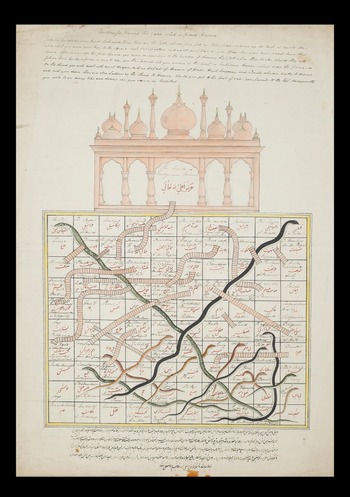
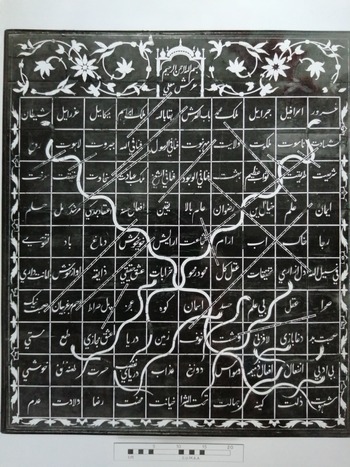
The few other surviving Indian 100-square Sufi boards are of a similar pattern, with minor variations. A very close example in the Ashmolean Museum (Fig. 2),Footnote 5 with the same square names and snake and ladder configurations as the RAS board, is executed on English paper watermarked 1810 and can be attributed to the same workshop. It differs in its English translations added within the squares, in its embellishment with watercolour washes and its English and Persian texts above and below which give the rules of play. It was again most likely commissioned by a British patron in northwest India, possibly in the Delhi or Lahore regions. A further example, largely similar to these two in its board design and terminology, is the finely made wooden board with mother-of-pearl inlay work in the Cambridge Museum of Archaeology and Anthropology (Fig. 3).Footnote 6 It has slightly fewer snakes and ladders (11 and 16 respectively), and about a quarter of its square names show transpositions or variations from the RAS board model. The shrine structure enclosing the Throne of God is also much diminished in size.
100-square Sufi gyān caupar̩ board. North India, possibly Delhi or Lahore, c.1815. Ink and watercolour on paper, 71 x 50 cm. Ashmolean Museum, Oxford, EA2007.2.

100-square Sufi gyān caupar̩ board. Delhi-Agra region or Lahore, c.1825–50. Wood with mother-of-pearl inlay, 79.8 x 69.5 cm. Museum of Archaeology and Anthropology, Cambridge, 1951.995.

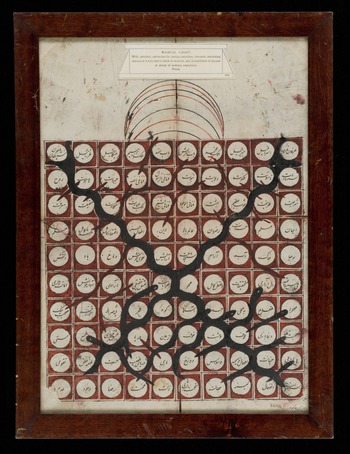
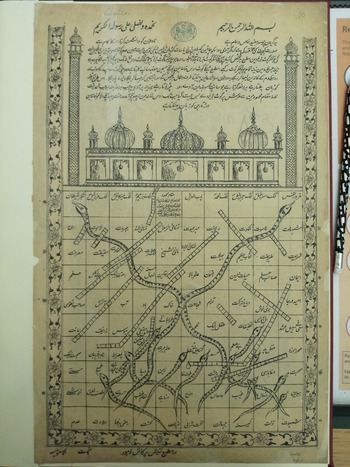
Two further 100-square Sufi boards on paper that are comparable in design, though of little artistic merit, have been published in recent years. One, in the Wellcome Institute collection (Fig. 4),Footnote 7 has the Persian square names inscribed in circles with red surrounds, while the shrine structure above is replaced by radiating curves, evidently representing the seven heavenly zones, the lowest of which can be reached as usual by a ladder from square 84 (fanā fī Allāh). There are 10 snakes and 13 ladders in this version, the ladders being barely recognisable as such. Coloured red, they are more like bending poles or slender snakes (in Nepalese boards too, red benign snakes often stand in for ladders). The more imposing, malefic snakes are ominously black and the two longest, most disastrous ones—Pride and Satan, at each end of the top row—have their jaws gaping voraciously wide. While this board was initially described as Persian,Footnote 8 it is more likely to be from some part of northern India. A further, possibly lithographed, late nineteenth century paper board is in the St Petersburg Museum of Anthropology and Ethnography.Footnote 9 It has 13 snakes and 14 ladders, and the very roughly sketched snakes again have gaping jaws which increasingly resemble pincers.Footnote 10 Another example, more elegant in its board design and as yet unpublished, is in the State Museum of the History of Religion, St Petersburg. It has 13 snakes and 16 ladders, and the Throne of God is set within a multi-domed and pillared structure above.Footnote 11 In addition to these, a further hand-drawn and roughly inscribed version on paper, perhaps of the early twentieth century, appeared some years ago on the London art market.Footnote 12 It has 11 snakes and 15 ladders and retains a small domed shrine design around the winning Throne square, a little like that in the Cambridge wooden board. Probably slightly earlier than this is a lithographed board of attractive design, which bears a British Museum Library acquisition stamp of 1892 (Fig. 5).Footnote 13 Published by the Ganesh Prakash Press, Lahore, it has 14 snakes and 14 ladders, a triple-domed shrine structure with tall flanking minarets and an Urdu explanatory text above.
100-square Sufi gyān caupar̩ board. North India, c.1875–1900. Ink and watercolour on paper, 39.4 x 28.5 cm. Wellcome Collection, London, MS Or. Persian 800.

100-square Sufi gyān caupar̩ board. Lahore, c.1890 or earlier. Lithographed on paper, 40 x 26 cm approx. British Library, London, MS OP.218(10).

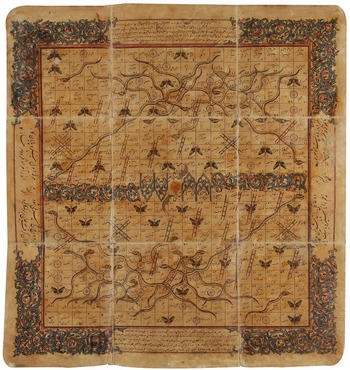
Whereas Jain and Hindu gyān caupar̩ boards come in varying types and sizes, the Sufi board model of 100 (10 x 10) squares—or 101 including the winning Throne square—had seemed to be the only version of the game in use throughout the nineteenth century. But recently a Sufi board of larger and more elaborate type has come to light (Fig. 6).Footnote 14 Inscribed and painted on thin cotton cloth, burnished on the front side, it represents a much expanded, double-sided form of the game, comprising 361 squares (19 x 19). The board is divided across the middle into two opposing, symmetrical tracks of 180 numbered squares with identically matching square names and other features. The players sit at opposite sides of the board and the course of play converges in the middle, at the unnumbered, winning Sun-square, into which twin long-tailed heavenly birds lead from the two squares 161 (fanā fī Allāh). Each side of the board is configured with 14 snakes and 19 ladders. To these, uniquely, are added 14 wells and 19 butterflies as further hazard or bonus squares: each straddles two consecutive squares, bringing demotion or promotion by one square to the player who lands on their far or near sides respectively. Such imaginative augmentations of the snake and ladder dynamic of gyān caupar̩ are only rarely seen: two scorpions, for example, bring mild demotions in a 72-square Vaiṣṇava board of the 1780s but do not reappear after that.Footnote 15
361-square, double-sided Sufi gyān caupar̩ board. Northwest India, c.1890–1910. Ink and watercolour on cotton cloth, 77 x 72.5 cm. Ashmolean Museum, Oxford, EA2015.415.

The rules of the game are inscribed in Persian for the players’ benefit on their facing sides of the board:Footnote 16
1. Choose one of the three pawns and, based on the number of one [cast] die, begin moving forward in the houses, given that two pawns will not land on one another.
2. When a pawn has passed house 153, it should [go to and] remain in the ‘House of the Bird’ until the two other pawns have passed house 172 from the right hand side and arrived at the end.
3. When there are too few houses to advance through, based on the numbers rolled on the dice, the pawns must go backwards, but only if they have not already reached the end.
4. Whenever the pawn lands on the house with the first wing of the butterfly, it will move forward one more house.
5. Whenever the pawn lands behind [on the second house of] the well, it will move back one house.
6. The pawn which lands at the bottom of a ladder will ascend to its top, and the pawn which lands on the head of the snake will descend to its tail.
7. The last two pawns need not pass the houses on the left side of the top two rows.
8. The players should roll the dice for one another.
On the other two sides of the board are cartouches enclosing verses by Sa‘di, Hafiz and Rumi which offer the players wise counsel or exhortation. At one side of the board, the seekers are reminded that the desired goal is not reached without effort:
At the other side, the goal of the Sun is invoked in a verse from Hafiz, while an equable spirit of fair play seems to be enjoined in another saying of Sa‘di:
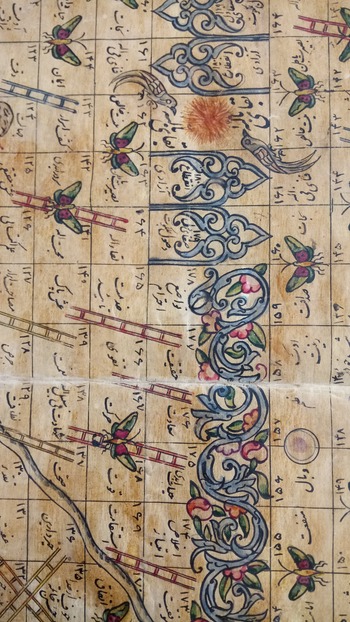
The border decoration framing these poetic cartouches comprises running bands of densely ornate leafy scrolls, coloured in blue-grey wash, from which emerge loosely drawn, small green leaves and pink and white flowerheads. Similar, narrower decorative bands extend across 14 of the squares in the climactic finishing row of the game at the middle of the board (Fig. 7). More British than Persian or Indian in style and taste, this floral scrollwork decoration is executed by a competent draughtsman apparently emulating an Arts and Crafts Movement model of the late Victorian or Edwardian age. Its curiously European character could perhaps suggest the collaboration of some graphic arts graduate of one of the flourishing British-style Government Schools of Art of that time, such as the Mayo School of Industrial Arts at Lahore under Lockwood Kipling and his successors. At any event, this decorative scheme suggests the board itself should not be dated earlier than the end of the nineteenth century. Since then it has received a fair amount of wear, visible in its deep creases from folding and in stains and water marks including a ring where a player has set down a wet glass or cup.Footnote 17
Detail of Fig. 6: Central area of the board with the finishing squares of the game.

In its 180 square names, its snake and ladder configurations and additional features, this board diverges in many ways from the 100-square type. Its terminology of virtue and vice, salvation and wretchedness, is more wide-ranging and general in nature, occasionally verging on truism: thus the snake of Filth (81) leads the player 44 squares down to Disease (37), while the ladder of Cleanliness (129) leads upward by eight squares to Health (137). There is more in the way of generalised moralising and less use of Islamic theological terms. The 19 ladders are numerous but often short; the 14 snakes are fewer but rather longer. Gluttony (85), for example, demotes the player by 60 squares to Abjection (25), whereas Chastity (131) promotes by just three squares to Innumerable Blessings (134).
A few configurative patterns recur from the 100-square game, notably the two disastrous long diagonal snakes that intersect across the board. Here Pride (172) demotes catastrophically to Wretchedness (7). The other snake square lurking in the final row would lead downward from Satan in the 100-square game, but here the devil is conspicuously absent. It leads down instead from Lie (durogh, 153) to Anxiety (iz̩t̩irāb, 13). In the fifth and six rows of the game the player has to wend his way through ambushes by as many as eight snakes, such as Profane Love (105) leading to Misery (23), Debauchery (111) to Waste of Ability (38), Revenge (113) to Burning Fire (32). Among the ladder squares, the virtues cited again tend to be general ones. Among the first ladders encountered, in the third and fourth rows, are Love (47) leading to Life (67), Seriousness (52) leading to Arriving Quickly at the Destination (91), Thought (59) leading to Enlightenment of the Intellect (96), Consultation (62) leading to Solving of Problems (99), and so forth. This continues in the eight ladder squares grouped in the seventh row, named as Wisdom, Valour, Precision, True Love, Fellowship with the Righteous, Cleanliness, Chastity and Justice. However, the last four ladders on the player's upward path are more overtly Islamic or Sufi in tone. Martyrdom in the Path of God (138) leads to Endless Life (175), Pure Love (140) to Truth (177), Awareness of God (166) to Humility (176), and Perseverance (169) to Success (173). As we have seen, the powerful square of Extinction in God (fanā fī Allāh, 161), a key landmark of the 100-square board, here leads not by a ladder but by a long-tailed heavenly bird to the final Sun square (or ‘House of the Bird’), named as Subsistence in God (baqā-yi billahi). The bird itself is sketched somewhat like a dove with a trailing, perhaps vestigially sīmurgh-like tail.
The 19 wells and 19 butterflies that the players encounter are original features of this board. A well is depicted simply as a circle with a pale central dot in watercolour to indicate its depths. Given the limited, single-square demotions that the wells inflict, their consequences can be dramatic. Corruption of Morals (12) leads to Destruction (11), Inactivity (51) to Calamity (50), Bad Friends (73) to Life-threatening Poison (72), and Excessive Anger (116)—alarmingly—to Sudden Death (115). The butterflies, which are delicately tinted in red, yellow and green watercolour, stand for further virtues, good deeds and aspirations. Training (20) advances the player to Progress (21), Loyalty (48) to Trust (49), Carrying out of Responsibility (94) to Ease of Body and Soul (95), Love of God (141) to Endless Joy (142), Pure Intention (162) to Inner Sight (163), and Unity (170) to Power (171).
This 361-square gyān caupar̩ board is the only example of its type so far known. It may perhaps have failed to gain any wider currency beyond its creator's own social circle or Sufi fraternity. We can only speculate as to its author, perhaps some leisured Sufi enthusiast with a taste for moralising sentiment, who was moved to enlarge on the 100-square model and to restructure its field of play symmetrically around a horizontal axis. Such later expansions or elaborations on a successful established model were quite common in the history of Indian board and card games. In the case of gyān caupar̩, a comparable example is seen in the development of the large Pahari type of Vaiṣṇava board, possibly at Kangra under Maharaja Sansar Chand (r. 1775–1823),Footnote 18 with a field of play of 342 (19 x 9 x 2) or 360 (20 x 9 x 2) numbered squares, divided into separately numbered halves around a central vertical axis. In the Pahari versions, the two halves are however interlinked in play terms and they differ from one another in their square nomenclature. This form of the game never spread beyond a few early nineteenth century Punjab Hill courts. Our expanded Sufi game similarly attained no wide popularity, despite its interesting novelties of design and play dynamic. It may in practice have been found over-elaborate in conception and perhaps too slow in reaching a finish. It originated, moreover, at the very period when the popularity of gyān caupar̩ in its traditional forms was finally waning in India.