Shortly before the 2010 midterm elections, several polls revealed that nearly one in four Americans believed that President Obama is secretly a Muslim, and roughly half of the electorate questioned whether he is Christian.Footnote 1 Not surprisingly, partisanship and ideology seemed to influence these results—as many as one in three conservative Republicans identified Obama's religion as Islam.Footnote 2 Major media outlets offered various theories to explain the public's misperceptions, including partisanship, ignorance, and a general disdain for Obama. Whatever the reason, inaccurate associations surely undermine more sanguine appraisals of the American electorate (Popkin Reference Popkin1991; MacKuen, Erikson, and Stimson Reference MacKuen, Erikson and Stimson1992) and favor ones that reflect information shortcomings and asymmetries (Delli Carpini and Keeter Reference Delli Carpini and Keeter1996). Moreover, there are likely electoral consequences of these associations, as they may threaten Obama's legitimacy as president, weaken his ability to promote a successful policy agenda, and affect his chances at re-election in 2012.
In this article, we address the following two questions: First, do individuals truly associate Obama with Islam, or are they simply motivated reasoners who take the opportunity to express perceived negativity about the president? Second, how does political sophistication affect beliefs about Obama, given that it should both increase an individual's capacity to accurately evaluate information, yet also increase exposure to misinformation? We test these questions by comparing individuals' explicit responses on a survey about religion and politics with reaction time data from an Implicit Association Test (IAT), which measures attitudes or beliefs that subjects may be unwilling or unable to explicitly reveal (Greenwald, McGhee, and Schwartz Reference Greenwald, McGhee and Schwartz1998).
MOTIVATED REASONING ABOUT OBAMA'S RELIGION
Motivated reasoning (Ditto and Lopez Reference Ditto and Lopez1992; Kunda Reference Kunda1990) offers one potential explanation for the misperceptions about Obama's religion found in recent polls (e.g., see Hollander Reference Hollander2010). When individuals engage in motivated reasoning, partisan goals trump accuracy goals so that individuals act as biased information processors who will vigorously defend their prior values, identities, and attitudes at the expense of factual accuracy (Lodge and Taber Reference Lodge, Taber, Lupia, McCubbins and Popkin2000; Taber and Lodge Reference Taber and Lodge2006; Westen et al. Reference Westen, Blagov, Harenski, Kilts and Hamann2006). In the case of Obama, partisans on the Right may be motivated to believe rumors about the president and reject factual information that does not bolster their particular worldview. Evidence of this motivated believing hypothesis comes from partisans' convergent results on an explicit questionnaire and an IAT designed to reveal how strongly associated concepts are in memory. These associations are often referred to as “implicit” associations because they come to mind automatically (i.e., without conscious effort) and may be outside of an individual's awareness.Footnote 3 For example, people may unknowingly associate certain professions (e.g., doctors, lawyers, and scientists) with men more than women because of gender stereotypes or participation rates; yet, when explicitly asked, they may deny that they linked these fields to a particular gender. If motivated believing were occurring, conservatives should be more likely than liberals to explicitly report that Obama is a Muslim because of their anti-Obama predispositions. Moreover, because these claims have already been accepted and stored into long-term memory, conservatives also should be more likely than liberals to reveal implicit associations between Obama and Islam on an IAT.
Motivated reasoning, however, can occur even if individuals do not actually believe information suggesting that Obama is a Muslim. In other words, individuals may simply take the opportunity to express negativity when asked about the president's religion, regardless of their actual beliefs. Just consider the number of negative, yet simultaneously contradictory, names that Obama has been called by his detractors (e.g., labeling him a fascist and socialist in the same breath).Footnote 4 And, let us not forget that until recently, liberal Democrats engaged in a similar practice of calling former president George W. Bush a litany of derogatory terms, many of which could not concurrently be true. Evidence for this phenomenon, which we call motivated expressing, comes from divergent patterns of explicit survey responses and implicit associations. According to this hypothesis, we still expect conservatives to explicitly state that Obama is a Muslim; however, because they construct this attitude on the spot and do not actually believe it to be true, conservatives should not exhibit stronger implicit associations than liberals on an IAT. Of course, it is difficult to make any definitive conclusions about whether associations are equivalent to beliefs, but we assume that associations are a necessary condition for those who hold beliefs.
POLITICAL SOPHISTICATION AND EXPOSURE TO MISINFORMATION
Another explanation for the public's misperceptions is a well-documented and widespread lack of political sophistication in the electorate (Delli Carpini and Keeter Reference Delli Carpini and Keeter1996), which should lead people to rely on other methods for determining Obama's religious affiliation. For example, some individuals may use mental shortcuts, or heuristics (Popkin Reference Popkin1991), to surmise that the name Barack Hussein Obama must have some Islamic roots. Others may have heard statements about Obama's Kenyan father or upbringing in Indonesia and assume that he is a Muslim because of these experiences. Whatever the exact process (which is beyond the scope of the present article), we assume that political sophisticates should be more capable of evaluating information (Luskin Reference Luskin1990) about Obama than their low-information counterparts. Consequently, sophisticates should be more likely to correctly identify Obama as a Christian than unsophisticated citizens. We call this the sophisticated processing hypothesis.
Yet, we also know that politically sophisticated citizens, by definition, are more likely to be exposed to political information than unsophisticated individuals (Delli Carpini and Keeter Reference Delli Carpini and Keeter1996; Zaller Reference Zaller1992). As a result, sophisticates will likely endure repeated exposure to misinformation linking Obama to Islam. One poll taken just before the 2008 presidential election reported that as many as 92% of Americans had heard at least one factually inaccurate statement about Obama,Footnote 5 and one can only imagine how many times sophisticates may have heard or read misleading information about the president, given their greater political attention. So widespread were these rumors that the Obama campaign even created a website called “Fight the Smears” to refute false claims circulating the Internet. Given that cognitive psychologists believe memory is organized associatively (Collins and Loftus Reference Collins and Loftus1975)—that is, in node-link structures in which contextual triggers can affect a node's accessibility—we expect repeated exposure to information, no matter how questionable, will create implicit associations between Obama and Islam. In other words, sophisticates need not believe specific misinformation to exhibit implicit associations in memory. Evidence for this hypothesis, which we call differential exposure, would come from stronger implicit associations linking Obama to Islam among sophisticates than nonsophisticates.
In sum, we empirically test a number of different hypotheses concerning misperceptions about President Obama's religion. First, our motivated believing hypothesis states that partisans on the Right will be motivated to process negative misinformation about the president and commit it to long-term memory. Thus, in addition to explicit reports linking Obama to Islam, conservatives should demonstrate stronger implicit associations than those on the Left. Second, our motivated expressing hypothesis suggests that conservatives may not actually believe that Obama is a Muslim but simply take the opportunity to express perceived negativity about him; therefore, we do not expect to find a partisan IAT effect. Third, our sophisticated processing hypothesis states that political sophisticates should be more capable of evaluating the veracity of information about Obama than their low-information counterparts; hence, sophisticates will be more likely to correctly identify Obama's religion. And finally, with our differential exposure hypothesis we argue that because sophisticates are exposed to more information of all types—which should include repeated misinformation—they will exhibit stronger implicit associations linking Obama to Islam than politically unsophisticated citizens.
EXPERIMENTAL DESIGN AND PROCEDURE
One week after the 2010 midterm elections, 356 undergraduates enrolled at a southeastern, public university participated in our study. Of this total, 52% were women, and nearly 90% of subjects listed their race as “White/Caucasian.” Partisanship and ideology were fairly evenly distributed, albeit slightly skewed toward Republicans (41% Republican, 30% Independent, and 29% Democrat) and conservatives (38% conservative, 38% moderate, and 24% liberal). Although we make no claims about the representativeness of our sample relative to the American public, we do find the same proportion of individuals in our sample who state that President Obama is a Muslim—that is, one in five participants—as reported in recent, nationally representative polls. In fact, we suspect that our findings may actually be conservative estimates of the effects present in the general electorate because any effects of partisanship, ideology, and political sophistication should be attenuated in an undergraduate sample. That is, older citizens tend to have more crystallized political attitudes and stronger partisan attachments than the typical college student (Sears Reference Sears1986), and these experiences would likely exacerbate any observed effects linked to motivated reasoning.
The first portion of the study involved a computer-based IAT, which is designed to measure the strength of automatic associations between concepts in memory (Greenwald, McGhee, and Schwartz Reference Greenwald, McGhee and Schwartz1998). Automatic associations—that is, processes that “operate outside of conscious awareness and guidance” (Bargh and Chartrand Reference Bargh and Chartrand1999, 462)—are important because they have been shown to disproportionately influence judgments and behaviors (Fazio Reference Fazio, Petty and Krosnick1995). The benefit of the IAT is that it allows us to detect implicit associations that may be unknown or intentionally misstated by individuals. Moreover, Devine (Reference Devine1989) and other scholars have demonstrated that both motivation and ability are necessary to override the biases resulting from automatic associations.
We presented subjects with words representing Christianity (Jesus, Christian, Gospel, and Church) and Islam (Muhammad, Muslim, Koran, and Mosque),Footnote 6 as well as black-and-white images of Barack Obama and John McCain,Footnote 7 the major-party candidates from the 2008 presidential election,Footnote 8 using a free, open-source program called FreeIAT (see figure 1).Footnote 9 Subjects were instructed to quickly sort each word or image into paired categories consisting of a candidate and religion, while making as few mistakes as possible. For example, in one block of trials subjects would be asked to sort objects into the category representing Barack Obama and Islam or John McCain and Christianity.Footnote 10 In total, subjects completed five blocks of timed trials.Footnote 11 We used each participant's reaction times to calculate an IAT effect measure, which is commonly known as the D-score and is similar to Cohen's d (Cohen Reference Cohen1988) in that it may be interpreted as a measure of effect size (Greenwald, Nosek, and Sriram Reference Greenwald, Nosek and Sriram2006). Positive D-scores (where −2 ≤ D ≤ +2) indicate associations of Obama with Islam (and McCain with Christianity).Footnote 12
Screenshots from the Candidate-Religion Implicit Association Test (IAT)

Following the Candidate-Religion IAT, subjects completed a brief questionnaire that measured their explicit feelings toward various political figures, parties, and religions. We used the difference in feeling thermometer ratings of Obama and McCain to create a relative evaluation of the candidates (preference for Obama = 1).Footnote 13 We also asked participants whether they could correctly identify Obama's religion (Christian = 1), as well as the likelihood that Obama is a Muslim on a 4-point scale (very likely = 1). Finally, subjects completed an 8-item political sophistication test (high sophistication = 1),Footnote 14 as well as demographic questions including gender (male = 1), race (nonwhite = 1), party identification (strong Republican = 1; 5-point scale), and ideology (very conservative = 1; 5-point scale).Footnote 15
RESULTS
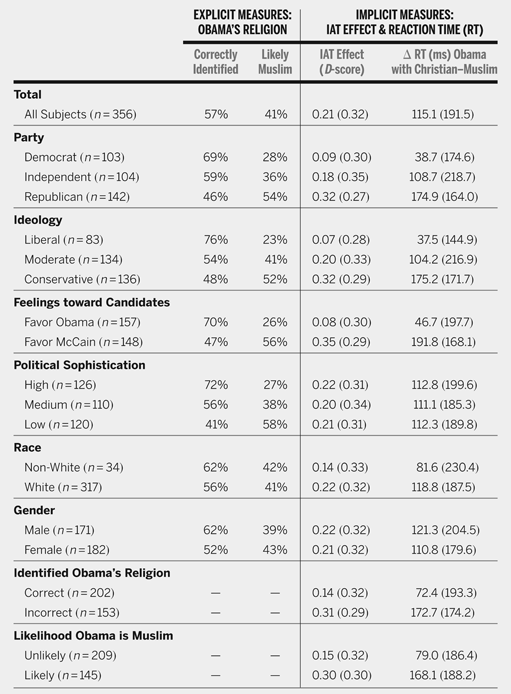
We begin by briefly reviewing some descriptive statistics from our survey and Candidate-Religion IAT (see table 1). First, only a slight majority of respondents (57%) were able to correctly identify Obama as a Christian, whereas a sizeable portion of the sample (41%) stated that it is “very likely” or “somewhat likely” that Obama is a Muslim. Moreover, we find that there is an overall IAT effect, M D-score = 0.21, such that subjects automatically associated Obama with Islam. To put this in perspective, a mean D-score of 0.21 translates to a “medium” effect size according to Cohen's (Reference Cohen1988) classification of “small,” “medium,” and “large” effects used for Cohen's d. It is also worth noting that the correlations among our implicit IAT effect measure, and two explicit measures, correct identification of Obama's religion and the likelihood that Obama is a Muslim, are modest at best, r = −0.26 and r = 0.30, respectively. Consistent with findings from a wide array of other IAT studies (e.g., see Lane, Banaji, Nosek, and Greenwald Reference Lane, Banaji, Nosek, Greenwald, Wittenbrink and Schwarz2007), these relatively weak correlations among implicit-explicit measures suggest that our IAT taps a distinct dimension relative to the self-reported questions about Obama.
Explicit and Implicit Associations between Obama and Islam (by Key Characteristics)

Notes: Cell sizes do not always total 356 due to missing values. The IAT Effect (D-score) is the difference in corrected mean response times between stereotype-inconsistent and consistent trial blocks (i.e., pairing Obama-Christianity and McCain-Islam; Obama-Islam and McCain-Christianity, respectively) divided by the pooled standard deviation. Standard deviations are in parentheses.
Not surprisingly, Republicans, conservatives, and those with favorable feelings toward McCain were more likely to explicitly identify Obama as a Muslim than Democrats, liberals, and those with favorable feelings toward Obama. A similar pattern emerges when we examine implicit associations according to the D-scores and mean IAT reaction times reported in table 1. Partisans on the Right had D-scores and mean reaction times between four and five times larger than those on the Left. We interpret these large differences to mean that pairings between Obama and Islam were consistent with existing associations for conservatives and thus facilitated their reaction times (relative to pairings of McCain and Islam). Finally, in the explicit questionnaire, political sophisticates were more likely to correctly identify Obama's religion than less knowledgeable individuals; however, sophisticates show no difference in implicit associations compared to unsophisticated citizens.
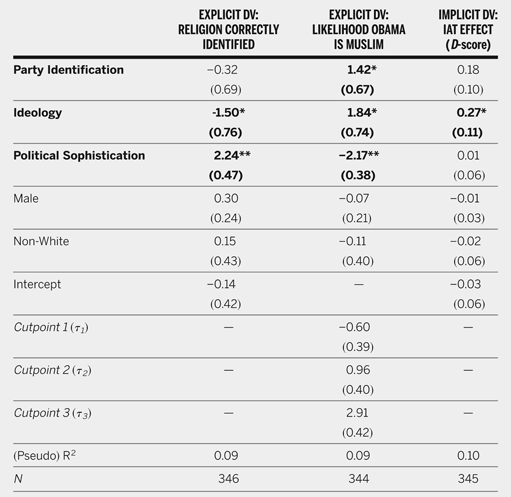
Now we turn to the results from our multivariate analyses, which allow us to test several different hypotheses (see table 2). We regressed each of our three dependent variables—correctly identifying Obama's religion (logit model; column 1), the likelihood that Obama is Muslim (ordered logit model; column 2), and our IAT effect D-score (OLS model; column 3)—on partisanship, ideology, political sophistication, gender, and race. The first two models test explicit associations, whereas the third model tests implicit ones. Recall that we proposed two competing motivated reasoning hypotheses to explain the consistent misidentification of Obama's religion. One possibility is that motivated believers, who are predisposed to accept and commit misinformation about Obama into long-term memory, should reveal strong associations on the Candidate-Religion IAT, as well as biases on explicit survey items. Another plausible alternative is that motivated expressers would state negativity about President Obama without actually believing the rumors; hence, we should find no IAT effect to accompany the biases on the explicit survey questions.
Models of Explicit and Implicit Associations between Obama and Islam

Notes: The IAT Effect (D-score) is a measure of association, where −2 ≤ D ≤ +2 and positive scores indicate an association between Obama with Islam (and McCain with Christianity). Models are estimated using logit, ordered-logit, and OLS respectively. Robust standard errors in parentheses.
* p < .05,
** p < .01
Looking at the effects of ideology on our explicit and implicit measures, we find strong support for our motivated believing hypothesis, which also means that we find little evidence of motivated expressing in the data. In each of our three models, ideology is correctly signed and a statistically significant predictor of beliefs about Obama's religion. For instance, the probability that a strong liberal will correctly identify Obama as a Christian is 0.72, while the likelihood that a strong conservative will get this question correct is only 0.37 (holding all other variables at their mean values or reference categories). Likewise, the probability that a strong conservative will state Obama is “very likely” or “somewhat likely” to be a Muslim is 0.60 compared to only 0.19 for strong liberals. More importantly, the IAT effect, which measures associations between Obama and Islam, increases by 0.27 when moving from very liberal to very conservative on the scale. Substantively speaking, this means that liberals demonstrate a weak association between Obama and Islam (i.e., a small effect size of 0.07), while conservatives exhibit a substantially strong association (i.e., a large effect size of 0.34).
Notably, the effects of partisanship are attenuated after accounting for ideology. Party identification only reaches conventional levels of statistical significance for one of the explicit dependent variables; the probability that a strong Republican will identify Obama as a Muslim is 0.55 compared to 0.23 for a strong Democrat. In addition, partisanship is a marginally significant predictor of an individual's D-score (p < 0.10), such that moving from a strong Democrat to a strong Republican increases the IAT effect by 0.18, controlling for other factors. As noted, the weaker effects of partisanship in our models are largely attributed to the high correlation with ideology (r = 0.75), which seems to be a stronger predictor of motivated believing than party identification.
Next, we test our sophisticated processing and differential exposure hypotheses. We expected that political sophisticates should be more capable of evaluating the veracity of information about Obama and thus more likely to correctly identify his religion than their low-information counterparts. We also hypothesized that because sophisticates are exposed to more political information than unsophisticated individuals, and by extension, more misinformation, sophisticates should demonstrate stronger associations linking Obama to Islam on the Candidate-Religion IAT. Looking at table 2, we see that political sophistication significantly predicts both of our explicit dependent variables.Footnote 16 We interpret these results as strong evidence for our sophisticated processing hypothesis, such that an increase in political sophistication reduces the likelihood that respondents explicitly misidentify Obama's religion. Substantively, the probability that a politically sophisticated individual will correctly identify Obama's religion is 0.75; for unsophisticated respondents that probability is only 0.25. Moreover, the probability that someone who scores high on our measure of political sophistication will perceive Obama as a Muslim is only 0.20, while it is 0.69 for those who score low.
Contrary to our differential exposure hypothesis, political sophistication has no effect on our implicit D-score (b = 0.01, s.e. = 0.06, p > 0.90). This means that although political sophisticates correctly identify the president's religion when explicitly asked, they are neither more nor less likely than unsophisticated individuals to automatically associate Obama with Islam. One way to interpret these null results is that political sophistication does not appear to inoculate citizens from the constant barrage of rumors, as those at high and low levels of sophistication exhibit the same 0.21 D-score linking Obama to Islam. This finding is also interesting because it suggests that even minimal exposure to misinformation for unsophisticated individuals appears to create long-term associations in memory. It also means that, at least for subjects in our sample, the investment of political learning did little to overcome their implicit associations, as even knowledgeable, sophisticated individuals linked Obama with Islam.
MODELING SIMULTANEOUS RELATIONSHIPS BETWEEN OBAMA AND ISLAM
Single-equation models do not accurately depict the complex relationships captured by our data, so we have also estimated a structural equation model (see figure 2). The best fitting model indicates that exogenous factors like party identification, ideology, and race do not directly influence beliefs about Obama's religion, as we have previously modeled. Instead, we find that these beliefs are mediated by feelings toward the president. Thus, we still find strong support for our motivated believing hypothesis, but we can demonstrate that predispositions affect an individual's evaluation of Obama, which in turn significantly influences the likelihood of accepting misinformation and incorrectly identifying the president's religion. In fact, moving from those who strongly dislike Obama to those who strongly favor him decreases an individual's D-score by a whopping 0.56 (recall that the effects of ideology and partisanship were 0.27 and 0.18, respectively).
Structural Equation Model of Relationship between Explicit and Implicit Measures
Notes: N = 346. Weighted-least squares estimates (WLSMV) using delta parameterization and 1,000 iterations in Mplus (v. 6.11). Fit indices for this model: RMSEA = 0.028, CFI = 0.980, TLI = 0.975, WRMR = 0.912. All paths are significant at the p < .05 level, except when indicated by a dotted line. Observed variables are shown with rectangles; the latent variable is indicated with an oval.

In addition to the process that mediates motivated believing, our structural equation model allows us to explore the consequences of automatic associations on self-reports about Obama's religion. Consistent with research that demonstrates automatic associations influence judgments and behavior (Fazio Reference Fazio, Petty and Krosnick1995), we find that our implicit measure linking Obama and Islam significantly predicts the likelihood of correctly identifying his religion (b = −0.82, s.e. = 0.21, p < 0.001), as well as the likelihood of stating that he is a Muslim (b = 0.54, s.e. = 0.22, p < 0.05), both in the expected direction. That is, implicit associations, which are automatically activated and may be outside of an individual's conscious awareness, increase the probability of (mis)identifying the president's religion.
In sum, we find strong support for our motivated believing and sophisticated processing hypotheses but little evidence of motivated expressing or differential exposure in the data. We also demonstrate how this process works structurally. Predispositions such as ideology, partisanship, and race affect how citizens feel about Obama. This evaluation, in turn, motivates individuals to believe misinformation about the president, which creates implicit associations between Obama and Islam in long-term memory. Finally, these implicit associations increase the likelihood of perceiving and explicitly stating that Obama is likely a Muslim. Interestingly, political sophistication mitigates explicit associations, but it has no effect on implicit ones.
CONCLUSION
Linking Obama to Islam is particularly pernicious in today's political climate, given how negatively the media have portrayed Muslims since the September 11 attacks (Jackson Reference Jackson2010). For instance, recent Gallup polls reveal that 40% of Americans admit to feeling some degree of prejudice toward Muslims.Footnote 17 Note that research also demonstrates that a person must be simultaneously motivated and able to override implicit associations—without both of these characteristics, ensuing judgments and behaviors are biased (Devine Reference Devine1989). If economic indicators are mixed on Election Day, associations linking Obama with Islam could potentially swing key votes of moderates, independents, and the undecided.
Our findings suggest that although routinely condemned, smear campaigns may be quite effective at creating implicit associations between targeted political figures and misinformation. Even the most sophisticated individuals in our sample showed a strong IAT effect, which was not moderated by ideology, partisanship, or evaluations of Obama. Future research should explore the sources, nature, and frequency of exposure to misinformation to determine exactly what is required to create such associations in long-term memory. In addition, it would be interesting to know the extent to which these associations bias political evaluations and attitudes. Ultimately, our work suggests that simply stating something over and over again, regardless of its validity, does have an impact on public opinion.
ACKNOWLEDGMENTS
We would like to thank the Political Science Research Group at Appalachian State University, as well as the faculty in the Bruce Centre for American Studies and the School of Politics, International Relations, and Philosophy at Keele University, United Kingdom, for their helpful comments on this project.