Hurricane Sandy made landfall in the northeastern United States on October 29, 2012. At its maximum intensity, it was classified as a category 3 hurricane. Sandy was downgraded to a large post-tropical cyclone just before it hit coastal New Jersey and New York City (NYC), but it still sustained winds of 80 mph and 10- to 13-foot high storm surges, producing an estimated $50 billion in US damages and 147 reported deaths across its path in the Atlantic basin.Reference Blake, Kimberlain and Berg 1 In NYC, 51 square miles of land experienced flooding.Reference Stronger 2 There were widespread power outages with about 2 million NYC residents experiencing power loss following the storm. Tens of thousands of residents were dislocated or displaced by Hurricane Sandy.Reference Gibbs and Holloway 3 Midmorning on October 28, 2012, NYC Mayor Michael Bloomberg issued a mandatory evacuation order for Zone A, requiring 375,000 residents to leave before the storm.Reference Gibbs and Holloway 3 Under NYC’s Coastal Storm Plan, Zone A must be evacuated in the event of a category 1 hurricane owing to coastal flood risk resulting from storm surge.Reference Gibbs and Holloway 3 An estimated 63% of Zone A residents did not evacuate.Reference Brown and Parton 4 According to the US 2010 census, 48% of Zone A residents are male, 15% are aged 65 years or older, and 51% are non-Hispanic white. In NYC as a whole, approximately 47% of residents are male, 12% are aged 65 years or older, and 44% are non-Hispanic white. 5 , 6
The types of injury mechanisms and outcomes that can be attributed to hurricanes are extensive. In other coastal storm and flooding disasters, a wide range of injury mechanisms have been documented, including falls, motor vehicle crashes, animal/insect bites, drownings, carbon monoxide poisonings, electrocutions, and hypothermia/hyperthermia.Reference Brewer, Morris and Cole 7 - 11 Following Hurricane Sandy, other researchers noted increases in carbon monoxide exposures,Reference Chen, Shawn and Connors 12 gasoline ingestions (from attempts to siphon gasolineReference Kim, Takematsu and Biary 13 ), and back strains and lacerations in NYC.Reference Brackbill, Caramanica and Maliniak 14 Many jurisdictions found large numbers of indirect injury deaths related to hurricanes, including injury deaths from both storm preparation and cleanup activities.Reference Stronger 2 , Reference Ragan, Schulte and Nelson 8 , Reference Combs, Parrish and McNabb 15 - Reference Zane, Bayleyegn and Hellsten 18
During the period shortly after Sandy, NYC’s Office of Chief Medical Examiner (OCME) identified 43 injury deaths attributed to the storm in NYC.Reference Zimmerman, Li and Gambatese 19 One additional death was identified during the following spring when the decedent was discovered, resulting in a count of 44 deaths.Reference Zimmerman, Li and Gambatese 19 The OCME is responsible for investigating all external-cause deaths and for certifying their cause and manner. Each case determined by the OCME to be attributed to Hurricane Sandy was assigned an International Statistical Classification of Diseases and Related Health Problems, 10th Revision (ICD-10), underlying cause of death code of X37 by the NYC Department of Health and Mental Hygiene’s Bureau of Vital Statistics. Code X37 indicates a victim of cataclysmic storm and does not provide information on the specific mechanism of injury (eg, drowning or fall). To determine the specific mechanism of injury for each death and identify any deaths from more persistent effects of Hurricane Sandy that were not assigned the X37 cause of death code, a review of the injury literal fields on the death certificate and of OCME case files was necessary.
The aim of this project was to describe the demographic patterns and the circumstances of Sandy-related injury deaths to understand which populations are most vulnerable and what environmental factors are major contributors to hurricane-related injury death in NYC. This information will help public health professionals and emergency managers develop planning and response activities accordingly. To ensure we addressed both immediate as well as more persistent effects of Sandy in NYC, we applied a framework to identify injury deaths that includes both direct and indirect causes. An additional goal of this work was to address the knowledge gap that exists about whether fatal hurricane-related injury outcomes differ in an urban, northern setting compared to more suburban or rural areas in the southeastern United States, which are typically more prone to hurricanes than NYC. This information will help to inform future prevention efforts in the NYC area as well as add to the body of knowledge on hurricane-related mortality.
Methods
Case Definition
Injury deaths were identified by the authors as being related to Hurricane Sandy on the basis of a classification scheme developed by Combs et al.Reference Combs, Quenemoen and Parrish 20 This scheme has been widely used in the literature in response to the absence of a universally accepted standard definition of a hurricane-related death 10 , 16 , 21 and allows for the classification of disaster-related deaths based on whether the cause of death was directly or indirectly related to the disaster.Reference Jani, Fierro and Kiser 17 , Reference McKinney, Houser and Meyer-Arendt 22 Injury deaths were determined to be directly related to Sandy if they were caused by the environmental forces of the storm or were the direct consequences of the storm (eg, flooding, struck by tree, crushed from structural collapse). Any injury death of violent intent (suicide or homicide) would therefore not fit this definition. Only unintentional injuries were eligible to meet the criteria for a directly related determination. Directly related deaths resulting from a storm that produces heavy flooding and wind damage, such as Sandy, are commonly caused by unintentional drowning or struck by/against injuries. 10 , 23 , 24 Deaths caused by other mechanisms of unintentional injury, including transportation-related, cut/pierce, poisoning, suffocation, fall, fire/burn, electrocution, and hypothermia, were also considered and reviewed to determine if they met the criteria for the directly related classification described above.
The authors also considered injury deaths that were indirectly caused by the storm. This definition was not constricted to unintentional injuries; suicides were also reviewed and evaluated for inclusion. Injury deaths that did not fit the direct definition but would not have occurred if the storm had not happened were classified as indirectly related and were identified by using the following criteria: did the environmental forces of the disaster lead to unsafe or unhealthy conditions that led to a loss of usual services, and did those losses or disruptions contribute to the death? Did the environmental forces of the disaster lead to displacement, property damage, or other personal loss or stress, and did those losses or disruptions contribute to the death? Although this definition can be applied to indirect deaths from non-injury causes, our review was limited to injury deaths. All injury mechanisms were eligible for inclusion as indirectly related including late effect injuries. Late effects are defined as “the residual effect (condition produced) after the acute phase of an illness or injury has terminated.” 25 For example, a medical condition from a previous injury may have been the underlying cause of death, but conditions during Hurricane Sandy may have played a role in the death. As iterated above, indirect deaths from non-injury causes, which may include non-injury deaths that resulted from interruption of medical treatment or services, were not included in this review.
Determinations of whether to count injury deaths as being related to Hurricane Sandy were made by 2 trained injury epidemiologists through discussions of the circumstance details of each case and independent review of cases with some level of ambiguity. Injury intent, mechanism, timing in relation to storm, characteristics of the environment, and other available circumstance information were considered in determining if the injury fit the case definition. Coding of qualitative data on circumstances was completed by one injury epidemiologist.
Data Sources
Injury deaths are typically identified by using death certificate data from the NYC Office of Vital Statistics Electronic Death Reporting System based on the ICD-10 code for underlying cause of death. Forty-four of these deaths had been previously identified by OCME as Sandy-related and fell under the disaster-related ICD-10 code of X37. To get more detailed information on the circumstances and mechanisms of these known injury deaths coded as X37, as well as to potentially identify additional injury deaths related to the storm by using the case definition outlined above, we reviewed 2 additional data sources along with the Office of Vital Statistics death records: NYC OCME files and American Red Cross disaster mortality data. OCME case files were reviewed for 506 injury deaths that occurred in NYC within the time period of interest. Included in the OCME files were case worksheets, investigation reports, death certificates, and supplemental case information forms. Autopsy and/or toxicology reports were also included if completed. We supplemented information on the circumstances of each death with details given in the American Red Cross disaster mortality data by linking the data to Office of Vital Statistics death certificate data. The Centers for Disease Control and Prevention partners with the American Red Cross to obtain mortality data during natural disasters. American Red Cross data were collected by Red Cross volunteers working on condolence teams across the Sandy-affected region to offer services to families of the decedents after the disaster.Reference Howland, Madsen, Nicaj, Noe, Casey-Lockyer and Begier 26 During Hurricane Sandy, the Red Cross worked closely with NYC’s OCME to follow up with the decedents’ families for all possible Sandy-related deaths prior to certification.Reference Howland, Madsen, Nicaj, Noe, Casey-Lockyer and Begier 26 The Red Cross typically works with medical examiners/coroners, hospitals, and first responders during a disaster to reach decedents’ families and collect data.
Abstraction
An electronic abstraction tool was developed to capture data on date of death, demographics, mechanism and intent of injury, and place of injury for decedents who met our two-tiered case definition described above. Additionally, data on injury circumstances were collected that further described how and why the injury occurred. Through a review of literature and questions determined a priori, we reviewed the OCME files and American Red Cross data for whether the following played a role in the fatal injury: power outage, work, cleanup activities, evacuation proceedings, whether the decedent lived alone, and history of health conditions or physical limitations that may have hindered the ability to evacuate (eg, multiple sclerosis).Reference Ragan, Schulte and Nelson 8 , 10 , Reference Lane, Charles-Guzman and Wheeler 27 Abstractors were thus able to categorize injuries as directly or indirectly related to Hurricane Sandy.
Analysis
Descriptive statistics (counts and proportions) were calculated by using SAS 9.2 (SAS Institute Inc, Cary, NC) to describe the demographic characteristics of the decedents, mechanisms of the fatal injuries, and circumstances surrounding all NYC injury deaths (direct and indirect) classified as Sandy-related. We mapped the fatal injury locations in relation to the 2012 hurricane evacuation zones by using NYC Department of Health and Mental Hygiene geocoder and ArcGIS (ESRI, Redlands, CA) to determine fatalities by evacuation zone. To geocode the data, we used the address of injury on the death certificate. For the late effect injury deaths, we used the address of the evacuated hospital where the patient was undergoing treatment as the address of injury due to the fact that the injuries had occurred years before Hurricane Sandy and the evacuation was likely the reason for the decedent’s health status decline. This project was approved by the NYC Department of Health and Mental Hygiene Institutional Review Board.
Results
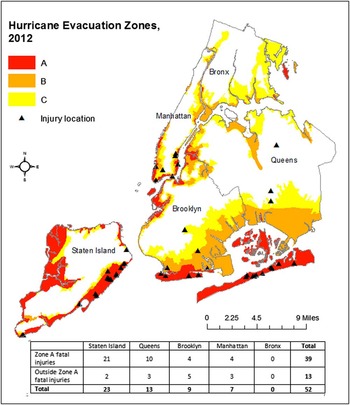
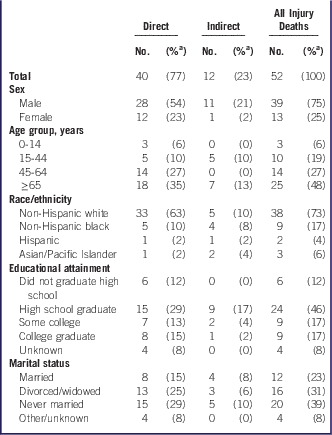
A total of 52 Sandy-related injury deaths were identified in NYC by applying a case classification definition that included direct and indirect injury deaths (ie, deaths that would not have occurred had Hurricane Sandy not happened). The majority of decedents were male (75%), and nearly half were aged 65 years and older (48%) (Table 1). Nearly three-quarters of decedents were non-Hispanic white (73%). All decedents were residents of NYC. NYC comprises 5 boroughs (counties): Bronx, Brooklyn, Queens, Manhattan, and Staten Island. Most decedents were residents of Staten Island (44%), followed by Queens (25%) and Brooklyn (23%). Most (75%) injury deaths occurred in Evacuation Zone A (Fig. 1).
Location of Fatal Injuries Related to Hurricane Sandy, New York City, 2012 (N=52).

Demographic Characteristics of Injury Deaths Related to Hurricane Sandy, New York City, 2012

a Percentages may not sum to 100% because of rounding.
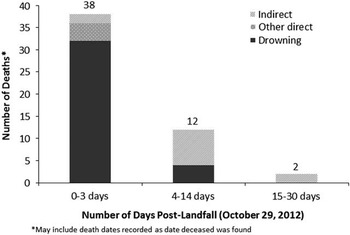
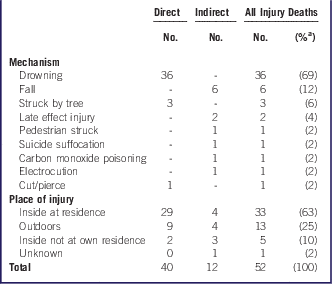
Forty deaths were classified as caused by injuries that were directly related to the storm. All of these deaths had been previously identified by OCME and had been assigned the cause of death code for cataclysmic storm (X37). Although OCME identified 4 additional deaths that also received the X37 code, these 4 deaths were classified as indirectly related under our injury framework owing to the specific details of how the injury occurred. Under our classification scheme, direct deaths represented over three-quarters (77%) of all the Sandy-related injury deaths, and most (73%) of the direct deaths occurred within the 3 days after the storm (Fig. 2). Mechanisms of these deaths included drowning, struck by tree, and cut/pierce (Table 2). Drowning due to storm-related flooding caused 90% (n=36) of the direct injury deaths. Indirect injury deaths occurred up to 30 days after the storm. Of the 12 indirect injury deaths identified, half (n=6) were caused by a fall. No indirect deaths were identified before the storm made landfall.
Injury Deaths Related to Hurricane Sandy by Date, New York City, 2012 (N=52).

Mechanism and Place of Injury of Injury Deaths Related to Hurricane Sandy, New York City, 2012

a Percentages may not sum to 100% because of rounding.
The home was the most common site of injury, with 63% of all decedents injured at home. In 73% (n=29) of the direct deaths and 33% (n=4) of the indirect deaths, the fatal injury occurred in the decedent’s home. All but one direct death occurring at home (n=28) was caused by drowning. At least 30% (n=9) of those who drowned at home were found in the basement or lived in a basement apartment. Thirteen decedents were injured outdoors. Mechanism of injury for those injured directly outdoors included drowning and struck by tree. For those injured indirectly, mechanisms included fall, electrocution, and struck by motor vehicle.
On the basis of the information collected on injury circumstances from the OCME case files, we were able to describe some of the environmental risks and individual behaviors that contributed to the fatal injuries. Among the direct deaths, at least 9 decedents lived alone. All 9 of these decedents died at home from drowning. Four of these individuals also had physical limitations. Five direct deaths occurred while attempting to evacuate after storm conditions were already unsafe. Among the indirect deaths, 5 deaths were caused by a power outage (ie, fall down a darkened staircase, carbon monoxide poisoning), 2 deaths were due to storm cleanup activities where workers had fallen while conducting repairs, and 2 deaths were associated with the evacuation of a hospital where the person was receiving treatment for complications of a late-effect injury. We identified a total of 3 occupational fatalities: 2 indirect deaths from cleanup activities and 1 direct death that occurred while the person was at work.
Overall, 39 individuals (75%) were fatally injured in evacuation Zone A. From the American Red Cross mortality data, we obtained some details about why some decedents did not evacuate. Numerous people cited the fact that Hurricane Irene, which had affected NYC a year prior, was milder than expected; therefore, the decedent did not think Hurricane Sandy would be too severe (n=5). Other decedents had decided to stay to protect their home and belongings; many were fearful of looters (n=5). A few individuals chose to stay behind with their pets (n=3). One decedent was unable to leave because of a disability. Another individual had plans to get a ride, but the plans fell through when the car broke down before the storm.
Discussion
We found a total of 52 injury deaths in NYC related to Hurricane Sandy. The majority of decedents were male (75%), and nearly half were aged 65 years and older (48%). Most (75%) injury deaths occurred in evacuation Zone A. A large majority of the direct injury deaths were caused by drowning, whereas the most common mechanism of indirect injury death was fall. The home was the most common site of injury, with nearly three-quarters (74%) of the direct deaths and one-third (33%) of the indirect deaths occurring as the result of injuries sustained at home.
Three-quarters (77%) of the Sandy-related injury deaths in NYC were caused by injury mechanisms that were directly related to the storm’s environmental forces; most were drowning deaths caused by storm-related flooding. Compared to other major US hurricanes, this finding is somewhat different. In other significant storms, indirect deaths exceeded direct deaths.Reference Ragan, Schulte and Nelson 8 , Reference Combs, Parrish and McNabb 15 - Reference Zane, Bayleyegn and Hellsten 18 Some indirect injury deaths occurred before the storm hit (ie, during storm preparation), 23 , Reference Brunkard, Namulanda and Ratard 28 - Reference Philen, Combs, Miller, Sanderson, Parrish and Ing 31 and in some instances, there were many more indirect deaths related to cleanup activities.Reference Combs, Parrish and McNabb 15 - Reference Zane, Bayleyegn and Hellsten 18 , Reference McKinney, Houser and Meyer-Arendt 22 , 24 , Reference Philen, Combs, Miller, Sanderson, Parrish and Ing 31 Motor vehicle crashes were a common cause of fatal injury in other regions, often due to loss of control from environmental conditions including floodwaters, debris, or traffic signal outages.Reference Ragan, Schulte and Nelson 8 , Reference Combs, Parrish and McNabb 15 - Reference Zane, Bayleyegn and Hellsten 18 In NYC, there were no injury deaths prior to the storm, few deaths related to cleanup activities, and no identified motor vehicle crashes, although there was a pedestrian fatality. There were also notably few deaths from carbon monoxide poisonings and no deaths from house fires compared with post-hurricane experiences in other jurisdictions. 11 , Reference Philen, Combs, Miller, Sanderson, Parrish and Ing 31
The unique characteristics of NYC’s urban setting may have contributed to the relatively smaller proportion of cleanup-related injury deaths from Hurricane Sandy. Compared to the United States overall, as well as other coastal cities that have been affected by hurricanes (eg, New Orleans, LA; Galveston, TX; Miami, FL), NYC has a lower proportion of home owners. 32 Because the majority of New Yorkers do not own their home, they may have been more likely to rely on management companies or city agencies for cleanup assistance. Cleanup activities can be dangerous because they involve individuals engaging in rarely performed tasks with powerful equipment, often in the presence of hazardous conditions.Reference Ragan, Schulte and Nelson 8 NYC’s Rapid Repairs program allowed for contractors to begin cleanup work before receiving a permit,Reference Gibbs and Holloway 3 which may have facilitated a greater reliance on professionals. Fifty-six percent of NYC households do not have access to a personal vehicle, 32 which may help to explain the lack of deaths from motor vehicle crashes. The close proximity to numerous hospitals and trauma centers may have also prevented injury fatalities in NYC.
Barriers to evacuation are complex and include logistical as well as psychosocial factors. Because the majority of fatal injuries occurred in Zone A, many of the Sandy-related injury deaths in NYC may have been prevented had individuals in Zone A evacuated. Public messaging regarding evacuation orders during Sandy in NYC was only moderately successful in reaching all Zone A residents and in influencing evacuation behavior. A post-Sandy survey conducted by NYC found that only 71% of Zone A residents reported hearing an announcement to evacuate from a public official. Furthermore, those who received an official instruction to evacuate were only slightly more likely to evacuate than those who did not receive such instruction (78% vs 68%).Reference Gibbs and Holloway 3 Although research shows that individual perception of risk is a leading factor in the decision to evacuate,Reference Fife, Smith and Maus 33 , Reference Dash and Gladwin 34 one recent study reported that neither perceived nor actual risk of flooding accurately predicted evacuation behavior.Reference Horney, MacDonald and Van Willigen 35 Despite a few individuals citing the relatively weak arrival of Hurricane Irene in 2010 as a barrier to evacuation, there is conflicting evidence of the influence of a previous disaster on predicting evacuation behavior.Reference Dash and Gladwin 34 , Reference Rincon, Linares and Greenberg 36 Depending on the confluence of demographic and social characteristics, divergent factors emerge as influential in the evacuation decision, such as previous experience with disaster, perceived level of risk, and number of years at residence.Reference Dash and Gladwin 34 However, these predictors are constrained for individuals for whom evacuation is difficult or impossible owing to a lack of resources or social networks and who require instrumental assistance to evacuate.
Several individuals died while trying to evacuate when storm conditions were already unsafe. The timing and circumstances of evacuation are also important and can play a role in risk of evacuation-related injury. It is important to note that there can be negative health impacts related to evacuation as well. Research has found increased risk of falls among older adults, spread of illness from living in close proximity at temporary evacuation shelters, and psychological stress associated with lack of privacy, lifestyle disruption, and being displaced from one’s home.Reference Lane, Charles-Guzman and Wheeler 27 , Reference Murray, Kilborn and DesVignes-Kendrick 37 , Reference Uscher-Pines, Vernick, Curriero, Lieberman and Burke 38 These factors must be weighed by government officials and emergency managers when implementing hurricane evacuation orders. The timing of the evacuation order and the availability of instrumental assistance may help increase evacuation and prevent some evacuation-related injuries.Reference Fife, Smith and Maus 33 , Reference Adams, Kaufman and Van Hattum 39
A clear strength of this work is the fact that every injury death from October 27, 2012, through December 30, 2012 (excluding homicides), was reviewed in the OCME case files and matched to 2 other data sources. Because no Sandy-related deaths were identified beyond November 28, 2012, we stopped case file review at December 30, 2012. The work is therefore limited by the period of case file review, and additional indirect injury deaths may have occurred after December 30, 2012. An additional limitation is that uniform data on circumstances could not be collected because the amount of information available on a given decedent in the OCME files and the Red Cross disaster mortality data varied widely. Some details on circumstances are likely to be undercounted simply because of a lack of information (eg, number of decedents with physical limitations, number of decedents who lived alone). There were likely non-injury deaths related to Sandy, as the result of exacerbation of chronic conditions for example,Reference Zane, Bayleyegn and Hellsten 18 , Reference Brunkard, Namulanda and Ratard 28 but investigation of deaths from chronic conditions was beyond the scope of this project. The deaths reported here are also limited to individuals who died in NYC. Residents who may have sustained a fatal injury in NYC or an evacuation-related fatal injury after leaving NYC are not included in this dataset if they died elsewhere, such as in neighboring New York counties or New Jersey.
For injury deaths, the date of death on a decedent’s death certificate in NYC is not necessarily the date of injury (although they can occur on the same date). This poses certain limitations when reporting dates of death for injury deaths, particularly for decedents who drowned. Generally, the date of death is when the decedent’s body was found, and some decedents were not found until the floodwaters receded. Although the greatest number of deaths occurred on October 30, the day after landfall, many of the decedents likely died on October 29, the day of landfall. The death certificates of some of the decedents whose bodies were found in the days after have the date of injury recorded as October 29, but this field was incomplete for some decedents because the exact date of injury was likely unknown.
We identified 2 indirect injury deaths caused by the late effects of a previously sustained injury. These deaths were included because information in the case files suggested that if the hospitals where these individuals were receiving treatment had not been evacuated (ie, if Hurricane Sandy had not happened), they likely would not have died. These individuals represent a larger group of people who may have suffered from interruptions of medical care during Hurricane Sandy, and who may have died under similar circumstances, but from non-injury causes. It was beyond the scope of this project to enumerate how many people died from the consequences of an interruption in their medical treatment.
The purpose of this work was to apply a case definition and classification framework that is flexible enough to include all potentially preventable deaths as recommended by Combs et al.Reference Combs, Quenemoen and Parrish 20 In applying this framework to a retrospective file review of injury deaths that occurred in NYC from 2 days prior to up to 2 months after Hurricane Sandy, we found large agreement with the deaths identified by NYC’s OCME in the immediate post-Sandy period. Of the 44 deaths with underlying cause of death code X37 for cataclysmic storm, 40 of these fit our definition of direct deaths. Only 4 deaths that we report as indirectly related had X37 as the cause of death code (owing to slight differences in classification framework), and only 8 additional indirect injury deaths were found. Based on research on mortality attributed to hurricanes in other regions, we expected a greater number of indirect injury deaths in NYC. Deaths that resulted from indirect exposures to the disaster, such as from cleanup activities or interruption of services, are not expected to be identifiable through cause of death coding, as they tend to be somewhat less proximal to the disaster, and the causes vary widely. These deaths are important to identify in order to evaluate the effectiveness of prevention policies and to develop best practices to reduce preventable deaths related to hurricanes.
To identify and fully describe injury deaths related to a natural disaster, including obtaining information on the mechanisms of the fatal injuries, it was necessary to review multiple mortality-based data sources. The availability of standardized information proximal to a disaster is consistent with the goals set forth by the Centers for Disease Control and Prevention to provide actionable data to emergency planners and policy-makers during a disaster.Reference Malilay, Heumann and Perrotta 40 We recommend that NYC consider the creation of a standardized natural disaster mortality tracking systemReference Zane, Bayleyegn and Hellsten 18 , Reference Choudhary, Zane and Beasley 41 to capture relevant details, such as mechanism of the injury and circumstances proximal to the death. This would also allow for the identification of both indirect injury deaths and non-injury deaths, such as cardiovascular deaths. Public health should play a role in providing the infrastructure required for adopting such a system.
Conclusions
This work, which operationalized a case classification framework during retrospective file review, provides an increased understanding of individual- and community-level vulnerabilities specific to a severe coastal storm. The circumstances of both direct and indirect Sandy-related injury deaths described in this article can help city planners and emergency officials recognize additional avenues for prevention. For example, evacuation messaging should be targeted to at-risk populations, such as older adults. Barriers to evacuation, including instrumental assistance for those with physical limitations or functional needs, should also be addressed. Preventing indirect injury deaths may require other interventions, including making mental health resources readily available and safety messaging during cleanup activities and prolonged power outages. The unique profile of injury deaths in NYC compared to other jurisdictions should be considered during future coastal storm planning efforts.
Acknowledgments
The authors acknowledge the NYC Department of Health and Mental Hygiene’s Office of Vital Statistics for providing the electronic death certificate data, NYC’s Office of Chief Medical Examiner for facilitating access to the case files, and Disaster Cycle Services of the American Red Cross for sharing their data through the memorandum of understanding with The Centers for Disease Control and Prevention. The authors also acknowledge staff in the Bureau of Environmental Surveillance and Policy for providing mapping support. The authors also acknowledge Kathryn Brown, Leze Nicaj, and CAPT Rebecca S. Noe for their input.
Funding
US Centers for Disease Control and Prevention cooperative agreement number 1U01TP000585-01.
Disclaimer
The contents of this article are solely the responsibility of the authors and do not necessarily represent the official views of the Centers for Disease Control and Prevention.