In the mid-1990s, after the first World Trade Center attack, Osama Bin Laden apparently made an important decision about the future of the burgeoning terrorist group now known as Al Qaeda. Up until the mid-1990s, Al Qaeda had played a major role in Salafi Jihadi terrorist operations around the world, but its involvement was mostly behind the scenes. Al Qaeda provided financing for operations, trained fighters from affiliated groups, and smuggled weapons to sympathetic parties. However, Bin Laden, the group's leader, determined that it was time for Al Qaeda itself to engage in a major attack and step out of the shadows. When planning began for the operation that was to become the East African embassy bombings of 1998, Bin Laden sent some of Al Qaeda's top military commanders and operatives, including some in the Kenya cell, to Hezbollah to learn from one of the most successful terrorist groups of the last twenty years. Even though Bin Laden's Sunni Salafi beliefs led him to clear theological disagreements with the Shia-affiliated Hezbollah, and Hezbollah had not actually conducted a suicide attack in years, Bin Laden considered them the experts and sent his people to learn. Furthermore, Bin Laden purportedly told his operatives to specifically study the Hezbollah suicide bombing of the U.S. Marine Corps barracks in Lebanon in 1983. His operatives went, took careful notes, and returned with the operational concepts and knowledge necessary for the 1998 embassy bombings.Footnote 1
This story illustrates key concepts related to nonstate actors, innovation, and diffusion in the suicide attack case. First, sometimes desire is not enough to adopt an innovation. Even though Al Qaeda had money, committed members, and weapons, it sent its members to Hezbollah, a suicide attack innovator, to pick up the tacit knowledge necessary to conduct its own operations. Second, organizational capacity matters. Al Qaeda lacked a prior operational history, making them extremely flexible when it came to designing the embassy bombings. Without an operational past that caused them to privilege certain attack strategies, it was easier to branch into a new area of operations such as suicide bombing. Third, it is impossible to tell the story of how military power matters without understanding how it spreads. The connection between Al Qaeda and Hezbollah became a critical node in the spread of suicide attacks around the world, connecting a key innovator in the 1980s, Hezbollah, to the primary exporter of knowledge about suicide attacks from the mid-1990s to the present, Al Qaeda.
Studies of terrorism in general and suicide attacks in particular have tended to view terrorist groups independently. Pape argues that foreign occupation and religious differences between the terrorist group and the perceived occupying state drive suicide bombing.Footnote 2 Similarly, Bloom's market share and outbidding theory presumes groups adopt suicide attacks based on their need to compete for influence with other local terrorist groups.Footnote 3 While each author mentions the mass of interrelationships between many terrorist groups, they generally assume the independence of each observation in the “data” of suicide terrorist attacks across campaigns.Footnote 4
But what if the propensity for a terrorist group to adopt suicide tactics depends in part on its external linkages and whether it has the organizational capability to adopt the innovation? If organizational factors and diffusion processes influence who adopts at what times, ignoring these factors risks missing critical information about behavior. Using a diffusion framework to analyze suicide attacks builds on recent work on the spread of economic and financial policies as well as domestic political regimes.Footnote 5
The evidence presented below shows that organizational concepts taken from business innovation studies and the conventional military literature are helpful in assessing terrorist groups as well. For example, while experienced groups are often better at adopting incremental or sustaining innovations, disruptive innovations that require changing organizational forms or transforming operational methods can challenge more established groups. The disruptive organizational changes required to adopt suicide attacks made adoption difficult for terrorist groups that operated well before the era of suicide attacks began in the early 1980s. Leading pre-1980s groups, such as the Palestine Liberation Organization (PLO), the Provisional Irish Republican Army (PIRA), and the Basque Fatherland and Freedom Group (ETA), all failed to adopt in the short and medium term.Footnote 6
However, the effect of organizational age in the suicide terrorism case appears conditional in some ways on the interaction of organizational challenges with the diffusion element, or the means by which groups acquire the tacit knowledge necessary to adopt. The interaction helps explain both which groups are most likely to adopt and which are not. Networks of religiously motivated groups distributed suicide bombing around the world through the direct diffusion of knowledge from group to group and demonstration effects that influenced non-religiously motivated groups. For religiously motivated groups in particular, there is a direct relationship between organizational age and the probability of adoption. Very young groups are likely to adopt, but the probability of adoption drops sharply over time.
Additionally, analyzing the universe of terrorist groups, both those groups that adopted suicide bombing and those that did not, shows that Pape's key variable of interest—occupation—probably does not significantly predict the adoption of suicide bombing.Footnote 7 Groups with nationalistic motivations are not more likely to adopt suicide attacks than other groups. In general, this article expands our understanding of nonstate actors, innovation, and suicide attacks. It seeks to make suicide bombing more comprehensible by taking ideas about financial and organizational constraints designed to explain national militaries and applying them to terrorist groups. Thinking about suicide attacks as a special case of diffusion in the military area—an innovation for nonstate groups—can help bring the study of suicide attacks further into the mainstream and highlight how the phenomenon is both like and unlike other innovations.
The Diffusion of Innovations
Political economy scholars and others have recently shown great interest at evaluating economic and social policy changes through a diffusion lens.Footnote 8 Simmons and Garrett, in their introduction to a special issue of International Organization on the topic, describe several strands of argumentation in the literature, ranging from processes based in competition to those revolving more around learning or emulation.Footnote 9 This study examines the question of diffusion from a slightly different perspective. It discusses changes in violent behavior, rather than economic or social policy, it evaluates the decision of nonstate actors rather than nation-states, and it focuses on the importance of the capacity to adopt innovative policy changes rather than presuming adoption is mostly a matter of simply making a decision.
The key puzzle is how terrorist groups decide whether to adopt the innovation. For a terrorist group that exists, by definition, due to its commitment to violent action, the decision-making terrain is slightly different than for a state; there are limits to the economic analogy. Terrorist groups can learn from each other, but excluding cases where they are functioning within the same space, they are different from firms because they do not typically directly compete with each other. They are different from states because they exist in a constant state of war. There are inherent incentives to adopt a new tactic since every group wants to maximize its ability to deliver punishment to its target of choice, which is competitive pressure of sorts.Footnote 10
With economic policy diffusion, a government or other entity observes or receives information on a successful policy in another location and adopts so that they can compete with other adopters in the global marketplace. In the terrorist innovation case, groups most often adopt not to stay competitive with other adopters, but to be more successful in their dealings with outside parties.
While learning and emulation, especially, are certainly possibilities, especially learning between groups with loose affiliations or similarities, the question of capacity always looms large.Footnote 11 This builds on existing diffusion work in the economic realm. In studies examining changes in central bank policies, trade barriers, or other economic implements, diffusion research is relatively, though not always, silent on the question of capacity. The question is whether a decision to adopt is influenced more by competitive pressure, or by emulation and learning. However, it is generally assumed that if a state wants to implement a given economic policy, it will do so. There may be negative repercussions on the economic front or by particular interest groups, but capacity is not the key question.
In contrast, in the military realm, different innovations require different levels of financial investment and organizational transformation for adoption. Moreover, capacity is often not fungible in the short-to-medium term. This study focuses on suicide bombing, a particular military innovation that has low financial barriers to entry but high organizational barriers. Essentially, while capacity is not a serious concern from the financial side, it is possible that every terrorist group could not adopt the innovation even if every group wanted to do so. Groups that have reportedly attempted to adopt but failed, such as the Revolutionary Armed Forces of Colombia (FARC), demonstrate that capacity is an important potential issue.
A limited amount of the general terrorism literature focuses on the spread of terrorism within Latin America and Europe in the 1960s and 1970s.Footnote 12 In theory, suicide bombing can diffuse through both direct and indirect means. Direct diffusion occurs when groups physically coordinate and train together and knowledge is transferred from one group to another. Hezbollah operatives training Hamas operatives after Hamas's expulsion to Lebanon in 1992 was direct diffusion. Indirect diffusion occurs when one group learns about the actions of another group and models those actions. For example, when reports of the suicide vest created by the Tamil Tigers (LTTE) in Sri Lanka inspired similar tactics by Hamas, this was indirect diffusion.
Why Does Suicide Bombing Occur?Footnote 13
Much terrorism research, particularly on suicide attacks, focuses on what motivates the individuals that conduct attacks. What makes an individual decide not just to die fighting for a cause, but to die on purpose as a means of inflicting harm on others? After decades of research, it seems that suicide terrorists, on balance, are not generally afflicted with some sort of psychological condition. Individual-level motivations for volunteering include revenge against governments that killed loved ones, despair due to hopeless economic conditions, social pressure, or other personal crises.Footnote 14 Krueger and Malečkovà find no relationship between economic distress and support for terrorism, while other theories focus on whether the conflict involves territory.Footnote 15 Sageman casts doubt on any particular individual-level behavioral pattern by demonstrating, through a study of several hundred individual terrorists, the lack of a common background or enabling condition.Footnote 16
Pape argues that democracies are more sensitive to changes in domestic public opinion due to electoral pressures, so suicide bombing occurs in territories occupied by democracies as a high-profile attempt to influence public opinion toward withdrawal. Occupation is the critical determinant of whether or not suicide bombing occurs.Footnote 17 Recent work by Piazza similarly finds that occupation predicts suicide attacks but concludes that there is no relationship between regime type and suicide attacks.Footnote 18
Bloom also views the adoption of suicide terror tactics by terrorist groups as rational and based on cost-benefit analysis. However, instead of foreign occupation, Bloom argues that internal competitions for influence within oppressed communities create incentives for groups to seize “market share” of public opinion by “outbidding” each other through demonstrating higher levels of dedication to the cause. Suicide bombings signal intense commitment, since by definition they involve the death of a group member.Footnote 19 This creates internal political incentives for groups to adopt. Bloom also explicitly recognizes interlinkages between groups and frames the question in terms of who adopts and who fails to adopt. Moghadam disagrees with both Pape and Bloom, writing that suicide attacks have become a globalized phenomenon and the transnational nature of jihadi demands means local bargaining or occupation explanations have inherent limits.Footnote 20 This builds on in-depth research conducted by Pedahzur, who shows the increasingly complicated interactions between elite networks and individual actors that produce suicide attacks.Footnote 21
Terrorist Groups and Military Organizations
Terrorist groups, like military organizations, face resource constraints that influence their planning processes, from how often they attack—the operational tempo—to who they plan to attack and how they plan to conduct attacks. The availability of resources influences the types of equipment, such as the types of bombs or small arms, a group can build or purchase. Financial resources also influence the ability of a group to send potential actors off for training at external sites or buy safe houses to shield group activities from the government.
Terrorist groups also face organizational constraints. Recent research shows the importance of looking at the organizational characteristics of terrorist groups. Asal and Rethemeyer find that organizational size is a significant predictor of the lethality of terrorist attacks, because larger groups can draw on a larger and more varied set of experiences—human capital that improves their effectiveness.Footnote 22 Once terrorist groups form, plan, and conduct operations, they develop at least tacit bureaucracies and hierarchies—and sometimes even explicit bureaucracies and hierarchies. Group members gain or lose prestige depending on whether their ideas succeed or fail and subunits may gain or lose prestige based on their ability to plan and conduct specific types of operations. So just like businesses and military organizations, terrorist groups develop expertise at particular tasks. But instead of producing widgets or fighting tank battles, terrorist groups develop expertise in assaulting military bases, hijacking airplanes, or building remotely detonated explosives. Research by North on economic institutions and Wilson on bureaucracies indicates that the informal “rules” and ways of doing business also function as institutions that regulate behavior.Footnote 23
Are Suicide Attacks a Military Innovation?
Military innovations are changes in the character of warfare involving shifts in the way organizations plan for and conduct attacks. Military innovations are often, though not always, linked to technological changes.Footnote 24 Suicide attacks are a potential organizational response to the challenge of gaining access to and destroying particular types of targets. For a terrorist group, suicide bombings are often an attempt to circumvent an asymmetrical weakness by using members of the group themselves as part of the delivery mechanism.Footnote 25 It substitutes people (sometimes people in cars or planes) for artillery, missiles, and other expensive weapons. Suicide attacks are also an attempt to circumvent the barriers to assassination and attack presented by modern security screening.
Adopting suicide bombing requires shifting the way a group does business. The training operatives receive for suicide attacks is different than the training they get for other types of attacks. Terrorist training at the tactical level has traditionally placed at least some emphasis on evading capture and handling interrogation if capture occurs. However, this is unnecessary in the case of suicide attackers, necessitating changes in their training regimens. For example, evidence from the Hamas case suggests that some suicide bombers receive ideological training concerning the justness of the cause and the action instead of the more traditional survival training.Footnote 26 Each preexisting group that has used suicide attacks changed its recruitment practices. The LTTE often used suicide bombings against hard targets they could not otherwise destroy, changing the scope of the possible through new tactics. When suicide attacks are mostly used against hard targets, meaning the goal of the attack is an instrumental on-the-ground military accomplishment, groups need a higher attack success rate and thus highly trained operatives. After recruiting new members into the Tamil Tigers, the LTTE sent the best to specialized training where they attempt to become Black Tigers. The LTTE then selected its suicide attackers from the ranks of the Black Tigers.Footnote 27
If suicide attacks are mostly used against softer civilian targets, the success rate requirements are likely lower, both in terms of the casualties per operation and whether or not the operation succeeds at all. For example, while both Hamas and Islamic Jihad initially used trained operatives to conduct attacks, by the Al-Aqsa Intifada, both groups shifted to recruiting soft supporters from the community for specific suicide operations and training them for short periods of time, mostly for ideological reinforcement.Footnote 28 This avoided risking the human capital of trained members.
The combination of the innovative use of explosives in an operation that necessitates killing the carrier in order to damage opponents, and the different recruiting and training methods required to conduct the attacks means that suicide bombing can be considered a military innovation. While not all military innovations are effective and not all terrorist groups attempt to maximize casualties, suicide attacks inflict significant casualties relative to the cost of the attack. The bomber or an external controller can decide exactly when to detonate the bomb to maximize or minimize casualties depending on the situation and change locations to alter the desired impact. The average number of killed and wounded in suicide attacks also tends to exceed that of other types of terrorism, though there is variability ranging from the highly destructive attacks of Al Qaeda and Hezbollah to the less destructive attacks of Hamas and the PKK.Footnote 29 Evaluating terrorist attacks from 1980–2001, Pape finds that suicide attacks composed 3 percent of the total number of terrorist attacks but accounted for almost 48 percent of the deaths.Footnote 30 The reality of these numbers, however, is less important than the perception among terrorist groups about the success of the tactic.
The Debut of Suicide Attacks
The human as a bomb is not an entirely new method of employing military force—late-nineteenth- and early-twentieth-century anarchists and Japanese kamikaze pilots both engaged in suicide bombing to some degree.Footnote 31 However, the Lebanon bombings in the early 1980s signaled a new era of suicidal military activity. In the wake of the Lebanese civil war, the Shiite population in Lebanon concentrated in the south and around Beirut. Several groups, most prominently Amal, sprang up to help defend Shiite interests in the midst of the sectarian strife. In 1982, the Israeli occupation, continued Maronite-Palestinian violence, and the deployment of Western troops caused a splinter within Amal. The more radical elements, which sought to establish an Islamic state in Lebanon, moved to the Bekka Valley and joined forces with over a thousand Iranian Revolutionary Guards sent by Ayatollah Khomeini to help establish a Lebanese Islamic state. The group took over a Lebanese army fortress and the surrounding territory, naming itself Hezbollah, or “Party of God.”Footnote 32 On 11 November 1982, Hezbollah launched its first suicide attack, a bombing near an Israeli military installation in Tyre.Footnote 33 While not technically the first mover, the first to use suicide bombing, Hezbollah launched the first suicide bombing “campaign” and achieved international notoriety after the 23 October 1983 bombing of the U.S. Marine Corps barracks in Beirut, Lebanon. The nonstate nature of the act, the casualties from the initial demonstrations, and the media coverage make the early Lebanon bombings the appropriate point at which the innovation should be considered mature.Footnote 34
If suicide attacks are a military innovation, one should think about adoption as a strategic choice and evaluate the factors that make both adoption and nonadoption likely.Footnote 35 Given a set of terrorist groups in the international system, once they learn about suicide attacks, they have to decide whether to adopt the tactic. What has stopped most terrorist groups in most time periods since the Lebanon campaigns from using suicide bombing? Instead of beginning by trying to explain why Hamas or Al Qaeda uses suicide bombing, it is more useful to figure out why the vast majority of terrorist groups do not.
Predicting the Spread of Suicide Attacks
The last several years have witnessed an explosion in the number of groups using suicide bombing tactics. The diffusion of the innovation is ongoing. Unlike nation-states, terrorist groups exist on the basis of their violent opposition to a government or other group. Most states most of the time are not at war and are not mobilizing for war.Footnote 36 Terrorist groups face life and death struggles on a more daily basis than most national militaries. Unlike states, terrorist groups cannot “hide” or become neutral. This means that deciding how to respond to an innovation in possible tactics they can employ is a somewhat simpler proposition for terrorist groups given their relatively constant state of high vigilance and mobilization. While for national militaries there is substantial variation in the interest a military organization is likely to show in a given innovation, terrorist organizations facing the constant threat of extinction should have inherent interests in thinking about the adoption of new tactics such as suicide attacks that, according to conventional wisdom, may make success against an adversary more likely.Footnote 37
Groups facing asymmetrical military disadvantages in comparison with a nation-state often try to find equalizers to at least partially redress the imbalance. However, not all groups that utilize suicide attacks appear to do so because they lack other options. Hezbollah's suicide bombing campaigns occurred during times of relative organizational strength; the LTTE in Sri Lanka utilized suicide bombings simultaneously with a host of other military tactics; and Al Qaeda chose to employ suicide attacks even prior to the U.S. attack on Afghanistan.Footnote 38 This also proves it makes sense to think about the organizational adoption of suicide attacks as a strategic choice rather than an automated response. Even if suicide attacks are adopted purely out of necessity, the strategic failures of some groups to adopt suggest there is utility in examining the factors that predict adoption.
Moreover, while nation-states design innovations mostly to employ against each other, even if they exist in a highly competitive environment, terrorist groups exist to fight governments or sets of governments, not each other. They rarely have to worry about “countering” an innovation the way a nation-state has to worry about countering the innovation of another state.Footnote 39
In the nation-state context, alliances can theoretically allow states to substitute paying the cost of adoption for paying the cost of allying through a reduction in their freedom of action. Alliances can also sometimes allow states to more quickly acquire the technology and knowledge necessary for adoption from an alliance partner. For terrorist groups, the small sizes of most groups and their independent goals mean the protection function of alliances is usually not possible. However, direct cooperation for the purpose of exchanging information about best practices can and does occur, influencing the probability of adoption.Footnote 40 While less formal than “epistemic communities,” shared beliefs about effectiveness and the way to weigh costs and benefits could shape how a terrorist group makes decisions about whether to adopt an innovation.Footnote 41 Direct or indirect contacts between groups could drive a learning process that may look like emulation if preexisting factors such as ethnicity, religion, language, or other things serve as the locus for diffusion.Footnote 42 The mechanism for diffusion becomes the direct transmission of information from group to group or mimicry through vicarious learning.
For religion in particular, some scholars argue that the religious orientation of many new terrorist groups and the supernatural rewards offered for participation in acts such as suicide attacks over the last few decades make religion a potential locus of adoption.Footnote 43 The intense personal and group-based factors driving religiously motivated groups could make them especially likely to adopt upon exposure from similar groups. The transnational character of religious motivations also potentially makes religious groups candidates for network-like diffusion effects. However, as explained above, suicide attacks diffused from Hezbollah to Al Qaeda despite differences in their theological perspectives, though both are Islamic. The argument here does not depend on the unique characteristics of any particular religion, but rather the ability of religion to serve as a coordination vehicle for like-minded groups.Footnote 44
H1A: The greater the number of direct or indirect links between a terrorist group and other groups, of which at least one is an adopter, the more likely it is that the group will adopt.
H1B: Religiously motivated groups, especially from similar religious traditions, should be more likely to adopt and diffuse the innovation.
It is also possible to predict which groups are most likely to adopt suicide attacks based on a better understanding of the relationship between the financial and organizational constraints that influence group behavior. The framework used here is called adoption capacity theory to reflect the way adoption requirements for a given innovation combine with interests to shape the range of the possible for organizations.Footnote 45 Business innovation scholars have clearly demonstrated differences in the way firms respond to different types of innovations. While large firms tend to do very well when facing incremental innovations, they often do poorly when facing disruptive innovations that require not just doing something differently, but mastering new tasks with very different organizational routines. It is precisely their human capital, expertise, and experience at old ways of doing business that blinds them to the promise of new business processes or technology, while also generating enormous bureaucratic obstacles to change. Research on the semiconductor industry by Henderson and on the disk drive industry by Christensen shows this pattern across different types of firms.Footnote 46 So, when these types of innovations happen, groups with preexisting expertise in particular ways of doing business will often be less willing to adopt the innovation than newer groups.
The two key metrics that define the adoption requirements for a given innovation are the levels of financial intensity and organizational capital required to adopt the innovation. Financial intensity refers to the resource mobilization necessary for a group to adopt a new military innovation.Footnote 47 For innovations that have low financial barriers to entry, resource considerations should not influence the extent of diffusion. Actors that want to adopt the innovation are likely to have the necessary resources. In this case, the oft-cited statistic for the “cost” of a suicide bomb, based on Atran's research and documents captured by the Israeli government, is $150.Footnote 48 While the cost can vary depending on the particular explosive, whether it is a car bomb or not, and other factors, the point is simply that the monetary cost-per-unit of the hardware for a suicide attack is extremely low.Footnote 49 Financial barriers should not prevent a group from adopting.
Organizational capital refers to the previously intangible aspects of organizational strength that firms draw upon when facing periods of industry transition. From a military perspective, organizational capital is the nontechnological aspect of how militaries generate force, comprised of doctrine, education, and training. Organizations with a high degree of organizational capital are much better able to take advantage of new innovations and transform themselves successfully for the future than organizations with a low degree of organizational capital.
It is important to separate out the determination of a group's organizational capital level from whether or not it adopts an innovation, to avoid a tautology. We need an ex ante measure of capacity from the period right before the innovation is introduced into the international system. One way to measure organizational capital levels is by looking at how much groups spend on research and development.Footnote 50 However, it is difficult to find systematic evidence on research and development or experimentation by terrorist groups. Existing evidence is very anecdotal in description and means an experimentation indicator has coding constraints. Because nonstate actors face larger budget constraints than nation-states and are less likely to have a formal research and development arm, finding formal evidence of experimentation is difficult. Where any evidence of experimentation by terrorist organizations does exist, it should correlate with higher organizational capital levels. Organizational size is also often an accurate predictor of whether firms can effectively implement incremental innovations, or improvements to the way they currently do business. In the terrorism realm, it has been associated with greater lethality. However, for disruptive innovations, which require an entirely new way of operating, organizational size is less likely to affect the probability of adoption.Footnote 51
Another way to measure organizational capital levels is to evaluate the “critical task” of groups, or the way a group conceptualizes its broad strategy and then the means of implementing that strategy.Footnote 52 Wilson and others find that when groups conflate their critical task with the mechanism of achieving the goals set out by their task, conflating means and ends, they have a much harder time adopting innovations than groups whose critical task is not bound up in a particular operational method. One example of a dysfunctional critical task is the Vietnam-era U.S. Army's emphasis on overwhelming firepower. The emphasis on overwhelming firepower drove flawed search-and-destroy missions and using body counts as a metric of success, while making it harder for them to adopt counter-insurgency methods.Footnote 53 This concept is potentially applicable to terrorist groups. The extent to which terrorist groups view their existence as bound up with particular fighting methods, as opposed to broader goals, influences the breadth of their critical task focus. Those groups with a strong identification to particular ways of fighting, such as using remotely detonated explosives, may find it especially difficult to expand their critical tasks to adopt suicide attacks. Alternatively, those groups more broadly focused on goal accomplishment rather than methods should have an easier time adopting. However, as with research and development, there are measurement challenges.
A final way to measure the organizational capacity of groups is by evaluating their organizational “age,” a concept best articulated by Olson.Footnote 54 As groups build an operational history, they develop institutionalized command and control structures focused on the types of operations the group conducts. More bureaucratized groups with multiple decision levels and veto points, those with older organizational ages, are likely to have more trouble shifting tactics to adopt. Actors will have political capital invested in particular tactics, especially if their credibility in the group is built on expertise in a particular area. Members of national militaries often resist the introduction of new technologies or organizational practices that threaten their organizational status by making their training and expertise less relevant. Similarly, some members of well-established terrorist groups will have strong bureaucratic reasons to resist the introduction of suicide attacks because it will challenge established organizational hierarchies. Higher organizational ages are therefore associated with lower levels of organizational capital.Footnote 55
While these measures are far from perfect, they represent a first step at evaluating the diffusion of suicide attacks as an innovation, rather than treating it as an exotic and separate phenomenon. Focusing on the constraints that influence group decision making can fruitfully help us predict why some actors choose suicide attacks, why some do not, and the implications for international politics.
Adoption of suicide bombing, as a disruptive innovation, requires significant organizational changes by preexisting terrorist groups. One way to determine the organizational change requirements is by comparing the organizational capacity of groups to the organizational capacity of the first-moving actor, Hezbollah. This test reveals large organizational challenges for potential adopters of suicide attacks.Footnote 56 With a start year of 1982, Hezbollah turned to suicide terror very early in its history, before it had a set operational profile. This suggests that the optimal organizational age is low. There is not reliable experimentation data or doctrine to shed definitive light on the critical task focus component of organizational capital. However, Kramer suggests Hezbollah initially conceptualized its mission broadly, which made them open to suggestions, possibly from the Iranians, about suicide attacks.Footnote 57 In general, for terrorist groups strong linkages seem to exist between organizational age and critical task focus, especially for younger groups.Footnote 58 Younger groups, lacking an operational profile due to a lack of attack experience, are likely to also lack a set critical task focus, making them more flexible and therefore more likely to adopt new innovative tactics. Even beyond Hezbollah's experience, adoption seems to require a high level of organizational capital, especially for older groups. Recruiting suicide bombers is a social as much as a physical process—the extreme nature of the act, since it guarantees death for the actor, requires organizational reinforcement to convince someone to sign on.Footnote 59 The terrorist group has to decide that using suicide attacks will help accomplish its goals, requiring an evaluation of, among other things, the relative instrumental and/or symbolic benefits, the relative cost of training suicide bombers versus training for other types of operations, and the potential repercussions, in terms of reprisals.
Also, since suicide attacks by definition involve the death of members of the terrorist group, and potentially members with substantial expertise and knowledge depending on the particular situation, they cut into overall organizational knowledge and expertise. This is one reason Hamas shifted from using trained members to recruiting specifically for suicide bombings.Footnote 60 The impact varies depending on whether long-term members or new recruits are used for suicide missions. But in general, suicide attacks impose a net organizational cost that has to be balanced out by either the direct instrumental or signaling benefits of the attack. Finally, there must be people not only willing to die for a particular cause, but willing to kill themselves.Footnote 61 This is a supply issue; finding people willing not simply to risk death, but to kill themselves in pursuit of an organizational objective. The software costs of suicide attacks, the costs borne by the organization for suicide bombing, therefore far outstrip the hardware costs.Footnote 62 Given the high levels of organizational capital and low levels of financial intensity required to adopt suicide bombing, groups lacking a high level of organizational capital will be unlikely to adopt.
H2: Groups with lower organizational ages, all other things being equal, should have greater levels of organizational capital and thus be more likely to adopt than groups with higher organizational ages.
Research Design
This study examines diffusion of suicide attacks through statistical analysis of all terrorist groups from 1968–2006 as defined by the American Memorial Institute for the Prevention of Terrorism and the RAND Corporation (MIPT-RAND) through 15 July 2006, supplemented by illustrative examples of terrorist group decision making in the wake of the suicide attacks innovation.Footnote 63 The dataset is based on a long-term terrorism data collection effort undertaken by the RAND Corporation and records all types of terrorist incidents, both suicide and nonsuicide.Footnote 64
The aggregated terrorist group information available through the MIPT-RAND dataset yields 823 terrorist groups and limited aggregated data on each group, including its start date, the motivations of the group, the targets of their attacks, and the total incidents, injuries, and people killed. Only groups that conducted some sort of attacks within the modern terrorism era are included, to avoid biasing the results by including groups that rose, acted, and fell prior to the real debut of modern terrorism.Footnote 65
The dependent variable is whether or not a group has used suicide attacks. It is coded 1 if the group adopted suicide attacks, and 0 if otherwise. The dependent variable is coded based on data from MIPT, Pedahzur, and Pape.Footnote 66 The main independent variable of interest, a measure for the organizational capital of each terrorist group, is based on its organizational age.Footnote 67 Organizational age is defined for these purposes as the time gap between the creation of the terrorist group, according to MIPT, and 2006. As explained above, the existence of terrorist groups, given their status as nonstate actors opposing nation-states with violence, is always in question, meaning the organizational age for a group starts when the group forms. Since the data ends in 2006, each group is coded by its start date in relation to 2006. The PIRA, since it was formally instituted in 1969, is coded a thirty-seven while Hamas, created in 1988, is coded an eighteen. A break point should exist for those groups that came into existence after 1982 and the beginning of the suicide bombing era, versus those already in existence at that point.
There may be some particular instances where terrorist groups go through major transformations in response to either internal or external challenges, but defeat is typically not an opportunity for reconstruction in terrorist organizations. A nation-state can often recover from military defeat. Defeat does not always mean a country is fully conquered, so it makes sense to reset the organizational age of militaries when defeats occur. However, terrorist groups in most cases cease to exist once defeated, meaning the organizational age assumption made for coding purposes is accurate.Footnote 68
Another set of independent variables comes from the MIPT data on group “motivations.” The motivations are: anarchist, anti-globalization, communist/socialist, environmental, leftist, nationalist/separatist, other, racist, religious, right-wing conservative, and right-wing reactionary.Footnote 69 For each possible motivation, a dummy variable is coded 0 if MIPT did not define the group as having that particular motivation, and 1 if the motivation is applicable.Footnote 70 To further test alliance possibilities and account for potential clustering in geographic areas and between groups, several other variables are added. To account for the reaction to the U.S. invasion of Iraq, an Iraq War variable is coded 1 if the main country of origin for the group is Iraq and the start year for the group is 2003 or after, and 0 if otherwise. To account for the clustering of groups surrounding strife in Lebanon and Israel, a Lebanon variable is coded 1 if the country of origin is Lebanon, and 0 if otherwise, and an Israel variable is coded 1 if the country of origin is Israel (including Gaza and the West Bank), and 0 if otherwise. Finally, to test the alliances argument, many argue that Al Qaeda has played a prominent role promoting suicide terror tactics among loosely affiliated groups, serving as a locus for diffusion, so an Al Qaeda network variable is coded 1 if the relevant data source for that group argues there is a strong link, including members and operational planning, between Al Qaeda and a terrorist group, and 0 in other cases.Footnote 71
Since the unit of analysis is the terrorist group and the subject of interest is how groups that conduct campaigns behave, the data used for the statistical tests is limited to only those groups that conducted more than one attack and whose attacks have killed at least one person. The conceptual focus of this study is on the decision-making process of terrorist groups, specifically the decision about whether or not to adopt suicide attacks as a strategy. Given inherent data collection limitations due to secrecy about the organization of terrorist groups, there is a high propensity for red herring groups within the data; groups that never really existed or which only existed on a limited scale. Moreover, there are groups that appear to have formed for a single attack but lack a concrete “organization.” Multiple attacks and fatalities are concrete symbols of group existence and commitment that help weed out false groups that never act or form and de-form around a single act. If a group has announced its existence but never committed an attack, only engaged in a single operation, and/or never executed an attack that generated fatalities, it does not have an operational profile and is excluded.
Statistical Analysis
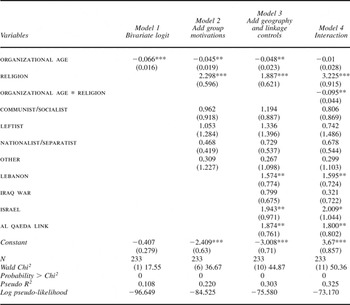
Since the dependent variable is dichotomous, the appropriate statistical model is logistic regression. The models presented below use Huber-White robust standard errors to correct for potential heteroskedasticity. Table 1 shows a series of statistical models that build from a bivariate analysis of the relationship between organizational age and suicide attacks to a model that includes all of the independent variables described above, including the group motivation variables, the geographic variables, and the Al Qaeda link variable.Footnote 72
Statistical relationship between organizational capital and the adoption of suicide attacks

Notes:
Robust standard errors in parentheses. While the organizational age * religion in Model 4 is not significant, it is an artifact of the interaction. For Model 4, if organizational age * religion is set to 1 if groups are not religious, and 0 if groups are religious (and all of the other motivation variables are reset similarly as well), and a new interaction term is generated, the organizational age * religion becomes significant even though the values on the religion and organizational age * religion variables are the same (they just flip signs). This shows that in this instance, the significance of the lower order terms is not as important given the interaction term (Braumoeller Reference Braumoeller2004).
* p < .10;
** p < .05;
*** p < .01.
The first three models validate the organizational capital hypothesis, showing that there is a negative and significant relationship between organizational age and the adoption of suicide bombing by terrorist groups. While the coefficient is not especially large, the variable is always significant above the .05 level. The relationship also holds whether or not group motivations, controls for geographic regions, and terrorist group cooperation controls are included or excluded. The nationalist/separatist motivation variable is not significant in any of the models, in stark contrast to Pape's findings. While Pape is potentially correct that many groups that have adopted suicide attacks felt occupied, a likely trigger for nationalist/separatist sentiment, a great number of groups with nationalist/separatist motivations, including prominent terrorist groups such as the IRA and ETA, failed to adopt the innovation. The Lebanon and Israel variables are positive and significant, reflecting the way both locations have served as focal points for suicide attacks campaigns. The Iraq War variable is not significant, but that might be an artifact of the timeframe of the dataset.
As predicted, the adoption of suicide attacks also seems to cluster generally along the lines of a particular group motivation—religion. Building on other findings showing the potential importance of cultural factors in driving diffusion, religion appears to function as a transmission mechanism for tacit knowledge about suicide bombing. Religion can help groups communicate across national or even ethnic lines because it is a common language for the spread of operational knowledge. As a test of the shared religion proposition, I substitute an “Islam” variable for those religiously motivated groups that are Islamic, along with an interaction term between Islam and organizational age. Substituting those variables for the religion and religion*organizational age interaction, I then reran Model 4 in Table 1. As described above, sixty-nine of seventy-five religiously motivated groups espouse Islamic beliefs. The Islam variable is positive and significant while the interaction term is negative and significant, just like the religion variable and interaction term in Model 4. These results further bolster hypothesis H1B by showing how Islam serves as the basis for diffusion between religiously motivated groups. The evidence presented here suggests that suicide tactics have diffused among Islamic groups because that is the coordinating network and probably also because suicide attacks began with Hezbollah. However, the evidence does not necessarily say anything about the propensity for Islamic groups in general to adopt. While about 25 percent of the suicide attack adopters are not Islamic, there are not observations of religiously motivated, non-Islamic groups adopting. Therefore, it is not possible to directly test whether there is something about Islam, as opposed to other religions, that makes diffusion more likely. The results do show that, as hypothesized, the transnational character of religious beliefs, as opposed to nationalism, makes religion an ideal network for diffusion across time and space. These limits to the data make the results more suggestive than anything else. Figure 3 below further attempts to shed light on the question of diffusion relationships.
However, even among religious groups, the high level of organizational capital required for adoption should make it difficult to adopt for groups that cannot learn from a group that already has expertise in organizationally preparing for suicide bombing. This is different from the actual mechanics of suicide attacks. It is the organizational jump to a system that not only encourages group members to actively kill themselves, rather than just engage in risky activities, but also has replacement and leadership-retention consequences, which require the greatest effort. One likely example of direct diffusion comes from Hezbollah and Hamas. In 1992, Israel captured and deported 415 Palestinians, mostly members of Hamas but also some members of Islamic Jihad, to Lebanon. While in Lebanon, the Sunni members of Hamas and Shiite members of Hezbollah apparently began coordinating training, leading to the direct diffusion of knowledge concerning suicide attacks from Hezbollah to Hamas.Footnote 73 Additionally, confirming Asal and Rethemeyer's finding, alliances, in this case between Al Qaeda and other groups, play a significant role in spreading the innovation. None of the other group motivation identifiers are significant.
Given the potential for religiously motivated groups to serve as critical nodes for the diffusion of suicide attacks, whether through direct interaction or indirect demonstration effects, it makes theoretical sense to interact the organizational age and religion variables. The interaction can better differentiate the actual mechanism through which suicide bombing spreads and the significance of the organizational capital variable. Model 4 in Table 1 shows the results from a statistical model, once again using logit regression, that incorporates an interaction term between the religion and organizational age variables into Model 3. The results support both hypotheses and show the importance of evaluating suicide attacks from a diffusion perspective. The interaction between the organizational age and religion variables is significant and in the predicted direction.
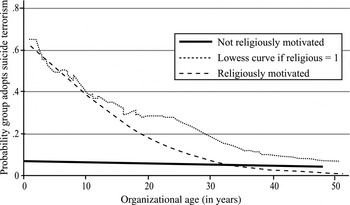
Figure 1 below displays a graph of the substantive relationship between organizational age and the adoption of suicide attacks, separated by whether or not religion is a motivating factor. There are two lines on the graph, one for nonreligious groups and one for religious groups. The background displays a histogram of the organizational age variable. The wide variation of values shows that the results make sense across the range of organizational age values. If the distribution was too skewed in one direction or another, it would suggest the sample sizes are too small in the other direction to make valid inferences.
Substantive relationship between organizational age, religion, and the adoption of suicide attacks

Adoption capacity theory is unique in its ability to explain not just why groups adopt suicide attacks—which many other scholars have examined—but why some groups fail to adopt. For the first five years of a religiously motivated terrorist group's existence, the probability that it adopts suicide bombing is between 50–60 percent. However, the probability declines after that point, reaching 27 percent by year fifteen and only 15 percent by year twenty-two. In year fifty-one, the oldest group age, the probability of adoption by religiously motivated groups declines to less than 1 percent. Religious affiliations serve as the networks through which knowledge spreads, just as the existing alliance between the United States and Great Britain did in the case of nuclear weapons. Organizational age appears to explain why groups such as the Islamic Liberation Organization in Egypt did not adopt suicide bombing in the mid-1980s and why groups such as the Moro Islamic Liberation Front still have not really adopted suicide bombing today. The significance of the Al Qaeda link variable shows the plausibility of this argument as well.
The way increasing organizational age creates veto points is one explanation for why Fatah, despite its leading role among the Palestinians during the study period, lagged far beyond younger groups such as Hamas and Palestinian Islamic Jihad in adopting suicide bombing. It was only in the Second Intifada with the creation of the Al Aqsa Martyrs Brigade that Fatah adopted suicide attacks—and this was after a period of “[c]onfusion in the organization's ranks.”Footnote 74 One possibility is that the expertise of Fatah at hijacking, assault, and other nonsuicide operations led to a narrowing of the way Fatah conceptualized its critical task in addition to broadening the number of organizational actors that could function as veto players and prevent adoption.
While nonreligious groups also become marginally less likely to adopt as their organizational age increases, the trend line for Figure 1 shows the effect is not significant. For nonreligiously motivated groups, the probability of adoption in the first five years never exceeds 7.5 percent, but still declines over time. Why would the organizational capacity to adopt be substantively important for religious groups but not for nonreligious groups? One explanation lies in the social networks and ideologies that connect many Islamic groups—though not all given Sunni/Shia splits. Nonreligious groups may lack the baseline networks necessary to get direct exposure to the innovation, though that would not stop them from vicarious learning, that is, indirect diffusion.
However, it is important to note that religion is not determinative; there has been cooperation at some points across religious lines between terrorist groups. The group that conducted the single largest number of suicide attacks between 1981 and 2003 is the LTTE. The LTTE conducted 191 attacks from 1981–2003, or almost as many as every group in the Middle East combined (224).Footnote 75 While the Tamil struggle predates the beginning of the modern suicide attacks era, the LTTE insurgency against the Sri Lankan government began in late 1982/early 1983, at the beginning of the suicide attacks era. So, the organizational age variable predicts that the relatively young LTTE would have the capacity to adopt.
Another explanation lies in critical task focus, which is not measured in the statistical analysis but which adoption capacity theory suggests should matter. The LTTE's violent genesis at the beginning of the suicide attacks era, at a point when both more established groups such as the PIRA and newer groups such as Hezbollah were all active, may have given the LTTE an especially broad strategic perspective. Some LTTE members, despite not having direct religious ties to groups such as Hezbollah, engaged in joint training with groups in North Africa and the Middle East in the late 1970s and early 1980s. This made them strong candidates to adopt.Footnote 76 Therefore, the theory accurately predicts the behavior of groups such as the LTTE as well as more religiously motivated groups.
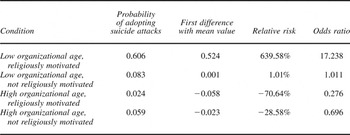
Table 2 below shows relative risks and odds ratios derived from Model 4. Young religiously motivated terrorist groups adopt suicide attacks in their very early operational stages over 60 percent of the time, representing a relative risk increase of almost 640 percent compared with the mean values. At high organizational age levels, the effect reverses; the relative risk of adoption for religiously motivated groups is −71 percent. The large negative relative risk scores for both of the “high” organizational age possibilities show that the organizational age variable does influence the probability of adoption—otherwise the probabilities would be constant across levels of organizational capital and only vary based on religion.Footnote 77
Relative risks and odds ratios describing the relationship between organizational capital, religion, and the adoption of suicide attacks

Notes:
Probabilities generated using Clarify and compared to the mean value (King, Tomz, and Wittenberg Reference King, Tomz and Wittenberg2000). “High” and “Low” refer to shifts from minimum to maximum values and vice versa.
Interestingly, in groups with very high organizational ages, indicating terrorist organizations with substantial longevity, the probability of adoption for nonreligious groups is actually slightly higher than for religious groups. The relative risk of adoption by nonreligious groups with high organizational ages is −29 percent, more than 40 percent higher than the risk of adoption by religiously motivated groups of similar age. One explanation is that the availability of tacit knowledge through networks of religiously motivated groups means the nonadopter groups in the dataset are like Fatah prior to the Al Aqsa Intifada. These are groups that had extensive operational experience before the onset of the suicide attacks era, rather than groups created after the early/mid-1980s that decided not to adopt. This explanation relies in some ways on critical task focus, which is not directly measured in the analysis, rather than age. Nonreligiously motivated groups may only acquire the capacity to adopt the innovation later in their existence, since they did not have immediate access through religious networks.
In a similar vein, the failure of the Provisional Irish Republican Army (PIRA) to adopt suicide attacks is something of a puzzle. If the essence of Pape's theory about democratic occupiers with different religious beliefs becoming prime targets for suicide terrorists is true, the Catholic PIRA should have turned to suicide attacks against the Protestant United Kingdom.Footnote 78 Similarly, Bloom's outbidding theory might predict that the PIRA would turn to suicide attacks to compete with the “Official” IRA and the “Real” IRA, especially during fragile periods of the peace process.Footnote 79 However, the PIRA never adopted. The failure of the PIRA to utilize suicide attacks may be explained by the mismatch between the organizational capital required to adopt and the organizational capital possessed by the PIRA. Most importantly, the PIRA's operational success criteria, or the way that it evaluated when and how to conduct operations, likely made it difficult for the PIRA to adopt. Based on official PIRA documents, Jackson identifies the operational success criteria for the PIRA as focused on: “volunteer safety,”Footnote 80 “security force casualties,” “economic damage,” “publicity and public reaction,” and “minimization of civilian casualties.”Footnote 81 Given the focus on member survival, it is not surprising that the PIRA did not adopt a tactic whose fulfillment necessitated the death of group members.
The PIRA's high organizational age and command structure also made adoption less likely. The PIRA's campaign began in 1969, over a decade before the beginning of the suicide attack era. The PIRA's belief that it was the legitimate heir to the IRA Army Council, the military arm of Ireland, led it to adopt organizational procedures very similar to that of a regular military, describing their units as brigades and battalions.Footnote 82 Even after the PIRA's reorganization in the 1970s, which also demonstrates diffusion principles since they studied the PLO, the Baader-Meinhof Gang, and ETA, the PIRA's General Headquarters appointed and directly controlled special teams of operatives for important operations such as the assassination attempt on British Prime Minister Margaret Thatcher.Footnote 83 While the IRA engaged in research and training, existing operational concepts constrained the scope of those efforts. They excelled in “sustaining” tactical innovations.Footnote 84 When it came to producing different types of attacks through a new method, that is, suicide attacks, the organization did not adjust.
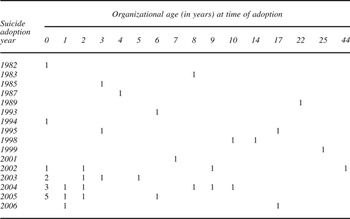
One objection to these results is that the adoption of suicide attacks are a secular trend—it is not that groups with younger organizational ages are more likely to adopt, but rather that the innovation has become popularized in recent years. Table 3 below lists the organizational ages of all adopting groups during their first year of adoption. Even early in the suicide attacks period, there is a substantial correlation between low organizational age and adoption. It is true that the organizational age of adopters has declined in recent years as more new groups have adopted suicide attacks—but that is more evidence for evaluating suicide attacks from a diffusion perspective since the current period is arguably the middle “bulge” in the classic diffusion S curve.
The correlation between organizational age and suicide attacks adoption

Another objection might be that nearly all of the groups that have adopted suicide bombing are religious, meaning there is not enough variation to accurately model the relationship. Of the fifty terrorist groups in the dataset that have committed suicide bombings, forty-one qualify as having both committed more than one attack and generated fatalities during the attacks. Of those forty-one groups, almost 25 percent are coded as nonreligiously motivated by MIPT, including Amal (Lebanon) and the PKK (Turkey).
Additionally, while the logit results demonstrate a significant relationship, both statistically and substantively, the appropriateness of the logit form is assumed rather than derived from the data. The curve for religiously motivated groups in Figure 1 could reflect just a few younger terrorist adopters that are skewing the overall relationship between organizational age, religion, and the adoption of suicide attacks. To test for this possibility, I ran a form of nonparametric regression known as Lowess regression on the set of religiously motivated groups.Footnote 85 Lowess regression involves generating point-by-point estimates based on the information near each point, rather than imposing a global functional-form assumption on the statistical relationship. The outcome, displayed below in Figure 2, shows a good fit between the original and Lowess curves, increasing confidence in the results.Footnote 86
Lowess robustness check of substantive results

A final objection to these findings could be that “older” terrorist groups such as ETA are those that have had political wings, meaning they had a great deal invested in the political process and sought to avoid disruption through suicide attacks. However, a first mover, Hezbollah, and another prominent adopter, Hamas, both have political wings and conducted suicide attacks after the creation of those wings. Also, even after groups build inroads into the political system, if they are still employing terrorist tactics in any form, it is important to ask why they would choose to not use a method considered effective. For example, a terrorist group might not adopt to limit the outrage and casualties from attacks, instead using attacks to signal continuing capabilities and help push along a bargaining process. However, it is just as likely that the failure to adopt might be interpreted as weakness, with limited casualties from attacks signaling an inability to deliver punishment, making it harder to achieve group goals because the government will feel less pressure to negotiate. Therefore, political involvement should not systematically influence the probability of adoption.
Figure 3 below highlights the relevance of applying a diffusion approach to the study of suicide attacks. It includes most of the known groups that have conducted suicide terror operations, combining some affiliated groups in the same regions to simplify the presentation, and attempts to show the relationships between the groups. The figure depicts two types of relationships, with the direction of the arrows showing the direction of the relationships. The black arrows signify a direct relationship, meaning there is some evidence of meetings, joint training, and other behavior that would indicate the potential for the direct diffusion of suicide terror knowledge from one group to another. The gray arrows signify an indirect relationship, meaning there is evidence that a group learned, through print media or otherwise, about suicide terror tactics from information about the behavior of another group.Footnote 87
Suicide attacks diffusion diagram (1982–2006)
Notes: BKI = Babbar Khalsa International. DHKP/C = Revolutionary People's Liberation Party/Front. FARC = Revolutionary Armed Forces of Columbia. GIA = Armed Islamic Group. IJG = Islamic Jihad Group. IMU = Islamic Movement of Uzbekistan. LTTE = LIberation Tigers of Tamil Eelam. PIJ = Palestinian Islamic Jihad. PKK = Kurdistan Workers' Party. PFLP = Popular Front for the Liberation of Palistine.

Suicide attacks have diffused from two main “hubs” over the course of the era. The first hub is Hezbollah, through which the Palestinian organizations and the LTTE adopted. The second hub comes from Al Qaeda, which learned from Hezbollah but then became a central node through which multiple Jihadi groups around the world appear to have learned. Having links to one of these hubs seems to play a major role in predicting which groups will adopt.
The linkages show the importance of recognizing the intersections between groups—it is not a coincidence most of the groups that have used suicide attacks over the last twenty-five years have a direct or indirect link to other suicide attack groups, and sometimes more than one. One could argue that the linkages merely reflect groups going out and seeking knowledge after they have decided to adopt. However, the fact that groups seek assistance to adopt proves that there is tacit knowledge associated with the innovation that is relevant for adoption. The point is not that diffusion-related forces are the sole determinants of adoption, just that they matter.
Alternative Arguments
Kalyvas and Sánchez-Cuenca explain terrorist group strategy as a function of its need for and level of public support, arguing that a U-shaped curve best explains the nonincidence of suicide attacks. For groups that are totally disconnected from the population, such as Al Qaeda, suicide attacks impose low organizational costs because the organization does not need local support. For groups interlinked with the population, such as Hamas, societal culture shifts in ways that make suicide attacks more acceptable. However, for groups in the middle, such as the PIRA, that are partially linked to the population but more operationally distinct than Hamas, the risk of civilian casualties in suicide bombings makes them too costly to adopt. The group fears angering the local population and losing support that is necessary to shield them from authorities.Footnote 88
The Kalyvas and Sánchez-Cuenca theory is not inconsistent with adoption capacity theory. Popular support could influence the interest of terrorist groups in adopting suicide attacks, but organizational constraints also significantly influence the probability that a group will adopt. However, relying entirely on popular support as an explanation for strategic choices ignores the internal organizational factors that affect terrorist groups. While their argument and adoption capacity theory make similar predictions for several groups, adoption capacity theory more fully explains the decisions of more groups. For example, the Tamil Tigers engaged in the single largest number of suicide attacks in the 1981–2003 period, yet they were about as linked to the local population as the PIRA or even less so—a lot less than Hamas and a lot more than Al Qaeda.Footnote 89 So according to the Kalyvas and Sánchez-Cuenca theory, the LTTE should not have adopted suicide attacks.
The Kalyvas and Sánchez-Cuenca argument is also limited by its focus on terrorist groups as individual actors in a vacuum, rather than as linked actors in the international system. Given the evidence of terrorist group cooperation and knowledge distribution, it makes sense to view adoption as influenced by a diffusion process, rather than as a solely independent decision.
Another alternative strain of theorizing might regard suicide attacks as a special case of insurgency warfare, where actors facing overwhelming force choose asymmetric responses because they are most likely to be effective. For example, Arreguín-Toft argues that groups are functionalist and choose the strategies most likely to be effective.Footnote 90 If this theory is true, the adoption of suicide attacks by terrorist organizations should vary solely with perceived success by groups that use suicide attacks. Adoption capacity theory does not exclude the possibility that perceptions of success influence adoption—indeed that is a key part of the argument. But according to a purely functionalist argument, the PIRA and ETA should have adopted. Both had a desire to inflict casualties through terrorist attacks and the LTTE clearly showed that suicide attacks could be effectively utilized without always targeting civilians. But neither adopted—an outcome only fully explained by adoption capacity theory due to their high organizational ages and the bureaucratic constraints that influenced their behavior.
Conclusion
This article explains the development and spread of suicide bombing in the context of the diffusion of innovations. Financial and organizational constraints very similar to those that influence the decision making of military organizations also influence the decision making of terrorist groups. Adoption capacity theory shows how the high organizational capital requirements for adopting suicide attacks made those terrorist groups that were most successful in the presuicide terror era unlikely to adopt the new innovation. The link between organizational age and adoption, statistically, appears conditional on the networking variable—religion. However, qualitative evidence presented above does show the plausibility of critical task focus as an explanation for some key nonreligious groups such as the PIRA.Footnote 91
Evaluating the adoption of suicide attacks from innovation and diffusion perspectives also helps capture the distinctive characteristics of suicide terror adopters in comparison with nonadopters. The presence of indirect and especially direct links between so many groups that have adopted across time, space, and group aims highlights the importance of viewing suicide attacks from a diffusion perspective. The interaction with religion and the relationship groups have to Al Qaeda highlights the importance of network effects. The extensive interlinkages between religiously motivated suicide terror groups and the demonstration effects that have fueled adoption by non-religiously motivated groups show that focusing only on internal politics or the strategic environment falls short. Nearly every group that adopted suicide bombing from its debut in Lebanon in the early 1980s through summer 2006 had either a direct or indirect connection to another adopter. This makes the mechanism for diffusion in most cases a combination of learning and emulation. Some vicarious learning occurs as groups view the actions of those abroad. However, the dominant adoption dynamic appears to involve some sort of transmission from group to group and organizational factors play a significant role in influencing whether a group is open to and able to adopt.
Adoption capacity theory and this study of suicide bombings may also shed light on future diffusion research outside the military realm. Focusing on adoption requirements is a conceptual framework useful for examining both state and nonstate actors, potentially allowing for more work comparing states with nonstate groups. More generally, adoption capacity theory attempts to bring questions of capacity back into the equation, instead of just focusing on the “demand” side. While interest in adopting innovations is certainly an important variable predicting behavior, the capabilities of actors from states to central banks to terrorist groups shape the universe of the possible, significantly influencing diffusion patterns.
From a policy perspective, these results suggest two key points relevant for those interested in suicide attacks. First, while it is tempting to evaluate the behavior of every group solely in terms of its local context, a broader perspective is necessary. The tactics a group adopts are significantly influenced by who they are connected to and their organizational configuration. This insight could be useful in helping government officials predict the future behavioral trajectories of terrorist groups and determine, when new innovations in terrorist tactics emerge, the likely character of their diffusion pattern throughout the international system. Additionally, it may be possible to track down the connections between groups and figure out the key operational nodes by which particularly difficult-to-grasp concepts spread. Second, since predicting the diffusion of innovations by terrorist groups requires understanding both the local context and the broader web of links between a group and others that have come before, possessing accurate intelligence is vital in predicting behavior. It is not the case that there is a one-size-fits-all model of terrorist groups. Instead, it is important to gather a great deal of data on groups to understand their motivations, goals, and likely behaviors, something only possible with accurate intelligence.