Introduction
In the spring of 2010, thousands of largely northern and northeastern Thai protestors staged a months-long demonstration in Bangkok's commercial district, a protest that ended with over 90 people killed and one of Asia's largest department stores destroyed by fire. This was the most recent culmination of a crisis that has been fomenting since the ousting of Prime Minister Thaksin Shinawatra in 2006. To make sense of this conflict, many scholars of Thailand have focused on the skewed power relations between Thailand's capital and its rural hinterlands.Footnote 1 But despite the common characterisation by the popular press of northern and northeastern angst as profoundly rural,Footnote 2 the sense of impending disaster that my northern interlocutors articulated was one inherently bound up in the idea of the city as the centre of power, authority and legitimacy.
Many of the mediums and architects with whom I worked saw the city of Chiang Mai as having lost a spiritual centre and thus requiring the resurrection of an animating force that would ensure the future prosperity of the city and stave off calamity. While for some, this loss had supernatural overtones, for others, supernatural elements had been converted to cultural ones: while mediums turned towards recalling the spirits of Chiang Mai to ensure the return of prosperity and efficacy, for Chiang Mai's architects, the solution to Chiang Mai's subordinate status vis-à-vis Bangkok lay in improving upon Chiang Mai's built environment in order to revitalise a northern Thai essence. Yet for each group, it was the invocation of Chiang Mai's past that would guarantee a solution to contemporary social problems. Each group saw themselves as the privileged voices of this northern Thai-ness, a force that was increasingly imperiled by the economic and political power of Bangkok. And, for each, the Three Kings Monument was a central point around which the debate focused.
Monumentalism and heritage
While this article seeks to explore the parallels between the discourse of national heritage amongst architectural professionals and the discourse of spirits by the mediums, the subject of national heritage and monuments' role in the construction of national heritage is a contentious one. Invocations of heritage against calamity inevitably change and refocus what is thought of as ‘heritage’, a subject well documented in the anthropological literature. Often, constructions of things deemed ‘national heritage’ are often those that favour rational, secular readings of the urban landscape designed for individual consumption rather than those focused on the messiness of communities and living religions. Michael Herzfeld compares the ‘social and cultural evacuation of space’,Footnote 3 what he terms ‘spatial cleansing’, in Greece, Italy and Bangkok. In his examples, the forces of neoliberal-minded rationalisation, stemming from state or private sources, erase heterogeneous or contradictory elements in favour of a monument-oriented architecture that nonetheless purports to better serve national heritage. This is a result, Herzfeld argues, of ‘the globalization, paradoxical though it may seem, of a sense of national heritage, calibrated both to the demands of an exigent neoliberal economic system and to the politico-cultural as well as financial forces that it has unleashed’.Footnote 4 Such an idea of ‘national heritage’, reified and put into use for the state, is what emerges from Chiang Mai's culture industry.
Anthony Vidler, in his discussion of ‘the architectural uncanny’,Footnote 5 describes the attempt to monumentalise the city as a form of urbanism beginning in the Renaissance: the thinking of the city as a ‘memorial of itself’Footnote 6 and the planning of cities to ‘perpetuate the myth of memory as installed for keeps, so to speak, in the heart of a metropolis that is (finally) rendered significant and speaking to its people’.Footnote 7 Such an image is ironically the imposition of an architect or planner's vision over that of smaller, heterogeneous communities and – as is glaringly evident from Herzfeld's case studies – pays little attention to the way in which other populations living in the neighbourhoods interpret or make use of the space. Thinking of the city as a series of monuments creates an individual (rather than a collective) relationship between the resident and the imagined community of the city, and therefore allows for the adoption of those part of the symbolic which fit with an individual's expectations or hopes and the purging of those parts of the symbolic which are incompatible.
But in Chiang Mai's case, the problem is not simply that the Thai state has appropriated the symbols of the North and deployed them in a way to create a narrative of Thai triumphalism designed for individual consumption at the expense of local residents; rather, Thailand's ‘statuemania’, to use Maurizio Peleggi's term,Footnote 8 works on both local and national levels. While, as I show below, there is a clear attempt on the part of the Thai state to homogenise and compartmentalise northern Thai identity, northern institutions such as spirit mediumship often adapt to and incorporate such efforts. Indeed, despite the state-oriented reading which the builders of such monuments might have in mind, they have within them other possible, subversive readings.
I turn now to the specific example of the Three Kings Monument in Chiang Mai's urban centre because of its significance from the point of analysing power relations between Bangkok and Chiang Mai as well as the intersection between architecture and spirit mediumship. I choose these two specific areas to analyse even though there is a multitude of others, as they best capture the growing sense of urban crisis in the present-day city.
The Three Kings Monument
The bronze Three Kings Monument stands in the northern-central part of Chiang Mai's old city, within the square of the old fortifications. It decorates a rectangular plaza, bordered on three sides by busy roads and on one side by the colonial-style city hall, now Chiang Mai's Art and Culture Centre. This structure was the former site of a Lanna-era royalFootnote 9 palace, but when Chiang Mai became incorporated into the Siamese nation-state, such a system of (local) monarch-oriented space would not do politically.Footnote 10 Instead, the Chiang Mai royalty was, through a series of both coercive and cajoling actions,Footnote 11 removed from power. The Siamese government granted them a new palace, which, however, was far outside of the city walls, at the edge of the river and conspicuously near the foreign district. The central city square became the new city hall, and significantly the old royal residence was converted to a women's prison.Footnote 12 The royalty – the living embodiment of Chiang Mai's barami – was removed and replaced with those symbols of Central state authority. Finally, when the city hall moved out of the city centre, the Three Kings Monument then became the site of a cultural museum, creating a trajectory whereby royal power becomes state power becomes cultural heritage.
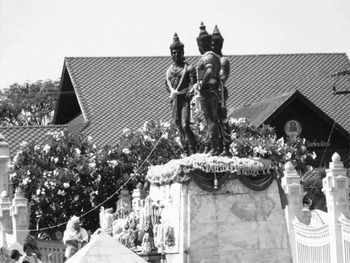
The Three Kings Monument was constructed by the Central Thai artist Khaimuk Chutoo, a relative of Queen Sirikit, and commissioned by the Fine Arts Department in Bangkok to replace a smaller, earlier statue at the same site. The statue was transported over a period of time of ten months from Bangkok to Chiang Mai and unveiled on 23 September 1983. The monument depicts in bronze three muscled figures, each adorned with Central Thai-style royal regalia. Their faces are nearly identical, each with the chiselled good looks and Western-style features of modern-day Thai soap opera stars. In all of these traits: the statue's appearance as a European-style bronze monument, the kings' appearance in Central regalia, and the fact of something centrally constructed and moved to Chiang Mai; the Three Kings Monument could be read as a form of symbolic colonisation of Lanna history, whereby a Thai-centric reading gains hegemonic power over local interpretations. Indeed, as the inscription beneath the statues suggests, the polity over which Chiang Mai ruled was ‘Lannathai’, not simply ‘Lanna’, a renaming that asserts that Chiang Mai was always ‘Thai’, even in an era when such words were meaningless.Footnote 13
The Three Kings are those kings who, according to the Yonok Chronicle, laid the plan for Chiang Mai over the site of a prior Lawa village. The kings were not all kings of the city; rather, they include the city's founder as well as the kings of two friendly city-states who advised him on its construction. They are: Mangrai, a TaiFootnote 14 warlord who became the founder of Chiang Mai and thereby the first northern Tai kingdom of Lanna; Ngam Meuang of the neighbouring city-state of Phayao;Footnote 15 and Ruang of Sukhothai. This last figure is important, as he is also identified as King Ramkhamhaeng, the founder of Sukhothai, according to Thai nationalist historiography, the first truly Central Thai state. Ramkhamhaeng himself is credited by standard Thai national history as being the source of Central language and kingship. Ramkhamhaeng and his kingdom of Sukhothai were the subject of much of Thailand's national myth-making during the late nineteenth and early twentieth centuries, and are still used as an example of ‘Thai-style democracy’ (i.e. rule by a moral but absolute power) today.Footnote 16
Given the statue's origins in a workshop oriented towards Bangkok's current monarchy, which traces its moral authority if not its actual lineage from Ramkhamhaeng, the statue at first glance presents a Bangkok-oriented reading. The lifelike bronze statues stand with their heads close together, as if conferring over the future of Chiang Mai. Mangrai stands to the back, his arms spread and almost embracing his two friends and seeking their counsel (he is centrally located) but passive. Ngam Meuang stands faded into the background, much as Phayao as a city-state has become simply a lesser northern province. Both Mangrai and Ngam Meuang look attentively at Ruang, who is pointing to the ground in an authoritative manner, as if saying ‘here is where the city shall be!’
Ramkhamhaeng's presence next to Mangrai adds Thai nationalistic legitimacy to the founding of Chiang Mai. As the architect of the Thai nation guides the architect of Lanna society, Lanna's intimate relationship with the Thai national narrative is assured. Indeed, the monument suggests that while Chiang Mai was constructed by Mangrai, the basis of his knowledge was in fact stemming from the Central Thai king.
Such a reading is the sort that a monumentalist view of the city would take. I, as an informed but solitary urban flâneur, read the statue in its space and imagine my relationship to Lanna and its founders on an individual basis. Yet the statue is not just a statue as such a reading would have it. In front, there is a small sand pit where offerings of incense and flowers can be made in order to pay respects to or ask for the intercession of the spirits of these kings. Passing by the monument in the morning (even those mornings when there was no ritual held) often brought a whiff of incense or flowers from the offerings piled at the kings' feet. Indeed, the statue is the site of magico-religious power as much as it is a site for nationalist history. But, as I argue here, the two discourses are not entirely separate. Instead, idioms of progress, power, efficacy and domination all have embedded within them magico-religious ideas.
Centre and periphery
Chiang Mai, Thailand's second-largest city outside of the Bangkok metropolitan area and the capital of Thailand's North, is at the same time overshadowed by the capital politically, economically and symbolically. Indeed, Bangkok is the quintessential primate city, 40 times the size of Chiang Mai. But the prominence of Bangkok vis-à-vis Chiang Mai is nothing new. Tamara Loos characterises the regions of the North, Northeast and Malay South as having been internally colonised, as early twentieth-century relations between the provinces and Bangkok were patterned after relations between Britain and its Southeast Asian colonies.Footnote 17 Even today, Chiang Mai suffers from a lack of political representation and domination by the centre. The province's governor (phu wa) is appointed by the Ministry of the Interior, not elected locally; the city is dominated by tall buildings owned by absentee landlords; and the language of education and government is Central Thai. The high-rise condominiums in particular were the focus for local anger during the early 1990s as condominiums replaced temple spires as the dominant feature on the urban skyline.Footnote 18 The situation turned even more ominous several years later during the economic crisis of 1997, when many of these structures were left unfinished, their concrete shells like scars on the cityscape.
Now, in the wake of the coup of 2006, the call for a re-engagement with Chiang Mai's urban essence becomes a point of desire. Such a move comes after a long period of time during which the promotion of regionalism was seen as potentially dangerous to national unity. The Thai government, from the absolute monarch Chulalongkorn in 1893 to the anti-royalist Phibun administration, had throughout the twentieth century called for a reframing of Lanna from a ‘Lao’ region distinct from Central Thailand to an indistinguishable ‘Thai’ one.Footnote 19 Cold War attempts similarly constructed primordially anti-Communist northern Thais in the face of rising rural leftist insurgency. Such writing dismissed ‘exotic’ practices such as spirit mediumship as things that: ‘still seep into the culture of Lanna, but only in a superficial way, as an outer shell that is not particularly meaningful [mai mi sara]’.Footnote 20 But as tourism both international and domestic becomes more significant, the drive to create a Chiang Mai that is more distinctive comes to the fore.
Thailand's North was the setting for a number of romantic films depicting lonely and wealthy Bangkokians, alienated from their surroundings and searching for something authentic, finding love in the cool and misty northern peaks.Footnote 21 Building upon the popularity of Switzerland following the current Thai monarch's Swiss upbringing, many northern resorts draw parallels to the peaks ringing Chiang Mai and the Swiss Alps; others focus on new royal attempts to plant coffee in the mountains as the key feature linking Chiang Mai spiritually with a civilised ‘European’ version of Thailand. As Nidhi Eoseewong writes, such an image of the ‘charming’, civil, feminine Chiang Mai coexists with the popular impression of Chiang Mai as a ‘Lao’ backwater, inhabited by country bumpkins and witchesFootnote 22 — this latter category personified for many by the northern Thai spirit medium.
Supernatural efficacy
For mediums, the power of the city stemmed from the sacred power of the city's spirits, conceived of in two terms, as barami and sak. Barami is closely linked to Thai ideas of kingship — indeed, in Lao the term is a synonym for ‘king’. But barami is also present in other contexts: auspicious spirits (who are often characterised as kings themselves), powerful amulets and famous monks. It is that quality of powerful and virtuous people and places that draws prosperity and power to them and which they can extend to their followers. People and objects with barami also possess supernatural efficacy — sak; barami is sacred power specifically associated with kingship and moral rule, while sak is that which is amoral but effective. Sak is that quality which influences what would normally be considered ‘chance’. Having access to such power ensures protection from chaos and uncertainty at the same time as it promises prosperity.
In mediumship rites of the sort that are common across the Tai-speaking region, the source of power is a site in the centre of the city which provides, as Gehan Wijeyewardene argues, urban ‘order and prosperity’Footnote 23 in the face of opposing forces of chaos and ruin. A well-planned city was one that reflected the heavens in miniature, complete with the supernatural (e.g. the spirits) and temporal (e.g. the king) stand-ins for the gods. Therefore, spirit mediumship had at one point a close relationship with city planners — space, properly configured, would invite divine and supernaturally royal beings to live in the city. Northern chronicles are full of references to such practices: The Chiang Mai Chronicle recounts how in 1465 an astrologer in the secret employ of Chiang Mai's enemies convinced the Lanna king to cut down a tree and build his palace at the auspicious northeastern corner of the city, with promises that it would lead to supernatural power.Footnote 24 Such a move instead caused ruin and destruction by violating the pre-existing layout of the city.
But this connection between planners and mediums is no longer present. For many middle-class Thais, the role of forces that revitalise the power of the city has been replaced by ‘cultural heritage’ in the idiom that I explore above. This heritage is conceived of as specifically that of the Lanna period from the thirteenth century until the nineteenth.Footnote 25 While planners generally put a caveat before claims of sak (e.g. ‘Some people believe that…’ or ‘In the past…’), as I argue below, the efforts of planners towards cultural revitalisation followed a similar process to supernatural revitalisation: through the resurrection of past ideas about urban space, the future could be rendered more efficacious and urban chaos quelled. Mediums as well as planners expressed worry that such efficacy (whether sak or heritage) was in decline, and that urban chaos was enveloping the city, leading to environmental, social and spiritual collapse.
The parallel that I draw here, between cultural heritage and supernatural ideas of efficacious power, is a common feature across Thailand. As Peleggi writes, the Thai Fine Arts Department, the organ of the state involved in cultural preservation, ‘is motivated by a conservationist stance alien to the ethos of rural communities but reflecting the aesthetics and cultural capital of an educated elite’. Yet, as Peleggi notes, at the same time, the sites and subjects selected to be memorialised are precisely those that are believed to have sak,Footnote 26 a process that exactly describes the creation of the Three Kings Monument. What on the surface seems a contradiction – only sacred sites are preserved, but without their magic efficacy – is in fact not. As I argue below, renovation of sacred sites is a process that echoes the social and psychological effectiveness of magic, if not its outward appearance.
The Three Kings Monument is one such site. As I mention above, it is a place where the power of the local monarchy was converted to the power of the Central Thai state and now to the idea of cultural heritage, indeed, ‘heritage’ ensconced in a monument stemming directly from the Central Thai state and nobility. But it is precisely for this reason why it is a site of desire for artists and mediums alike. The monument, as a clear reminder of Chiang Mai's marginality, is exactly that point where a desire for centrality is expressed.
Possessed by the past
At the annual spirit possession rite honouring the Three Kings, a white thread stretched down from the statues into the relative cool of a series of tents that covered the entire central urban plaza (Figure 1), where it terminated at an altar complete with offerings of fruit, bowls with cash, bottles of orange and red Fanta, and whole pigs' heads. In front of the altar, as in the other tents in the plaza, mediums – largely older women, but with many younger, transgendered men as well – danced to an amplified brass band. Each came in their possessing spirit's usual attire — this was a gathering of Chiang Mai's spirits where the supernatural lords of Chiang Mai's small neighbourhoods could pay their respects to the city's central point. Some of them drank Thai rice whisky and made raucous jokes together, others were more reserved and solemn. Each made a point of giving the monument and the altar numerous gestures of prayer and respect (wai), which they also liberally extended to each other. The noise and the heat were both overwhelming, and, above the din of the music and of voices, a medium would occasionally let out loud retching noises as she expelled one spirit in order to welcome another. At the end of the rite at four o'clock, all of the mediums turned towards a portrait of the living (Central) Thai monarch as the royal anthem played. Each bowed her head in a solemn wai as she acknowledged the country's highest source of barami.
Three Kings monument during the Three Kings rite

What differentiated this rite from other mediumship rites (chok khru) held elsewhere in the cityFootnote 27 were its timing and size. The ritual was held just before the rainy season, during a frenzy of mediumship-related activities concerned with the gates and corners of the city's wall. As I argue below, while the city pillar – the central axis of the city – would normally be the site for the final and central ritual, mediums' expulsion from many temple grounds (see below) meant that the final act of propitiation to the spirits must take place in front of the Three Kings. The ceremony was held over the course of several days and at its height involved several hundred mediums in addition to a brass and electric band. Warrior spirits wore green (reflecting modern-day army uniforms), spirits of old ascetics wore white, those possessed by children wore purple, and those possessed by the spirits of northern Thai warrior kings wore yellow (the colour of the current Thai monarch). Meng (mon, warrior) spirits used one tent, those possessed by the more domestically focused mot (witch) spirits used another, and those possessed by guardian spirits (chao nai) a third, but mediums in each group danced as their possessing spirits paid homage to the spirits of the Three Kings.
The Three Kings Monument rite differs from a medium's everyday consultations in that it is performed not for individual supplicants or for a particular place, but to draw forth sak for the city as a whole — it is significant that during rites such as the Three Kings, lay spectators are neither the focus of mediums' attention nor are even afforded a privileged viewpoint. Rather, the rite is about the generation of power which, in the Thai idiom, channels power through contagion. The thread from the kings' statue to the altar acts as a conductor, bringing this charismatic power so that it may be used for the benefit of the greater urban population.
Magical benefit to the city
The process of transforming the virtuous power of ancestor spirits into tangible benefit can best be brought out through an ethnographic example. During the middle of the rite one year, the sky began to threaten rain. Hearing rumbles of thunder, several of the mediums stretched their hands up to the sky and a cry went up: ‘tok, tok, tok [fall]!’ The mediums made long pulling motions as they physically attempted to draw the water from the sky. At that point, a medium pulled me over to the brass band's singer. She leaned down and made a motion as if she was rubbing cash in between her fingers and then pointed at the singer. A little uncomfortable and confused, I pulled out a 20-baht bill (about 66 US cents, or just over the cost of a noodle-soup dinner). The medium frowned and shook her head, holding up one finger — 100 baht (about 3 US dollars). Obligingly, I did so, but when she motioned for me to give another 100-baht bill, I declined, feeling as though I was being exploited.
It was only later that I realised that I, being identified in this situation (along with numerous others) as a foreigner and therefore a source of wealth, was like the cloudy sky. By having me give money, the mediums were calling the actual profit out of the potentiality — they were making it rain. It is notable that in this case as well as others where I was asked for money by mediums, the mediums did not ask for donations for themselves, but rather that I donate to deserving others. In doing so, I would be improving my own stockpile of merit and charisma. The mediums were calling for prosperity (khwam charoen) and acting as conduits for it, directing it towards their followers specifically and the city in general, whether it be rain from a cloudy sky or cash from a (presumed to be) wealthy foreigner in a way which contributed money to the needy and virtue to the rich. Other spirits echoed similar ideas: they had returned to the world of the living, foregoing Buddhist rebirth, in order to spread luck and prosperity and thereby increase their own karmic store before they were reborn. The rite's central purpose was the welcoming of prosperity, progression and advancement. Indeed, a common blessing from mediums upon receiving a donation was simply, ‘[may you] prosper’ [charoen]. The mediums' activation of the site's sak, in their idiom, renders the potentially prosperous actually prosperous (e.g. the cloud begins to rain or the foreigner begins to give large tips) much as it renders the potentially dangerous actually harmless (e.g. a busy street, in my example below, has no fatal car accidents despite having fast traffic in narrow lanes).
Changing roles of spirits and spirit cults
Magical meanings and the idea of places and things of mystical efficacy (sing sak-sit) were always important in the context of urban politics. While fertile rice fields and quantities of strong soldiers were important, it was that underlying and invisible effectiveness of these material things which was the crucial element. Donald Swearer characterises the northern Thai city (meuang) as a ‘sacred centre’,Footnote 28 a place which, like the Indian mandala, radiates power and prosperity out to the countryside, thus rendering borders less important.Footnote 29 Stanley Tambiah describes the meuang as a ‘galactic polity’, an urban centre which in turn both is subject to other centres and has minor satellites of its own.Footnote 30 As each segment of the meuang is potentially independent or potentially absorbable by other, larger segments, the charismatic power of urban centres was a continual concern of Southeast Asian city-builders. A city which has sak and whose ruler and auspicious objects have barami is a prosperous one (and in a circular argument, prosperity is seen as a sign of supernatural favour). Such a city could draw neighbouring city-states into its orbit, but a city whose attractive power was on the wane risked becoming dominated by the superior influence of neighbouring centres. The maintenance of urban supernatural palladia was therefore important in convincing the city's population as well as potential rivals of the city's overall efficacy and success. Such a symbolic contest over the maintenance and promotion of the city's intangible qualities becomes the foundation for efforts to revitalise ‘heritage’ as well, as I argue below. It is also what is behind the fierce contestation between nation-states over the legitimate ownership of certain auspicious or famous sites, such as the Preah Vihear temple on the Thai–Cambodian border.
While I argue that such ideas of maintaining the intangible value and prestige of the urban centre remains important, the role of spirit mediums in being the privileged voices of this power has waned in recent years as the rhetoric of national heritage has waxed. Spirit possession rites took place around the city pillar, as they do in other Mekong-region towns, but in Chiang Mai they do so no longer, owing to pressure from the Bangkok-based Buddhist clergy. The city pillar (named sao inthakin after the Hindu deity associated with kingship, Indra) is currently housed at Chedi Luang temple, the base of operations for the city's royalist and rationalist Thammayut sect of Buddhism. Rosalind Morris details the antipathy between Thammayut monks and mediumsFootnote 31 — Chedi Luang's Thammayut order expressly denies the efficacy of rites such as mediumship. Yet it is not simply in Thammayut temples where mediumship is not welcome: while many other temples have shrines for temple guardian spirits (northern: phi seua wat), even at these temples, none of the monks with whom I spoke admitted to allowing possession rituals on temple grounds. One put it succinctly: ‘We don't let those people in. [Well,] they can come in [to donate and make merit], but they aren't allowed to be possessed. They aren't allowed to fool [lohk] people like that here.’Footnote 32 While the city pillar was offered a yearly rite of propitiation with the grudging support of Chedi Luang temple, mediumship was banned from such an event.
Mediums, then, find themselves on the outskirts of mainstream religious practice. Yet, as I allude to above, the pillar was not the only source of sak in the city. Barred from conducting the principal possession ritual at the city pillar, mediums turned towards another source: the barami of Chiang Mai's past kings. The Three Kings Monument naturally became a new source for the propitiation of the sak of the city, and the focus of rites turned from the guardian spirits of the city to the Kings' spirits themselves. But at the same time, Chiang Mai's mediums made concessions to current power relations. As the current statue's origins suggest, the square is a structure built in Bangkok's form and idiom — not to mention its geographic location. Additionally, mediums' explicit devotion to it as well as to the current Thai king makes their situation more complex than simply a narrative of northern resistance. Instead, symbols of heritage such as the new statue or political power such as the image of the Thai monarch are appropriated by mediums as symbols of powerful supernatural power in readings which neither the Fine Arts Department nor the monarchy would condone. In short, they have readily appropriated and subverted the attempt by the Fine Arts Department to convert sak into heritage by turning heritage back into sak.
Mediumship and anxiety
Grandmother Faa sold lottery tickets in front of the shrine of Lord Chiang Mai Gate (chao pratu chiang mai). This was a spirit who looked after the market sellers at the nearby Chiang Mai Gate market and who lived in the city's southeastern gate.Footnote 33 A shrine to him leaned out dangerously into the busy street, pinching the already too-fast traffic to a narrow strait, but Faa assured me that I had nothing to fear from the speeding cars: ‘If you go down there to Saen Pung Gate, there are car crashes all the time. Lord Chiang Mai Gate doesn't let that happen here. People are good to him.’ She noted how Saen Pung Gate's spirit had only a small shrine and not many worshippers. In Faa's view, the lack of attention given to this spirit caused it in turn to be more lax in its vigilance. Lord Chiang Mai Gate, on the other hand, received regular offerings in the early morning from market vendors.
But Lord Chiang Mai Gate's cult was in decline. When I asked Faa where, other than the market, Lord Chiang Mai's supplicants came from, Faa grew more evasive. She said that residents from the Three Kings Monument southwards to Chiang Mai Gate used to make offerings to him, but so many of the original inhabitants had been displaced that the offerings were far less than before. Additionally, the shrine's medium had died and the spirit had not called on anyone else to replace her. She continued: ‘I [and the other vendors] still wai [show respect for/pray to] him, because I sell tickets here and because I used to live here. But we had to move because new people came into the city.’ I asked who these new people were, and she replied flatly: ‘Chinese people. Look around at these houses here, it's all Chinese people. You go back [towards the centre of town] from here, it's all Chinese [chin mot].’
Faa's accusation of ‘the Chinese’ bears some analysis. As I questioned her further, she identified people from Bangkok under this label of ‘Chinese’ as well as ethnically Chinese people from elsewhere in Southeast Asia. Such a connection is neither limited to Faa nor to this point in time. During the last years of the nineteenth century, a northern military leader (himself ethnically Shan) by the name of Phaya Pahb led a revolt against the increasing presence of Siamese officials and Chinese labour in Chiang Mai, calling for Shans and northern Thais to expel the ‘chek tai’ (Chinese and ‘Southerners’). This revolt had its parallel in the later and larger Phrae uprising, in which several Central Thais were killed, but the association between Bangkokians and Chinese remains, at least for Faa's generation.Footnote 34
What I seek to explore is Faa's idea that old regimes of space, which, according to Faa, keep the city ordered and safe, are in collapse. The Chiang Mai Gate area is not alone in experiencing massive demographic change. Chiang Mai has, over the course of the 1990s, experienced a decrease in home ownership as well as an increase in both in- and out-migration.Footnote 35 Such dislocations form the basis for anxiety and uncertainty in the city just as they contribute to the increase in personality-based instead of place-based spirit cults — i.e. a scattered population can still come together to worship a particular medium, but a heterogeneous population might not come together to worship the local spirit. Pattana Kitiarsa (in 2003) has shown how spirit mediumship acts to relieve the anxieties produced by an increasingly changing world.Footnote 36 Chiang Mai's situation suggests that an increasingly atomised population with increasingly uncertain forms of income sees an increase in the desire for mediumship while at the same time an undermining of its spatial basis. Additionally, as Mary Beth Mills notes for northeastern Thailand, the recognition of real disparities in income, status and standards of living between Bangkok and the provinces becomes the source for fears and panics over supernatural invasion.Footnote 37
Faa's fear over car crashes around Saen Pung Gate echoes Morris's medium informant's fear of the ‘era of bad deaths’,Footnote 38 a time when urban chaos (signified by car accidents in Morris's case as well as Faa's case) heralds a decline in the fortunes of the city, and, like Saen Pung's spirit, neglected spirits of place do nothing to stave off this misfortune. The potential crash inherent in Saen Pung's dangerous gate is no longer averted by its spirit. Specifically, this decline is depicted as stasis: the increase in bad deaths means an increase in wandering ghosts (phii taay hoong). Spirits that are not reborn do not progress, and their malevolent presence causes others to be unable to progress (charoen — precisely that term which spirit mediums use as a blessing) as well.
Such fears of bad ghosts pervade stories about urban space as often as do fears of criminals or violent death.Footnote 39 An apartment building next to a busy road contained the ghost of a college student who died trying to cross. A hotel built too close to the city wall (and thereby, according to one medium, weakened the power of its inhabiting benevolent spirit) was infested with ghosts of young women that would leap out of mirrors. A patch of trees, rising forlornly out of a concrete parking lot, would kill anyone trying to cut them down out of rage at having had bars built over crematory grounds. These ghosts were thought of as horror-movie villains by many of my informants, but as nebulous malevolent forces by others. Indeed, for my medium informants, the action of bad spirits simply caused misfortune, sickness, and a lack of the kind of efficacy that sak would provide. They are the antithesis of the benevolent tutelary spirits of the city.
With the spectre of abandoned buildings rising over the Chiang Mai skyline and the prospect of a military government which many of my informants (those who were later to join the Red Shirt movement) saw as being hostile to their interests, the efficacious power of Chiang Mai seemed to be at a low. Many residents, both spirit cult members and non-members alike, related stories of invasion from the outside: Burmese migrantsFootnote 40 spreading amphetamines in the city; ghosts of labourers born through unsafe working practices put in place by unscrupulous Bangkokian landlords; or the suicides of youth living alone in high-rise apartment blocks. All of these stories stem from and are amplified in the daily drumbeat of blood and death that graces the front page of national and local newspapers. What was needed, according to many of the attendees at the Three Kings and other rites, was the intercession of spirits who would provide sak to a flagging city. Such a revival would clear away the city's stasis and provide for development, progress and forward motion.
This discourse is quite similar to that related by many city planners with whom I worked. Facing an increase in uncertainty and the conflicts and anxieties that accompany the city's economic downturn and political crisis, those residents of Chiang Mai who followed mediums as well as Chiang Mai's architects both sought the intercession of ‘spirits’ from the past in the present: one quite literally (e.g. spirit mediums) and the other through the notion of cultural heritage (e.g. via reviving ‘traditional’ use of space). They presume that by mobilising the efficacy of Lanna, Chiang Mai's potential could be realised.
Planning the past
When I spoke about my project with many of my informants, they often drew a sharp distinction between themselves and spirit mediums. Their characterisation of themselves vis-à-vis spirit cults evokes that found in Benedict Anderson's analysis of the sharp divisions in Thai society during the 1970s.Footnote 41 Anderson shows how a new generation of Thais, making reference to their college educations, marked a radical split from their parents, one which reached its bloody conclusion in the violence of 6 October 1976.Footnote 42 Yet it is just such a distinction – ‘educated’ versus ‘uneducated’ – to which my informants pointed to during my field research as determining the line between culture and superstition. ‘We have learning’ (kan seuk sa or, often, kan rianru), ‘we don't believe in such things [mediumship]’ went the common line.Footnote 43
These sentiments go some distance to explaining why mediumship is not generally considered a part of Chiang Mai's cultural heritage, and why it does not fit into middle-class characterisations of what is ‘Lanna’. Indeed, when I described some of the aspects of my research project to many of those involved in the architectural revival of ‘Lanna’, the section of my research dealing with mediumship met with antipathy. The head of a non-governmental organisation (NGO) dealing with the preservation of traditional architecture cautioned me: ‘You have to be very careful dealing with mediums. Who knows if what they say is true or not? Maybe it is [true], but regardless, it's better to work with elderly people [instead of mediums] if you really want to know about the past.’ Another professor simply dismissed mediums in Chiang Mai as ‘a bunch of drunks’.
Their antipathy stems from a number of different sources. First of all, as I have mentioned above, mediumship is often seen as that relic of Chiang Mai's ‘Lao’-ness and thereby unproductive to any attempt to revive the auspicious aspects of northern life. In addition, mediumship is a continually changing institution. As mediums cast themselves as increasingly relevant to the everyday modern lives of their followers – counselling distraught lovers, offering winning lottery numbers, and providing supernatural defences against traffic accidents – they thereby lose the patina of what Morris terms ‘pastness’.Footnote 44 By not fitting into the idealised narrative of ‘Lanna’ (e.g. when mediums drank rice whisky and handed out lottery numbers), mediums, despite their undoubted presence in Lanna history, are excised from the archive of ‘Lanna’.
But much like spirit mediums warned of an ‘era of bad deaths’, planners also perceived Chiang Mai as enmeshed in a non-productive time of random violence and misery. Environmental problems such as heat, flooding and air pollutionFootnote 45 competed with social problems such as drug use, violence and AIDS (acquired immune deficiency syndrome).Footnote 46 According to many in Chiang Mai's urban planning community, what was needed to combat these threats was the return of northern Thai ‘culture’. Much like mediums turned to an invisible supernatural power that provided the solution to all of the disparate threats which Chiang Mai faced, planners turned towards culture as a power which would similarly solve Chiang Mai's current state of crisis. As with the mediums, many such efforts were directed at the city's centre, the Three Kings Monument. Here, in the interests of space, I look at the efforts of the Association of Lanna Architects (ALA), the principal professional organisation amongst architects working in Thailand's North.
Resurrecting urban space
The annual meeting of the ALA (the Northern Thai branch of the Association of Siamese Architects) in 2006 focused on the revitalisation of public space in the city, a task that has been the target of many city-planning-oriented NGOs and individual architects alike. The reason for this is rooted in the popular characterisation that private space stems from a ‘Western’ ideology or from absentee developers concerned only with exploiting the North for capital gain. Indeed, Thaksin Shinawatra's ‘mega projects’ in the North, especially the Chiang Mai Night Safari or the Royal Flora Expo,Footnote 47 were often cited by NGOs as examples of this sort of exploitation — space built using state funds yet neither fully open to the public nor environmentally sustainable.Footnote 48 This discourse echoes a common anti-globalisation and anti-Western discourse popular amongst Thai academics and NGOs, possibly best exemplified by the writer Thirayuth Bunmi, but also echoed by many in Chiang Mai's academic and professional community. Thongchai Winichakul characterises the growing anti-globalisation trend in Thai studies as stemming from a confluence of anti-capitalist discourses on the left with conservative and royalist discourses on the right.Footnote 49 In Chiang Mai, echoing (Thai) royal concerns with national identity and the need for a moral, virtuous authority, many architects and community activists pushed for ‘local wisdom’ (phumipanya) as a bulwark against the corrosive effects of global capital and Westernisation.
One architect at the 2007 meeting of the ALA summarised the conflict during a panel addressing Lanna architecture. This man, a middle-aged architect – older and less stylishly dressed than those on stage – leapt up from the front row and grabbed the microphone. He pulled it close to his mouth, causing his voice to boom out across the lecture hall. While the moderator stood close to reclaim the microphone when the man finished, he nonetheless allowed the man to speak.
‘I have been deceived by my teachers!,’ he cried. ‘They should have told me that I have only three options: to study abroad, to go to work in Bangkok, or to be a teacher. But instead I tried to be an architect here in Chiang Mai.’
He pulled the microphone close to his mouth, causing his speech to become distorted again. ‘It's a deception! It's so hard to find work, and what work you do find doesn't pay! Now people always use modern styles [of architecture]. Who knows Lanna-ness [khwam pen khon lanna] or Thai-ness more than us? We have had seven hundred years to develop our architecture, why do we now have to follow trends from Caucasians [farang]?’
The man, protesting against the high-modern architectural styles fashionable amongst younger architects in Chiang Mai, depicts northern Thailand as being the home of a pure ‘Lanna’ essence. What the city needs, according to him, is the proper representation of Lanna, that ‘seven hundred year’-old architectural tradition. But not everyone can channel this Lanna essence — his self-essentialisation as a Lanna architect places him in the seat of absolute authority vis-à-vis those foreign (in his formulation, Bangkok-based and Western) forces. In this sense, the architect is a medium. He posits a tradition with deep roots in the local society and with a greater moral and ethical power, and he posits himself as the privileged vehicle for that force — he is the vessel through which Lanna speaks.
He was not alone in this sentiment. Indeed, the ALA, as its name suggests, existed to promote and advocate the idea of ‘Lanna’ as a fundamental unity which could be made manifest in architecture, the realisation of which was the job of the ‘Lanna architect’, that person through whom the North's spirit would be expressed. This goal was reflected in each year's competition. In 2006, the ALA proposed to recreate the central square of the city: the northern Thai plaza, the khuang and the home of the Three Kings Monument (khuang luang) specifically.
In northern Thai, the word khuang denotes an open space used communally by members of a certain group. In the past, temples and housing compounds had their own khuang.Footnote 50 On a larger scale, cities and capitals had special khuang for ritual functions as well. In this way, smaller units (e.g. the house) recapitulated larger units (e.g. the city), which in turn were designed around the idea of the cosmos in miniature.Footnote 51
As I describe above, at one point in time this central square was home to the city pillar and the site of the major urban renewal rituals. In the supernatural idiom, this central point would be the fountain out of which the city's magico-religious power poured. In the planners' vision, it would be the centre of Chiang Mai's symbolic and social network — the fountain out of which the city's culture poured. The planners had put national heritage in the place of the supernatural.
However, as I describe above, the area in front of the monument is already the site of a wide plaza used for weekend markets, spirit medium festivals, and other public activities even though the relocation of the provincial offices to a distant suburb neatly removed the opportunity for mass political gatherings at the doors of the government offices. As a large square near the centre of town already existed, what, then, needed to be done by architects to improve upon it? How was it not already a khuang? According to the architects, the square needed to be made more ‘Lanna’ and needed to show an increased connection with ‘the land’.
One proposal was to raise the entire square so that the traffic passed underneath. On top of the tunnel would be a three-tiered garden with the Three Kings Monument relocated to its highest point. This would be, according to the architect, in keeping with the Indian idea of the mandala, the ‘traditional’ Lanna layout, the mountain-like shape of Borobudur, and the natural shape of the palm tree. The invocation of these disparate symbols placed Chiang Mai within not only the discourse of world heritage sites, but one which linked these and the natural world. But in doing so, the proposal would remove the use-value out of the space entirely. For a project advocating public space, raising the square so that traffic would pass underneath would eliminate the open space currently used for vendors, rituals or foot traffic.
Another proposed restructuring of the Three Kings Monument was to put sunken plazas running north to south and decorate them according to the season. This minor change would, according to the architect, have a profound impact, as (in the architect's depiction) the ‘true Chiang Mai people’ (chao chiang mai thae thae) have almost forgotten the beauty of seasons and the value of their own cultural heritage (watthanatham) owing to the corrosive influence of consumer space. Having a more colourful central space and one which changed with the seasons would ‘fix the wiang [Lanna-era term for walled city] and [thus] fix the lives of the people who are inside of it, giving an open space without the need for commerce’.
In this proposal, the architect paints an image of a once-pure people drowning in a sea of commercial interests, at risk of losing their cultural compass because of rampant consumerism. The cure lies in the re-establishment of the wiang — by using this term, the architect is explicitly making reference to the city as an ancient fortress, one that has residing within it a source of barami. But the planner's imagination of his clientele is betrayed by the visuals accompanying the proposal, which depicted well-dressed silhouettes of individuals walking singly or in pairs gazing at the decorated walls of the plaza like visitors at an art museum, instead of the Three Kings Monument's current community of vendors, spirit mediums, or youth listening to music or comparing motorcycles.
Each of these proposals, seen in the light of Herzfeld's and Vidler's work above, emphasises the ‘monumentality’ of public space to the detriment of its usefulness. They bolster the Three Kings Monument's visibility, but in doing so place barriers to its use by mediums or others seeking to congregate in the city's central square. In other words, while the monument is meant to be a sign of the Lanna community, it ironically fragments that community.
But my point here is not to simply critique the architects' vision. Rather, I argue that the central idea of a revitalisation of Lanna space parallels that of mediums: the revitalisation of the Three Kings would restore Chiang Mai as a city, especially a city with charisma and cultural potential. Indeed, as the architects mention, the renovation of the Three Kings khuang would in fact fix the intangible woes of the city. As the second architect proposes, the renewal of the khuang (and thereby return of the walled sacred city, the wiang) would bring about a return to a non-commercialistic, more ‘Lanna’ way of life.
Such a discourse of a return to the khuang as a means to restore Lanna is echoed in city planners' groups as well. Duangchan Aphawatcharut Caroenmeuang, the head of an anti-urban sprawl organisation in Chiang Mai, characterises Chiang Mai's past as being one of especially tight social relationships , specifically owing to the availability of public spaces such as the khuang (translation mine):
The way of life of the ancestors of the Chiang Mai folk gave the opportunity for people to have the time to meet together all of the time. Walking [instead of driving] together and riding bicycles down the orchard road made people on the same route greet each other and built a sense of family. It also created a close-knit bond and the feeling of being a community together [khwaam pen chum-chon diaw kan]. The ability to share various thoughts often increased the feeling of being a community and everyone helped to improve their community in order to make it better.Footnote 52
Duangchan continues to claim that in the past, Chiang Mai's residents did not attempt to trick people in order to make a profit, and they respected ancient sites such as the khuang and did not destroy themFootnote 53 — a claim which, I should note, glosses over the history of structural modifications of the city (e.g. destroying the northeastern corner of the city wall, piercing the wall with new gates, and, of course, the dramatic restructuring of the city when it was annexed by Siamese forces). Indeed, as Marc Askew argues, the very idea of a valued, unalterable heritage in Thailand stems from the latter half of the twentieth century, not from ‘the way of life of the ancestors’.Footnote 54
In the future, according to Duangchan, it is the knowledge from the past that will correct the problems that Chiang Mai is facing in the present.Footnote 55 Specifically, it is the rediscovery of that lost local knowledge (phumipanya) about public spaces which is needed to revitalise the city. As she writes: ‘Our society has looked down upon local wisdoms and no longer believed in them. Not until this society faced economic crisis [in 1997] did people review their thoughts and revive local wisdom. Examples can be seen from the violation of the kheut [taboos, often related to construction] that led to the recent severe flood problems.’Footnote 56 In a similar vein, she writes that ‘in the past’ Chiang Mai was a place of kindness and neighbourly love, something which has been broken by a growth in gangs, suicides, the loss of public space, and because ‘people who live there have lost the feeling of being owners of the city’.Footnote 57
Peleggi writes that ‘[d]uring the past ten years or so, nostalgia has established itself firmly in the Thai collective consciousness, first as the other side of the middle class pursuit of modernity (than samai) and globalisation (lokhanuwat) and, after the financial crisis of 1997, as an imaginary refuge from the ruthlessness of the global marketplace’.Footnote 58 Lanna becomes a site of such nostalgia doubly so because of its perceived backwardness. Through revitalising the central space in the city in an ‘authentic’ manner, Chiang Mai's architects seek to avert the general spread of violence and anomie much as Chiang Mai's spirit mediums seek to stem the ‘era of bad deaths’ through an appeal to the city's past barami. Each effort is geared towards the elimination of Bangkok's influence through a reference to a more ‘pure’ source of charismatic power. Yet the key irony in each of these examples is that heritage and spirits are each continually changing things: mediumship continually adapts to the changing present moment and deals with contemporary crises much as Chiang Mai's planners reinterpret the city's history in ways that emphasise a fundamentally different approach to space. Indeed, the idea of cultural heritage in Chiang Mai becomes, like a spirit, an invisible quantity which is sought after to relieve current anxieties yet always adopts new and hybrid forms.
The absent centre
In each of these cases, the appeal to restoring the Lanna city provides a direction towards solving the problematic present. Propitiating spirits eases traffic problems on Chiang Mai's roads much as recalling past systems of taboo (kheut) alleviates Chiang Mai's annual urban flooding problems and restoring the Three Kings khuang brings social harmony. Yet the appeal to Lanna also provides a source of legitimacy for those who find themselves in subordinate roles in relation to Central Thai sources of power, especially those who claim to be the privileged conduits of intangible forces, be they spirits or Lanna heritage.
As I show above, Chiang Mai's medium community is facing a crisis of legitimacy, having been denied access to mainstream religious sites and routinely been the subject of scorn and distrust from the middle-class community. Many supplicants and mediums with whom I spoke complained of residential dislocation and increasing uncertainty as well as a lack of political representation at a local level (and, for many following the military coup of 2006, a lack of faith in politics in general). In the face of this, they offer claims of indigeneity — saying that it is we who actually control the fortunes of the city. For instance, one medium, having been ignored by her community for several years, burst out in anger when her ceremony was finally reinstated, claiming that she had been sending evil spirits in the form of rabid dogs into the cityFootnote 59 because of her neglect. By claiming to be the source of a problem previously believed to have been bad luck, she represents chaos as something with which one can speak and be reasoned with — one can avert seemingly random disaster via propitiating the city's spirits (and, by not doing so, one invites disaster). Similarly, when the mediums place the string around the heads of the Three Kings and call them to come and possess,Footnote 60 they are causing the kings to speak in real, physical voices rather than standing as empty vessels. The kings pull sacred power (sak) from the past and mobilise it for such mundane causes as winning the national lottery, resolving love affairs and avoiding military conscription. The prospect of a direct appeal to a local and personable authority in the form of Chiang Mai's returned kings in the face of seemingly random and chaotic forces, contrasts with the distance, inefficacy and seeming disinterest of other forms of authority.
In a similar vein, representations of Lanna by planners and urban design NGOs also reflect a desire for authority. Recalling the angry architect who disrupted the panel at the ALA meeting, the assertion of a Lanna essence is often coupled with an awareness of the disparity between Chiang Mai and Bangkok. Like sak provides a means towards efficacy, in the face of failing infrastructure and the deteriorating political situation, calls to revive the urban space of Lanna are appeals towards the attractive power of the meuang and attempts to bring back what was imagined to have existed. In their representations, forces of national integration are also forces of a profit-driven, capitalist and consumerist lifestyle often equated with the West.
I have hinted above to why the Three Kings Monument is central to this struggle. The monument, constructed in Bangkok by the Thai state and by a relative of the royal family, suggests that, as with politics and economics, culture and heritage are reinterpreted through the capital before they return to the provinces. But at the same time, the Three Kings Monument, a symbol of Chiang Mai's lack en face of Bangkok in the very centre of the city, becomes the emblem for those local professionals invested in overturning this current political power differential. By turning to Chiang Mai's past, they assert that the transformative power of the city lies in a lost Lanna heritage or Lanna's sak, and that, through restoring Chiang Mai in its ‘past’ glory, the present can be rescued. But at the same time, that force which restores is asserted and never assured. Such insecurity and anxiety only further push the drive to reassert and re-centre the city.