Introduction
The Herbert Sondheim, Inc. fashion business scrapbooks collection (the ‘Sondheim Collection’) in the New School Archives and Special Collections documents the activities of a notable New York City Garment District manufacturer of ready-to-wear women's fashions from the 1920s through the 1940s. In a precursor to the contemporary fast fashion industry, Sondheim's employees sketched and kept detailed notes on materials and construction of couture garments produced by European designers. The sketches were brought back to New York from Paris, where Herbert Sondheim, Inc. adapted them for easy manufacture, rendering them more affordable and easily attainable for American consumers. This paper will introduce the Herbert Sondheim label and provide an overview of the fragmented, ambiguous and complex documentary record left by the company. The authors will chronicle the custodial history of the Sondheim Collection, describe a retrospective cataloguing project covering the digitized portion of the collection, and discuss some of the challenges associated with applying descriptive visual materials cataloguing standards to fashion adaptations. The characteristics that render the cataloguing difficult are the same characteristics that render the collection a valuable primary source for investigating European influences on American designers and bygone business practices of New York's garment industry.
General description of the collection
The New School Archives and Special Collections (NSASC) began as the Kellen Archives Center for Parsons School of Design, the art and design division of the New School. Consequently, although the unit now serves the entire university, its foundational collections exclusively consisted of Parsons School of Design's historical records and the papers of artists and designers and the records of corporate bodies involved in the design industry. Herbert Sondheim donated nineteen business scrapbooks directly to Parsons School of Design's library in late 1960 or early 1961, prior to the establishment of a formal archives unit at the institution. According to a brief notice in the February 1961 issue of Parsons's Alumni magazine, ‘the gift consists of 20 large portfolios containing original designers' sketches.’ The notice identifies Sondheim as a ‘well-known dress manufacturer.’ Current NSASC staff presume that the school's library integrated the scrapbooks into its collections.Footnote 1
The 19 oversize scrapbooks (referenced as ‘portfolios’ in Alumni) contain partial business records of Herbert Sondheim, Inc. dating between 1923 to 1947. Two of the 19 scrapbooks consist of publicity records in the form of photographs and press clippings related to the Sondheim brand dating from 1946 to 1947. The remainder collectively consist of over 900 pages, each page displaying multiple fashion design sketches rendered in a variety of media on page recto and verso. Two scrapbooks, arbitrarily numbered Scrapbook Volume #8 and Scrapbook Volume #9 by NSASC staff, were dismantled for outsourced conservation treatment due to concerns about the condition of the scrapbook mounts and the overall condition of the sketches. The treatment resulted in the removal of 1207 individual sketches affixed to the pages of the two scrapbooks. Conservators cleaned and re-housed the sketches in acid-free folders in document boxes with interleaving paper between each sketch. The sketches were digitized after conservation treatment and the resultant image files later formed the basis for the cataloguing project described below.
Although the overall Sondheim Collection includes sketches from a wide variety of artists employed by Herbert Sondheim, Inc., ranging from beautifully painted pieces to partial outlines, the majority of the sketches in Volumes #8 and #9 appear to have been created by a smaller number of different, sometimes anonymous artists. These sketches are relatively simple, lacking artistic details that aren't required to provide the manufacturer's design team with an idea of all of the necessary construction elements of each garment.
Herbert Sondheim, Inc.
Herbert Sondheim (father of composer Stephen Sondheim) was a charismatic entrepreneur who exemplifies the path of American designers and the changing landscape of American fashion from the 1920s through the early 1960s.Footnote 2 For 39 years, Sondheim managed his own clothing label, although it is uncertain how much he was involved with the actual design process.Footnote 3
Judging by the amount of press that he received, it seems that Sondheim enjoyed success and notoriety throughout most of the 1940s and 1950s, and served as a leading industry spokesperson throughout this time. During World War II, he represented the garment industry by serving on the advisory committee for the U.S. War Production Board and the Office of Price Administration, which helped to allocate scarce materials and prohibit non-essential production. Additionally, his obituary in the 2 August 1966 edition of the New York Times notes that he was a member of the executive committee of the Costume Institute of the Metropolitan Museum of New York, the dress industry chairman of the Federation of Jewish Philanthropies, a director of the Fashion Institute of Technology, and a founder of the Fashion Originators Guild.Footnote 4 He also served as a visiting lecturer at Parsons School of Design in the 1940s, which may explain why he decided to donate a portion of his company's records to the school's library. From his long list of accolades and media attention, it appears that the Sondheim brand held a certain prestige for many years. Like many American dressmakers who simply ‘adapted’ French fashion, his legacy did not extend through the end of the 20th century, and the public no longer recognizes his name. The practices in which he and other American clothing manufacturers engaged, however, are increasingly familiar and relevant to the global fashion design and retailing industry.Footnote 5
The Sondheim Collection provides a glimpse into the history of ‘fast fashion,’ and raises questions about designer credibility. Predating globalized fast-fashion brands such as Zara and H&M, American ready-to-wear manufacturers like Herbert Sondheim, Inc. followed similar practices by quickly producing lower-cost, ready-to-wear versions of French couture just weeks after they were first presented in Paris. The goal of these American manufacturers was to copy the work of other designers as quickly as possible to appease consumers, which is not unlike contemporary fast-fashion brands. In a sense, the sketches in the Sondheim Collection function as the equivalent of iPhone photographs, allowing American manufacturers to obtain images of clothing without purchasing the garments themselves. The Sondheim Collection demonstrates the dichotomy between the ingenuity of French fashion designers, and the willingness of American designers to sell quickly-made copies, which were sometimes marketed using the name of the original French designer.Footnote 6
Cataloguing the digital images
NSASC employs the open source digital collection management software CollectiveAccess to provide access to its digital (born digital and digitally reformatted) collections.Footnote 7 The Visual Resources Association's VRACore 4.0 is the descriptive metadata structure standard used for two and three-dimensional records, although the NSASC does not use all available VRA Core 4.0 elements in its records.Footnote 8 Data value standards include the Library of Congress/NACO name authority files for personal names and corporate bodies and the Getty Institute's Art and Architecture Thesaurus and Union List of Artists Names.
Cataloguing specifications are derived from standards outlined in Cataloging cultural objects, although most records are relatively simple due to lack of trained cataloguing staff, absence of subject specialists, and the NSASC's emphasis on collection-level records as manifested in archival finding aids rather than item-level records generated by traditional visual materials library collections.Footnote 9 The NSASC prioritizes ‘agents,’ the term VRA Core 4.0 employs in place of ‘creator’ and ‘contributor,’ and their role designators, in cataloguing with less emphasis on subject access, also in-keeping with traditional archival practice.Footnote 10 Senior NSASC staff develop collection-specific templates for providing simple cataloguing tasks to student employees and technicians with minimal library or information science training. When a newly digitized or ingested collection shares similar attributes with a previously catalogued collection, usually consisting of the same work type, the collection-specific template may be re-purposed. The template is structured with a high degree of guidance to ensure quality, consistency and integrity, both within a single digital collection and across multiple collections.
The NSASC hired Parsons School of Design Fashion Studies MA alumna Sara Idacavage in 2014 as a subject specialist to catalogue the digitized portion of the Sondheim Collection. After considering potential online audiences for the Sondheim Collection, the desirability of a cataloguer familiar with the terminology potentially employed by end users, in this case fashion design researchers, became apparent. The NSASC staff hypothesized it would be easier to train a subject specialist in metadata creation, particularly a subject specialist already familiar with data content standards from previous experiences with historical costume collections, than to teach a technician or student worker familiar with its data structure, content and value standards about early 20th-century fashion design. Because the archival materials to be catalogued were non-textual records, they required some degree of specialized interpretive ability. As Stephen J. Miller (18) observes, ‘metadata creation in most digital projects places a strong emphasis on the particular digital collection, the specific types of resources it contains, and selecting metadata elements and standards needed for the specific end users’ anticipated information retrieval needs.'Footnote 11
Idacavage was introduced to the Sondheim Collection in a course titled, ‘Paris-New York: Intersections of Art and Design.’ Professor Rosemary O'Neil recognized Idacavage's interest in early 20th-century fashion and suggested that she make an appointment with the NSASC to view the scrapbooks in the Sondheim Collection. After consulting the sketches, Idacavage realized that the collection represented the complicated issues of copying French fashion for American consumers, which would eventually become the basis for her master's thesis. Having gained familiarity with the Sondheim Collection and the history of its first owner from using the collection extensively as primary source materials, Idacavage developed a research methodology for identifying sketches, sometimes down to an exact season. As Miller observes, ‘Metadata projects do the best they can with the time, staff, and budget they have in terms of how much time and effort they can expend on doing research’ (48). In Idacavage's experience, subject expertise acquired in the course of academic study enabled her to rapidly identify years of creation instead of approximate decades and decipher abbreviations into a now obscure designer's name.
Experience working with the collection
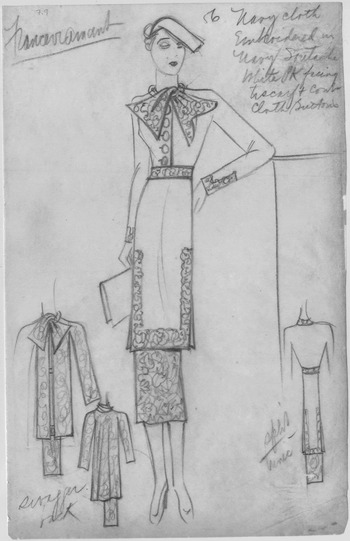
The process of cataloguing the digitized portion of the Sondheim Collection took approximately four months with Idacavage working part-time. Initially, Idacavage invested time in conducting research to create a ‘cheat sheet’ that would allow her to easily reference information that would be needed for cataloguing the records. This information included an authority list of potential designer names and garment construction terms, including commonly featured silhouettes, fabrics, and sewing techniques that she anticipated she would encounter when cataloguing this group of sketches. To assist in assigning dates to the sketches, she also created a PowerPoint presentation with images as a reference for how silhouettes and trends gradually changed throughout the 1930s. She continually added more designer names and terms throughout the process, and sometimes edited records when she determined the meaning of abbreviations. For example, she was initially unable to determine the significance of ‘Franc-’ inscribed at the top of a sketch, but after finding one sketch with the full name ‘Francevrament’ written, she realized that sketches labeled with ‘Franc-’ should be attributed to a French designer named Francevrament (see Fig. 1).
Although new to the demands of creating metadata for archival collections, Idacavage rapidly established a sense of pace and strove to meet a set goal of a minimum number of new records daily. Due to similarities in groups of sketches or a newly-discovered term, Idacavage was able to frequently copy edit batches of records. Additionally, once she discovered new designers represented in the collection, Idacavage created a name authority file within CollectiveAccess, using pre-existing authorities or, in the case of lesser known designers, creating local authorities after conducting research.
Navy Women's Ensemble with Split Tunic and Swagger Coat Embroidered with Navy Soutache, 1930s. Sketched by unidentified employee of Herbert Sondheim, Inc. after design by Francevramant. From the Herbert Sondheim, Inc. fashion business scrapbooks, KA.0039, New School Archives, The New School, New York, New York.

Discussion
The digitized portion of the Sondheim Collection, consisting of over 1,200 records that can now be accessed through the New School's Digital Collections website, provides a detailed view of how fashion evolved between the Great Depression and World War II through the ever-changing styles of evening gowns, day dresses, jackets, skirts, and more, as well as various examples of millinery and hair styles that were popular throughout this time period.Footnote 12 After Idacavage completed her cataloguing project, she determined that the digitized sketches date from 1930 to 1940 and that they depict the work of approximately thirty-one designers.
The majority of the sketches feature thorough notes about the materials and construction of the depicted garments, as well as the name of the original designer, including well-known French labels (Chanel, Schiaparelli, Balenciaga, Vionnet, Molyneux) and lesser-known labels (Dormoy, Rosevienne, Francevramant, Manguin). As fashion history tends to focus primarily on fashion houses that have left the longest-lasting impressions, the inclusion of obscure labels is vital for researchers seeking to understand fashion history more fully. The sketches provide evidence that American dress manufacturers considered these fashion houses’ products worthy of expending a great deal of time and money to view. The result is a collection that provides a more complete sense of which French design houses were influential during the time period, instead of exclusively focusing on houses that continue to have a greater presence in museums, fashion history books, and fashion design curriculum.
Not all digitized sketches are attributed to an identified designer. The uncertain design provenance of many of the sketches makes it difficult to confirm the dates, creators, inspiration, and intended purposes. Furthermore, this lack of information makes it impossible to know just how many of these sketches Sondheim eventually used and to what extent they played into the manufacturer's actual designs. Whenever identifiable, Idacavage assigned a French design label to individual records as an agent with the agent role of designer. All sketches, however, indicate that Herbert Sondheim, Inc. is a corporate agent with the agent role of compiler. The NSASC believes this is the most accurate way to represent the functions of the sketches and why Sondheim employees created them.
Despite ambiguity, researchers may use the Sondheim Collection as a resource to interpret French influence on American designers and better understand the bygone business practices of New York's garment industry. Additionally, certain clues, such as a note in pencil indicating the name of a French designer found within a larger group of unattributed sketches, indicate that many of the sketches were likely based on French designs. It is safe to assume that Herbert Sondheim, Inc. did employ these sketches as inspiration for Sondheim brand garments; numerous accounts prove that adaptation was an expensive and often dangerous business that no designer or dress manufacturer would risk partaking in if they didn't expect to profit from it.
Apart from the field of architecture, cataloguing art and design records is frequently vexing, even when using the Getty's vocabularies, as the taxonomies are focused more on historical costume such as one might encounter in traditional museum collections and less on 20th-century mass-produced fashion.
Results and the future of the collection
Parsons School of Design students and faculty as well as external researchers seeking primary sources documenting the work of European designers featured in the Sondheim Collection constitute the primary identified users of the digital collection. Many of the Parisian design houses whose work Sondheim's employees sketched do not maintain publicly accessible archives, if any business records still exist. Even if publicly accessible, budget and time limitations impede the average North American researcher from visiting European archives.
Many of the NSASC's visitors during the academic year are AAS, BFA, and MA/MFA students for whom archival research fulfills the requirement of a class assignment or are motivated by desire for inspiration in one's own design practice. The online presence of two volumes of catalogued sketches may be sufficient for researchers whose information seeking goal may simply be to find any primary source documenting Chanel. For more advanced researchers, such as faculty and students in Parsons MA Fashion Studies program, museum curators or independent fashion historians, locating online sketches identified as that of a particular house may be enough to schedule a research appointment to consult the remaining undigitized 17 volumes in the Sondheim Collection.
The online availability of the digitized sketches provides a corrective to the practice of simply consulting issues of Vogue, Harper's Bazaar and other widely available fashion periodicals or basing historical research on museum collections, which typically privilege couture over ready-to-wear garments.Footnote 13 These two research practices are legitimate, but one should not presume that either or both conducted in tandem can present critically minded design researchers with a full picture of the fashion ecology of the 1930s and 1940s. The Herbert Sondheim, Inc. sketches provide evidence of a much richer, more complex and infinitely less glamorous field of cultural production.Footnote 14
The sketches have also found a new audience that Herbert Sondheim himself may not have expected: students studying the business of fast fashion, a popular research topic for both undergraduate and graduate-level student researchers. The NSASC directs students seeking historical context for fast fashion to the digitized Sondheim sketches. Although presented with the option of making an appointment to consult the undigitized scrapbooks, the vast majority of students appear satisfied with browsing the online collection. Visitors to the CollectiveAccess site can download low resolution JPEG files, and the NSASC provides a software generated preferred citation within each item-level record, making this an attractive option for illustrating assignments.
The NSASC employs the term ‘identified users’ in the above paragraph because it is unknown who is consulting the digitized sketches online and why. Although Google Analytics allows NSASC staff to collect and analyze data concerning visitors to the CollectiveAccess site, the data cannot inform administrators about researcher motivations, specific information needs, levels of ability and comfort using digital library resources, degree of visual literacy, or knowledge of fast fashion, which would allow end-users to interpret the records within a historical context (or, if context is even relevant to the end-users).
No one, apart from one of this paper's authors, has contacted the NSASC concerning the namesake of this collection, according to the NSASC's records. Herbert Sondheim as a businessman, an important figure in the mid-20th-century American fashion industry, and the eponymous corporation remain shadowed by the enduring cultural capital of the Parisian fashion houses that supplied the inspiration for Herbert Sondheim, Inc.’s output. Sondheim's enduring legacy, at least for now, appears to consist of generating thousands of sketches of couture designs for the purpose of copying and then having the foresight to transfer their ownership to cultural institutions rather than disposing of them when his business became untenable.