1. Introduction
Trilobites were relatively abundant and diverse in marine Devonian habitats. In particular, the Late Devonian period is important for the phacopid development because the main groups of reduced-eyed or blind phacopids arose at that time, notably in the north peri-Gondwanan margin. The publications of Richter & Richter (Reference Richter and Richter1926, Reference Richter and Richter1955), Maksimova (Reference Maksimova1955), Osmólska (Reference Osmólska1958, Reference Osmólska1963), Chlupáč (Reference Chlupáč1966, Reference Chlupáč1977) and Feist et al. (Reference Feist, McNamara, Crônier and Lerosey-Aubril2009) have been major contributions to our current knowledge of Gondwanian Upper Devonian phacopids.
The present paper contributes to the systematic study of the Upper Devonian phacopids. The discovery of new occurrences assigned to Trimerocephalus, Dianops and Phacops sensu lato from SW Algeria gives us the opportunity to understand these forms more fully. These phacopines lend a particular dimension to the Upper Devonian trilobite fauna; they are among the youngest representative phacopines, and those with the least number of ocular lenses (Crônier et al. Reference Crônier, Bignon and François2011). The gradual visual complex regression leading to blindness is an evolutionary trend often observed in different lineages of trilobites, notably in proetids and phacopids (Richter & Richter, Reference Richter and Richter1926; Feist & Clarkson, Reference Feist and Clarkson1989; Crônier et al. Reference Crônier, Feist and Auffray2004). This paedomorphic trend is thought to be related to environmental changes such as a global sea-level rise (Feist, Reference Feist and McNamara1995).
Additionally, the palaeobiodiversity of Upper Devonian phacopids has been explored through diversity curves in order to understand their fluctuations in time. These fluctuations can also be linked to environmental changes.
2. Geological setting and material
2.a. Local geological succession
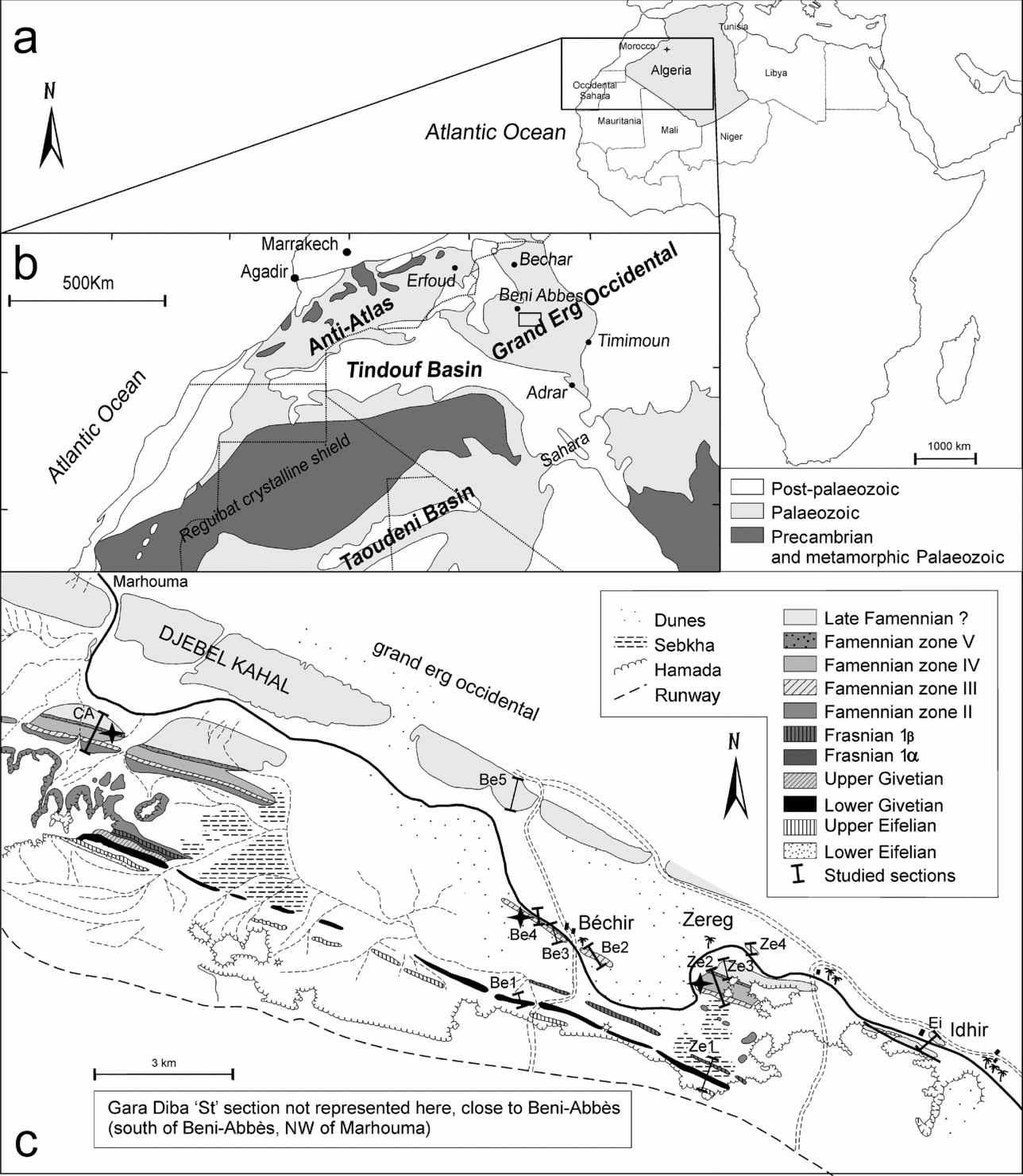
The material originates mostly from the ‘Argiles de Marhouma’ Formation of the Saoura Valley, Ougarta Basin, Algerian Sahara, regarded as Frasnian–Famennian in age on the basis of ammonoids, brachiopods, conodonts and trilobites (Malti et al. unpub. data). It has been collected from several sections (Tamtert-Zereg, Béchir, Cheffar-El-Ahmar and Idhir) located to the SE of Beni-Abbès (30 km; Fig. 1), except for the section Gara Diba which is located at the entrance to Beni-Abbès city.
(a, b) Geographical and geological locations of the Marhouma area, SE of Beni-Abbès (30km), Saoura Valley, Ougarta Basin, Algeria. (c) Location of studied sections (Tamtert-Zereg Ze, Béchir Be, Cheffar-El-Ahmar CA and Idhir Ei).

This area belongs to the major structural unit of the Saharan Platform. It comprises a Precambrian basement unconformably overlain by thick sediments occurring in a number of Palaeozoic basins, including the basin of Ougarta which comprises the Marhouma area.
The ‘Argiles de Marhouma’ Formation is represented by calcareous condensed red nodular or pseudonodular limestones rich in goniatites and known as ‘griottes’ or ‘Goniatitico-rosso’, which indicate an epicontinental platform (Benhamou et al. Reference Benhamou, Abbache, Elmi, Mekahli, Racheboeuf, Ouali-Mahadji and Boumendjel2004). This facies is similar to the'Ammonitico-rosso’ of the Mesozoic Tethysian area. In both cases, these facies are linked to the slope deposits of deepening basins along their transition towards the platform.
These red nodular limestones are found at Tafilalt–Maider in Morocco as far as the Mountains of Ougarta (Saoura) in Algeria.
This spatial extension was controlled by a distension phase of the Hercynian orogeny as understood by modelling the physical geography of the basins with facies ‘griottes’ in an insular palaeogeography (Benhamou et al. Reference Benhamou, Abbache, Elmi, Mekahli, Racheboeuf, Ouali-Mahadji and Boumendjel2004). After the Frasnian, the extension regime changed and a contraction phase at the end-Famennian led to a silico-clastic sedimentation of the Strunian. An estimation of the thickness of these Famennian deposits was given recently as 260 m by Ouali Mehadji et al. (Reference Ouali Mehadji, Bendella, Atif, Belkacemi and Abbache2012) for the ‘Argiles de Marhouma’ Formation.
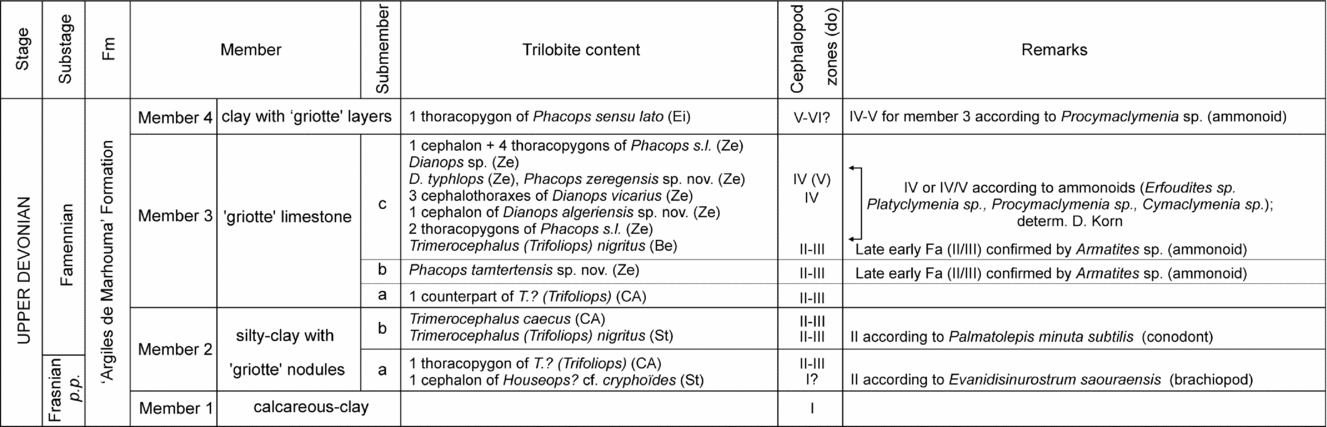
According to Malti et al. (unpub. data), the ‘Argiles de Marhouma’ Formation consists of four successive members: the calcareous-clay member (Member 1; Frasnian); the silty-clay with ‘griotte’ nodule member (Member 2; Famennian); the ‘griotte’ limestone member (Member 3; Famennian); and the clay with ‘griotte’ layer member (Member 4; Famennian). These members can be divided into submembers (Fig. 2). This formation contains abundant and diverse faunas, the macrofauna comprising ammonoids, brachiopods (Brice et al. unpub. data) and trilobites (this paper), and the microfauna consisting of conodonts (Wendt et al. Reference Wendt, Kaufmann, Belka, Klug and Lubeseder2006) and ostracodes (Casier, Reference Casier1985).
Lithostratigraphic column of the ‘Argiles de Marhouma’ Formation and stratigraphical location of studied trilobites (from sections Tamtert-Zereg Ze, Béchir Be, Cheffar-El-Ahmar CA, Idhir Ei and Gara Diba St).

2.b. Trilobite content
In the published fauna previously reported from Algeria, some Upper Devonian trilobites have been cited by Haug (Reference Haug1903) with Trimerocephalus caecus from Beni-Abbès and by Menchikoff (Reference Menchikoff1930) with Phacops s.l. granulatus from Ouarourout and Bou Mehaoud and Omegops bergicus from the ‘oued’ Khorb el Ethel. There is also a drawing of a cephalon of Phacops sp. from Tamtert (Termier & Termier, Reference Termier and Termier1950; pl. CCVI, fig. 16). As observed in other areas from the northern peri-Gondwanian margin such as Morocco (Crônier & Feist, Reference Crônier and Feist1997; Crônier & Clarkson, Reference Crônier and Clarkson2001), the phacopid remains are in fact relatively abundant and well preserved. The phacopid diversity is high and many species are still being described. Phacopids include disarticulated moulting remains as well as complete, enrolled specimens. The trilobite content with their geographic and stratigraphic locations is listed in Figure 2.
The material described and figured herein is housed in the Museum of the Central Faculty of Alger, Algeria (MUA/1094/001–015).
3. Systematic palaeontology
Morphological terminology mainly follows Chlupáč (Reference Chlupáč1977) and Crônier et al. (Reference Crônier, Bignon and François2011). Some abbreviations have been used: ‘exsag.’ for exsagittal; ‘sag.’ for sagittal; and ‘tr.’ for transverse. I to VI refer to successive Frasnian–Famennian cephalopod zones (Wedekind, Reference Wedekind1908).
Family phacopidae Hawle & Corda, Reference Hawle and Corda1847
Subfamily phacopinae Hawle & Corda, Reference Hawle and Corda1847
Genus Phacops Emmrich, Reference Emmrich1839
Type species. Calymene latifrons Bronn, Reference Bronn1825, Middle Devonian, Eifel, Germany.
Remarks. The synonymy of the genus is very extensive. After the original definition by Emmrich (Reference Emmrich1839), the most significant works are these of Barrande (Reference Barrande1852), Wedekind (Reference Wedekind1911), Richter & Richter (Reference Richter and Richter1926), Delo (Reference Delo1935), Campbell (Reference Campbell1967) and Chlupáč (Reference Chlupáč1977).
The earlier authors had already noticed the heterogeneity of the genus Phacops which is now expressed by defining subgenera (Chlupáč, Reference Chlupáč1977; McKellar & Chatterton, Reference McKellar and Chatterton2009).
Because of this heterogeneity, the understanding of the taxonomic status of species is uneven and the justifiability of treating phacopine groups as sufficiently different for a valid attribution of generic or subgeneric taxonomic status remains problematic (McKellar & Chatterton, Reference McKellar and Chatterton2009; Crônier et al. Reference Crônier, Bignon and François2011).
A preliminary phylogenetic analysis has been conducted in order to assess the phylogenetic position of the ‘granulatus’ group towards the ‘Phacops’ sensu lato group (Crônier, Reference Crônier, Kim, Salimova and Meshchankina2008). The ‘granulatus’ group from the Upper Devonian seems to constitute an independent clade (especially by its distinctive L1 and visual complex) that differs from the ‘Phacops’ sensu lato group from the Middle Devonian (especially by L1 with an intercalating ring, a more developed visual complex with more lenses and closer to the posterior furrow, a longer (sag.) pygidium and a stronger tuberculation).
The study of their relationship and their alpha-taxonomy is still in progress (by Crônier and Holloway); we will therefore use ‘Phacops sensu lato’ for Upper Devonian species with a developed visual complex.
Upper Devonian species assigned. Phacops postaltaicus Maksimova, Reference Maksimova1960: Frasnian, Kazakhstan; P. guranensis Maksimova, Reference Maksimova and Modzalevskoy1969: Frasnian, East Asia; P. turco turco Richter & Richter, Reference Richter and Richter1939: Frasnian, Turkey; P. n. sp. a Feist, Reference Feist and McNamara1995: Frasnian (Iδ), France; P. tamtertensis sp. nov.: Famennian (III–IV), Algeria; P. zeregensis sp. nov.: Famennien (IV–VI), Algeria; P. tafilaltensis Crônier & Clarkson, Reference Crônier and Clarkson2001: Famennien (V–VI), Morocco; P. granulatus (Münster, Reference Münster1840): Famennian (II–IV?, V–VI), Germany, Silesia, Poland, Moravia, Austria, England, Spain, Portugal, Algeria, Morocco, Urals, Kazakhstan, China, Iran; P. granulatus guilinensis Zhu, Reference Zhu and Yu1988: Famennian (VIβ), China; P. circumspectans circumspectans Paeckelmann, Reference Paeckelmann1913: Famennian (VI), Germany; P. circumspectans tuberculosus Yuan & Xiang, Reference Yuan and Xiang1998: Famennian (VIβ), China.
Phacops tamtertensis sp. nov.
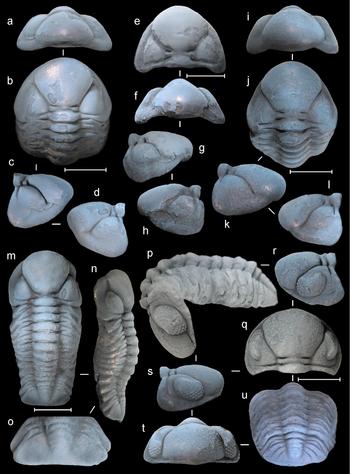
Figures 3i–l, 4a
Etymology. After the locality of Tamtert.
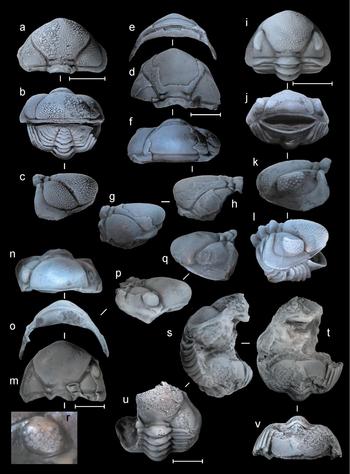
Phacopid trilobites from the ‘Argiles de Marhouma’ Formation, Upper Devonian, Saoura Valley, Algeria (see Fig. 1). (a–c) Trimerocephalus caecus, MUA/1094/007: cephalon in dorsal, frontal and lateral views. (d–h) Trimerocephalus (Trifoliops) nigritus Crônier, Reference Crônier2003, MUA/1094/008: cephalon in dorsal, ventral, frontal and lateral views. (i–l) Phacops tamtertensis sp. nov., holotype, MUA/1094/001: cephalon in dorsal, frontal and lateral views. (m–r) Houseops? cf. cryphoïdes (Richter & Richter, Reference Richter and Richter1926), MUA/1094/006: cephalon in dorsal, frontal, ventral and lateral views and detail of the right eye. (s–v) Trimerocephalus (Trifoliops) nigritus Crônier, Reference Crônier2003, MUA/1094/009: (s–t) partially enrolled exoskeleton in lateral and ventral views, (u) cephalon and (v) pygidium in dorsal view. Scale bars: 5 mm.

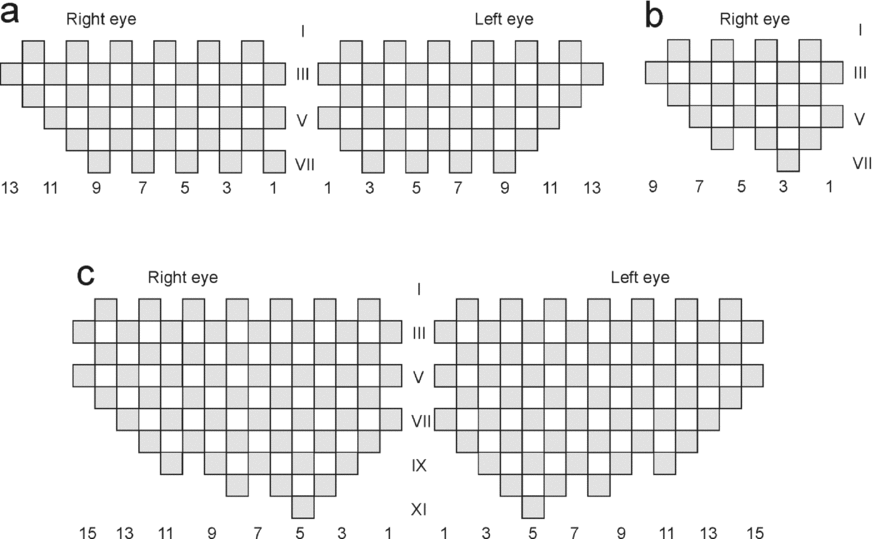
Schematic representation of right and left eyes in three Upper Devonian phacopid trilobites from the ‘Argiles de Marhouma’ Formation, Saoura Valley, Algeria. (a) Phacops tamtertensis sp. nov., MUA/1094/001; (b) Houseops? cf. cryphoïdes, MUA/1094/006; (c) Phacops zeregensis sp. nov., MUA/1094/002. I–VI = horizontal rows; 1–15 = vertical files. Grey boxes indicate a lens present.

Holotype. Complete articulated individual, MUA/1094/001.
Type locality. Zereg section, Saoura Valley, Ougarta Basin, Algeria.
Type stratum. Submember b, Member 3, ‘Argiles de Marhouma’ Formation, Famennian II–III (II or III from Armatites ammonoids; determ. Korn), Upper Devonian.
Studied material. Only holotype.
Diagnosis. Cephalon narrow; glabella with a wide base and a frontal outline slightly tapered; glabella and cheeks slightly inflated; S2 and S3 distinct; L1 just swollen, without intercalating ring; visual complex with 13 vertical lens files and maximum 3 lenses per file, longer than the postocular length of the genal field; palpebral furrow almost transverse. Fine, dense and heterogeneous tubercles on cephalon.
Description. Cephalon: Length/width ratio about 0.63. Dorsal view: The glabellar ratio of width at L1/maximum width of frontal lobe is about 0.50. The glabella is bounded by deep axial furrows moderately divergent (66°) with anterolateral angles slightly truncated. The frontal lobe overhangs a deep preglabellar furrow. S2 and S3 are indicated by a break in the sculpture. S1 is continuous and curved in its middle part, subparallel to S0 in its adaxial curvature and becoming deeper in its distal portions. L1 is shorter (sag.) than L0 but more than half its length. L1 has subcircular lateral lobes separated from its median part by a weak exsagittal furrow. S0 is well marked and moderately deep with a slight curvature in its middle portion. L0 with a median nodule is slightly inflated in the middle part and its lateral lobes are not defined. The reniform visual surface has 13 dorsoventral files of lenses and 3 maximum lenses per file (Fig. 4a). The inter-lensar sclera is thickened dorsally only. The palpebral furrow is distinct. The exsagittal length of the postocular genal field is half to equal length of the posterior border. The cheek is slightly swollen. Lateral view: The glabella is rounded anteriorly. The outline of L1 is curved. L0 is as high as glabella at its maximum convexity, and is curved anteriorly and straight posteriorly. The anterior border is short, slightly flattened and sloping posteroventrally. A marginulation extends from the antero-lateral border up to the genal angle. The posterior furrow is deep and narrow. The lateral border furrow is shallow and wider anteriorly. The posterolateral furrow is continuous and the posterolateral border widens at the genal angle. The subocular librigenal field is narrow and concave at the front of the eye, becoming distinct backwards. Frontal view: The glabellar outline is semicircular with lateral sides flattened obliquely. Both the palpebral area and palpabral lobe are about level. Ventral view: The vincular furrow is deep, wide (sag.), curved and parallel to the preglabellar furrow. The posterior band of the cephalic doublure is long (sag.) and slightly curved posteriorly. Thorax: In dorsal view, the maximum axial width/maximum thoracic width (tr.) ratio is about 30%. The axial rings are slightly convex to subangular, without defined lateral lobes. The axial furrows are just present. The anterior pleural band is narrower (exsag.) than the posterior pleural band. The pleural and interpleural furrows are deep. The axial rings and the lateral border of segments are granulated. Pygidium: In dorsal view, the posterior outline is rounded. Its displaced position inside the thorax does not permit a detailed description except for the axial furrow closure behind the axis terminus that is complete and indistinct. Ornamentation: The cephalon is covered with dense, fine conical tubercles of heterogeneous size. The tubercles are slightly smaller on the glabellar anterior face. The palpebral lobe has an additional row of fine tubercles along the upper edge of the eye. The anterior band of the cephalic doublure possibly has some granulation and pits and the posterior band has scaly granules.
Comparison. The new species differs from Middle Devonian Phacops by a less-inflated glabella, a shallow lateral furrow especially behind the facial suture posterior branch, a less-prominent and convex visual complex, a just swollen L1 without intercalating ring and a thiner tuberculation.
This species resembles Phacops granulatus on account of its narrow cephalon, a frontal lobe not overhanging a deep preglabellar furrow, both palpebral area and palpebral lobe about level in height. However, Phacops granulatus differs in having a broader (tr.) glabella, fine homogeneous tubercles on glabella, no median occipital nodule and a visual surface with less vertical files (14–15).
The new species shares conical tubercles of heterogeneous size with Phacops tafilaltensis, glabella and cheeks slightly inflated and a median occipital nodule. However, Phacops tafilaltensis differs in having a broader (tr.) cephalon, a visual surface much longer (18 vertical files, 4–5 lenses per file), a palpebral area lower in height than the palpebral lobe and a lack of ornamentation on the cephalic doublure.
The new species also resembles Rabienops wedekindi (Richter & Richter, Reference Richter and Richter1926) on account of its narrow cephalon and a visual surface with the same number of vertical files (13). However, Rabienops wedekindi differs in having a broader (tr.) glabella, fine homogeneous tubercles on glabella, no median occipital nodule and a visual surface with four maximum lenses per file.
Phacops zeregensis sp. nov.
Figures 4c, 5p–u
Etymology. After the locality of Zereg.
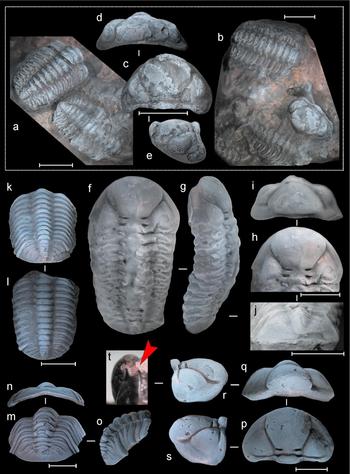
Phacopid trilobites from the ‘Argiles de Marhouma’ Formation, Upper Devonian, Saoura Valley, Algeria (see Fig. 1). (a–l) Dianops vicarius Chlupáč, Reference Chlupáč1961: (a–d) cephalon in frontal, dorsal and lateral views, MUA/1094/011; (e–h) cephalon in dorsal, frontal and lateral views, MUA/1094/012; (i–l) cephalon in frontal, dorsal and lateral views, MUA/1094/013. (m–o) Dianops typhlops (Gürich, Reference Gürich1896): exoskeleton in dorsal and lateral view and detail of pygidium, MUA/1094/010. (p–u) Phacops zeregensis sp. nov., holotype, MUA/1094/002: (p) exoskeleton in lateral view; (q–t) cephalon in dorsal, lateral, and frontal views; (u) thoracopygon in dorsal view. Scale bars: 5 mm.

Holotype. Complete articulated specimen, MUA/1094/002.
Type locality. Zereg section, Saoura Valley, Ougarta Basin, Algeria.
Type stratum. Submember c, Member 3, ‘Argiles de Marhouma’ Formation, Famennian IV or IV/V (from clymenid ammonoids; determ. Korn), Upper Devonian.
Studied material. Only holotype.
Diagnosis. Cephalon narrow; glabella slightly inflated with a wide base and a parabolic frontal outline; S2 and S3 absent; L1 slightly inflated, without intercalating ring; lateral preoccipital lobes transverse and not differentiated; visual complex with 15 vertical files and 5 maximum lenses per file; length (exsag.) of the postocular genal field equal to length of the posterior border. Pygidium with few differentiated axial rings and few deep and thin pleural furrows; interpleural furrows absent; pygidial posterior margin curved. Thin, dense and homogeneous tuberculation on cephalon; distinct tubercles aligned transversely on the pygidial axis.
Description. Cephalon: Length/width ratio about 0.63. Dorsal view: The glabellar ratio of width at L1/maximum width of frontal lobe is about 0.53. The glabella is bounded by deep axial furrows moderately divergent (69°) with anterolateral angles subangular. The frontal lobe overhangs a shallow preglabellar furrow. S1 is continuous and slightly curved in its middle part, subparallel to S0 in its adaxial curvature, and becoming deeper in its distal portions. L1 is shorter (sag.) than L0 but more than half its length. L1 has transverse lateral lobes not differentiated from its median part by an exsagittal furrow. S0 is shallow with a slight curvature in its middle portion. L0 is slightly inflated in the middle part and its lateral lobes are not defined. The visual surface is longer than the postocular length of the genal field, reniform with 15 vertical files of lenses and 5 maximum lenses per file (Fig. 4c). The inter-lensar sclera is thin. The palpebral furrow is distinct and convex (abax.). Lateral view: The glabella is sloping obliquely dorsoventrally in its anterior part. The outline of L1 is slightly curved. L0 is as high as glabella at its maximum convexity, and is slightly curved anteriorly and straighter posteriorly. The anterior border is short, forming a border projected forward. The posterior furrow is deep and narrow. The lateral border furrow is shallow. The posterolateral furrow is continuous and the posterolateral border widens at the genal angle. The subocular librigenal field is absent and the lower edge of the eye is in the lateral border furrow. Frontal view: The glabellar outline is semicircular becoming subvertical laterally. The palpebral area is inflated and higher than the palpebral lobe. Thorax: In dorsal view, the maximum axial width/maximum thoracic width (tr.) ratio is about 28%. The axial rings are strongly convex without defined lateral lobes. The anterior pleural band is narrower (exsag.) than the posterior pleural band. The interpleural and pleural furrows are deep. The pleura are transverse adaxially. The axial rings have small scattered tubercles. Pygidium: In dorsal view, the shape is lenticular to trapezoidal with a maximum width behind the midlength (sag.). The posterior outline is rounded. The length/width ratio is rather long (51%). The pydigial axis is rather short (sag.) and wide (tr.), inflated with a swelling decreasing gradually to the back. Its posterior closure is rounded. Four axial rings (+ terminal piece) are poorly defined. The pleural furrows are few, deep and thin, not reaching the posterior margin. Ornamentation: The cephalon is covered with dense and fine tubercles of homogeneous size, except for the damaged lateral border where there is no evidence of sculpture. A few distinct tubercles, spaced apart and transversely aligned, are present on the pygidium.
Comparison. The new species differs from other Phacops by transverse lateral lobes not differentiated from the median part of L1, a shallow lateral border furrow especially behind the facial suture posterior branch.
The new species resembles Rabienops wedekindi on account of its morphometric features, a fine inter-lensar sclera, a palpebral area higher than the palpebral lobe and a subocular field absent. However, Rabienops wedekindi differs in having subcircular lateral preoccipital lobes, a visual surface with less vertical files (13) and a longer postocular genal field.
This new species shares a narrow cephalon with Phacops granulatus, a visual complex with 14–15 vertical files and thin and dense tubercles on the glabella. However, Phacops granulatus differs in having more divergent dorsal furrows, S2 and S3, subcircular lateral preoccipital lobes, a visual surface with four maximum lenses per file, a longer pygidium and a wider pygidial axis.
Undetermined Phacops
Figure 6a–e
Material. One cephalon and four thoracopygons on the same slab poorly preserved; Zereg section, Saoura Valley, Algeria; Submember c, Member 3, ‘Argiles de Marhouma’ Formation, Famennian IV–V, Upper Devonian.
Phacopid trilobites from the ‘Argiles de Marhouma’ Formation, Upper Devonian, Saoura Valley, Algeria (see Fig. 1). (a–e) Undetermined Phacops sensu lato, MUA/1094/003: (a, b) general view of thoracopygons and one isolated cephalon; (c–e) cephalon in dorsal, frontal and lateral views. (f–j) Undetermined Dianops (Richter & Richter, Reference Richter and Richter1923), MUA/1094/015: (f–g) exoskeleton in dorsal and lateral views, (h–i) cephalon in dorsal and frontal views and (j) pygidium in dorsal view. (k–l) Undetermined thoracopygon in dorsal views, MUA/1094/004. (m–o) Undetermined thoracopygon in dorsal, frontal and lateral views, MUA/1094/005. (p–t) Dianops algeriensis sp. nov., MUA/1094/014: cephalon in dorsal, frontal, right lateral, left lateral and detail views. Scale bars: 5 mm.

Remarks. The exoskeleton may be assigned to Phacops but its alteration prevents a specific assignation. The general shape and the visual surface length with five maximum lenses per file may suggest the new described species Phacops zeregensis.
Figure 6k–l
Material. One well-preserved thoracopygon; Idhir section, Saoura Valley, Algeria; Submember a, Member 4, ‘Argiles de Marhouma’ Formation, Famennian V–VI?, Upper Devonian.
Description. Pygidium with lenticular to trapezoidal shape. Its maximum width is behind the midlength (sag.). The posterior outline is widely rounded and transverse in its median part. The length/width ratio is rather wide (46%). The axis is well defined by axial furrows, rather long sagitally and narrow, strongly convex. Five axial rings (+ terminal piece) are defined by narrow furrows. The pleural furrows are few, deep and thin, not reaching the posterior margin. The interpleural furrows are poorly distinct. The posterior border forms a thin ridge. The thoracic rings are strongly convex without defined lateral lobes. The anterior pleural band is slightly narrower (exsag.) and less inflated than the posterior pleural band. The interpleural and pleural furrows are deep. The pleura are transverse adaxially. Thorax and pygidium are covered with relatively dense and coarse tubercules; the pygidial posterior ridge with rather dense scaly granules.
Figure 6m–o
Material. Two well-preserved thoracopygons; Zereg section, Saoura Valley, Algeria; Submember c, Member 3, ‘Argiles de Marhouma’ Formation, Famennian IV–V, Upper Devonian.
Description. Pygidium with lenticular to trapezoidal shape and slightly vaulted (tr.). Its maximum width is behind the midlength (sag.). The posterior outline is transverse in its median part and curved laterally. The length/width ratio is wide (39%). The axis is rather short (sag.) and wide (tr.), slightly convex. Four axial rings (+ terminal piece) are defined by wide furrows laterally and showing the interannular ring medially. The pleural furrows are few, deep and thin, not reaching the posterior margin. The interpleural furrows are very thin and poorly distinct. The limbus is rather broad (sag.) and forms a thin ridge posteriorly. The thoracic rings are strongly convex without defined lateral lobes. The anterior pleural band is slightly narrower (exsag.) and less inflated than the posterior pleural band. The interpleural and pleural furrows are deep. The pleura are transverse adaxially. Thorax and pygidium are covered with fine and dense granules; the pygidial posterior ridge with rather dense scaly granules.
Genus Houseops Feist et al. Reference Feist, McNamara, Crônier and Lerosey-Aubril2009
Type species. Houseops canningensis Feist, McNamara, Crônier & Lerosey-Aubril Reference Feist, McNamara, Crônier and Lerosey-Aubril2009, Upper Devonian, Canning Basin, Australia.
Remarks. This genus is characterized by a subdued transverse cephalic profile protruding anteriorly, a narrow glabellar base, retracted anteriorly and recurved anterolateral corners, flat and poorly defined preoccipital lateral lobes, a median occipital tubercle, eyes low, a moderately deep vincular furrow and a short and flat postvincular area, a pygidial axis posteriorly narrow with few rings and a thin sculpture with sparse tubercles.
Houseops is more closely related to Nephranops Richter & Richter, Reference Richter and Richter1926 and Chotecops Chlupáč, Reference Chlupáč1971 than to any other phacopine. Nephranops shares with Houseops a thin sculpture and a median occipital tubercle but differs from Houseops in the obsolete visual lenses, the higher transverse cephalic vault and the wider and dorsalwards concave postvincular area. Chotecops differs from Houseops in the wider glabellar base, the wider and dorsalwards concave postvincular area and a pygidium with more axial rings.
According to Chlupáč (Reference Chlupáč1977) and Feist et al. (Reference Feist, McNamara, Crônier and Lerosey-Aubril2009), the older Chotecops might constitute the ancestral clade of both Nephranops and Houseops. Unfortunately, the poorly known Frasnian phacopines do not confirm this possible phylogenetic relationship.
Species assigned. Houseops canningensis Feist et al. Reference Feist, McNamara, Crônier and Lerosey-Aubril2009: Famennian (IIα), Australia; H. beckeri Feist et al. Reference Feist, McNamara, Crônier and Lerosey-Aubril2009: Famennian (IIα), Australia; H. sp. A Feist et al. Reference Feist, McNamara, Crônier and Lerosey-Aubril2009: Famennian (IIα), Australia: H. miserrimus miserrimus (Drevermann, Reference Drevermann1901): Famennian (II), Germany; H. miserrimus wiedensis (Lütke, Reference Lütke1968): Famennian (IIα), Germany; H.? cryphoides (Richter & Richter, Reference Richter and Richter1926): Frasnian (Iγ), Germany; H.? pronini (Maksimova, Reference Maksimova1955): Frasnian, Urals; H.? nalivkini (Maksimova, Reference Maksimova1955): Famennian (IIα), Urals; H.? ocellatus (Perna, Reference Perna1915): Famennian (II), Urals.
Houseops? cf. cryphoïdes (Richter & Richter, Reference Richter and Richter1926)
Figures 3m–r, 4b
v. 1926 Phacops (Phacops) cryphoïdes: Richter & Richter, p. 257, pl. 12, figs 41–42.
Reference Pfeiffer1954 Phacopidella cf. liopyga; Pfeiffer, p. 48.
Reference Pfeiffer1959 Phacops (Phacops) cryphoïdes: Pfeiffer, p. 269– 270, pl. 3, figs 2–4.
2007 ‘Phacops’ cf. cryphoïdes: Kaiser et al. p. 239.
2009 Houseops? cryphoïdes: Feist et al. p. 14–15.
Material. One mostly exfoliated cephalon in a pyritized brachiopod bed within a thick clay layer from the Gara Diba section, near Beni-Abbès, Algeria; Submember a, Member 2, ‘Argiles de Marhouma’ Formation, Famennian II? (II according to Evanidisinurostrum saouraensis brachiopod; determ. Brice), Upper Devonian.
Description. Glabella broad and pentagonal overhanging strongly a deep preglabellar furrow. Dorsal furrows deep. Anterior border short, forming a crest slightly projected forward. L1 broad with differentiated, subcircular and swollen lateral lobes. S1 continuous. S2 and S3 present on internal mould. Reduced visual complex with 21 lenses, 9 vertical files and 3 maximum lenses per file (Fig. 4b). Postocular genal field long. Subocular librigenal field narrow and concave in front of the eye, becoming distinct backward. Vincular furrow moderately deep and wide. Posterior band of the vincular furrow convex and curved.
Remarks. The poorly known Frasnian phacopines with a deep, wide and curved vincular furrow and a reduced visual complex have been previously assigned to Phacops. Feist et al. (Reference Feist, McNamara, Crônier and Lerosey-Aubril2009) have tentatively assigned them to Houseops. Houseops? cryphoïdes differs from Phacops mainly in the anteriorly positioned small visual complex with few lenses and in the lack of intercalating ring.
Houseops? cryphoïdes reported by Richter & Richter (Reference Richter and Richter1926) from the Mid-Frasnian of Sessacker (Germany) is a poorly known cephalon. This specimen exhibits small palpebral lobes, a visual surface with 18–23 lenses, a rather convex palpebral furrow adaxially, a facial suture between the palpebral lobe and the visual surface outwardly convex (abax.), a sculpture with granules of two sizes as in Trimerocephalus caecus but much finer, and granules more numerous and grouped under the visual surface, on the cheek and on the borders.
Moreover, this German specimen exhibits a similar vincular furrow to that of Phacops and seems to have a plane and curved posterior band of the vincular furrow (after a cast of the holotype).
Kaiser et al. (Reference Kaiser, Becker, El Hassani, Becker and Kirchgasser2007) have reported but not figured Houseops? cf. cryphoïdes from the Upper Frasnian of Oulmes region, Moroccan Meseta.
Because of its poor preservation, our Algerian specimen is tentatively assigned to cryphoïdes, mainly on account of the anteriorly positioned small visual complex, a rather convex palpebral furrow adaxially, a rather narrow cephalon with the anterolateral borders evenly curved in outline, a wide glabellar base and anterolateral angles slightly subangular. However, our Algerian specimen differs from the German specimen by a convex posterior band of the vincular doublure. Moreover, our specimen would be much younger (Famennian IIβ? according to brachiopods; determ. Brice) than the German specimen and allies (Frasnian).
Genus Trimerocephalus McCoy, Reference McCoy1849
Type species. Phacops mastophthalmus Richter, Reference Richter1856, Upper Devonian (Famennian), Thuringia, Germany.
Remarks. Trimerocephalus is characterized by the absence of eyes and the submarginal facial suture often cutting the anterior extremity of the cheeks. A continuous S1 and a wide (tr.), short (sag.) and clearly segmented pygidium are characters shared by the small-eyed Acuticryphops Crônier & Feist, Reference Crônier and Feist2000. Trimerocephalus is also close to the blind Dianops (Richter & Richter, Reference Richter and Richter1923). Dianops differs by an interrupted (tr.) S1, a facial suture running on the latero-frontal border, a longer (sag.) pygidium, strongly convex without distinct segmentation.
Within Trimerocephalus, Chlupáč (Reference Chlupáč1966) distinguished three groups: ‘mastophthalmus/caecus/dianopsoides’ with an anteriorly rounded glabellar outline and an often transverse cephalon; ‘sponsor/polonicus/interruptus’, probably younger, with a pentagonal glabellar outline, pointed anteriorly and a narrow cephalon; and an independent group comprising T.? steinachensis (Richter & Richter, Reference Richter and Richter1926) with a frontal border not overhung by the frontal lobe and T. (Trifoliops) trifolius (Osmólska, Reference Osmólska1958) with a frontal border widened strongly laterally.
However, this traditional classification is not completely confirmed by a cladistic analysis where three clades have been obtained (Crônier, Reference Crônier2003). Trimerocephalus mastophthalmus and T. dianopsoides occupy with T. (Trifoliops) and T.? steinachensis a marginal position as sistergroup of clades ‘caecus/sponsor’.
Trimerocephalus mastophthalmus differs from the group ‘caecus’ by the facial suture outline cutting the cheek, a fine granulation and the absence of the median nodule. Trimerocephalus dianopsoides differs by a hardly defined pygidial segmentation, the absence of S2 and S3 and the presence of the ocular protuberances.
Trimerocephalus lentiginosus (Maksimova, Reference Maksimova1955) discovered in the upper Famennian of the Urals has an age not confirmed by conodont data.
Species assigned. Trimerocephalus caecus (Gürich, Reference Gürich1896): Famennian (II–III), Poland, Germany, Urals, Algeria, France; T. cryptophthalmoides (Maksimova, Reference Maksimova1955): Famennian (II), Urals, Kazakhstan; T. dianopsoides Osmólska, Reference Osmólska1963: Famennian (II?–III), Poland; T. interruptus Berkowski, Reference Berkowski1991: Famennian (III), Poland; T. lacunosus (Pfeiffer, Reference Pfeiffer1959): Famennian (II), Germany; T. lelievrei Crônier & Feist, Reference Crônier and Feist1997: Famennian (II-III), Morocco; T. lentiginosus (Maksimova, Reference Maksimova1955): Famennian (V), Urals; T. mastophthalmus (Richter, Reference Richter1856): Famennian (II–III?), Germany, Poland, England, Asia, Kazakhstan; T. mimbi Feist et al. Reference Feist, McNamara, Crônier and Lerosey-Aubril2009: Famennian (II), Australia; T. polonicus Osmólska, Reference Osmólska1958: Famennian (III), Poland; T. procurvus Arbizu, Reference Arbizu1985: Famennian (III), Spain, Germany; T. sponsor Chlupáč, Reference Chlupáč1966: Famennian (III), Moravia, Spain; T. shotoriensis Feist, Reference Feist, Yasdi and Becker2003 in Feist et al. Reference Feist, Yasdi and Becker2003: Famennian (II–III), Iran; T.? steinachensis (Richter & Richter, Reference Richter and Richter1926): Famennian (II), Germany; T. tardispinosus Feist & Becker, Reference Feist and Becker1997: Famennian (II), Australia; T. vodorezovi (Maksimova, Reference Maksimova1955): Famennian (II), Kazakhstan; T. (Trifoliops) trifolius (Osmólska, Reference Osmólska1958): Famennian (II–III?), Poland, France; T. (Trifoliops) nigritus Crônier, Reference Crônier2003: Famennian (II–III?), Poland, France.
Trimerocephalus caecus (Gürich, Reference Gürich1896)
Figure 3a–c
1896 Phacops caecus: Gürich, p. 362–363, pl. 15, figs 4a–c.
1926 Phacops (Trimerocephalus) caecus: Richter & Richter, p. 180–184, pl. 10, figs 80–86 (with previous synonymy).
1958 Trimerocephalus caecus: Osmólska, p. 128–131, fig. 3, pl. 2, figs 1a–c, 2a, b, 3.
Reference Hahn and Hahn1975 Trimerocephalus caecus: Hahn & Hahn, p. 25, pl. 2, fig. 4.
Reference Morzadec and Babin1976 Trimerocephalus caecus: Morzadec & Babin, p. 368–369, pl. 1, figs 1–11.
non Reference Becker1985 Trimerocephalus caecus: Becker, p. 29 [ = Trimerocephalus procurvus Arbizu, Reference Arbizu1985].
Material. One complete enrolled individual in a greenish black limestone from Cheffar-El-Ahmar section, Saoura Valley, Algeria; Submember b, Member 2, ‘Argiles de Marhouma’ Formation, Famennian II–III, Upper Devonian.
Remarks. This specimen shows morphological features of Trimerocephalus caecus from Poland: wide and deep dorsal furrows, deep lateral and posterior border furrows, two types of tubercles on cephalon and two nodules on L1. It can differ by the possible absence of the median occipital nodule (default preservation?).
German specimens from Langenaubach (Drevermann, Reference Drevermann1901) and Gattendorf (Richter & Richter, Reference Richter and Richter1919) have been found in the Cheiloceras and the Prolobites Zones. Poland specimens from the Cheiloceras and the Clymenia Zones (Osmólska, Reference Osmólska1958) differ by the absence of tubercle on L0 and a cephalic outline less wide and less subcircular.
This species is close to Trimerocephalus lelievrei from Morocco (Crônier & Feist, Reference Crônier and Feist1997) in having a marginal facial suture which does not cut the cheeks, the same sculpture and no protuberance ocular. Nevertheless, Trimerocephalus lelievrei has a more elongated (tr.) cephalon, a glabella which is lower and less pointed anteriorly.
Sub-genus Trimerocephalus (Trifoliops) Crônier, Reference Crônier2003
Type species. Trimerocephalus (Trifoliops) trifolius (Osmólska, Reference Osmólska1958), Upper Devonian (Famennian), Holy Cross Mountains, Poland.
Species included. Trimerocephalus (Trifoliops) trifolius (Osmólska, Reference Osmólska1958) and T. (T.) nigritus Crônier, Reference Crônier2003.
Remarks. Trimerocephalus (Trifoliops) differs from Trimerocephalus sensu stricto: the vincular furrow is widened (tr.) in T. (Trifoliops); the frontal border is inflated, wide and oriented forwards only in T. (T.) trifolius; a feature shared by T.? steinachensis.
Trimerocephalus (Trifoliops) nigritus Crônier, Reference Crônier2003
Figure 3d–h, s–v
v. 2003 Trimerocephalus (Trifoliops) nigritus: Crônier, p. 59–62, fig. 3b, fig. 6a–h.
Diagnosis emended. Cephalic outline wide and trilobed; glabella with a broadly parabolic frontal outline; frontal lobe overhanging the frontal border; S2 and S3 absent. Pygidium rather trapezoidal and vaulted (tr.); pygidial posterior margin curved laterally with a slight forwards inflection medially; segmentation weak or indistinct.
Material. One partially exfoliated cephalon (MUA/1094/008) from Béchir section (SE of Beni-Abbès) and one subenrolled individual (MUA/1094/009) from the Gara Diba section (near Beni-Abbès), Algeria; Submember c, Member 3 for MUA/1094/008 (Famennian II–III from Armatites sp. ammonoid; determ. D. Korn); and Submember b, Member 2 for MUA/1094/009 (Famennian II–III from Palmatolepis minuta subtilis conodont; determ. C. Randon), ‘Argiles de Marhouma’ Formation, Famennian II–III, Upper Devonian.
Remarks. The cephalon from the Béchir section shows the morphological features of Trimerocephalus (Trifoliops) nigritus: a trilobed cephalic outline (even if partially damaged); deep dorsal furrows; a median portion of S1 shallow with L1 less inflated and lateral lobes slightly differentiated; S0 more clearly differentiated with a strongly inflated L0 and lateral lobes not differentiated; no ocular protuberance; a facial suture cutting the cheeks forming a narrow crescent; a vincular furrow very broad (tr.), fairly deep and slightly widened (sag.); a posterior band of the doublure narrow (sag.), flat and granulose (contrary to what was written in Crônier, Reference Crônier2003, p. 60); a fine and dense granulation on cephalon.
The specimen from the Gara Diba section showing the right side of the cephalo-thorax and the complete connected pygidium shows morphological features of Trimerocephalus (Trifoliops) nigritus: a trilobed cephalic outline; S2 and S3 indistinct; a median portion of S1 shallow with L1 less inflated and lateral lobes slightly differentiated; S0 more clearly differentiated with a strongly inflated L0 and lateral lobes not differentiated; no ocular protuberance developed; a fine and dense granulation on exoskeleton. Unfortunately, the ventral part is damaged except the posterior band of the doublure that is narrow (sag.), flat and granulose. The facial suture is also not visible. This specimen may differ by less deep dorsal furrows.
In addition to a previous description (Crônier, Reference Crônier2003), further information on pygidial morphology is now available. Pygidium with a trapezoidal shape. In dorsal view, the anterior margin is straight (tr.). The dorsal furrows are hardly marked. The axis is short (sag.) and wide (tr.). Its posterior extremity is rounded and lowered. Rings are damaged. The terminal piece seems to be delimited by a slightly marked furrow. Pleural furrows are slightly marked, pleural ribs not inflated and interpleural furrows absent. These furrows delimit a laterally widening limbus that is very broad (sag.). The posterior border shows a very slight forwards inflection in its median portion. Angles of lateral and posterior border are about 95°. Pygidium is strongly arched (tr.) in frontal view and shows a fine and dense granulation.
These pygidial features are shared by Trimerocephalus dianopsoides, which has a barely defined pygidial segmentation.
Crônier (Reference Crônier2003) assigned an isolated pygidium to Trimerocephalus (Trifoliops) nigritus. Nevertheless, this pygidium with a transverse and lenticular shape has a shorter (sag.) pygidial axis, well-marked pleural and interpleural furrows becoming less distinct posteriorly and delimiting a laterally widening limbus, and a slight thickening along the whole length (tr.) of the posterior pygidial margin. This isolated pygidium may reasonably belong to Trimerocephalus (Trifoliops) trifolius.
Genus Dianops (Richter & Richter, Reference Richter and Richter1923)
Type species. Phacops limbatus Richter, Reference Richter1848, Upper Devonian (Famennian), Thuringia, Germany.
Remarks. Dianops terminates the evolutionary trend of the Upper Devonian phacopids. It is characterized by gradual reduction up to entire disappearance of eyes and shifting of the facial suture towards the outer margin. This trend can be observed within Dianops. Dianops typhlops (Gürich, Reference Gürich1896) and D. vicarius Chlupáč, Reference Chlupáč1961 are therefore the most primitive, and development continues through D. limbatus and D. griffithides (Richter & Richter, Reference Richter and Richter1919) to D. anophthalmus (Frech, Reference Frech1892) in which the facial suture is already running on the lateral cephalic border.
Species assigned. Dianops aktjubensis (Maksimova, Reference Maksimova1955): Famennian (V), Urals, Kazakhstan; D. anophthalmus (Frech, Reference Frech1892): Famennian (V–VI), Silesia, Austria, Rhineland?; D. griffithides griffithides (Richter & Richter, Reference Richter and Richter1919): Famennian (V), Germany, France, Urals?; D. griffithides mugodjaricus (Maksimova, Reference Maksimova1955): Famennian (V), Kazakhstan; D. limbatus (Richter, Reference Richter1848): Famennian (V–VI), Germany; D. pernai (Maksimova, Reference Maksimova1955): Famennian (V), Urals, Kazakhstan; D. typhlops (Gürich, Reference Gürich1896): Famennian (IV), Poland; D. vicarius Chlupáč, Reference Chlupáč1961: Famennian (IV), Moravia; D. guizhouensis Xiang, Reference Xiang1981: Famennian (VI), China.
Dianops typhlops (Gürich, Reference Gürich1896)
Figure 5m–o
1896 Trimerocephalus typhlops: Gürich, p. 359, pl. 15, fig. 7a–b.
1926 Phacops (Trimerocephalus) typhlops: Richter & Richter, p. 192, pl. 10, figs 90–94 (with previous synonymy).
1958 Dianops typhlops: Osmólska, p. 135–136,pl. 4, figs 1–4.
Reference Becker and Schreiber1994 Dianops typhlops: Becker & Schreiber, p. 377, pl. 1, fig. 12.
Material. One complete individual in a strongly nodular and shaly red ‘griotte’ limestone from Zereg section, Saoura Valley, Algeria; Submember c, Member 3, ‘Argiles de Marhouma’ Formation, Famennian IV(–V) (IV or IV/V from clymenid ammonoids; determ. Korn), Upper Devonian.
Remarks. The Algerian specimen shows morphological features of Dianops typhlops from Poland: anterolateral glabellar angles truncated (exsag.), S1 interrupted in its middle part, a flat L1 coalescing with the frontal lobe in its median part and without differentiated lateral lobes, an effaced posterolateral border furrow on a short distance at the genal angle, a frontal lobe with granules dense on the anterior part becoming short ridges laterally on the ventral part.
To complete this description, the Algerian specimen has a rather wide pygidium, a short axis, fewer than four distinct axial rings, three distinct pleural furrows and no defined thoracic lateral lobes.
However, this specimen displays some slight differences from Dianops typhlops from Poland: a glabella prominent but slightly flattened; S2 and S3 weakly suggested as small depressions; shallow axial furrow adjacent to L1; a posterior pygidial margin almost transverse without a clear medial notch; and a lack of thoraco-pygidial ornamentation.
Dianops typhlops has been described in Poland by Gürich (Reference Gürich1896) and Richter & Richter (Reference Richter and Richter1926) from the Platyclymenia Zone (IV). Our specimen corresponds to the description proposed by Richter & Richter (Reference Richter and Richter1926), except for the ornamentation of the thorax (coarsely to finely granular for Polish specimens) and of the pygidium (granular to coarser on the border for Polish specimens).
Dianops typhlops also described in Poland by Osmólska (Reference Osmólska1958) from the Clymenia Zone (V) shows a cephalon less vaulted and a lateral border relatively narrower in comparison with the lectotype. The Algerian specimen differs by pleurae and a pygidial axis less distinctly segmented, a lateral border relatively wider and a glabella more prominent although slightly flattened.
Dianops vicarius Chlupáč, Reference Chlupáč1961
Figure 5a–l
1961 Dianops typhlops vicarius: Chlupáč, p. 480, pl. 2, figs 3–4.
1966 Dianops vicarius: Chlupáč, p. 113–115, pl. 32, figs 11–13, pl. 24, figs 1–11.
Reference Hahn and Hahn1975 Dianops vicarius: Hahn & Hahn, p. 26, pl. 2, fig. 15.
1977 Dianops vicarius: Chlupáč, p. 124, pl. 32, figs 5–7.
Material. Three relatively well-preserved cephalo-thoraxes in a strongly nodular and shaly red ‘griotte’ limestone bed from Zereg section, Saoura Valley, Algeria; Submember c, Member 3, ‘Argiles de Marhouma’ Formation, Famennian IV (IV or IV/V from clymenid ammonoids; determ. Korn), Upper Devonian.
Remarks. Our specimens correspond to the descriptions of Dianops vicarius from Poland proposed by Chlupáč (Reference Chlupáč1966, Reference Chlupáč1977): cephalic outline subcircular and vaulted; glabella steeply falling away forwards and to S1; anterolateral corners rounded to truncated (exsag.); deep dorsal furrows; S1 deep laterally as elongated (tr.) depressions and shallow medially; S0 deep laterally as elongated (tr.) depressions also and bent forwards medially; L1 flat, slender as depression between the frontal lobe and L0; vaulted L0 twice as wide as L1; convex genal field; shallow lateral border furrow as ill-defined depression (adax.) and widening anteriorly; narrow distinct posterior border furrow (adax.); posterolateral border furrow effaced over a long distance at the genal angle. Surface rather smooth; anterior part of the frontal lobe with fine and dense granulation becoming short ridges on the ventral part.
To complete this description, the Algerian specimens have S1 almost effaced medially, L1 with transverse differentiated lateral lobes by a very slight exsaggital furrow, a deep axial furrow and distinct adjacent to L1, no defined thoracic lateral lobes and no thoracic ornamentation.
However, these specimens display some slight differences from Dianops vicarius from Poland: S2 and S3 not distinct or weakly suggested and a facial suture indistinct.
Dianops vicarius and D. typhlops are the closest species. The main differences are: the interrupted S1 in D. typhlops (frontal lobe coalescing with L1 in its median part) and differentiated in D. vicarius (frontal lobe separated and depressed of L1 in its median part); an interrupted posterolateral border furrow over a short distance at the genal angle in D. typhlops and over a long distance in D. vicarius; and a posterior pygidial margin with a medial notch in D. typhlops, transverse medially without a clear medial notch in D. vicarius.
Dianops vicarius and D. typhlops are also the oldest representatives of the genus. They occur in the Platyclymenia Zone. Both species share some primitive features such as a facial suture close to the lateral furrow and a better differentiated L1.
Dianops pernai is also close to Dianops vicarius with a frontal lobe demarcated from S1. However, Dianops pernai differs by more divergent dorsal furrows, a frontal lobe pointed anteriorly, a posterolateral border furrow almost interrupted and a more convex genal field.
Dianops algeriensis sp .nov.
Figure 6p–t
Etymology. After the area of Algeria.
Holotype. Exfoliated cephalon, MUA/1094/014.
Type locality. Zereg section, Saoura Valley, Ougarta Basin, Algeria.
Type stratum. Submember c, Member 3, ‘Argiles de Marhouma’ Formation, Famennian IV or V (from clymenid ammonoids; determ. Korn), Upper Devonian.
Studied material. Only holotype.
Diagnosis. Cephalon rather narrow; glabella little prominent and narrow, bounded by deep axial furrows slightly divergent (55°) with anterolateral angles rounded to cut off; S2 and S3 absent; L1 coalescing with the frontal lobe, without intercalating ring; lateral preoccipital lobes transverses and slightly differentiated; posterior furrow deep and wide; lateral border furrow shallow anteriorly; posterolateral furrows effaced at the genal angle. Numerous granules on the preserved portion of L0.
Description. Cephalon: Length/width ratio about 0.62. Dorsal view: The glabellar ratio of width at L1/maximum width of the frontal lobe is about 0.61. The glabella is not greatly prominent and is narrow. The frontal outline is parabolic. The anterolateral border is wide and evenly curved in outline. The frontal lobe does not overhang the indistinct preglabellar furrow. S1 is interrupted in its middle part and becoming deep laterally as elongated (tr.) depressions. L1 is half the length (sag.) of L0 length. L1 is not inflated and without median depression. S0 is deep and transverse in its median part. L0 is convex and its lateral lobes are not defined. The muscle scars form deep depressions. Lateral view: The glabella is slightly swollen and sloping obliquely dorsally in its anterior part and then posteroventrally. The outline of L1 is slightly curved. L0 is as high as the glabella at its maximum convexity, and is curved anteriorly and straighter posteriorly. The facial suture is indistinct. The genal angle is rounded and without a node. Frontal view: The glabellar dorsal outline is semicircular becoming subconvergent laterally. Ornamentation: Present on the preserved distal left portion of L0 covered with numerous and fine granules.
Comparison. The new species differs from other Dianops by having a less prominent and narrow glabella; deep dorsal, posterior (adax.) and occipital furrows. The new species differs from Dianops typhlops by a less-inflated glabella and better-defined lateral preoccipital lobes and from D. vicarius by the absence of the frontal lobe demarcation from S1.
Undetermined Dianops
Figure 6f–j
Material. One complete specimen, poorly preserved; Zereg section, Saoura Valley, Algeria; Submember c, Member 3, ‘Argiles de Marhouma’ Formation, Famennian IV–V, Upper Devonian.
Remarks. The exoskeleton is assigned to Dianops but its imperfect preservation prevents a specific assignation.
4. Palaeobiodiversity analysis
Trilobites are important elements in Devonian marine benthic communities. Throughout the Devonian period, their abundance and taxonomic diversity fluctuated (Lerosey-Aubril & Feist, Reference Lerosey-Aubril, Feist and Talent2012). After a peak which occurred during the Early Devonian, their diversity was restricted at high taxonomic levels by one of the most severe of all biological crises during the Kellwasser event (Schindler, Reference Schindler1990; Crônier & Van Viersen, Reference Crônier and van Viersen2007). Most trilobites that were adapted to outer shelf bottom habitats after the major transgressive Taghanic event of the mid-Givetian (Johnson, Reference Johnson1970) were affected by repeated sea-level rises leading to a reduction of reefal habitats (Schlager, Reference Schlager1981). Only the Phacopida and Proetida survived the biological crisis, but they were severely affected (Crônier & Van Viersen, Reference Crônier and van Viersen2007).
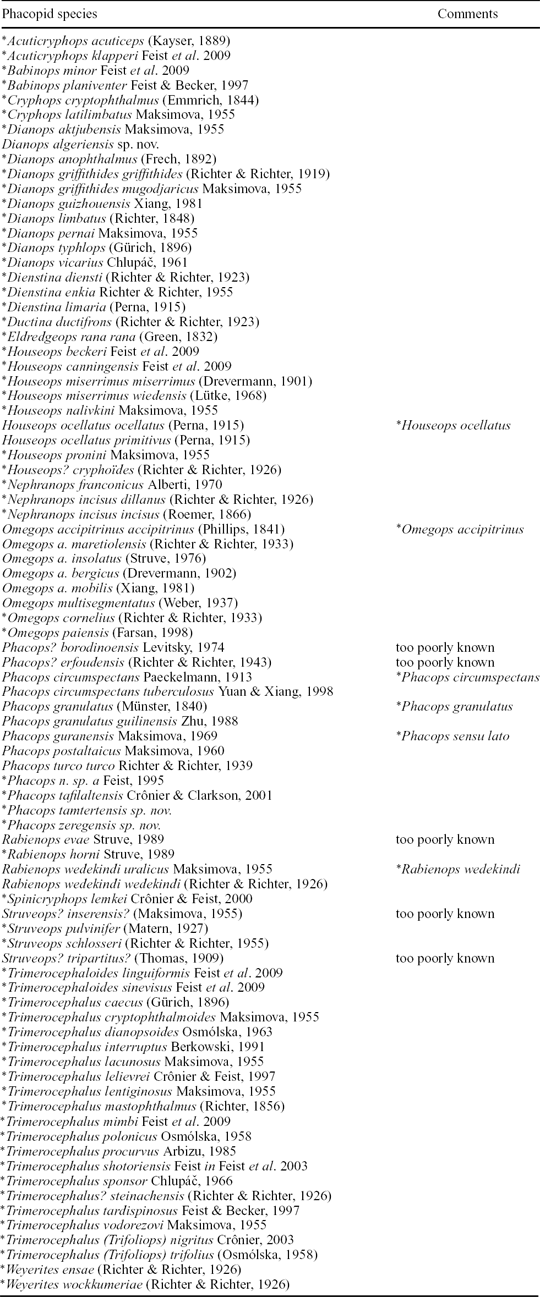
In this context, we focused our investigations on Upper Devonian sections in order to evaluate phacopid biodiversity at a global level and to understand their fluctuations in time. This biodiversity is represented in our study by 68 known phacopid species (poorly known species were excluded and most subspecies have been ignored) for 21 taxa (mostly genera; distinction between Phacops sensu lato from Frasnian or Famennian time; consideration of cryphoides taxon and granulatus group) within 14 consecutive and discrete chronostratigraphic intervals from Upper Devonian strata. See Table 1 for the taxonomic list. This taxonomic database was compiled from literature and completed with our new data.
Taxonomic database of all known phacopid species (from literature and new data from this study) including those poorly known from Upper Devonian strata. Taxa with asterisk have been considered in our analysis. Subspecies have often been excluded.

4.a. Diversity estimation through 14 intervals
Knowledge of the number of species or genera through geological time has been an important field of study during these last years. This knowledge via curves of diversity provides potentially large-scale information such as palaeoenvironmental events or evolutionary trends. The diversity curves are meaningful, although an estimate of Phanerozoic global biodiversity is limited by biases in the fossil record and the validity of theses curves has been widely debated (Foote, Reference Foote2000; Smith, Reference Smith2001). The main biases include inaccuracies in taxonomic data and uneven sampling intensity across organisms, environments, geographic areas and time intervals (Badgley, Reference Badgley2003). Recognition of these methodological problems has resulted in notable improvements in the Phanerozoic diversity database (Adrain & Westrop, Reference Adrain and Westrop2000; Alroy et al. Reference Alroy, Marshall, Bambach, Bezusko, Foote, Fürsich, Hansen, Holland, Ivany, Jablonski, Jacobs, Jones, Kosnik, Lidgard, Low, Miller, Novack-Gottshall, Olszewski, Patzkowsky, Raup, Roy, Sepkoski, Sommers, Wagner and Webber2001) using methods such as rarefaction, for example.
Curves of diversity, origination and extinction have therefore been established on the presence/absence database from the occurrence of Upper Devonian phacopids in order to estimate their biodiversity. Data have been organized on a ‘range-through’ assumption for which the existence of a taxon is considered continuous between its first to last appearance. Due to a lack of stratigraphical precision, the occurrence of taxa was considered within 14 consecutive and discrete chronostratigraphic intervals: four for Frasnian (Iα, Iβ, Iγ and Iδ) and ten for Famennian (Post-Iδ, IIα, IIβ, IIIα, IIIβ, IV, Vα, Vβ, VIα and VIβ).
Curves of diversity, origination and extinction were achieved using the data analysis software PAST (Palaeontological Statistics) v2.14 (Hammer et al. Reference Hammer, Harper and Ryan2001; Hammer & Harper, Reference Hammer and Harper2006). The ‘Endpoint correction’ option that counts a FAD (First Apparition Datum) or LAD (Last Apparition Datum) within an interval as a half unit instead of one unit, while both FAD and LAD lay within an interval as a third of a unit, was used (Hammer & Harper, Reference Hammer and Harper2006).
4.b. Fluctuations
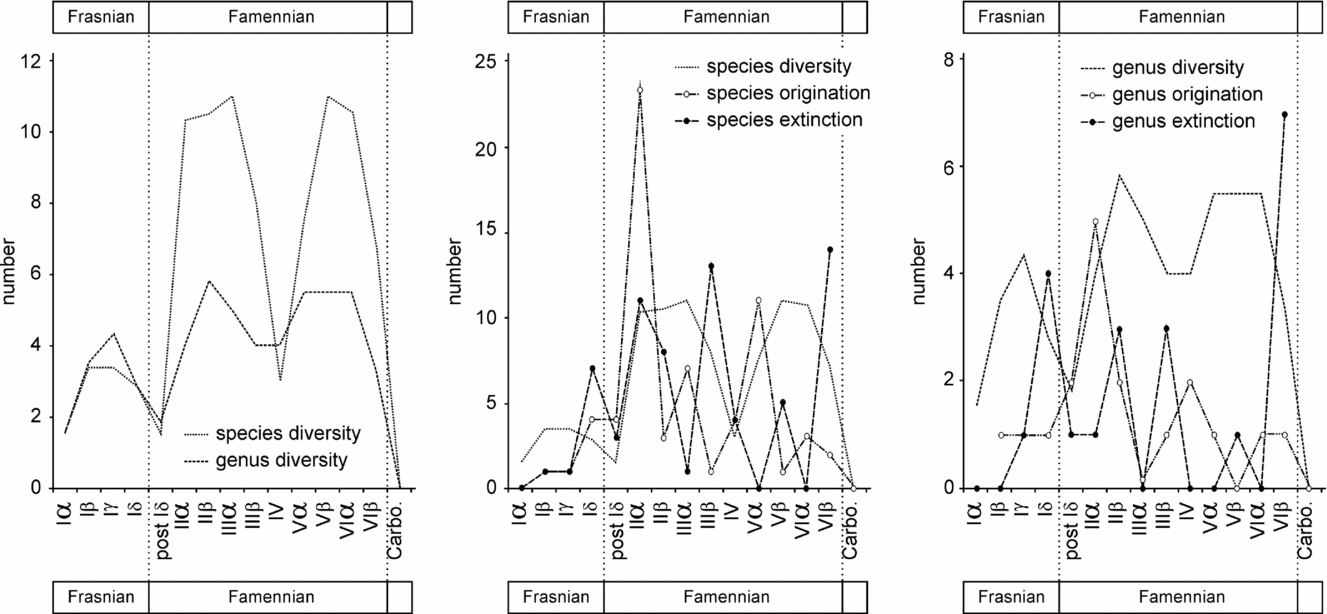
Curves of diversity show a great reduction of both specific and generic diversity during the Famennian post-Iα, IV and VIβ (Fig. 7). At a specific level the two highest drops occurred during the Famennian IV and VIβ; at a generic level the two highest drops occurred during the Famennian Post-Iα and VIβ (Fig. 7). These severe drops were preceded by a diversification phase (Fig. 7).
Curves showing diversity, origination and extinction on the presence/absence database from the occurrence of Upper Devonian phacopids. The various metrics have been defined by Hammer & Harper, Reference Hammer and Harper2006.

The evolutionary pattern of specific and generic origination (Fig. 7) shows a moderate increase during the Frasnian/Famennian post-Iα followed by a major increase during the Famennian IIα. The specific and generic origination rates fell drastically thereafter during the Famennian IIβ and IIIα, respectively. After this period other peaks of origination occurred at a specific and generic level and are more moderate than those which took place previously: during the Famennian IIIα, Vα and VIα for the specific origination; and during the Famennian IV and VI for the generic origination (Fig. 7).
After a low rate at the beginning, the evolutionary pattern of specific and generic extinction (Fig. 7) show the Frasnian four major peaks of extinction: during the Frasnian Iδ, the Famennian IIα (specific level), IIβ (generic level), IIIβ and VIβ. These major peaks were followed by sharp decreases: the Famennian post-Iα (generic level), the Famennian IIIα, Vα (specific level) or IV–Vα (generic level).
At the specific level, the major peak of increase was an origination peak occurring during the Famennian IIα; at the generic level, the major peak of increase was an extinction peak occurring at the end of the Famennian.
Whatever level is considered, the evolution of phacopid diversity was characterized by three major declines resulting from extinction rates higher than origination rates. After each decline, a faunal turnover occurred. The history of these turnovers is shown in Figure 8. These biodiversity reductions followed by successive turnovers within Upper Devonian phacopids were caused by successive and major environmental perturbations (Kellwasser or Hangenberg events) which affected the marine environments and thus the marine ecosystems. Additionally, the most important peak of specific and generic origination occurred after the post-Kellwasser event during the Famennian IIα.
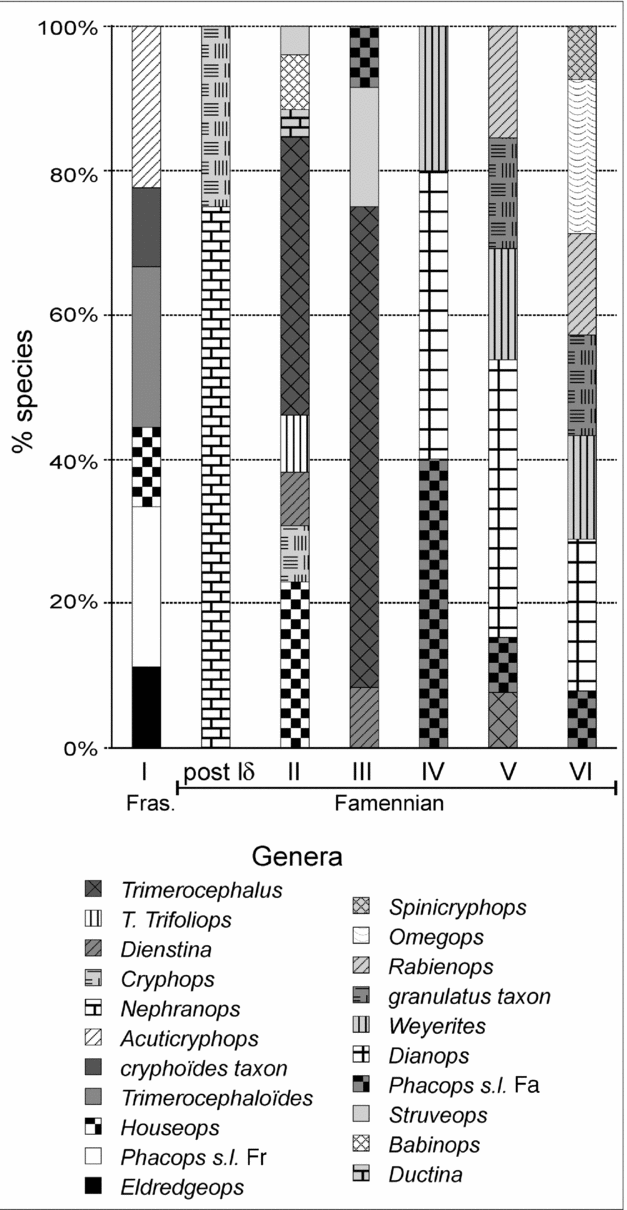
Relative diversity of phacopid genera from the Frasnian to the Famennian in percent of species.

4.c. Turnovers and bioevents
As compared to the Givetian (see Crônier & van Viersen, Reference Crônier and van Viersen2007), the Frasnian is not particularly rich in phacopids although material may be abundant locally (Feist et al. Reference Feist, McNamara, Crônier and Lerosey-Aubril2009). During the Early Frasnian, the major transgression initiated in the Mid-Givetian resulted in a homogenization of deep-sea/pelagic environments and a reduction of shallow/neritic environments (Johnson, Reference Johnson1970; House, Reference House1985).
Of the six phacopid genera known during the Frasnian, two genera originated in the early Frasnian (Houseops and Trimerocephaloïdes) and two others occurred during the mid–late Frasnian (Acuticryphops and ‘cryphoïdes’ taxon). Only two genera come from the Givetian and persist into the Frasnian: Phacops and Eldredgeops (C. Brett and J. Zambito, pers. comm.). They are known from North America (Eldredgeops) and East Asia (Phacops). These genera were almost equally present during the Frasnian, representing 10–25% of the specific diversity (Fig. 8).
During the late Frasnian, the pronounced eustatic deepening became maximal just before the upper Kellwasser event (Girard et al. Reference Girard, Klapper, Feist, Over, Morrow and Wignall2005), leading to the development of the pelagic euxinic facies. In these offshore depositional environments beyond the light penetration limit, the gradual visual complex regression leading to blindness is an evolutionary trend observed in various independent lineages. This evolutionary trend may result from an ‘opportunistic’ and adaptive strategy correlative with environmental constraints, insofar as it leads to a good fit between organisms and their environment (Crônier Reference Crônier1999; Crônier & Courville, Reference Crônier and Courville2003). Moreover, the late Frasnian Acuticryphops shows a morphological intra-specific drift inducing a relatively important variability of the visual complex (Crônier et al. Reference Crônier, Feist and Auffray2004; Feist et al. Reference Feist, McNamara, Crônier and Lerosey-Aubril2009) which would be located at speciation boundaries. These disturbances that occurred during development seem to be linked to environmental stress, in particular with rapid sea-level fluctuations of the end-Frasnian (Feist & Schindler, Reference Feist and Schindler1994).
At the global scale, the Kellwasser event led to the extinction of almost all reefs and their associated trilobites (Lichidae), and a significant decrease in other trilobite taxa. The Kellwasser extinction especially affected phacopids adapted to life in deep benthic habitats and their biodiversity, and led to a turnover. With one exception, all genera such as Acuticryphops (the most common reduced-eyed phacopid of the late Frasnian) became extinct at the base of the upper Kellwasser event (Feist et al. Reference Feist, McNamara, Crônier and Lerosey-Aubril2009).
During the Famennian, phacopid diversity was punctuated by several bioevents: the Cheiloceras and Condroz-Enkeberg events (Famennian IIα–β); the annulata event (Famennian IV); and the Dasberg and Hangenberg events (Famennian Vα and VIβ, respectively).
The post-Kellwasser event recovery marked a new step for phacopid biodiversity. A first turnover occurred during the Famennian post-Iδ with two new genera reported: Nephranops in European offshore environments and Cryphops from Upper triangularis Zone, representing 75% and 25% of the specific diversity, respectively (Fig. 8).
Nevertheless, the significant post-Kellwasser recovery occurred during the late early Famennian (IIα–β) leading to a second turnover. Both blind and eyed-phacopid genera co-occurred in photic offshore environments. Other marine organisms such as the ammonoids also experienced a significant post-Kellwasser recovery during the Cheiloceras event (Walliser, Reference Walliser1985). Of the eight phacopid genera, six genera were new and dominated by Trimerocephalus until the Famennian III; Trimerocephalus represented 40% of the specific diversity during the Famennian II and almost 70% during the Famennian III (Fig. 8). Houseops ‘reappeared’ after a pseudo-extinction around late Frasnian times (Fig. 8); however Houseops of the Frasnian are different from those of the Famennian, and may represent two distinct genera.
A third and final turnover occurred during the Famennian IV. Phacopids originated and diversified in the deeper offshore environments and were mostly blind or reduced-eyed, reflecting the ultimate evolutionary step of the visual complex regression leading to blindness. Well-developed-eyed phacopids were widely distributed in contemporaneous shallow shoal environments. Two genera, Dianops (blind) and Weyerites (reduced-eyed), occurred and persisted until the end-Famennian (Fig. 8). During the same period Phacops regressed significantly from 40% to 10%, whereas Weyerites and Dianops decreased moderately from 20% to 15% and from 40% to 25–30%, respectively (Fig. 8). The stratigraphic range of the Famennian Phacops extended into the Famennian III–VI. Phacops known in the Frasnian are different from those known in the Famennian such as Phacops granulatus widely distributed geographically.
At the end of the Famennian, in addition to these previous genera four genera Spinicryphops, Rabienops, ‘granulatus’ taxon and Omegops (developed-eyed) occurred, representing only 5%, 15%, 15% and 20% of the specific diversity, respectively (Fig. 8). All phacopid genera became extinct at the end-Famennian (Hangenberg event) because of a sea-level rise and anoxic conditions. In this regard, the Famennian is noted for its taxonomic turnovers and for its decline in phacopid diversity. On a global scale, the Hangenberg event led to the extinction of high-level taxonomic proetids.
5. Conclusions
First, the new discovery of phacopids in the Upper Devonian of Algeria allows the following conclusions to be drawn. On the basis of our material, it has been possible to identify numerous blind phacopid species co-occurring or not with more or less normal-eyed forms. At a generic scale, the Algerian faunule may be regarded as diversified and cosmopolitan without marked original features and closely related to European species due to the presence of Trimerocephalus and Dianops. At a specific scale, this Algerian faunule is closely related to the Holy Cross Mountains (Poland) and Montagne Noire (SW France) species due to the presence of Trimerocephalus (Trifoliops) nigritus.
Secondly, our analysis of biodiversity fluctuations of Upper Devonian phacopids allows the following conclusions to be drawn. During Late Devonian time, eustatic variations (transgressive–regressive pulses) had a major influence on the phacopid diversity and their evolution leading to major bioevents (upper Kellwasser and Hangenberg events).
Pronounced sea-level deepening in Devonian time led to major morphological adaptations such as the gradual visual complex regression leading to blindness of various taxa adapted to life in deep-water habitats. Rapid regressive sea-level fluctuations of the end-Frasnian and of the end-Famennian led to major extinctions within these deep benthic communities. The Kellwasser extinction especially affected the phacopid biodiversity and precipitated their decline (extinction of several genera). After a significant post-Kellwasser recovery during the late early Famennian leading to a major faunal turnover, the Hangenberg event precipitated the extinction of all phacopids, which were already strongly impoverished.
Acknowledgements
Our work benefited from the constructive remarks provided by M. Legrand-Blain (France), D. Bruton (Norway) and an anonymous referee. This paper is a contribution to UMR 8217 Géosystèmes-CNRS and to IGCP 596 ‘Climate change and biodiversity patterns in the Mid-Palaeozoic’.