Introduction
Surgical site infections (SSIs) are a significant cause of postoperative morbidity and mortality, contributing to prolonged hospital stays, increased healthcare costs, and substantial patient discomfort.Reference Seidelman, Mantyh and Anderson1 SSIs are among the most common healthcare-associated infections (HAIs), accounting for 20% of all HAIs.Reference Calderwood, Anderson and Bratzler2 The financial burden of SSIs is estimated to add between $3,000 and $29,000 to the cost of care per patient, depending on the severity of the infection and the type of surgical procedure.Reference Anderson3 Furthermore, SSIs are associated with a 2–11-fold increased risk of mortality, underscoring the critical importance of effective prevention strategies.4 Despite advances in infection control practices, the rate of SSIs has remained relatively stable over the past decade, highlighting the ongoing challenges in preventing these infections.
The National Healthcare Safety Network (NHSN) surveillance for surgical site infections (SSIs) plays a critical role in monitoring and preventing infections in healthcare settings. By systematically collecting and analyzing data on SSIs, NHSN provides hospitals with essential information to identify trends, implement targeted interventions, and improve patient outcomes. Through NHSN, hospitals can benchmark their performance against national data, which drives accountability and fosters a culture of continuous improvement. The importance of NHSN surveillance extends beyond infection control; it also impacts hospital performance by influencing publicly reported metrics and reimbursement rates. Hospitals with higher-than-expected SSI rates may face financial penalties and reputation damage. Therefore, active participation in NHSN surveillance is vital for enhancing patient safety, optimizing clinical practices, and maintaining a hospital’s financial and operational health.
While NHSN recommends reporting superficial incisional SSIs, these are often excluded from standardized infection ratio (SIR) models.4 This exclusion overlooks the potential severity of certain superficial infections that require further medical intervention, termed Serious Superficial Incisional Surgical Site Infections (SSISSIs).Reference Seidelman, Smith and Shoff5 SSISSIs, characterized by infections necessitating debridement in an operating room or leading to hospital readmission within 30 days, represent a crucial subset of SSIs that may provide a more accurate measure of infection control performance. The objective of this study was to determine the prevalence of SSISSIs in a large network of community hospitals and to assess how their inclusion impacts hospital performance rankings.
Methods
We performed a retrospective analysis of prospectively collected data on 14 NHSN procedures. We eliminated NHSN procedures with fewer than 1000 entries and excluded hospitals with < 5 years’ worth of SSI data in the Duke Infection Control Outreach Network (DICON) during the research period. These exclusions left us with data from 47 community hospitals within DICON between 1/1/13 and 12/31/22. Data were collected following standardized surveillance protocols. We denoted surgical categories as cardiology, gastrointestinal, gynecology, neurology, orthopedics, and others. We defined hospital volume as small, medium, or large according to our prior definition.Reference Anderson, Hartwig and Pappas6 Deep-incisional SSIs and organ/space SSIs were collectively defined as complex SSIs. We defined SSISSIs as superficial incisional SSIs requiring debridement in an operating room or resulting in readmission within 30 days post-surgery, consistent with our prior definition.Reference Seidelman, Smith and Shoff5 We defined diagnosis setting as current admission, patient readmission at another facility, patient readmission at this facility, surgeon post-discharge surveillance, or other post-discharge surveillance (diagnosed in the outpatient setting outside the surgeon’s office). The primary analysis compared hospital performance rankings based on rates of complex SSIs (deep and organ/space) alone and when combined with SSISSIs. The Wilcoxon rank-sum assessed differences in hospital rankings, with a two-tailed P value of ≤0.05 considered statistically significant.
Results
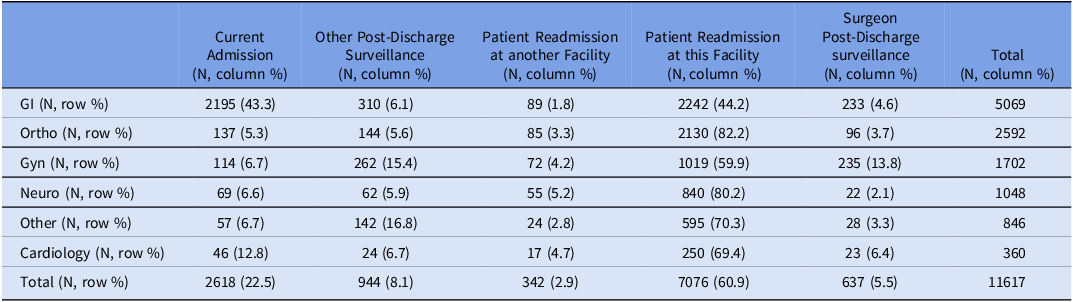
Eleven-thousand six-hundred seventeen SSIs were reported following 1,272,257 surgical procedures: SSI rate of 0.91 per 100 procedures. The highest proportion of SSIs came from gastrointestinal surgery (5069, 43.6%), then orthopedics (2592, 22.3%), and then gynecology (1702, 14.7%; Table 1). SSIs were most frequently diagnosed by patient readmission to the same facility (60.9%) and during the current admission (22.5%). Most SSIs diagnosed during the current admission were gastrointestinal surgeries. Gynecology SSIs were more likely to be diagnosed by the surgeon during post-discharge surveillance (13.8%) and other post-discharge surveillance (15.4%) than any other surgical category.
Surgical site infections stratified by surgical category and location of diagnosis

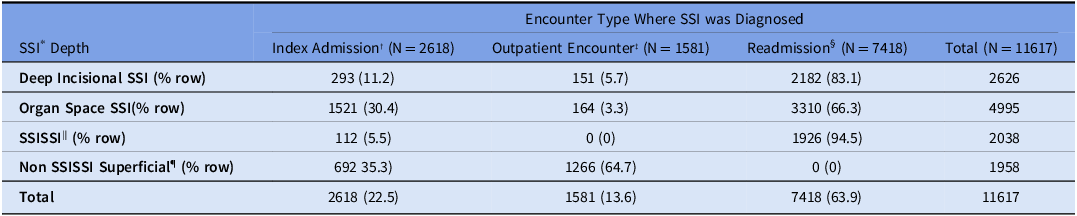
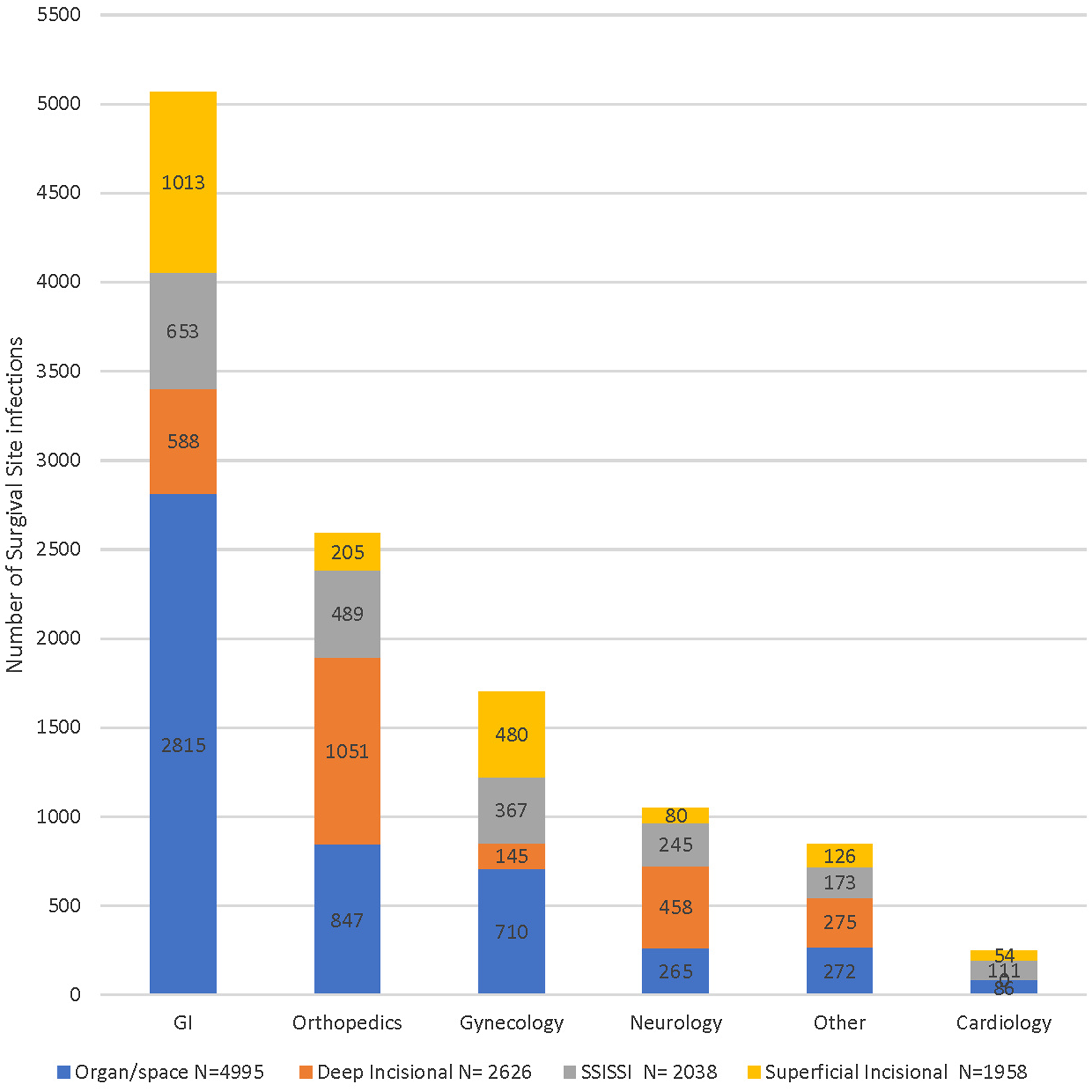
Out of all SSIs, 3,996 (34.4%) met criteria for superficial incisional SSIs, with 2,038 (17.5% overall and 51.0% of superficial incisional SSIs) meeting criteria for SSISSIs. Most SSISSIs were diagnosed during readmission (94.5%), with the remainder (5.5%) identified during the initial hospital stay (Table 2). Gastrointestinal (32.0%) and orthopedic (24.0%) surgeries had the highest proportions of SSISSIs (Fig. 1). Cardiology surgeries had the smallest proportion of SSISSIs (5.4%).
Surgical site infection (SSI) depth diagnosis stratified by the type of encounter when the SSI was diagnosed

* SSI = surgical site infection.
† Index Admission refers to the admission when the surgery that the NHSN Operative Procedure took place, SSI = surgical site infection.
‡ Outpatient Encounter refers to a patient encounter in the outpatient setting as a physician’s outpatient clinic visit.
§ Readmission refers to an inpatient patient encounter that occurs after the admission for the index NHSN operative procedure.
‖ SSISSI refers to a superficial incisional surgical site infection that requires debridement in an operating room or lead to hospital readmission within 30 days.
¶ A non-SSISSI refers to a superficial incisional surgical site infection that does not meet the criteria for an SSISSI. Specifically, the superficial incisional surgical site infection does not require debridement in an operating room or lead to hospital readmission within 30 days.
Number of surgiacl site infections stratfied by surgical specialty and depth during teh study period.

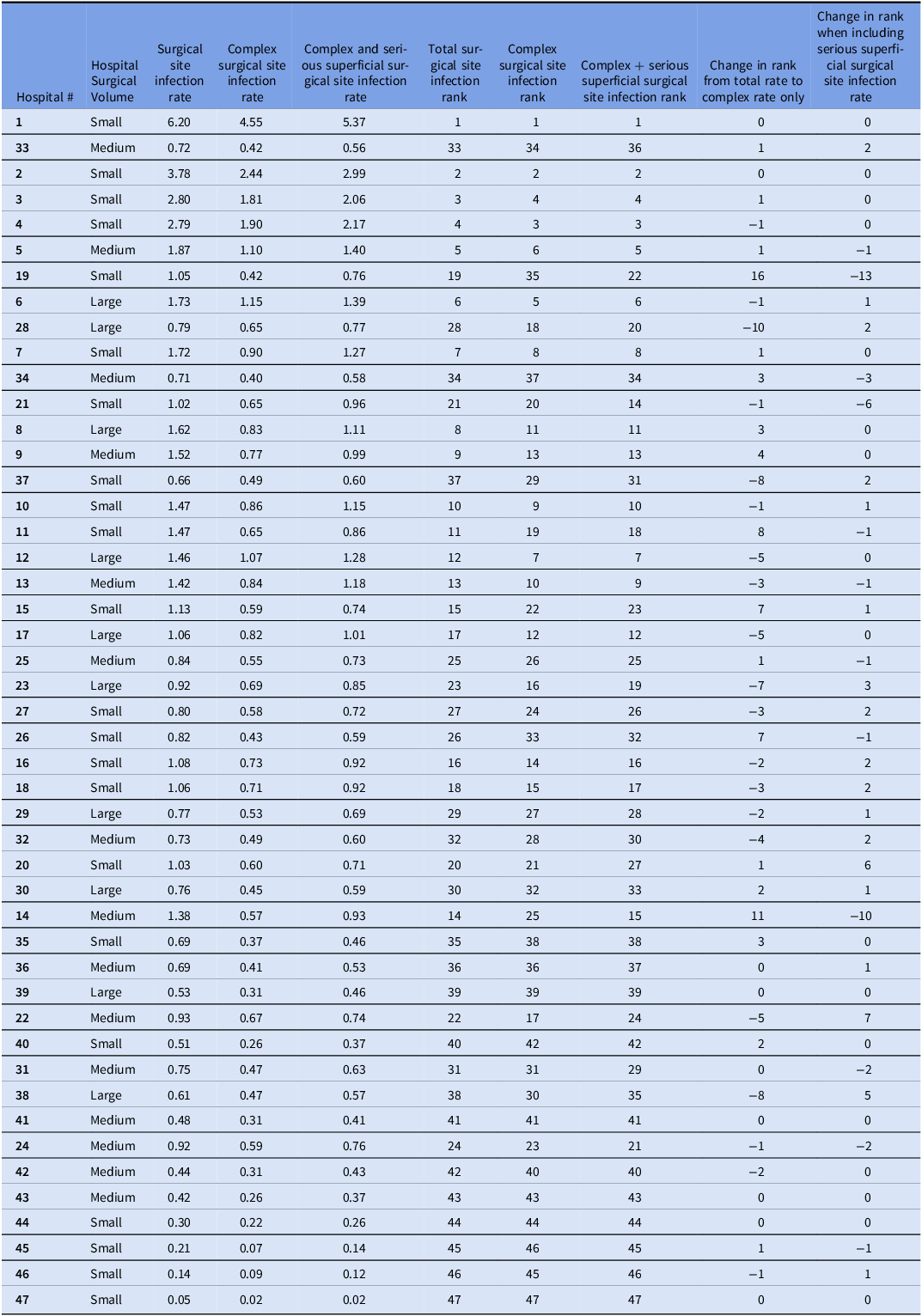
When SSISSIs were included in hospital infection rates, hospital rank changed in 30 out of 47 hospitals (Table 3). The maximum rank change was 13 places when SSISSIs were added to complex SSI rates. Objectively, the inclusion of SSISSIs in the calculation of hospital infection rates significantly altered performance rankings (p = 0.02). Additionally, when calculating total SSI rate rank compared to complex SSI rate rank, the rank changed in 38 out of 47 hospitals with a maximum rank change of 16.
List of hospitals, surgical site infection rate, complex surgical site infection rate, complex and serious superficial surgical site infection rate, rank change of hospitals when comparing total surgical site infection rank to complex surgical site infection rank, and rank change when comparing total surgical site infection rate to complex surgical site infection rate only. Hospital surgical volume was defined as small: >1500 proc/year, medium: 1500–4000 proc/year, large: <4000 proc/year

Discussion
Our large study of over 11,000 surgical site infections determined that the inclusion of SSISSIs in hospital infection rate calculations significantly impacted hospital performance rankings, changing the rank in 30 out of 47 hospitals. This highlights the importance of considering SSISSIs in SSI metrics, as their inclusion can significantly alter hospital performance assessments and rankings, potentially influencing hospital reputation and financial reimbursement.
The findings suggest that SSISSIs, although a subset of superficial infections, represent a critical category with implications for patient outcomes and hospital rankings. Their exclusion from current SIR models underestimates the burden and morbidity of SSIs and skews hospital performance assessments. Including SSISSIs in performance metrics provides a more comprehensive view of hospital infection control efforts, reducing the potential for surveillance bias and highlighting the need for more targeted infection prevention strategies.
This study has limitations that should be acknowledged. First, the retrospective identification of SSISSIs potentially introduces bias. Second, the reliance on existing medical records and data may result in incomplete capture of all relevant clinical details. Additionally, SSIs diagnosed outside of the health system may not be recorded, leading to underestimation of the true incidence of SSIs. This limitation is particularly significant in the context of post-discharge surveillance, where patients may seek care at different institutions, thereby missing SSIs that develop after leaving the primary surgical facility. As a result, our findings represent the minimum impact of evaluating SSISSIs in surveillance data. Lastly, the SSISSI definition may include patients readmitted for a noninfectious complication but happen to be coincidentally diagnosed with an SSI.
We propose that next steps for evaluation of SSISSIs involve a detailed comparison of outcomes associated with SSISSIs, complex SSIs, and non-SSISSI superficial SSIs. Specifically, we plan to evaluate mortality rates, the frequency of return to the operating room, length of hospital stay, and the occurrence of other adverse events. This analysis will help determine whether SSISSIs lead to outcomes that align more closely with complex SSIs, which are generally associated with more severe clinical consequences, or if they resemble non-SSISSI superficial SSIs, which may have a less significant impact on patient outcomes. This additional investigation is critical for refining our understanding of SSISSIs and improving infection surveillance practices.
SSISSIs contribute significantly to the overall burden of SSIs in community hospitals and have a notable impact on hospital performance rankings. Their inclusion in infection surveillance metrics is recommended to ensure a more accurate assessment of SSI rates and to enhance the reliability of hospital rankings.
Supplementary material
The supplementary material for this article can be found at https://doi.org/10.1017/ice.2025.18
Acknowledgments
None reported.
Financial support
None reported.
Competing interests
Potential conflicts of interest. All authors report no conflicts of interest relevant to this article.