Roman emperors were at the pinnacle of society. They were supreme commanders of the armies, the highest priests and the ultimate source of law and justice. These three roles were made clear to the inhabitants of the empire from the reign of Augustus onwards through a variety of media. Public ceremonies showed emperors leaving the city for campaigns, and returning in triumph, at sacrifice, or sitting in judgement. Inscriptions likewise indicated the main roles of emperors through titulature or narrative. The military and the religious leadership of emperors were also made abundantly clear through public monuments and on centrally issued coinage.Footnote 1 Yet, throughout Roman imperial history these last two types of source material are surprisingly silent on the emperors’ legal role.
JUDGE AND LAWGIVER
The legal role of emperors should be differentiated into two different categories; they were judges who could be approached by their subjects, and authorities who could issue general law. As judges, emperors received petitions and issued rescripts, which was done on paper, and could involve litigants who wanted a ruling on a legal point that would be relevant in litigation before a lower judge. Alternatively, emperors heard lawsuits or prosecutions themselves and issued verdicts (decreta). This was mostly on appeal, but occasionally emperors acted as first-instance judges as well. There was an important expectation that, when people petitioned emperors, they were then supposed to look favourably on their subjects. Fergus Millar's famous petition-and-response model, supported by literary, epigraphic and papyrological evidence, shows how a good emperor was expected to be approachable to his subjects and bestow justice on them.Footnote 2
The second category was that of emperors as legislators of general laws. Emperors held extraordinary legislative powers from Augustus onwards, ultimately even allowing Ulpian to argue that princeps legibus solutus est.Footnote 3 Through edicta, orationes, the introduction of senatus consulta and leges, emperors were in a position to issue general laws. Emperors could even be described to be above the law. Others had legal roles as well, of course. Praetorian legal innovation survived at least to its ossification in Hadrian's Edictum Perpetuum.Footnote 4 Yet, emperors were explicitly perceived as issuing general law. The link between emperors and legislative power is made clear in the explicit nullification by some late antique rulers of enactments issued under usurpers (rescissio actorum).Footnote 5 Only legitimate rulers could be legislators.
Both roles, judge and legislator, constitute the imperial administration of justice. Both, too, were linked to good emperorship, though sitting in judgement receives more attention in our literary and epigraphic record than imperial legislation.Footnote 6 Augustus’ social reforms are the main exception, but on the whole ancient authors are fairly silent on emperors instigating law. Occasionally, the two categories are amalgamated, as in Herodian's description of Commodus, whom he judges for ‘avoiding legal and imperial business’. Most texts, however, focus on emperors sitting in judgement as a sign of good rulership. Marcus Aurelius, for instance, is said at one occasion to have spent five days with ‘the examination of law cases’ in contrast to Lucius Verus who was ‘either banqueting or preparing banquets’ at the time. Trajan, similarly, is praised by Dio for his attention on civil administration and the dispensing of justice. How much of a commonplace the judging ruler was is clear from Menander Rhetor's statement that highlighting an emperor's humanity towards petitioners was a good way to praise him.Footnote 7
The epigraphic record, like literary texts, focusses on emperors as judges who could overturn earlier decisions.Footnote 8 In the well-known Goharian inscription from a.d. 216, this is made explicit. Caracalla, while in Antioch, receives an embassy from Goharia, about 300 kilometers away. The residents of the village ask for judgement in a dispute about who the rightful local priest of Zeus is. The defendant, through his representative Aristaenetus Hadrianus, argues that the trial cannot take place, because there is no earlier judgement, and therefore no case on appeal. Caracalla still decides to accept the case and judges against the defendant. The text indicates a common expectation that an emperor only judges on appeal but also the obvious realization that he can be called upon at other times as well, certainly for a ‘dispute about piety’, which needed to be judged by ‘a most pious king and judge’.Footnote 9
DEPICTING IMPERIAL JUSTICE IN MONUMENTAL ART
Imperial justice, it appears, was a core quality of good emperorship. It was emphasized through textual sources, but those were only legible to a relatively small part of society. Likewise, only a fraction of imperial subjects would see emperors act as judge, or be directly affected by emperors’ decisions as appeal judges.Footnote 10 The construction of spaces for court sessions, including in the Forum of Augustus, may have changed the urban landscape of Rome, but no type of Roman building functioned exclusively as a place for administering justice.Footnote 11 So these changes will not have unambiguously brought emperors in their legal role to the attention of his people. In brief, it was difficult to broadcast imperial justice to the empire at large through literary and architectural media. In light of this, it is striking how absent the imperial administration of justice is from the visual material, which could reach a much larger audience.
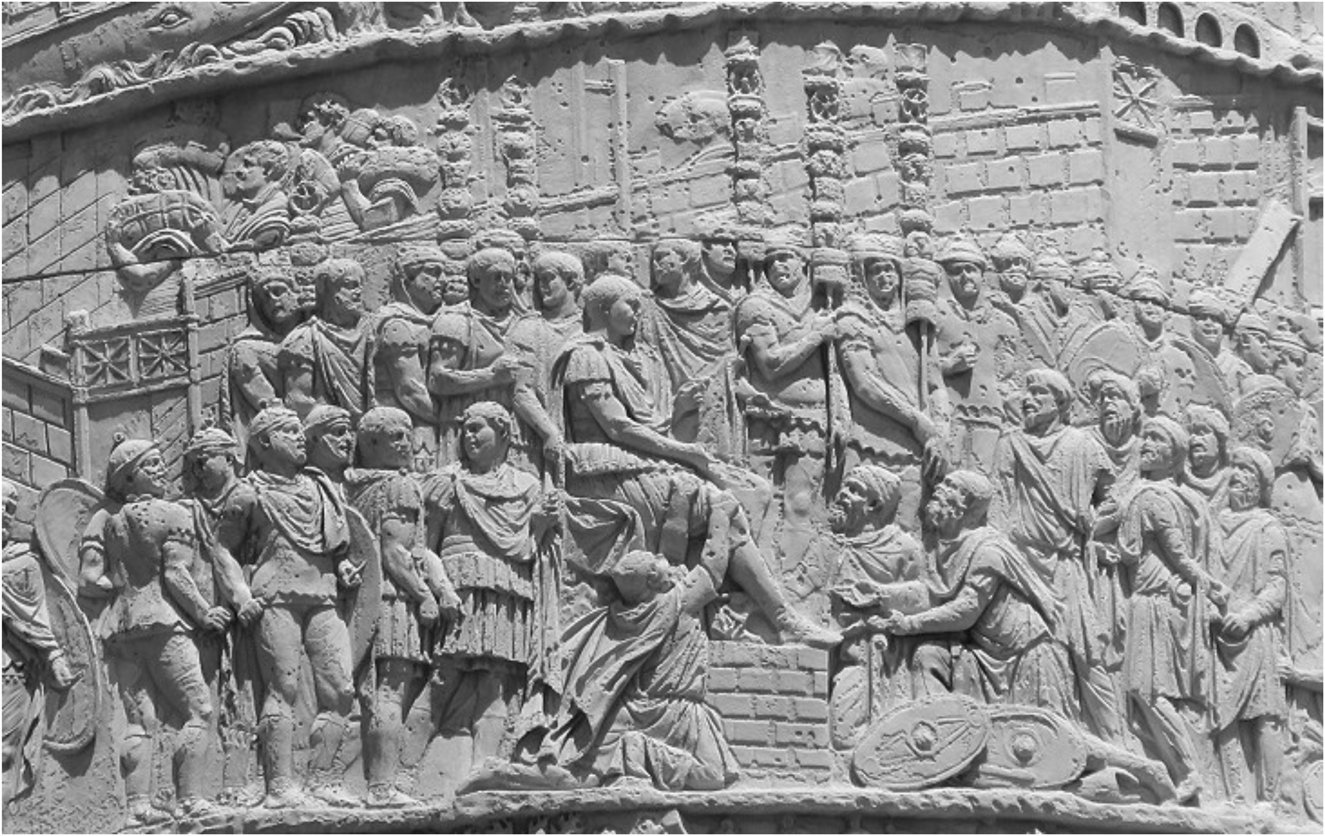
Out of 156 surviving imperial statues, 44 of which are togate, only 8 indicate the (original) presence of a capsa (the box into which the text of a legal enactment could be deposited) or a scroll, which could have brought imperial justice to mind.Footnote 12 Representations on historical reliefs are even rarer. Justice was not part of the ‘repertoire of typical theme and scenes’, which images on public monuments developed in the Imperial period. Most of these themes were military (profectio, aduentus, adlocutio, the submission of enemies, and the triumph) or religious (emperors at sacrifice). Distributing money to the urban populace also was a stock image, but sitting in judgement never became proper part of that repertoire.Footnote 13 The few reliefs that are sometimes described as ‘Justitia scenes’ primarily show emperors judging barbarians, in a clearly military context, as in one of the panel reliefs of Marcus Aurelius, or Trajan's judging of barbarian chiefs on his column (Figure 1; see next page). Noticeably, however, the people being judged were hostes, and as such could not expect proper legal process. These scenes, then, depict occasions in which emperors pronounced the fate of defeated hostes. They were not acting as judges in a real Roman court. Not coincidentally, the reliefs are better known as ‘submission scenes’, and are paralleled in the military images on sarcophagi.Footnote 14
Trajan's column, Rome, scene 75, figures 14–35, photo J.C.N. Coulston

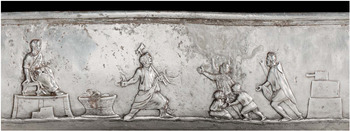
There might be an exception: a somewhat ignored silver cup from Meroe, now in the Boston Museum of Fine Arts (Figure 2; see next page), may show a Roman emperor (possibly Augustus) in a judgement scene, though dating and attribution are problematic, and the scene may well be mythological rather than historical. Yet, it shows many of the trappings of a Roman court, with litigants, magistrate and executioner all present.Footnote 15 Alternatively, one can see some presence of imperial justice in the famous miniature of Christ's trial before Pilate in the sixth-century Rossano Gospels. Though it is, of course, Pilate and not the emperor who sits on the imperial throne, he is flanked by the imperial standards.Footnote 16 This reminds us that the face of the emperor would have been present in almost all judicial contexts. Yet, that is not the same as showing the emperor in a judicial role. These extant images show that there were possibilities for a suitable iconographical scheme of emperors judging Romans. Yet, these were not developed. The rare images of an emperor in judgement show his supremacy over conquered people, not his justice towards his subjects. Strikingly, moreover, there are no depictions of subjects presenting petitions to emperors in person, even though this happened and would have been easy to depict.
‘Meroe cup’: Goblet with relief decoration, Boston Museum of Fine Arts Expedition 24.971. Photograph © 2020 Museum of Fine Arts Boston.

One of the reasons the above-mentioned reliefs are sometimes interpreted as ‘justice’ scenes is that the emperor is depicted on the sella curulis (‘curule chair’). In the Republic, sitting on this type of chair was a magistrate's prerogative and an indication of his civic role.Footnote 17 The link to this Republican role, and even to bestowing justice, was retained for a long time in Roman perceptions. Pliny makes the connection explicitly in his Panegyric (56.7):
magnificum est, ciuibus iura; quid, hostibus reddere? speciosum, certam fori partem; quid, immanes campos sella curuli uictorisque uestigio premere? imminere minacibus ripis tutum quietumque; quid, spernere barbaros fremitus, hostilemque terrorem non armorum magis, quam togarum, ostentatione compescere?
If it is noble to administer justice to fellow citizens, what it is to enemies! The splendour of occupying a curule chair in the assured peace of the forum pales beside the glory of setting it up in vast open spaces in the conqueror's wake, with calm and security acting as a threat to hostile riverbanks; the glory too of scorning the cries of savages, and displaying the toga instead of parading arms to quell fear of the foe!Footnote 18
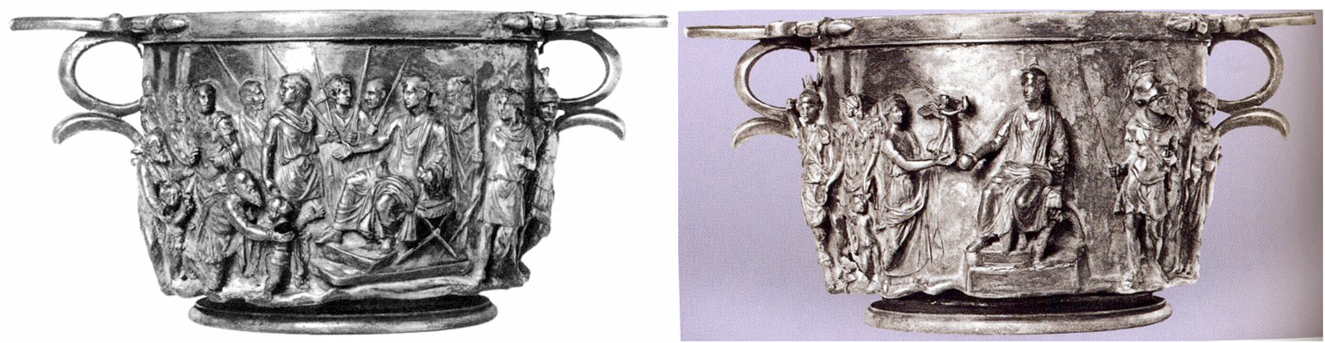
Noticeably, like in the historical reliefs, the emphasis in Pliny is on the just treatment of enemies. Still, the link between the sella curulis and magisterial duties was there, and can also be seen in other panegyrical texts, including much later ones.Footnote 19 At the same time, though, the curule chair rapidly became a trapping of imperial power. Caesar obtained the right to use a golden sella curulis, which after his death came to symbolize his superior position. Hence, the young Octavian's attempt to display the ‘gilded throne’ in the theatre, and the choice to depict it on coins. Depictions of the empty sella curulis came to symbolize emperors and became an imperial prerogative.Footnote 20 The sella curulis may have retained associations with magisterial justice, but it increasingly also became an indication of imperial power as such. The Boscoreale Cup already shows Augustus enthroned in his curule chair, the only seated figure before barbarians and even gods (Figure 3; see next page). The image may reflect the development of seated togate statues, which seems to have been a Julio-Claudian innovation.Footnote 21 Magistrates were also still depicted on the sella but mainly in funerary art, where they were no longer in competition with the ruler.Footnote 22 Over time, the image of the enthroned emperor, on sella or throne, became ‘one of the most typical ways of displaying imperial majesty and sovereignty’. Emperors were allowed to be seated. Everyone else had to stand.Footnote 23 Thus on the so-called Palazzo Sacchetti relief, from the Severan Age, the emperor is seated, elevated over the standing senators by his position on a platform, possibly presenting new consuls. Again, the image seems not to be a depiction of imperial justice as much as one of imperial power.Footnote 24 This is some way removed from the image of emperors as approachable judges.
a–b: Boscoreale cup, Louvre, Salle Henri II, Room 33, 1895 (photo public domain)

The one clear monumental reference to imperial justice, though still an inscription of sorts, stems from the reign of Augustus. On the clipeus uirtutis, the golden shield awarded to the young emperor by the Senate in 27 b.c. to honour his virtues, iustitia was the third of four engraved virtues, alongside uirtus, clementia and pietas. A surviving marble copy from Arles, alongside images on coins and altars, indicates that copies of the shield were visible throughout the empire, though not always depicting the virtues.Footnote 25 Reference to these same four virtues in the Res Gestae (34.2) illustrates their importance to the new regime.Footnote 26 A statue, if not a temple, to the Iustitia Augusta was even dedicated on 8 January a.d. 13, possibly even in the Forum.Footnote 27 Such attention in the Augustan Age makes it even more noticeable that imperial justice is so rarely depicted in later monumental art.
DEPICTING IMPERIAL JUSTICE ON IMPERIAL COINAGE
Emperors were not emphasized in monumental art either as judges or as legislators. What about on coinage, the most frequently distributed vehicle for imperial imagery? If anything, coins place even less emphasis on emperors in their legal capacity.Footnote 28 Carlos Noreña, in his groundbreaking analysis of the depiction of virtues on imperial coinage from a.d. 69–235, shows that iustitia coins form only 2% of denarii showing imperial virtues (itself already a small subset of the total number of denarii). A much larger subset of the uirtutis-denarii (24%) are aequitas coins. Though these show a seated figure of justice, the principal message of this type seems to have been a narrower one: the just administration of the imperial mint, and trustworthiness of centrally issued coins, although the idea of fair dealing may occasionally have been included in the concept.Footnote 29
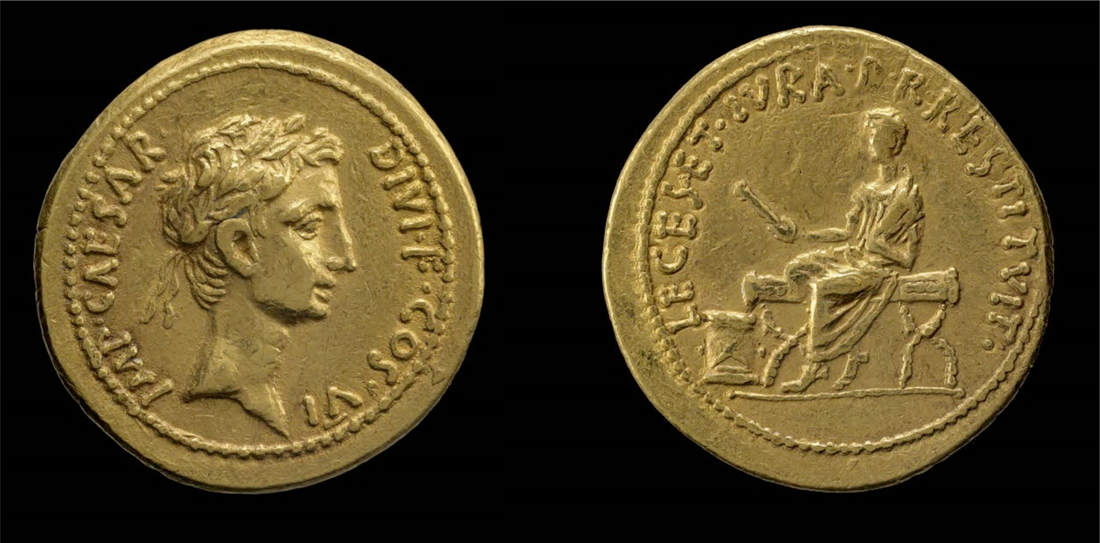
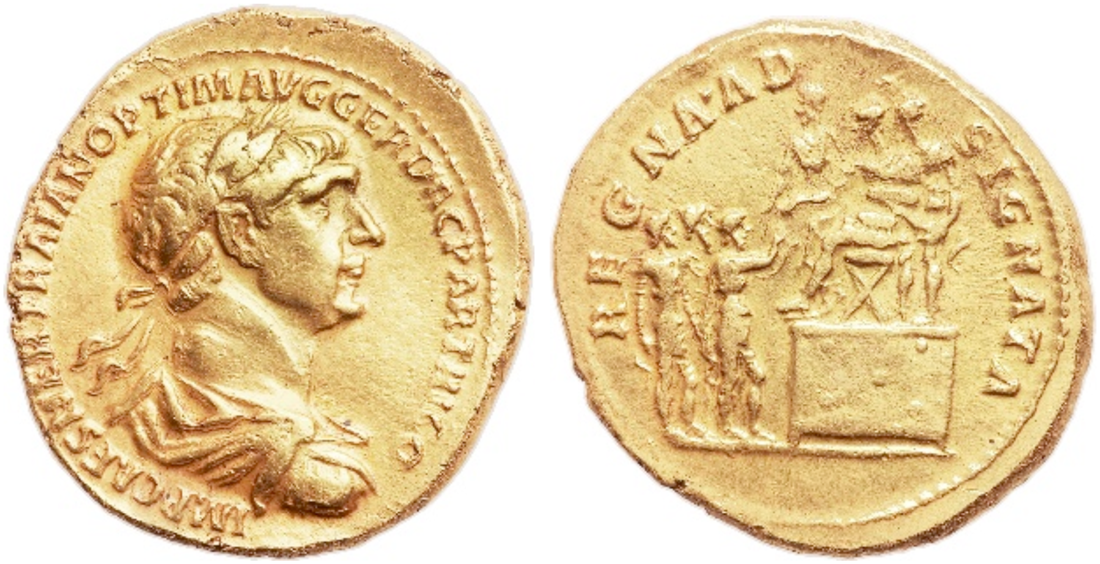
Looking at an even longer period of time, and at all denominations, the pattern remains similar. An analysis of coin types from 31 b.c. – a.d. 491 (rather than a much more precise analysis from hoard finds, as done by Noreña) shows that, even when adding coin types that show emperors in a curule chair, and including images of scrolls, or clementia to the iustitia and aequitas coin types, the relative numbers remain surprisingly small (Table 1; see next page).Footnote 30 Famously, Augustus is depicted as returning leges et iura to the people of Rome in the well-known aureus of 28/27 b.c. (Figure 4; see below). The image of the ruler sitting on the sella curulis depositing a scroll in the capsa, with accompanying legend, is unambiguous. This shows that, just as we have seen with the historical reliefs, the problem was not the development of a suitable iconographical scheme. The coin also seems to testify, again, to the importance of ‘justice’ in the early stages of Augustus’ rule. Yet, neither the scheme nor the attention for justice was continued in Augustus’ reign.Footnote 31 Nor was it picked up by later emperors to become part of the numismatic repertoire. The few, later images of emperors in the curule chair depict an emperor as censor, maintaining mores rather than involved in judicial practice, or show him enthroned, bestowing gifts to his people or soldiers (indicating imperial liberalitas).Footnote 32 In an interesting series of Trajanic coins, the emperor is depicted in a curule chair upon a tribunal, at first sight giving judgement to three figures standing before him. But the clothes of the figures show them as non-Roman, and the legend regna adsignata (kingdoms assigned) indicates that the coin shows a confirmation of (Eastern) kings, in preparation for the Parthian War (Figure 5; see below).Footnote 33 This may be about imperial justice of sorts, but it is not about emperors as judges or legislators.
Justice (in the wider sense) presented on imperial coin types, in RIC (N = 42,738) (Table by Sven Betjes)

Aureus 28/27 b.c., British Museum, 1995.0401.1, courtesy of The British Museum

Regna Adsignata aureus, RIC II, Trajan, no. 366, courtesy of Heritage Auctions

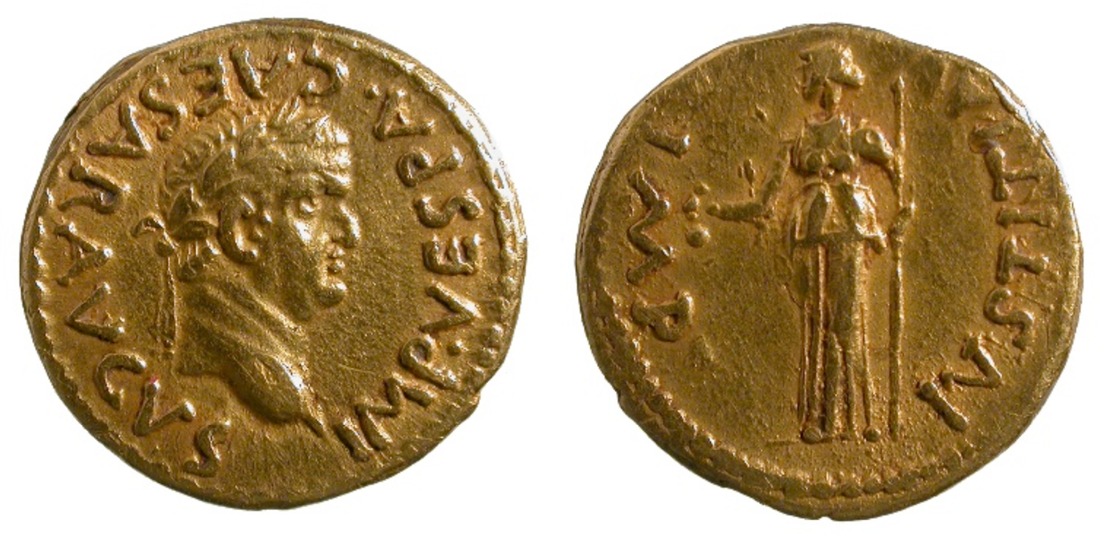
Even the iustitia coins may not always have brought to mind emperors as judges or legislators. The first visual representation of Justice, with accompanying legend, is the so-called Finstock Aureus, dated to a.d. 70 and struck in the East (Figure 6; see below). Yet, as Chris Howgego has shown, the coin was not originally intended to portray iustitia. Instead, markings on the coin show reworking on the mould, with the original legend pietas still legible, which also explains the rather odd posture of the figure of Justice. The destruction of the Jewish Temple may have made it potentially problematic to emphasize piety, but was a good occasion for depicting imperial justice.Footnote 34 Again, as we have seen above, imperial justice could equally mean imperial superiority over conquered people.
Finstock Aureus, no. FASAM–2CD627, Portable antiquities scheme, courtesy of The Ashmolean Museum

Still, it is likely that most iustitia coins, showing emperors on the obverse and the personification of justice on the reverse, would have made people think of imperial justice in the wider sense. Yet, with such a small number of coins, it is difficult to maintain that this was an aspect of imperial behaviour that was centrally emphasized. Only during the reign of Hadrian did numbers of coins rise noticeably; almost 75% of coin types with iustitia issued in the first three centuries of the empire were struck under Hadrian.Footnote 35 It is tempting to link this rise to Hadrian's many travels, making him visible to a larger group of subjects, during the course of which he is likely often to have been approached to give his judgement. Hadrian played an important role in the harmonization of Roman law, and with his visits and many letters intervened directly in legal affairs throughout the empire.Footnote 36 This might be linked to a colossal porphyry statue of a seated and togate Hadrian from Caesarea Maritima.Footnote 37 It may, then, not be coincidental that the best-known story of emperors administering justice is focussed on Hadrian:
… once, when a woman made a request of him as he passed by on a journey, he at first said to her, ‘I haven't time’, but afterwards, when she cried out, ‘Stop, then, being emperor’, he turned about and granted her a hearing.Footnote 38
The passage is well known, and shows how emperors, like Hellenistic kings before them, were seen as the ultimate source of justice.Footnote 39 But this narrative tradition was only rarely translated into images, whether in monumental art or on coinage.
Provincial coins seem to show a similar lack of justice scenes. Out of more than thirty-seven thousand coin types for the years 44 b.c. – a.d. 192, 222–244 and 249–254, only sixty-nine show a curule chair, and only twenty of those show an emperor seated on that chair. Eighteen are from Alexandria, with sixteen showing Trajan in military dress, facing an Armenian captive on eleven of them. The only image of a togate emperor on a curule chair depicts Hadrian. Several coin types from the Early Empire, especially from the kingdom of the Bosporus, show the curule chair in combination with shield, wreath and sceptre, and sometimes with the local king's head, indicating that a provincial leader derived his authority from Rome. Three rather odd types, from an unknown location, show Divus Augustus on the obverse and a curule chair on the reverse, with the extremely rare legend dedvctor, possibly referring to Augustus as founder of a colony. The link to justice is minimal.Footnote 40 There are thirty-two types depicting one or two emperors holding a scroll, of which twenty-one, from a range of cities, show Marcus Aurelius and Lucius Verus facing one another in toga, clasping hands and holding a scroll. The image is magisterial but hardly one of imperial justice. Coins from Tarsos, for instance, include the legend ΟΜΟΝΟΙΑ ϹƐΒΑϹΤΩΝ. Two leaded bronzes from Corinth show Nero, standing on a suggestum, holding a scroll, apparently emphasizing the emperor's oratory rather than his justice.Footnote 41 There are 301 coin types showing Dikaiosyne holding scales.Footnote 42 As a comparison, for the same period there are 2,197 types showing a (radiate) crown and 6,130 types showing Tyche. In short, local coins do not show imperial justice either, or at least not other than very incidentally.
THE LEGAL EMPEROR: MEDIA AND AUDIENCES
Imperial justice is often considered as a core aspect of imperial rule. The presence of iustitia on the clipeus uirtutis and in the Res Gestae, as well as the many literary testimonies to the imperial administration of justice, seem unequivocal. So why the near-absence in the visual record? For the Augustan period, it has been suggested that there was no need to depict justice (or its counterpart, clementia) on coins, as the clipeus uirtutis already gave sufficient emphasis.Footnote 43 Yet, uirtus and pietas were regularly portrayed in the many depictions of emperors in their military and religious roles, though they figured even more prominently on the Golden Shield. Likewise, it has been argued that there was no real need to depict justice on coins, since with inscribed edicts and rescripta ‘justice had its own venues of advertisement’.Footnote 44 Again, this would also apply to emperors’ religious and military qualities, which were highly visible in the epigraphic record, even if only through their victory titles or position of Pontifex Maximus. Neither explanation, furthermore, explains the absence of imperial administration of justice in the other visual media.
The argument could be refined. Perhaps different types of Roman imperial virtues and behaviour needed to be manifested in different ways in different media.Footnote 45 It is possible that literary sources reflect the idea that everyone knew that the emperor was the ultimate judge, and that this view did not need to be reinforced through media produced by the state. Still, that would imply that the importance of showing the emperor to the audiences of these state-produced media as supreme arbiter of justice was held to be less important by whoever decided what was depicted in these media. In other words: this particular role did not need to be emphasized to the audience of these media.
It was, however, an important role for certain subsets of the empire. Those whose requests to the emperor had been granted had a clear incentive to make the imperial decision permanently and publicly visible in our epigraphic record.Footnote 46 Importantly, such imperial administration of justice may have been more directly relevant to the small elite of the empire than to the much larger lower strata of society, or to the military. Certainly, the role of emperors as judges who personally heard cases will have been of little importance for low-status provincials.Footnote 47 The case is not quite so clear-cut for the way in which emperors responded to petitions. It appears that among the petitioners to whom rescripts are addressed there are substantial numbers of sub-elite people.Footnote 48 However, many of these cases of more humble people petitioning emperors were probably the product of imperial mobility, as we have seen for Hadrian.Footnote 49 The rescripts that appear in the Codex Hermogenianus, for instance, result to a large extent from Diocletian's travels in the lower Danube provinces. The Egyptian petitions on papyri perhaps represent a more ‘normal’ state of affairs, since the province rarely received imperial visits: of the 770 published petitions from 30 b.c. to a.d. 284, only 4 were to emperors.Footnote 50 It is probably no accident that the large collection of imperial rescripts from Egypt (the so-called apokrimata) come from the time of Severus’ visit.Footnote 51 Finally, it needs to be kept in mind that emperors will have delegated large numbers of petitions on to the provincial governor. Very many petitioners would not have received any real decision from emperors.Footnote 52 All of this makes it likely that the emperors’ legal role was much more prominent for the elite of the empire.
This would explain the prominence of legal administration in the epigraphic record of imperial legal decisions, which were predominantly set up by those in local positions of civic authority. It would also explain the emphasis on this imperial role in our historical literary sources, written by members of the elite who were directly affected by the emperor as judge and legislator. The image of Roman emperors as approachable judges may have been important to a small cross-section of society but perhaps not so much to a much larger part of society, which was targeted through visual vehicles of imperial communication.Footnote 53 This, then, would explain the striking difference between the dominant presence of the emperor's legal role in literary texts and its near absence in other types of source material, which had different primary audiences.Footnote 54
It was far more difficult to reach the millions of inhabitants throughout the Roman empire than to address hundreds of senators, or even the people of Rome, who could see their emperor in the Forum on an almost daily basis. It then seems likely that most coins, one of the few means to reach a far wider audience, were meant to put forward messages that were deemed of interest to that large audience rather than to the easier-to-reach elite.Footnote 55 Justice may still have been worth emphasizing in a variety of media in the Early Augustan reign, when the Principate was being established. Yet, the fact that it did not develop into an important representational category in our visual evidence is telling. Only under Hadrian do we see a second attempt at bringing iustitia to the fore on coinage, possibly related to his travels. Again, however, the experiment was not taken up by later emperors.
Our construction of Roman emperorship is still heavily based on prejudices in our textual evidence. That gives us only a limited view of what an emperor was expected to be. It may be that the dominance of the emperor as judge and legislator in textual sources needs more explaining than the near absence of that role in the visual material.