Attention-deficit/hyperactivity disorder (ADHD), whose main symptoms are inattention, hyperactivity, and impulsivity, is one of the most frequent neurodevelopmental disorders in childhood, affecting approximately 5% of school-age children. ADHD produces a broad spectrum of academic problems, limitations in daily living skills, low social competence, and motor problems (Barkley, Reference Barkley2005; Matza, Swensen, Flood, Secnik, & Leidy, Reference Matza, Swensen, Flood, Secnik and Leidy2004; Sawyer et al., Reference Sawyer, Whaites, Rey, Hazell, Graetz and Baghurst2002). Unfortunately, in more than half of the cases, this complex disorder persists into the stage of adult life (American Psychiatric Association, 1994), with long-term consequences that include loss of productivity, healthcare consumption, criminality, material damage, loss of years of life, and other costs (Bernfort, Nordfeldt, & Persson, Reference Bernfort, Nordfeldt and Persson2008).
In the past few years, the underlying heterogeneity of ADHD has been shown, as various subgroups have been identified, each characterized by a specific profile of alterations that influence the severity and progression of the disorder (Sonuga-Barke, Reference Sonuga-Barke2005). In this regard, the association between ADHD and learning disabilities (LDs) has very negative repercussions, especially in the academic context (Faraone, Biederman, Monuteaux, Doyle, & Seidman, Reference Faraone, Biederman, Monuteaux, Doyle and Seidman2001). Furthermore, the LD make up one of the conditions that most often appear associated with ADHD, with a much greater prevalence than what is found in the general population (Brook & Boaz, Reference Brook and Boaz2005; Fletcher, Shaywitz, & Shaywitz, Reference Fletcher, Shaywitz and Shaywitz1999). Approximately 50% of students with ADHD are also classified as LD (Schnoes, Reid, Wagner, & Marder, Reference Schnoes, Reid, Wagner and Marder2006). Moreover, in children with a clinical diagnosis of ADHD, an LD in written expression is twice as common as problems in reading, math, or spelling (Mayes, Calhoum, & Crowell, Reference Mayes, Calhoum and Crowell2000). However, despite the high prevalence of difficulties in written expression in children with ADHD, and the subsequent effect on their academic performance and intellectual and social development (Bruning & Horn, Reference Bruning and Horn2000), research on this topic is very scarce in comparison with the number of studies that have been dedicated to reading (Marzocci et al., Reference Marzocchi, Oosterland, Zuddas, Cavolina, Geurts and Redigolo2008; Miranda, Soriano, & García, Reference Miranda, Soriano, García, Scruggs and Mastropieri2006; Purvis & Tannock, Reference Purvis and Tannok2000; Shanahan, Yerys, Scott, Willcutt, & Pennington., Reference Shanahan, Yerys, Scott, Willcutt and Pennington2006; Willcutt et al., Reference Willcutt, Betjemann, Pennington, Olson, DeFries and Wadsworth2007) or mathematics (Lucangeli & Cabrele, Reference Lucangeli and Cabrele2006; Miranda, Meliá, & Marco, Reference Miranda, Meliá de Alba and Marco2009; Zentall, Smith, Lee, & Wieczorek, Reference Zentall, Smith, Lee and Wieczorek1994).
Without a doubt, the executive functions contribute decisively to the development of writing skills in elementary school students (Altemeier, Jones, Abbott, & Berninger, Reference Berninger, Siegel and Renninger2006). The comparison of good and poor writers of narrative texts shows that the poor writers have specific difficulties on measures of initiating responses and shifting response set, set inhibition, and set switching (Berninger, Reference Berninger, Siegel and Renninger2006; Hooper, Swartz, Wakeley, de Knif, & Montgomery, Reference Hooper, Swartz, Wakely, de Kruif and Montgomery2002). In the elaboration of a written composition, a series of executive skills are involved, such as focusing attention, working memory, planning and organizing the text according to a purpose, and continuous monitoring of performance. The competent writer must pay attention to different actions simultaneously, holding them in the memory and regulating their correct execution at the appropriate time. If the demands of the task exceed the available resources, which is the case of a large number of students with ADHD, the system can become overloaded, leading to interference in the flow of the information necessary for the writing task (Alamargot & Chanquoy, Reference Alamargot and Chanquoy2001; Hayes & Flower, Reference Hayes, Flower, Gregg and Steinberg1980). In this sense, and according to the explanatory model of ADHD based on executive dysfunction (Barkley, Reference Barkley1997; Niggs, Reference Niggs2001), when writing essays the students who suffer from ADHD would be likely to have problems with retaining ideas in their minds, acting upon and organizing ideas, quickly retrieving grammar, spelling and punctuation rules from long-term memory, manipulating all this information, remembering ideas to write down, organizing the material in a logical sequence, and then reviewing and correcting errors.
Most of our understanding of the writing process has been based on the model developed by Hayes and Flower (Reference Hayes, Flower, Gregg and Steinberg1980, Reference Hayes and Flower1987; Hayes, Reference Hayes, Lewy and Ransdell1996). These authors proposed a model of writing that describes phases of mature or expert writing in three processes: (a) the planning processes are engaged to prepare the content of the text by retrieving ideas from the writer's long-term memory and organizing them if necessary; (b) the translation process grammatically encodes the conceptual structure elaborated during planning by retrieving the syntactic and morphological properties of this content from the mental lexicon. Orthographic encoding is further needed prior to handwriting. With the motor execution process, writers graphically transcribe their text; and (c) the revision process (reading and editing) allows writers to compare the segments of the text not yet handwritten or the text already written with their mental representation of the intended text. It is important to point out that these writing processes are not activated linearly. Instead, each process can interrupt any other process at any time during the composition.
Hayes and Flower (Reference Hayes, Flower, Gregg and Steinberg1980, Reference Hayes and Flower1987; Hayes, Reference Hayes, Lewy and Ransdell1996) argued that writers are overloaded when they compose a text because of the heavy demands the activity places on the working memory. Later, Kellogg (Reference Kellogg, Levy and Ransdell1996, Reference Kellogg, Torrance and Jeffrey1999) included the Hayes and Flower proposal in the model he elaborated about the relationships between writing and working memory. Within that framework, several studies have confirmed the existence of demands on the verbal and visual working memory and attentional demands on the central executive during written composition (Kellogg, Reference Kellogg1987; Olive, Kellogg, & Piolat, Reference Olive, Kellogg and Piolat2008).
The few studies that have dealt with textual aspects related to planning in children with ADHD, specifically coherence, describe poorly articulated compositions in which information is accumulated in an enumerative manner, without following a logical thread. Re, Pedron, and Cornoldi (Reference Re, Pedron and Cornoldi2007) reached these conclusions after using a variety of tasks based on different elicitation stimuli (visual and auditory) and types of text (descriptive and narrative). Meanwhile, Rodríguez and García (Reference Rodríguez, García, González-Pienda and Núñez2008) analyzed the effects of two factors—ADHD and writing LDs—on the productivity, coherence, and quality of the written composition. The most interesting contribution of this study stemmed from the use of the triple task, one of the online instruments for evaluating writing (Olive, Kellogg, & Piolat, Reference Olive, Kellogg, Piolat, Olive and Levy2001). According to the conclusions of this study, the children with ADHD made little use of composition processes like thinking about the composition, making an outline, or correcting it. This finding justifies that their texts have less quality, coherence, and structure. Along the same lines, García et al. (Reference García, Rodríguez, Caso, Fidalgo, Arias and González2007) carried out a study in which they differentiated ADHD subtypes according to their performance on various written composition measures. Although all the subtypes analyzed showed deficits on parameters such as overall coherence or the thread of the argument, the inattention subtype also showed difficulties on other variables, such as relevance of the information or the lexical indicators (e.g., lexical repetition), the latter being related to the translation process.
Specifically, related to the translation process, the research has considered various indices of textual productivity, generally concluding that students with ADHD write shorter texts with fewer words (Re et al., Reference Re, Pedron and Cornoldi2007; Resta & Elliot, Reference Resta and Elliot1994). With regard to the measures of a morphosyntactic nature, the studies refer to texts with a lower number of sentences (García et al., Reference García, Rodríguez, Caso, Fidalgo, Arias and González2007; Soriano, García, & Baixauli, Reference Soriano, García, Baixauli, González-Pienda and Núñez2008), subordinate clauses (Re et al., Reference Re, Pedron and Cornoldi2007), and functional words (García et al., Reference García, Rodríguez, Caso, Fidalgo, Arias and González2007), although no differences were found with regard to the mean length of the utterances (Miranda et al., Reference Miranda, Soriano, García, Scruggs and Mastropieri2006). In the same way, from a lexical point of view, the compositions of children with ADHD contain a basic vocabulary lacking in diversity, which leads to a tendency to repeatedly state certain terms (Soriano et al., Reference Soriano, García, Baixauli, González-Pienda and Núñez2008).
In another vein, the studies that have dealt with the analysis of the mechanical aspects of writing show that students with ADHD make more spelling and grammatical errors (Gregg, Coleman, Stennett, & Davis, Reference Gregg, Coleman, Stennett and Davis2002; Re et al., Reference Re, Pedron and Cornoldi2007). Likewise, the motor control problems of children with ADHD are well known (Schoemaker, Ketelaars, van Zonneveld, Minderaa, & Mulder, Reference Schoemaker, Ketelaars, van Zonneveld, Minderaa and Mulder2005) and reflected in handwriting alterations that make their texts difficult to read (Adi-Japha et al., Reference Adi-Japha, Landau, Frenkel, Teicher, Gross-Tzur and Shalev2007; Brossard, Majnemer, Shevell, & Snider, Reference Brossard, Majnemer, Shevell and Snider2008).
Regarding the revision process, we have found no study that has specialized in this area in the population of children with ADHD. This fact is surprising, given the involvement of self-regulation in the revision process (Hacker, Reference Scardamalia, Bereiter and Wittrock1994; Scardamalia & Bereiter, Reference Scardamalia, Bereiter and Wittrock1986) and the evidence studies have provided supporting the deficit in executive functioning as a main neuropsychological problem of ADHD (Willcutt, Doyle, Nigg, Faraone, & Pennington, Reference Willcutt, Doyle, Nigg, Faraone and Pennington2005). Only the study by García et al. (Reference García, Rodríguez, Caso, Fidalgo, Arias and González2007) includes revision as a partial measure of the writing process, concluding that these students use this revision phase significantly less in their compositions.
In sum, although many noteworthy advances have been made in the study of the writing performance of students with ADHD, various limitations can be detected when reviewing the studies on this topic. One limitation is that the majority of the studies that have dealt with the analysis of higher order processes like coherence or textual cohesion (García et al., Reference García, Rodríguez, Caso, Fidalgo, Arias and González2007; Re et al., Reference Re, Pedron and Cornoldi2007; Re & Cornoldi, Reference Re and Cornoldi2010; Reid & Lineman, Reference Reid and Lienemann2006; Thompson & Reid, Reference Thompson and Reid2010) have used assessment procedures based on holistic quality ratings and, to a lesser degree, quantitative measures of writing abilities. Other limitations are related to the small sizes of the samples studied (Brossard et al., Reference Brossard, Majnemer, Shevell and Snider2008), and to the criteria used for selecting them, which are mainly based on the detection of symptoms by the teacher, instead of applying rigorous clinical diagnostic criteria (García et al., Reference García, Rodríguez, Caso, Fidalgo, Arias and González2007; Re et al., Reference Re, Pedron and Cornoldi2007). Finally, only the study by Rodríguez and García (Reference Rodríguez, García, González-Pienda and Núñez2008) dealt with the three basic components of writing, including the revision component, which is of special interest in the study of possible writing difficulties in children with ADHD.
With these considerations in mind, the purpose of the present study was to carry out an in-depth examination of the writing performance of children with a clinical diagnosis of ADHD. For this purpose, the performance of children with ADHD was compared to that of children without ADHD on a written narration task. The main question of interest was to identify the specific problems of children with ADHD in writing a story with a familiar topic, using for the analysis different textual indicators of the phases included in the Hayes and Flower model (Reference Hayes, Flower, Gregg and Steinberg1980, Reference Hayes and Flower1987; Hayes, Reference Hayes, Lewy and Ransdell1996): planning, translation and revision.
METHOD
Participants
The participants were 100 students selected for the experimental and control groups. Most of the children were from families with a medium to low socioeconomic status, but without cultural or environmental disadvantages. The majority of the parents were professionals (22.8% of the ADHD group, 26% of the control group), performed administrative or commercial jobs (28.7% of the ADHD group, 24.9% of the control group), or worked in the services sector (26.1% of the ADHD group, 25.7% of the control group).
All of the subjects were Caucasian and spoke Spanish as their primary language. They ranged in age from 9 to 14 years (M = 12 years, 1 month; SD = 1 year, 9 months). They were students in primary and secondary education from different schools in Valencia (Spain).
Of the entire sample, 50 children had ADHD, whereas the remaining 50 made up the comparison group of children without ADHD. The cases with ADHD were recruited from children referred by general healthcare pediatricians to the children's neurology service at La Fe Hospital, due to presenting typical symptoms of the disorder. Of the cases referred, subjects only went on to the screening phase if they had scores of T > 65 on Conners' ADHD index from the Conners' Rating Scales, parent (Conners et al., 1998) and teacher (Conners et al., 1998) versions, which were given to the families on their first visit to the neuropsychiatric service.
The children who met the cutoff point on Conner's index were evaluated by the child neurologist and clinical psychologist at the children's neurology service of La Fe Children's Hospital in Valencia (Spain). Finally, 50 children were diagnosed with ADHD according to the following criteria: a clinical diagnosis of combined subtype ADHD (American Psychiatric Association, 1994), with strict agreement between a parent and teacher about the presence of at least six symptoms of inattention and at least six symptoms of hyperactivity/impulsivity, including (a) duration of the symptoms of more than 1 year; (b) problem appeared before the age of 7; (c) an IQ score of 80 or more as measured by the Wechsler Intelligence Scale for Children—Revised (WISC-R; Wechsler, Reference Wechsler1993); and (d) exclusion criteria included psychosis, autism, neurological damage, epilepsy, or sensory or motor deficits. Of the total sample, 48% of the participants were receiving psychostimulants, the medication commonly used in Spain in the treatment of ADHD. The administration of the medication was interrupted 72 hr before the tests were applied.
To obtain the comparison group without ADHD (50 subjects), the collaboration of the school psychologist was requested. The criteria that were adopted to select the children were (a) normal academic progress; (b) an IQ score above 80 on the WISC-R; and (c) absence of language or learning problems, psychosis or neurological damage, sensory deficits, or motor deficits. The information about the children's developmental and academic history was obtained from the school records available to the school's psychoeducational support services.
Specifically, of the 100 children who made up the entire sample, 85 were boys and 15 girls, representing 85% and 15%, respectively. Likewise, of the 50 children who made up the group with ADHD, 98% were boys and 2% were girls; and of the 50 children in the comparison-normal group, 72% were boys and 28% were girls.
In addition, there were no differences between the children in the ADHD group and those in the comparison group on age, F (1, 98) = 0.125, p < .724, Cohen d = −0.07, or total IQ (WISC-R; Weschler, Reference Wechsler1993), F (1, 98) = 0.138, p < .711, Cohen d = −0.08.
Procedure
There is no consensus in the literature regarding the best way to collect a written language sample (Hudson, Lane, & Mercer, Reference Hudson, Lane and Mercer2005). Following the objectives of this study, a text composition task was chosen, which consisted of asking the children to write a spontaneous essay about a personal experience, specifically a trip. They were given the following instructions: “Now we are going to write an essay. You have to write here everything you can think of about a trip you took.” The children were given as much time as they needed to complete the written essays, but the majority of the participants finished writing in 15 min.
Afterward, the children played at being teachers. They were told that, just as teachers do, they had to revise what they had written and correct the errors they thought they had made with a red pen, or introduce any changes they thought would improve their composition (e.g., spelling errors, punctuation marks, add, eliminate or change words or sentences in the text). The task was administered to the children by one of the authors individually in a noise-free room in La Fe Children's Hospital during one session.
Dependent measures
For the evaluation of the written narrative, different types of text indicators were selected. They reflect on textual production aspects of the planning, translation, and revision phases. To do so, we relied on variables that traditionally have been used in rating narrative discourse (for a review, see Hughes, McGillivray, & Schmidek, Reference Hughes, McGillivray and Schmidek1997) or that are usually included in standardized tests and evaluation scales for this type of discourse (Bishop, Reference Bishop2004; Gillam & Pearson, Reference Gillam and Pearson2004; Strong, Reference Strong1998). The measures selected have also been used in studies on the skills of children with ADHD in oral (Francis, Fine, & Tannock, Reference Francis, Fine and Tannock2001; Miranda, Ygual, & Rosel, Reference Miranda, Meliá de Alba and Marco2004) and written (García et al., Reference García, Rodríguez, Caso, Fidalgo, Arias and González2007; Re et al., Reference Re, Pedron and Cornoldi2007) discourse.
Text indicators related to the planning process. A distinction was made between two types of indicators of the planning process, related to coherence and textual cohesion, respectively. The coherence was rated according to the structure, time sequencing errors, and digressions or content errors. In contrast, the cohesion was rated according to the use of referential expressions and the use of different types of connective cohesion procedures.
STRUCTURE. A score of 1 point was given for the presence of each of the three basic parts of a narration (range = 0–3; maximum score = 1, minimum score = 0): setting (statements about place, time and/or characters in the story), plot (order of events in the story) and conclusion (resolution or end of the story).
TIME SEQUENCE ERROR. A score of 1 point was given for each alteration in the chronological order of the events related in the composition.
CONTENT ERRORS OR DIGRESSIONS. The statements were included that were not semantically related to the topic of the surrounding linguistic context and affected local coherence, as well as the utterances that were not related to the general topic of the composition and affected overall coherence. One point was given for each of the off-topic statements found.
COHESIVE ADEQUACY. This measure was derived by counting the incomplete and ambiguous references (Liles, Reference Liles1985). Incomplete references were those in which the information referred to by the cohesive markers was not provided in the text. Ambiguous references were those that led to an incorrect interpretation of the text. Therefore, higher scores on this variable indicate a worse performance level.
CONNECTIVE COHESION. This was rated based on the use of connectors that establish different relationships (time, causal, additive, etc.) among the statements and paragraphs of the text. In this way, a count was taken of the total number of connectors used.
Indicators of the translation process. We differentiated between three types of indicators. The first, related to the morphosyntax, included the number of words, the number of sentences, the mean length of the utterances, the index of syntactic complexity, and the morphosyntactic errors. The second indicator referred to the lexical diversity of the narrations, whereas the last one included the number of errors of a mechanical or formal nature.
NUMBER OF WORDS. These are the number written in each writing sample.
NUMBER OF SENTENCES. The sentences were counted in each composition, considering as a sentence the grammatical unit made up of a subject and a predicate that included a personal form of a verb (Gómez Torrego, Reference Gómez Torrego1997).
MEAN LENGTH OF UTTERANCE IN WORDS (MLUw). This was calculated by dividing the number of words by the number of utterances. In this way, we follow the word counting modality (Clemente, Reference Clemente1989), which is more easily applicable to synthetic languages like Spanish with a great morphological richness.
SYNTACTIC COMPLEXITY INDEX. To obtain this measure (Scarborough, Reference Scarborough1990), we followed the Spanish adaptation by Siguán, Colomina, and Vila (Reference Siguán, Colomina and Vila1990). Specifically, the number of subordinate clauses and compound verbs was divided by the total number of utterances.
MORPHOSYNTACTIC ERRORS. A count was made of the errors related to gender and number agreement, subject–verb agreement, word order in sentences, omissions, substitutions or additions of functional words (e.g., articles, prepositions, adverbs).
TYPE–TOKEN RATIO CORRECTED. This (Templin, Reference Templin1957) was obtained by counting the total number of content words (tokens) and dividing this number into the number of different content words (types).
FORMAL ERRORS. A count was made of the spelling errors (phonological and orthographical inaccuracy) and the handwriting errors (i.e., illegible words and letters).
Indicators of the revision process. With regard to revisions, two major types of modifications were distinguished: surface or formal revisions and meaning or deep revisions (Chanquoy, Reference Chanquoy2001). In addition, two other dependent variables were computed: uncorrected formal errors and uncorrected content errors.
FORMAL REVISIONS. Formal revisions were considered as the punctuation mark and spelling corrections, and the rewriting of unreadable words.
CONTENT REVISIONS. This kind of revision involves word, phrase, clause, or sentence deletions, additions, shifting and transformations.
UNCORRECTED FORMAL ERRORS. These were obtained by subtracting the formal revisions from the formal errors.
UNCORRECTED CONTENT ERRORS. These were obtained by subtracting the content revisions from the content errors.
The compositions were rated by one of the authors of this study and four people with degrees in psychology who attended a training course consisting of three sessions lasting 2 hr each. These raters were blind with respect to the goals of the study, and they did not know whether a participant was in the ADHD group or the control group. After the training sessions, the raters analyzed a 16-composition sample chosen at random. A percentage of interevaluator agreement of 91.5% (range = 80–100%) was obtained on the different variables used in the analysis. The percentage obtained indicated a substantial level of agreement.
RESULTS
A between-groups analysis of covariance (ANCOVA) was performed for each of the measures, using gender as a covariate. Bonferroni adjustment was used, dividing 0.05 by the number of F tests. Thus, we used an α level of 0.01 for planning indicators, an α level of 0.007 for translation indicators, and an α of 0.0125 for revision indicators. Furthermore, we report effect size using the Cohen d (Cohen, Reference Cohen1988). ADHD participants were recorded as the comparison group, so that the d estimation of effect size would remain positive when individuals with ADHD scored lower on the variables.
Results on text indicators related to planning
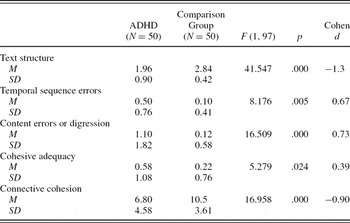
The ANCOVAs showed (see Table 1) that there were significant differences in text structure, F (1, 97) = 41.547, p < .000, Cohen d = −1.3, and temporal sequence errors, F (1, 97) = 8.176, p < .005, Cohen d = .67, in the group of children with ADHD.
Results of subjects with ADHD and comparison group on planning measures

Note: ADHD, attention-deficit/hyperactivity disorder.
Furthermore, the results of the ANCOVAs showed that the essays written by the children with ADHD differed from those written by the children in the control group with regard to content errors, F (1, 97) = 16.509, p < .000, Cohen d = 0.73, and connective cohesion, F (1, 97) = 16.958, p < .000, Cohen d = −0 .90. However, results did not reach statistical significance for cohesive adequacy, F (1, 97) = 5.279, p < .024, Cohen d = 0.39, with poorer achievement shown by the children with ADHD.
Results on translation indicators
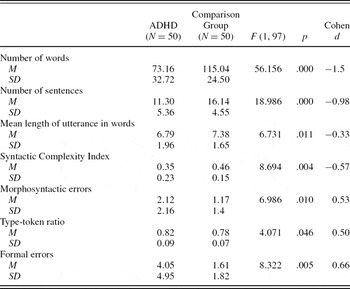
The ANCOVAs carried out later (see Table 2) indicated that the texts written by the children with ADHD had a lower number of words, F (1, 97) = 56.156, p = .000, Cohen d = −1.5, and were made up of fewer sentences than the texts written by the children in the comparison group, F (1, 97) = 18.986, p = .000, Cohen d = −0.98. In contrast, the essays of the two groups did not differ as far as the MLUw is concerned, F (1, 97) = 6.731, p = .011, Cohen d = −0.33.
Results of subjects with ADHD and comparison group on translation measures

Note: ADHD, attention-deficit/hyperactivity disorder.
In addition, the ANCOVAs showed that the texts written by the children in the ADHD group presented less syntactic complexity, F (1, 97) = 8.694, p = .004, Cohen d = −0.57, and the ADHD group made more formal errors than the children in the comparison group, F (1, 97) = 8.322, p < .005, Cohen d = 0.66.
In contrast, the essays of the two groups did not differ on the degree of variability in the lexicon used, F (1, 97) = 4.071, p = .046, Cohen d = 0.50, or morphosyntactic errors, F (1, 96) = 6.986, p = .010, Cohen d = 0.53.
Results on revision indicators
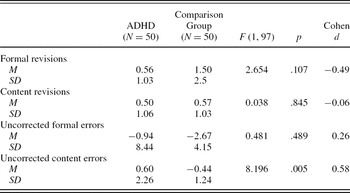
The results of the ANCOVA (see Table 3) showed that there were no significant differences in the number of formal revisions, F (1, 97) = 2.654, p = .107, Cohen d = −0.49, or with regard to the content revisions, F (1, 97) = 0.038, p = .845, Cohen d = −0.06. By contrast, in the writing of the children with ADHD, a higher percentage of noncorrected content errors was found, F (1, 97) = 8.196, p = .005, Cohen d = 0.58, although no differences were observed between the two groups on noncorrected formal errors, F (1, 97) = 0.481, p = .489, Cohen d = 0.26.
Results of subjects with ADHD and comparison group on revision measures

Note: ADHD, attention-deficit/hyperactivity disorder.
DISCUSSION
The purpose of this study was to delve more deeply into the study of the writing difficulties of students with ADHD, analyzing different indicators of their performance on written compositions. The results obtained showed that the students with ADHD are less proficient writers, because they show a significantly inferior performance compared to that of their peers on the majority of the variables evaluated.
In the first place, in the textual planning, the group of children with ADHD obtained significantly inferior overall results on measures of text structure, time sequencing, digressions, and the use of connectors. These findings agree with those obtained in other studies on the topic, in both the oral modality (Francis et al., Reference Francis, Fine and Tannock2001) and the written one (García et al., Reference García, Rodríguez, Caso, Fidalgo, Arias and González2007; Re et al., Reference Re, Pedron and Cornoldi2007).
Specifically, on the text structure, the children with ADHD showed difficulty in articulating an organizational plan directed toward a purpose, even though the narrative outline is the textual genre that is learned first from a developmental point of view (Peterson & McCabe, Reference Peterson and McCabe1983). This result may be affected, among other factors, by the problems of these students in the central executive and in the visuospatial sketchpad (Martinussen, Hayden, Hogg-Johnson, & Tannock, Reference Martinussen, Hayden, Hogg-Johnson and Tannock2005; Rapport et al., Reference Rapport, Alderson, Kofler, Sarver, Bolden and Sims2008), which is activated when the writer creates a mental visualization of the form of the paper and organizes the arrangement of ideas and supporting details in it (Hayes, Reference Hayes, Lewy and Ransdell1996; Le Bigot, Passerault, & Olive, Reference Le Bigot, Passerault and Olive2009; Vanderberg & Swanson, Reference Vandenberg and Swanson2007).
There were also important alterations detected in the time sequencing of the events in the compositions of the children with ADHD, and a significant number of digressions or incoherent sentences. The findings suggest a processing style based on an accumulation of ideas that interfere with each other. Inhibitory control problems could be impeding the suppression of the activation of irrelevant information (Fillmore, Milich, & Lorch, Reference Fillmore, Milich and Lorch2009). One objective for future studies would consist of investigating the involvement of inhibition deficits in event sequencing alterations and the digressions found in the narrations of students with ADHD, by directly evaluating the inhibition skills.
Our data also show that the children with ADHD used significantly fewer connectors, linguistic units whose purpose is to explicitly link the formal and semantic arrangement of the different parts of the text. In compensation, they chose other ways of linking the text, like juxtaposing or concatenating sentences, just as occurs in the oral colloquial register (Briz, Reference Briz2001). It would be necessary to carry out a more detailed study to verify whether the children with ADHD also make greater use of connectors with a more general meaning (like the polyfunctional conjunction and) instead of connectors that are more complex from a semantic point of view (consecutive, causal, etc.). In this sense, it is worth pointing out the difficulties experienced by children with ADHD with the comprehension of causal relationships, one of the key aspects of narrative text (Lorch et al., Reference Lorch, Eastham, Milich, Lemberger, Sanchez and Welsh2004).
In contrast, and unlike the data provided by other studies on oral discourse (Tannock, Purvis, & Schachar, Reference Tannock, Purvis and Schachar1993), our study does not show a tendency pattern of differences between the children with ADHD and the children without ADHD in the correct use of referential cohesion (cohesive adequacy). This finding is somewhat unexpected, as cohesive adequacy requires the retrospective and prospective functions of the operative memory, a deficient area in children with ADHD. Thus, to dominate this aspect it is necessary to consider whether or not to introduce a certain referent and select the appropriate linguistic form, so that the speaker can correctly identify it. The result obtained may be due to the typological differences between languages. English is a language that requires the obligatory presence of the subject in the sentence. Therefore, the speaker must consider a greater number of linguistic restrictions when formulating a sentence, which places greater cognitive demands on the processing system. In contrast, Spanish is a pro-drop language that allows the omission of the subject and, thus, presents a greater flexibility in making the referents in the text explicit. This difference probably leads to the disparity in results between the two languages studied. However, only a detailed analysis of the referential procedures used would make it possible to find out whether the children with ADHD use more immature mechanisms like mere lexical repetition (Karmiloff-Smith, Reference Karmiloff-Smith1983), instead of more complex linguistic strategies (the use of pronouns, for example). Although lexical repetition assures the identification of the referents in the text, its use leads to a highly redundant discourse and is indicative of a less rich vocabulary. One piece of data that could point in this direction is the lower amount of lexical diversity found in their writing.
Second, the results obtained for the translation indicators reveal a deficient performance in the group of children with ADHD in comparison with their peers. As in other studies on written expression (Miranda, Soriano, & García, Reference Miranda, Soriano, García, Scruggs and Mastropieri2006; Re et al., Reference Re, Pedron and Cornoldi2007; Resta & Elliot, Reference Resta and Elliot1994), the children with ADHD wrote shorter texts with fewer words and sentences. They also showed an inferior syntactic competence that was reflected in the use of a lower number of subordinate clauses and significantly lower scores on the index of syntactic complexity. Consequently, the children with ADHD seem to have a more reduced repertoire of late-acquisition sentence structures, which would denote a certain syntactic immaturity, as with age there is an increase in the index of syntactic complexity and the use of subordinate clauses (Fernández & Aguado, Reference Fernández and Aguado2007). On the other hand, that the children with ADHD include a lower number of subordinate clauses in their writing may indicate that they avoid making the effort required by this type of linguistic structures. An example of these demands would be using verb tenses or pronouns in a fluid and automatic way when elaborating a subordinate construction.
In contrast, on the MLUw, there were no significant differences found between the groups of children with and without ADHD. In this sense, we must point out that, despite being one of the most well-known and widely used measures in linguistic analysis (Aguado, Reference Aguado1995; Serra, Serrat, Bel, & Aparici, Reference Serra, Serrat, Bel and Aparici2000), it presents some limitations. In fact, the research indicates that its predictive value diminishes with time. Some studies (Scarborough, Rescorla, Tager-Flusberg, Fowler, & Sudhalter, Reference Scarborough, Rescorla, Tager-Flusberg, Fowler and Sudhalter1991) have shown that the MLUw correlates more weakly with linguistic development when it exceeds three or four words than during the earliest studies of language acquisition. It seems that, from an index equal to 4 on, the measure experiences a ceiling effect; that is, the increase in words does not necessarily imply an increase in grammatical complexity (Fernández & Aguado, Reference Fernández and Aguado2007). Therefore, this limitation of the measure could justify its lack of sensitivity in this study.
With regard to formal indicators of writing, and coinciding with other studies (Miranda et al., Reference Miranda, Soriano, García, Scruggs and Mastropieri2006; Re et al., Reference Re, Pedron and Cornoldi2007), the children with ADHD made more formal errors; that is, they showed less spelling and handwriting accuracy. Keeping in mind that transcription and reading skills draw on many of the same subprocesses—orthographic and phonological coding—(Berninger, Cartwright, Yates, Swanson, & Abbott, Reference Berninger, Cartwright, Yates, Swanson and Abbott1994; Shanahan, Reference Shanahan, MacArthur, Graham and Fitzgerald2006), deficits in word reading are likely to manifest themselves as spelling difficulties.
Finally, with regard to the revision process, the results showed significant differences between children with and without ADHD on one of the variables evaluated, specifically on uncorrected content errors. Although the children with ADHD were given plenty of time to do so and specific instructions, they are not as capable as their classmates in correcting errors that affect the meaning of the text. They show a worse overall proficiency, as they leave more content errors uncorrected.
In conclusion, our results show that students with ADHD demonstrate a worse performance on different indicators of the main processes of written composition: planning, translation, and revision. This finding suggests that children with ADHD have considerable difficulties on tasks that require organizing and structuring information, which could be related to deficits in executive functioning (Barkley, Reference Barkley2005). As shown in a recent study (Hooper et al., Reference Hooper, Costa, McBee, Anderson, Yerby and Knuth2011), the language and attention/executive functions (including verbal and nonverbal working memory, attention, planning, and rapid retrieval) are highly associated with written expression. Specifically, the working memory takes care of simultaneously managing a series of processes, such as keeping various ideas alive, recovering morphosyntactic clues from the long-term memory and continuous revision, all of which intervene in the elaboration of a coherent and cohesive text (Kellogg, Reference Kellogg, Levy and Ransdell1996, Reference Kellogg, Torrance and Jeffrey1999; Swanson & Berninger, Reference Swanson and Berninger1996).
Unfortunately, these difficulties can have a great impact on the daily lives of children with ADHD, not only due to their effect on the comprehension and composition of texts, but also because they might lead to mistakes in social comprehension (Francis et al., Reference Francis, Fine and Tannock2001). Other issues remain unanswered and are open to future investigation. For example, one limitation in our study is that we did not control for the linguistic and reading ability of the participants. Systematic assessment data were not available to permit formal diagnoses of language or LDs. Thus, a particularly low linguistic and reading ability in the ADHD group could have affected their writing performance. Furthermore, our study did not use direct measures of executive functioning (i.e., working memory, inhibition, set shifting, lexical fluency), which would have made it possible to determine which executive processes are involved in the composition problems of children with ADHD and the explanatory role they play in these deficits. Another point to consider is the broad age range of the participants, so that they could be grouped according to different phases in the development of writing skills.
Furthermore, it is necessary to design standardized instruments with proven reliability and validity, in order to offer a more panoramic view of the writing performance of these students and more precisely identify different performance profiles within the heterogeneity of the disorder. Another valuable contribution would be to evaluate written composition using other types of texts (expository, argumentative) that better fit the demands of the academic curriculum at these ages. An additional topic open to investigation has to do with the nature of the relationship between difficulties in written expression and the different subtypes of ADHD (inattention, hyperactivity–impulsivity, and combined).
In conclusion, the good news is that some recent findings have shown that, once they have been detected, many of the deficiencies observed in the writing of children with ADHD could improve with explicit instruction in different strategies focused on the different phases of written composition. Although scarce, some studies on intervention (De La Paz, Reference De la Paz2001; Lienemann & Reid, Reference Lienemann and Reid2008; Reid & Lienemann, Reference Reid and Lienemann2006; Thompson & Reid, Reference Thompson and Reid2010) have documented the efficacy of instruction using a strategic instruction (SRSD model; Harris & Graham, Reference Harris and Graham1996). The use of mnemonic rules, graphic organizers, and self-instruction has also been shown to produce improvements in the overall quality of compositions. Facilitation techniques (outlines guide) have also been successfully applied by means of collaborative writing activities in children with ADHD (Re, Caeran, & Cornoldi, Reference Re, Caeran and Cornoldi2008). Finally, in a recent publication (McCloskey, Perkins, & Dinner, Reference McCloskey, Perkins and Dinner2009), instructional guidelines were included for executive function difficulties impacting written expression problems. This type of intervention could be a promising route in the written-expression learning difficulties experienced by students with ADHD.
ACKNOWLEDGMENTS
This research was supported by Grant EDU2009-07672 (to A.M.) from the Plan Nacional I+D+I (Ministerio de Ciencia e Innovación).