Introduction
More than a decade has passed since the target of universal primary education by 2015 was globally endorsed in the ‘Education for All’ and Millennium Development Goal commitments. Progress has been made, but 32 million school-aged children in sub-Saharan Africa are still not in school, with girls and those from poor households disproportionately affected (UNESCO, 2010). With 2015 fast approaching, there has been significant recent research and policy focus on the situation of the 14.8 million children (under 18) in sub-Saharan Africa estimated to have lost one or both parents to AIDS, who may face particular educational disadvantages (UNAIDS, 2010).
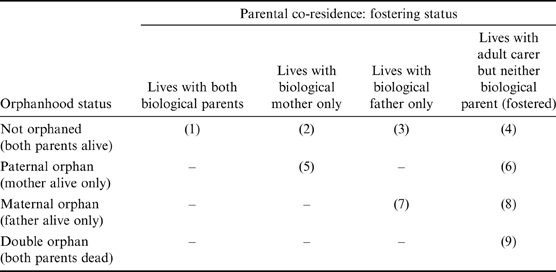
However, while the situation of orphans is of major concern, this focus has arguably obscured serious consideration of the many situations under which children move between households, and the associated impacts. In countries across sub-Saharan Africa, a high proportion of children spend at least part of their childhoods not living with their biological parents. Based on DHS data (1997–2002) from 40 sub-Saharan African countries, Monasch & Boerma (Reference Monasch and Boerma2004) reported that fewer than two-thirds of children under fifteen were living with both biological parents; 11.9% were living with neither parent, but the majority of those (8.6% of the total) had both biological parents alive, while only 0.9% had lost both their parents. This distinction is crucial. Orphanhood is here defined as having one or both biological parents dead; this category is sub-divided into ‘double orphans’ (both biological parents dead) and ‘single orphans’ (one parent dead; either maternal or paternal orphans). Fostering refers to the practice of a child (under 18 years of age, corresponding with the UN definition) living with an adult care-giver who is neither biological parent. The intersection of orphanhood and parental co-residence, which provides the analytical basis for this paper, produces multiple categories (see Table 1).
Typology of fostering and orphanhood adopted in this paper (excluding children with no co-residential adult carer)

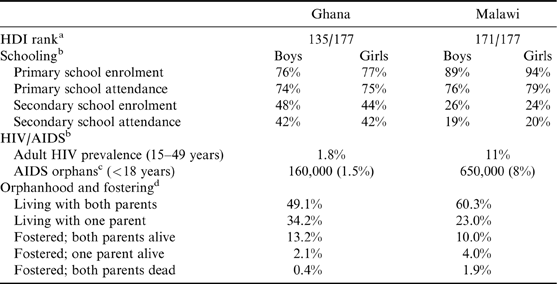
The aim of this paper is to combine insights from qualitative and quantitative research to measure and begin to explain the impacts of both fostering and orphanhood on schooling for children in two contrasting African countries: Ghana and Malawi. Ghana, which has recently become a lower-middle-income country, ranks 135/177 on the UNDP's Human Development Index, while Malawi remains one of the world's poorest countries, ranking 170th (UNDP, 2013). Around three-quarters of primary-aged children in Ghana are enrolled in and attend school, but this falls to below half at secondary level. Malawi has better primary school enrolment, at around 90%, but attendance is lower and secondary school enrolment/attendance rates are particularly poor (UNICEF, 2012). Ghana and Malawi have very different HIV/AIDS profiles. Typically of southern Africa, Malawi has been hit hard by AIDS, with an estimated adult (15–49 years) HIV prevalence of 11% and 650,000 AIDS orphans: over 8% of under-18s in the country (UNICEF, 2012). By contrast, the adult HIV prevalence in Ghana is 1.8%, reflecting the lower impact of the epidemic across West Africa. An estimated 160,000 children in Ghana (1.5%) have been orphaned by AIDS (UNICEF, 2012). However, although orphanhood is a major driver of fostering in Malawi in particular, both countries have high proportions of non-orphaned fostered children (Monasch & Boerma, Reference Monasch and Boerma2004; see Table 2).
Profiles of Ghana and Malawi: development, schooling, HIV and child fostering
a Source: UNDP (2013).
b Source: UNICEF (2012).
c Single and double orphans combined.
d Source: Monasch & Boerma (Reference Monasch and Boerma2004); DHS data 1997–2002.
Fostering and orphanhood in Ghana and West Africa: historical and current social context
From colonial times to the present day, demographers have consistently reported high rates of child fostering in Ghana, and across West Africa (Alber et al., Reference Alber, Martin, Notermans, Alber, Martin and Notermans2013). Based on 1970s census and national survey data, Isiugo-Abanihe (Reference Isiugo-Abanihe1985) estimated that 20% of children under ten in Ghana were not living with their biological parents, with the highest rates among the Akan of central/southern Ghana. Even higher fostering levels were reported in Liberia and Sierra Leone (Ibid). Similarly, in Page's (Reference Page and Lesthaeghe1989) analysis of World Fertility Survey data, over 30% of children in central/southern Ghana, and 20–30% of children in northern Ghana, were not living with their biological parents, with comparable figures in Côte d'Ivoire, southern Nigeria and parts of Cameroon. More recently, Monasch & Boerma (Reference Monasch and Boerma2004) reported that 15.7% of children under fifteen in Ghana were living with neither biological parent: of these, 13.2% had both parents alive, 2.1% had one living parent, while 0.4% had lost both parents. Again, this reflects a regional pattern: across West Africa, 12.0% of children under fifteen were reportedly living with neither biological parent; of these, 9.0% had both parents alive, 2.2% had one living parent and 0.8% had lost both parents (Ibid).
Since the 1970s, fostering has gained increasing prominence in the West African ethnographic literature. In Esther Goody's (Reference Goody1973, Reference Goody1982) seminal account of the patrilineal Gonja of northern Ghana, almost a fifth of children lived with aunts, uncles and grandparents, instead of biological parents. From a functionalist perspective, Goody proposed that fostering facilitated children's socialization and training, and reinforced bonds between physically dispersed kinsmen. Goody (Reference Goody1982) also noted a high prevalence of kinship fostering in southern Ghana, with children being ‘claimed’ or ‘begged’ by kin to provide companionship or labour. Other ground-breaking work in the region includes that of Lallemand (Reference Lallemand1988, Reference Lallemand1993, Reference Lallemand1994) who, following the French structuralist tradition, viewed the circulation of children (in Togo and elsewhere) as part of a system of generalized system of gift exchange, and Bledsoe and colleagues' (Reference Bledsoe, Ewbank and Isiugo-Abanihe1988, Reference Bledsoe, Isiugo-Abanihe and Lesthaeghe1989) research with the Mende of Sierra Leone, where ‘grannies’ (older kinswomen) typically care for young children, who are later fostered to urban-based relatives for schooling purposes.
Most of the West African literature focuses on purposive fostering, relating to kinship obligations, alliance building, education/apprenticeship and domestic labour, as distinct from ‘crisis fostering’, whereby family breakdown (for example through parental death, separation or migration) necessitates the child's movement (Isuigo-Abanihe, 1985; Alber et al., Reference Alber, Martin, Notermans, Alber, Martin and Notermans2013). Far from being an unfortunate necessity, kinship fostering is often viewed in a positive light, bringing potential advantages to the child, and to both sending and receiving households. For example, fostering to facilitate education has been widely documented, in northern Benin (Alber, Reference Alber and Bowie2004a), Burkina Faso (Akresh, Reference Akresh2009) and Cameroon (Eloundou-Enyegue & Stokes, Reference Eloundou-Enyegue and Stokes2002; Notermans, Reference Notermans and Bowie2004). Out-fostering as a household strategy to cope with economic shocks or demographic imbalances has also been highlighted in several studies (e.g. Akresh, Reference Akresh2009, in Burkina Faso; Serra, Reference Serra2009; Castle, Reference Castle1995, in Mali), while in-fostering can enable women, particularly in patriarchal societies, to strengthen their social positions (Etienne, Reference Etienne1979; Lallemand, Reference Lallemand1993; Notermans, Reference Notermans and Bowie2004), and to benefit from extra labour (Serra, Reference Serra2009). Based on recent work in northern Ghana, Kuyini and colleagues (Reference Kuyini, Alhassan, Tollerud, Weld and Haruna2009), have emphasized ‘the need to keep family ties alive’ as a key factor behind ‘traditional kinship foster care’, echoing Goody's earlier analysis.
Although fostering is a long-standing practice across West Africa, it is by no means unchanging. Back in the 1970s/80s, researchers were noting shifts in childcare arrangements resulting from social and economic changes. Goody (Reference Goody1982) reported a decline in fostering in northern Ghana as better transport links enabled young people to escape social ties and obligations. Children were increasingly fostered from rural to urban locations, while aunts/uncles and non-kin began to replace grandparents as principal foster carers. Goody also identified a shift ‘from sending children in response to claims by kin, to making claims on kin to take children so they can attend better schools, have the advantages of a city life or learn new skills not available in a small town’ (Goody, Reference Goody1982, p. 177, emphasis added). In Ghana's Volta Region, Brydon (Reference Brydon1979) reported a rise, during the 1950s, of rural-to-urban fostering to facilitate access to schools, while in the 1970s, parents who had migrated to cities to find work began to send their children back to be cared for by rural-based relatives. More recently, the expansion and feminization of transnational labour migration has placed new demands on foster carers in Ghana (Coe, Reference Coe2008, Reference Coe2011) and elsewhere in West Africa (e.g. Drotbohm, Reference Drotbohm, Alber, Martin and Notermans2013).
A key point emerging from this literature is the diverse and contingent nature of fostering experiences in West Africa. For example, Verhoef & Morelli (Reference Verhoef and Morelli2007) noted that, in north-west Cameroon, children's experiences are shaped more by the circumstances of fostering (for example, whether the child is actively desired and requested by the foster parents, the relationship between the child and foster parents, and the personalities of those involved) than the fact of being fostered per se (see also Notermans, Reference Notermans2008, in east Cameroon; Martin, Reference Martin, Alber, Martin and Notermans2013, in Benin; Castle, Reference Castle1995, in Mali).
Fostering and orphanhood in Malawi and southern Africa: historical and current social context
In contrast to West Africa, the fostering literature on southern Africa is dominated by the impacts of AIDS on the mortality of reproductive-aged adults, resulting in rapidly increasing numbers of orphans (UNAIDS, 2010) and diminished kin networks to cope. However, there are at least as many non-orphaned fostered children as orphans in southern Africa (Grant & Yeatman, Reference Grant and Yeatman2012). At the time of Monasch & Boerma's (Reference Monasch and Boerma2004) work, 15.9% of children in Malawi were living with neither biological parent; of these, 10.0% had both parents alive, 4.0% had one living parent, while only 1.9% had lost both parents (Table 1). Again, this corresponds to a regional pattern: across southern Africa, 16.9% of children were living with neither biological parent; of these, the majority (11.3%) had both parents alive, 4.1% had one parent alive and just 1.5% had lost both parents (Ibid, although the numbers of orphans have substantially increased over the last decade: see below).
Historically, fostering across much of southern Africa (including Malawi) was driven by the demands of long-distance labour migration, which often entailed the disintegration of families and children being ‘shuttled among kin’ (Madhaven, Reference Madhaven2004, p. 1446). Over the last century, large numbers of men from across the region left their homes, often for extended periods, to seek work (for example, in South African gold mines) as a response to rural impoverishment (Murray, Reference Murray1981; Fassin, Reference Fassin2007). Although less well-documented, many woman also migrated, either internationally or internally, to cities to find work (Dodson, Reference Dodson2000), leaving their children in the care of kin.
Arguably, it was this widespread out-migration of young adults and ensuing family separation that paved the way for the enormity of the southern African AIDS epidemic (Fassin, Reference Fassin2007), which has become a key driver of ‘crisis’ fostering. UNAIDS (2010) estimates that at least 5 million children across the region, and 650,000 children in Malawi alone, have lost one or both parents to AIDS. The literature on AIDS orphans in southern Africa is vast, and cannot be reviewed fully here. Most orphans in Malawi are cared for in extended families (Beard, Reference Beard2005), and Foster (Reference Foster2002), among others, has described the remarkable lengths to which foster parents in southern Africa go to provide for children in their care. However, the sheer scale of the situation has prompted concerns about the ability of ‘extended family safety nets’ to cope indefinitely (Foster, Reference Foster2000, Reference Foster2002; Guest, Reference Guest2003; Nyambedha et al., Reference Nyambedha, Wandibba and Aaagaard-Hansen2003; Mathambo & Gibbs, Reference Mathambo and Gibbs2009; Grant & Yeatman, Reference Grant and Yeatman2012; Zagheni, Reference Zagheni2011). Caring for extra children can place a substantial extra financial and time burden on households (Heyman & Kidman, Reference Heyman and Kidman2009), and the role of poverty in compromising the ability of AIDS-affected household to cope has been highlighted in several studies (Foster, Reference Foster2000, Reference Foster2002; Kidman et al., Reference Kidman, Hanley, Foster, Subramanian and Haymannx2012; Nyambedha et al., Reference Nyambedha, Wandibba and Aaagaard-Hansen2003). Miller et al. (Reference Miller, Gruskin, Subramanian and Heymann2007), based on work in Botswana, found that orphans lived disproportionately in the poorest households, and Kidman and colleagues (Reference Kidman, Hanley, Foster, Subramanian and Haymannx2012), working recently in Malawi, have used the term ‘double jeopardy’ to describe the challenges faced by orphans living in impoverished households.
In Malawi (and across southern Africa more generally) there are widespread and pervasive public discourses around the neglect and abuse of orphans by foster parents, that are reproduced and circulated through the media and in schools (Ansell et al., Reference Ansell, Robson, Hadju and van Blerk2012). There is also a growing body of literature documenting the increased psycho-social vulnerability of such children (Bauman & Germann, Reference Bauman, Germann, Foster, Levine and Williamson2005; Nyamukupa et al., Reference Nyamukupa, Gregson, Lopman, Saito, Watts, Monasch and Jukes2008), although Levine et al. (Reference Levine, Foster, Williamson, Foster, Levine and Williamson2005) have noted that, in many cases, the apparent ‘exploitation’ of fostered orphans (being taken out of school to perform farm work, for example) may be essential for household survival.
In summary, Malawi, like Ghana, has a long-standing tradition of fostering for non-orphaned (as well as orphaned) children. In contrast to Ghana, though, this fostering has largely resulted from parental out-migration and consequent family disruption. While not necessarily best described as ‘crisis fostering’ (in that it may be part of a planned household survival strategy) it is nonetheless very different to the demand-led fostering widely described across West Africa. Recently, the AIDS epidemic has compounded the need for families across southern Africa to take in foster children; however, orphans still probably constitute the minority of fostered children.
Impacts of orphanhood and fostering on schooling
Orphans might be expected to be educationally disadvantaged for several reasons, including increased poverty, psychological trauma and the need to assume adult livelihood/care-giving responsibilities (Guest, Reference Guest2003; Kelly, Reference Kelly, Foster, Levine and Williamson2005; Grant, Reference Grant2008; Kidman et al., Reference Kidman, Hanley, Foster, Subramanian and Haymannx2012). However, the evidence is far from conclusive. Several single-country studies in east and southern Africa have shown poorer schooling outcomes (indicated variously by enrolment, attendance and progress) for maternal and double orphans; an effect that is independent of socioeconomic status (e.g. Ainsworth et al., Reference Ainsworth, Beegle and Koda2005; Case & Ardlington, Reference Case and Ardlington2006; Evans & Miguel, Reference Evans and Miguel2007; Operario et al., Reference Operario, Cluver, Rees, MacPhail and Pettifor2008; Ardlington & Leibrandt, Reference Ardlington and Leibrandt2010; Kidman et al., Reference Kidman, Hanley, Foster, Subramanian and Haymannx2012). Moreover, in a recent paper based on longitudinal research in Tanzania, Beegle et al. (Reference Beegle, de Weerdt and Dercon2010) found evidence that the educational disadvantage experienced by maternal orphans persists into adulthood.
The effects of paternal orphanhood are rather less clear and may be largely a function of decreased household economic status (Case & Ardlington, Reference Case and Ardlington2006; Ardlington & Leibrandt, Reference Ardlington and Leibrandt2010; Kidman et al., Reference Kidman, Hanley, Foster, Subramanian and Haymannx2012), although some South African studies have found paternal orphanhood to be strongly and independently associated with poor school progress (Timaeus & Boler, Reference Timaeus and Boler2007; Parikh et al., Reference Parikh, DeSilva, Cakwe, Quinlan, Simon, Skalicky and Zhuwau2007). Other studies have found little or no significant educational disadvantage for orphans when controlling for other socioeconomic factors (e.g. Masmas et al., Reference Masmas, Jensen, Da Silva, Høj, Sandström and Aaby2004; Sharma, Reference Sharma2006; Yamano & Jayne, Reference Yamano and Jayne2005; Kurzinger et al., Reference Kurzinger, Pagnier, Kahn, Hampshire, Wakabi and Dye2008; Chuong & Operario, Reference Chuong and Operario2012).
Similarly varied outcomes have emerged from multiple-country studies. Based on analysis of seventeen African DHS datasets (1995–2000), Bicego et al. (Reference Bicego, Rutstein and Johnson2003) found that, in both East and West Africa, orphans were disproportionately likely to be behind in school, with the effects most marked for double orphans and maternal orphans; however, their regional-level analysis did not investigate differences between countries. A small educational disadvantage associated with orphanhood was identified by Lloyd & Blanc (Reference Lloyd and Blanc1996) in their analysis of seven African DHS datasets: children with living parents had slightly higher enrolment rates than those without, but the differences were generally small or statistically insignificant. Likewise, Case et al. (Reference Case, Paxson and Ableidinger2004) analysed nineteen African DHS datasets from the 1990s and found various associations between maternal, paternal and double orphanhood and school enrolment, but no consistent pattern. Ainsworth & Filmer's (Reference Ainsworth and Filmer2006) analysis of 35 nationally representative African datasets also indicated substantial between-country variation; they concluded that the orphan enrolment gap was small, often statistically insignificant, and was dwarfed by income gaps.
Rather less research has investigated schooling outcomes for non-orphaned fostered children, but the findings are similarly equivocal. While purposive fostering in West Africa is often represented as a means of increasing educational opportunities, the outcomes are less clear. Gage (Reference Gage2005) found that secondary-school-aged fostered girls in Ghana were less likely to attend school full-time than non-fostered girls, a relationship mediated through increased workforce participation. Alber's (Reference Alber2004b) qualitative work in Benin revealed that the perceived preferential schooling of biological over foster children has increased parents' reluctance to relinquish their children to foster parents. In South Africa, Timaeus & Boler (Reference Timaeus and Boler2007) found that non-paternal co-residence (independently of paternal orphanhood) was associated with slower academic progress and a similar effect was found, also in South Africa, of non-maternal co-residence by Chuong & Operario (Reference Chuong and Operario2012). The conclusion of Huisman & Smits' (Reference Huisman and Smits2009) 30-country study using DHS data was a generally negative educational impact of non-parental co-residence, although they did not distinguish between orphans and non-orphans.
Others have suggested positive schooling impacts of purposive fostering. Zimmerman (Reference Zimmerman2003), working with a large South African dataset, found no differences in enrolment between fostered and non-fostered children. Moreover, because children were fostered purposively from poorer to wealthier households (better able to afford schooling), Zimmerman estimated that the net impact of fostering was a 22% reduction in school non-attendance. And, from an historical perspective, Alber (Reference Alber, Thelen and Haukanes2010) has argued that the spread of schooling in North Dahomey (now Benin) was greatly facilitated by rural-to-urban child fostering.
Several studies have indicated a protective effect of living with grandparents. Based on Lesotho DHS data, Parker & Short (Reference Parker and Short2009) found that living with a grandmother reduced the risk of school drop-out for maternal orphans and other children with non-co-resident mothers. Living with a grandmother may also protect orphaned children from repeated inter-household mobility (Madhaven et al., Reference Madhaven, Schatz, Clark and Collinson2012), itself a risk factor for school drop-out. In ethnographic research, grandparents have been widely observed to be more empathetic, emotionally supportive and more willing to make personal sacrifices to provide materially for children than other foster carers, despite often being poorer (e.g. Goody, Reference Goody1973; Alber, Reference Alber and Bowie2004a; Okele et al., Reference Okele, Blystad, Moland, Rekdal and Heggenhougen2006; Nyasani et al., Reference Nyasani, Sterberg and Smith2009).
To summarize, while both orphanhood and the fostering of non-orphaned children have the potential to impact negatively on education, there is substantial variation in measured outcomes. Large-scale, survey-based studies show broad patterns and variation, but they are ill-placed to explain this variation. While they hint at the need to understand the social context, they cannot provide this. By contrast, ethnographic studies provide detailed information on the complex and context-specific nature of fostering, but are unable to capture the wider educational (and other) implications of these complexities. To the authors' knowledge, the study reported here is the first to combine ethnographic and survey approaches to fostering in the same populations, and thus to combine objectively measured outcomes with an exploration of meanings and processes. Crucially (in contrast to most earlier work, based on adults' accounts), both the survey and qualitative data presented here come principally from children themselves (Coe, Reference Coe2008; Notermans, Reference Notermans2008; Alber, Reference Alber, Alber, Martin and Notermans2013). This study is thus situated within the growing body of work that positions children as competent and reflective social actors, capable of engaging actively in the research process and knowledge generation (e.g. James, Reference James2007; Porter et al., Reference Porter, Townsend and Hampshire2012).
In what follows, survey data from Ghana and Malawi are used to test the hypotheses that orphanhood and fostering are independently associated with educational disadvantage, as indicated by enrolment, attendance and progress. A further hypothesis is tested: that living with grandparents (as opposed to other foster carers) has a protective effect on orphaned and fostered children. Qualitative data, in the shape of children's accounts of their experiences, are then used to help interpret the survey findings and to explore how the particular socio-historical contexts in each country shape schooling experiences for fostered and orphaned children.
Study Context and Methods
Material is presented here from the Child Mobility Survey (www.dur.ac.uk/child.mobility), conducted with children and adolescents (aged 8–18 years) in Ghana, Malawi and South Africa (the South African data are not reported here). In each country, eight study settlements (all relatively low income) were selected: one urban, one peri-urban, one rural with basic services (primary school and/or health post) and one remote rural with no services, in each of two contrasting agro-ecological regions.
In Ghana, sites were selected in Central Region (southern coastal savannah) and Brong Ahafo Region (central forest belt). All the Ghanaian field-sites were ethnically mixed, with Akan majorities (Fantes in the south; Bonos in the central belt) but substantial numbers of migrants from other ethnic groups. Fieldwork in Malawi was conducted in the Shire Highlands of the Southern Region (Blantyre Districts) and the Central Plains (Lilongwe Districts). Chewa peoples predominated in the Lilongwe sites, while the Blantyre sites were more ethnically diverse, principally Mang'anja, Chewa and Ngoni. Agriculture (mainly subsistence) was the major economic activity in the rural and peri-urban sites in both countries, along with petty trading. In the urban settlements, people engaged in various, mostly informal sector activities. Christianity was the major religion in all study sites, with significant minorities practising Islam or traditional religions.
Fieldwork was undertaken between 2006 and 2009. Ethical clearance was granted by participating universities, and parents'/guardians' consent was sought for all interviews with under-18s (in addition to consent from the interviewee). Qualitative research was undertaken in all sixteen field-sites using semi-structured interviews, life history interviews, accompanied walks and group interviews; altogether approximately 500 interviews with children/adolescents (aged 8–18 years), parents/carers and key informants were completed across the eight sites in each country, including around 40–50 with young people who were orphaned and/or fostered. Additionally, 37 ‘young researchers’ (aged 9–22 years) received training and supervision to conduct complementary ‘peer research’ in their own communities (Robson et al., Reference Robson, Porter, Hampshire and Bourdillon2009; Porter et al., Reference Porter, Hampshire, Bourdillon, Robson, Munthali, Abane and Mashiri2010; Hampshire et al., Reference Hampshire, Porter, Owusu, Mariwah, Abane and Robson2012). Purposive sampling was used to ensure a broadly representative range of sex, age, schooling status, living arrangements etc. among interviewees. Four different thematic interview guides were used focusing respectively on education, health, livelihoods and transport; this paper draws principally on the education-themed interviews. Fostering and orphanhood were not planned as interview topics, but often emerged spontaneously from children's and adults' accounts. Detailed hand-written notes were taken during interviews and typed up. Analysis was thematic and primarily inductive, based on the principles of grounded theory, in which theoretical insights emerge from the data rather than vice versa (Glaser & Strauss, Reference Glaser and Strauss1967). The authors engaged in close reading of the interview notes, noting emerging themes, patterns and variation, and coded the data accordingly.
Subsequently, a questionnaire survey was conducted with 944 children/adolescents aged 8–17 years in Ghana and 906 in Malawi (18-year-olds were also included in the survey, but those data are excluded from this paper because 18 is the legal age of majority in both countries). Approximately equal numbers of respondents were surveyed in each field-site, by taking households along randomly selected transects and picking one child per household by lot. The survey was designed to test hypotheses emerging from the qualitative work, including those relating to the impacts of fostering and orphanhood on schooling (enrolment, attendance and progress). Descriptive statistics and multivariate analyses were performed using SPSS version 17.
Results
Patterns of fostering and orphanhood: survey data
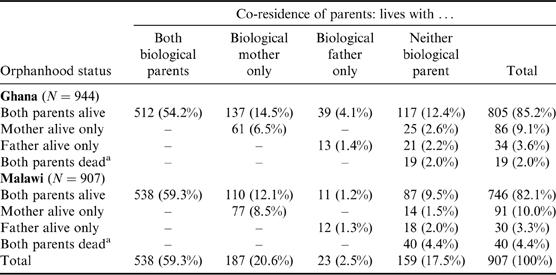
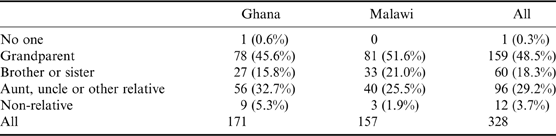
A high proportion of children in Ghana and Malawi were not living with their biological parents at the time of survey (Table 3). In both countries, fewer than three-fifths of children were living with both parents, while around a fifth lived with their mother only, just under fifth with neither parent and smaller numbers lived with their father only. Only one child altogether (in Ghana) was not living with any adult carer; the other children living with neither biological parent are thus (as defined in this paper) ‘fostered children’. In Ghana, nearly two-thirds of fostered children (117/182) had both parents alive, compared with just over half (87/159) in Malawi. Conversely, just 10% of fostered children in Ghana had lost both their parents (‘double orphans’), compared with 25% in Malawi, probably reflecting the greater impact of AIDS. In both countries, grandparents were the most common foster carers, followed by siblings, aunts, uncles and siblings (Table 4).
Fostering and orphanhood status of survey respondents (aged 8–17 years)
a ‘Dead’ includes parents for whom it is not known whether they are alive or dead.
Main carers of children (aged 8–17 years) living with neither biological parent

Impacts of fostering and orphanhood on schooling in Ghana and Malawi: survey data
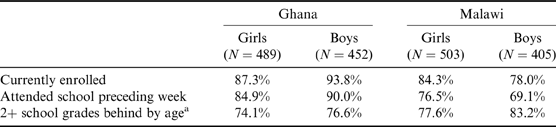
Table 5 presents descriptive statistics for school enrolment, attendance and progress by sex in each country. Around 90% of respondents aged 8–17 years in Ghana were enrolled in school, and around 80% in Malawi, but numbers attending regularly were lower (particularly in Malawi) and around 75% of children overall (over 80% of boys in Malawi) were two or more years behind the appropriate school grade for their age.
Schooling indicators: descriptive statistics by sex (children aged 8–17 years)
a Of those currently enrolled in school.
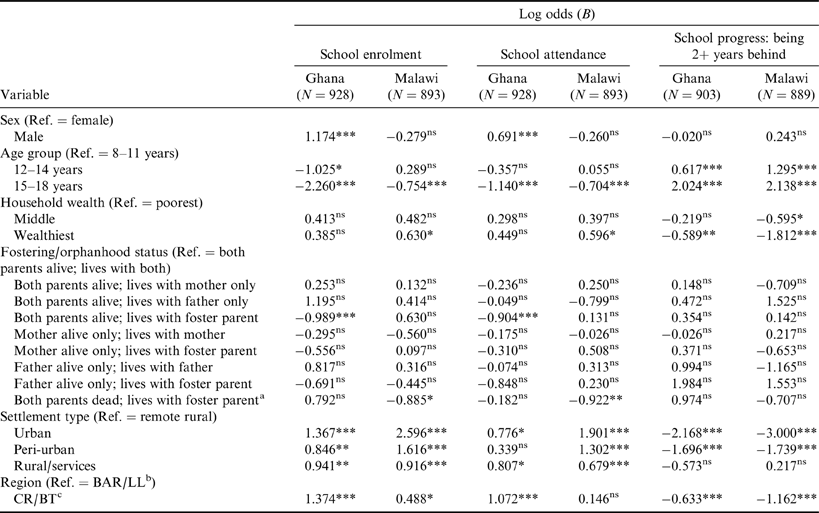
Multivariate logistic regressions were performed to test the hypotheses that orphanhood and fostering are independently associated with: (a) lower enrolment; (b) lower attendance; and (c) poor progress, controlling for sex, age group, household wealth category, rural/urban residence and region (Table 6). It is clear from this analysis that fostering and orphanhood are both associated with school enrolment and attendance, but in very different ways in the two countries. In Ghana, it is only children who are fostered but not orphaned (both parents are alive) that have significantly lower enrolment and attendance than the reference group (both parents alive, lives with both); the direction of the effect (non-significant) is similar for fostered single orphans (maternal and paternal). By contrast, in Malawi, it is only fostered double orphans that have lower rates of enrolment and attendance. Interestingly, in neither country does school progress appear to be affected by either orphanhood or fostering status.
Logistic regression analysis of school enrolment, attendance and progress: children aged 8–17 years by fostering and orphanhood status

a The one double orphan (in Ghana) who was not fostered is excluded from this analysis.
b BRA/LL=Brong Ahafo Region (Ghana)/Lilongwe Districts (Malawi).
c CR/BT=Central Region (Ghana)/Blantyre Districts (Malawi).
*p<0.05; **p<0.01; ***p<0.005; ns, not significant.
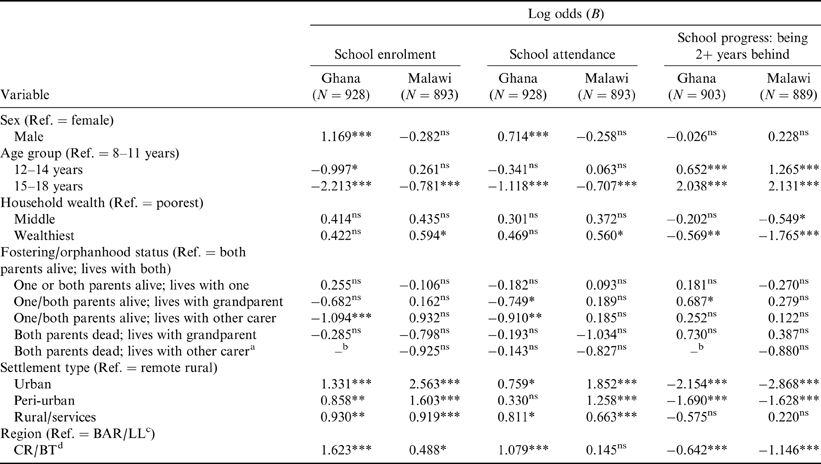
Further analysis was performed to test the hypothesis relating to the protective effect of grandparent carers. To avoid very small numbers in some cells, categories of orphanhood and fostering were combined into: (1) reference group: both parents alive, living with both parents; (2) one or both parents alive, living with one parent only (combining groups that appeared not to be educationally disadvantaged in either country); (3) at least one parent alive and fostered (associated with lower enrolment and attendance in Ghana); and (4) fostered double orphans (associated with lower enrolment and attendance in Malawi). Groups (3) and (4) were then sub-divided into those living with grandparents and those fostered by other relatives or non-kin (Table 7). Only in Ghana does it appear to make a difference whether or not the foster carer is a grandparent. Among fostered children with living parent(s), those with a grandparent carer do not have significantly lower enrolment than the reference group, whereas those fostered by someone else (another relative or non-relative) do have significantly lower enrolment. And although both groups of fostered children with living parent(s) have lower attendance rates than the reference group, the gap is significantly bigger for children fostered to someone other than a grandparent (although, intriguingly, children fostered by a grandparent were more likely to be behind the appropriate grade for their age). In Malawi, it does not appear to make a difference whether or not the foster carer is a grandparent, although the small numbers of double orphans fostered by a grandparent (n=17) makes this result somewhat inconclusive.
Logistic regression analysis of school enrolment, attendance and progress: children aged 8–17 years by fostering/orphanhood status and relationships to foster carer
a The one double orphan (in Ghana) who was not fostered is excluded from this analysis.
b Cell numbers too small for analysis.
c BRA/LL=Brong Ahafo Region (Ghana)/Lilongwe Districts (Malawi).
d CR/BT=Central Region (Ghana)/Blantyre Districts (Malawi).
*p<0.05; **p<0.01; ***p<0.005.
In summary, in Malawi, (fostered) double orphanhood is associated with reduced school enrolment and attendance. By contrast, in Ghana, it is children whose parents are both alive, but who are fostered – indicative of purposive fostering – that have lower enrolment and attendance rates than their peers. In Ghana, living with a grandparent may be partially protective in terms of enrolment and attendance, but not progress; in Malawi, living with a grandparent (as opposed to another foster carer) appears to make no difference to schooling. This variability of outcomes is not unexpected, given the lack of consensus in the literature. However, unlike most other studies, the qualitative data, presented below, can help shed light on the reasons for these differential outcomes.
Fostering, orphanhood and schooling in Ghana: qualitative data
Purposive fostering, a prominent feature in the West African literature, was a common theme in interviews with children in Ghana. The impetus was almost always ‘requests’ from aunts, uncles or others, which can be difficult to refuse, as this boy's account illustrates:
At the age of 11 years, I was sent to live with my auntie. […] She came to visit us. […] When the time came for her to leave, my parents said I should go and live with her because my auntie was telling them she has missed us so much and wanted to spend time with me. […] The way they asked me the question, I could not say I do not want to go and live with her. They asked me in front of her and some of my younger siblings, so I had to agree because it would not have been respectful to say I would not go. […] She was living alone so I used to help her with the household chores like sweeping, washing bowls and going to fetch water. I also sometimes used to run errands for her.
(14-year-old boy)Children were reportedly requested by kin explicitly to provide domestic or other labour, typically household chores for girls and often agricultural labour for boys:
When I was 5 years old I went to live with my grandmother for 6 months. I went to live with her because […] she needed help around the house. The main work I was doing was sweeping, fetching water and washing bowls.
(13-year-old girl)I came here six years ago to join my uncle [mother's brother] and help him on the farm. Uncle doesn't have any children. […] I also cook for everyone.
(16-year-old boy)In other cases, children were ‘requested’, principally by urban-based relatives, ostensibly at least to facilitate schooling or vocational training. Non-relatives (teachers, pastors or other family acquaintances) were also reported to demand children, again usually for ‘educational’ purposes, although in practice it was widely recognized that the child might be expected to provide domestic or other labour. As one interviewee put it:
The fact is the need for a foster child or servant is an indication that there is work in the household that has to be done. In most cases it is the services of a house-help that motivates parents to go in for them.
(17-year-old girl, living with grandmother)Most (although not all) purposively fostered children interviewed in Ghana believed that the experience had been detrimental to their schooling. Some said they had had to drop out of school through lack of financial and other material support, while others felt that their academic performance was being compromised in other ways. Crucially, many such children compared their situations unfavourably with biological children living in the same household, as this boy explained:
I stay with my uncle to come to school. […] My uncle has a [biological] child who attends a preparatory school while I attend public school. I don't know why we are not attending the same school. All that I know is that it is my uncle who decided where both of us should attend school. But sometimes I think because the fees at the preparatory are high they prefer sending their child.
(14-year-old boy, parents alive)Several children made a link between high workloads and negative impacts on schooling (echoing Gage's (Reference Gage2005) findings). As the second excerpt below illustrates, this can happen even when education is (supposedly) the motivation for fostering:
[My aunt] prepares doughnuts and I am the one who goes to sell them for her every morning. […] Because of selling doughnuts before I go to school it makes me always very tired by the time I get to school. I sometimes even doze off during the lessons … and I am always punished for coming to school late.
(13-year-old girl, fostered by aunt, parents alive)I went to live with a teacher. […] She asked [my mother] that she should allow me to come and live with her and she would send me to school. […] It was a little difficult because she had a provision store, so immediately after school I had to go to the store to open it for business. I usually closed school at 2pm, go to the store to sell till 4pm then go the house to cook supper which will be ready by 7pm. After cooking I go to wash the dishes then go to remove all the dirty clothes in the house and wash. By 10pm I would be finished with the washing … [then] I had to make ice cream and ice water ready for the next day's sale. After doing all these I would be tired so I did not get time to study.
(18-year-old woman)Other fostered children reported more extreme and physical forms of abuse at the hands of foster carers. Grace's account (below) is harrowing, but not unusual:
There was a woman trader who used to come here to buy cassava flour. […] She was not married and had no children. She became friends with my mother and asked her for a child to foster. My mother agreed to let me go. So I went to live with this woman. I was 9 years old. But the woman took delight in maltreating me: she would beat me and starve me, and she didn't let me go to school, so I missed one year of school.
(14-year-old girl)When asked why her mother had agreed to this arrangement, Grace's response was typical: ‘She and my mother were friends, so it was because of the friendship that my mother consented for me to go there. I had no choice but to obey my mother.’ She went on to explain that she ‘didn't have the courage’ to tell her mother what was happening, for fear of further punishment. It was only when her uncle paid a surprise visit and found her severely beaten, that her family became aware of the maltreatment and retrieved her.
Although purposive fostering dominated interview accounts in Ghana, some children reported moving because of ‘push factors’, principally parental death, labour migration or divorce/separation. Grandmothers were widely reported to be the default carers of orphaned or otherwise abandoned children and, although such households may be particularly income-poor (see Ansell & Young, Reference Ansell and Young2004), there was a strong sense among interviewees that grandparents are emotionally supportive and do the best they can for the children in their care. Frank's case provides a good illustration: although he had a demanding workload that interfered with his school attendance, Frank appreciated his grandmother's efforts on his behalf, particularly the fact that she allows him to use the proceeds from farming to meet schooling expenses:
My mother and father are dead, and I am staying with my grandmother, so I often come late to school. I have to do everything in the house. I wash the bowls, cook, fetch water, sweep. So that's why I come late to school. Before school, I fetch water, sweep and cook banku [thick maize-meal porridge] for my grandmother. […] Also, because we are poor, we often owe money to the school. […] I do all the work on my grandmother's farm – she is too old to work on the farm, so it is me alone. I take cocoyam leaves and plantain leaves to sell in the market, to pay for school.
(Frank, 14-year-old boy)Although it is useful to distinguish between purposive and ‘crisis’ fostering, in practice, motives for fostering may be multiple and overlapping. When ‘push factors’ require a child to be fostered, there may be several potential recipients, with different kinship claims and motivations for taking a foster child, as Robert reported:
I went to live with [aunt] when my parents separated. My father was not taking care of us, so my auntie had a store and she told me to come and look after it and she was giving me money at the end of the month so that I can go and give some to my mother and other siblings since my father stopped taking care of all of us.
(18-year-old man)Conversely, while purposive fostering is usually portrayed as being demand-driven, temporary out-fostering can also help alleviate subsistence costs for the sending household, and may be an important livelihood strategy for resource-constrained families. It is this complex interplay that can both shape children's experiences of fostering in Ghana and sometimes obscure its potentially detrimental impacts.
Fostering, orphanhood and schooling in Malawi: qualitative data
As might be expected in a country so badly affected by AIDS (see above), the situation of orphaned children was a very prominent theme of interviews conducted in Malawi. Indeed, uncertainty about the future led some parents to deliberately raise their children as desirable prospective foster children, as this focus-group exchange between mothers illustrates:
When your children are trained to these [domestic] tasks it becomes easier for them to fend for themselves in the event of your death…
If children are not capable of undertaking household chores, if you should die, nobody is keen to foster them.
There is no one who will be happy to foster a child that is lazy.
The poor and often discriminatory treatment of orphans was a recurring theme in interviews. These two boys, both double orphans living with their uncles, were typical in comparing their situations unfavourably with their carers' biological children:
My friends opened the term last month, but I am failing to go because I do not have school fees and my uncle told me to just wait a bit. […] Honestly speaking, the treatment that a fostered child receives is different from biological children. […] In most instances I have to raise my own money for transport, because my guardian only gives me money for soap and other provisions.
(18-year-old man)My uncle is very cruel to me. […] He did not want me in his house. [His own children] attend school regularly. They have their real father who provides for them so they lack nothing.
(13-year-old boy)Orphans in Malawi were particularly likely to complain of excessive workloads and many clearly felt uncared for:
She [aunt] gives [her own children] lighter tasks like cleaning plates, sweeping in the house, while as for me, I am told to go and fetch water and firewood. I also do the washing; I am the one doing the cooking. […] My cousin helps me too, but it is rare.
(10-year-old girl, double orphan)Very prominent in the Malawi interviews was a widespread public discourse of orphan discrimination and maltreatment. Thus (unlike in Ghana) many children with no direct personal experience discussed the phenomenon of ‘orphan neglect’, as this extract, from a girl living with her biological parents, illustrates:
Orphans work a lot. […] Some get abused by their foster parents. They are made to work too much and don't even go to school. They are made to cultivate a large piece of land which my mother would not let me do.
(14 year-old girl)Many adults, like this school-teacher, draw on a similarly universalizing discourse of orphan abuse:
The fostered children are often late to school. […] They are told to work at the houses where they are staying. Thus, an orphan could be told to clean a lot of plates while the own child is let to go to school or play.
Children in Malawi were fostered for reasons other than orphanhood; other common ‘push factors’ included parental divorce/separation and re-marriage and, especially, labour migration, although these were far less widely discussed. Purposive fostering also featured in the accounts of Malawian children, but this was again much less prominent than in Ghana. Moreover, in contrast with Ghana, purposive fostering was rarely demand-led; more often, children were sent by their parents to live with relatives closer to school. This was important especially for secondary school, when children are ‘selected’ to a particular school, based on exam grades, which may be far from home. Other parents had different reasons for schooling their children elsewhere, like 16-year-old Jackson, whose father sent him to his sister in town because, ‘I was too playful in [village]. I was moving in bad company and some of my friends were smoking chamba [hemp].’ Unlike the situation in Ghana (and in contrast to the accounts of orphaned children) most purposively fostered children interviewed in Malawi believed the impacts on their schooling to be largely positive. Although lack of emotional support was sometimes reported by such children, there was generally a recognition that lodging with relatives afforded them opportunities to pursue their schooling that would not have been possible had they stayed in the parental home.
Discussion
The findings presented here underline the variable- and context-specific nature of child fostering and orphanhood and associated impacts on schooling. In Malawi, double orphans appear to suffer significant educational disadvantage (in terms of school enrolment and attendance, although not necessarily progress) compared with other children in their settlements, while fostered children with at least one living parent experience no discernible disadvantage. By contrast, in Ghana, it is non-orphaned fostered children that experience disproportionately low rates of school enrolment and attendance. Moreover, in Ghana (but not in Malawi), being fostered by a grandparent appears to offer partial protection against some (but not all) detrimental impacts on schooling.
This variation in outcomes mirrors the findings of other, much larger-scale studies (Lloyd & Blanc, Reference Lloyd and Blanc1996; Case et al., Reference Case, Paxson and Ableidinger2004; Ainsworth & Filmer, Reference Ainsworth and Filmer2006). However, unlike those studies, which rely entirely on survey data, the qualitative work in this study can begin to shed light on why the situations in Ghana and Malawi are so different.
Context matters: understanding the variation in outcomes between Ghana and Malawi
At first glance, it seems ironic that in Ghana, with its long tradition of purposive kinship fostering, such children should experience significant educational disadvantage. Ostensibly, kinship fostering is supposed to benefit the child, by extending opportunities for both formal and informal education, alongside other potential advantages to sending and/or receiving households. In much of the West African literature, purposive fostering is presented as a win–win situation. In reality, this study shows that, while some fostered children do indeed benefit educationally (and in other ways), many others feel over-burdened with domestic tasks, and their schooling suffers. In many cases, requests to foster children (which can be difficult to refuse) are made in order to meet a labour shortage in the receiving household, even when education is the supposed purpose. The conflation of the terms ‘foster child’ and ‘servant’ in one of the interview excerpts from Ghana (above) is particularly telling in this respect, and echoes Alber's (Reference Alber, Alber, Martin and Notermans2013, p. 87) assertion that there is ‘no clear distinction’ between children who are ‘brought to help in urban households and at the same time be sent to school’ and ‘the employing of domestic labour’.
The situation may be rather different for Ghanaian children who are fostered because of a ‘crisis’ and are taken in, often at short notice, by a willing relative. While the distinction between ‘purposive’ and ‘crisis’ fostering may be over-simplistic, at least not joining a household expressly to meet a labour deficit is a good start. As noted above, grandmothers are reported to be common carers of orphaned or otherwise parentless children and although (as Frank's case illustrates) they may be lacking both resources and labour (see also Ansell & Young, Reference Ansell and Young2004), there is a common sense that grandparents do their best, and provide important emotional and psychological support for fostered children (see also Goody, Reference Goody1973; Alber, Reference Alber and Bowie2004a; Okele et al., Reference Okele, Blystad, Moland, Rekdal and Heggenhougen2006).
In Malawi, the context of fostering is very different. Fostering has traditionally been driven by ‘push factors’ (particularly parental labour migration) and, today, orphanhood dominates the discussion. The AIDS epidemic has led to large numbers of orphaned children in need of care, in addition to children of separated families. While, as Foster (2000, 2002) and others have observed, extended family support networks have been largely able to accommodate the growing number of orphans, this can come at a price (Bauman & Germann, Reference Bauman, Germann, Foster, Levine and Williamson2005; Nyamukupa et al., Reference Nyamukupa, Gregson, Lopman, Saito, Watts, Monasch and Jukes2008): double orphans may experience substantial educational disadvantage in terms of school enrolment and regular attendance (see also Kidman et al., Reference Kidman, Hanley, Foster, Subramanian and Haymannx2012).
On the other hand, purposive fostering in Malawi is predominantly initiated by the sending family (rather than the receiving family, as in Ghana). As such, it can be a successful strategy to enable schooling and enhance human capital (Zimmerman, Reference Zimmerman2003; Ansell & Van Blerk, Reference Ansell and Van Blerk2004; Serra, Reference Serra2009). Unlike orphans, non-orphaned fostered children in Malawi do not appear to experience any educational disadvantage. Unfortunately the survey data do not permit a comparison of educational status before and after fostering, but purposive fostering to relatives better placed to provide good quality education may even enhance schooling opportunities for some children.
It is interesting to note that, while orphanhood (in Malawi) and purposive fostering (in Ghana) are associated detrimentally with school enrolment and attendance, there is no apparent effect on progress. It is not clear why this should be the case, but one possibility is a selection effect: those children who manage to stay in school and attend regularly may have considerable support, which differentiates them from the many others whose schooling is curtailed. They might, for example, have a particularly good relationship with their foster carers; in the Malawian case, these might be orphans that were left in a better financial position by their biological parents, or perhaps have benefited from programmes aimed at orphans and vulnerable children while others have not (see Beard, Reference Beard2005). Unfortunately, data limitations preclude going beyond speculation here, but this would be worth pursuing in further research.
One further point merits attention: that fostering and orphanhood are not the only, or indeed the most important, predictors of schooling outcomes. In both Ghana and Malawi, many children living with their biological parents also complained of having to drop out of school, or that heavy workloads were compromising their ability to learn effectively. In the statistical analysis, while orphanhood and fostering were (in different combinations) significant predictors of school enrolment and attendance, other independent variables had a far bigger effect. In both countries, rural children were very substantially disadvantaged in their schooling compared with urban-based children, regardless of domestic situation. And in Malawi at least, even within settlements that were uniformly impoverished, children from the poorest households had lower school enrolment and attendance than those that were slightly better off, while the direction of this effect was similar, although not statistically significant, in Ghana. In other words, poor, rural children continue to suffer the brunt of educational disadvantage in both countries, with important implications for future livelihoods and the inter-generational transmission of disadvantage. In Ghana (although not in Malawi), girls were less likely to be enrolled in and attending school than boys, which is also a cause for concern, as is the very marked drop in schooling rates among those aged 15+, reflecting low participation in secondary education in both countries, and the high proportions of children who are two or more years ‘behind’ in the schooling.
Conclusions and Policy Implications
This study underlines the importance of integrating qualitative and quantitative research to understand the educational implications of fostering and orphanhood. Only by appreciating both the individual circumstances and the wider social and historical context is it possible to make sense of the variation in outcomes. This is crucial for appropriate targeting of interventions to enhance educational opportunities for vulnerable children.
Thus, in Malawi, this study's conclusions echo those of Kidman and colleagues (Reference Kidman, Hanley, Foster, Subramanian and Haymannx2012). Double orphans appear to experience greater barriers to school enrolment and attendance than other children in AIDS-affected communities, and orphan-specific programming should be considered (although of course this must be done sensitively to avoid increasing stigmatization; see Levine et al., Reference Levine, Foster, Williamson, Foster, Levine and Williamson2005; Foster, Reference Foster2006). However, many children who are not orphans also face enormous barriers to schooling. Moreover, it seems that double orphans who do manage to stay in school and attend regularly are able to progress relatively well. Any focus on orphans should therefore not detract from addressing the wider structural inequalities that underpin the disadvantages faced by all children living in poor or vulnerable households, particularly in rural areas. The Social Cash Transfer Programme (SCTP), initiated in Malawi, includes a small cash bonus for each child attending school; this is an important step in the right direction, although its reach remains limited (Robson, Reference Robson2012). As Ansell & Young (Reference Ansell and Young2004) have noted, reducing the economic costs of caring for orphans might enable children to stay with relatives (such as grandmothers) best placed to meet children's non-material needs, and might diminish the need for repeated migration.
In Ghana, the policy implications are rather different. Ghana has far fewer AIDS orphans and orphans do not appear to experience additional educational disadvantage compared with other children in their communities. As in Malawi, children from poor, rural households face enormous barriers to schooling, whatever their family situation. However, purposively fostered children in Ghana may face substantial barriers to schooling. This disadvantage may be concealed and overlooked because of the current policy/research focus on orphans; it may also be masked by the assumption that purposive fostering is for the child's own benefit. Although the evidence from this study is limited (see below), this needs urgent further investigation.
This study has some methodological limitations. First, its cross-sectional design makes it impossible to compare children's current situations with those in their previous households. If children are being purposively fostered from poorer/rural households to wealthier/urban ones, then it may be that, even if their schooling compares unfavourably with other children in their current settlements, it represents an improvement on their situation before (see Zimmerman, Reference Zimmerman2003). Secondly, the survey sampling strategy entailed randomly selecting one child per household, which makes it impossible to compare the situations of fostered and biological children in the same household. Finally, the dataset does not include variables on household size and structure (such as the presence or absence of biological children) that might be important to control for.
Those limitations notwithstanding, the message emerging from this paper is clear. To move beyond the rhetoric of ‘Education for All’ to reality, it is crucial both to delineate the statistical relationships between fostering, orphanhood and schooling outcomes, and to understand how those relationships are shaped by individual circumstances and specific social and historical processes. This study represents a modest step in that direction; we hope others will go further.
Acknowledgments
The study was funded by UK ESRC/DFID (RES-167-25-0028). The authors wish to thank all the study participants, the young researcher team and the adult research assistants (Ghana: Samuel Agblorti, Broda Esia Donko, Regina Obli-Odei, Mercy Otsin, Samuel Owusu and Ekaw Afful Wellington; and Malawi: Linny Kachama, Matthews Nkosi, Bernie Zakeyo, Bryan Mkandawire, Faith Hackim, Meya Mkandawire, Lucia Desire, Maurice Zulu, Kisinger Chima and Joseph Chiwaula).