

Social support (SS) has long been recognised as a source of wellbeing, mental health and adjustment (Chronister, Johnson, & Bervenin, Reference Chronister, Johnson and Bervan2006; Froland, Brodsky, Olson, & Stewart, Reference Froland, Brodsky, Olson and Stewart1979; Rueger, Malecki, & Demaray, Reference Rueger, Malecki and Demaray2008; Thoits, Reference Thoits2011). A recent meta-analysis found that SS can influence academic achievement, conduct, psychological adjustment, self-concept, social adjustment, health, coping and careers, making the investigation of SS very relevant to late childhood and adolescence (Chu, Saucier, & Hafner, Reference Chu, Saucier and Hafner2010). Of the various theories explaining the function of SS, the stress-buffering hypothesis is widely researched and shows that stress is generally reduced by SS (Cohen & Wills, Reference Cohen and Wills1985; Davis, Gavazzi, Scheer, & Uppal, Reference Davis, Gavazzi, Scheer and Uppal2011; Uchino, Reference Uchino2009).
Social support has also been associated with enhanced regulation in relationships (relational regulation theory; RRT; Lakey, Reference Lakey, Maddux and Tangney2010). RRT posits that the largest part of SS is relational and regulates the emotions of the recipient of the support by ordinary processes, such as discussions about processes and activities, rather than how to cope with stress (Lakey, Reference Lakey, Maddux and Tangney2010). Social support has also been described as an important factor bolstering adaptive or eustress responses to threats in which the threat is (re)conceptualised as a challenge (Le Fevre, Kolt, & Matheny, Reference Le Fevre, Kolt and Matheny2006; Nelson & Cooper, Reference Nelson and Cooper2005). Previous research investigating eustress responses have shown that respondents reporting higher levels of SS also have higher scores on other adaptive change capabilities, are more self-efficacious, procrastinate less and make fewer excuses (Bowles, Reference Bowles2006; Bowles & Hattie, Reference Bowles and Hattie2013). Thus, the theories and models explaining SS are relatively unequivocal in describing SS as a positive facilitator in a range of contexts and settings.
The problem being addressed in the present study is not the relevance of SS but the definition, measurement and sources of SS during late childhood and adolescence, as this is a period of stress during which first-time experiences and challenges are met (Conger & Little, Reference Conger and Little2010). Chronister et al. (Reference Chronister, Johnson and Bervan2006) recommend that SS measures should carefully separate the SS from multiple supporters and use multiple dimensions to define constructs so as not to confuse the SS provided by different contributors. This is exemplified in the Child and Adolescent Social Support Scale (CASSS), which has been validated and used extensively since its publication (Malecki & Demaray, Reference Malecki and Demaray2002). The measure has good construct validity and provides a total score of SS, as well as measures of parental support, teacher support, classmates and friends support. While these are clearly appropriate SSs, the difference between classmates and closer friends was not discriminated in this scale. An improvement on the measurement of SS would be to conceptualise SS from a total score, parental support and teacher support, as does the CASSS, but to ask also for ratings of friends (generally) rather than close friends, and include siblings as supporters. As argued by Conger and Little (Reference Conger and Little2010), the transition out of childhood into adolescence and from adolescence into adulthood is a period of change in which many profound and first-time life experiences occur. As well as parents, the next most constant companions through this period of adolescence are siblings. So, we consider it important to examine the relevance of support from siblings (discussed in the following sections).
Previous measures of SS have proven useful and statistically sound but are sometimes constrained by theoretical concerns or are not inclusive of instrumental, informational and emotional SSs (see Wills & Shinar, Reference Wills, Shinar, Cohen, Underwood and Gottlieb2000, for an overview of measures). For example, the CASSS (Malecki & Demaray, Reference Malecki and Demaray2002) is based on Tardy’s model (1985) and is defined by five dimensions of SS: direction, disposition, description/evaluation, content, and network. While these factors provide a very global representation of the complexities of SS, it may be that direction and disposition are secondary to other factors that are more salient and immediate to the provision of support. For example, a contrasting set of factors of SS includes emotional support, instrumental support, informational support, companionship support, and validation support (Wills & Shinar, Reference Wills, Shinar, Cohen, Underwood and Gottlieb2000) and measures whether members of a social network are accessible to provide desired SS. These are comprehensive general measures of SS, but we aim to construct a more concise measure that reduces the respondent burden when completing the questionnaire, given that the questionnaire is relevant for children and adolescents, and the focus on types of SS provided.
A definition of SS needs to be simple yet sufficiently broad to adequately capture and measure the SS experienced by children and adolescents. In the present study, SS is defined as instrumental, informational and emotional SS (House, Reference House1981; House & Kahn, Reference House, Kahn, Cohen and Syme1985; Thoits, Reference Thoits, Sarason and Sarason1985). Emotional support is defined as assisting by being supportive and behaving in a caring, encouraging and possibly loving manner (Fleuriet, Reference Fleuriet2009; Harley & Eskenazi, Reference Harley and Eskenazi2006). Instrumental support is tangible assistance associated with meeting concrete, practical needs (Fleuriet, Reference Fleuriet2009; Harley & Eskenazi, Reference Harley and Eskenazi2006), while informational support is associated with finding information and providing information on which action can be taken (Fleuriet, Reference Fleuriet2009; Harley & Eskenazi, Reference Harley and Eskenazi2006). Although the relationship with the support provider may be equitable, the relationships adolescents share with parents and teachers are often not reciprocal in the same way adult relations are reciprocated. Despite this, both adults and adolescents SS may be implied and powerful as a presence (e.g., from teachers) but may never be drawn on or conscientiously sought, as in help seeking (Fallon & Bowles, Reference Fallon and Bowles2001). Further, it may manifest in standard conversations of request through to quite formal and complex communications involving conflict (Bowles, Reference Bowles2005). Within these contexts, SS for children and adolescents is usually manifested through varying degrees of emotional, instrumental and informational support.
The specific SS provided to adolescents is largely defined by proximity, contexts, circumstances and systems in which adolescents live (Bronfenbrenner, Reference Bronfenbrenner1979). Therefore, of most importance are parents, grandparents, siblings, friends and teachers in providing a range of SS functions (Furman & Buhrmester, Reference Furman and Buhrmester1985), and in this research we are focusing on the support provided by parents, siblings, friends and teachers — salient influencers of adolescents (Hohepa, Scragg, Schofield, Kolt, & Schaaf, Reference Hohepa, Scragg, Schofield, Kolt and Schaaf2007). Parents are central as providers of support for adolescents (Bronfenbrenner, Reference Bronfenbrenner1979). Research has shown that when SS from parents is elevated there can be reduced depressive symptoms (Auerbach, Bigda-Peyton, Eberhart, Webb, & Ho, Reference Auerbach, Bigda–Peyton, Eberhart, Webb and Ho2011). Testing a structural equation model of an integrated model of adolescent physical activity, peers were very influential and parents were influential but less so in supporting adolescents to actively engage in physical activity (Li, Iannotti, Haynie, Perlus, & Simons-Morton, Reference Li, Iannotti, Haynie, Perlus and Simons-Morton2014).
In other research involving a large Dutch sample of adolescents aged from 9 to 18 years, Bokhorst, Sumter, and Westenberg (Reference Bokhorst, Sumter and Westenberg2010) found that parents and friends provided the most support compared with teachers. From age 16 to 18, friends provided more support than parents. Support from teachers was similar to friends until age 11 to 13 and then it declined. This decline was explained as the transition to secondary school, as children become less reliant on their classroom teacher. Gender effects were shown, with females indicating more support than males from teachers, classmates and friends. The previous research has also shown that females perceive they have more support than males in reference to friends (e.g., Helsen, Vollebergh, & Meeus, Reference Helsen, Vollebergh and Meeus2000; Malecki & Demaray, Reference Malecki and Demaray2002). A key question of interest in this research is who provides the most SS, when it is defined as emotional, instrumental and informational support, and are there differences between genders and age groups? It is expected that the findings of SS in this research from parents, teachers, siblings, and friends would be consistent with the trends in the previous research on SS.
The extensive research involving the CASSS (Malecki & Demaray, Reference Malecki and Demaray2002), measuring SS from parents, teachers, classmates and friends, shows that the correlation of classmates and close friends was .57 and .58, which were the largest correlations. The correlation of other relationships of the CASSS ranged from .23 to .50. The problem with the CASSS is associated with the duplication in the measurement of friends and classmates. Given the voluntary nature of friendships, friendship support could serve as a logical reference group for understanding sibling relationships that are more constant during the transition to adulthood (Buhrmester, Reference Buhrmester, Boer and Dunn1992; Connidis, Reference Connidis2001). Similarly, having brothers and sisters present is not essential for adequate development or transition (Conger, Bryant, & Brennom, Reference Conger, Bryant, Brennom, Conger, Lorenz and Wickrama2004), but positive sibling relationships have been associated with higher self-esteem, academic competence, and empathy, at least in early adulthood (Volling, Reference Volling, Bornstein, Davidson, Keyes and Moore2003), and with improved self-concept, social skills and behaviour management for children and adolescents (Malecki & Demaray, Reference Malecki and Demaray2002), hence their inclusion in this research. Sibling relations are important in development to adulthood and may compensate for low peer support (Conger & Little, Reference Conger and Little2010; Milevsky, Reference Milevsky2005). Therefore, we aim to develop and explore the SS provided by siblings as supporters, alongside friends, teachers and parents.
We also aim to investigate the consistency of SS factors over time. There are some studies where measures over time show moderate levels of consistency of SS from particular providers. The correlation of an 8-week, test–retest association ranged from .60 to .76 (Malecki & Demaray, Reference Malecki and Demaray2002). Over a 2-year period, the consistency of relations with mothers was shown to be .62 and friendship support was .60 at mid-adolescence (Laursen, Furman, & Mooney, Reference Laursen, Furman and Mooney2006). We aim to replicate the measurement of SS over an 8-week period. Therefore the research questions under consideration were:
-
1. Can a more concise measure of SS comprised of items representing instrumental, informational and emotional support from parent, teachers, siblings and friends be developed?
-
2. Are there differences in the support provided to early-, mid- and older-age adolescents?
-
3. Are there gender differences that have a direct or combined effect with age on the SS provided to adolescents?
-
4. Is there consistency over a short time period in the level of SS provided to adolescents?
-
5. Who provides the support to adolescents and is it consistent across two time periods?
Method
Participants
Participants were 137 students from one secondary college in metropolitan Melbourne, Australia. Three groups of students were asked to participate from Year 7, Year 9 and Year 11 (the 1st, 3rd and 5th years of high school), and were administered the scales over two time periods 3 months apart. The mean age at Time 1 for the Year 7 females was 12.44 years (SD = 0.51, n = 25); for Year 7 males, 12.44 years (SD = 0.51, n = 27); for Year 9 females, 14.42 years (SD = 0.50, n = 24); for Year 9 males, 14.36 years (SD = 0.49, n = 28); for Year 11 females, 16.47 years (SD = 0.51, n = 17), and for Year 11 males, 16.25 years (SD = 0.48, n = 16).
The number of respondents and the response rates for Year 7 students at Time 1 was 60 of 76 (76%); for Year 9, it was 58 of 80 (73%); and for Year 11, it was 41 of 70 (58%). The responses at Time 2 were slightly less: for Year 7, 58 of 78 (74%); Year 9, 56 of 80 (70%); and Year 11, 39 of 70 (56%). The number of respondents with Time 1 and Time 2 data were for Year 7, 52 of 73 (71%); Year 9, 52 of 70 (74%); and Year 11, 33 of 70 (47%); with an overall response rate for Time 1 and Time 2 of 137/199, or 68%.
Measures
Social Support Questionnaire
The Measure of SS (MSS) developed for this research was derived from an adult measure of SS previously used in organisational settings (Caplan, Cobb, French, Harrison, & Pinneau, Reference Caplan, Cobb, French, Harrison and Pinneau1975; Terry, Nielsen, & Perchard, Reference Terry, Nielsen and Perchard1993). Six of the seven items used by Terry et al. (Reference Terry, Nielsen and Perchard1993) were directly relevant to adolescence and were modified in format to suit an older child/adolescent age group. The constructs were related to whether the provider of SS ‘go out of their way’, could ‘be relied on’, would ‘assist in helping the person to feel better’, would ‘offer sound advice’, could ‘be counted on to listen to you’, and ‘go out of their way to help you out’ (Caplan et al., Reference Caplan, Cobb, French, Harrison and Pinneau1975). Each of these six stems was related to four sources of support, from parents, siblings, friends and teachers. Each stem was rated on a 4-point Likert-type scale of very much, somewhat, a little, and not at all, as was used in previous research (Caplan et al., Reference Caplan, Cobb, French, Harrison and Pinneau1975).
Procedure
Data were gathered from participating students’ class groups, with separate activities being provided for non-participants. Teachers managed the activity and the collection of consent forms and questionnaires. The data were gathered in the latter half of the first term (first quarter of the year) and the latter half of the second term (second quarter of the year).
Results
Data Analysis
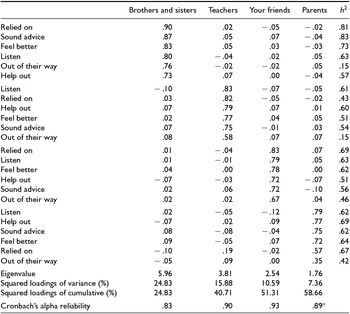
An exploratory factor analysis with maximum likelihood extractions and oblique rotation of the total 24 items rendered the pattern as expected, with six items loading relatively independently on the four factors representing the SSs at Time 1 (Table 1). The latent factor of brothers and sisters’ support was the first factor and accounted for 24.83% of the variance. The subsequent factors contributed sufficiently to the communality, with teachers accounting for 15.88%, friends for 10.59%, and parents for 7.36% of the variance. Similarly, the reliabilities of the four factors were also very high, ranging from .83 to .93. The factor loading of each item (Table 1) was above the significance level for the sample size (Hair, Black, Babin, Anderson, & Tatham Reference Hair, Black, Babin, Anderson and Tatham2010).
Factor Loadings for Exploratory Factor Analysis With Oblique Rotation of the SS Items

Note: Eigenvalues have been rounded to hundredths. Oblique rotation method with Kaiser normalisation as factors were expected to associated. h2 refers to be the extraction communalities.
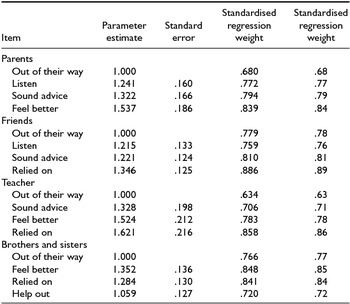
To establish the structure of the items to factors a confirmatory factor analysis was completed using Time 2 data. A number of items were eliminated because they did not contribute to a simple factor structure. Improvements to the fit were made after examination of the modification indices and the standardised residual covariances, and eight items were removed. The resulting fit indices from the above model were CFMIN/df = 1.53; RMR = .04; GFI = .88; AGFI = 0.84; RMSEA = 0.06; CFI = .95 required further adjustment. After removing eight items, the final model (CFMIN/df = 1.38; RMR = .04; GFI = .90; AGFI = 0.86; RMSEA = 0.05; CFI = 0.96) was generated, which was a satisfactory fit. The final model was comprised of four factors with four items each (Table 2).
Regression Weights Relevant From the CFA of the SS Questionnaire

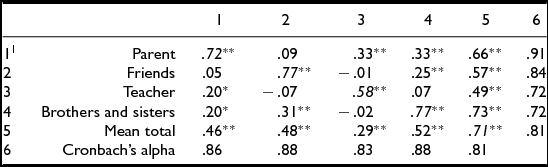
The correlation of the means of factor scores (see Table 3) for both Times 1 and 2 were significant except for pairwise combinations involving friends and parents, friends and teachers, and teachers and siblings. This means that these relationships are relatively independent whereas there is a weak association between parents with brothers and sisters. The other Time 1 to Time 2 correlations were significant and ranged from .20 to .50 for the pairwise combination of relationships. The repeated correlations showed the relative consistency of the factors over time, showing a range of .58 to .77. The Cronbach's alphas were all relatively high (Table 3).
Correlations and Cronbach's Alpha Social Supports at Times 1 and 2
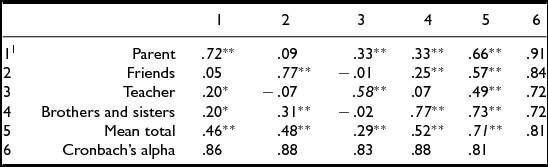
Note: 1Above the diagonal is Time 1 and below is Time 2. The diagonal is the correlation of the same factors at Times 1 and 2; n = 137. *Correlation is significant at the .05 level (2-tailed). **Correlation is significant at the .01 level (2-tailed).
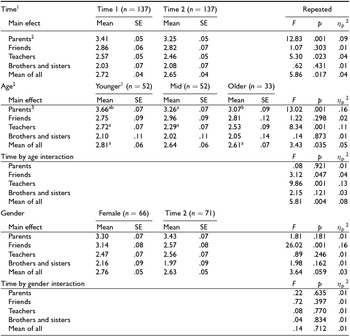
Two split-plot ANOVAs with Bonferroni adjustment of post hoc tests were used to analyse the relationship between the (1) ratings of support (DVs) by age (IV; three levels) and (2) ratings of support (DV) by gender (IV; males and females) compared at both Time 1 and Time 2 (within factor; Table 4). The time-by-age interactions were found for friends and teachers. For friends, the decline between Years 9 and 11 at Time 1 is less than at Time 2. Similarly, the decline between Year 9 and Year 11 for teachers at Time 1 is reversed at Time 2 and replaced with an incline. However, both these effects are relatively small. There was no significant interaction involving gender and time of testing.
Comparison of Means for Times 1 and 2, Age Groups, and Gender

Note: 1The means for the age and gender analyses were derived from Time 2 scores. 2All analyses are completed on Time 2 data unless otherwise stated. 3Post hoc analysis shows that means with the same superscript are significantly different at the .001 level.
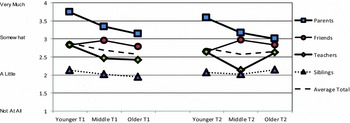
The ANOVAs also revealed significant differences by age for parents and for teachers (Table 4). Younger respondents indicated they received more support from parents than the two older groups of students. Younger students also rated the support from teachers as significantly higher than the support received by students in the mid age group. Females reported receiving more support from friends than males reported. No other gender differences were significant. There were significant differences between Time 1 and Time 2 for parents, teachers, and the mean of all scores, indicating the Time 1 score was significantly higher than Time 2. In all of these analyses, the significant differences were weak (Figure 1).
The interaction of SS with age of students at two time points.

Importantly, the greatest effect was not between time of testing, age groups or genders but was between the support providers. A within-subjects comparison of the support provided showed there were significant differences between each of the supports provided at Time 1, F(1,136) = 110.83, p < .001; ηp = .77, and Time 2, F(1,136) = 111.81, p < .001; ηp = .69 (Figure 1). A relatively consistent, strong, linear relationship was found in each analysis, indicating that the order of the support provided was mostly from parents, then friends, then teachers, and least from siblings, for each time.
Discussion
In summary, a brief measure of SS comprised of items representing instrumental, informational and emotional support from parents, teachers, siblings and friends was developed with good structure and high reliability (Caplan et al., Reference Caplan, Cobb, French, Harrison and Pinneau1975). There was little evidence of consistent, significant differences in the support provided to early, mid- and older-age adolescents, although young adolescents reported significantly more support generally. There was a general trend showing females reported more support than males, significantly so from friends. There were significant declines in the SS provided by parents and teachers from Time 1 to Time 2, and a significant general trend of reduced support over time; however, these effects were weak. By contrast, the greatest variability was shown in the analysis of the SS provided by parents, then friends, teachers and siblings.
The factor structure of the exploratory analysis conformed with the expected pattern involving each of the six different actions from supports to ‘go out of their way’, ‘be relied on’, help the person to ‘feel better’, provide ‘sound advice’, be counted on to ‘listen to you’, and ‘help you out’ (Caplan et al., Reference Caplan, Cobb, French, Harrison and Pinneau1975; Terry et al., Reference Terry, Nielsen and Perchard1993), reflecting the views of House (Reference House1981), House and Kahn (Reference House, Kahn, Cohen and Syme1985) and Thoits (Reference Thoits, Sarason and Sarason1985). The confirmatory model refined the items loading on factors, showing that generally, helping out was not an item contributing to parents, teachers or friends’ SS. Similarly, being listened to did not load on the SS provided by teachers and siblings. Assisting in feeling better was not an item that loaded on SS from friends. Similarly, sound advice was not considered SS provided by siblings. The only item provided by all SSs related to going out of their way to assist. This may suggest that the support provided by different supporters varies and the compounding nature of differential support from a range of SSs provides multiple possibilities to reduce the stress and prompt adaptive responses (Bowles & Hattie, Reference Bowles and Hattie2013). Linking the type of support to the providers makes a more comprehensive model of SS not determined in previous explanations and models of SS, and suggests a reconceptualisation of the SS held by previous models. This study has shown the potential relevance and utility of the measure and how using the structure of the original item set with larger and international groups of respondents would be advantageous for future research (Malecki & Demaray, Reference Malecki and Demaray2002).
The pattern of correlations showed a consistent pattern. Friend support was not associated with support from parents or teachers. More interesting is that the absence of SS associating siblings with friends and teacher support was not associated with friend support. This provides some suggestion that support is differential. Each group of supporters provides support that is consistent with support provided by other group members, but the level of support may be largely defined by an adolescent/adult division. The only significant correlation between adults and adolescents was for siblings and parents in a weak, significant relationship, indicating a family support factor may work at times. Given that SS is provided within social contexts, and given the complexity of relationships, it may be that social support is best conceived from a combined stress buffering (Cohen & Wills, Reference Cohen and Wills1985; Davis et al., Reference Davis, Gavazzi, Scheer and Uppal2011; Uchino, Reference Uchino2009) and ecological model (Bronfenbrenner, Reference Bronfenbrenner1979). That is, social support is generally considered accessible, available and provided by all supports when not activated, but the support measured in this study varies by SS providers, depending on the context and need. This is reflected in the relative independence of the factors defined in this research compared with the CASSS (Malecki & Demaray, Reference Malecki and Demaray2002), with test–retest reliability over an 8-week time period very similar in range (.58–.77). Each of the coefficient alphas was sufficiently high to use in future research (Boyle, Reference Boyle1991).
In line with Bokhorst and colleagues (Reference Bokhorst, Sumter and Westenberg2010), SSs remained relatively consistent across adolescence except for teachers, who at Time 2 showed a significant increase for older students compared to Year 9, and parents, who showed a consistent decline from Year 7 to Year 9 and Year 9 to Year 11. Teacher support may be explained by an end-of-semester effect in which students have become aware of the support of teachers for academic success (Hattie, Reference Hattie2013). Gender effects have been previously shown, with females indicating more support than males from teachers, classmates and friends (Bokhorst et al., Reference Bokhorst, Sumter and Westenberg2010; Helsen et al., Reference Helsen, Vollebergh and Meeus2000; Malecki & Demaray, Reference Malecki and Demaray2002). The only significant difference found in this research was for parents and teachers, but these effects were small. Taken together, the pattern of effects tends to suggest that the construct of SS may be relatively stable but may vary and fluctuate given specific contexts, such as is shown here, where teachers may provide more support for late adolescents later in the semester. It may be that teachers have a greater utility for adolescence in attending to the challenges of late high school, and by this stage fewer teachers are having a more profound educative and personal relationship with students. One important implication of this research is not to assume that SSs are perceived by adolescents as automatically supportive, even though they may be able to be supportive. Further, that intervention programs involving SSs, such as siblings as agents, may be improved by addressing elements of the specific relationship and how to improve them (if necessary) in conjunction with other content and activities in the program. This may improve and increase the network of supports available to the adolescent.
Finally, the support provided to adolescence by individual SSs explains a very large variance, as shown in Figure 1. At both Time 1 and Time 2, significant effects were shown for each combination of parents, friends, teachers and siblings, in that order. These results are consistent with the order of SS found in the use of the Social Support Scale for Children and Adolescents (Bokhorst et al., Reference Bokhorst, Sumter and Westenberg2010). Importantly, the ratings of the level of support across the four relationships ranged from a little to above somewhat, with the average support provided being between a little and somewhat. This indicates that the perception of support could be improved for all and even the best SSs. For example, elevating the support provided by siblings, the lowest rating supporters, may have a profound influence on an adolescent.
Future research into whether specific groups of adolescents — for example, males, those participating in sporting activities, youth clubs, members of specific cultural groups —receive more social support, and whether there is an effect of social activity and engagement that influences this perception would be helpful. Further, identifying the groups who are receiving large and low amounts of support, how this is manifested and the associated consequences, is important. Investigating the utility and acceptance of support, within context, is also worthwhile as such information will provide for targeted and effective support that is appreciated and likely to enhance wellbeing and mental health (Froland et al., Reference Froland, Brodsky, Olson and Stewart1979; Chronister et al., Reference Chronister, Johnson and Bervan2006; Thoits, Reference Thoits2011). Considering the salience of the SS provided by other significant people in adolescents’ networks would also add to the quality of our understanding of SS (Furman & Buhrmester, Reference Furman and Buhrmester1985). Assumed throughout this research is the benefit of SS and its link to positive psychological and other outcomes. This may not always be the case as some SSs may be instrumental in introducing adolescents to antisocial or risk-taking behaviour, and unhealthy habits may be introduced to the individual through ostensibly supportive social networks (Bowles, Reference Bowles2008). These relationships and their outcomes are worthy of investigation. This study has also shown the potential relevance and utility of the measure, but further establishing the consistent structure of the original item set with large and international respondents would be valuable. Finally, establishing the applicability of the questionnaire to age groups other than adolescents would be advantageous for future research. For example, investigating the SS available from significant others at key periods of transition and afterwards, such as adolescence and adolescence to adulthood, would be useful to service providers.
In conclusion, this research adds to the extant literature by considering the stability of SS for adolescents of three different age groups, and provides a definition of a brief measure of social support that has the potential to be used in a number of settings in future. The results show the consistency of the findings over a short time period and the small variability due to age and gender. It provides confirmation of the findings of previous researchers and highlights the low level of support that adolescents perceive that they receive from some of their most significant others, and that there is a considerable range in the perceived support from adults and less variability in the supporters of similar age (friends and brothers and sisters) as adolescents get older. It also highlights the need for further research to improve SS provided to adolescents and informs the debate on the utility and measurement of SS (Wills & Shinar, Reference Wills, Shinar, Cohen, Underwood and Gottlieb2000).
Acknowledgment
As the first author is the Editor of the Journal of Relationships Research, the editorial management of the double-blind review process of this manuscript and the decision to publish was managed by a member of the Editorial Board, independent of the Editor.