


Introduction
Obsessive-compulsive disorder (OCD) is ranked by the World Health Organization (WHO) as one of the top 20 most burdensome diseases in the world. It is now recognized as a mental health condition that affects children and young people, and prevalence estimates for childhood OCD range from 0.5% to 4% in epidemiological studies (e.g. Heyman et al., Reference Heyman, Fombonne, Simmons, Ford, Meltzer and Goodman2001). Without treatment, OCD can be chronic, persisting into adulthood and causing considerable disruption to a child's social, educational and family life. Expert consensus recommends that all children and adolescents with OCD should be offered CBT (National Institute for Health and Clinical Excellence [NICE], 2005).
Many children and young people with OCD are unable to access CBT for a variety of reasons, including a lack of trained therapists, or geographic, financial and social constraints restricting access to specialized services. In addition, aspects of the illness itself can prevent attendance at mental health services. Current mental health policies are demanding equal access to effective treatment, emphasizing the need to explore alternative models of treatment delivery (NICE, 2005). There is emerging evidence from the adult OCD literature that a variety of technologies may be used to deliver effective CBT in ways other than face-to-face therapy. For example, the effectiveness of telephone-administered CBT (TCBT) has recently been compared with face-to-face treatment in adults with OCD, and clinical outcome was equivalent across both conditions at post-treatment and at 6-month follow-up (Lovell et al., Reference Lovell, Cox, Haddock, Jones, Raines, Garvey, Roberts and Hadley2006).
This pilot study therefore sought to establish the feasibility and clinical outcome of telephone CBT for young people with OCD. It was hypothesized that TCBT would be an effective treatment for OCD, as evidenced by significant reduction in symptoms of OCD.
Method
Participants
Participants were 10 young people (8 males, 2 females) aged 13–17 years. All participants were outpatients referred for treatment to a specialist outpatient clinic for childhood OCD in the South London and Maudsley NHS Trust. Reason for referral in all cases was for treatment of OCD. Mean age of onset of OCD was 8 years (range 5–15 years). Five young people were taking a stable dose of a selective serotonin reuptake inhibitor (SSRI) at the time of referral. Comorbid diagnoses included Tourette Syndrome (n = 2), another ICD-10 Axis I anxiety disorder (n = 2), current major depression (n = 2), and an eating disorder (n = 1). One young person suffered from cystic fibrosis.
Inclusion criteria
Inclusion criteria were broad so as to reflect the clinical characteristics that are typical of young people with significant OCD. Inclusion criteria were: (a) a primary ICD-10 diagnosis of OCD; (b) a Children's Yale Brown Obsessive Compulsive Scale (C-YBOCS) score of ≥ 16; (c) access to either a landline or a mobile telephone; (d) parental consent and young person consent or assent; and (d) medication-free or a stable dose of medication for 12 weeks prior to study entry. Exclusion criteria were: (a) obsessional slowness; (b) current alcohol or substance misuse; (c) current suicidal ideation and intent; (d) a diagnosed learning disability (IQ < 70) or developmental disability (e.g. an autism spectrum disorder).
Ethical approval
The study was approved by the Research Ethics Committee of the South London and Maudsley NHS Trust/Institute of Psychiatry, King's College London.
Participant attrition
Ten participants were screened for inclusion in the study, and all consented/assented to participation. Participants were consecutive referrals to the clinic who needed and wanted CBT for OCD, but lived too far away from the clinic to travel for weekly face-to-face treatment. All participants had received previous treatment at their local Child and Adolescent Mental Health Service, and referral to a specialist service was sought when OCD symptoms remained impairing. No participants were excluded because they did not meet criteria. One participant was removed from the study prior to completing the treatment as he discontinued medication and became increasingly depressed with increasing suicidal ideation. He was referred back to his local Child and Adolescent Mental Health Service for closer monitoring of his mental state, and for management of his mood. One participant was referred for inpatient treatment following the completion of post-treatment measures as her OCD continued to be severely impairing. Data for these participants are included in analyses on a last observation carried forward, where the last observation was the assessment completed prior to their removal from the study. This analytic strategy was chosen to ensure that observations of symptom severity were not reflective of additional treatment received outside of the study protocol.
Assessment
All participants completed a face-to-face assessment, consisting of a clinical interview with one or both parents and a semi-structured interview with the child using the Children's Yale-Brown Obsessive-Compulsive Scale (CY-BOCS; Scahill et al., Reference Scahill, Riddle, McSwiggin-Hardin, Ort, King, Goodman, Cicchetti and Leckman1997), which was the primary outcome measure. Diagnosis was confirmed in a multidisciplinary team, including a psychiatrist and psychologist experienced in the assessment and treatment of childhood OCD. An additional child and parent measure of OCD severity was obtained: the Children's Obsessive Compulsive Inventory (ChOCI; Uher, Heyman, Turner and Shafran, Reference Uher, Heyman, Turner and Shafran2008). Assessments were completed at baseline, post-treatment, and 6-month and 12-month follow-up.
Procedure
Following assessment and consent to participation as described, treatment sessions were arranged on a weekly basis at times agreed with the young person and their parents. Treatment was conducted according to a standardized youth-friendly CBT treatment manual that is routinely used and offered to young people who attend the clinic for face-to-face treatment. Young people receive a workbook that provides worksheets for them to record their homework tasks. Treatment was provided by three therapists, all experienced in CBT treatment for OCD. Post-treatment data were collected at the end of the scheduled sessions.
Data analysis
Repeated-measures analyses of variance were conducted on each of the outcome measures to assess overall improvement across the treatment and follow-up periods. The Bonferroni correction was used to control for Type I errors. Treatment effect size was calculated using a modified version of Cohen's d to evaluate within-treatment effects. As noted above, results are presented using a last observation carried forward method for all 10 participants as this represents the most conservative analyses.
Results
Treatment outcome
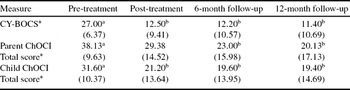
Means (and standard deviations) for the measures are presented in Table 1. The clinician-rated CY-BOCS was used as the main outcome measures. Results revealed a significant decrease in OCD symptom severity as reflected by CY-BOCS scores, F (1.45, 13.07) = 17.56, p < .01, and pairwise comparisons revealed that the pre-treatment mean score was significantly different to the post-treatment and follow-up mean scores. At post-treatment, 7 of the 10 participants (70%) had a CY-BOCS score of 10 or below, which is equivalent to a subclinical level of symptomatology, and this improvement was maintained over the 12-month follow-up period.
Means (standard deviations) for outcome measures, using a last observation carried forward method (n = 10)

Note: *significant differences between mean scores at p < .05 level;
a and b denote significant differences in means, adjusted for multiple comparisons using the Bonferroni correction.
For both the adolescent and the parental report OCD symptom measures, there were significant decreases in OCD symptom severity, (F [1.86, 16.74] = 6.79, p < .01; F [1.66, 11.62] = 12.80, p < .01 respectively). Pairwise comparisons revealed that the pre-treatment mean scores were significantly different to the mean scores obtained at post-treatment and follow-up.
Estimating treatment effects
The within-treatment effect was calculated using a modified version of Cohen's d, and revealed an effect size of 2.27, which represents a large effect size.
Participant acceptability and program feasibility
Acceptability of telephone CBT was assessed from the participants' perspective by asking families to provide open-ended feedback about the program. Feedback was sought via a focus group facilitated by clinicians who were not members of the treating team. Comments received indicated that families found the telephone treatment convenient (less travel time, less time absent from work and school), flexible (telephone calls could be made even when the family were away from home or when OCD symptoms prevented family members from being in the same room), that it made it possible for them to access a service that would otherwise have been unavailable, and that it was less stressful than attending a clinic. Family involvement in treatment was possible through speaking with both young people and their parents in either a tele-conference format or sequentially on the telephone.
Discussion
The results of this pilot study suggest that telephone-administered CBT may be an effective and efficacious model of service delivery for young people with OCD. Seven out of 10 young people treated (70%) achieved remission of their OCD, as assessed by a CY-BOCS score <10 at post-treatment and these gains were maintained at follow-up. Telephone CBT offers promise in terms of increasing the availability and accessibility of CBT. The study adds to the evidence base for the efficacy of CBT for OCD, and to the small but accumulating evidence suggesting that CBT treatment can be effectively delivered using a range of service delivery models and at different intensities other than the traditional, weekly, individual face-to-face treatment model (Turner, Reference Turner2006).
Interpretation of the findings needs to be considered in the context of methodological limitations. The sample size is small and the study uncontrolled. There is evidence that childhood OCD symptoms do not remit/improve in a waiting list control group, but further controlled research is required to carefully evaluate the efficacy of TCBT, particularly compared to a face-to-face treatment model that represents the usual model of care. Post-treatment and follow-up assessments were not carried out by independent or blind raters. This leaves open the possibility that assessment bias or expectancy effects inflated outcomes. It is therefore encouraging that self- and parent-report measures of OCD symptom severity resulted in significant change over the course of treatment, and that these changes were maintained over the follow-up period.
This uncontrolled pilot study demonstrates that telephone cognitive-behaviour therapy achieves good clinical outcomes in young people with OCD and suggests that it is both a feasible and acceptable way of delivering psychological treatment. Randomized, controlled trials are required to establish whether telephone-administered therapy can increase access to an effective treatment for paediatric OCD, and offer further choice to service users with regard to mode of treatment delivery.
Acknowledgements
We are grateful to Chloe Volz, Helen Knight, Hilary Mack and Sarah Robinson for their assistance in completing clinical assessments as part of this study. This research was supported by a grant from the Health Services Research Committee, South London and Maudsley NHS Foundation Trust.



Comments
No Comments have been published for this article.