Introduction
Micas are major rock-forming minerals that are abundant in the Earth’s continental crust (Brigatti & Guggenheim, Reference Brigatti and Guggenheim2002). They are regarded as recorders of the evolution of metallogenic environments and of changes in ore-forming fluid conditions (Lacalamita et al., Reference Lacalamita, Mesto, Scordari and Schingaro2012a; Xu & Veblen, Reference Xu and Veblen1995). Micas are 2:1 phyllosilicates (or T-O-T type layer silicates), with monovalent and, less frequently, divalent cations occurring in the interlayer regions (Nespolo, Reference Nespolo1999; Pauling, Reference Pauling1930). An ideal single mica layer is characterized by monoclinic C2/m space group symmetry, the surface oxygen atoms of the tetrahedral sheets in a mica layer are related by a sixfold axis perpendicular to the (001) plane (Bailey, Reference Bailey1984; Nespolo & Ďurovič, Reference Nespolo, Ďurovič, Mottana, Sassi and ThompsonGuggenheim2002; Ross et al., Reference Ross, Takeda and Wones1966). Therefore, a single layer can fit laterally on an adjacent layer in six possible orientations, with relative layer rotations of 0°, ± 60°, ± 120°, and 180° about an axis (c*) perpendicular to (001) (Bailey, Reference Bailey1984; Ferraris & Ivaldi, Reference Ferraris and Ivaldi2002; Ross et al., Reference Ross, Takeda and Wones1966). Mica polytypism is thus determined by the number of layers that can be arranged in a particular rotational sequence. A graphical method describing the 1M, 2M 1, 2M 2, 2O, 3T, and 6H polytypes was presented for stacking sequences of the six standard mica polytypes (Guinier et al., Reference Guinier, Bokij, Boll-Dornberger, Cowley, Jagodzinski, Krishna, Zvyagin, Cox, Goodman, Hahn, Kuchitsu and Abrahams1984; Ross et al., Reference Ross, Takeda and Wones1966; Smith & Yoder, Reference Smith and Yoder1956). In addition, Ross et al. (Reference Ross, Takeda and Wones1966) derived all 4-layer polytypes, and Xu and Veblen (Reference Xu and Veblen1995) derived all 5-layer polytypes involving 120° rotations.
Mica polytypism has been well investigated for a wide range of geological settings, and the frequency of occurrence of mica polytypes has been shown to be a function of crystallization environments (Bailey, Reference Bailey1984; Fregola et al., Reference Fregola, Capitani, Scandale and Ottolini2009; Lacalamita et al., Reference Lacalamita, Scordari, Schingaro and Mesto2012b; Ross et al., Reference Ross, Takeda and Wones1966; Smith & Yoder, Reference Smith and Yoder1956; Xu & Veblen, Reference Xu and Veblen1995). For example, the 1M polytype is the most common in biotite, followed by 2M 1 and 3T, and they may coexist with other long-period/complex polytypes (Baronnet & Kang, Reference Baronnet and Kang1989; Bozhilov et al., Reference Bozhilov, Xu, Dobrzhinetskaya, Jin and Green2009; Fregola et al., Reference Fregola, Capitani, Scandale and Ottolini2009; Nespolo, Reference Nespolo1999, Reference Nespolo2001; Pignatelli et al., Reference Pignatelli, Dusek, De Titta and Nespolo2011; Ross et al., Reference Ross, Takeda and Wones1966). An unusual arrangement of atoms or staggering deviation of layers leads to a change in the local symmetry (Baronnet & Kang, Reference Baronnet and Kang1989; Nespolo & Ďurovič, Reference Nespolo, Ďurovič, Mottana, Sassi and ThompsonGuggenheim2002). Biotite with long-period/complex polytypes occurs frequently in volcanic rocks due to non-equilibrium and a complex crystallization history (Fregola & Scandale, Reference Fregola and Scandale2011; Ross et al., Reference Ross, Takeda and Wones1966; Sunagawa et al., Reference Sunagawa, Endo, Daimon and Tate1968; Tomisaka, Reference Tomisaka1958, Reference Tomisaka1962; Vand & Hanoka, Reference Vand and Hanoka1967; Xu & Veblen, Reference Xu and Veblen1995). Thus far, complex biotite polytypes have been identified in nature, such as several 4-layer polytypes (Pignatelli et al., Reference Pignatelli, Dusek, De Titta and Nespolo2011; Ross et al., Reference Ross, Takeda and Wones1966; Takeda & Donnay, Reference Takeda and Donnay1965; Zhukhlistov et al., Reference Zhukhlistov, Zvyagin and Pavlishin1988), 5-layer polytypes (Baronnet, Reference Baronnet1992; Pignatelli & Nespolo, Reference Pignatelli and Nespolo2011; Xu & Veblen, Reference Xu and Veblen1995), 32- and 36-layer mixed rotation polytypes (Kogure & Nespolo, Reference Kogure and Nespolo1999), and a long-periodicity 94-layer polytype (Fregola & Scandale, Reference Fregola and Scandale2011). The coexistence of short- and long-period polytypes in the same occurrence is, however, extremely rare (Pignatelli et al., Reference Pignatelli, Faure and Mosser-Ruck2016; Ross et al., Reference Ross, Takeda and Wones1966), and the origin of this coexistence is poorly understood.
Several hypotheses have been proposed to explain the formation of polytypes and polytype coexistence (Baronnet & Kang, Reference Baronnet and Kang1989; Fregola & Scandale, Reference Fregola and Scandale2011; and references therein), in which the effect of chemical composition rather than structure considerations is one of the most controversial. Some studies proposed that the chemical composition is an important controlling factor (Baronnet & Kang, Reference Baronnet and Kang1989; Baronnet et al., Reference Baronnet, Nitsche and Kang1993; Fregola et al., Reference Fregola, Capitani, Scandale and Ottolini2009; Güven & Burnham, Reference Güven and Burnham1967; Stöckhert, Reference Stöckhert1985; Xu & Veblen, Reference Xu and Veblen1995). However, different polytypes with similar compositions have been found to coexist (Bigi & Brigatti, Reference Bigi and Brigatti1994; Brigatti et al., Reference Brigatti, Guidotti, Malferrari and Sassi2008; Fregola & Scandale, Reference Fregola and Scandale2011; Lacalamita et al., Reference Lacalamita, Mesto, Scordari and Schingaro2012a; Laurora et al., Reference Laurora, Brigatti, Mottana, Malferrari and Caprilli2007; Takeda & Ross, Reference Takeda and Ross1975). The formation of mica polytypes is believed to be a two-stage process involving nucleation and crystal growth (Baronnet & Kang, Reference Baronnet and Kang1989). During a rapid crystallization of biotite in extrusive rocks, the rapid change in physicochemical conditions induces complex structural oscillations (Xu & Veblen, Reference Xu and Veblen1995), leading to nucleation at non-equilibrium conditions (Pignatelli et al., Reference Pignatelli, Faure and Mosser-Ruck2016; Ross et al., Reference Ross, Takeda and Wones1966). Although theories involving screw dislocation and mica polytypes seem to rationalize the occurrence of long-period complexes (Baronnet & Kang, Reference Baronnet and Kang1989; Pignatelli et al., Reference Pignatelli, Dusek, De Titta and Nespolo2011; Ramsdell, Reference Ramsdell1947; Sunagawa et al., Reference Sunagawa, Endo, Daimon and Tate1968; Tomisaka, Reference Tomisaka1958, Reference Tomisaka1962), such theories are still under debate (Fregola & Scandale, Reference Fregola and Scandale2011; and references therein) because of a lack of direct evidence at the atomic scale.
High-resolution transmission electron microscopy (HRTEM) is a powerful technique to reveal the stacking sequence of micas (Fregola & Scandale, Reference Fregola and Scandale2011; Nespolo & Ďurovič, Reference Nespolo, Ďurovič, Mottana, Sassi and ThompsonGuggenheim2002; Xu & Veblen, Reference Xu and Veblen1995). The stacking sequences of long-period and inhomogeneous mica polytypes require HRTEM images along two zone axes rotated 30° apart about the c-axis (e.g. [010] and [110] zone axes). The objective of the current study was to use HRTEM in combination with other in situ microscopy techniques to investigate and identify the coexisting polytypes of the biotite in rhyolite from the Long Valley Caldera, California, USA. This is to be followed by a discussion of a possible formation mechanism related to non-equilibrium nucleation and spiral growth in order to understand the rare coexistence of standard and complex polytypes of biotite. The work aimed to provide new evidence and insight to explain the structure and genesis of complex polytypes of biotite and their coexistence with other polytypes.
Materials and Methods
Biotite phenocrysts occurring as fine platelets without alteration were collected from a rhyolite at the Long Valley Caldera. The Long Valley magmatic system occurs along the eastern part of the Sierra Nevada Mountains on the western edge of the Basin and Range Province (Metz & Mahood, Reference Metz and Mahood1991). The caldera remains thermally active, with numerous hot springs and fumaroles, and the rocks have undergone considerable deformation, seismicity, and other disturbances in recent years. A major explosive eruption occurred at 0.73 Ma, leaving behind in the caldera a basalt containing a large volume of pre-caldera high-silica rhyolite lava; biotite occurs as the most abundant mafic phenocryst in the lavas. Ash-fall deposits containing biotite also occur (Metz & Mahood, Reference Metz and Mahood1991).
Single biotite platelets were examined via light microscopy. For the micro-X-ray diffraction (µXRD) analysis, patterns were recorded using a Rigaku D-MAX RAPID-V diffractometer (Tokyo, Japan) with a microfocus rotating anode source (MicroMax-007HFM X-ray generator of Rigaku; Tokyo, Japan) and a curved imaging plate detector. The diffractometer was operated with CuKα radiation (λ = 1.5418 Å) generated at 40 kV and 30 mA. The µXRD patterns were collected in reflection mode using a 0.03 mm collimator and a collection time of 1000 s. The data were collected as two-dimensional images and then converted into º2θ-intensity profiles using the Rigaku 2DP software. For each XRD pattern the interpretable º2θ region was selected manually.
The elemental composition of biotite was determined on a JEOL JXA-8230 (Tokyo, Japan) electron probe microanalyzer (EPMA) at operating conditions of 15 kV, 20 nA, and ~ 3 μm beam diameter. The ZAF correction method was used for data reduction. The standards used for data correction were orthoclase for K, albite for Na, BaF2 for F, chrome-diopside for Si and Ca, olivine for Mg, magnetite for Fe, rutile for Ti, rhodonite for Mn, and pure aluminum metal for Al. All the mentioned standard metals/minerals for EPMA were produced by Structure Probe, Inc (SPI) Supplies (West Chester, Pennsylvania, USA). Because of a relatively large Fe content, the biotite samples were identified to be Fe-rich (Guggenheim et al., Reference Guggenheim, Bain, Bergaya, Brigatti, Drits, Eberl, Formoso, Galán, Merriman, Peacor, Stanjek and Watanabe2002).
Biotite samples were oriented and embedded in epoxy resin and dried at 100°C for 5 h. After solidification and cooling, ultrathin sections ~ 70 nm thick were sliced with a diamond knife using a Leica EM UC7 ultramicrotome (Wetzlar, Germany). The ultrathin samples were then arranged on carbon-coated copper microgrids, as described by He et al. (Reference He, Yang, Ma, Su, Xian, Zhu, Teng and Guggenheim2021). The TEM and related investigations were performed at 200 kV voltage using an FEI Talos F200S field-emission transmission electron microscope (Brno, Czech Republic), coupled with two SuperX high-resolution energy-dispersive spectrometers (Thermo Fisher, Brno, Czech Republic) and a high-angle annular dark-field (HAADF) detector. Z-contrast images were acquired using a camera length of 160 mm to maximize the contrast variations between different atoms in the HAADF images (Xu et al., Reference Xu, Shen, Konishi and Luo2014, Reference Xu, Shen and Konishi2015). High-resolution scanning transmission electron microscopy (HRSTEM) images were filtered using Gatan Digital Micrograph (version 3.11; AMETEK, Inc., San Diego, California, USA) to remove the noisy contrast generated by amorphous materials.
The energy-dispersive X-ray spectroscopy (EDS) information from the investigated samples was collected from thin areas under the same conditions to ensure consistency of intensity and accurate comparison to the standards. The EDS sampling time was 6 min to prevent any beam damage to the biotite sample; the spot size was ~1 nm, the scanning range was ~100 nm × 300 nm, the sample thickness was <30 nm, and the stage tilt was zero. The EDS semi-quantitative analytical lines were NaKα, MgKα, AlKα, SiKα, KKα, TiKα, MnKα, and FeKα (Figs. S4a,b). The mass concentrations of cation oxides (e.g. SiO2, MgO) were calculated from the element ratio and k-factors. The composition of a standard biotite (calibrated using the electron probe microanalyzer) was used to quantify the elemental fractions of Al, Mg, Fe, Ti, Mn, K, and Na in the samples (Table S1).
Results
Micro-XRD and SAED Patterns
Polytypes of Fe-rich biotite can be determined by the characteristic reflections in X-ray diffraction patterns (Takeda & Ross, Reference Takeda and Ross1975). The micro X-ray diffraction (µXRD) patterns (Figs. 1a and S1a,b) show coexisting 1M and 2M 1 polytypes and 2M 1 and 3T polytypes, respectively. The reflections at 34.04°2θ (2.63 Å), 27.52°2θ (3.24 Å), and 54.53°2θ (1.68 Å) in the top μXRD pattern were attributed to the
 31, 112, and
 35 reflections of the 1M Fe-rich biotite, respectively (PDF card No. 80–1108 CuKα). In the lower μXRD pattern, the diffraction peaks at 26.25°2θ (3.39 Å), 30.62°2θ (2.91 Å), 33.11°2θ (2.70 Å), and 35.84°2θ (2.50 Å) were attributed to the 106, 108, 109, and
 4 reflections of the 3T Fe-rich biotite (PDF card No.73–1659 CuKα), respectively. Note that the reflections at 27.28°2θ (3.28 Å), 36.83°2θ (2.44 Å), and 55.09°2θ (1.67 Å) in the two μXRD patterns correspond to the 114, 133, and 139 reflections of the 2M 1 Fe-rich biotite (PDF card No.83–1366 CuKα), respectively. The 1M, 2M 1, and 3T polytypes were identified also by SAED patterns recorded from the [110] zone axis (Fig. 1b–d). The μXRD and SAED patterns (Fig. 1) revealed the polytype mixture in the Fe-rich biotite monocrystal, indicating that a complex polytype occurs in the Fe-rich biotite from the rhyolite.
μ-XRD patterns, SAED patterns, and HRTEM image of biotite crystals: a Representative μ-XRD patterns of biotite samples and standard 1M, 2M 1, and 3T-polytype PDF cards. b,d SAED patterns of b 1M, c 2M 1, and d 3T biotite crystals. e,f Representative HRTEM image e and SAED pattern f from [010] zone axis. Arrows in f are the projection of the stacking vectors. The space-fixed azimuthal orientation symbols of Zvyagin in (001) projection is labeled at the lower right, with the length of all stacking vectors being equal to a/3. As the orientation symbols show, when viewed along [010], both stacking vectors 2 and 4 can produce component vectors that are parallel to the [100] direction (a-axis direction) and is equal to + a/6

[010] Zone Axis SAED Pattern and HRTEM Image
The SAED patterns of 1M, 2M 1, 3T, and the two 4-layer period polytypes taken along the [010] zone axis were identical (Fig. 1e), and the polytypes cannot be distinguished from each other. The representative SAED pattern showed that the h0l reflections fit the characteristics of the subfamily-A biotite (Nespolo, Reference Nespolo1999). In addition, as shown in the HRTEM image from the [010] zone axis (Fig. 1f), the projection of the stacking vectors points to the right, producing a shift of a/6 along the a direction, which agrees well with the SAED patterns along the [010] direction (Nespolo, Reference Nespolo1999). Considering the space-fixed azimuthal orientation symbols of Zvyagin (as labels shown in lower right of Fig. 1f), each stagger of these stacking vectors characterized by a 120° rotation between the adjacent layers produced a vector parallel to the [100] direction and equal to + a/6 for both the stacking vectors 2 and 4 pointing to the right. For stacking vector 6, the stagger could be –a/3 pointing to the left, which is equivalent to + a/6 pointing to the right, when viewed along the [010] zone axis (Fregola & Scandale, Reference Fregola and Scandale2011; Zvyagin, Reference Zvyagin1987, Reference Zvyagin1997). The HRTEM images from the [010] zone axis suggest the occurrence of subfamily-A of mica polytypes in the samples, but the stacking vectors 2, 4, and 6 cannot be discriminated. To obtain the “Ross-Takeda-Wones (RTW)” expression for distinguishing and describing mica polytypes (Ross et al., Reference Ross, Takeda and Wones1966), layer rotations associated with image shifts need to be determined. HRTEM images viewed along the [110] or [1
 0] zone axes provide important information about stacking orientation for the polytypes involving 120° rotations only (Banfield & Murakami, Reference Banfield and Murakami1998; Baronnet & Kang, Reference Baronnet and Kang1989; Fregola & Scandale, Reference Fregola and Scandale2011; Kogure, Reference Kogure2002; Kogure & Banfield, Reference Kogure and Banfield1998; Xu & Veblen, Reference Xu and Veblen1995).
[110] Zone-axis of the two 4-layer Period Polytypes
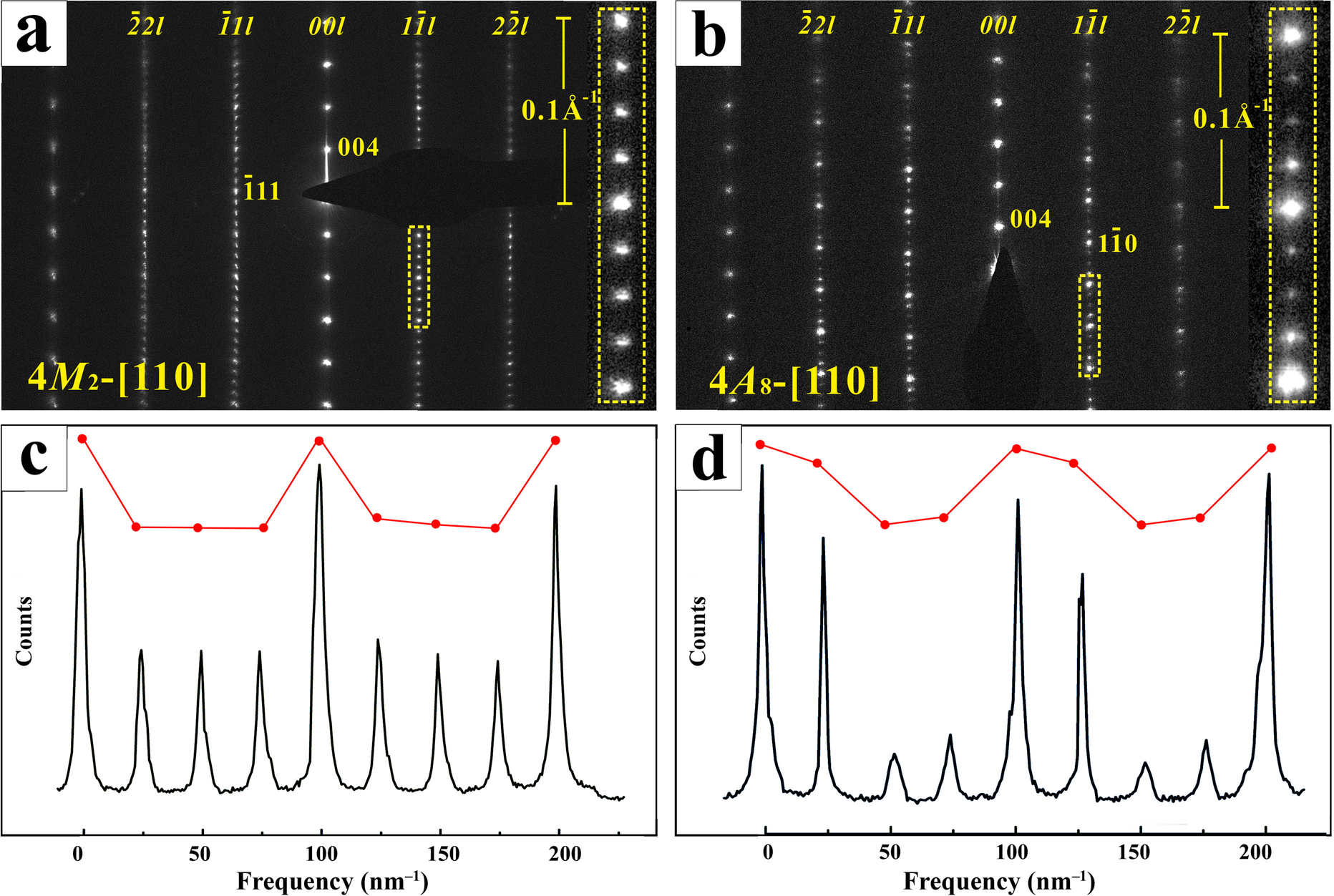
The SAED patterns along the [110] zone axis (Fig. 2a, b) showed strong diffraction spots in both 00 l and 1 l
 rows, with a repetition of ~ 1/10 Å−1, and three additional diffraction spots belonging to the 4-layer polytype that occurred between the host strong spots in the 1 l
 row. The diffraction spot intensities of the two SAED patterns were significantly different (Fig. 2a, b). The diffraction spots in Fig. 2a showed intensity characteristics: strong–weak–weak–weak–strong … (Fig. 2c), corresponding to the [0222] stacking sequences. The diffraction spots in Fig. 2b exhibited intensity distribution: very strong–strong–very weak–weak–very strong … (Fig. 2d), attributed to the [002
 ] stacking sequences. Observations and calculations suggested that the intensity distribution of reflections in the reciprocal lattice rows parallel to the c*-axis can be used to infer the stacking sequences corresponding to mica polytypes (Ross et al., Reference Ross, Takeda and Wones1966; Takeda & Ross, Reference Takeda and Ross1975, Reference Takeda and Ross1995). Two 4-layer polytypes that were theoretically speculated by Ross et al. (Reference Ross, Takeda and Wones1966) were identified as 4M 2 (Fig. 2a) and 4A 8 (Fig. 2b), and the latter is the first report in natural samples.
SAED patterns of the two 4-layer polytypes: SAED patterns of a 4M 2 biotite crystal and b 4A 8 biotite crystal. c,d Intensity counts of the two repetition periods of hkl reflections, indicated by the yellow dotted boxes in a and b. Red spots and line segments indicate the trend of the intensity changes

The low-magnification TEM image captured along the [110] zone axis of the 4-layer-polytype Fe-rich biotite domain did not show sufficient variations in contrast, and polytype characteristics could not be determined (Fig. S2a). One-dimensional (1D) lattice fringe images were useful for identifying polytypes (Fregola & Scandale, Reference Fregola and Scandale2011; Iijima & Buseck, Reference Iijima and Buseck1978). The TEM image of a tilted Fe-rich biotite specimen (Fig. S2a), rotated ~3° about the [110] direction, showed clear variations in contrast (Fig. S2b). Along the c-axis, distinctions containing four mica layers repeated periodically more than 15 times. The 1D TEM images of Fe-rich biotite monocrystals displayed dozens of four-layer polytype domains, and two representative biotite domains containing 4M 2 and 4A 8 polytypes are shown in Fig. 3a, b. The low-magnification 1D TEM images showed regular 4-layer (4 nm) periodicity in the range of hundreds of nanometers (Figs. 3a, b and S3a,b, with enlargements of the yellow dashed squares). The fast Fourier transform (FFT) patterns showed that the repetitive period of both 4M 2 and 4A 8 are similar but the sub-cell spot intensities are different for each polytype (Figs. 3a, b and S3a,b, inset at the bottom right), corresponding to different stacking sequences.
One-dimensional (1D) HRTEM images of representative four-layer biotite domains, with fast Fourier transform (FFT) patterns (bottom right of each image) showing a periodic shift after every four layers. a 1D image of the 4M 2 biotite domain with the enlarged HRTEM image in the yellow rectangle, and FFT pattern. b 1D image of the 4A 8 biotite domain with enlarged HRTEM image in the yellow rectangle, and FFT pattern

The stacking sequences of the two 4-layer polytype domains were determined via the atomic-resolution HAADF–STEM images taken along the [110] zone axis (Fig. 4a, b). In the HAADF–STEM (or Z-contrast) images, the intensity (I) of the atom spots is proportional to the atomic number (Z) and the number of atoms (m) along the beam direction (i.e. I ~ mZ
n
) (Pennycook, Reference Pennycook2002). The HAADF-STEM images (Fig. 4a, b) show that the brighter rows were the octahedral sheets (O columns) in the T-O-T sandwiched unit layer, because of the existence of metal cations (i.e. Fe2+) with relatively large atomic numbers. Owing to the resolution limit of the measurement instrument, the cations in the O columns could not be distinguished as separated spots. The darker spots adjacent to the O columns represented tetrahedral sheets (T columns), whereas the interlayer K columns are between two T-O-T unit layers, with a distance of ~0.45 nm between the two adjacent K cations when viewed from the [110] zone axis (Fig. 4a, b). The stacking sequences of 4-layer polytypes (Fig. 4a, b) are [0222] and [002
 ], which were determined by simulation as 4M 2 and 4Tc 8 (i.e. 4A 8), respectively, in Ross et al. (Reference Ross, Takeda and Wones1966). The 4M 2 polytype with a stacking sequence of [0222] meant that these Fe-rich biotite domains had monoclinic (C2) symmetry based on 3T (P3112 or P3212) and 1M, with a preserved twofold axis. On the other hand, the 4A 8 polytype had a stacking sequence of [002
 ] with a monoclinic (C
 ) symmetry, as a result of the preservation of
 (e.g. the inversion center) from the packing of 2M 1 and 1M (off by 60°) only. Both 2M 1 and 1M have unit-cell parameters of a = 0.53 nm, b = 0.92 nm, and c = 4.00 nm, where β = 95.1°.
High-resolution, high-angle annular dark-field scanning transmission electron microscopy images of the two 4-layer long-period biotite domains (4M 2 and 4A 8). The stacking sequences with the RTW symbols are a [0222] and b [002
 ]. The ball-and-stick model displays the corresponding structures of biotite along the [110] zone axis. The purple, green, red, and yellow spheres represent K, (Si, Al), O, and (Mg, Fe), respectively

Composition Analysis
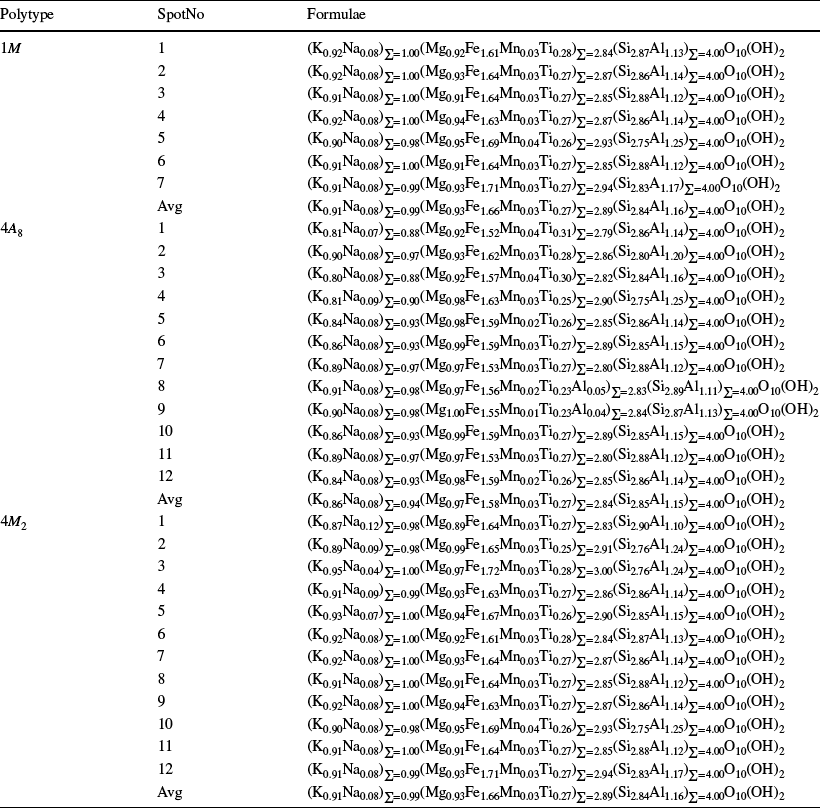
Each Fe-rich biotite domain was analyzed using EDS (see Materials and Methods). The average electron probe microanalysis (EPMA) result was used as the standard mica composition to obtain the k-factors of each element (Table S1). The formulae calculated using the chemical compositions of several 4M 2 and 4A 8 Fe-rich biotite domains, corrected by k-factors, are listed in Table 1. The elemental distribution in a domain was generally homogeneous for a specific polytype (Table 1) but slightly different for other polytypes (Table 1, Figs. 5a and S4-5). The average structural formulae of the two 4-layer Fe-rich biotite polytypes were calculated based on 11 oxygen atoms as follows:
EPMA:

EDS:


Biotite formulae of 1M-, 4A 8-, and 4M 2- biotite based on EDS ratios

a Diagram showing the relationship between the K and Fe contents of 4M 2 and 4A 8 biotite crystals, as calculated using the cation coordination number. b HRSTEM image showing screw dislocations (indicated by the black triangles) throughout a 4A 8 biotite domain. Enlarged red box in b shows a screw dislocation with layers on both sides of the dislocation indicated by means of a black dotted line and the dislocation line indicated with a dotted yellow line

In this calculation, the Fe was assumed to exist as Fe2+, which is the dominant valence state of Fe ions in the samples (Metz & Mahood, Reference Metz and Mahood1991), and share the octahedral sites with Mg ions. The estimated standard deviations (ESD) of Fe, K, Si, and Mg were calculated based on compositional data from EPMA (Table S2), with the formula (Hooper & Eloranta, Reference Hooper and Eloranta1986):

where N, z, and P are the number of compositional data, the element type, and specific content value (stoichiometry used here), respectively. After correction, the EDS calculation results, on average, agreed well with the EPMA test results. The ESD of elements calculated and reported in Table S2 showed that all estimated standard deviations were <5.70%. The effect of thickness and local inhomogeneity had been eliminated as much as possible. A comparison of the elemental composition showed that the Fe and K contents of the 4M 2 Fe-rich biotite were apparently greater than those of the 4A 8 Fe-rich biotite, whereas the contents of other elements showed only a very small difference between the two polytypes (Table 1, Figs. 5a and S5a,b).
Discussion
The Non-equilibrium Nucleation of the two 4-layer Polytypes
Under the crystallization conditions for a specific geological environment, a specific mineral species will have an identical crystal structure and chemical composition (Verma & Krishna, Reference Verma and Krishna1966). Different mica polytypes, however, may coexist in a specimen (Kogure & Nespolo, Reference Kogure and Nespolo1999; Pignatelli & Nespolo, Reference Pignatelli and Nespolo2011; Pignatelli et al., Reference Pignatelli, Dusek, De Titta and Nespolo2011; Ross et al., Reference Ross, Takeda and Wones1966; Rule et al., Reference Rule, Bailey, Livi and Veblen1987). Formation of mica polytypes is a two-stage process, and various basic structures form during the early dislocation-free nucleation and growth process (Baronnet & Kang, Reference Baronnet and Kang1989). The formation of complex polytypes is generally considered to be induced by heterogeneous nucleation (Baronnet, Reference Baronnet1992; Penn & Banfield, Reference Penn and Banfield1998). The coexistence of multiple short/complex polytypes is considered to be related to complex nucleation under non-equilibrium crystallization conditions (Pignatelli et al., Reference Pignatelli, Faure and Mosser-Ruck2016; Xu & Veblen, Reference Xu and Veblen1995). This process explains why complex polytypes occur mainly in rocks related to volcanic eruption, mostly rhyolites (Kogure & Nespolo, Reference Kogure and Nespolo1999; Pignatelli et al., Reference Pignatelli, Faure and Mosser-Ruck2016; Ross et al., Reference Ross, Takeda and Wones1966).
During processes involving rapid eruption and cooling, mineral crystallization occurs rapidly; the differences between local composition and crystallization environment of the magma are, therefore, recorded by mineral structures that are sensitive to small compositional variations, such as micas. Consequently, the complexity of the stacking structure can reflect the variations in crystallization environments determined by the oscillations in local microstructure and chemical composition.
From the perspective of structural equivalence, the two 4-layer mica polytypes can be simplified to a combination of standard polytypes: 1M + 1M + 2M 1 for 4A 8 and 1M + 3T for 4M 2. The 4A 8 and 4M 2 polytypes are probably a result of structure oscillation between different basic polytypes, i.e. 1M, 2M 1, and 3T. Previous studies have suggested that changes in temperature, pressure, and local composition can result in variations in the relative energies of the potential wells for the 1M, 2M 1, and 3T polytypes (Xu & Veblen, Reference Xu and Veblen1995). The 1M polytype is the most common form occurring in biotite in nature, followed by 2M 1, and then 3T, as the latter two are less stable (Ferraris & Ivaldi, Reference Ferraris and Ivaldi2002; Nespolo, Reference Nespolo2001; Nespolo et al., Reference Nespolo, Takeda, Kogure and Ferraris1999; Xu & Veblen, Reference Xu and Veblen1995). The greater stability of 1M has been shown experimentally by monotropic transformations of other polytypes to the unique 1M structure for trioctahedral species (Baronnet, Reference Baronnet1992; Yoder & Eugster, Reference Yoder and Eugster1955). Nevertheless, the 2M 1 and 3T polytypes can still form metastably under special conditions. Crystallization processes will be affected by an external force that is induced by compositional fluctuation of an ore-forming fluid, like rapid cooling. The structural oscillation among the 1M, 2M 1, and 3T polytypes, due to complex interactions between growing crystals and external forces, leads to a nonperiodic or even chaotic stacking sequence like that observed in interstratified layer silicates (Wang & Xu, Reference Wang and Xu2006). Such structural oscillations provide the basic structures for subsequent stable periodic repetition of complex polytypes driven by dynamic factors such as screw dislocations.
As mentioned above, the compositional variations provide a dynamic driving force for structural oscillation (Baronnet, Reference Baronnet1992; Ross et al., Reference Ross, Takeda and Wones1966; Smith & Yoder, Reference Smith and Yoder1956). According to the EDS results (Table 1, Figs. 5a and S5a,b), the Fe and K contents between the two 4-layer Fe-rich biotite polytypes were different. As is shown in Table 1 and Fig. 5a, the 4A 8 Fe-rich biotite domains have lower K and Fe contents than the 4M 2 Fe-rich biotite domains. Baronnet (Reference Baronnet1992) proposed that the type and number of octahedral and interlayer cations can affect polytype formation considerably. Note that the K and Fe contents of the 4M 2 polytype Fe-rich biotite were closer to those of 1M, which is the most stable biotite polytype, and higher than those of the 4A 8 Fe-rich biotite domains (Table 1 and Fig. S5a). Table 1 shows that the 4A 8 polytype features more interlayer and octahedral vacancies in its structure, with higher charge density and higher energy, and therefore lower stability than the 4M 2 and 1M polytypes. To some extent, this result can explain the rare occurrence of 4A 8 in nature relative to 4M 2 (Ross et al., Reference Ross, Takeda and Wones1966; Takeda & Donnay, Reference Takeda and Donnay1965). These complex polytypes formed under rapid cooling from melts, owing to the kinetic barriers preventing the transformation of the polytype phases into the more stable state (i.e. 1M polytype of biotite).
The Growth Mechanism of 4-layer Polytypes
Previous studies have proposed that the formation of complex/long-period polytypes may be due to spiral growth via the oriented attachment of several primary mica platelets (He et al., Reference He, Yang, Ma, Su, Xian, Zhu, Teng and Guggenheim2021; Penn & Banfield, Reference Penn and Banfield1998). Also, the formation of polytypes was attributed to structural control between successive layers during the layer-by-layer growth (Gilmer, Reference Gilmer1977; Stranski, Reference Stranski1928). As described above, biotite commonly occurs in nature as the 1 M polytype because of its thermodynamic stability. However, when crystal growth conditions fluctuate, complex polytypes with stacking sequences involving more than one standard structure can be generated. The equilibrium and kinetic theories related to spiral growth have been used to interpret the formation of long-range ordered complex polytypes (Baronnet, Reference Baronnet1992; Baronnet & Amouric, Reference Baronnet and Amouric1986; Baronnet et al., Reference Baronnet, Amouric and Chabot1976; Vand & Hanoka, Reference Vand and Hanoka1967). Instead of standard biotite polytypes (i.e. 1M, 2M 1, 2M 2, 2O, 3T, and 6H; the 6H polytype has never been found and the 2O polytype has been reported only once, by Ferraris et al. in Reference Ferraris, Gula, Ivaldi, Nespolo, Sokolova, Uvarova and Khomyakov2001), other mica polytypes are formed by spiral growth in the last differentiation stage of magma (Ramsdell, Reference Ramsdell1947; Sunagawa et al., Reference Sunagawa, Endo, Daimon and Tate1968; Pignatelli et al., Reference Pignatelli, Dusek, De Titta and Nespolo2011). Complex polytypes can result from screw dislocations generated by the imperfect oriented attachment of several nanoparticles during the early growth stages (Penn & Banfield, Reference Penn and Banfield1998). Specifically, if two crystals with different stacking sequence come into contact, one domain can simply grow on the surface of the other by spiral growth, leading to a new stacking sequence. At the contact position, the presence of some transition layers, permitted by the necessary structural adjustment between the two, can be observed (He et al., Reference He, Yang, Ma, Su, Xian, Zhu, Teng and Guggenheim2021; Nespolo, Reference Nespolo2001) or not (as in this case). Such a growth mechanism leads to a Burgers vector equal to, or an integral multiple of, the repeat distance of the new basic structure (Baronnet, Reference Baronnet1992; Baronnet & Amouric, Reference Baronnet and Amouric1986; Fregola et al., Reference Fregola, Capitani, Scandale and Ottolini2009; Nespolo, Reference Nespolo1999; Vand & Hanoka, Reference Vand and Hanoka1967).
This growth mechanism can be applied to the formation of the two 4-layer polytypes. The HRSTEM images (Fig. 5b) provide direct evidence of spiral growth, with extensive screw dislocations occurring throughout the 4A 8 polytype Fe-rich biotite domain (indicated by black triangles in Fig. 5b). Similar screw dislocations are found in all investigated domains of 4-layer Fe-rich biotite. Spiral growth provides a mechanism for a 4-layer nucleus of Fe-rich biotite to produce long-range ordered structures. The mechanism also explains the origin of complex long-period polytypes of micas. Combined with the theory of heterogeneous nucleation and spiral growth theories, the occurrence of ordered complex polytypes generally indicates a fluctuating environment and non-equilibrium conditions of crystallization, during rapid cooling (Pignatelli et al., Reference Pignatelli, Faure and Mosser-Ruck2016; Ross et al., Reference Ross, Takeda and Wones1966).
Summary and Conclusions
Five biotite polytypes (i.e. 1M, 2M 1, 3T, 4M 2, and 4A 8) were identified in the Fe-rich biotite phenocrysts within rhyolite from the Long Valley Caldera, California. The 4A 8 polytype is reported in a natural sample for the first time. The structure of the two 4-layer polytypes (i.e. 4M 2 and 4A 8) were determined by SAED patterns, 1D lattice images, and HRSTEM images. By using quantitative EDS measurements, a small difference in chemical composition between the two 4-layer polytypes was found, i.e. the 4M 2 Fe-rich biotite has slightly greater Fe and K contents than 4A 8 Fe-rich biotite.
The coexistence of these polytypes occurs because of rapid cooling and changes of crystallization environments during volcanic eruption, resulting in chemical and structural oscillations and complex nucleation processes, owing to the decompression and degassing of the melts. Although the most abundant polytype in biotite is 1M, other polytypes with high formation energies also occur in the non-equilibrium crystallization environment of the rhyolite magma. Screw dislocations resulting in spiral growth provide a mechanism for the long-range order of these uncommon polytypes. The results from the current investigation suggest an inhomogeneous nucleation and growth mechanism that affects the stacking sequence of biotite. This mechanism explains the origin of long-period polytypes and the intergrowths of diverse polytypes formed during non-equilibrium crystallization.
Supplementary Information
The online version contains supplementary material available at https://doi.org/10.1007/s42860-021-00168-z.
Funding
This study was supported financially by the National Natural Science Foundation of China (Grant Nos. 41921003, 41825003, and 42072044), Youth Innovation Promotion Association CAS (Grant No. 2018387), the Department of Science and Technology of Guangdong Province (Grant No. 2017GC010128 and 2019TX05L169), and the Science and Technology Planning of Guangdong Province, China (2020B1212060055).
Declarations
Conflict of Interest
The authors declare that they have no conflict of interest.