




No CrossRef data available.
Substance abuse hinders desistance in young adults' antisocial behavior
Published online by Cambridge University Press: 01 December 2004
Abstract
We examined two hypotheses about the developmental relation between substance abuse and individual differences in desistance from antisocial behavior during young adulthood. The “snares” hypothesis posits that substance abuse should result in time-specific elevations in antisocial behavior relative to an individual's own developmental trajectory of antisocial behavior, whereas the “launch” hypothesis posits that substance abuse early in young adulthood slows an individual's overall pattern of crime desistance relative to the population norm during this developmental period. We conducted latent trajectory analyses to test these hypotheses using interview data about antisocial behaviors and substance abuse assessed at ages 18, 21, and 26 in men from the Dunedin Multidisciplinary Health and Development Study (N = 461). We found significant individual variability in initial levels and rates of change in antisocial behavior over time as well as support for both the snares hypothesis and the launch hypothesis as explanations for the developmental relation between substance abuse and crime desistance in young men.We thank the Dunedin Study members, Dunedin Unit Director Richie Poulton, Unit research staff, and Study founder Phil Silva. Research assistance was provided by HonaLee Harrington. The Dunedin Multidisciplinary Health and Development Research Unit is supported by the New Zealand Health Research Council. We also thank Alex Piquero for his helpful comments. This research received support from the NIDA (Grant DA15398 and DA13148), NIMH (Grants MH45070 and MH49414), William T. Grant Foundation, and Air New Zealand.
Information
- Type
- Research Article
- Information
- Copyright
- © 2004 Cambridge University Press
Demarcating one of the most striking transitions in normative behavior over the early life course, young adulthood marks a significant shift from a pattern of increasing antisocial behavior in adolescence to emerging desistance. The study of crime desistance offers a unique perspective on the developmental interplay between substance abuse and antisocial behavior during young adulthood. One of the most robust empirical observations in the study of antisocial behavior, the age–crime curve, plots rates of crime against age to show that both prevalence and incidence of offending appear highest during late adolescence and begin to drop off only in young or emerging adulthood (Blumstein, Cohen, & Farrington, 1988; Farrington, 1986). Although the age-related decline in antisocial behavior remains the least understood developmental process in life-course research on crime and psychopathology (Laub & Sampson, 2001), recent studies suggest that substance abuse is highly related to antisocial behavior during this period of desistance (Fergusson & Horwood, 2000; Huang, White, Kosterman, Catalano, & Hawkins, 2001; Krueger, Hicks, Patrick, Carlson, Iacono, & McGue, 2002).
In the present article, our aim was to test the role of substance abuse in the developmental process of desistance from antisocial behavior in young adulthood. To this end, we examined two related questions. First, we examined the extent to which individual differences characterize the process of crime desistance. The age–crime curve is an empirical observation describing a group-level or population-wide trajectory, but it ignores potential for individual differences in desistance. Second, we examined two hypotheses describing the role of substance abuse in the normative pattern of desistance from antisocial behavior during young adulthood. We examined both of these questions in the context of a longitudinal study, where we have repeatedly assessed a cohort of men over an 8-year period as it made the transition from adolescence to adulthood.
The Process of Crime Desistance
Several writers have posited that the population pattern of crime desistance in young adulthood varies in a systematic way across individuals, such that desistance is an individualized process characterized by a decline in antisocial behavior over time that eventually leads to termination or the end of antisocial activity (Bushway, Piquero, Brody, Cauffman, & Mazerolle, 2001; Piquero, Blumstein, Brame, Haapanen, Mulvey, & Nagin, 2001). That is, there are hypothesized to be interindividual differences in intraindividual change in antisocial behavior over time (Laub & Sampson, 2001; Moffitt, 1993). Although prior studies are consistent with this hypothesis, this work has largely relied on measurement strategies, research designs or analytic techniques that are suboptimal to test hypotheses about desistance (Bushway et al., 2001; Laub & Sampson, 2001; Moffitt, 1993).
For example, antisocial behavior has often been assessed through criminal justice records that, unlike self-report measures, introduce the risk that declining rates of antisocial behavior over time will reflect the impact of incarceration, learning to evade detection through experience, change from illegal to legal antisocial activities, or ongoing antisocial behavior that does not lead to arrest. Although self-report measures may introduce their own bias (Babinski, Hartough, & Lambert, 2001; Huizinga & Elliott, 1986), this effect is thought to be constant over time, and thus not to distort the longitudinal pattern of crime desistance that is commonly observed.
Moreover, research designs in previous studies have historically been cross-sectional or have employed only two time points to test whether various factors reduce antisocial behavior relative to an initial assessment point (Bushway et al., 2001; Laub & Sampson, 2001; Moffitt, 1993; but also see Horney, Osgood, & Marshall, 1995; Laub, Nagin, & Sampson, 1998; Nagin, Farrington, & Moffitt, 1995; Nagin & Land, 1993; Piquero, Brame, Mazerolle, & Haapanen, 2001). However, to define desistance as a developmental process or slowing rate of antisocial behavior over time, we need analytic methods that test trajectories of behavior assessed repeatedly within the period when desistance occurs (i.e., young adulthood for men). Newly introduced statistical methods (e.g., growth curve models) meet this criterion, but such methods require at least three repeated measures to define individual trajectories of change (Rogosa & Willett, 1985). In the present study, we examined individual differences in desistance using recently available data that include self-report measures of antisocial behavior and three occasions of measurement in young adulthood. As such, we provide a timely, unique, and strong test of whether the population age–crime trajectory masks individual variability in desistance for men.
The Role of Substance Abuse
Building on this initial question, we tested two hypotheses concerning the role of substance abuse in the process of crime desistance in young adult men. Here we distinguish between antisocial behavior, defined as behaviors that show a “disregard for, and violation of, the rights of others” according to the Diagnostic and Statistical Manual of Mental Disorders, 4th ed., Text revision (DSM-IV-TR; American Psychiatric Association, 2000, p. 701), and substance abuse.1
Although some theorists may consider substance abuse to be merely a form of antisocial behavior, research in the alcoholism field suggests that this may not always be the case (as represented in the varying subtypes of alcoholism that may not include antisocial behavior; Zucker, 1986). In the current manuscript, we focus on these two constructs as separable, although we recognize that they may be related hierarchically as well.
We also recognize that ignoring the complexity of such larger sets of relations can result in biased findings without due attention to this context in analytic strategies. We further consider this issue in the presentation of our statistical models.
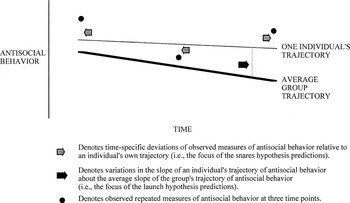
In this regard, we proposed two hypotheses in which substance abuse acts as a snare that serves to entrench young adults in prolonged patterns of antisocial behavior during a period of normative desistance. Building on this conceptualization of developmental snares as introduced by Moffitt (1993), here we further distinguish between two mechanisms through which such factors may act. The first, captured by the “launch” hypothesis, posits that substance abuse early in young adulthood may both identify young men who are on a long-term course of elevated antisocial behavior as well as set men on such a course. The second, for which we retain the term “snares” hypothesis, posits that substance abuse acts through a series of proximal influences on crime desistance such that short-term alterations in the course of antisocial behavior are impacted by substance abuse. Both models consider individual differences in crime desistance, but they suggest alternative, although not necessarily incompatible, mechanisms through which substance abuse influences trajectories of antisocial behavior over time. As such, although both are consistent with Moffitt's original definition of snares, here we distinguish between the two. Together the testing of these developmental hypotheses has the potential to provide crucial information about individual differences in the process of crime desistance that may help to identify factors that promote desistance or forestall it.
The launch model
Perhaps the most common method for examining individual development over time, the launch method is “analogous to a catapult, in which the initial forces of the contextual antecedent are the major determinants of the shape of the curve of the outcome” (Kinderman & Skinner, 1992, p. 166). In such models, launching factors serve as distal predictors of change over time under the assumption that such time-lagged influences are more salient predictors of course than are time-varying or contextual factors. The role of such distal factors, although often described in causal terms, may also be one of early identification that belies the effects of selection resulting from prior developmental processes. In either case, when applied to the study of crime desistance and substance abuse in young adulthood, this model posits that early signs of substance abuse predict maintenance of elevated antisocial behavior over young adulthood. This prediction is thus concerned with individual differences in the intercepts and slopes characterizing the trajectories of antisocial behavior over time (see Figure 1).

A contrast of the snares versus launch hypotheses.
Previous studies show support for the launch model as an explanation for antisocial behavior during adolescence, when such trajectories reflect a rise in antisocial behavior. For example, Munson, McMahon, and Spieker (2001) showed that greater maternal depression predicted steeper escalations in children's externalizing symptoms over time, especially among children with avoidant insecure attachments. However, to our knowledge, the role of substance abuse as a launching factor in young adulthood, when the expected pattern is desistance, has yet to be examined.
The snares hypothesis
In the work of developmental criminologists and life-course researchers (Laub & Sampson, 2001; Moffitt, 1993), two sets of factors have been implicated in desistance. The first set is often called “protective” factors in that they hasten the process of desistance among men at risk for continued antisocial behavior. Research focusing on protective effects has attributed reductions in antisocial behavior during young adulthood to the acquisition of adult roles and responsibilities that are incompatible with an antisocial lifestyle and to changes in the social bonds and social controls that accompany such adult roles (Laub et al., 1998; Sampson & Laub, 1993). Supporting the role of protective factors in crime desistance, several recent studies suggest that reduced involvement in antisocial behavior coincides with entry into good marriages and good jobs during young adulthood (Horney et al., 1995; Laub et al., 1998; Quinton, Pickles, Maughan, & Rutter, 1993). The second set may be called “ensnaring” factors in that they interfere with the normative deceleration of antisocial behavior that is observed in the population. As defined in the current article, snares exert a contemporaneous or short-term effect on antisocial behavior, such that the local effects of snares alter the normative course of antisocial behavior when they or their sequelae are present. Unlike protective factors, the importance of snares in the maintenance of antisocial behavior has rarely been empirically evaluated (although see Piquero, Brame, et al., 2001).
Ensnaring factors and protective factors are thought to play different roles in modifying antisocial behavior during young adulthood (Rutter, 1987). Although the protective influences offered by a good marriage or a good job may serve to actively promote desistance during young adulthood, snares may serve to actively retard desistance during young adulthood. As such, a “snare” is posited to be more than merely the opposite of a protective factor. By distinguishing between these two influences, we are able to differentiate how the presence of various factors impacts young adults' lives directly. This distinction also has important potential implications for interventions. For example, desistance research that focuses on protective factors in marriage and at work necessarily suggests that interventions should focus on acquiring and promoting new adult roles and responsibilities. In contrast, research that focuses on snares suggests that, if snares can be identified, interventions should focus on removing those barriers to crime desistance that are likely to impede a healthy transition to adulthood.
Despite their potential importance for interventions targeting antisocial behavior, to our knowledge, little research has examined such protective factors and no research has directly tested the snares hypothesis. The paucity of studies focusing on these factors is expected given the relatively recent introduction of the constructs to the literature and the lack of datasets that can meet demands noted earlier for studies of desistance to include self-report data assessed repeatedly during young adulthood. Nonetheless, substance abuse has been hypothesized to be a potent snare (Moffitt, 1993). Several mechanisms may account for the ensnaring role of substance abuse within trajectories of antisocial behavior. First, substance abuse has been associated with difficulties in conventional adult roles, the same protective factors that have been found to precede desistance in antisocial and criminal behavior (e.g., good marriages; Bachman, Wadsworth, O'Malley, Schulenberg, & Johnston, 1997; Leonard & Rothbard, 2000). Second, substance abuse has been associated with interrupted education and incarceration (Sher & Gotham, 1999; Vaillant, 1995), both of which have been proposed as additional snares forestalling normative desistance. Third, substance abuse may reflect a physiological dependence that motivates antisocial behavior necessary to purchase, obtain, and use substances. Fourth, the social nature of substance abuse during young adulthood may serve to maintain common activities and ties with a deviant peer context. Fifth, the disinhibiting properties of alcohol and other drugs may increase the odds that poor judgment and impulsivity will lead to antisocial activities. Each of these pathways may result in greater antisocial behavior for those who abuse substances during a developmental period in which most individuals are curbing their involvement in deviant behavior. Across these pathways, substance abuse may serve as either a marker variable for a process influencing substance abuse or as either a direct or indirect causal factor. Our goal here is not to distinguish these roles of substance abuse but rather to examine whether there is support for substance abuse to function in any one of these roles based on its prediction of crime desistance.
In contrast to the launch hypothesis, this basic prediction of the snares hypothesis is concerned with time-varying deviations in antisocial behavior away from the expected pattern of desistance over time. Whereas snares are expected to alter time-specific variation in antisocial behavior within the course of desistance, launching factors provide a more global prediction in which substance abuse alters the actual trajectory of antisocial behavior (see Figure 1). However, the launch and snares hypotheses are not necessarily incompatible; for example, substance abuse early in young adulthood may both decelerate an individual's overall pattern of crime desistance relative to others during this period (a launch prediction) and increase the likelihood of antisocial behavior within certain points in young adulthood relative to that individual's expected level of antisocial behavior (a snares prediction). By examining these hypotheses in tandem, we hope to better elucidate the multiple roles that substance abuse may play in crime desistance during young adulthood.
The Current Study
In sum, we examined two hypotheses about the effect of substance abuse on desistance in antisocial behavior during young adulthood. First, we tested whether the pattern of desistance that typifies the population trajectory of antisocial behavior among males over young adulthood masks significant individual variability. Second, we tested whether the role of alcohol and marijuana abuse in young adults' antisocial behavior could be explained through either a snares or a launch hypothesis. According to the snares hypothesis, alcohol and marijuana abuse account for heterogeneity in young adults' antisocial behavior by acting as snares, increasing the odds that young adults will show time-specific elevations in antisocial behavior above their underlying propensity for antisocial behavior over time. The launch hypothesis examines whether substance abuse early in young adulthood marks a distinct overall course of antisocial behavior that follows. By testing these hypotheses, we examine assumptions about crime desistance and maintenance and offer a more refined specification of the association between substance abuse and antisocial behavior over time.
Method
Participants
Participants are members of the Dunedin Multidisciplinary Health and Development Study, a longitudinal investigation of health and behavior in a complete birth cohort (Silva & Stanton, 1996). The study members were born in Dunedin, New Zealand, between April 1972 and March 1973. Of these, 1,037 children (91% of eligible births, 52% males) participated in the first follow-up assessment at age 3, and they constitute the base sample for the remainder of the study. Cohort families represent the full range of socioeconomic status in the general population of New Zealand's South Island and are primarily White; fewer than 7% self-identified at age 18 as Maori or Pacific Islanders. Assessments have been conducted at ages 3 (n = 1,037), 5 (n = 991), 7 (n = 954), 9 (n = 955), 11 (n = 925), 13 (n = 850), 15 (n =976), 18 (n = 993), 21 (n = 961), and most recently at age 26 (n = 980, 499 males, 96% of living cohort members). The current study focused on self-report data gathered from men at ages 18, 21, and 26. Rates of diagnosed conduct disorder, substance dependence, and self-reported delinquent offending in New Zealand were similar to those obtained for surveys of same-age epidemiological samples in the United States; for documentation supporting generalization from the Dunedin cohort to other settings, see Moffitt, Caspi, Rutter, and Silva (2001).
For the current study, men with incomplete data at age 18 (n = 64) or who were missing data at both ages 21 and 26 (n = 10) were omitted from analyses (final n = 461 of 535 male respondents at age 18, including 438 with completed data and 23 with partially missing data). The t tests showed no significant differences between retained and omitted cases, where available, on antisocial behavior, alcohol symptoms, or marijuana symptoms at ages 18, 21, or 26. Detailed analyses comparing groups of study members who did not take part in assessments versus those who did on a variety of family and individual characteristics have revealed no group differences as reported in Moffitt et al. (2001).
Measures
Alcohol abuse and marijuana abuse were assessed by symptoms from the Diagnostic Interview Schedule (DIS; Robins, Helzer, Cottler, & Goldring, 1989). The DIS was administered to participants at ages 18 (DIS-III-R), 21 (DIS-III-R), and 26 (DIS-IV). Antisocial behaviors were assessed via the self-report offending interview, which ascertains illegal behaviors and conduct problems (Moffitt, Silva, Lynam, & Henry, 1994). Antisocial behaviors and substance abuse symptoms were ascertained on the same day but in separate, counterbalanced sessions conducted by interviewers who were blind to the other assessment. Because we were interested in examining changes in both the mean and variance of behavior over time, continuity in item content for each scale was very important. For this reason, parallel items were selected from each assessment age to measure antisocial behavior, alcohol abuse, and marijuana abuse.3
Although the Dunedin study has a rich array of measures extending down to age 3, our constraint for parallel measurement and our focus on the desistance characterizing antisocial behavior in young adulthood guided us to focus on ages 18–26 in the current study. This also allowed for a specific empirical test of our theoretical questions of interest.
Antisocial behavior
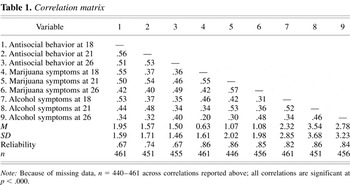
We used eight parallel items assessing conduct disorder (DSM-IV-TR; American Psychiatric Association, 2000) to create a variety score for antisocial behavior within each period. Variety scores index the total number of different forms of antisocial behavior in which a participant has engaged as opposed to, for example, the total frequency of antisocial acts. Previous studies suggest that variety scores may better reflect the extent or severity of antisocial involvement and these scores are consistent with a diagnostic approach to assessing conduct problems (Gottfredson & Hirschi, 1995; Robins, 1978). Our variety scores were the total number of forms of antisocial behavior in which each participant had engaged over the past twelve months. Eight forms of antisocial behavior were assessed, including breaking and entering, destroying property (illegal acts of vandalism), fighting (simple assault, aggravated assault, or gang fighting), setting fires (arson), lying (criminal fraud), stealing with confrontation (robbery), stealing without confrontation (criminal theft), and carrying or using a weapon. Psychometric properties of the resulting variables are reported in Table 1.
Correlation matrix

Substance abuse
Nineteen items from the DIS assessed symptoms of alcohol abuse and dependence and 10 items assessed symptoms of marijuana abuse and dependence across the three assessments. These symptoms largely reflect those for substance abuse and dependence as stated in the DSM-IV-TR (e.g., unable to stop using, tolerance, continued use despite health or social problems; American Psychiatric Association, 2000). Each symptom was coded as present or absent within the previous year. The total number of symptoms endorsed for each scale served as the alcohol abuse and marijuana abuse scores, respectively, for the current study. Table 1 contains psychometric properties for these variables.
Results
Analytic strategy
To test our hypotheses, we examined a series of latent trajectory models (LTMs). LTMs, also referred to as growth curve analyses or random-effects modeling, extends latent variable analyses within the structural equation modeling framework to provide a flexible tool for testing hypotheses of change over time and predictors of such change (McArdle, 1988; Meredith & Tisak, 1984, 1990). First, we estimated an unconditional linear growth model to examine whether the characteristics of individual trajectories of antisocial behavior varied across men. Second, we tested the launch hypothesis through a conditional LTM in which substance abuse at age 18 served as an exogenous predictor of change over time in antisocial behavior. Third, we tested the snares hypothesis through a time-varying covariate LTM that considers the repeated measures of substance abuse as time-varying covariates to test their time-specific influences on antisocial behavior above and beyond the influence of each individual's underlying trajectory of antisocial behavior. The time-varying covariate LTM allows for a direct test of our hypothesis about developmental snares given the simultaneous estimation of (a) variability across men in individual trajectories of antisocial behavior and (b) the association of substance abuse with time-specific deviations away from this predicted trajectory for each man's antisocial behavior within time (see, e.g., Bryk & Raudenbush, 1992, p. 151; Curran & Hussong, 2002; Curran, Muthén, & Harford, 1998).
To avoid bias due to the limited attrition in the sample, we estimated all models using the direct maximum likelihood procedure available in Mplus (Muthén & Muthén, 1998) and thus included all cases who had complete data at age 18 and at least one subsequent time point (final n = 461).4
Comparisons were made for all analyses when the effects of missing data were estimated using maximum likelihood in Mplus versus with results using listwise deletion. Parameters changed only slightly and no substantive differences were found across approaches.
Trajectories of antisocial behavior in young adulthood
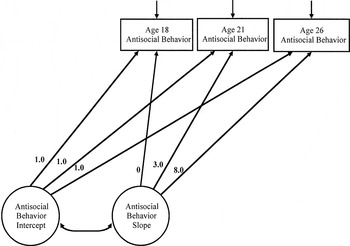
To examine the fixed and random components of growth in antisocial behavior, we estimated an unconditional LTM for the repeated measures of antisocial behavior reported at ages 18, 21, and 26. Two latent factors were estimated: one to define the intercept of the developmental trajectory of antisocial behavior (with all factor loadings fixed to 1.0), and one to define the linear slope of the trajectory (with factor loadings set to 0, 3, and 8 to define an annual metric of time). This model is presented in Figure 2. A mean was estimated for the intercept and slope factors, and these values represented the mean model-implied developmental trajectory pooled over all individuals. A variance was also estimated for the intercept and slope factors, representing the degree of individual variability in trajectories around the group mean values. The covariance between the two factors represented the covariation between initial level and rate of change. Larger variance estimates imply greater individual variability in the starting point and the rate of change over time. Finally, residual variances were estimated for each repeated measure, and these values represented variability in the time-specific measures not accounted for by the underlying random trajectories.

The unconditional growth model for antisocial behavior.
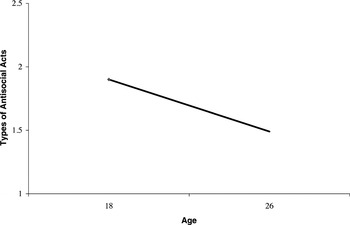
The unconditional LTM presented in Figure 2 was estimated and found to fit the observed data well, χ2 (1) = 9.31, p = .002, IFI = .98, CFI = .98. The means of the latent factors showed that the model-implied trajectory for the group was characterized by a significant intercept of 1.90 different types of antisocial behavior at the first time period (t = 26.33, p < .001), and a significantly decreasing slope of .05 units per year (t = −5.84, p < .001; see Figure 3). Thus, the model-implied mean rate of antisocial behavior significantly decreased from 1.90 to 1.50 types of behavior over the period of study. Further, significant variance estimates for both the intercept

and slope

factors indicated substantial interindividual variability in intraindividual developmental trajectories of antisocial behavior. Finally, the negative correlation between the intercept and slope factors (r = −.44, t = −3.20, p < .01) indicated that higher initial values were associated with steeper decreases over time.

The group-averaged trajectory of antisocial behavior.
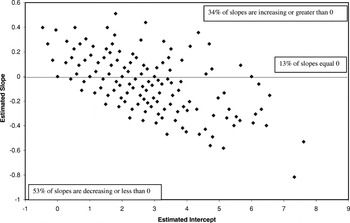
Overall, these results indicate that the mean developmental trajectory of antisocial behavior for the sample is significantly decreasing over time, consistent with previous findings on the age–crime curve. However, we also found that there are substantial individual differences in both the initial level and rate of change over time.5
To examine whether men who were incarcerated during the 12-month periods before assessments at ages 21 and 26 accounted for this pattern of desistance (Piquero, Blumstein, et al., 2001), we reestimated these models dropping the 14 men who had been incarcerated for more than 1 month prior to either assessment point. No meaningful changes in the findings occurred. We also reestimated these models to explore whether cases that showed a notable drop in antisocial behavior at age 21 relative to ages 18 and 26 served as influential outliers. Again, no meaningful changes in the findings occurred.
Note that these individual case by case estimates are for descriptive visualization purposes only. See Carrig, Wirth, and Curran (in press) for further details.

The pattern of trajectory parameters based on regression analyses within individuals.
Test of the launch hypothesis
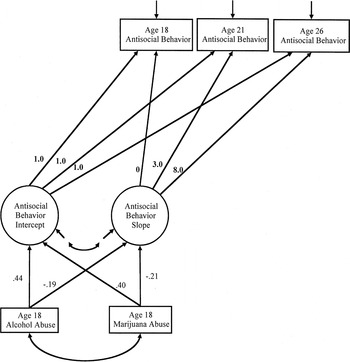
We next estimated a conditional LTM that tested the hypothesis that substance abuse at age 18 predicts a slowed or dampened pattern of desistance in the overall developmental trajectory of antisocial behavior over young adulthood. In other words, this model tested whether the magnitude of intercepts and slopes underlying antisocial behavior varied as a function of age 18 substance abuse. Both marijuana and alcohol abuse at age 18 were included as exogenous predictors of the intercept and slope factors defining the trajectories of antisocial behavior over ages 18, 21, and 26 (see Figure 5). The resulting model provided a good fit to the data, χ2 (3) = 11.33, p = .01, CFI = .99, IFI = .99. Greater alcohol and marijuana abuse at age 18 both significantly predicted higher intercepts of the trajectories of antisocial behavior (

, and

, respectively). Both marijuana

and alcohol

abuse were also negatively related to the slope of the antisocial behavior trajectories, meaning that higher age 18 substance abuse predicted lower or increasingly negative slope values. Because such negative predictions may reflect a variety of relations, we further probed this effect by plotting model-implied trajectories of antisocial behavior one standard deviation above and below the mean of the predictor (i.e., substance abuse). This procedure is similar in many respects to probing interactions in multiple regressions and formally recognizes the interaction inherent in these models between time and substance abuse, reflected in the growth factor prediction (Curran, Bauer, & Willoughby, in press).

The conditional latent trajectory model testing launch hypothesis.
Results indicated that men with the highest substance symptoms at age 18 also showed steeper negative slopes in their trajectories of antisocial behavior (M = −.03, −.02, and −.01 for those high, medium, and low in substance abuse at age 18, respectively), although this finding reflects a change of less than one type of antisocial acts difference between each of the three groups over the 8-year period. Importantly, probing of this relation by recoding the trajectory factors such that the intercept factor represents average antisocial behavior at age 26 also revealed that men who reported greater substance abuse at age 18 showed greater antisocial behavior at even the final time points (β = .17 and .09, z = 5.13 and 4.80 for marijuana and alcohol abuse, respectively, p < .001). Taken together, these results indicate that men elevated in substance abuse at age 18 reported higher initial levels of and steeper decreases in antisocial behavior over time, but were significantly elevated in antisocial behavior across all periods of observation.
Test of the snares hypothesis
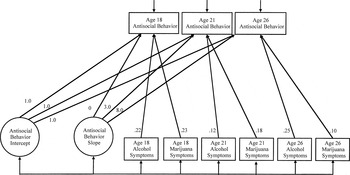
The extent to which substance-abuse symptoms account for time-specific elevations in antisocial behavior over young adulthood was examined through a time-varying covariate model in which indicators of substance abuse (e.g., alcohol and marijuana abuse) at ages 18, 21, and 26 served as predictors of within-time individual variability in antisocial behavior that is not accounted for by the underlying individual trajectories of such behavior (see Figure 6 and Curran et al., 1998, for more detail). This strategy evaluates whether higher levels of substance abuse uniquely predict a time-specific elevation or “shock” in antisocial behavior above and beyond what is expected based on the individual-specific underlying trajectory of antisocial behavior (Curran & Bollen, 2001). In other words, significant prediction of time-specific measures of antisocial behavior, above and beyond the decreasing individual trajectories, from the measures of substance abuse indicate that substance abuse maintains a higher level of antisocial behavior than would be expected for that individual given his overall pattern of antisocial behavior during young adulthood. In this manner, the time-varying covariate model examines whether substance abuse is either a marker variable for a causal process or a causal variable itself in relation to antisocial behavior.7
Note that we were unable to include trajectories for both marijuana and alcohol abuse in these models, as described in the autoregression latent trajectory modeling approach (Bollen & Curran, in press; Curran & Bollen, 2001), because of the complexity of these models with the current data structure.

The time-varying covariate model testing snares hypothesis.
The hypothesized model with the time-varying effects of alcohol and marijuana abuse fit the observed data well, χ2 (1) = 10.59, p = .001, CFI = .99, IFI = 1.0. At the age 18 and 21 assessment periods, men with more symptoms of alcohol or marijuana abuse reported significantly higher levels of antisocial behavior than would be expected based on their individual trajectories alone (at age 18,

, and at age 21,

for alcohol; at age 18,

, and at age 21,

for marijuana). At the age 26 assessment, this effect of alcohol abuse was marginally significant

, and this effect for marijuana abuse was nonsignificant

. These results suggest that, during the periods when these young men experience more symptoms of substance abuse, they do not decline in their antisocial behavior to the extent that we would expect based on their antisocial behavior throughout young adulthood. Rather, alcohol abuse appears to ensnare these young men within elevated patterns of antisocial behavior. This effect becomes weaker as men age through this period of crime desistance.
8Because the time-varying covariate model controls for trajectories of antisocial behavior over time in this prediction, the models are informed by longitudinal processes but the prediction is primarily contemporaneous. To examine the extent to which such predictions hold with a reversed prediction, that is that time-specific deviations from the underlying trajectory of antisocial behavior predict substance abuse within time, we tested a second model with the predictive pathways reversed. The model provided an adequate fit to the data, χ2 (1) = 8.72, p = .001, CFI = .99, with the exception of the IFI index that indicated more problematic fit (IFI = .83). Deviations in antisocial behavior from individual trajectories did not predict alcohol or marijuana abuse at ages 18 (

, respectively) or 26

but time-specific elevations in antisocial behavior were associated with greater alcohol and marijuana abuse at age 21

.
To examine whether the snaring effects of substance abuse persisted over the subsequent measurement interval, we modified our LTM to include (a) covariances (rather than structural pathways) between substance abuse indices and antisocial behavior within each measurement period that were constrained to be equal within time (e.g., the age 18 covariance between marijuana abuse and antisocial behavior was equated with the age 18 covariance between alcohol abuse and antisocial behavior), and (b) structural pathways from substance abuse at ages 18 and 21 predicting subsequent time-specific variations in antisocial behavior at ages 21 and 26, respectively. To identify this model, these paths were constrained to be equal within time (e.g., the path between age 18 marijuana abuse and age 21 antisocial behavior was equated with the path between age 18 alcohol abuse and age 21 antisocial behavior). The resulting model fit the data well, χ2 (2) = 9.50, p = .01, CFI = .99, IFI = .99. All lagged predictions of time-specific deviations in antisocial behavior above and beyond the influences of the underlying trajectory process and the covariances among substance abuse and antisocial behavior were nonsignificant (

from ages 18 to 21;

). These results suggest that substance abuse exerts a contemporaneous, rather than a lagged, effect on time-specific deviations away from individual trajectories of antisocial behavior as predicted by the snares hypothesis.
Discussion
The current findings confirm a long-standing but largely untested assumption in developmental research on antisocial behavior; namely, that there are significant individual differences in intraindividual patterns of crime desistance during the transition from adolescence to adulthood. Although a gradual, linear decline in antisocial behavior typified the process of desistance for men in the Dunedin sample, these men differed significantly from one another both in the extent of antisocial behavior that they showed in late adolescence and in the rate at which their antisocial behavior declined as they entered adulthood. Moreover, alcohol and marijuana abuse each accounted for significant interindividual variability in antisocial behavior over time through two mechanisms. Our analyses of the launch model showed that men with greater substance abuse at the end of adolescence showed greater antisocial behavior across young adulthood, although their trajectories showed greater decline than those of their peers. In essence, these men started young adulthood with a very high level of antisocial involvement and thus they had further to fall as they desisted. Supporting the snares hypothesis, we also found that men who abused substances during young adulthood showed greater antisocial behavior than would be expected based on their estimated individual trajectories of antisocial behavior over time. In other words, periods in which men reported greater symptoms of substance abuse corresponded to elevated antisocial behavior with respect to that individual's pattern of antisocial behavior over time. Further, this conclusion was most strongly supported in our younger adult assessments. As such, substance abuse appears to exert both proximal and distal effects on desistance in antisocial behavior over young adulthood.
The more distal effects of substance abuse were consistent with research on adolescent antisocial behavior showing that boys with greater substance involvement are more involved in antisocial behavior (Blumstein, 1995). However, substance abuse in late adolescence predicted trajectories of antisocial behavior that were both initially elevated but also more steeply declining. It should be noted that this effect of age 18 substance abuse on change in antisocial behavior over time was modest as groups high, medium, and low in antisocial behavior showed rates of decrement that differed by less than one type of antisocial behavior over the 8-year interval. Whether or not this finding is consistent with the prediction that substance abuse forestalls crime desistance depends on how desistance is defined. If crime desistance is defined as rate of intraindividual decline in antisocial behavior over time, then our finding is counter to the launch prediction. However, this pattern of change must also be considered within the normative pattern of desistance in antisocial behavior that typifies this period. As such, if crime desistance is defined as a reduction in antisocial behavior back to a normative baseline consistent with the general population, then our finding is consistent with the launch prediction as individuals with greater age 18 substance abuse consistently show elevated antisocial behavior over young adulthood compared to their peers. Given the latter interpretation, the role of substance abuse may vary over development such that it presages accelerated growth in antisocial behavior when the overall pattern is one of escalation (in adolescence) and it hinders desistance when the overall pattern is one of deceleration (in young adulthood). Which of these definitions of desistance are most useful in addressing which questions about the development of antisocial behavior is a matter for further debate.
We also found support for the snares hypothesis. The mechanism of the snares hypothesis occurs within the individual such that substance abuse predicts greater time-specific elevations in antisocial behavior above that expected based on each individual's own estimated trajectory of antisocial behavior over time. In other words, within those time periods when these men reported elevated substance abuse, they also showed more antisocial behavior than we would expect given their overall pattern of antisocial behavior throughout young adulthood. In this manner, substance abuse acted as a snare or vulnerability factor, actively retarding the normative pattern of crime desistance.
In contrast to this focus on snares, previous studies have shown that protective factors such as entry into good marriages or good jobs serve to reduce involvement in antisocial behavior over young adulthood (see Laub & Sampson, 2001). The distinction between such protective and ensnaring factors highlights the different impact that these two sets of factors have on young adults' lives. The ensnaring action of substance abuse is an important element in the matrix of causal mechanisms contributing to the process of crime desistance. Substance abuse may interfere with the normative tasks of young adult development by entrenching young adults within antisocial patterns of behavior (Miczek, DeBold, Haney, Tidey, Vivian, & Weertz, 1994; Reiss & Roth, 1993), by increasing their likelihood of encountering other potential snares (e.g., educational problems or incarceration, Sher & Gotham, 1999; Vaillant, 1995), and by reducing their likelihood of gaining access to protective factors along the way (e.g., good marriages; Bachman et al., 1997; Leonard & Rothbard, 2000). Consistent with this developmental pattern, previous theorists have used the term “canalization” in reference to such developmental trajectories characterized by accumulating risk factors that narrow opportunities for change and reinforce continued difficulties in adaptation (Cairns & Cairns, 1994).
These direct time-varying effects of substance abuse on antisocial behavior, however, appeared to weaken with age. Although additional assessments of these men into later adulthood are needed to further test this trend, the developmental relevance of substance abuse as a snare for antisocial behavior is consistent with previous work emphasizing the heightened dangers of substance abuse for adolescents and young adults compared with their older counterparts (Baumrind & Moselle, 1985). Whether such developmental sensitivity is conveyed via the context of young adulthood, which promotes prosubstance using attitudes and opportunities, the physiological impact of first initiated heavy substance involvement, or some other mechanism is a matter for further study.
Regardless, we found similar ensnaring effects in relation to both alcohol abuse and marijuana abuse, suggesting that the snares hypothesis is a robust effect with respect to these substances. However, parallel findings do not necessarily indicate that similar mechanisms account for the effects of alcohol and marijuana abuse on antisocial behavior. Rather, different mechanisms may be present for each. For example, growing dependence on illicit drugs such as marijuana may serve to entrench young adults within an illegal economy where antisocial behavior is required for maintaining substance use (Blumstein, 1995). In contrast, alcohol abuse may be a more proximal influence in which repeated, heavy use of alcohol results in greater disinhibition and impaired judgment, together increasing the likelihood of antisocial activity (Bushman & Cooper, 1990; Taylor & Chermack, 1993). That we cannot here distinguish among these mechanisms is a limitation of the current study that offers an avenue for future research.
As evidenced by the present findings, latent trajectory modeling offers a powerful alternative to traditional methods that study change over time and that examine hypotheses about intraindividual development. Using these techniques, the current study offers significant insights into the developmental associations that may emerge over time between substance abuse and antisocial behavior. These hypotheses suggest a direction of causality in which substance abuse serves to maintain engagement in antisocial behavior. Alternatively, the direction of effect may be reversed, reflecting self-selection in which the maintenance of antisocial behavior over time increases the likelihood of substance abuse. This possibility cannot be ruled out for our test of the launch hypothesis. However, although self-selection and the snares hypothesis may coexist (Moffitt, 1993), results from our time-varying covariate analyses offer evidence that self-selection does not account for the impact of snares as an impediment to crime desistance during young adulthood. Because predictions of antisocial behavior within time held above and beyond predictions based on the underlying trajectory of individual behavior, effects of substance abuse on antisocial behavior were residualized from the effect of continuity and developmentally normative change in antisocial behavior over time. Thus, previous antisocial behavior cannot account for these associations.
We offer this conclusion in the context of limitations in the current study. First, longitudinal studies of desistance suffer from the lack of information beyond the study window, leaving open to question whether those showing decelerated antisocial behavior will continue on a path toward cessation or later return to further antisocial behavior (Laub & Sampson, 2001). Second, we sampled eight behaviors from among those that index antisocial behavior during young adulthood. The extent to which substance abuse varies as an ensnaring factor across other types of antisocial behaviors is a question left for future study. Third, we have focused on the ensnaring role of substance abuse among men. However, differences in the timing and, potentially, the predictors of crime desistance suggest that gender-specific hypotheses may need to be tested to more fully understand the normative process of desistance in women as well as men (Moffitt et al., 2001). Fourth, we have studied only one cohort in one part of the world and the findings require replication, although we have good reason to be optimistic because previous findings from the Dunedin Study have replicated in and generalized to other samples and developmental settings (e.g., Moffitt, Caspi, Silva, & Stouthamer–Loeber, 1995). Fifth, although the present study identified the snaring effects of both alcohol abuse and marijuana abuse, further research is needed to explore the mechanisms that mediate these effects.
Although not a goal of the current study, mechanisms accounting for covariation between substance abuse and antisocial behavior are informed by the current findings. That substance abuse may also result from antisocial behavior, that they may unfold in reciprocal relation to one another, and that they may travel together over time as covaried trajectories influenced by a shared etiological factor are potential relations that may stand in concert with support from the current study for substance abuse as an influence on crime desistance. What is apparent, for now, is that substance abuse forestalls the normative decline in antisocial behavior that typifies young adulthood. By implication, clinical interventions that effectively reduce substance abuse may lower participation in crime among young people, hasten desistance, and help to smooth the transition from adolescence to adulthood.
References
REFERENCES
American Psychiatric Association.
(2000).
Diagnostic and statistical manual
(4th ed., Text revision).
Washington, DC:
Author.
Babinski, L. M.,
Hartough, C. S., &
Lambert, N. M.
(2001).
A comparison of self-report of criminal involvement and official
arrest records.
Aggressive Behavior
27,
44–54.Google Scholar
Bachman, J. G.,
Wadsworth, K. N.,
O'Malley, P. M.,
Schulenberg, J., &
Johnston, L. D.
(1997).
Marriage, divorce and parenthood during the transition to young
adulthood: Impacts on drug use and abuse. In
J. Schulenberg,
J. L. Maggs, &
K. Hurrelmann (Eds.),
Health risks and developmental transitions during adolescence (pp.
246–282).
New York:
Cambridge University Press.
Baumrind, D., &
Moselle, K. A.
(1985).
A developmental perspective on adolescent drug abuse.
Advances in Alcohol and Substance Abuse
4,
41–46.Google Scholar
Bentler, P. M.
(1990).
Comparative fit indexes in structural models.
Psychological Bulletin
107,
238–246.Google Scholar
Blumstein, A.
(1995).
Youth violence, guns and the illicit-drug industry.
Journal of Criminal Law and Criminology
86,
10–36.Google Scholar
Blumstein, A.,
Cohen, J., &
Farrington, D. P.
(1988).
Criminal career research: Its value for criminology.
Criminology
26,
1–35.Google Scholar
Bollen, K. A.
(1989).
A new incremental fit index for general structural equation models.
Sociological Methods & Research
17,
303–316.Google Scholar
Bollen, K. A., &
Curran, P. J.
(in press).
Autoregressive latent trajectory (ALT) models: A synthesis of two
traditions.
Sociological Methods and Research.
Bryk, A. S., &
Raudenbush, S. W.
(1992).
Hierarchical linear models: Applications and data analysis methods.
Newbury Park, CA:
Sage.
Bushman, B. J., &
Cooper, H. M.
(1990).
Effects of alcohol on human aggression: An integrative research
review.
Psychological Bulletin
107,
341–354.Google Scholar
Bushway, S.,
Piquero, A.,
Brody, L.,
Cauffman, E., &
Mazerolle, P.
(2001).
An empirical framework for studying desistance as a process.
Criminology
39,
491–515.Google Scholar
Cairns, R. B., &
Cairns, B. D.
(1994).
Lifelines and risks: Pathways of youth in our time.
Cambridge:
Cambridge University Press.
Carrig, M. M.,
Wirth, R. J., &
Curran, P. J.
(in press).
A SAS macro for estimating and visualizing individual growth
curves.
Journal of Structural Equation Modeling.
Curran, P. J.,
Bauer, D. J., &
Willoughby, M. T.
(in press).
Testing and probing interactions in hierarchical linear growth
models. In
C. S. Bergeman &
S. M. Boker (Eds.),
The Notre Dame series on quantitative methodology: Vol. 1.
Methodological issues in aging research.
Mahwah, NJ:
Erlbaum.
Curran, P. J., &
Bollen, K. A.
(2001).
The best of both worlds: Combining autoregressive and latent curve
models. In
L. M. Collins &
A. G. Sayer (Eds.),
New Methods for the analysis of change (pp.
105–136).
Washington, DC:
American Psychological Association.
Curran, P. J., &
Hussong, A. M.
(2002).
Structural equation modeling of repeated measures data. In
D. Moskowitz &
S. Hershberger (Eds.),
Modeling intraindividual variability with repeated measures data:
Methods and applications (pp.
59–86).
Mahwah, NJ:
Erlbaum.
Curran, P. J.,
Muthén, B.O., &
Harford, T. C.
(1998).
The influence of changes in marital status on developmental
trajectories of alcohol use in young adults.
Journal of Studies on Alcohol
59,
647–658.Google Scholar
Farrington, D. P.
(1986).
Age and crime. In
M. Tonry &
N. Morris (Eds.),
Crime and justice: An annual review of research
(Vol. 7, pp.
189–250).
Chicago:
University of Chicago Press.
Fergusson, D. M., &
Horwood, L. J.
(2000).
Alcohol abuse and crime: A fixed-effects regression analysis.
Addiction
95,
1525–1536.Google Scholar
Gottfredson, M., &
Hirschi, T.
(1995).
Control theory and the life-course perspective.
Studies on Crime and Crime Prevention
4,
131–142.Google Scholar
Horney, J.,
Osgood, D. W., &
Marshall, I. H.
(1995).
Criminal careers in the short-term: Intra-individual variability in
crime and its relation to local life circumstances.
American Sociological Review
60,
655–673.Google Scholar
Huang, B.,
White, H. R.,
Kosterman, R.,
Catalano, R. F., &
Hawkins, J. D.
(2001).
Developmental associations between alcohol and interpersonal
aggression during adolescence.
Journal of Research in Crime and Delinquency
38,
64–83.Google Scholar
Huizinga, D., &
Elliott, D. S.
(1986).
Reassessing the reliability and validity of self-report delinquency
measures.
Journal of Quantitative Criminology
2,
293–327.Google Scholar
Kinderman, T. A., &
Skinner, E. A.
(1992).
Modeling environmental development: Individual and contextual
trajectories. In
J. B Asendorpf &
J. Valsiner (Eds.),
Stability and change in development: A study of methodological
reasoning (pp.
155–190).
Newbury Park, CA:
Sage.
Krueger, R. F.,
Hicks, B. M.,
Patrick, C. J.,
Carlson, S. R.,
Iacono, W. G., &
McGue, M.
(2002).
Etiologic connections among substance dependence, antisocial
behavior and personality: Modeling the externalizing spectrum.
Journal of Abnormal Psychology
111,
411–424.Google Scholar
Laub, J. H.,
Nagin, D. S., &
Sampson, R. J.
(1998).
Trajectories of change in criminal offending: Good marriages and
the desistance process.
American Sociological Review
63,
225–238.Google Scholar
Laub, J. H., &
Sampson, R. J.
(2001).
Understanding desistance from crime. In
M. Tonry (Ed.),
Crime and justice: An annual review.
Chicago:
University of Chicago Press.
Leonard, K. E., &
Rothbard, J. C.
(2000).
Alcohol and the marriage effect.
Journal of Studies on Alcohol,
13(Suppl.),
139–146.Google Scholar
MacCallum, R. C.
(1990).
The need for alternative measures of fit in covariance structure
modeling.
Multivariate Behavioral Research
25,
157–162.Google Scholar
McArdle, J. J.
(1988).
Dynamic but structural equation modeling of repeated measures
data. In
J. R. Nesselroade &
R. B. Cattell (Eds.),
Handbook of multivariate experimental psychology
(2nd ed.).
New York:
Plenum Press
Meredith, W., &
Tisak, J.
(1984).
“Tuckerizing” curves.
Paper presented at the annual meeting of the Psychometric Society,
Santa Barbara, CA.
Miczek, K. A.,
DeBold, J. B.,
Haney, M.,
Tidey, J.,
Vivian, J., &
Weertz, E. M.
(1994).
Alcohol, drugs of abuse, aggression and violence. In
A. J. Reiss &
J. A. Roth (Eds.),
Understanding and preventing violence: Vol. 3. Social influences (pp.
377–570).
Washington, DC:
National Academy Press.
Moffitt, T. E.
(1993).
Adolescence-limited and life-course persistent antisocial behavior:
A developmental taxonomy.
Psychological Review
100,
674–701.Google Scholar
Moffitt, T. E.,
Caspi, A.,
Rutter, M., &
Silva, P. A.
(2001).
Sex differences in antisocial behaviour: Conduct disorder,
delinquency, and violence in the Dunedin longitudinal study.
Cambridge:
Cambridge University Press.
Moffitt, T. E.,
Caspi, A.,
Silva, P. A., &
Stouthamer–Loeber, M.
(1995).
Individual differences in personality and intelligence are linked
to crime: Cross-context evidence from nations, neighborhoods, genders,
races, and age-cohorts. In
J. Hagan (Ed.),
Current perspectives on aging and the life cycle
(Vol. 4, pp.
1–34).
Greenwich, CT:
JAI Press.
Moffitt, T. E.,
Silva, P. A.,
Lynam, D. R., &
Henry, B.
(1994).
Self-reported delinquency at age 18: New Zealand's Dunedin
Multidisciplinary Health and Development Study. In
J. Junger–Tas &
G. J. Terlouw (Eds.),
The international self-report delinquency project (pp.
354–369).
Amsterdam:
Kugler Publications.
Munson, J. A.,
McMahon, R. J., &
Spieker, S. J.
(2001).
Structure and variability in the developmental trajectory of
children's externalizing problems: Impact of infant attachment,
maternal depressive symptomatology, and child sex.
Development and Psychopathology
13,
277–296.Google Scholar
Muthén, L. K., &
Muthén, B. O.
(1998).
Mplus: The comprehensive modeling program for applied researchers.
User's guide.
Los Angeles:
Muthén & Muthén.
Nagin, D. S.,
Farrington, D. P., &
Moffitt, T. E.
(1995).
Life-course trajectories of different types of offenders.
Criminology
33,
111–139.Google Scholar
Nagin, D. S., &
Land, K. C.
(1993).
Population heterogeneity: Specification and estimation of a
nonparametric, mixed Poisson model.
Criminology
31,
327–362.Google Scholar
Piquero, A.,
Blumstein, A.,
Brame, R.,
Haapanen, R.,
Mulvey, E. P., &
Nagin, D. S.
(2001).
Assessing the impact of exposure time and incapacitation on
longitudinal trajectories of criminal offending.
Journal of Adolescent Research
16,
54–74.Google Scholar
Piquero, A.,
Brame, R.,
Mazerolle, P., &
Haapanen, R.
(2001).
Crime in emerging adulthood.
Unpublished manuscript.
Quinton, D.,
Pickles, A.,
Maughan, B., &
Rutter, M.
(1993).
Partners, peers, and pathways: Assortative pairing and continuities
in conduct disorder.
Development and Psychopathology
5,
763–783.Google Scholar
Reiss, A. J., &
Roth, J. A.
(1993).
Understanding and preventing violence.
Washington, DC:
National Academy Press.
Robins, L. N.
(1978).
Sturdy predictors of adult antisocial behaviour: Replications from
longitudinal studies.
Psychological Medicine
8,
611–622.Google Scholar
Robins, L. N.,
Helzer, J. E.,
Cottler, L., &
Goldring, E.
(1989).
Diagnostic Interview Schedule (version III-R).
St Louis, MO:
Washington University.
Rogosa, D. R., &
Willett, J. B.
(1985).
Understanding correlates of change by modeling individual
differences in growth.
Psychometrika
50,
203–228.Google Scholar
Rutter, M.
(1987).
Psychosocial resilience and protective mechanisms.
American Journal of Orthopsychiatry
57,
316–331.Google Scholar
Sampson, R. J., &
Laub, J. H.
(1993).
Crime in the making: Pathways and turning points through life.
Cambridge, MA:
Harvard University Press.
Sher, K. J., &
Gotham, H. J.
(1999).
Pathological alcohol involvement: A developmental disorder of young
adulthood.
Development and Psychopathology
11,
933–956.Google Scholar
Silva, P. A., &
Stanton, W. R.
(1996).
From child to adult: The Dunedin Multidisciplinary Health and
Development Study.
Auckland:
Oxford University Press.
Taylor, S. P., &
Chermack, S. T.
(1993).
Alcohol, drugs, and human physical aggression. Journal of
Studies on Alcohol,
Supplement
11,
78–88.Google Scholar
Vaillant, G. E.
(1995).
The natural history of alcoholism revisited.
Cambridge, MA:
Harvard University Press.
Zucker, R. A.
(1986).
The four alcoholisms: A developmental account of the etiologic
process.
Nebraska Symposium on Motivation
34,
27–83.Google Scholar
A contrast of the snares versus launch hypotheses.
Correlation matrix
The unconditional growth model for antisocial behavior.
The group-averaged trajectory of antisocial behavior.
The pattern of trajectory parameters based on regression analyses within individuals.
The conditional latent trajectory model testing launch hypothesis.
The time-varying covariate model testing snares hypothesis.
 You have
Access
- 117
- Cited by