I. INTRODUCTION
Carbon nanotubes (CNTs) can significantly reinforce composites due to their mechanical properties.Reference Qian, Wagner, Liu, Yu and Ruoff1 Nanotubes also have high electrical and thermal conductivities, which make them attractive for functional composites.Reference Terrones2, Reference Thostenson, Ren and Chou3 Many important advances have been made since the first nanotube polymer composite was reported, as summarized in a variety of reviews on the topic,Reference Terrones2–Reference Moniruzzaman and Winey7 but challenges still remain in achieving uniform dispersion in the polymer matrix, and in producing nanocomposites with high percentages of CNTs, as well as in dispersing them. There are a few solvents reported to suspend CNT, they include superacidsReference Ramesh, Ericson, Davis, Saini, Kittrell, Pasquali, Billups, Adams, Hauge and Smalley8 and some organic solvents, such as dimethylformamide, dichlorobenzene, N-methyl pyrrolidone and analog molecules.Reference Bahr, Mickelson, Bronikowski, Smalley and Tour9–Reference Ausman, Piner, Lourie and Ruoff11 Surfactants are another option to disperse CNTs, chemical functionalization is another possibility.Reference Moniruzzaman and Winey7, Reference Sun, Fu, Lin and Huang12
The field of CNT-polymer nanocomposites has advanced to the point that masterbatch formulations containing CNTs at typical loadings of 15–20 wt% have been commercially available for several yearsReference Baughman, Zakhidov and de Heer13, Reference Thayer14; and there are already commercial products containing CNTs for mechanical reinforcement mostly for high performance sports equipment, with CNT added to epoxy-carbon fiber composites15 and for electrostatic charge dissipation applications, one of the oldest uses of multiwalled carbon nanotubes (MWCNTs). This allows plastic materials to be electrostatically painted or used in fuel lines adding a relatively small amount, 2–5 wt%, of nanotubes.Reference Thayer14, 15 However, the use of commercial masterbatches has sometimes been reported to leave MWCNT aggregates after melt-mixing, due to the high viscosity of the masterbatch,Reference Prashantha, Soulestin, Lacrampe, Krawczak, Dupin and Claes16 which can decrease mechanical properties.
Functionalization of nanotubes prior to composite processing is usually required to improve compatibility and promote dispersion in polymer matrices and is used in most masterbatch formulations. There are many options available for functionalization with a variety of chemical groups,Reference Dyke and Tour17–Reference Peng and Wong19 thus it is conceivable that the type and the strength of interactions between CNTs and the matrix might be controllable through judicious choice of the functionalizing moiety and the polymer matrix. However, the use of functionalization must be balanced against the overall performance goals for the nanocomposite as it can reduce mechanical and electrical properties of the CNT by subjecting them to harsh chemical treatments inducing defects and changing carbon hybridization from sp2 to sp3.Reference Moniruzzaman and Winey7
Fibers are often the major component in high-performance carbon fiber composites, with the matrix serving as a binder. Pursuing such a strategy with CNT composites requires overcoming nanotube-nanotube interactions and addressing limitations in conventional polymer processing. Preparing CNT composites with high nanofiber loadings is challenging, as at high concentrations CNTs tend to segregate from the macromolecular matrices, even with functionalization.Reference Mamedov, Kotov, Prato, Guldi, Wicksted and Hirsch20 Melt mixing is not a viable manufacturing process for composites with large CNT concentrations, as CNTs increase melt viscosity, requiring high shear, or higher temperaturesReference Shofner, Rodriguez-Macias, Vaidyanathan and Barrera21–Reference Pötschke, Fornes and Paul23; thus producing these type of composites has required different approaches.
Blighe et al.Reference Blighe, Blau and Coleman24 report a polyurethane (PU) composite with ≤60 wt% single-walled CNTs (SWCNTs) [80 wt% of SWCNTs functionalized with 25 wt% polyethylene glycol, (PEG)] by mixing PEG-SWCNTs with a water dispersion of PU particles. In this scheme the SWCNT aggregate between PU particles and mechanical properties were not enhanced. Mamedov et al.Reference Mamedov, Kotov, Prato, Guldi, Wicksted and Hirsch20 report layer-by-layer assembled composites with ≤50% SWCNTs; oxidized CNTs, with negatively charged carboxylic acid groups, were deposited alternately with layers of positively charged polyelectrolyte polymers. This method is relatively simple albeit limited to films of polyelectrolytes. Highly loaded CNT composites have also been produced by simply infiltrating a SWCNT sheet (buckypaper) with solutions of polymers such as polycarbonate (PC).Reference Pham, Park, Wang, Liang, Wang, Zhang, Funchess and Kramer25 This method is limited to films and to soluble polymers, and problems with controlling evaporation of the solvent result in microvoids and solvent-induced crystallization. Hot pressing has been reported for polyetheretherketone (PEEK)-laminated composites with 20 wt% SWCNT buckypaper,Reference Song, Zhang, Zhang and Xie26 but problems of infiltrating the viscous polymer melt in the nanotube bundles result in pure PEEK layers sandwiching a real composite region (with an undetermined high percentage of CNTs). Hou et al.Reference Hou, Ge, Zeng, Li, Reneker, Greiner and Cheng27 report an electrospinning approach to produce polyacrylonitrile (PAN) fibers with up to 35 wt% MWCNTs from a dimethyl formamide solution of MWCNTs and PAN. MWCNTs were aligned within the nanofibers and the electrospun sheets had improved mechanical properties and reduced shrinkage upon carbonization of PAN. Fragneaud et al.Reference Fragneaud, Masenelli-Varlot, Gonzalez-Montiel, Terrones and Cavaillé28 grafted polystyrene by atom transfer radical polymerization on nitrogen-doped MWCNTs (CNx) subjected to two prefunctionalization steps, and used the resulting 60 wt% CNx composites as a masterbatch for solution mixing. Yang et al.Reference Yang, Chen, Pu, Zhou, Chen, Li, Xu, Yi and Wang29 reported composites with up to 43 wt% MWCNTs by dispersing them with PEG during the in situ polymerization of the polyimide of pyromellitic dianhydride and 4,4′-oxydiphenylamine (PMDA-ODA); MWCNTs dispersed well only when PEG was used.
We believe that a promising, yet little explored, route toward composites with high CNT content are in situ polymerizations, where nanotubes dispersed in the polymerization medium incorporate into the composite as the polymer forms. This obviates further mixing steps, and if monomers reacted with the CNTs even prior functionalization would be unnecessary. Here we report a route for functionalization and subsequent polymerization of styrene, based on the “nanotube salts” method,Reference Liang, Sadana, Peera, Chattopadhyay, Gu, Hauge and Billups30–Reference Stephenson, Sadana, Higginbotham and Tour32 which involves functionalization and subsequent polymerization of styrene using alkaline metals dissolved in liquid ammonia (NH3).
Liang et al.Reference Liang, Beach, Kobashi, Sadana, Vega-Cantu, Tour and Billups33 have reported the use of nanotube salts to functionalize CNT with poly(methyl methacrylate) (PMMA). However, to the best of our knowledge, there are no other reports exploring this reductive alkylation method for composites. We consider that this method could result in lesser damage than other functionalization methods as it does not require prior oxidation or other intermediate reactions, and that the functionalization with polymer should enhance dispersion.
This method is a one-step approach to graft polystyrene onto MWCNTs (PS-g-MWCNTs). Varying amounts of polymer can be grown on MWCNTs, so it is possible to produce polymer composite-like materials with very high loadings of CNTs in a polystyrene matrix. In this article, we focus on the synthesis of PS-g-MWCNT composites with high loadings of MWCNTs. Nevertheless, the presented methodology can be used to obtain similar composites using other monomers, which can be used for the generation of masterbatches for several polymer-matrix compositions.
II. EXPERIMENTAL
A. Materials
MWCNTs, produced through chemical vapor deposition (CVD),Reference Kamalakaran, Terrones, Seeger, Kohler-Redlich, Rühle, Kim, Hayashi and Endo34 were purified by dispersing them with a pulsed probe sonicator in boiling water under reflux, followed by reflux in HCl (6 M) and filtration, using a modification of the method reported by Alvizo-Paez et al.Reference Alvizo-Paez, Romo-Herrera, Terrones, Terrones, Ruiz-García and Hernández-López35 Styrene monomer (reagent grade, Fluka) was used as received, as in preliminary experiments polymerization proceeded well without further purification. For easier handling, lithium was used in the form of granules (99% Li, ∼0.5 wt% Na, “high sodium,” reagent grade, Aldrich). Tetrahydrofuran (THF) (ACS grade, Tedia) was dried by reflux and distillation with lithium aluminum hydride (LiAlH4). Other reagent grade solvents were acquired from Aldrich and used as received.
B. Synthesis of PS-g-MWCNT
The general procedure was as follows: 500 mL ammonia (NH3, 99.9% purity) were condensed under an inert atmosphere with argon (Ar), in a 1000 mL three-neck round flask. The flask was kept in a cryogenic bath (dry-ice/acetone, or acetone cooled with liquid nitrogen). The flask was flame-dried and the reaction carried out under dry Ar flow to prevent the entrance of humidity [water vapor reacts with Li+ to produce hydrogen and lithium hydroxide (LiOH), which could hydrogenate nanotubesReference Pekker, Salvetat, Jakab, Bonard and Forro36]. 500 mg of Li were added, using magnetic stirring to dissolve the Li. Separately 50 mg of purified MWCNTs were dispersed in 100 mL of dry THF by sonication for 4 h, and styrene (1–2 g depending on the amount of polymer to produce) was dissolved in 50 mL of THF. Once the Li was dissolved in NH3 both THF solutions were simultaneously added to the reaction flask, and the mixture stirred with a homogenizer at 12,000–15,000 RPM for 10 min. Thereafter, the polymerization was allowed to proceed for 20–30 min, the cryogenic bath was removed and the ammonia was allowed to evaporate overnight (at least 10 h). The products were purified by stirring for 10 min in a separation flask with 250 mL of HCl 5 vol% solution (to remove residual Li and lithium salts formed as by-products), followed by stirring with 50 mL of chloroform (CHCl3, to remove unreacted styrene), this process was repeated eight times. Finally, the purified PS-g-MWNCTs were filtered, dried under vacuum for 12 h and weighed.
C. Mixing of PS-g-MWCNTs with Virgin PS
For solution mixing we dissolved commercial polystyrene (donated by Mabe S.A. de C.V.) in chloroform (0.06 g/mL) by stirring at room temperature for ∼3 h, until completely dissolved. We similarly dispersed PS-g-MWCNT in CHCl3 and then mixed them with enough PS solution for a final MWCNT concentration of ∼1 wt% by magnetic stirring. The solution was poured in an evaporation dish and the solvent was eliminated by evaporation under vacuum at room temperature. For melt mixing we used commercial “crystal polystyrene” (Mn = 100,000 g/mol, Mw = 230,000 g/mol by GPC) and mixed it with PS-g-MWCNT composites in a twin-screw Thermo-Haake Minilab (ThermoFisher Scientific Inc., Watham, MA). The MWCNT loading in these melt mixed composites was 1 wt%. After mixing at 60 RPM for 10 min, at 150 °C, the composites were removed from the mixer and hot-pressed.
D. Characterization
PS-g-MWCNT and the nanocomposites were characterized spectroscopically with a Renishaw inVia micro-Raman system (633 nm laser) (Renishaw PLC, Wotton-under-Edge, UK), and by Fourier-transform infrared (FTIR) spectroscopy using a ThermoNicolet 6700 spectrophotometer (ThermoFisher Scientific Inc., Waltham, MA) with a zinc selenide (ZnSe) crystal attenuated total reflectance accessory (ATR-FTIR, 256 scans, 4 cm−1 resolution). Morphology was observed by high-resolution transmission electron microscopy (HRTEM; in a FEI Tecnai model Nos. F20 and F30, FEI Company, Hillsboro, OR, and a JEOL model No. 4000EX, JEOL Ltd., Tokyo, Japan). The morphology of the PS-g-MWCNTs nanocomposites was also examined in a scanning electron microscope (SEM; FEI model No. XL-30 SFEG, FEI Company, Hillsboro, OR) .We used low acceleration voltages (2–8 kV) to view directly the high polymer content composite surfaces without a conductive coating. We used a thermogravimetric analysis (TGA; TA Instruments model No. Q5000, TA Instruments, New Castle, DE) to determine weight fraction of the polymer in the PS-g-MWCNT nanocomposites by heating the polymer nanocomposites samples from 25 to 650 °C at 10 °C/min under nitrogen flow.
III. RESULTS AND DISCUSSION
A. In situ polymerization studies
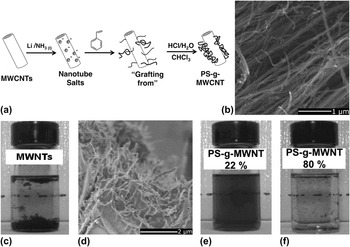
Figure 1(a) illustrates the reaction mechanism. Alkali metals dissolve in ammonia releasing electrons, which the CNTs absorb. The negatively charged nanotubes, surrounded by Li+ ions, are called “nanotube salts.”Reference Chattopadhyay, Sadana, Liang, Beach, Xiao, Hauge and Billups31, Reference Liang, Beach, Kobashi, Sadana, Vega-Cantu, Tour and Billups33 In this “grafting-from” approach, the first step is for styrene molecules to react with the negatively charged MWCNTs and then polymer chains grow from the nanotube surface. Without CNT in the reaction medium, polymerization did not occur. Under these conditions functionalization of carbon nanotubes has been explained to proceed by a radical mechanism.Reference Liang, Sadana, Peera, Chattopadhyay, Gu, Hauge and Billups30, Reference Chattopadhyay, Sadana, Liang, Beach, Xiao, Hauge and Billups31, Reference Liang, Beach, Kobashi, Sadana, Vega-Cantu, Tour and Billups33, Reference Chattopadhyay, Chakraborty, Mukherjee, Wang, Engel and Billups37 However, given that the nanotubes are negatively charged, and that ammonia-solvated electrons are abundant in the reaction medium, we cannot discard the possibility of an anionic polymerization process.Reference Viswanathan, Chakrapani, Yang, Wei, Chung, Cho, Ryu and Ajayan38 On the other hand, as shown in the supplementary information, we were also able to obtain a sulfonated polyaniline (S-PAni) by the polymerization of poly(o-aminobenzenesulfonic acid), albeit with small yields. This monomer only polymerizes in oxidative environments; therefore, other polymerization mechanisms may be at play, but studying the actual mechanism was beyond the scope of this work.
Reaction scheme and effect of MWNT wt% on dispersibility in chloroform. (a) Reaction scheme. (b) SEM image of the purified MWCNT used as starting material, these do not disperse in chloroform, even with sonication, and flocculate out (c). After functionalization the nanotubes are coated with polymer (d), and the composite dispersions in chloroform are stable even after 3 weeks for lower loadings (e), though for the highest loadings they flocculate (f).

SEM of the reaction products shows that PS coated the MWCNTs [Fig. 1(d)]. These composites could be easily dispersed in THF and chloroform by simple magnetic stirring; this is additional evidence that PS coats the CNTs, which by themselves are not soluble in those solvents. Such composite dispersions are stable for several weeks, examples are shown in Fig. 1. With the 80 wt% MWCNTs sample floccules are observed after 3 weeks [Fig. 1(f)], which might indicate that with such high loadings the PS coating over the MWCNT is not thick enough to prevent aggregation for longer durations.
We varied the amounts of Li, liquid ammonia and THF, while keeping constant the amount of MWCNTs (50 mg) and styrene (1 g), to investigate their effects on reaction efficiency (polymer weight in the dry composite as percentage of monomer used). Larger amounts of Li increased efficiency; e.g., when using a 1:13 MWCNTs/Li(s) ratio, with 150 mL of NH3 42% of styrene polymerized. Larger THF volumes also increased efficiency, e.g., up to 47% with 650 mL THF, 300 mL NH3 and a large amount of Li (300 mg). The use of larger volumes of NH3 also increased the efficiency of the reaction. The highest efficiency was 65% with 500 mL NH3, 200 mL of THF, and 600 mg of Li. The effect of using more ammonia could be related to its role in facilitating the release of electrons from Li by solvating them. However, combining larger NH3 volumes with larger THF volumes reduced efficiency, possibly because the solution was too dilute. The major effect in increasing the yield was that of adding more Li, but this increased the amounts of by-products, and mass ratios larger than 1:20 MWCNT/Li were not tested.
The electrons released by lithium should take part in polymerization, which would explain why more Li increased polymer yield. This implies that functionalization might be limited once polymerization starts. Such competition could explain why some sections of nanotubes or even entire nanotubes appear bare (see below and Fig. 2): once polymerization started styrene molecules would attach to growing polymer chains instead of to the unfunctionalized nanotube surfaces. Steric hindrance may have also impeded further absorption of electrons once nanotubes were coated with polymer. We note that Liang et al.Reference Liang, Beach, Kobashi, Sadana, Vega-Cantu, Tour and Billups33 report lower degree of functionalization with PMMA than for CNT functionalization with smaller molecules as reported by the same group.Reference Liang, Sadana, Peera, Chattopadhyay, Gu, Hauge and Billups30, Reference Chattopadhyay, Sadana, Liang, Beach, Xiao, Hauge and Billups31
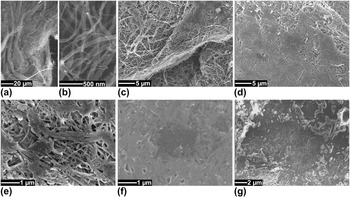
SEM images of (a, b) the starting MWCNT material and of PS-g-MWCNT synthesized by in situ polymerization, with different MWCNT loading: (c) 80 wt%, (d) 75 wt%, (e) 67 wt%, (f) 42 wt%, and (g) 22 wt%. Images acquired with low acceleration voltages (2–8 kV, in a FEI-XL-30 SFEG) to observe the composites without a conductive coating.

We selected as typical reaction conditions 500 mL NH3, 200 mL THF, and a 1:10 ratio MWCNT/Li, and controlled the amount of polymer in the composite by varying the amount of monomer. Using 1 g of styrene, and by changing the amount of Li we produced MWCNT grafted with as low as 10 wt% PS and up to 50 wt% PS (90–50 wt% MWCNT), with 2 g of monomer we obtained MWCNT grafted with up to ∼78 wt% PS (22 wt% MWCNTs).
We show in the Supplementary Information (Fig. S1) that, in addition to PS this reaction allows to produce MWCNT grafted with poly(o-aminobenzenesulfonic acid) (sulfonated aniline, S-PAni) and poly(methyl methacrylate) (PMMA). The polymer yield showed variations under the same synthesis conditions for PS and PMMA, more in the case of S-PAni where yields were very low. Nevertheless, our results indicate that wider exploration of the parameter space to attain further optimization or control of the experiment variables should provide a high level of control over the polystyrene fraction for other polymers as well as for PS-g-MWCNT.
B. Composite morphology
We show examples of morphology of nanocomposites with varying high percentages of MWCNT in Fig. 2. At the highest CNT loading we observe few CNTs well coated with polymer, others have a very thin polymer coating, and some even appear bare [Fig. 2(c)]. As the loading of CNT in the composite is decreased, the polymer coating is more abundant and more uniform and with loadings of 42 and 22 wt% the nanotubes appear embedded in a continuous PS matrix in most of the samples. We should note however, that even in the samples with high polymer loading we could observe some zones with MWCNT coated only partially, similar to what is shown in Figs. 2(d) and 2(e).
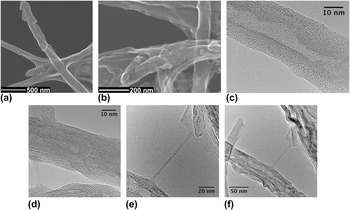
Figure 3 confirms that MWCNTs were coated with polymer [Figs. 3(a) and 3(b)], these samples were prepared by depositing a few drops of a dilute solution (prepared by sonication) of composite over lacey carbon TEM grids. HRTEM [Figs. 3(c)–3(f)] shows a nonuniform thickness to the polymer coating. However, this may not fully represent the original material, as sonication can cleave some of the polymer coating, and the solvent could remove polymer not directly bound to the MWCNTs. The thin polymer strands bridging two nanotubes in Figs. 3(d) and 3(e) likely formed during sample preparation.
Electron microscopy images of PS-g-MWCNT containing 22 wt% of MWCNT (a, b) SEM images show coated CNT; (c) HRTEM images of PS-g-MWCNTs show MWCNT with a thin coating of PS In some cases a thin thread of polymer bridging two nanotubes, can be seen as in (d) and (e). (f) is a lower magnification image of (e) showing more clearly the two nanotubes joined by the polymer strand. Samples prepared by depositing a few drops of PS-g-MWCNT solution in CHCl3 over lacey carbon TEM grids. HRTEM images were acquired in an FEI Tecnai F20, a Tecnai F30 and a JEOL 4000EX.

C. Use of PS-g-MWCNT as masterbatches
1. Solution mixing
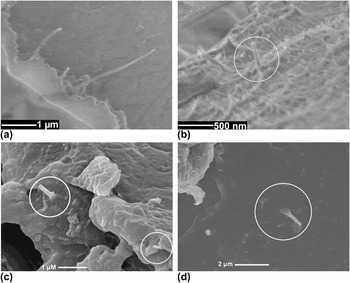
Given that PS-g-MWCNT could easily disperse in chloroform we tested solution mixing with neat polystyrene. Under SEM we observed nanotubes well dispersed in the PS matrix, most of them as individual nanotubes. Figures 4(a) and 4(b) show representative examples. The easy dispersal of PS-g-MCWNT in the pure PS, the good wetting by PS we observed, and the morphology of the synthesized composites, all indicate that the reductive alkylation reaction efficiently coated MWCNT with a PS film, and that the polymer is covalently attached to the carbon nanotube walls.
SEM images of a 1 wt% PS-g-MWCNT/PS composite prepared by mixing chloroform solutions of PS-g-MWCNT with pure PS, (a) shows a few MWCNT in a crack formed as the composite film dried, (b) shows a MWCNT sticking out in a fractured surface made after cooling the composite under liquid nitrogen. (c, d) Fracture surfaces of melt-mixed 1 wt% PS-g-MWCNT/PS composites. MWCNT are circled to facilitate visualization.

2. Melt mixing
In addition to good dispersion by solution mixing we observed that the PS-g-MWCNT could be mixed efficiently and well dispersed by melt mixing with virgin polystyrene, for several CNT loadings tested, even for the higher loading composites. Figures 4(c) and 4(d) show PS-g-MWCNT wetted by the polymer matrix, very short lengths of MWCNT can be seen, and there are no pullout holes, indicating that the polymer coating on the MWCNT creates a good interface with the PS. Purified MWCNT (nonfunctionalized) mixed under the same conditions present clear evidence of pullout, including longer exposed segments of MWCNT and holes, as shown in Supplementary Information Fig. S2. We also observed indirect evidence of covalent bonding in experiments with other monomers where fracture surfaces show that the MWCNT fracture and do not pull out (see Supplementary Information Fig. S3).
D. Effect of MWCNT loading on thermal stability
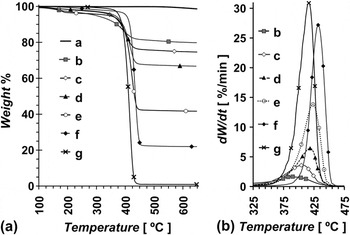
TGA analysis also confirmed that the MWCNTs were coated with polymer. Figure 5 shows the TGA curves and the first derivative of weight versus time. Pure PS starts to degrade at 390 °C and by 500 °C has completely pyrolyzed into volatile compounds. Thus TGA determined the MWCNT weight fraction in the products, as shown in Fig. 5(a) curves b to f. The peaks in the derivative curve of Fig. 5(b) mark the maximum polymer degradation rate (T d). For 22 wt% MWCNT T d is 16 °C higher than for pure PS. Such increases in thermal stability are usually explained by increased barrier properties: nanofillers, once above a percolation threshold, create a barrier to the diffusion of oxygen and combustion gases.Reference Kashiwagi, Grulke, Hilding, Harris, Awad and Douglas39 When fillers with high thermal conductivity are used (e.g., CNT) they also help dissipate heat, thus preventing the polymer from degrading until higher temperatures are reached.
(a) TGA wt% versus T curves for PS-g-MWCNTs nanocomposites under nitrogen flow (10 °C/min heating). Curve a shows pure MWCNT with negligible weight loss up to 650 °C. PS starts to degrade at 390 °C, and pyrolyzes completely (curve g) leaving a residue corresponding to the concentration of MWCNT in the composites b: 80 wt%, c: 75 wt%, d: 67 wt%, e: 42 wt%, and f: 22 wt%. (b) shows first derivatives of wt% versus time and how MWCNT loading affects the degradation temperature, b: 80 wt%, T d = 390 °C; c: 75 wt%, T d = 405 °C; d: 67 wt%, T d = 418 °C; e: 42 wt%, T d = 423 °C; f: 22 wt%, T d = 432 °C; and g: pure PS, T d = 417 °C.

With larger CNT loadings we saw an unexpected decreasing trend in degradation temperature with increasing MWCNT content; the opposite of what is usually reported. We consider that this happened because in our samples the effect of limited gas diffusion would decrease as increasing CNT concentrations (much higher than usually reported in the literature) created a semiopen network of PS-coated CNTs (see Fig. 2), which facilitated the evolution of polymer pyrolysis products and allowed a faster reaction. In the highest loading samples the uncoated portions of CNTs could conduct heat toward the polymer grafted over the MWCNTs. We could then expect that in the products with lower contents of PS the effect of CNT lowering T d would be more evident; indeed we observe such trend, with 67 wt% CNT the PS in the composite degrades at almost the same temperature as pure PS, and with higher concentrations the composites show a lower T d than pure PS, as can be seen in Fig. 5(b); this is consistent with the idea that uncoated CNT portions conduct heat toward the polymer coating. We note that a decrease in T d was reported for 13 wt% SWCNT-PS composites, and was attributed to the high thermal conductivity of the CNT.Reference Liu, Yao and Adronov40
E. Spectroscopy
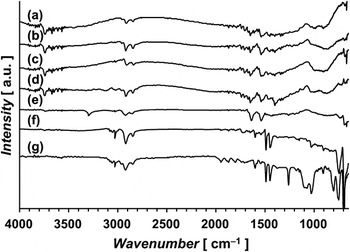
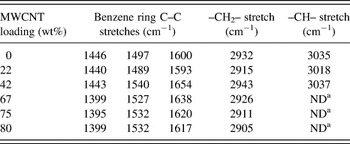
FTIR spectroscopy confirms that PS functionalized the CNTs. The characteristic absorption bands of polystyrene can be seen in Fig. 6. There were shifts in C–C stretch bands (Table I) which might be due to confinement effects, i.e., the restricted motion of the polymer chains directly in contact with the MWCNT affects their vibrational modes.
FTIR spectra of (a) Purified MWCNTs, and PS-g-MWCNTs nanocomposites with MWCNTs loads of (b) 80 wt%, (c) 75 wt%, (d) 67 wt%, (e) 42 wt%, and (f) 22 wt%; (g) pure PS.

Shifts in vibrational stretch bands in PS-g-MWCNT nanocomposites.

a ND = not detected.
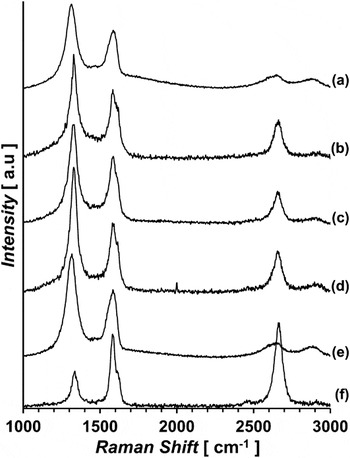
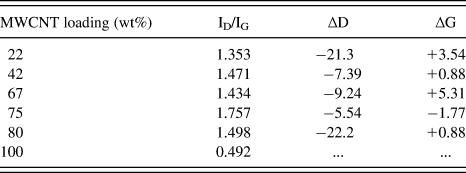
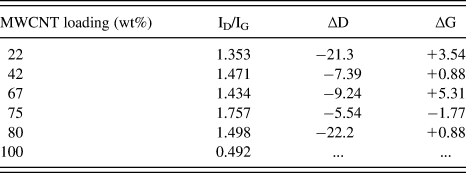
Large increases in the relative intensity of the D (“disorder,” sp3 carbon) and G (“graphitic,” sp2 carbon) bands in Raman spectra (Fig. 7) confirmed functionalization, as shown by the ratios of intensities, ID/IG, in Table II. The D and G peaks were displaced due to functionalization, and to a lesser extent due to interactions with the polymer matrix. In principle, the Raman spectroscopy results supported our assumption that polymerization limits the amount of functionalization, as the lowest increase in ID/IG corresponds to the composite with most polymer.
Raman spectra of PS-g-MWCNTs nanocomposites with decreasing fractions of PS, (a) 22 wt% MWCNT, (b) 42 wt%, (c) 67 wt%, (d) 75 wt%, (e) 80 wt%, and (f) purified MWCNTs.

ID/IG ratios and peak shifts for the composites from Raman spectroscopy (633 nm laser excitation).
If the degree of functionalization of MWCNT changes with the amount of polymer formed in the reaction, a trend in the ID/IG ratio would be expected. However, in our method another process may have also changed the intensities of the D and G peaks: longitudinal opening of the MWCNTs. As reported elsewhere the reaction conditions in this reductive alkylation functionalization method can lead to opening of MWCNT.Reference Cano-Márquez, Rodríguez-Macías, Campos-Delgado, Espinosa-González, Tristán-López, Ramírez-González, Cullen, Smith, Terrones and Vega-Cantú41 This discovery actually was an offshoot of our work in composites, where we first observed partial exfoliation and opening of MWCNT.
When functionalization with a monomer is done to grow a polymer the degree of functionalization is lower than when attaching small functional groups.Reference Liang, Beach, Kobashi, Sadana, Vega-Cantu, Tour and Billups33 Considering that in this polymerization process there is no prior MWCNT treatment, and that unfunctionalized portions of the nanotube surfaces appeared to exist, we expect that the nanotube properties will be less affected than in methods where the nanotubes are first oxidized and then functionalized further. We also postulate that as functionalization only occurs in the outermost walls the inner layers of MWCNT would be unmodified and retain their mechanical and electrical properties. In this regard we note that Stephenson et al.Reference Stephenson, Sadana, Higginbotham and Tour32 report that the resistivity of buckypapers of MWCNT functionalized by nanotube salts is not very different from that of unfunctionalized MWCNT. However, further work would be needed to fully evaluate the effect of polymer functionalization on the electrical properties of MWCNT.
We consider that further optimization of the method reported in this article can provide PS-g-MWCNT with a compromise between the lowest amount of functionalization and highest amount of polymerization so that the highest possible degree of reinforcement is achieved. Such optimization could also reduce the unexpected side effect of lengthwise opening of MWCNT. However, we believe that this should not adversely affect the composite properties, as the edges formed by the opening of the CNT can be attachment points for polymer chains in addition to the sidewall polymer-nanotube bonds.
IV. CONCLUSIONS
We have shown that reductive alkylation is a promising “one-pot” method to produce PS-grafted MWCNT materials with the ability to control the concentration of polymer, and produce composites with very high nanotube concentrations (≥80 wt%) not achievable by other methods.
An unusual decrease of the thermal stability of the composite with the amount of MWCNT was observed, which might be due to the large amount of CNT. This promotes an open network of PS-coated MWCNT, which facilitates the evolution of polymer pyrolysis products, allowing a faster reaction. The high thermal conductivity of the CNTs can also play a role in this.
To the best of our knowledge no other in situ polymerization or mixing process has been reported to produce composites with as high nanotube percentages as those we achieved, in basically one step. These composites are easily processable by melt- and solution-mixing. Given the various functionalization options possible, and that this procedure has been shown to polymerize other monomers, we believe this method should be useful for creating masterbatches and standalone composites with very large nanotube percentages for several polymer matrices.
Supplementary Material
Supplementary materials can be viewed in this issue of the Journal of Materials Research by visiting http://journals.cambridge.org/jmr.
ACKNOWLEDGMENTS
We thank CONACYT for scholarship support (CGEG, AGCM); Beca-Mixta funding for a research stay at Georgia Tech (CGEG); and for Grants CB-2004-SEP-47337 and CB-2008-SEP-107082 (FJRM); CB-2004-SEP-47338, CB-2008-SEP-106942, Bilateral-project S-4183, CIAM-2006-01-58899, and FA9550-09-1-0026 (YIVC); Solvay Advanced Polymers (MLS), and NSF Award CMMI-0800019 (MLS). We also thank Daniel Ramírez-González, Jessica Campos-Delgado, David Smith, and David Cullen, for their aid during electron microscopy characterization; Yonathan Thio for use of the twin-screw extruder; Mauricio Terrones and Florentino López-Urías for helpful discussions. The authors also acknowledge Gladis J. Labrada-Delgado and Beatriz A. Rivera-Escoto, of the Laboratory for Nanoscience and Nanotechnology Research (LINAN) at IPICYT for their help in materials characterization.