INTRODUCTION
Prognosis is an issue that most physicians and patients describe as difficult to discuss (Hagerty et al., Reference Hagerty, Butow and Ellis2005), and whether to tell patients with cancer about their diagnosis and prognosis is a matter of great debate (Harris et al., Reference Harris, Shao and Sugarman2003). Although it is often considered important to give patients prognostic information so that they can make important decisions in an informed manner (Harris et al., Reference Harris, Shao and Sugarman2003), some physicians either avoid the topic (Back et al., Reference Back, Arnold and Baile2005; Mack et al., Reference Mack, Wolfe and Grier2006) or disclose vague (The et al., Reference The, Hak and Koeter2000) or overly optimistic information (Lamont & Christakis, Reference Lamont and Christakis2001).
Whereas many studies have recommend that physicians be the first to disclose the prognosis to the patient (Tang et al., Reference Tang, Liu and Lai2006; Hari et al., Reference Hari, Mark and Bharati2007; Ngo-Metzger et al., Reference Ngo-Metzger, August and Srinivasan2008) in some cultures, including Japan, physicians are not expected to inform patients that they have a terminal illness (Mystakidou et al., Reference Mystakidou, Parpa and Tsilila2004; Yun et al., Reference Yun, Lee and Kim2004; Gabbay et al., Reference Gabbay and Etzioni2005; Jiang et al., Reference Jiang, Liu and Li2007), and family members often receive the information earlier and in more detail than does the patient (Yoshida et al., Reference Yoshida, Hirai and Morita2011). In this case, family members can be given decision-making authority and responsibility for the patient even when the patient is competent to make such decisions (Jiang et al., Reference Jiang, Liu and Li2007). However, decisions regarding patients' end-of-life concerns generate great distress for family members (Meeker, Reference Meeker2004; Parks & Winter, Reference Parks and Winter2009). For this reason, improving support systems available for family members making difficult end-of-life decisions with regard to prognostic disclosure is an important task for Japanese medical professionals. However, to our knowledge, only a few empirical studies have specifically addressed the practices of prognostic disclosure to patients and family members, including the factor of who makes the decisions. Moreover, family evaluations of the types of prognostic disclosure have not been explored.
The primary end points of this analysis were, therefore, to explore 1) the practices of prognostic disclosure for patients with cancer and their family members in Japan, 2) the person(s) deciding how to communicate the prognosis, and 3) family evaluations of the various types of prognostic disclosure.
METHOD
Procedure
This qualitative study was conducted as the second part of a nationwide questionnaire survey of 8402 bereaved family members of cancer patients who died in certified hospice and palliative care units in Japan. The procedures related to the original survey are described in a previous article (Miyashita et al., Reference Miyashita, Morita and Tsuneto2008).
We conducted semistructured face-to-face interviews between April and August 2008. Each interview was tape recorded. The interviewers included two psychologists, a research nurse, and three graduate students. The interviews followed an interview guideline developed by the authors and was tailored to the purpose of this study. The interview contained predetermined open-ended questions as follows: 1) How were you and the patient told about the patient's prognosis? 2) Who decided on the method of prognosis disclosure? 3) How do you perceive the way prognosis was disclosed to you and the patient?
Participants
For this study, we analyzed 105 family members who met two criteria: agreement to respond to an interview recruitment, and ability to attend face-to-face interviews. Subsequent participation was by mail.
The interviewer explained the purpose and method of the study in detail and obtained written informed consent from all the participants. Ethical and scientific validity were confirmed by the institutional review board of the Graduate School of Human Sciences, Osaka University.
Analysis
All interviews were tape recorded and transcribed. Content analysis was performed on the transcribed data. First, each interviewer identified the type of prognostic disclosure to the patient and participant from the following characteristics: 1) survival periods (e.g. “until May” or “several weeks”), 2) information only about incurability (they did not receive information related to survival periods), 3) no disclosure (they did not receive any disclosure at all), or 4) overly optimistic information (they were told the patient is not incurable). Second, each interviewer also identified the person who decided how to disclose prognosis to the patient and participant from the following categories: 1) patient, 2) family member, 3) physician or nurse, or 4) no discussion. Next, researchers extracted all statements from the transcripts related to familial evaluations of prognostic disclosure. Then, we carefully broke down family evaluations into four categories from 1) satisfied, 2) made a compromise, 3) feelings of doubt, and 4) feelings of regret. Finally, two coders chosen from psychology students independently determined the family evaluation of prognostic disclosure for each participant. When their coding was inconsistent, they discussed further and made a final judgment.
RESULTS
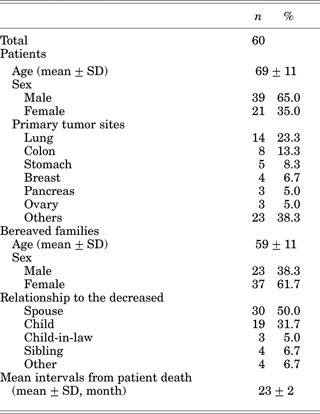
Of the 105 family members initially recruited, 60 members participated in the survey (response rate 57.1%). Table 1 summarizes the background information for the patients and participants.
Background of patients and the bereaved families

Family-Reported Practices of Prognostic Disclosure
The types of prognosis communication that patients received were divided into the following characteristics: well-defined, predicted survival periods (25.0%, n = 15), communication of incurability without well-defined, predicted survival periods (11.7%, n = 7), no disclosure about incurability (60.0%, n = 36), and communication of curability (3.3%, n = 2). Meanwhile, the types of prognostic disclosures that participants received were: well-defined, predicted survival periods (75.0%, n = 45), communication of incurability without well-defined, predicted survival periods (23.3%, n = 14), and no disclosure about incurability (1.7%, n = 1).
Individuals Who Decided on the Type of Prognostic Disclosure
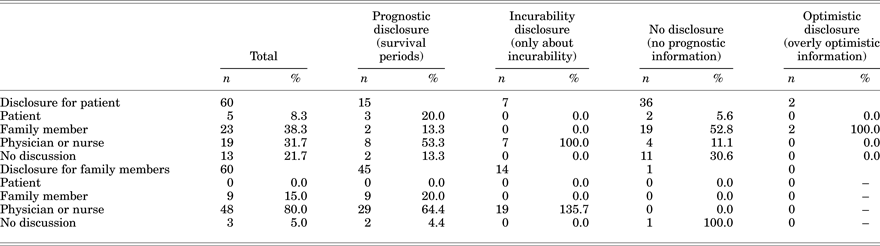
The individuals who decided on the degree of prognostic disclosure to patients broke down into the following groups: patient (8.3%, n = 5), family member (38.3%, n = 23), physician or nurse (31.7%, n = 19), and no one/no discussion (21.7%, n =13). In comparison, the person who decided the degree of prognostic disclosure to family members broke down as follows: family member (15.0%, n = 9), physician or nurse (80.0%, n = 48), and no one/no discussion (5.0%, n = 3). Table 2 shows detailed results regarding the decision makers. A large majority of family members (19 out of 23) who decided on the degree of disclosure by themselves chose not to disclose to patients information related to prognosis and incurability, whereas 15 of 19 cases in which the physician or nurse decided the degree of disclosure chose to disclose prognosis or incurability information to patients.
Decision maker for the type of prognostic disclosure
Family Evaluations of the Type of Prognostic Disclosure
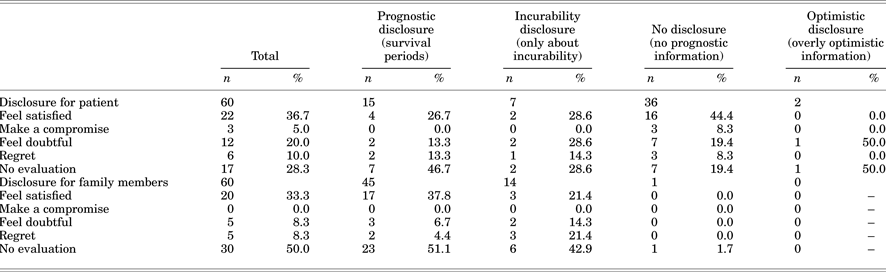
In total, 23 participants (38.3%) told us that they felt satisfied with the degree of prognostic disclosure, 4 participants (6.7%) revealed that they made a compromise related to disclosure, 13 participants (21.7%,) said that they felt doubtful, and 6 participants (10.0%) felt regret. In comparison, 20 participants (33.3%) said that they felt satisfied with the degree of prognostic disclosure for patients, 5 participants (8.3%) said that they felt doubtful, and 5 participants (8.3%) experienced regret. The concordance rate of the determinations of the evaluations by the two coders was 92.6%. Table 3 provides detailed results regarding the family evaluations of prognostic disclosure. The percentage of family members who reported that they were satisfied with the degree of disclosure to patients was 26.7% in the “prognostic disclosure” group, and 44.4% in the “no disclosure” group. The percentage of family members who reported that they either regretted or felt doubtful about the degree of disclosure to patients was 26.6% in the “prognostic disclosure” group, and 30.5% in the “no disclosure” group.
Family evaluation on prognostic disclosure
DISCUSSION
In Japan, an important task for medical professionals is to improve the support system for family members regarding prognostic disclosure. Our study is, to our knowledge, the first survey to investigate family evaluations of prognostic disclosure to both patients and family members, including an analysis of who makes such decisions.
Our survey evaluated prognostic disclosure practices in Japan for patients with cancer and their family members. Whereas only 25% of patients were provided predictions of survival periods, >70% of the family members received prognostic disclosures. This agrees with the notion that physicians are not expected to inform patients that they have a terminal illness in Japan and other Asian countries (Tang & Lee, Reference Tang and Lee2004; Gabbay et al., Reference Gabbay and Etzioni2005; Yoshida et al., Reference Yoshida, Hirai and Morita2011). It can be said that the main targets of prognostic disclosures in Japan are still family members.
The most important finding is that only ~30% of medical professionals assume responsibility for the degree of prognostic disclosure to patients, whereas >80% assume responsibility in case of disclosure to family members. Thirty-seven percent of participants reported that they themselves decided on what degree of prognosis communication was appropriate. These data agree with the notion that family members are sometimes given decision-making authority and responsibility for the patient in Asian countries (Jiang et al., Reference Jiang, Liu and Li2007). It is also notable that 18 of 22 participants who decided how to disclose the prognosis to the patient chose not to disclose any information at all. Honest, timely, and complete prognostic disclosure is a key determinant of the overall satisfaction of patients (LeClaire et al., Reference LeClaire, Oakes and Weinert2005; Heyland et al., Reference Heyland, Dodek and Rocker2006), and in Japan, ~50% of patients preferred to receive information about the expected length of survival (Fujimori et al., Reference Fujimori, Akechi and Morita2007). The result of this study shows that family members can often prevent patients themselves from receiving adequate prognostic disclosure. Therefore, further investigations should determine precisely why family members either agree or disagree with prognostic disclosures to patients, in order to understand whether the decisions of family members are reasonable, and to possibly support more empathetic communication.
Another important finding from this study was that >30% of family members regretted or felt doubtful about the types of prognostic disclosure to patients, whereas 38% of participants were satisfied with the way prognoses were disclosed. It is notable that there were some family members who were satisfied with prognostic disclosure and some who regretted it in every type of disclosure group. Previous studies showed that prognosis discussions enhance patients' and family members' satisfaction with end-of-life care. (Heyland et al., Reference Heyland, Allan and Rocker2009; Innes & Payne, Reference Innes and Payne2009) However, our results suggest that any one type of disclosure is not necessarily always the most acceptable choice for family members. Therefore it would be important to clarify factors that correlate with the differences in evaluation among family members who made the same decision.
This study had several limitations. First, as the number of participants was small and the response rate was not very high (57.1%), the study subjects might not be representative of the whole population. Second, the study subjects were limited to the families of patients who had been admitted to palliative care units, and the findings might not be applicable to families/patients in other settings. A future survey of families of patients who have not been admitted to palliative care units represents an expected next step in this research. Third, both practices and evaluations were explored from the family members' point of view. Further research including patients' perceptions will be needed. Finally, this study depended upon retrospective evaluations obtained from bereaved family members, and recall bias could exist. Confirmation of our findings will require prospective observational studies.
ACKNOWLEDGMENTS
This study was supported in part by a grant-in-aid for Cancer Research from the Japanese Ministry of Labor, Health and Welfare.