In April 2006 a national public hearing about fashion studies was arranged by the Faculty of Humanities at Stockholm University, where about 40 people from various Swedish institutions were brought together to describe their involvement with fashion. Information was given about their collections and their organizations with regard to the theme of fashion in order to identify similarities, as well as areas of possible future collaboration with the Centre for Fashion Studies. This hearing I attended which was valuable to us in our fashion literature acquisition process at the university library.
Two months later, on 1st June 2006, the Centre for Fashion Studies (CFS) was established as a new academic subject within the Faculty of Humanities, through a generous donation from the Erling Persson Family Foundation, connected to clothing manufacturer H&M.
The education at the CFS was established to be interdisciplinary, theory-based and to serve as an international forum. It was also important that it would aim to increase collaboration between the university, colleges, relevant culture institutions, the business community and society as a whole. This new activity at the university also marked the introduction of the topic of fashion studies in Sweden, a multi-disciplinary initiative that brings together research conducted within several disciplines in different parts of the country.Footnote 1 This added a key role for the university library, which is integrated in research and education conducted at the university. The library works in close collaboration with all disciplines to provide adequate support to researchers, lecturers and students in a rapidly changing information society.
The first symposium
CFS organized and hosted a two day international symposium Fashion studies : Perspectives for the future in September 2006, where a number of prominent international fashion scholars participated. The keynote speaker was Valerie Steele from the museum at the Fashion Institute of Technology in New York and she gave a speech on Fashion, Art and Life. Footnote 2
The symposium gave an overview and insight about what fashion is, its importance in our history and culture, and also that fashion is not a linear development.Footnote 3 ‘Fashion is like a huge vacuum cleaner’ expressed Valerie Steele at the symposium.Footnote 4 The statement gives not only an idea but also an understanding and significance of what can be included in fashion as a system of meaning and its role in society.
The symposium was, in fact, a starting point and a further stepping stone for all of us: for both the CFS and the university library working with fashion as an academic subject at the university. At this symposium the library exhibited some of the fashion books that we hold in our collection and a brochure about our information resources available. In addition, publishers were also present displaying their fashion publications.
This launched the education offer from CFS and in the autumn of 2006 two programmes started: a one year master programme and an introductory course. I attended the introduction course and later an intermediate course in the spring of 2007. Four hundred students were accepted for the introductory course and we attended lectures, workshops and lessons on campus. This was relevant and pertinent to my work as a librarian developing the fashion collection at the university library.
Collection development strategies
At this point in time we, Margareta Willers, a librarian with much experience and skill, and I as Arts Librarian, had already begun an inventory of the material related to fashion held by the library. This was the most important task when the subject was established and the process was immediately initiated.
I was acutely aware that fashion books already existed in our collection, but we found that we had to do a stock check on certain collections. We have in stock 2.5 million books across the library collections, and to do a complete inventory would have been very difficult. Books about fashion could have been placed in any number of locations: together with theatre and dance, art history, ethnology, history and literary studies, social anthropology, sociology and business with marketing. This stock check was, of course, a very time consuming task.
A special allocation of funds was provided early on by CFS and these funds were supplemental to our general acquisitions budget, which made the purchase of literature, encyclopedias, databases, peer reviewed journals and e-journals possible and enabled us to provide a well-curated collection with fashion titles in the university library. The development of this knowledge base at the library is central to its collaboration with CFS.
In January 2008 my colleague Margareta sadly passed away and I took over the fashion collection acquisition project at the university library.
Part of the collection development process was an open seminar in May 2008, which brought together librarians from a number of cultural institutions in the Stockholm area. It was of great importance to go through the libraries' fashion material in order to see what their fashion stock entailed and we achieved clarity on this point.
Collection diversity
Textbooks
The acquisition process was undergoing constant review and discussion about both a broad, general selection to more specialization. We acquired books in fashion with a worldwide perspective, with no restrictions on language, geography or religion.
However first and foremost, we had to order the textbooks in time for the courses in autumn 2006. The list of textbooks was provided by CFS and, at the time, we ordered books from our agent Dawson Books in the UK. We managed to receive, catalogue, label and shelve the book material just in time to enable students access at the beginning of the autumn term. The key textbooks were Fashion-ology : an Introduction to Fashion Studies, Adorned in Dreams: Fashion and Modernity and The Language of Fashion.Footnote 5
Houses of fashion and haute couture
A sizeable number of biographies were acquired at an early stage about established fashion designers, such as Elsa Schiaparelli, Paul Poiret, Christian Dior, Coco Chanel, Yves Saint Laurent, Armani, Prada, Gucci and Louis Vuitton.
Haute couture, or high fashion, is a central element of the fashion system and a substantial number of books on the subject are available in our collection, as are publications with an historical perspective, from medieval times to the 20th century. Examples of the latter include haute couture in 18th-Century France and the court life of Queen Marie Antoinette at Versailles. Her dressmaker Marie-Jeanne Bertin created luxurious dresses for her on the eve of the French revolution. Other haute couture offerings include embroidery and lacemaking; the scene in Paris and Milan; couture catwalks and shows; trends in fashion industry and the representation of haute couture in film.
From corsets and crinolines to the phenomena of the tailored gentleman
Monographs on corsets and crinolines, which is a wide topic in fashion studies because of the variety of styles of undergarments through different periods in history, are represented in the collection, as are books about the symbolism of the colour black in fashion ranging from mourning to the ‘little black dress’ by Chanel; fashion forties and the New Look by Dior; (un)fashion; urban fashion; styling models; dress, body and identity and fashion in film and art. Our collection also has examples of books about pearls and furs, wedding dresses, heritage brands and other luxury goods. When it comes to categories of men's fashion, books about the dandy, the peacock male and tailored gentlemen are represented in the library. As far as the category ‘tailored gentlemen’ is concerned there are publications covering the master tailors at Savile Row and their contribution in tailoring clothing for Gary Cooper, Cary Grant, Brian Ferry as well as all the James Bond characters.Footnote 6
Another focus is fashion theory, including forecasting, the business of fashion, marketing and management, eco fashion, fashion and law, fashion in society and in sport, as well as fashion in and as communication. Books about the darker side of fashion and fashion design demonstrate how the fashion industry can create, and historically has created, victims that become subject to disease, madness and even death.
Models and moviestars as icons, and H&M Celebrity guest designers
Along with the supermodels, such as Lisa Fonssagrives Penn and Jean Shrimpton, actresses like Marilyn Monroe, Grace Kelly, Audrey Hepburn, Greta Garbo and Ingrid Bergman, singers such as Madonna and David Bowie, and public figures like Jacqueline Kennedy and Princess Diana, have also influenced fashion, becoming icons of sophistication or outrage, and set standards of iconic fashion style. The acquisition of monographs often also coincided with the launch of the guest designer collections at H&M, such as Viktor&Rolf in 2006, Roberto Cavalli in 2007, Comme des Garçons and Matthew Williamson in 2008, Sonia Rykiel in 2009, Lanvin in 2010 and Versace in 2011, Marni and Maison Martin Margiela in 2012 and Isabel Marant in 2013. Even the launches prior to 2006 gave us a perspective on what literature to purchase.
What was important during the early building process was also to acquire material for researchers at the CFS that was of importance to them with their focus on research and was a driving force in our acquisition endeavours. Prominent international lecturers within fashion studies gave public lectures at CFS which also gave us an opportunity to acquire new books on the topics covered.
Choo shoes, Manolos, and perfume as part of the fashion collection
The scholars Peter McNeil and Giorgio Riello spoke at the international symposium Fashion studies: Perspectives for the future in September 2006 about For serious pedestrianism: Fashion and footwear in history. Their talk was based on the publication they edited called Shoes: a history from sandals to sneakers. This lead to McNeil's appointment as Sweden's first Professor of Fashion Studies at the university in 2008, where he established artefact-based shoe studies in the curriculum at CFS.
Another factor in the rise of shoes as a fashion topic was the release of H&M guest designer Jimmy Choo's collection in November 2009. It was the first time that H&M cooperated with an accessory brand. To complement the luxury shoes came also a women's and a men's clothing collection together with handbags and other accessories.Footnote 7 One month earlier a fragrance for Jimmy Choo was announced, called Blossom.Footnote 8 The interest in shoes and perfume as accessories has taken off in popular culture and in fashion studies. An example at the time was the American television series ‘Sex and the City’, where the luxurious Manolo Blahnik shoe brand was heavily exposed and where fashion in general was portrayed as a forceful social phenomena.Footnote 9 Multiple, converging factors have contributed to an increased interest in shoes as a fashion phenomenon and discourse at CFS and so the library has added a great number of monographs on shoes to the collection. These aspects also set the development of the fashion collection of books on shoes in a broader time-specific cultural context which is important to note and observe.
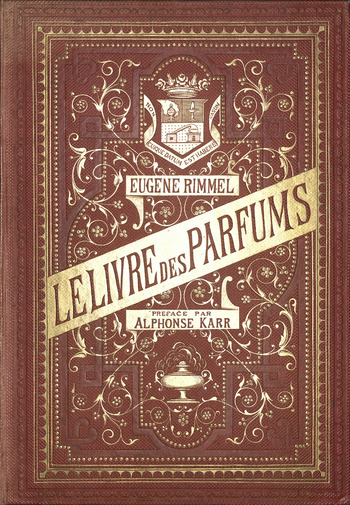
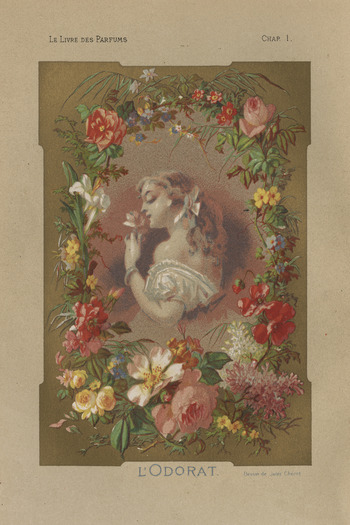
Prestigious designers often produce a fragrance as part of the fashion collection. French couturier Paul Poiret created the first perfume brand in Paris in 1911, dedicated to one of his daughters, Parfums de Rosine, but it was his fellow couturière Coco Chanel that saw the potential in the business when she in 1921 launched the perfume Chanel No. 5 and put her name on the perfume bottles.Footnote 10 The private launch took place at a dinner party at an exclusive restaurant in Cannes and the bottles were only available in her fashion boutiques in Paris, Deauville and Biarritz as part of her collection. When, three years later in 1924, she licensed her perfume Chanel No. 5 it was already an exclusive luxury item.Footnote 11 Our rare book collection contains a number of important publications on perfume, for example (See Fig. 1 and 2), Le livre des parfums and The art of perfumery and the methods of obtaining the odors of plants…Footnote 12
Binding – blind and gold stamped cloth. E. Rimmel, Le livre des parfums, 1870 in our rare book collection. Photo: Stockholm University Library. See Libris http://libris.kb.se/bib/12477431

Plate, Jules Cheret, L'Odorat from E. Rimmel, Le livre des parfums, 1870 in our rare book collection. Photo: Stockholm University Library. See Libris http://libris.kb.se/bib/12477431

Handbooks and encyclopedias, databases, e-books, e-journals and periodicals
It was essential to acquire handbooks and encyclopedias at an early stage. Many of the titles in the library were at first acquired in hard cover and paperback form, while electronic media resources was phased in over time.
In 2009 I became a library advisor for Berg fashion library, an online database published by Bloomsbury. Berg fashion library (BFL) was launched in 2010 with access to a large fashion literature inventory of e-books, a number of reference resources including the ten-volume reference work The Berg encyclopedia of world dress and fashion, with a numerous number of online articles. The BFL proved to be an indispensable tool for students in their studies and my involvement was invaluable in the process of our collection development. We also have subscriptions to the databases American Vogue archive (1892-), Vogue Italia archive (1964-), Harper's Bazaar Archive (1867-), and Women's wear daily archive (1910-), all produced by ProQuest.
Periodical literature is the cornerstone of academic research and a good collection is essential to help establish fashion as a subject in the university. This includes popular magazines, as well as academic titles. In 2009 we had a trial subscription to all e-journals offered by Berg, and have continued to subscribe to the peer-reviewed e-journals Fashion theory and Fashion practice and we also hold, from other publishers, a few e-journal fashion titles such as Harper's bazaar (2005-) Harper's bazaar UK (2011-) and Harper's magazine (1992-2007). The Norwegian journal Personae : klaer, kropp, kultur gives a Nordic perspective on fashion and deals with the subject in philosophical, aesthetic and social perspectives.
A number of generous donations of journals came in at an early stage both from institutions and individuals, providing a valuable contribution to the library. As a result, we have acquired retrospectively the English, Italian and French editions of Vogue (1953–1964), as well as older volumes of Details, The face, Arena, Blitz, Flaunt, I-C magazine, Nylon, Interview, Dazed & confused, L'Officiel de la couture et de la mode de Paris, Femme chic, L'Art et la mode, and Harper's bazaar. We also have a near-complete set of the beautiful Swedish journal with floral fabric covers Saisonen : Magasin för konst, nyheter och moder (1917–1925).
Outreach
In May 2009 an open seminar took place at Stockholm University Library. The seminar was a collaboration with the CFS in order to thank donors and to inform the university staff and students about fashion studies. The programme of lectures included talks about Swedish fashion history 1870–1950, and in particular the Swedish fashion designer Augusta Lundin, as well as the atelier at Märthaskolan, about fashion, literature and mentality in 17th-century France, and about Vogue magazine covers and the magazine's history.
The national interest in the study of fashion at Stockholm University was clearly on the rise at this stage. I initiated and organized a seminar in April 2011 with the title Dräkt och mode – i bibliotekens samlingar (Costume and Fashion – in library collections). The seminar took place at the National Library of Sweden and drew delegates from a number of cultural and educational institutions in the Stockholm area. I spoke about the ongoing work developing the fashion collection at the university library. Speakers from CFS included Louise Wallenberg discussing fashion as an academic subject and Paula von Wachenfeldt who presented on fashion in fiction. There were many contributions ranging from papers about the meaning and importance of costume in theatre, French fashion journals and silent film posters in the National Library of Sweden, army uniforms, and men in swimsuits. Furthermore there was a presentation about the costume dresses in the film Marie Antoinette, directed by Sofia Coppola.
The library serves researchers, lecturers and students, but also the general public. Loans of fashion books to students and researchers have increased a lot, as has awareness and interest amongst the general public, which in turn increases visits and loans at the library. Users outside of Stockholm find our holdings in Sweden's national catalogue system Libris. The heavy media coverage about fashion studies as a new academic subject and of the acquisition process at the library generated interest, and the number of incoming inter-library loan requests increased to a large extent initially as well.
In conclusion
Being a part of the project from its beginning in 2006 and in leading it in full since 2009, I am confident in my claim that Stockholm university library's intention to have one of the best collections of fashion literature has been achieved.
In January 2013 the CFS moved off campus, to the Filmhuset, where a merger took place in conjunction with the Department of Media. CFS formerly belonged to the Department of Art History.
The acquisition strategy at the library, as from mid-2013, is to deliver media resources as quickly as possible, and the strategy is based on the needs and demands of researchers, lecturers and students. Primarily we acquire resources in electronic formats and we use patron-driven acquisition as a business model. These two parallel developments constitute new methods of fashion literature acquisition which are still in place at present.
Acknowledgments
I would like to thank my fellow colleagues in the arts subjects, my colleague Margareta Willers, who was not able to see the end result, Peter McNeil, Louise Wallenberg and Paula von Wachenfeldt of the CFS, for their cooperation and collaboration. I would also like to thank Kathryn Earle and staff at Bloomsbury Publishing for good collaboration over the years.