Introduction
The maize weevil Sitophilus zeamais (Motschulsky) (Coleoptera: Curculionidae) is one of the most widespread and destructive primary insect pests of stored maize and other cereal grains. This insect causes serious damage through direct feeding by adults and larvae and indirectly by way of contamination, which results in serious reduction in value. Contamination of produce can be serious due to the accumulation of uric acid (Hill, Reference Hill2002). Control of weevil populations worldwide has been provided principally by the use of contact and residual insecticides, such as organophosphorus and pyrethroid insecticides, and fumigants, such as methyl bromide and phosphine (White and Leesch, Reference White, Leesch, Subramanyam and Hagstrum1996). Although they are still most effective, their repeated use has disrupted natural biological control systems and led to resurgences of this pest (Brower et al., Reference Brower, Smith, Vail, Flinn, Subramanyam and Hagstrum1996), often resulting in the development of resistant populations (Champ and Dyte, Reference Champ and Dyte1977; Subramanyam and Hagstrum, Reference Subramanyam, Hagstrum, Subramanyam and Hagstrum1996; White and Leesch, Reference White, Leesch, Subramanyam and Hagstrum1996), which raises environmental and human health concerns (White and Leesch, Reference White, Leesch, Subramanyam and Hagstrum1996).
To address these shortcomings of synthetic insecticides, there has been a great deal of interest to seek alternative control methods that are less toxic to non-target organisms and are biodegradable. Substances of plant origin are attractive because they are generally considered to be more biodegradable. The neem tree Azadirachta indica A. Juss. (Meliaceae) has many useful compounds, including azadirachtin, a tetranortriterpenoid limonoid, the principal active ingredient in many neem-based insecticides (Mordue and Blackwell, Reference Mordue and Blackwell1993). It possesses antifeedant, repellent, growth disrupting and larvicidal properties against a large number of pests (Schmutterer, Reference Schmutterer1990; Aerts and Mordue, Reference Aerts and Mordue1997). The first commercial formulation of neem, Margosan O®, was developed in the USA in 1986 (Larson, Reference Larson, Schmutterer and Ascher1987). Since then, many other commercial formulations, such as Azatin, Bioneem, Neemies, Safer's ENI, RD-Repelin, Neemguard, Neemark, Neemazal and Oikos 32 EC, have been produced (Cóndor, Reference Cóndor2007; Isman and Akhtar, Reference Isman, Akhtar, Ishaaya, Horowitz and Nauen2007; Kavallieratos et al., Reference Kavallieratos, Athanassiou, Saitanis, Kontodimas, Roussos, Tsoutsa and Anastassopoulou2007; Akhtar et al., Reference Akhtar, Yeoung and Isman2008).
Calneem oil, containing 0.3% azadirachtin as its major active ingredient, is a new commercial product that is extracted from the neem seeds and is registered in Ghana for the control of field and storage pests (Obeng-Ofori, Reference Obeng-Ofori2007; Adarkwah et al., Reference Adarkwah, Obeng-Ofori, Büttner, Reichmuth and Schöller2010). It is an oil extract from pure neem seed kernels collected and crushed in Ghana. Calneem, at dosages ranging from 0.5 to 3.0% (v/v), caused 59–90% mortality in adults of Tribolium castaneum (Herbst) (Coleoptera: Tenebrionidae) on wheat (Adarkwah et al., Reference Adarkwah, Obeng-Ofori, Büttner, Reichmuth and Schöller2010). Similarly, the oil applied at the rate of 7 ml/l by topical application caused 65% mortality of Ephestia cautella (Walker) (Lepidoptera: Pyralidae) within 120 h (Shehu et al., Reference Shehu, Obeng-Ofori and Eziah2010). Information concerning the efficacy of Calneem against other stored product insect pests is lacking.
In Cameroon, where the neem tree was introduced in 1947 (Yengué and Callot, Reference Yengué and Callot2002), and is widely distributed in the northern regions and a few areas in the southern regions, to date, little is known about the insecticidal properties of the plant, while its use in the treatment of diseases is common (Tourneux and Yaya, Reference Tourneux and Yaya1998; Noumi and Anguessin, Reference Noumi and Anguessin2010). In this study, we extended the bio-efficacy assay of Calneem to S. zeamais on maize and compared its activity against this insect with those of local neem oils from two localities in Cameroon, which were extracted traditionally and in the laboratory. Adult mortality, effect on hidden immature stages and reduction of progeny emergence of S. zeamais were the parameters used to assess the insecticidal efficacy of the neem oils.
Materials and methods
Test maize seeds
Maize seeds (var. Shaba) were harvested in an experimental field of the Institute of Agricultural Research for Development, Ngaoundere, Cameroon in January 2009. The seeds were sun-dried, cleaned and disinfested by keeping them in a freezer at − 20 °C for 20 days prior to the bioassays. The maize was then kept under experimental conditions for at least 2 weeks before use. The moisture content of the seeds was 11.32%, determined using the method of AFNOR (1982).
Insect rearing
Adults of S. zeamais were obtained from a colony maintained since 2005 in the Applied Chemistry Laboratory of the University of Ngaoundere. The weevils were reared on disinfested maize in 900-ml glass jars, in which 30 adults were introduced to 250 g maize, and kept under ambient laboratory conditions (temperature: 17.3–28.8 °C and relative humidity (RH): 56.3–97.8%). Twenty such glass jars were used for the insect rearing. The adults were removed after a 2-week ovipositional period by sieving the grains through a 2-mm mesh sieve to separate the grains from the weevils, after which the grains were returned into the jars. The glass jars containing the infested maize (eggs and immatures) were kept until the adults emerged. Then sieving was repeated every 7 days and the insects kept for another 7 days, to obtain 7- to 14-day-old insects of mixed sexes that were then used for the bioassays.
Collection and processing of neem seeds
The ripe fruits were collected on the ground under neem trees with diameter ranging between 1.50 and 1.80 m in Garoua and Maroua (Northern Cameroon) in March of 2009. In Garoua, fruits were collected in the Yelwa quarter (latitude 9°20.6′N, longitude 13°24′E and at an altitude of 175 m above sea level (masl)), whereas in Maroua fruits were collected in the Meskine quarter (Maroua premier) (latitude 10°33.16′N, longitude 14°15.04′E and altitude of 356 masl). The cities of Garoua and Maroua are in the Sudano-Sahelian agro-ecological zone (IRAD, 2007). This agro-ecology is characterized by two seasons: wet (June to September) and dry (October to May). Annual rainfall ranges between 800 and 1000 mm. Annual mean temperature is 29° C, with a maximum of 39 °C in March and minimum of 17 °C in January. Average annual RH stands at 67%.
The neem fruits were kept in tap water for 24 h to further soften the pulp. De-pulping was done by hand. The seeds obtained were dried on jute bags placed on the ground under shade. The dry seeds were decorticated by hand. The seed kernels obtained were used for oil extraction.
Extraction of neem seed oil
The kernels obtained from each locality were extracted separately according to two methods: via the kneading method (traditional) and by cold pressing, using a hydraulic press in the laboratory (refined). For the traditional method, the kernels were pounded in a mortar, and the powders obtained were moistened with lukewarm water (0.25 litres for 2.6 kg of powder) in a plastic container until a dough-like material was formed. The paste obtained was kneaded for several minutes and then pressed firmly with the hand. Kneading and pressing were alternated to collect maximum oil from the neem cake. The oil obtained was stored in a refrigerator at 4 °C until needed for bioassay. For the cold pressing in the laboratory, the kernels were first ground in a mixer–blender (Leroy Somme 16.015, Angouleme, France). The oil was then extracted from the kernel powder using an MC 2000 AUF hydraulic press manufactured in the mechanical engineering laboratory of National School of Agro-Industrial Sciences, University of Ngaoundere, Cameroon (Tchiegang et al., Reference Tchiegang, Dandjouma, Kapseu and Parmentier2003). The oil was then stored in a refrigerator at 4 °C until needed for bioassay.
Calneem
Calneem used in bioassays is a neem biopesticide produced in Ghana by AQUA AGRIC community project and marketed in the UK. It is a cold-pressed, filtered, pure and natural oil derived from neem seeds. Calneem contains 0.3% azadirachtin as its major active ingredient. The Department of Stored Product Protection at the Federal Research Centre for Cultivated Plants, Julius Kühn-Institut, Berlin, Germany provided the oil. On arrival at Ngaoundere (within 3 days), the oil was kept in a refrigerator at 4 °C until needed for bioassays.
Determination of oil density
A pycnometer was used to determine the density of the oil according to the method of AFNOR (1982).
Adult toxicity tests and progeny production
The application rates were 2, 4, 6, 8 and 12 ml/kg. These rates were obtained by adding 0.1, 0.2, 0.3, 0.4 and 0.6 ml of oil to 50 g maize in a 900-ml glass jar. Each of the volumes of the oil was diluted in 1.25 ml of acetone (99% purity). Glass jars containing test solutions and 50-g samples of grain were hand-shaken for 5 min to get uniform coating. The samples were kept for 1 h to allow the solvent to evaporate before introducing the weevils. Twenty unsexed weevils (7- to 14-day-old) were introduced into each jar. Controls consisted of maize with acetone alone. The treatments were arranged in a completely randomized design on shelves with four replications per treatment. All treatments were maintained in the laboratory under ambient conditions. The daily temperature and humidity in the laboratory ranged from 17.3 to 28.8°C and 56.3 to 97.8% RH, respectively. Mortality was recorded 1, 3, 7 and 14 days after weevil infestation. On the 14th day post-infestation, all insects were removed. All treatments began on the same day and, therefore, were exposed to the same temperature and RH regime. The counting of F1 progeny was carried out once a week for 5 weeks, commencing 6 weeks after infestation. After each counting session, the insects were removed from the jars. The emergence started only after the 5th week post-infestation.
Effects on hidden eggs and immature stages
The procedures of Obeng-Ofori et al. (Reference Obeng-Ofori, Reichmuth, Bekele and Hassanali1997) were used. Batches of 200 g maize in 900-ml glass jars were infested with 30 insects (7- to 14-day-old) of mixed sexes. The parent adults were sieved out 14 days after infestation. The grains were then treated with 0.4, 1.2 and 2.4 ml of neem oil corresponding to the rates of 2, 6 and 12 ml/kg of maize, respectively, and admixed as described above. Control consisted of grains treated with acetone alone. Each treatment had three replications that were kept under fluctuating laboratory conditions (17.8–26.8 °C and 56.6–98.5% RH). The grains were inspected for adult emergence starting 4 weeks after treatment, for 5 weeks.
Data analysis
Data on percentage cumulative corrected mortality and percentage reduction in progeny emergence were transformed using arcsine ( ) and the number of progeny produced was log-transformed (x+1) before conducting ANOVA; statistical analysis was performed using SAS (Zar, Reference Zar1999; SAS Institute, 2003). Tukey's test (P = 0.05) was applied for mean separation. Probit analysis (Finney, Reference Finney1971; SAS Institute, 2003) was used to determine lethal concentrations causing 50% mortality (LC50) of S. zeamais at 1, 3, 7 and 14 days after treatment application. Abbott's formula (Abbott, Reference Abbott1925) was used to correct for control mortality before probit analysis and ANOVA.
Results
Oil yield and density
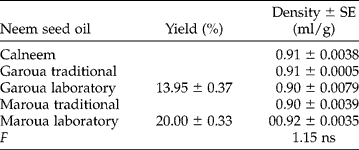
The neem seeds from Maroua (20.00%) had a higher oil yield compared with those from Garoua (13.95%) (Table 1). There were no differences in density among the oils (P>0.05).
Density of Calneem oil from Ghana and Azadirachta indica seed oils from two localities in Cameroon extracted traditionally and in the laboratory, and oil yields of the laboratory extracts
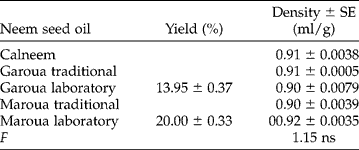
ns, not significant.
Adult toxicity tests
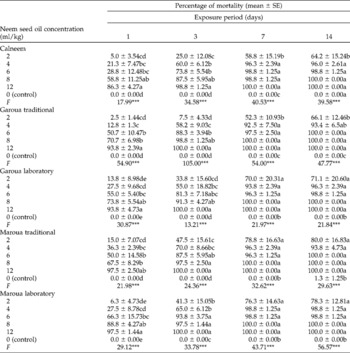
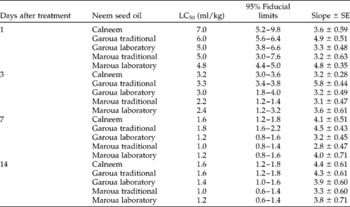
For each of the five neem seed oils, mortality increased with ascending concentrations and post-exposure time (Table 2), which was less evident at higher concentrations (6–12 ml/kg) and for a longer exposure period (7 days or more). Overall, the neem oils caused similar mortality levels to S. zeamais (P>0.05). Within 1 day of exposure, the mortality caused by the highest neem oil concentration (12 ml/kg) to S. zeamais ranged between 86.3 and 97.5%. This concentration achieved complete mortality of the weevils, 7 days after treatment for all the oils tested. The lowest (2 ml/kg) concentrations of the different oils caused >60% mortality to S. zeamais within 14 days post-treatment. LC50 values for the different neem seed oils decreased with post-exposure period, but this decrease was not significant between days 7 and 14 (Table 3). For example, the values for Calneem were 7.0 (5.2–9.8), 3.2 (3.0–3.6), 1.6 (1.2–1.8) and 1.6 (1.2–1.8) at 1, 3, 7 and 14 days after exposure, respectively. Those for the Maroua laboratory oil for the same exposure periods were, respectively, 4.8 (4.4–5.0), 2.4 (1.2–3.2), 1.2 (0.8–1.6) and 1.2 (0.6–1.4). For days 1 and 3, but not 7 and 14 after treatment, the LC50 values were different among the neem seed oils. Calneem had a value of 7.0 (5.2–9.8), which was higher than that of the Maroua laboratory oil, which stood at 4.8 (4.4–5.0), 1 day after treatments. The 3-day LC50 value for the Garoua traditional oil (3.3 (3.4–3.8)) was higher than that of the Maroua traditional (2.2 (1.2–1.4)) and the Maroua laboratory (2.4 (1.2–3.2)) oils. In general, the slopes were steep and positive, with values ranging from 5.8 ± 0.44 for the Garoua traditional extract (the highest value obtained at 3 days post-exposure) to 0.8 ± 1.4 for the Maroua traditional extract (the lowest value obtained at 7 days post-exposure). R 2 values were higher for days 1 and 3 than for days 7 and 14.
Corrected cumulative mortality of Sitophilus zeamais exposed to Calneem oil from Ghana and Azadirachta indica (neem) seed oils from two localities in Cameroon, extracted traditionally and in the laboratory

Means in the same column followed by the same lower case letter do not differ significantly at P < 0.05 (Tukey's HSD test). Each datum represents the mean of four replicates.
*** P < 0.001.
LC50 values of Calneem oil from Ghana and Azadirachta indica seed oils from two localities in Cameroon, extracted traditionally and in the laboratory at 1, 3, 7 and 14 days after treatment

LC50 values considered significantly different when 95% fiducial limits do not overlap.
Progeny production
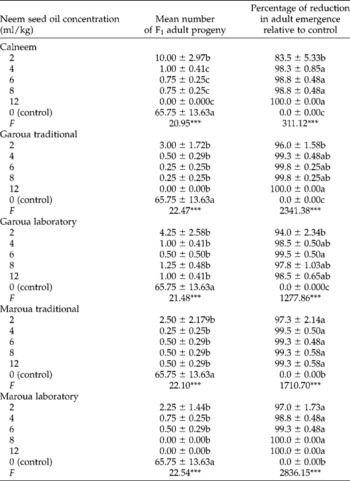
All five neem seed oils significantly reduced F1 progeny emergence of S. zeamais and this reduction increased with concentration, irrespective of the oil tested (Table 4). This reduction in progeny emergence of S. zeamais was similar for the five oils (P>0.05). The 12 ml/kg concentration completely suppressed the emergence of S. zeamais F1 progeny for all oils except the Garoua laboratory (98.5 ± 0.65%) and the Maroua traditional (99.3 ± 0.58%) oils. Even the lowest tested concentration of the oils greatly inhibited progeny production in the weevil, with the lowest value of 83.5 ± 5.3% recorded for Calneem.
F1 progeny production of adult Sitophilus zeamais in grains treated with Calneem oil from Ghana and Azadirachta indica seed oils from two localities in Cameroon and extracted traditionally and in the laboratory

Means within a column followed by the same letter are not significantly different at P < 0.05 (Tukey's HSD test). Each datum represents the mean of four replicates.
*** P < 0.0001.
Hidden eggs
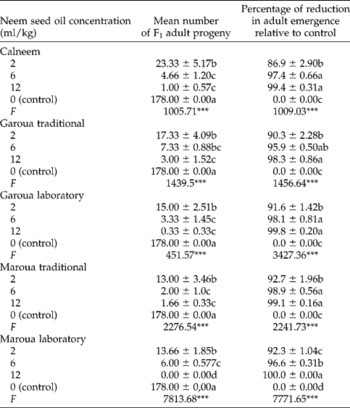
All the neem oils greatly inhibited the development of the hidden eggs and immature stages of S. zeamais, with the lowest value of 87% recorded for Calneem (2 ml/kg) (Table 5). The inhibition increased with concentration, regardless of the variety of the neem oil. However, no significant differences in the inhibition of the development of the eggs and immature stages were recorded among the different neem oils (P>0.05). No adults emerged from the grains treated with the highest oil concentration (12 ml/kg).
Adult emergence in grains containing eggs and immature stages of Sitophilus zeamais and treated with Calneem and Azadirachta indica oils from two localities in Cameroon and extracted traditionally and in the laboratory

Means within a column followed by the same letter are not significantly different at P < 0.05 (Tukey's HSD test). Each datum represents the mean of four replicates.
*** P < 0.0001.
Discussion
The commercial Calneem oil extracted from the Ghanaian neem seed and the neem oils extracted from neem seeds from two locations in northern Cameroon using different extraction methods were toxic to adult S. zeamais. When applied topically, 7 ml/l of Calneem oil caused 65% mortality of adult E. cautella within 5 days of exposure (Shehu et al., Reference Shehu, Obeng-Ofori and Eziah2010), and at a concentration of 0.35 ml/kg it caused 90% mortality to adult T. castaneum on maize within 3 days of exposure (Adarkwah et al., Reference Adarkwah, Obeng-Ofori, Büttner, Reichmuth and Schöller2010). In our study, Calneem oil at a concentration of 2 ml/kg maize caused only 25% mortality to S. zeamais for the same exposure period, suggesting that the oil may be less toxic to the weevil than to T. castaneum. There are differing results between S. zeamais (or S. oryzae) and T. castaneum in their susceptibility to botanicals. Xie et al. (Reference Xie, Fields and Isman1995) found that S. oryzae was more sensitive to azadirachtin and neem concentrates than T. castaneum, whereas Ho et al. (Reference Ho, Koh, Ma, Huang and Sim1996) reported higher susceptibility of T. castaneum adults than those of S. zeamais to garlic oil. Eugenol and the essential oil of Ocimum gratissimium (L.) (Lamiales: Lamiaceae) were more toxic to S. oryzae than T. castaneum, while the reverse trend was recorded with β-(Z)-ocimene (Ogendo et al., Reference Ogendo, Kostyukovsky, Ravid, Matasyoh, Deng, Omolo, Kariuki and Shaaya2008). These variations in the susceptibility of S. zeamais and T. castaneum to botanicals emphasize the need to test each botanical for all stored product insect species.
The antifeedant effect of neem on stored product insects has been extensively investigated (Saxena et al., Reference Saxena, Jilani, Abdul-Kareem and Jacobson1988). Treating stored grain can disrupt insect feeding by making the stored materials unattractive or unpalatable. As a consequence, insect growth, survival and reproduction are adversely affected (Norris, Reference Norris, Haug and Hottmann1986; Saxena, Reference Saxena, Greenhalgh and Roberts1987). It has been shown that azadirachtin is also toxic to insects (Rembold, Reference Rembold and Jacobson1989; Koul et al., Reference Koul, Isman and Ketkar1990). In our study, 90% mortality of S. zeamais was recorded within 24 h after treatment with the neem oils at a concentration of 12 ml/kg, which supports the toxic rather than the antifeedant effect of the neem oils. Adarkwah et al. (Reference Adarkwah, Obeng-Ofori, Büttner, Reichmuth and Schöller2010) recorded greater than 50% mortality of T. castaneum adults 2 days after topical application of Calneem oil. The toxicity of the oil results in its protectant effect against insect damage to stored grain. At lower concentration (2 ml/kg), S. zeamais mortality caused by the neem oils increased from ≤ 15% 1 day after treatment to ≥ 64% 14 days after treatment. This lends credence to the antifeedant mechanism of the neem seed oils. It appears that the toxic effect of neem oils predominates at higher concentrations, whereas its antifeedant action prevails at lower concentrations.
There was no significant difference among the toxicity of Calneem, Garoua traditional, Garoua laboratory, Maroua traditional and Maroua laboratory oils when applied to maize before being infested with adult S. zeamais. This finding is of great economic significance especially in the tropics where most farmers are peasants and are unable to afford the machines for extracting neem seed oil for the preservation of their grains in storage. In addition, the technique of extracting neem seed oil by the traditional kneading method is widely used in northern Cameroon; the oil thus extracted is sold for medicinal purposes and could thus be adopted by farmers for stored grain protection after the appropriate sensitization. Lale and Abdulrahman (Reference Lale and Abdulrahman1999) found no difference in bioactivity between neem seed oils extracted by the traditional kneading method and the soxhlet method using hexane as a solvent against Callosobruchus maculatus (F.) (Coleoptera: Bruchidae) in cowpea. The similarity in toxicity of neem oils from the two localities (Garoua and Maroua) against S. zeamais may facilitate also their adoption by peasant farmers for stored grain protection, because they would not need to spend money on transportation to harvest more active neem seeds or buy more expensive neem seed oils of higher bio-efficacy originating from other localities.
The different neem seed oils showed significant effect in reducing the number of F1 progeny, indicating their potential for use in the management of the maize weevil. No difference on F1 progeny emergence was observed among the different oils, which is similar to the trends observed with the toxicity test discussed above. Udo (Reference Udo2005) reported that there was a correlation between F1 progeny emergence and mortality observed on treated grains, although the possible presence of oviposition deterrence could not be overlooked. Mortality could only partially account for progeny inhibition in the present study. This contention is well supported since local neem oil (12 ml/kg) recorded 100% mortality in 3 days, but progeny emergence was not completely inhibited. The insects thus laid eggs in the grain before death. The reduction of adult emergence could also be explained in part by the anti-ovipositional and reproductive properties of neem due to azadirachtin and other neem oil components that exert a dose-dependent influence on the fecundity of female insects by affecting ecdysone 20-mono-oxygenase (Schmutterer, Reference Schmutterer1990). Neem oil considerably reduced the emergence of F1 progeny in four insect pests of stored product, namely T. castaneum, S. oryzae, Rhyzopertha dominica (F.) (Coleoptera: Bostrichidae) and C. analis (F.) (Nazli, Reference Nazli1997).
Our investigations on the effect of Calneem and local neem oils on the hidden eggs and immature stages of S. zeamais showed that neem seed oil in a dose-dependent manner greatly reduced the percentage of emergence of S. zeamais in the range of 86.9–100%. The absence of differences among the effect of the five neem seed oils on the development of the eggs and immature stages of S. zeamais corroborates earlier findings of Lale and Abdulrahman (Reference Lale and Abdulrahman1999), where two formulations of neem seed oil (traditional and soxhlet extract) significantly reduced the development of eggs and larvae to adults in C. maculatus. In S. zeamais, adult weevils lay their eggs inside the grain and upon hatching, the larvae begin to feed inside the grains, excavating some tunnels as they develop (Fleurat-Lessard, Reference Fleurat-Lessard1996). Treatment of grains with neem oil extracts may probably have killed the larvae or may possibly have rendered the grain tissue inedible. The effect of neem seed oil on eggs and larvae of insects has been widely reported (Ascher, Reference Ascher1993; Mitchell et al., Reference Mitchell, Smith, Johnson and Morgan1997; Casida and Quistad, Reference Casida and Quistad1998; Jenkins et al., Reference Jenkins, Dunkel and Gamby2003). According to Mordue (Luntz) and Nisbert (Reference Mordue and Nisbert2000), azadirachtin acts at the physiological level on eggs and larvae by reducing growth, increasing larval mortality, inducing abnormal moults and delaying moults. These effects are coupled to the disruption of the endocrine system controlling the growth and moulting of eggs and larvae, which has been demonstrated for Oncopeltus fasciatus Dallas (Hemiptera: Lygaeidae) and Locusta migratoria L. (Orthoptera: Acrididae) (Schmutterer, Reference Schmutterer1990).
Conclusion
From our findings it can be concluded that Calneem oil is a potent insecticide against S. zeamais. Local neem seed oils possess similar insecticidal and reproduction-inhibitory properties against the maize weevil. Neem seed oils from different localities of northern Cameroon, irrespective of the method of extraction, would be of great value in the protection of stored maize against S. zeamais infestations.