Introduction
Research focusing on older persons from culturally and linguistically diverse backgrounds is highly relevant due to the growing aging migrant population across the world. In the USA, for example, the proportion of persons aged 65 years and older who are members of Hispanic, Asian, and “other” ethnic groups is expected to increase from 11% in 2008 to 32% in 2050 (Federal Interagency Forum on Aging-Related Statistics, 2010; Vincent and Velkoff, Reference Vincent and Velkoff2010). In Australia, one-third of people over the age of 65 years were born overseas, with Italy and Greece being the most common countries of origin where the main language is not English (Australian Bureau of Statistics, 2002; Australian Institute of Health and Welfare, 2007). By 2026, 21% of the older population is projected to come from non-English speaking backgrounds (Gibson et al., Reference Gibson, Braun, Benham and Mason2001). The English language proficiency of Australia's older immigrant population varies greatly. Migrants from Italy and Greece in Australia, for example, typically have very limited language proficiency (Benham and Gibson, Reference Benham and Gibson2000). Those with dementia are likely to have even more compromised communication ability, as bilingual persons commonly lose their ability to speak in a second language as dementia progresses (Lewis and Kirchen, Reference Lewis, Kirchen, Yeo and Gallagher-Thompson1996).
An Australian postal survey of 189 local Melbourne facilities found that 19% of residents either “preferred or needed” to speak a non-English language to have their care needs met effectively (Runci et al., Reference Runci, O'Connor and Redman2005a), indicating a significant presence of residents with limited English language proficiency in aged residential care. Communication difficulties provide a particular challenge in terms of meeting care needs effectively in general or “mainstream” aged care facilities.
Residential care in Australia is federally funded and comprises private, government, and not-for-profit facilities. An alternative to mainstream facilities is ethno-specific residential care. Unlike mainstream facilities, ethno-specific facilities cater predominantly for residents from a particular background and are more likely to have bilingual staff and focus on the cultural, religious, or culinary needs of a specific culture (DPS, 2005). A recent report calling for research on dementia and culturally and linguistically diverse communities underscored the importance of continued research focusing on residential aged care, including quality of life issues, as well as the development of appropriate models of care for these residents, together with the comparison of care types (Low et al., Reference Low2009).
The theory underpinning our research is that residents with limited English language proficiency in mainstream care may have unmet social needs. According to the “unmet needs” paradigm (Cohen-Mansfield and Werner, Reference Cohen-Mansfield and Werner1997), social isolation and limited sensory stimulation present a higher risk for behavioral and psychological symptoms of dementia, such as verbally disruptive behavior. These symptoms may indicate distress in the older person and are likely to be distressing for those in their environment, such as co-residents, aged care facility staff, and visitors. Furthermore, valid assessment of these symptoms in residents with dementia and limited English fluency is challenging and they may be more likely to receive inappropriate intervention such as the use of psychotropic medication as a first line of treatment.
A comparison of depression and prescribed medication of Chinese residents in mainstream and Chinese-specific care in Sydney (Australia) reported no difference in the levels or rates of depression (Goh et al., Reference Goh, Low and Brodaty2010). Differences were found, however, in rates of prescribed medication. Residing in ethno-specific care was associated with lower use of antipsychotic medication and greater number of residents being treated effectively with antidepressants.
A pilot study comparing language use of 39 older persons from Italian backgrounds with severe dementia who were residing in either mainstream or ethno-specific care found that those in Italian-specific care were more likely to communicate (specifically in Italian with co-residents) and were less likely to receive daytime benzodiazepines compared with those in mainstream care (Runci et al., Reference Runci, Redman and O'Connor2005b). There was no significant difference in the frequency of staff-to-resident communication between the facility types. That is, although many of the staff members in the mainstream facilities did not speak the native language of the residents, they were making equivalent efforts to communicate with them. Clearly, the small sample size limited the conclusions that can be drawn from this pilot study. In addition, participants were observed on a single occasion and the focus was on the use of language.
Our current study extends this pilot research (Runci et al., Reference Runci, Redman and O'Connor2005b) to include a larger number of participants and aged care facilities and to observe participants on multiple occasions. We included Greek and Italian residents, as they are the two largest non-English speaking older populations in Australia. Thus, the current research further investigates whether the communication rates of residents in mainstream care differ from those in ethno-specific care. In addition, other factors that may influence communication rates, such as prescribed medication and quality of life measures, were incorporated. It was hypothesized that residents in mainstream care would have a lower rate of social interaction with co-residents and be more likely to be prescribed psychiatric medication compared with those in ethno-specific care.
Methods
Participants
Aged care facility residents from Greek or Italian backgrounds, aged 65 years and over, who had been diagnosed with dementia by a medical practitioner (as documented in their aged care facility file) were eligible for inclusion. While specific assessments of dysphasia, visual or hearing impairment were not conducted as part of our study, those with known uncorrected visual or hearing impairment were excluded.
Procedures
Recruitment
Following phone calls to confirm the presence of any Greek or Italian residents with cognitive impairment and managers’ interest in the study, introductory letters were sent to mainstream aged care facilities in Melbourne (Victoria) and all those that were listed as Greek or Italian-specific. A total of 35 facilities were thereby deemed eligible and 23 (66%) of these provided consent for involvement. Data collection was conducted at 20 of these facilities. The residents at the remaining three facilities were not eligible at the time of data collection. The reasons why the 12 other facilities did not consent to involvement were: eligible residents became unwell/hospitalized, they were concurrently involved in another research project, or there were other current priorities at the facility (e.g. change-over of management and imminent accreditation).
Next of kin (NOK, most commonly a close family member) provided consent for resident involvement in the study, as none of the residents were able to provide written consent due to their cognitive impairment. The consent procedure was altered during the study. The first six facilities involved in the study were provided with consent packs (both English and either Greek or Italian language versions) to be distributed to the NOK of eligible residents, resulting in a recruitment rate of only 13%. As a result, the procedure was changed to enable staff members to obtain verbal consent from NOK to pass on their contact details to the researchers. Bilingual researchers then contacted the NOK and obtained written consent in their preferred language. Three of the initial six facilities agreed to use the amended consent procedure, as well as all subsequent facilities thereby giving a markedly increased recruitment rate of 82%.
The aim was to recruit 80–100 participants, with 20–25 in each of the four groups of Italian or Greek residents in either mainstream or ethno-specific care. The sample size of 80–100 residents was considered sufficient, assuming a moderate effect size of 0.50 based on the participant verbalization data in the pilot study with power of 0.80 and α = 0.05.
Consent forms were received for 90 residents: 44 from Italian background (22 in mainstream care and 22 in ethno-specific care) and 46 from Greek background (23 in mainstream and 23 in ethno-specific care). Data were collected for 82 of the participants. The remaining eight residents (four in each facility type) did not participate in the study, predominantly due to illness or not meeting eligibility criteria.
Data collection and measures
The project involved the following three components: an interview with a family member of each resident, observation of each resident, and an interview with a direct care staff member.
Prior to the commencement of observations, a structured interview was held with the NOK of each participant in their preferred language to obtain background information, language proficiency ratings, and confirm cognitive impairment. Language proficiency ratings were based on the system used by the Australian Bureau of Statistics (2001). Participants were rated by NOK as speaking each language “very well,” “well,” “not well,” or “not at all.” They provided English proficiency ratings prior to arrival in Australia (if known), prior to onset of dementia, and current at the time of interview. The Cognitive Decline Scale (from the Psychogeriatric Assessment Scales, PAS; Jorm et al., Reference Jorm1995) was administered with the NOK to confirm the presence of cognitive deterioration and functional decline. The authors of the tool report internal consistency of 0.84 and test-retest correlations of 0.66 over 3.6 years for the Cognitive Decline Scale (Jorm et al., Reference Jorm, MacKinnon, Christensen, Henderson, Jacomb and Korten1997). In addition, the scale has been found to be significantly correlated with the Mini-Mental State Examination (MMSE; Folstein et al., Reference Folstein, Folstein and McHugh1975) and the Informant Questionnaire on Cognitive Decline in the Elderly (IQCODE; Jorm et al., Reference Jorm, Scott and Jacomb1989). The Cognitive Decline Scale score provides a score out of ten, with scores above four indicating cognitive impairment.
Researchers administered the Greek or Italian versions of the MMSE (Folstein et al., Reference Folstein, Folstein and McHugh1975) with each resident as an indicator of the level of cognitive impairment. The MMSE was conducted following the final observation of each resident, as it was important that researchers did not have contact with participants during the observation period of the project and potentially impact on their communication. Scores below 24 out of 30 indicate the presence of cognitive impairment, scores between 11 and 20 represent “moderate” impairment, and scores below 11 represent “severe” impairment (Folstein et al., Reference Folstein, Folstein, McHugh and Fanjiang2000).
The main component of the data collection was the observation of residents. Researchers observed participants on three separate occasions for 20-minute periods and recorded the verbalizations of the participants and the verbalizations of “others” in their environment. “Others” were co-residents, staff members, or visitors of co-residents. The verbalizations of “others” were only recorded when they were interacting with the participants (including both when they responded to the participant and when they initiated interaction with the participant). Language categories were: verbalizations in a comprehensible language (English, Greek, or Italian), verbalizations “language unclear” (verbalizations that could not be understood as English, Italian, or Greek), or no verbalizations.
Observation periods were at least one day apart and, where possible, within a two-week period. Data collection took place at morning or afternoon teatime, when no other structured activity was taking place and when the participant was in the communal area. Direct care staff were informed of the presence of the observer. They were not informed regarding the main hypotheses of the study and it is assumed that the presence of the observer would have impacted both facility types equally.
One-zero time sampling procedure was used; i.e., at the end of each sampling interval, the researcher recorded whether or not the behaviors (verbalization categories) occurred in the previous sample interval. Pilot observations and timing were conducted to determine the sample interval that most closely matched the average duration of verbalizations and the sample interval was set at 30 seconds. As data collection periods were of 20-minute duration and language use was recorded at 30-second intervals, the maximum possible total count was 40 for each of the three observation sessions.
Five bilingual research assistants collected the data. Inter-observer reliability was calculated for the verbalization categories of the participants for both Greek and Italian research assistants on three occasions. Agreement was very high, with mean κ of 0.90 (SE = 0.03).
A structured interview was held with a direct care staff member. The Quality of Life in Late-stage Dementia scale (QUALID; Weiner et al., Reference Weiner, Martin-Cook, Svetlik, Saine, Foster and Fontaine2000) was administered to provide a measure of quality of life. The QUALID scale is a brief, proxy-based measure that enquires about the frequency of 11 observable behaviors, including affective state, behavioral signs of comfort, engagement in activities, and interactions with others. Lower scores on the QUALID represent higher quality of life, with scores potentially ranging from 11 to 55. The QUALID scale is a recommended measure by the Dementia Outcomes Measurement Suite for use in late-stage dementia (Sansoni et al., Reference Sansoni2007). The scale's authors report good test-retest reliability (intra-class correlation = 0.81) and internal consistency (Cronbach's α = 0.77), and excellent inter-rater reliability (intra-class correlation = 0.83). Evidence of construct, discriminant, and convergent validity have been also provided and the scale has been shown to correlate with measures of depression and neuropsychiatric symptoms (Sansoni et al., Reference Sansoni2007).
The psychiatric medication regime of each participant was recorded at the initial visit and changes, if any, were noted at each visit. Medications were categorized as antipsychotics, antidepressants, and benzodiazepines. Benzodiazepines were further classified as those taken during the daytime and those taken at night-time.
The project was approved by the Monash University Human Research Ethics Committee.
Data analysis
Independent samples t-tests were conducted to test for significant differences between the facility and participant characteristics and test scores. Chi-square tests of independence (or Fisher's Exact Tests where cells counts were low) were conducted to identify relationships among medication, language proficiency, and facility type. Multivariate analysis of covariance was conducted to determine whether a significant difference existed between verbalizations of participants and verbalizations of “others” for those in mainstream and ethno-specific facilities after controlling for covariates. Potential covariates were length of stay in Australia, English language proficiency, native language proficiency, and scores on the measures of cognitive impairment. Pearson correlation coefficients were performed to identify covariates for inclusion in the multivariate analyses.
Results
Aged care facility characteristics
Of the 20 aged care facilities in the study, 12 were mainstream, four were “Italian-specific,” and four were “Greek-specific.” The majority of facilities (14/20) provided predominantly high level of care beds, with a minority providing predominantly low level of care beds (4/20) and the remaining providing between 40% and 60% of each bed type. There was no difference between the number of high or low level of care beds at each facility type (low: t (18) = 0.09, p > 0.05; high: t (18) = 4.31, p > 0.05). The mean number of beds was 63.83 (SE = 7.52) in mainstream and 61.50 (SE = 9.91) in ethno-specific facilities. The mean percentage of residents who preferred to speak languages other than English was 98% (SE = 2.38) in ethno-specific and 24% (SE = 5.99) in mainstream facilities. The mean percentage of staff members who spoke either Greek or Italian was 56% (SE = 11.55) in ethno-specific and 15% (SE = 6.90) in mainstream facilities. The staff to resident ratio did not differ between the two facility types (t (16) = 0.18, p > 0.05).
Participants
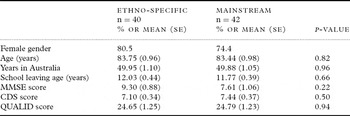
Characteristics of the participants are shown in Table 1. The majority of participants (74%) were able to read and write in their original language prior to the onset of any cognitive impairment (eight of the NOK were unable to answer this question).
Participant characteristics and test scores in mainstream and ethno-specific care

MMSE = Mini-Mental State Examination (scores below 10 indicate “severe” impairment); CDS = Cognitive Decline Scale (scores above 4 indicate cognitive impairment); QUALID = Quality of Life in Late-Stage Dementia scale.
The MMSE and the Cognitive Decline Scale confirmed cognitive impairment. The mean total scores on the MMSE were slightly higher for those in ethno-specific facilities compared with mainstream facilities; however, this difference was not statistically significant and both scores were in the “severe” impairment range. There was minimal difference between the Cognitive Decline Scale scores in each facility type. The QUALID scores ranged from 11 to 49, with a mean of 25 (SE = 0.87) and the mean score was similar in each facility type.
Language proficiency
In terms of English language proficiency (as rated by NOK), most of the participants (86%) did not speak English at all before coming to Australia. Almost all (96%) gained some level of English language proficiency prior to any cognitive deterioration. Just over half (52%) gained very limited English language proficiency (speaking English “not well”), with one-third (33%) speaking English “well” and the remaining speaking English “very well” (11%). Over half (63%) of the NOK reported deterioration in English language proficiency since the onset of dementia. The majority of participants currently spoke English either “not at all” (23%) or “not well” (61%). Of the remaining 12 participants, 11 spoke English “well” and only one participant was rated as currently speaking English “very well.” In terms of native language proficiency, 37% of NOK reported some deterioration, with most participants (87%) still speaking their native language either “well” or “very well.” A significant association was found between current native language ability and facility type, with a higher level of native language proficiency in the ethno-specific care (χ2 (1, n = 82) = 5.145, p = 0.023). No other significant differences were found for language proficiency between the two facility types (current English χ2 (1, n = 82) = 0.285, p > 0.05; English prior to arrival in Australia (Fisher's Exact Test), p > 0.05; optimum English language χ2 (1, n = 82) = 0.198, p > 0.05).
Communication
None of the variables tested was significantly correlated with participant verbalization categories, and thus no covariates were included in the analysis of participant verbalizations. Correlations did, however, reveal significant associations between both current English language and current native language proficiency for the frequency of verbalizations of “others” when interacting with the participants; these were thus included as covariates in the analysis.
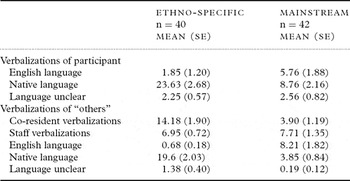
There was a significantly higher overall frequency of participant verbalizations in ethno-specific care (F (3,77) = 7.86, p < 0.0001, partial η2 = 0.23). Scores revealed that those in ethno-specific care verbalized at a higher frequency in their native language than those in mainstream care (F (1,77) = 18.80, p < 0.0001, partial η2 = 0.19), with no difference for frequency of English language verbalizations (F (1,77) = 3.04, p > 0.05) or language unclear verbalizations (F (1,77) = 1.96, p > 0.05) (Table 2).
Mean (and SE) frequency of verbalization categories for those in mainstream and ethno-specific care

Data collection periods were 20 minutes and language was recorded at 30-second intervals, giving a maximum possible frequency of 40.
There was a significantly higher overall frequency of verbal communication by “others” with the participants in ethno-specific care (F (3,72) = 9.40, p < 0.0001, partial η2 = 0.28) after controlling for current English and current native language proficiency. There was a higher frequency of co-resident verbalization in ethno-specific facilities compared with mainstream (F (1,76) = 25.62, p < 0.0001, partial η2 = 0.26), while no differences were found for the frequency of staff verbalizations (F (1,76) = 0.20, p > 0.05) or the verbalizations of visitors of co-residents (F (1,76) = 1.51, p > 0.05).
In terms of the language used by “others,” there was an overall significant difference in frequency between the two facility types after controlling for current English and native language proficiencies (F (3,72) = 23.67, p < 0.0001, partial η2 = 0.50). English language was used at a higher frequency by “others” in mainstream care (F (1,76) = 26.34, p < 0.0001, partial η2 = 0.26) and both native language (F (1,76) = 46.10, p < 0.0001, partial η2 = 0.38) and language unclear (F (1,76) = 6.83, p < 0.05, partial η2 = 0.08) were more frequently observed in ethno-specific care.
Psychiatric medication
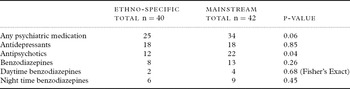
The majority of participants (72%) were prescribed psychotropic medication, 44% were prescribed antidepressants, 42% antipsychotics, and 26% benzodiazepines. Daytime benzodiazepines were prescribed at a low rate in both facility types (7% of our sample). While there was a trend toward a higher overall rate of prescribed psychotropic medication in mainstream care, this difference did not reach statistical significance (p = 0.063) (Table 3). The medication type that significantly differed between facility types was antipsychotics (χ2 (1, n = 82) = 4.23, p < 0.05), with a higher prescription rate in mainstream care.
Number of residents prescribed each type of psychotopric medication

Discussion
The main finding of our study was the increased rate of resident-to-resident interaction in the ethno-specific facility compared with the mainstream facility. No difference was found for the rate of staff-to-resident communication. These results reflect our previous findings (Runci et al., Reference Runci, Redman and O'Connor2005b) and support our hypotheses. Findings indicate that these residents may have unmet needs for social interaction with peers in line with the unmet needs paradigm (Cohen-Mansfield and Werner, Reference Cohen-Mansfield and Werner1997).
Scores on both the MMSE (completed with the participant in their original language) and the Cognitive Decline Scale (conducted with the NOK) indicated a high level of cognitive impairment in the participants. Language proficiency ratings confirmed low levels of current English language and higher levels of current native language of the participants. While over half of the participants had deteriorated in their use of English since the onset of their dementia, there had been less impact on native language. This supports the consensus in the literature that older bilingual persons commonly deteriorate to a greater degree in their second language as dementia progresses (Lewis and Kirchen, Reference Lewis, Kirchen, Yeo and Gallagher-Thompson1996). The only significant difference found between the language proficiency ratings in each facility type was for native language, with those in ethno-specific care having higher levels than those in mainstream care. It may be that those with greater fluency in their original language are more likely to seek out ethno-specific care, or that those in mainstream care have more limited opportunities to use and retain ability in their original language.
In our pilot study, we found a significant difference in the rate of prescription of daytime benzodiazepines between participants in each facility type (Runci et al., Reference Runci, Redman and O'Connor2005b). In the current study, there was no statistically significant difference between the facility types for the overall percentage who were prescribed psychiatric medication or specifically for daytime benzodiazepines; however, there was a significantly lower rate of prescription of antipsychotics in ethno-specific care. A recent Australian study reported a lower prescription of antipsychotic medication in ethno-specific care in a comparison of residents of Chinese-background in mainstream or ethno-specific care (Goh et al., Reference Goh, Low and Brodaty2010). One explanation is that staff could be more likely to use antipsychotic medication to manage frustration in residents when communication difficulties arise in mainstream care. The concern is that in the context of communication difficulties, the behavior of residents might be misinterpreted as “disruptive” or, alternatively, residents may actually be more agitated due to communication difficulties. A limitation of the current study is the lack of contrast with the Australian-born residents within the mainstream care setting. It could be that the Greek and Italian residents within the mainstream care were prescribed antipsychotics at a similar rate as their co-residents, and thus this represents a facility difference rather than a difference in the rate of prescription specifically to these residents.
Little is known regarding the impact of having limited communication opportunities with co-residents on the day-to-day life and well-being of aged care facility residents. While it might be an isolating and lonely experience, the quality of life measure did not detect any differences between facility types. In addition, no difference in the level or rate of depression was found between Chinese residents in Sydney mainstream or ethno-specific care facilities (Goh et al., Reference Goh, Low and Brodaty2010). It would be useful in future research to provide additional measures regarding the day-to-day implications of being unable to communicate with peers, including measures of psychiatric symptoms. According to the unmet needs paradigm, these residents may be at a higher risk of behavioral and psychological symptoms of dementia. Conducting a valid assessment of psychiatric symptoms (including the assessment of internal processes, such as hallucinations and delusions) with persons with cognitive impairment and limited English language proficiency poses a significant challenge. Commonly used proxy-based measures would need to be administered with residential care staff who had both extensive involvement with the resident and also speak the resident's original language.
Residing in ethno-specific care provides an option for facilitating peer interaction in the resident's original language and improving social engagement; however, this option is not a realistic one for the majority of residents. These facilities are not a viable alternative for smaller, geographically dispersed, newly arrived populations without established community organizations. In addition, ethno-specific facilities frequently have long waiting lists (Multicultural Mental Health Australia, 2004), and consequently they may not even be an option for many persons from large and established populations. Thus, the more realistic option is the provision of greater opportunities for original language interaction within mainstream care. Another commonly employed care model which would enable this, is the clustering of residents from a particular background within mainstream facilities along with the recruitment of bilingual staff and additional language-specific resources. The unmet needs theory recommends more stimulating activities and a richer social environment (Cohen-Mansfield and Werner, Reference Cohen-Mansfield and Werner1997). Additional opportunities for interaction with peers could be provided within mainstream care by involvement in community day care programs, visits from community bilingual volunteers, as well as the provision of activity programs and intervention strategies that are not reliant on language (for example, Montessori activities; van der Ploeg and O'Connor, Reference van der Ploeg and O'Connor2010). Use of a family-generated audio or videotape provides a further option for social stimulation that can be tailored to the individual language of the participants (Cohen-Mansfield and Werner, Reference Cohen-Mansfield and Werner1997; Garland et al., Reference Garland, Beer, Eppingstall and O'Connor2007). The provision of books, DVDs, and music in the participant's original language may also be beneficial.
In both the pilot study and current study the rate of staff-to-resident interaction did not differ between the facility types. This finding is encouraging, indicating that staff were communicating with residents at equivalent rates in both care types, despite often not speaking a common language. The observation of residents in both studies was carried out at morning or afternoon teatime. This time was chosen because residents are together in the communal area, no other activities are taking place, and consequently, they have the opportunity to interact. While this may provide a relatively ideal opportunity to observe resident-to-resident interaction, it may not be ideal for providing information regarding staff-to-resident interaction. Given the challenges that communication difficulties may pose at direct care times (e.g. bathing, toileting), it would be useful to include different contexts in future research focusing on staff communication with residents.
In conclusion, the current study replicated an earlier pilot study with a larger sample of both facilities and participants and multiple observation periods, and confirmed the main finding that older persons with cognitive impairment and limited English language proficiency in ethno-specific care were more likely to interact with co-residents than those in mainstream care. Again, there was no difference in the rate of staff-to-resident interaction between the facility types. The results indicate the lack of opportunity and potential unmet need for native language interaction with peers for those with minimal English fluency in mainstream care. Further measures of psychiatric symptoms, quality of life, and social engagement may provide a greater understanding of the consequences of unmet social needs. Prescribed medication needs to be monitored to ensure that persons from diverse backgrounds with dementia and limited English language proficiency are not misinterpreted as “disruptive,” or are not actually more agitated due to difficulty in communicating their needs.
Conflict of interest
None.
Description of authors' roles
S. Runci designed the project, managed the project, conducted the analyses, and wrote the paper. B. Eppingstall managed the project and assisted in preparing the paper. D. O'Connor supervised S. Runci and B. Eppingstall for the entirety of the project, from project design to final write-up.
Acknowledgments
This project was funded by the National Health and Medical Research Council (Dementia Research Grants Program #465125). We sincerely thank to the residents, their families, and the aged care facility staff and management. We also thank the Research Assistants who conducted the data collection (Salvatore Celiento, Sandra Genovesi, Donna Papas, Areti Plitas, and Lucy Vucic), members of our project reference group (Maree Farrow, Penni Michael, Ljubica Petrov, and Stella Tallorito), and Eva van der Ploeg for her comments on our draft of this paper.